Firms use various strategies and methods to make businesses more competitive for the sake of survival and prosperity in a continuously changing environment. Organizational downsizing is one of the strategies often used by firms, particularly when the global economy is declining (Sutton, Reference Sutton2009). Can organizational downsizing really improve business performance? According to research, results are inconclusive (Cascio, Reference Cascio2002; Tsai & Yen, Reference Tsai and Yen2008; Love & Kraatz, Reference Love and Kraatz2009; Muñoz-Bullon & Sanchez-Bueno, Reference Muñoz-Bullon and Sanchez-Bueno2011). At the same time, organizational downsizing harms employees and their families and the unemployment even causes social issues (Naumann, Bies, & Martin, Reference Naumann, Bies and Martin1995; Naumann, 1998; Mckee-Ryan & Kinicki, Reference Mckee-Ryan and Kinicki2002). In order to deal with these problems, researchers in the field of organizational change believe that a responsible downsizing strategy (namely, an employee-oriented downsizing strategy) cannot only improve firm performance but also minimizes negative impacts on employees (Appelbaum, Everard, & Hung, Reference Appelbaum, Everard and Hung1999; Freeman, Reference Freeman1999; Cascio, Reference Cascio2002). However, empirical evidence directly related to responsible downsizing strategies is quite limited, especially for using quantitative research method. Therefore, this research aims to contribute to the development of this theory by adopting a more complete examination.
The leadership style of a firm usually influences its downsizing strategy with regard to planning, implementation, and even performance outcomes (Bennis & Nanus, Reference Bennis and Nanus1985; Hodgetts, Reference Hodgetts1996; Budros, Reference Budros1999). This is especially true when the economy is in decline or when an organization downsizes and subordinates depend on management's words and actions (Sutton, Reference Sutton2009). Some research suggest that firm leaders’ employee-oriented behaviors will benefit firm post-downsizing performance (e.g., Hodgetts, Reference Hodgetts1996; Smith, Reference Smith2001). Therefore, the question to be considered is, ‘If firm will with a more employee-oriented leadership style, would their responsible downsizing strategy have better firm performance’? This important question has not been raised or empirically tested in the literature.
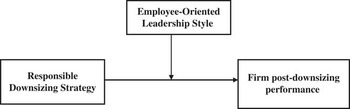
Therefore, this research uses firms that have implemented a downsizing strategy in Taiwan (including branches or joint ventures of multinational corporations and local firms) as the sample. Meanwhile, both quantitative and qualitative research methods were adopted to determine if firms with employee-oriented leadership styles had better post-downsizing performance owing to their responsible downsizing strategy (see Figure 1).
Research framework

There are four dimensions in a responsible downsizing strategy. How does performance increase for each dimension of a responsible downsizing strategy as a result of the interactive effect with employee-oriented leadership style? This question is also worthy of analysis and discussion. The result of this research is expected to bring an important implication to the theoretical development of organizational change, leadership and benefit management practices.
Literature Review
Responsible downsizing strategy and firm performance
Organizational downsizing strategy and firm performance
In order to survive and prosper in a rapidly changing environment, firms use various strategies to make their organization more competitive. Organizational downsizing has been a popular management strategy in global business since the 1980s (Fisher & White, Reference Fisher and White2000; Sutton, Reference Sutton2009; Datta, Guthrie, Basuil, & Pandey, Reference Datta, Guthrie, Basuil and Pandey2010; De Meuse, Marks, & Dai, Reference De Meuse, Marks and Dai2011). After several years of research and investigation by many researchers, whether organizational downsizing can definitively improve firm performance is still debated (Chadwick, Hunter, & Walston, Reference Chadwick, Hunter and Walston2004; Love & Kraatz, Reference Love and Kraatz2009; Muñoz-Bullon & Sanchez-Bueno, Reference Muñoz-Bullon and Sanchez-Bueno2011). However, whether downsizing is a panacea or paradise lost (Lowe, Reference Lowe1998), organizational downsizing undeniably hurts employees economically, physically, psychologically, and socially. Employees’ families are also negatively affected, to the point of causing social tension (Naumann, Bies, & Martin, Reference Naumann, Bies and Martin1995; Naumann, 1998; Mckee-Ryan & Kinicki, Reference Mckee-Ryan and Kinicki2002). Therefore, organizational downsizing is usually criticized as an irresponsible strategy implemented by a company management team that cares only for the interests of the firm and ignores other stakeholders. Some researchers (Shah, Reference Shah2000; Millward & Brewerton, Reference Millward and Brewerton2002; Sutton, Reference Sutton2009) point out that organizational downsizing causes employees to lose trust in their firm, resulting in a reduction of work satisfaction, organizational commitment, and personal performance (Mckinley, Sanchez, & Schick, Reference McKinley, Sanchez and Schick1995). This is one of the reasons why firm performance does not improve after organizational downsizing. Therefore, a firm that wants to downsize as well as improve firm performance will have to consider their employees’ feelings.
Responsible downsizing strategy
In order to mitigate or solve this important problem regarding organizational downsizing strategy, many researchers have studied this area and had some significant results (e.g., Cameron, Reference Cameron1994; Appelbaum, Everard, & Hung, Reference Appelbaum, Everard and Hung1999; Cascio, Reference Cascio2002). The strategy typology developed by Porter (1980, 1985) is arguably the most recognized and widely used by both business policy and industrial relations researchers (Arthur, Reference Arthur1992). This strategy typology has been applied to the downsizing context and used to evaluate downsizing strategies to determine why they cannot ensure firm performance. Researchers found that if a downsizing strategy is a ‘cost leadership strategy’ (e.g., Cameron, Reference Cameron1994; Freeman, Reference Freeman1999; Cascio, Reference Cascio2002; Rigby, Reference Rigby2002), it could not boost firm performance. Rather, a ‘differentiation strategy’ that emphasizes creating more value is more effective. For example, Cameron (Reference Cameron1994) investigated the automotive industry and discovered that a downsizing strategy that only focussed on cost-cutting caused organizational disability (e.g., loss of revenues, market share, and personnel) and impaired performance. Instead, a successful downsizing strategy must include the comprehensive consideration of approach, preparation, employee participation, leadership, employee care, execution, and post-downsizing performance measurement. Freeman (Reference Freeman1999) and Appelbaum, Everard, and Hung (Reference Appelbaum, Everard and Hung1999) also claim that an organizational downsizing strategy should include both a behavior and strategic thinking. It should not be undertaken just for cost-down measures. Instead, the strategy needs to fully consider the whole downsizing process, from planning to post-downsizing firm performance.
Meanwhile, employees are the key to the downsizing process. Cascio (Reference Cascio2002) studied 6,418 downsizing cases in 500 top companies of S&P during the period from 1982 to 2000 and discussed ‘strategies for responsible restructuring’ that also asserted that a cost-oriented downsizing strategy cannot ensure firm performance. A responsible downsizing strategy should comprehensively consider long-term payoff to firms. He claimed that for those successful downsized companies that must have the ability to improve performance, and must take a reduction in employees as a last resort. In addition, they must continue to invest in the growth of the company as well as ‘park’ the best employees and respect the others. Furthermore, they should provide outplacement assistance such as job training, consulting, and job search assistance to laid-off employees. Strong and continuously growing companies with a strong business model must treat employees as long-term assets. Consolidating the finding from the above research, we can conclude that the responsible downsizing strategy, an employee-oriented strategy, may not only improve firm performance but also reduce harm to employees. Numerous studies support the concept of employee-oriented human resource management (HRM) practices that boosts firm performance (Naumann, Bies, & Martin, Reference Naumann, Bies and Martin1995; Gowing, Kraft, & Quick, Reference Gowing, Kraft and Quick1998; Chadwick, Hunter, & Walston, Reference Chadwick, Hunter and Walston2004). Based upon the literature, further empirical investigation is warranted.
From the literature (e.g., Cameron, Reference Cameron1994; Freeman, Reference Freeman1999; Appelbaum, Everard, & Hung, Reference Appelbaum, Everard and Hung1999; Cascio, Reference Cascio2002), we found that a responsible downsizing strategy is composed of four main dimensions: (1) management has the mindset of treating employees as long-term assets because employees are sources of innovation and renewal and are key for the firm's long-term profitability; (2) there is a suitable strategy for organization change before a downsizing strategy, management evaluates the long-term payoff and carefully estimates the company's ability to better performance, and then chooses a suitable organization change strategy; (3) management invites employee opinions about the downsizing plan, and the process of choosing laid-off employees is just; and (4) management implements appropriate employee-caring HRM practices, such as providing laid-off employees with legal severance pay and providing outplacement assistance and job training, consulting and job search assistance, etc. Numerous previous studies have supported the above dimensions and can benefit firms performance, and these studies suggested that firms should care about survivors, treat employees as long-term assets (e.g., Brockner, Wiesenfeld, Reed, Grover, & Martin, Reference Brockner, Wiesenfeld, Reed, Grover and Martin1993; Cascio, Reference Cascio1993; Beam, Reference Beam1997; Shah, Reference Shah2000, etc.), select a suitable change strategy (e.g., Cameron, Freeman, & Mishra, Reference Cameron, Freeman and Mishra1993; Cameron, Reference Cameron1994; Cascio, Reference Cascio2002 etc.), keep justice in process of selecting layoff employees (e.g., Brockner et al., Reference Brockner, Wiesenfeld, Reed, Grover and Martin1993; Naumann, Bies, & Martin, Reference Naumann, Bies and Martin1995, etc.), and implement employee-caring HRM practices (e.g., Brockner, Reference Brockner1988; Beam, Reference Beam1997; Shah, Reference Shah2000; Chadwick, Hunter, & Walston, Reference Chadwick, Hunter and Walston2004). However, it is necessary to directly prove the effect of each individual dimension to post-downsizing firm performance. It will be helpful to examine the structure of responsible downsizing strategy to improve the development of this theory. Therefore, we hypothesize:
Hypothesis 1 : The responsible downsizing strategy will positively affect post-downsizing firm performance.
Hypothesis 1-1 : Employee-caring HRM practices will positively relate to post-downsizing firm performance.
Hypothesis 1-2 : The mindset of employees as long-term assets will positively relate to post-downsizing firm performance.
Hypothesis 1-3 : The strategy for organizational change will positively relate to post-downsizing firm performance.
Hypothesis 1-4 : Employee participation and justice in the downsizing process will positively relate to post-downsizing firm performance.
However, the formation, execution, and performance of organizational strategies are always affected by the leadership of the organization. Can a responsible organizational downsizing strategy (an employee-oriented strategy) fit any leadership style of a downsizing company? In other words, it is worth investigating whether an employee-focussed leadership style can facilitate firm performance during and after the implementation of a responsible downsizing strategy.
Leadership style
Types of leadership style
In organizational leadership behavior research, leadership style is often discussed in a manner of dichotomization. For example, Fleishman in the 1960s categorized leadership behavior into structure and consideration styles. Blake and Mouton (Reference Blake and Mouton1965) also classified leadership behavior into concern for production and concern for people in their theory of managerial grid. Reddin (Reference Reddin1970) divided leadership behavior into task-oriented and relation-oriented styles in his research of leadership behavior and managerial effectiveness. Researchers suggested that leadership behavior patterns are divided into job-centered and employee-centered types (Likert, Reference Likert1979; Battilana, Gilmartin, Sengul, Pache, & Alexander, Reference Battilana, Gilmartin, Sengul, Pache and Alexander2010). Generally, the leaders with a more ‘job-centered’ style will manage employees with a careful direct method and supervise them to complete their tasks in a particular procedure. Moreover, they usually use more legitimate power and reward power to manage subordinates and treat employees as costs rather than assets. On the other hand, leaders with a more ‘employee-centered’ style will allow employees more room to make decisions, obtain promotion, reach personal growth objectives, and earn a sense of achievement. They use a holistic, cooperative process to reach a target. This method inspires subordinates to support their managers. Also, managers are encouraged to treat employees as an asset rather than a cost. This concept of leadership style is similar to studies on behavioral-based ‘transactional leadership’ and ‘transformational leadership’ (Bass, Reference Bass1985; Lowe & Galen, Reference Lowe and Galen1996; Jung, Yammarino, & Lee, Reference Jung, Yammarino and Lee2009; Cho & Dansereau, Reference Cho and Dansereau2010; Walter & Bruch, Reference Walter and Bruch2010). Transactional leadership is close to the ‘task-oriented’ style and transformational leadership is similar to the ‘employee-centered’ style. We used the terms of ‘employee-oriented’ and ‘task-oriented’ styles in this study because this study focussed on the leadership style instead of leader's behaviors.
Employee-oriented leadership style strengthens the relationship between responsible downsizing strategy and post-downsizing performance
In the existing literature, some papers have mentioned the connection between leadership style and organizational downsizing. However, little research has been directed at leadership styles that result in improving a firm's post-downsizing performance. For example, Dimaggio and Powell (1983) stated that any organization's reformation would be influenced by key individuals in the organization. Budros (Reference Budros1999) found that the characteristics and background of enterprise leaders influences companies to downsize, as well as the scale of the downsizing. For instance, a chief executive officer (CEO) with a finance background is more likely to emphasize a cost reduction compared with a CEO with a background in manufacturing, selling, and/or marketing. In addition, a CEO with a finance background will find it easier to implement an organizational downsizing than a CEO with another type of background. The research of Carmeli and Sheaffer (Reference Carmeli and Sheaffer2009) indicated that both leadership risk-aversion and self-centeredness are significantly intensified during an organizational downsizing. Above literature indicated leadership will influence the downsizing strategy. The empirical research of Vigoda-Gadot and Berri (Reference Vigoda-Gadot and Beeri2012) indicates that leadership has positive effect on employee organizational citizenship behavior in an organization change context, which is the foundation of firm performance.
All firm stakeholders are affected by downsizing. However, employees suffer the effects of downsizing more directly because their careers, income, and stability are in jeopardy. Therefore, Brockner (Reference Brockner1988) argued that survivors’ psychological state and reactions to the downsizing can moderate the effect of downsizing to survivors’ performance. Therefore, firm leaders need to pay special attention to employees. Lippitt and Lippitt (Reference Lippitt and Lippitt1984) asserted that leaders with a reactive mentality would pay more attention to solving a current problem and usually seek to improve performance by sacrificing employee benefits. The focus of proactive organizational downsizing is to ensure the organization's future. Therefore, this perspective must have perfect organizational planning and actively promote innovation and flexibility as well as respect employee opinion and implement suitable HRM practices. In short, the transformational (employee-oriented) leadership will benefit from better downsizing performance. In the interview by Hodgetts (Reference Hodgetts1996), Bennis also emphasized that if a business leader implements organizational downsizing for a short-term profit (transactional, task-oriented or cost-oriented), then the organizational downsizing may cause employees to lose trust in the company, resulting in the employee becoming concerned only with his/her own best interests. Company intelligence capital, such as human capital, social capital, or process capital, etc., will therefore be damaged. Hence, firm performance will not increase. Whereas, firms in which the leaders pay attention to employees’ long-term development can still maintain high level of competitiveness in a difficult management environment. The common behavior characteristics of these successful leaders is that they can create wealth for stakeholders by being able to inspire employees to create intelligence capital and focus on business values and morals. These characteristics also belong to an employee-oriented leadership style. Smith (Reference Smith2001) accumulated information regarding survivor's syndrome after organizational downsizings from 1992 to 1999. He claims that managers should be proactive and minimize employee impacts from downsizing. Sutton (Reference Sutton2009) pointed out that a business leader needs to use four behaviors to acquire employee's loyalty in a financial crisis: predictability, information sharing, control, and compassion, especially the research result on downsizing survivors by Brockner, Spreitzer, Mishra, Hochwarter, Pepper, and Weinberg (Reference Brockner, Spreitzer, Mishra, Hochwarter, Pepper and Weinberg2004) indicated that survivors’ job performance to be adversely affected by downsizing was reduced when they perceived controlFootnote 1 was relatively high. On the other hand, employee-perceived control is a moderator on the effect of downsizing to employee performance. Based on this, we infer that employees’ perceived they can control firm performance should be subject to firm leaders’ employee-oriented leadership style using a holistic, cooperative process to reach goals, allowing employees more room to make decisions, inspiring subordinates to support them, etc. In summary, we conclude that the employee-oriented leadership style can enhance (positive moderate) the effect of downsizing strategy to firm post-downsizing performance. Since a responsible downsizing strategy is an employee-focussed strategy, therefore we integrate above two concepts to propose that the employee-oriented leadership style can positively moderate the effect of a responsible downsizing strategy to firm post-downsizing performance. However, this construct has not been empirically examined yet. Therefore, we hypothesize:
Hypothesis 2 : An employee-oriented leadership style will enhance the positive effect of a responsible downsizing strategy on firm post-downsizing performance.
Hypothesis 2-1 : An employee-oriented leadership style will enhance the positive effects of employee-caring HRM practices on firm post-downsizing performance.
Hypothesis 2-2 : An employee-oriented leadership style will enhance the positive effect of the mindset of employees as long-term assets on firm post-downsizing performance.
Hypothesis 2-3 : An employee-oriented leadership style will enhance the positive effect of strategy for organizational change on firm post-downsizing performance.
Hypothesis 2-4 : An employee-oriented leadership style will enhance the positive effects of employee participation and justice in process on firm post-downsizing performance.
Research methods
Data collection and sample
Our samples were thus limited to firms that had actually implemented a downsizing strategy. As this research is aimed at the firm level, a favorable sample had to include firms with a dedicated business unit responsible for strategy formulation as well as profit and loss, namely a strategic business unit. We reached qualified firms through two approaches, including 690 firms that participated in a downsizing survey carried out by the Council of Labor Affairs in Taiwan as well as 104 multinational corporations in Taiwan that were paid to participate in a downsizing survey carried out by a leading consultant company.
In order to avoid the common source bias caused by using a single source of respondents for all measures (Podsakoff, MacKenzie, Lee, and Podsakoff, 2003), for each firm, the HRM department head who took charge of implementing the downsizing strategy was invited to assess the measures of responsible downsizing strategy and leadership style, while the senior executive who was responsible for planning the downsizing strategy were asked to evaluate post-downsizing firm performance. After 3 weeks, we contacted companies (with HRM department head) that did not reply or did not submit a completed questionnaire and asked them to help complete surveys.
A total of 190 firms replied to the questionnaire. A total of 154 qualified surveys were returned (with both HRM department head and senior executive response in the same company), resulting in a response rate of 19.39%. The sample covered a number of sectors, 48.7% of firms were within the manufacturing industry, 57.8% were local enterprises, 34.4% included 101–500 employees, and 40.9% laid-off 5–15% of their employees.
Measures
Firm post-downsizing performance
Since firms (even those in the same industry) have different downsizing strategies and expectations for their post-downsizing performance owing to different business conditions and resource bases (Cascio & Wynn, Reference Cascio and Wynn2004), the self-comparison approach rather than objective performance is therefore considered in this study. We asked senior executives to assess the average firm performance within 3 years after downsizing by comparing with their pre-downsizing performance in the areas of (1) the extent that the firm had improved in cost structure, (2) the extent that the firm had increased in asset utilization, (3) the extent that the firm had expanded in revenue opportunities, (4) the extent that the firm had promoted the customer value of products and services, and (5) the extent that the firm had improved in employee productivity (7-point Likert scale ranking from 1=‘extremely below expectation’ to 7=‘extremely exceeded expectation’ and 4=‘met expectation’). The Cronbach's α for the scale is 0.92.
Responsible organization downsizing strategy
We adopted scale developed by Tsai and Shih (Reference Tsai and Shih2013). The HRM department heads were asked to rate, on a 7-point Likert scale (ranking from 1 = ‘strongly disagree’ to 7 = ‘strongly agree’), the extent to which their firms had implemented a responsible downsizing program. The scale contained three items for mindset of employee as long-term assets (α = 0.77), three items for strategy for organization change (α = 0.83), three items for employee participation and justice in process (α = 0.77), and three items for employee-caring HRM practices (α = 0.73). Results of confirmatory factor analysis suggested the model fit all fall within acceptable ranges (χ2 = 247.78 [df = 108, p < .01], confirmatory factor analysis = 0.90, non-normed fit index = 0.88, root mean square error of approximation = 0.09, and standardized root mean square residual = 0.07) (Hu & Bentler, Reference Hu and Bentler1998), except for the significance of χ2 value, which was known to be sensitive to sample size and thus comparatively unreliable.
Moderating variables: The employee-oriented leadership style
Leadership style in this study is defined as the general leadership style that most of the leaders of a firm adopt, rather than a specific personal leadership shown by an individual leader. HRM department heads were provided with descriptive statements regarding employee-oriented leadership style (e.g., provide more empowerment, reach personal growth objectives, etc.) and task-oriented leadership style (e.g., supervise in a particular procedure, use more legitimate power, etc.). According to the descriptive statements on leadership, they were asked to evaluate their CEO's leadership style to be employee-oriented (coded 1) or task-oriented (coded 0). In our sample, 78% of firms identify themselves as employee-oriented leadership style and 22% of firms as counterparts.
Control variables
According to previous studies, we controlled firm size (measured by annual revenue) for downsizing strategy (Budros, Reference Budros1999; Filatotchev, Buck, & Zhukov, Reference Filatotchev, Buck and Zhukov2000), industry (measured by high-tech, manufacturing, and service), and stage life cycle during downsizing (measured by categorical choices of start-up, high growth, matured and declining stage) for firm performance (Filatotchev, Buck, & Zhukov, Reference Filatotchev, Buck and Zhukov2000; Cascio, Reference Cascio2002; Tsai & Shih, Reference Tsai and Shih2013).
Data analysis methods
Scale validation and hypotheses tests
The study used Cronbach's α coefficient for scale validation to examine the internal consistency of the measures and conducted confirmatory factor analysis to evaluate construct validity and model fitness of the scale. To test the hypothesis, the study employed correlation coefficient analysis to examine the correlation among variables in order to exclude irrelevant variables. Afterwards, we conducted hierarchical moderated regression analysis to examine the interactive effects of leadership style and responsible downsizing strategy on firm performance. Variables involved with interaction terms were centered to reduce multi-collinearity before creating the product terms (Aiken & West, Reference Aiken and West1991).
Focus group interview
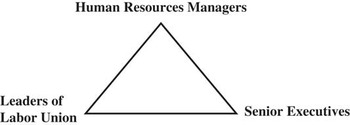
Statistical analysis can only see the phenomenon of the numeral presentation and makes it difficult to interpret the complicated causal relationship in interpersonal behaviors. Sherer and Leblebici (2001) suggest that qualitative research can distinguish the particularity and reason of creation of a HRM practice. In addition, the integration of qualitative and quantitative research methods should be able to avoid oversimplification and narrow reasoning, which can result from a structured questionnaire and objectivity of statistical analysis (Chien, 1994). Therefore, after the quantitative analysis, this study conducted focus group interviews, respectively, with three major stakeholder groups in the downsizing to seek critical information that would be helpful in interpreting the results of the statistical analysis. These three focus groups consisted of top leaders of labor unions, human resources managers, and senior executives. Generally, the leaders of labor unions and senior executives had opposing viewpoints, while human resources managers had neutral viewpoints. They all satisfied the conditions of power, ability, and motivation to be qualified sources of key information (Delery & Shaw, 2001). There were between six and eight participants in each focus group interview. Also, the format of this research involved all focus group interviews discussing the themes before the meeting and agreeing to a conclusion at the end, according to the view of Krueger and Casey (2000). The triangulate relationship of the three stakeholder groups is shown in Figure 2.
The stakeholder's triangle comparison

Results and Discussion
Hypotheses testing
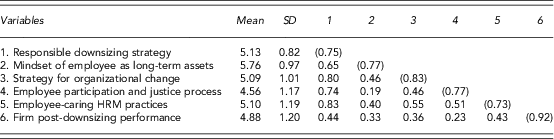
Descriptive statistics and correlations are summarized in Table 1. All of Cronbach's αwere acceptable, ranging from 0.73 to 0.92. All of the study variables were significantly inter-correlated.
Means, standard deviations, and correlations (n = 154)
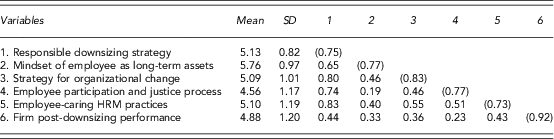
Note. Standardized correlation coefficients ≥0.19 in the table are significant at p < .05 at least.
Cronbach's α is presented in the diagonal.
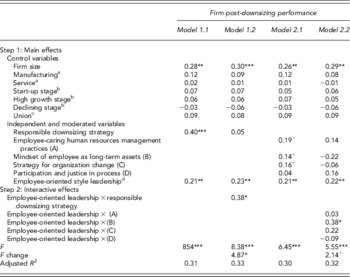
Table 2 shows the results of hierarchical moderated regression. Models 1.1 and 2.1 present the main effects of independent variables on the dependent variable, and Models 1.2 and 2.2 present the interactive effects. As Model 1.2 in Table 2 indicates, both responsible downsizing strategy (β = 0.40, p < .001) and employee-oriented leadership style (β = 0.21, p < .01) had a significant effect on firm performance. As expected, results suggested that the more responsible the downsizing strategy, the higher firm performance was, supporting Hypothesis 1. Moreover, an employee-oriented leadership style led to higher firm performance than a task-oriented leadership style. The addition of product term of overall responsible downsizing strategy and leadership style at step 2 (Model 1.2), suggesting that leadership style moderated the relationship between a responsible downsizing strategy and firm performance (β = 0.38, p < .05; ΔF = 4.87, p < .05). Therefore, Hypothesis 2 was also supported.
Results of hierarchical moderated regression analysis for interaction effects on firm performance (n = 154)

Note. aDummy variables for industry; contrast group is high-tech industry.
bDummy variables for firm's stage of life cycle; contrast group is mature stage.
cDummy variables for unions negotiation; contrast group is non-union.
dDummy variables for leadership style; contrast group is task-oriented style.
+p < .10; *p < .05; **p < .01; ***p < .001 (standardized coefficients are reported).
Model 2.1 showed that the four individual dimensions of responsible downsizing strategy merely have marginal significant or insignificant effects on firm post-downsizing performance. Therefore, H1-1, H1-2, H1-3, and H1-4 were not supported. We further examined the interactive effect of the four individual dimensions of responsible downsizing strategy and leadership style on firm performance. As Model 2.2 shows, an employee-oriented leadership style along with the mindset of employees as long-term assets significantly influences firm performance (β = 0.38, p < .05), supporting H2-2. However, H2-1, H2-3, and H2-4 were not supported. To interpret the nature of the interaction, we rearranged the total regression equation into simple regressions and plotted the values of the interaction pattern according to the rule provided by Aiken and West (Reference Aiken and West1991).
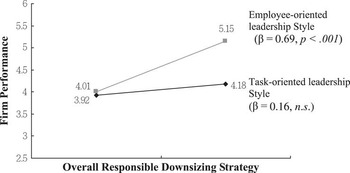
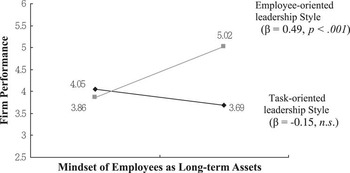
The plots of the significant interactions are illustrated in Figures 3 and 4. Consistent with our expectations, the pattern in Figures 3 and 4 reveal that the employee-oriented leadership style plays the role of an ‘enhancer.’ The employee-oriented leadership style significantly strengthened the effects of overall responsible downsizing strategy on firm performance (β = 0.69, p < .001). Meanwhile, the employee-oriented leadership style interacted with mindset of employees as long-term assets, one of the four responsible downsizing strategy aspects, thereby significantly promoting firm performance (β = 0.49, p < .001).
Interactive effects of leadership style and overall responsible downsizing strategy on firm performance

Interactive effects of leadership style and mindset of treating employees as long-term assets on firm performance

These results demonstrate two key points. First, firms that implement an employee-oriented leadership style generally have better post-downsizing performance than those that implement a task-oriented leadership style. Second, a comprehensive, responsible downsizing strategy, and the mindset of treating employees as long-term assets, significantly increased post-downsizing performance for firms with employee-oriented leadership, as compared to firms with task-oriented leadership styles.
These results are consistent with Likert's argument that an employee-oriented leadership style causes better organizational performance than a task-oriented style (although Likert's research was not in the context of organization downsizing). Furthermore, this result confirms the arguments of Bennis (1996), Shah (Reference Shah2000), Millward and Brewerton (Reference Millward and Brewerton2002), and Sutton (Reference Sutton2009) that firm leaders have to pay attention to employee trust during and after organizational downsizing. The logical question is then, ‘what are the reasons for this phenomenon’? Meanwhile, for four dimensions of the responsible downsizing strategy, why can leadership style only significantly moderate the effect of the ‘mindset of treating employees as long-term assets’ on firm performance? This research uses the key stakeholder focus group interview to interpret the statistical results.
The interpretation of statistic result by the focus group
After the above quantitative analysis, we presented the results to the three focus groups (leaders of labor unions, human resources mangers, and senior executives) for their interpretation. All of them confirmed the above statistical results. Naturally, the three groups had both similar and differing explanations for these statistical results. We summarized their common interpretations as follows:
1. Most leadership style in Taiwan tends to be more employee-oriented, since Taiwanese society emphasizes benevolence and cooperation. This leadership styles also values company performance.
2. Regarding the reasons why firms with employee-oriented leadership style have better responsible downsizing strategy performance.
During an organizational reformation process, employee-oriented leadership has a better ability to build upon common values to overcome the crisis. This includes relaying crisis awareness, developing the leadership team, establishing the shared vision, empowering employees, creating fast and successful results, and shaping a more suitable corporate culture. Thus, employees will also encourage other staff to work harder and be more willing to innovate when a firm implements a responsible downsizing strategy. All of these values will promote company performance after downsizing.
3. Regarding the reasons why firms with a task-oriented leadership style will not achieve better performance than employee-oriented leadership:
1. Employees under task-oriented leadership style do not believe that the downsizing strategy is responsible and think that it is just another strategy.
2. A task-oriented leadership style leads to the relationship between management and employees becoming a ‘contract relationship’ or ‘transactional contract.’ Trust is not strong and the emotional connection is brittle. Those small gestures such as offering more severance pay, providing more transfer training, maintaining fairness in the process, etc. will not actually increase compensation by very much. Therefore, employees will not necessarily work harder to achieve business goals. Therefore, the incremental benefit of post-downsizing performance is limited.
4. For four dimensions of the responsible downsizing strategy, why can leadership style only significantly moderate the effect of the ‘mindset of treating employees as long-term assets’ on firm performance?
Since the ‘mindset of treating employees as long-term assets’ creates a sense of recognition, employees can feel engaged from year to year in management practices and their sense of reliability is heightened. Thus, interaction in an employee-oriented leadership style enhances the relationship between responsible downsizing strategy and performance. As for the other individual aspects of the responsible strategy, change strategy selection is only an action in response to the business situation approach; employee-caring HRM practices are actions that compensate for the loss of employees; justice and inclusive participation in the process is only a lubricant. These are short-term efforts with high variables and will not motivate employees to work harder. Therefore, these variables interacting with an employee-oriented leadership style still cannot significantly promote firm performance.
Conclusions
Synthesizing the results from the quantitative and the qualitative method, we conclude that firms with employee-oriented leadership style shall have better post-downsizing performance while implementing a responsible downsizing strategy. The findings from this research provide empirical deductive evidence to contribute to the development of the theory that implementation of a responsible downsizing strategy will boost firm performance post-downsizing. In addition, a more employee-oriented leadership style will enhance the above causal effect. The reasons for this positive effect are as follows: (1) an employee-oriented leadership style utilizes more interaction and communication with employees; (2) this leadership style re-emphasizes employees as long-term assets in a downsizing; and (3) it encourages deeper employee loyalty and trust and thus inspire employees’ higher commitment to business goals. Firm performance will therefore be improved significantly. Leaders with a more task-oriented leadership style usually treat employees with a transactional mentality. The relationship between employers and employees is weak when it comes to understanding and helping one other. Therefore, during organizational downsizing, this strategy usually causes greater harm to employees. Even if executives stress the importance of employees or provide minor benefit improvements, they are still unable to win the trust of employees and even lead them to believe that the implementation of an organizational downsizing strategy is not responsible. Therefore, employees will not devote further effort to innovation and working hard in order to improve performance.
Implications
These findings indicate to researchers in organizational change management that we need to pay more attention to the variables of leadership style. Employee trust and loyalty are indeed important considerations to both downsizing strategy and firm post-downsizing performance. The implication for management practice is that responsible organizational downsizing does not necessarily apply to different leadership styles. Moreover, the trust of employees cannot be earned by some short-term practices.
Suggestions
We suggest that more studies and complete direct examinations are needed to develop responsible downsizing strategy as a theory. First, leadership style can only significantly moderate the effect of the ‘mindset of treating employees as long-term assets’ on firm performance. This implies that we need to have a more thorough examination of the contents of the other three dimensions of the responsible strategy. Second, the sample in this research comes from Taiwanese society, which emphasizes benevolence and righteousness. As a culture that emphasizes ‘power distance,’ ‘masculinity,’ ‘individualism,’ and ‘uncertainty avoidance,’ Taiwan is neutral. Therefore, the results may directly apply to other similar Chinese or Asian cultures but be limited to application to Western societies. If, in the future, studies of different backgrounds include a cross-cultural comparison, they will enable the theory of organizational downsizing strategy to be more inclusive and therefore more relevant to multinational corporations operating in different cultural settings.
Acknowledgements
This study was supported by National Science Council Research Fund of Taiwan (NSC 96-2416-H-160-001-MY3).