


Hostname: page-component-7b7567c8c-fvjsw Total loading time: 0 Render date: 2026-11-17T02:15:07.393Z Has data issue: false hasContentIssue false

Compressive properties of the lattice structure with a new process

Published online by Cambridge University Press:  18 November 2020

Qingyuan Xu
Affiliation:
Key Laboratory of Bio-based Material Science and Technology of the Ministry of Education of China, College of Material Science and Engineering, Northeast Forest University, Harbin 150040, China
Shuguang Li
Affiliation:
Key Laboratory of Bio-based Material Science and Technology of the Ministry of Education of China, College of Material Science and Engineering, Northeast Forest University, Harbin 150040, China
Runsheng Hu
Affiliation:
Key Laboratory of Bio-based Material Science and Technology of the Ministry of Education of China, College of Material Science and Engineering, Northeast Forest University, Harbin 150040, China
Mengmeng Liu
Affiliation:
Key Laboratory of Bio-based Material Science and Technology of the Ministry of Education of China, College of Material Science and Engineering, Northeast Forest University, Harbin 150040, China
Dong Wang
Affiliation:
Key Laboratory of Bio-based Material Science and Technology of the Ministry of Education of China, College of Material Science and Engineering, Northeast Forest University, Harbin 150040, China
Gaoyuan Ye
Affiliation:
Key Laboratory of Bio-based Material Science and Technology of the Ministry of Education of China, College of Material Science and Engineering, Northeast Forest University, Harbin 150040, China
Yingcheng Hu*
Affiliation:
Key Laboratory of Bio-based Material Science and Technology of the Ministry of Education of China, College of Material Science and Engineering, Northeast Forest University, Harbin 150040, China
*
a)Address all correspondence to this author. e-mail: yingchenghu@nefu.edu.cn
Get access

Abstract

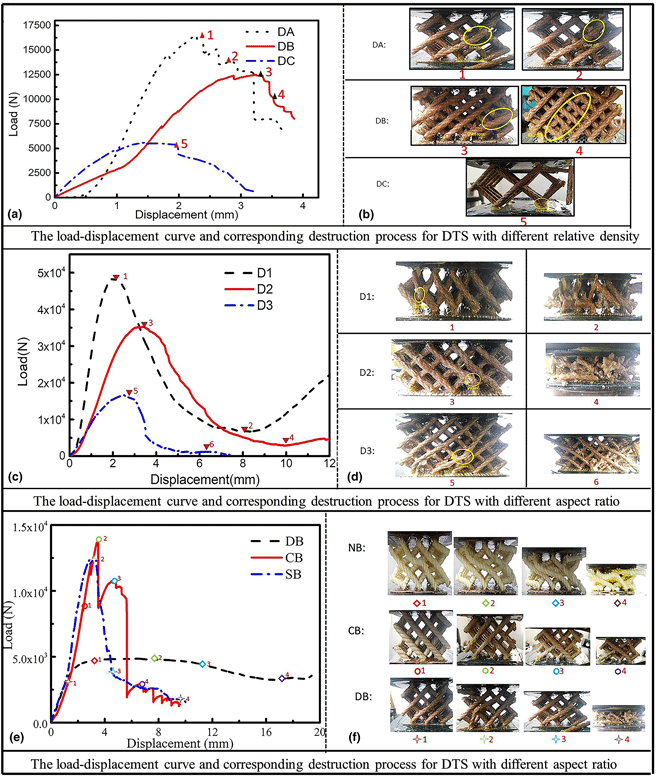
With the aim of optimizing the traditional construction process of a fiber-reinforced lattice structure, the present study modified a previously proposed technique called “truss stacking and node gluing.” To explicitly investigate the structural compressive properties (compressive strength and compressive modulus under the flat pressure), the geometrical parameters, material properties, and topological configuration were examined in detail. Additionally, the present study conducted the relevant theoretical analyses to predict the possible destruction modes and compressive properties. All the samples were tested with a universal testing machine at a rate of 2 mm/min using the ASTM-C365 standard. The results showed that compressive properties are positively related to the relative density and negatively related to the aspect ratio. It was also found that the compressive performance for different materials was in the following order (from good to bad): cotton-fiber reinforced epoxy composite (CREC), jute-fiber reinforced epoxy composite (JREC), and nylon-fiber reinforced epoxy composite (NREC). Furthermore, the mixed topological structure performed as well as the square structure, and they both overmatched the diamond structure. Lastly, the accuracy of the theoretical analysis was evaluated by comparing the theoretical values and the experimental values.

Information

Type
Article
Copyright
Copyright © The Author(s), 2020, published on behalf of Materials Research Society by Cambridge University Press

Access options

Get access to the full version of this content by using one of the access options below. (Log in options will check for institutional or personal access. Content may require purchase if you do not have access.)

Article purchase

Temporarily unavailable