


Hostname: page-component-7b7567c8c-2n9c9 Total loading time: 0 Render date: 2026-11-13T19:28:38.324Z Has data issue: false hasContentIssue false

Nitrite sensor based on room temperature ionic liquid functionalized α-zirconium phosphate modified glassy carbon electrode

Published online by Cambridge University Press:  24 August 2020

Yuting Ge
Affiliation:
School of Environmental and Chemical Engineering, Jiangsu Ocean University, Lianyungang 222005, China
Fengyan Gu
Affiliation:
School of Environmental and Chemical Engineering, Jiangsu Ocean University, Lianyungang 222005, China
Lin Liu*
Affiliation:
School of Environmental and Chemical Engineering, Jiangsu Ocean University, Lianyungang 222005, ChinaJiangsu Key Laboratory of Marine Bioresources and Environment, Lianyungang 222005, China
Pengjin Fang
Affiliation:
School of Environmental and Chemical Engineering, Jiangsu Ocean University, Lianyungang 222005, China
Jiadong Zhou
Affiliation:
School of Environmental and Chemical Engineering, Jiangsu Ocean University, Lianyungang 222005, China
Han Cheng
Affiliation:
School of Environmental and Chemical Engineering, Jiangsu Ocean University, Lianyungang 222005, China
Juanjuan Ma
Affiliation:
School of Environmental and Chemical Engineering, Jiangsu Ocean University, Lianyungang 222005, ChinaLDZ New Aoshen Spandex Co. LTD, Lianyungang 222005, China
Zhiwei Tong
Affiliation:
School of Environmental and Chemical Engineering, Jiangsu Ocean University, Lianyungang 222005, ChinaSORST, Japan Science and Technology (JST), Kawaguchi, Saitama 332-0012, Japan
Jianwei Wang
Affiliation:
LDZ New Aoshen Spandex Co. LTD, Lianyungang 222005, China
Bin Zhang
Affiliation:
LDZ New Aoshen Spandex Co. LTD, Lianyungang 222005, China
*
a)Address all correspondence to this author. e-mail: liulin@jou.edu.cn
Get access

Abstract

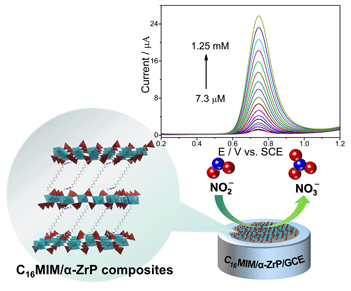
A novel ionic liquid/α-ZrP (C16MIM/α-ZrP) lamellar nanocomposite was fabricated via the electrostatic self-assembly deposition technique by using exfoliated α-ZrP nanosheets and guest molecules (1-hexadecyl-3-methylimidazolium bromide) as building blocks under mild conditions. C16MIM/α-ZrP nanocomposite was characterized by various analytical techniques such as X-ray diffraction (XRD), transmission electron microscopy (TEM), scanning electron microscope (SEM), Fourier transform infrared spectroscopy, and synchronous thermal analyzer. The net interlayer spacing of α-ZrP determined by XRD confirmed that the C16MIM cations formed a monolayer arrangement between the α-ZrP nanosheets. The morphology and microstructure of C16MIM/α-ZrP composite were observed using SEM and TEM. The C16MIM/α-ZrP modified glass carbon electrode exhibited excellent electrocatalytic activity toward the oxidation of nitrite in weak base media. The results obtained with differential pulse voltammetry demonstrated that the C16MIM/α-ZrP hybrid detected nitrite linearly in the concentration range from 7.3 μM to 1.25 mM with the detection limit of 1.26 μM (S/N = 3). Additionally, the prepared sensor showed outstanding reproducibility, high stability, and anti-interference capability.

Information

Type
Article
Copyright
Copyright © The Author(s), 2020, published on behalf of Materials Research Society by Cambridge University Press

Access options

Get access to the full version of this content by using one of the access options below. (Log in options will check for institutional or personal access. Content may require purchase if you do not have access.)

Article purchase

Temporarily unavailable

Supplementary material: File

Ge et al. supplementary material

Ge et al. supplementary material

Download Ge et al. supplementary material(File)
File 1.3 MB