


Hostname: page-component-7b7567c8c-tnkh4 Total loading time: 0 Render date: 2026-11-18T09:26:30.168Z Has data issue: false hasContentIssue false

A simple strategy for fabricating honeycomb patterns on commercially available polymer film under a wide humidity range

Published online by Cambridge University Press:  16 November 2020

Kai Huang
Affiliation:
State Key Laboratory of Separation Membranes and Membrane Processes, Tianjin Polytechnic University, Tianjin 300387, P.R. China
Qi Cheng
Affiliation:
State Key Laboratory of Separation Membranes and Membrane Processes, Tianjin Polytechnic University, Tianjin 300387, P.R. China
Honglei Zhang
Affiliation:
State Key Laboratory of Separation Membranes and Membrane Processes, Tianjin Polytechnic University, Tianjin 300387, P.R. China
Ligang Lin*
Affiliation:
State Key Laboratory of Separation Membranes and Membrane Processes, Tianjin Polytechnic University, Tianjin 300387, P.R. China
Qiying Wang
Affiliation:
State Key Laboratory of Separation Membranes and Membrane Processes, Tianjin Polytechnic University, Tianjin 300387, P.R. China
*
a)Address all correspondence to this author. e-mail: phdlinligang@163.com
Get access

Abstract

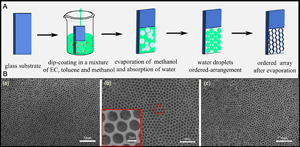
A simple and effective strategy is proposed for fabricating honeycomb-patterned ethyl cellulose (EC) films via a combination of the dip-coating and breath figure methods under a wide humidity range (40–90%). A mixture of toluene and methanol as a volatile solvent/nonsolvent pair was used to effectively control the surface morphology. Additionally, honeycomb patterns were successfully formed via dip-coating under a low humidity (relative humidity less than 40%), when water was directly added into the mixed solution. The important factors that influenced the morphology of EC honeycomb-patterned films were investigated, such as the humidity, solution concentration, and the withdrawal speed during dip-coating. The pore sizes could be controlled by changing the film-formation conditions. Water contact angle enables a transition from hydrophilic to hydrophobic. The possible mechanisms of honeycomb pattern formation are discussed. The fabrication of an ordered honeycomb-patterned film in a cost-effective and convenient manner will have broad application potential in the future.

Information

Type
Article
Copyright
Copyright © The Author(s), 2020, published on behalf of Materials Research Society by Cambridge University Press

Access options

Get access to the full version of this content by using one of the access options below. (Log in options will check for institutional or personal access. Content may require purchase if you do not have access.)

Article purchase

Temporarily unavailable

Supplementary material: File

Huang et al. supplementary material

Figures S1-S2

Download Huang et al. supplementary material(File)
File 827.2 KB