


Hostname: page-component-7b7567c8c-tnkh4 Total loading time: 0 Render date: 2026-11-16T13:18:18.082Z Has data issue: false hasContentIssue false

Extracting grain boundary motion in Cu–Al alloy from atomistic simulations

Published online by Cambridge University Press:  28 August 2020

Xiaobao Li*
Affiliation:
School of Civil Engineering, Hefei University of Technology, Hefei 230009, China
Hanlin Sun
Affiliation:
School of Civil Engineering, Hefei University of Technology, Hefei 230009, China
Yuxue Pu
Affiliation:
School of Civil Engineering, Hefei University of Technology, Hefei 230009, China
Changwen Mi*
Affiliation:
Jiangsu Key Laboratory of Engineering Mechanics, School of Civil Engineering, Southeast University, Nanjing 210096, China
*
a)Address all correspondence to these authors. e-mail: xiaobaoli@hfut.edu.cn
b)e-mail: mi@seu.edu.cn
Get access

Abstract

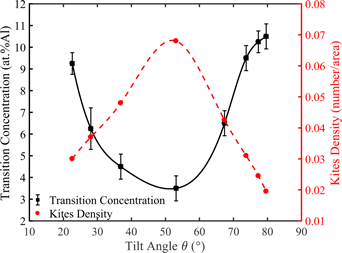
Grain boundary (GB) motions, such as migration, sliding and rotation, have been shown to play a vital role in the mechanical performance of polycrystalline metals. Despite extensive efforts have been made on the pure polycrystalline metals, few attentions have been paid to those in alloys. In this work, taking conventional nanoscale Cu–Al binary alloy system as an example, we intend to shed some light on understanding its GB motions under shear loading by means of molecular dynamics (MD) simulations. It is found that either shear-coupled GB migration or sliding motion can be observed, depending on GB tilt angles, temperatures and Al solute concentrations. By systematical MD simulations, the Al concentration required for transition between shear-coupled migration and sliding is found to decrease with increasing tilt angles (θ ≤ 50°) at fixed temperature, whereas it switches to the opposite trend for larger tilt angles. Furthermore, the GBs migrate much slower comparing with those in pure Cu, which shows the drag effects of the Al solutes in the alloy form. Moreover, the critical stress during shear loading shows a linear dependence on 2/3 power of the temperature.

Information

Type
Article
Copyright
Copyright © Materials Research Society 2020

Access options

Get access to the full version of this content by using one of the access options below. (Log in options will check for institutional or personal access. Content may require purchase if you do not have access.)

Article purchase

Temporarily unavailable

Supplementary material: File

Li et al. Supplementary Materials

Li et al. Supplementary Materials

Download Li et al. Supplementary Materials(File)
File 16.8 MB