I. INTRODUCTION
Ionic liquids (ILs) are a diverse group of salts that are liquid at ambient temperatures.Reference Kirchner1 The cation of the salt is generally an organic structure with a low symmetry, and the anion can be either organic or inorganic. ILs are the focus of intense research because of their extraordinary chemical and physical properties, such as negligible vapor pressure, thermal stability, and nonflammabilityReference Freemantle2,Reference Wasserscheid and Welton3 combined with a high ionic conductivity (0.1 to 18 × 10−3 S/cm) and a wide electrochemical window (2–6 V).Reference Galinski, Lewandowski and Stepniak4 ILs also have diverse solvating properties. For example, ILs can disperse carbon nanotubesReference Fukushima, Kosaka, Ishimura, Yamamoto, Takigawa, Ishii and Aida5 and dissolve biopolymers, such as cellulose.Reference Swatloski, Spear, Holbrey and Rogers6 Numerous applications are encountered for ILs in different fields, such as organic synthesis,Reference Olivier-Bourbigou, Magna and Morvan7 analytical chemistry,Reference Anderson, Armstrong and Wei8 and material science.Reference Armand, Endres, MacFarlane, Ohno and Scrosati9 However, regardless of their unique properties, the exploitation of ILs can be complicated in certain applications because of their liquid state. The problems relate to the possible leakage of the liquid or difficulties in obtaining or maintaining the liquid in a predefined physical shape. These drawbacks can be overcome by applying methods for “solidifying” ILs while keeping their specific liquid state properties, which is a challenging task.
To apply ILs in the solid state, different polymer gels having IL encapsulated into a polymeric three-dimensional network have been widely investigated.Reference Ye, Rick and Hwang10 Composites of polymers and ILs are found to be versatile platforms for immobilizing ILs because both offer virtually unlimited tuneability, and various polymer-based technologies are already well established in industry.Reference Lodge11 Unfortunately, in polymer gels, IL is only weakly connected to the network and can still have significant fluidity, and leakage issues may not be eliminated.
Alternatives to polymer gels are polymerized ionic liquids (PILs),Reference Yuan and Antonietti12 in which the IL moiety is covalently linked to a macromolecular structure to overcome the known disadvantages of polymer gels. PILs are prepared by polymerization of ILs containing polymerizable functional groups. These new materials have attracted growing interest since 1998 when the first examples of PILs were published by Ohno and Ito.Reference Ohno and Ito13
PILs can be classified as polycations and polyanions bearing corresponding ions in the macromolecular backbone or as zwitterionic polymers.Reference Ohno14 Furthermore, different types of copolymers (random, alternating, or block) and macromolecular architectures, such as branched or dendritic structures, are potentially possible. To date, the PIL research has focused mainly on introducing the polymerizable moiety into the cation. Common polymerizable functional groups used are vinyl and (meth)acrylate.Reference Mecerreyes15 Although imidazolium is the most popular choice as a cation, the use of other types, such as tetraalkyl ammonium,Reference Tang, Tang, Sun, Radosz and Shen16 pyridinium,Reference Marcilla, Blazquez, Fernandez, Grande, Pomposo and Mecerreyes17 pyrrolidonium, or piperidinium,Reference Ogihara, Washiro, Nakajima and Ohno18 has also been reported. A large variety of counteranions have also been used, such as halides, tetrafluoroborate, hexafluorophosphate, triflate, nitrate, bis(trifluoromethane)sulphonimide (TFSI), and alkyl sulphonates.
In most cases, polymerization is carried out using conventional thermal free radical polymerization in solution or in bulk initiated by AIBN (azobisisobutyronitrile).Reference Yuan and Antonietti12 However, several examples of preparation of PILs by controlled/living radical polymerization techniques are available. Techniques, such as atom transfer radical polymerization (ATRP),Reference Tsarevsky and Matyjaszewski19 reversible addition fragmentation transfer polymerization (RAFT),Reference Mori, Yahagi and Endo20 ring-opening polymerization and ring-opening metathesis polymerization processesReference Vygodskii, Shaplov, Lozinskaya, Lyssenko, Golovanov, Malyshkina, Gavrilova and Buchmeiser21 allow the control of molecular weight and PIL architectures.
PILs link macromolecular structures to typical characteristics of ILs. PILs are transparent materials exhibiting the flexibility and elasticity inherent to polymers and ionic conductivity and other characteristics of ILs. Based on the above-mentioned properties, PILs are applicable as polymer electrolytes in electrochemical devices, such as batteries, fuel cells, solar cells, and capacitors.Reference Green, Grubjesic, Lee and Firestone22 There are extensive applications for these unique materials in different fields, such as switchable surfaces,Reference Azzaroni, Brown and Huck23 optical and biosensors,Reference Zhang, Lu, Qiao, Zhang, Liu, Zhang, Han and Song24 gas absorbers,Reference Tang, Sun, Tang, Radosz and Shen25 and stationary phases for gas chromatography,Reference Zhao and Anderson26 just to mention a few.
The main drawback of PILs is the decrease in ionic conductivity after polymerization. Before polymerization, the PILs have conductivities comparable to the conventional ILs; however, during polymerization, the conductivities will decrease, often by several orders of magnitude. For example, the ionic conductivity of 1-ethyl-3-vinylimidazolium bis(trifluoromethane)sulphonimide is approximately 10−2 S/cm at room temperature but drops to 10−6 S/cm after polymerization.Reference Washiro, Yoshizawa, Nakajima and Ohno27 Methacrylate- and acrylate-type PIL monomers with a flexible spacer between the cation and the polymerizable functional group have significantly lower conductivities (approximately 10−4 to 10−5 S/cm), but the decrease in conductivity after polymerization is not so drastic. PILs of this type have conductivities of approximately 10−4 to 10−6 S/cm at 30 °C.Reference Ogihara, Washiro, Nakajima and Ohno18 The decrease in conductivity during polymerization is caused mainly by the decrease in the numbers of carrier ions and their mobility. There are also several factors that may influence conductivity such as polymer architecture, molecular weight, glass transition temperature (T g), and the chemical nature of polymer and IL moieties.Reference Ohno28 Intense research is on-going to find opportunities to maintain the conductivity of the polymerized material. Two strategies to overcome this problem are available: (i) to increase the concentration of the carrier ions and (ii) to increase the mobility of ions by changing the structure of the material.
In this study, both of the strategies mentioned above were combined to develop a new type of composite material with a high conductivity and variable mechanical properties by adding a conventional IL, 1-ethyl-3-methylimidazolium tetrafluoroborate ([EMIM][BF4]) to different methacrylate-type PILs prepared from 1-[n-(methacryloyloxy)alkyl]-3-methylimidazolium bromides. A similar approach has previously been carried out with PILs having a vinyl group as a polymerizable moietyReference Marcilla, Alcaide, Sardon, Pomposo, Pozo-Gonzalo and Mecerreyes29; however, to the best of our knowledge, the current study is the first attempt to improve the electrical properties of the methacrylate-type PILs by mixing them with IL. Another novel aspect of this work is that the polymerization of the PILs and PIL/IL mixtures was monitored in situ by measuring the resistivity of the polymerizing material.
Photopolymerization as an energy-efficient and technically simple method was applied for polymerization of PIL monomers and their mixtures with [EMIM][BF4]. Photopolymerization is widely applied in the coating industries for the preparation of different paints and prints and in the manufacture of curable materials.Reference Allen30 Regardless of the great potential of photopolymerization, the technique has only seldom been applied for the preparation of PILs.Reference Barta, Seifert and Firestone31,Reference Nakashima, Sakashita, Nonoguchi and Kawai32
II. EXPERIMENTAL
A. Materials
For the synthesis of polymerizable IL monomers, the following chemicals were used as received: N-methylimidazole (Aldrich, St. Louis, MO), α,ω-diols (Aldrich), methacryloyl chloride (Fluka, St. Louis, MO), BHT (Fluka), HBr (40% aqueous solution, LachNer, Czech Republic). ACN (Rathburn, Walkerburn, UK) was distilled over CaH2. 2-Bromoethanol (Fluka) was distilled prior to use, collecting a fraction with a boiling point of 149–150 °C at atmospheric pressure. [EMIM][BF4] (Aldrich) and polyethylene glycol (PEG 400, LOBA Chemie, Austria) were used as received.
B. Characterization
The 1H- and 13C-NMR spectra were recorded at ambient temperature on a Bruker Avance II 200 spectrometer (Billerica, MA), using d6-DMSO as a solvent. The 1H-NMR spectra were measured at 200 MHz and the 13C-NMR spectra at 50 MHz. The chemical shifts were internally referenced by the residual solvent signals relative to tetramethylsilane. The IR spectra were obtained on a Perkin–Elmer Spectrum BXII FT-IR instrument (Waltham, MA).
C. The synthesis of polymerizable IL monomers
1-[n-(methacryloyloxy)alkyl]-3-methylimidazolium bromides with different alkyl chain lengths (n = 2, 6, 7, or 10) were synthesized by our previously published methodReference Põhako-Esko, Taaber, Saal, Lõhmus, Kink and Mäeorg33 described in Scheme 1. The α,ω-bromoalcohols were synthesized from the corresponding α,ω-diols using a known procedure.Reference Kang, Kim and Moon34
N-methylimidazole (0.1 mol) and α,ω-bromoalcohol (1 eq) were mixed under inert atmosphere. The reaction mixture was stirred at room temperature for 24–48 h. Depending on the alkyl chain length of the α,ω-bromoalcohol used, a white solid or a colorless viscous liquid was formed. 1-(n-hydroxyalkyl)-3-methylimidazolium bromides were obtained in quantitative yields. To introduce the polymerizable functional group, hydroxyl-functionalized ILs were acylated with methacryloyl chloride. Methacryloyl chloride (2 eq) was added dropwise at 0 °C to 1-(n-hydroxyalkyl)-3-methylimidazolium bromide (0.1 mol) suspended in anhydrous acetonitrile. The reaction mixture was stirred at room temperature for 48 h in an inert atmosphere. The desired product was obtained after removal of the solvent by evaporation, and the excess of methacryloyl chloride was removed by extraction with diethyl ether. The ILs that were obtained were dried under vacuum (<1 mm Hg) for 24 h at room temperature. The acylation occurred with all starting materials with yields of more than 90%. To avoid polymerization, 2,6-di-tert-butyl-4-methylphenol (BHT) was added to the synthesized 1-[n-(methacryloyloxy)alkyl]-3-methylimidazolium bromides. The structures of the synthesized PIL monomers were confirmed by infrared (IR) and nuclear magnetic resonance (NMR) spectroscopy.
1-[2-(methacryloyloxy)ethyl]-3-methylimidazolium bromide (IL 2C): yield over two steps, 94%.
1H NMR (200 MHz, DMSO): δ 9.39 (s, 1H, –N–CH–N–), 7.89 (s, 1H, –N–CH=CH–N–), 7.81 (s, 1H, –N–CH=CH–N–), 6.06 (s, 1H, CH 2=C–), 5.73 (s, 1H, CH 2=C–), 4.60 (t, 2H, J = 5.4 Hz, –N–CH 2–), 4.46 (t, 2H, –CH 2–O = , J = 5.2 Hz), 3.91 (s, 3H, –N–CH 3), 1.86 (s, 3H, CH2=C–CH 3).
13C NMR (50 MHz, DMSO): δ 166.53, 137.57, 135.70, 127.09, 124.12, 123.22, 63.18, 48.44, 36.38, 18.34.
IR (cm−1): 3024 (C–Harom), 2961 (C–H), 2949 (C–H), 1718 (C=O), 1635 (C=CH2), 1575 (C=C), 1452 (C=N+), 1317, 1295 (C–O), 1161 (C–O, C–N overlapped), 945 (C=H2).
1-[6-(methacryloyloxy)hexyl]-3-methylimidazolium bromide (IL 6C): yield over two steps, 96%.
1H NMR (200 MHz, DMSO): δ 9.29 (s, 1H, –N–CH–N–), 7.84 (s, 1H, –N–CH=CH–N–), 7.77 (s, 1H, –N–CH=CH–N–), 6.02 (s, 1H, CH 2=C–), 5.69 (s, 1H, CH 2=C–), 4.20 (t, 2H, J = 7.2 Hz, –N–CH 2–), 4.10 (t, 2H, –CH 2–O–, J = 6.4 Hz), 3.89 (s, 3H, –N–CH 3), 1.89 (s, 3H, CH2=C–CH 3), 1.82 (quint., 2H, J = 6.8 Hz, –CH 2–CH2–N–), 1.64 (quint., 2H, J = 6.8 Hz, –CH 2–CH2–O–), 1.34 (m, 4H, –N–CH2–CH2–(CH 2)2–CH2–CH2–O–).
13C NMR (50 MHz, DMSO): δ 167.06, 137.10, 136.51, 125.91, 124.08, 122.77, 64.61, 49.21, 36.27, 29.74, 28.35, 25.60, 25.29, 18.43.
IR (cm−1): 3054 (C–Harom), 2940 (C–H), 2864 (C–H), 1711 (C=O), 1635 (C=CH2), 1571 (C=C), 1454 (C=N+), 1321, 1297 (C–O), 1163 (C–O, C–N overlapped), 942 (C=H2).
1-[7-(methacryloyloxy)heptyl]-3-methylimidazolium bromide (IL 7C): yield over two steps, 83%.
1H NMR (200 MHz, DMSO): δ 9.25 (s, 1H, –N–CH–N–), 7.80 (s, 1H, –N–CH=CH–N–), 7.73 (s, 1H, –N–CH=CH–N–), 6.00 (s, 1H, CH 2=C–), 5.66 (s, 1H, CH 2=C–), 4.17 (t, 2H, J = 7.0 Hz, –N–CH 2–), 4.08 (t, 2H, –CH 2–O–, J = 6.6 Hz), 3.86 (s, 3H, –N–CH 3), 1.86 (s, 3H, CH2=C–CH 3), 1.78 (quint., 2H, J = 7.0 Hz, –CH 2–CH2–N–), 1.60 (quint., 2H, J = 6.2 Hz, –CH 2–CH2–O–), 1.30 (m, 6H, –N–CH2–CH2–(CH 2)3–CH2–CH2–O–).
13C NMR (50 MHz, DMSO): δ 167.07, 137.09, 136.53, 125.88, 124.10, 122.77, 64.68, 49.26, 36.26, 29.78, 28.46, 28.41, 25.86, 25.66, 18.43.
IR (cm−1): 3050 (C–Harom), 2934 (C–H), 2851 (C–H), 1711 (C=O), 1634 (C=CH2), 1570 (C=C), 1455 (C=N+), 1321, 1296 (C–O), 1165 (C–O, C–N overlapped), 941 (C=H2).
1-[10-(methacryloyloxy)decyl]-3-methylimidazolium bromide (IL 10C): yield over two steps, 87%.
1H NMR (200 MHz, DMSO) δ 9.38 (s, 1H, –N–CH–N–), 7.86 (s, 1H, –N–CH=CH–N–), 7.78 (s, 1H, –N–CH=CH–N–), 5.97 (s, 1H, CH 2=C–), 5.64 (s, 1H, CH 2=C–), 4.18 (t, 2H, J = 7.2 Hz, –N–CH 2–), 4.05 (t, 2H, J = 6.6 Hz, –CH 2–O–), 3.87 (s, 3H, –N–CH 3), 1.80 (s, 3H, CH2=C–CH 3), 1.76 (quint., 2H, J = 7.4 Hz, –CH 2–CH2–N–), 1.57 (quint., 2H, J = 6.4 Hz, –CH 2–CH2–O–), 1.22 (m, 12H, –N–CH2–CH2–(CH 2)6–CH2–CH2–O–).
13C NMR (50 MHz, DMSO): δ 167.01, 137.09, 136.49, 125.83, 124.03, 122.75, 64.72, 49.23, 36.27, 29.91, 29.25, 29.18, 29.03, 28.81, 28.54, 25.97, 25.85, 18.40.
IR (cm−1): 3058 (C–Harom), 2924 (C–H), 2853 (C–H), 1714 (C=O), 1635 (C=CH2), 1570 (C=C), 1455 (C=N+), 1321, 1296 (C–O), 1165 (C–O, C–N overlapped), 939 (C=H2).
D. Preparation of PIL monomers and IL mixtures
PIL monomers (IL 6C, IL 7C, and IL 10C) were mixed with [EMIM][BF4] in different ratios, varying the content of [EMIM][BF4] in the range of 10–75% vol/vol. To obtain better miscibility, 5% vol/vol of PEG 400 was added, and the mixtures were sonicated at room temperature for 10 min. IL 2C was not used for the preparation of PIL/mixtures, as the conductivity of PIL 2C is lower compared to other PILs. IL 2C is also unstable compared to other synthesized polymerizable ILs and tends to autopolymerize very easily.
E. Polymerization of mixtures and measurement of ionic conductivity
In situ measurement of conductivity of polymerizing IL mixtures was carried out inside 2 mL Eppendorf tubes using platinum electrodes in the configuration shown in Fig. 1. Platinum electrodes were prepared from a 0.5-mm-diameter Pt wire (99.9%, Aldrich), separated by a distance of 4.9 mm using a Teflon spacer. The cell constant K, necessary for calculating resistivity from the measured resistance values, was determined using a 0.1 M KCl aqueous solution with a known conductivity of 12.64 × 10⁻³ S/cm at 24 °C. Platinum electrodes were cleaned with a piranha solution [H2SO4:H2O2 (30% aqueous solution), 3:1] and washed thoroughly with distilled water prior to the cell constant measurements. To carry out in situ measurements of resistivity of mixtures of PIL monomers and ILs, 1 mL of the mixtures was transferred into Eppendorf tubes, after which Pt electrodes were inserted to the same depth in each tube. The samples were placed into a UV chamber consisting of an aluminum box with internal dimensions of 98 × 260 × 70 mm, equipped with four 8 W blacklight fluorescent lamps with a peak emission wave length of 352 nm, symmetrically positioned around the samples. Mixtures of PIL monomers and ILs were irradiated for 40 h to obtain the polymerization of methacryloyl groups. By 40 h, the electrical resistance of all the samples reached a plateau. The temperature inside the irradiation chamber was measured conjointly with the electrical resistance of the samples using an Omega Pt100 thermoresistor (Stamford, CT) connected to a Keithley 2400 source meter (Cleveland, OH). The electrical resistance measurements were carried out at a 1 kHz frequency, and the current through a sample was set to 0.13 mA, kept constant during all the experiments. A Metrix 3240 signal generator (Paris, France) was used as a voltage source. Voltage and current were measured by Agilent 34410A multimeters (Santa Clara, CA), and a relay card was used for measuring multiple objects simultaneously. The operations of all the devices were controlled by a PC.
Irradiation chamber for polymerization and in situ resistivity measurements of PIL/IL mixtures.

Temperature rose rapidly inside the UV chamber as fluorescent lamps were turned on in the beginning of the experiment but stabilized rapidly at 80 °C.
III. RESULTS AND DISCUSSION
A. The synthesis of polymerizable IL monomers
1-[n-(methacryloyloxy)alkyl]-3-methylimidazolium bromides were synthesized with high yields and purities using a simple and efficient method. In contrast to the conventional synthesis route,Reference Ding, Tang, Radosz and Shen35,Reference Chen, Choi, Salas-de la Cruz, Winey and Elabd36 the polymerizable functional group was added in the last synthesis step (Scheme 1), which helps avoiding the premature polymerization of the synthesized PIL monomers. Structures of synthesized ILs were confirmed by 1H and 13C NMR and IR spectroscopy. There was no evidence in spectra of polymerization or formation of other by-products during the synthesis.
B. Polymerization
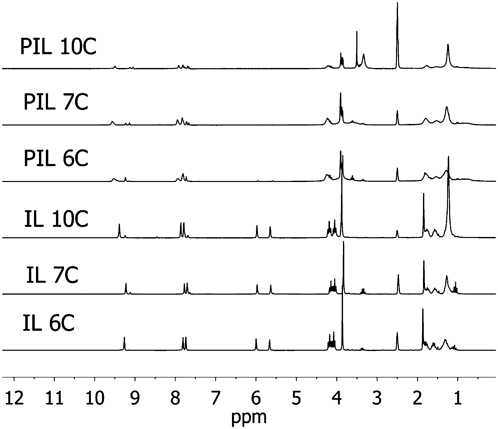
1-[n-(methacryloyloxy)alkyl]-3-methylimidazolium bromides and their mixtures with [EMIM][BF4] were polymerized in bulk using self-initiated photopolymerization that was carried out as described in Sec. II. During polymerization, the electrical resistivity of the polymerizing material was measured to observe progression of the polymerization reaction. After polymerization, the physical state of the PIL/IL mixtures varied from transparent self-supporting solids to viscous and sticky gels depending on the content of [EMIM][BF4]. The increase in the amount of IL in PILs led to the formation of gel-like materials rather than hard solids, which is characteristic of the neat PILs. When the content of [EMIM][BF4] was higher than 50% vol/vol, the mixtures were liquid even after polymerization. 1H NMR spectra were measured for the neat PILs. The spectroscopic analyses indicated that the full conversion was obtained during polymerization, as the peaks related to the methacrylic double bond (two singlets in the range 5.6–6.1 ppm) disappeared in the spectra of PIL 6C, PIL 7C, and PIL 10C (Fig. 2).
1H NMR spectra of PIL and PIL monomers.
Photopolymerization was used for polymerization of the neat PIL monomers and PIL/IL mixtures due to the advantages that make this technique favorable for industrial use. Photoinduced polymerization is a simple, solvent-free, energy-efficient, and cost-effective method for the preparation of different vinyl polymers. Polymerization carried out in bulk allows the preparation of polymers already in the predefined form, for example, as films or layers. Photopolymerization normally requires the addition of photoinitiators, which absorb the light and generate radicals to start the polymerization reaction. However, different monomers bearing the vinyl or (meth)acrylate function were found to be able to photopolymerize even in the absence of a photoinitiator.Reference Srinivasan, Lee, Grady, Soroush and Rappe37,Reference Mayo38 In the present study, 1-[n-(methacryloyloxy)alkyl]-3-methylimidazolium bromides and their mixtures with [EMIM][BF4] were also successfully polymerized without any initiator. The addition of photoinitiators may lead to several problems in practical applications, such as changes in color or toxicological risk due to the migration of photolysis fragments out of the material. In the present study, the use of photoinitiators was avoided, as most photoinitiators generate gaseous compounds during decomposition. Due to the gel-like consistency of the PIL, the gas bubbles that are formed remain in the material and disturb the resistivity measurements. The formation of the gas bubbles is also undesirable for the practical applications.
In the current study, PIL/IL mixtures were irradiated with UV light for 40 h. Figures 3–5 present the changes in resistivity of the PIL/IL mixtures during the irradiation. The increase in resistivity corresponds to the progression of the polymerization reaction. The data in Figs. 3–5 demonstrate that in all cases, a plateau was reached within 10 h, and the conclusion can therefore be drawn that most of the changes in the materials occur during this time.
Increase in resistivity of mixtures from IL 6C and [EMIM][BF4] during polymerization (irradiation with wave length 352 nm at 80 °C).
Increase in resistivity of mixtures from IL 7C and [EMIM][BF4] during polymerization (irradiation with UV light at 80 °C).
Increase in resistivity of mixtures from IL 10C and [EMIM][BF4] during polymerization (irradiation with UV light at 80 °C).
From the measurements, it is evident that PILs with different alkyl chain lengths reach the plateau at different times. This difference is obviously caused by the differences of the viscosities and concentrations of the polymerizable functional groups in the materials. Comparison of the PIL/IL mixtures with different ratios prepared from the same PIL monomer indicates that the mixtures with different ratios also reach the plateau at different times. Likewise, again both the viscosity and concentration of the polymerizable functional group play a significant role.
All of the polymerized PIL/IL mixtures were homogenous after polymerization, and no phase separation was observed. Phase separation can be problematic in the preparation of the polymer gels by polymerizing different nonionic vinyl monomers in the ILs. The key parameter here is the compatibility of monomers, polymers, and ILs. Even when the monomers and ILs are miscible, the resulting polymer can be incompatible with the IL and can lead to phase separation. Due to the chemical affinities of PILs and ILs, the phase separation did not occur. To assure a homogenous dispersion of [EMIM][BF4] in the polymerized mixtures, the PIL monomers and ILs were mixed prior to polymerization. Although individual ILs are generally miscible due to their chemical affinities, the bulky organic substituents of the PIL monomers still made it difficult to mix the PIL with [EMIM][BF4]. The formation of homogenous mixtures was therefore facilitated by addition of 5% vol/vol PEG.
C. Ionic conductivity
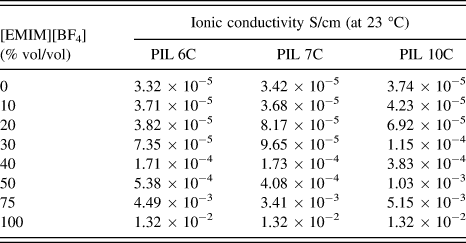
The in situ resistivity measurements of PIL/IL mixtures during polymerization demonstrated that, although the ionic conductivity of the PILs decreased, the addition of [EMIM][BF4] enhanced the conductivity of obtained materials compared to the neat PILs (Figs. 3–5). The final conductivities of all of the PIL/IL mixtures at room temperature after polymerization are summarized in Table I. The conductivities for the neat PILs were on the level of 10−5 S/cm at room temperature. For comparison, the measured ionic conductivity of [EMIM][BF4] was 13.2 × 10⁻³ S/cm, which is consistent with previously published data (13–14 × 10−3 S/cm at 25 °CReference Galinski, Lewandowski and Stepniak4). [EMIM][BF4] was chosen as an additive for PILs in the current study because of its high conductivity, which is one of the highest among the imidazolium-based ILs. The conductivities of the PIL/IL mixtures remained at a value between those of the neat PILs and [EMIM][BF4] and were dependent on the concentration of [EMIM][BF4]. The conductivity of PIL/IL mixtures was found to exponentially increase by increasing the content of [EMIM][BF4] (Fig. 6). For example, the conductivity of PIL 10C was the highest among the neat PILs. The addition of 10% vol/vol of [EMIM][BF4] to PIL 10C resulted in a 13% higher conductivity measured for the material. The addition of 20% vol/vol of [EMIM][BF4] yielded a conductivity rise of approximately 85%. Increases in conductivities greater than an order of magnitude (from 10−5 to 10−4 S/cm) were achieved for all of the PIL/IL mixtures with a [EMIM][BF4] content of approximately 40% vol/vol.
The ionic conductivities of PIL/IL mixtures.
The influence of the added [EMIM][BF4] on the ionic conductivity of PIL/IL composites (at 23 °C).
During polymerization, the conductivities of PILs decrease due to the increasing viscosities of the materials and loss of mobilities of the cations due to covalent linking with the macromolecular chains. The addition of [EMIM][BF4] increases the concentration of mobile ions and decreases the viscosity of the material. The viscosity of the material is also influenced by PEG, which was added to obtain homogenous mixtures of PIL monomer and IL. The influence of PEG on the ionic conductivity was evaluated by measuring the conductivities of [EMIM][BF4] and pristine PILs with and without PEG. In the case of [EMIM][BF4], the addition of PEG caused the conductivity to drop from 13.2 × 10⁻³ to 11.8 × 10⁻³ S/cm (at 23 °C). For all PILs, the decrease in conductivity due to addition of PEG was below 10%. The conductivities of PILs at room temperature by addition of PEG are presented in Table I. To give a comparison, the conductivities of pristine PILs without PEG were as follows: PIL 6C, 3.61 × 10⁻⁵ S/cm; PIL 7C, 3.75 × 10⁻⁵ S/cm; PIL 10C, 3.98 × 10⁻⁵ S/cm (at 23 °C). In the context of the conductivity changes by polymerization of the PILs, this effect of PEG can be considered to be negligible.
In the present study, 1-[n-(methacryloyloxy)alkyl]-3-methylimidazolium bromides with different alkyl chain lengths between the cation and the polymerizable functional group were synthesized and used for the preparation of PILs to evaluate the influence of alkyl chain length on the ionic conductivity of PILs. The longer linker between the cation and the macromolecular structure helps to retain the cation mobility, which is crucial for the ionic conductivity of the material. A linear correlation shown in Fig. 7 was found between the ionic conductivities of PILs and their alkyl chain lengths. Before polymerization, the conductivities of PIL monomers did not follow this trend. Among the PIL monomers, IL 6C was found to have the highest conductivity, 7.4 × 10⁻⁵ S/cm, at room temperature. The ionic conductivities for other monomers at room temperature were 4.8 × 10⁻⁵ S/cm for IL 2C, 5.7 × 10⁻⁵ S/cm for IL 7C, and 4.6 × 10⁻⁵ S/cm for IL 10C. The conductivities of the PIL monomers are influenced by the same parameters that influence the conductivities of the conventional ILs. As all of the PIL monomers investigated in this study bear the same anion and cation of the same type, the differences in conductivities were most likely caused by the differences in the viscosities of the compounds due to different substituents. This suggestion is consistent with the fact that the conductivities of PIL monomers before polymerization were significantly lower than those characteristic for conventional ILs. This decrease in conductivity is known to be caused by the long and bulky substituents of the PILs, which largely determine the liquidity of the compound.Reference Wasserscheid and Welton3
Effect of the alkyl chain length n on the ionic conductivity of PILs (at 23 °C).
The synthesis of 1-[n-(methacryloyloxy)alkyl]-3-methylimidazolium bromides (n = 2, 6, 7, or 10).
In the PIL/IL mixtures prepared in the present study, two different anions (Br− and  ${\rm{BF}}_{\rm{4}}^ -$) were combined. PIL copolymers with different anions incorporated into the structure were recently prepared. In the same previous study, combining different anions was proposed as an alternative way for tuning the properties of the PIL.Reference Jovanovski, Marcilla and Mecerreyes39 Studies of binary mixtures of conventional ILs indicate that the conductivity of the mixtures increases monotonically with an increase in the concentration of the more conductive anion,Reference Jarosik, Krajewski, Lewandowski and Radzimski40,Reference Niedermeyer, Hallett, Villar-Garcia, Hunt and Welton41 and the same trend was also observed in the current study for PIL/IL mixtures before polymerization. Combining different anions in PILs can also influence their conductivity. In addition to the conductivity, anions also have a remarkable effect on other physicochemical properties of PILs, such as solubility and solvating abilities. Combining various anions allows the preparation of new materials with unique characteristics. Properties of PILs having different anions incorporated in the structure therefore need more in-depth investigation.
IV. CONCLUSIONS
In this study, 1-[n-(methacryloyloxy)alkyl]-3-methylimidazolium bromides with different alkyl chain lengths (n = 2, 6, 7, or 10) were synthesized in high yields. The synthesized PIL monomers and their mixtures with [EMIM][BF4] were polymerized using self-initiated photopolymerization. For the first time, the progress of the polymerization reaction was observed in situ by measuring the resistivity of the polymerizing material. The prepared homogeneous composite materials were transparent solids or sticky gels depending on the content of [EMIM][BF4]. The addition of [EMIM][BF4] was found to be an efficient strategy to improve the ionic conductivity of PILs. An exponential relationship between [EMIM][BF4] concentration and conductivity of PIL/IL composites was found. Addition of 10% vol/vol [EMIM][BF4] increased the conductivity of PILs up to 13%, but the addition of 40% vol/vol [EMIM][BF4] led to an increase in the conductivities by an order of magnitude (from 10−5 to 10−4 S/cm). The chemical affinities of ILs and PILs allowed the preparation of homogenous composites with variation of the content of ILs over a wide range without phase separation. In the current study, the feasibility of photopolymerization as an energy-efficient and cost-effective polymerization technique for the preparation of PILs was confirmed. Photopolymerization enables the simple preparation of PILs already in a predefined form, such as layers or films.
ACKNOWLEDGMENTS
The authors would like to acknowledge the Estonian Science Foundation (Grant Nos. 8428 and 8794), Estonian Ministry of Education and Research (targeted Grant No. SF0180058s07), the European Regional Development Fund (Center of Excellence, Mesosystems: Theory and Applications, TK114; and “TRIBOFILM” 3.2.1101.12-0028), and the graduate school “Functional materials and technologies,” which received funding from the European Social Fund under Grant No. 1.2.0401.09-0079 in Estonia. The authors would like to acknowledge the NordForsk (Excellent Nordic Chemistry) for support. The authors also thank Silver Leinberg for his help with resistivity measurements.