





Crossref Citations

This article has been cited by the following publications. This list is generated based on data provided by Crossref.
Li, Tian-Xin
Miao, Jun-Wei
Guo, En-Yu
Huang, He
Wang, Jun
Lu, Yi-Ping
Wang, Tong-Min
Cao, Zhi-Qiang
and
Li, Ting-Ju
2021.
Tungsten-containing high-entropy alloys: a focused review of manufacturing routes, phase selection, mechanical properties, and irradiation resistance properties.
Tungsten,
Vol. 3,
Issue. 2,
p.
181.
Raman, Lavanya
Anupam, Ameey
Karthick, G.
Berndt, Christopher C.
Ang, Andrew Siao Ming
Narayana Murty, S V S
Fabijanic, Daniel
Murty, B S
and
Kottada, Ravi Sankar
2021.
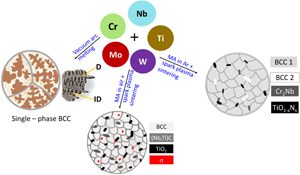
Strengthening mechanisms in CrMoNbTiW refractory high entropy alloy.
Materials Science and Engineering: A,
Vol. 819,
Issue. ,
p.
141503.
Kumar, Ashwani
Jayabalan, Bhagyaraj
Singh, Chetan
Jain, Jayant
Mukherjee, Subrata
Biswas, Krishanu
and
Singh, Sudhanshu S.
2022.
Processing and properties of yttria and lanthana dispersed ODS duplex stainless steels.
Materials Science and Engineering: A,
Vol. 837,
Issue. ,
p.
142746.
Shkodich, N.F.
Kuskov, K.V.
Sedegov, A.S.
Kovalev, I.D.
Panteleeva, A.V.
Vergunova, Yu.S.
Scheck, Yu.B.
Panina, E.
Stepanov, N.
Serhiienko, I.
and
Moskovskikh, D.
2022.
Refractory TaTiNb, TaTiNbZr, and TaTiNbZrX (X = Mo, W) high entropy alloys by combined use of high energy ball milling and spark plasma sintering: Structural characterization, mechanical properties, electrical resistivity, and thermal conductivity.
Journal of Alloys and Compounds,
Vol. 893,
Issue. ,
p.
162030.
Pandey, Vivek Kumar
Shadangi, Yagnesh
Shivam, Vikas
Sarma, B.N.
and
Mukhopadhyay, N.K.
2022.
Theoretical and experimental study on phase stability of TiVZrMoW refractory high entropy alloy.
Philosophical Magazine,
Vol. 102,
Issue. 6,
p.
480.
Sabban, Rushikesh
Dash, K.
Suwas, S.
and
Murty, B. S.
2022.
Strength–Ductility Synergy in High Entropy Alloys by Tuning the Thermo-Mechanical Process Parameters: A Comprehensive Review.
Journal of the Indian Institute of Science,
Vol. 102,
Issue. 1,
p.
91.
Chen, Bingqing
and
Zhuo, Longchao
2023.
Latest progress on refractory high entropy alloys: Composition, fabrication, post processing, performance, simulation and prospect.
International Journal of Refractory Metals and Hard Materials,
Vol. 110,
Issue. ,
p.
105993.
Olorundaisi, Emmanuel
Babalola, Bukola J.
Teffo, Moipone L.
Anamu, Ufoma S.
Olubambi, Peter A.
Fayomi, Juwon
and
Ogunmefun, Anthony O.
2023.
Phase prediction, microstructure, and mechanical properties of spark plasma sintered Ni–Al–Ti–Mn–Co–Fe–Cr high entropy alloys.
Discover Nano,
Vol. 18,
Issue. 1,
Ujah, Chika Oliver
Kallon, Daramy V. V.
and
Aigbodion, Victor Sunday
2024.
Corrosion characteristics of high-entropy alloys prepared by spark plasma sintering.
The International Journal of Advanced Manufacturing Technology,
Vol. 132,
Issue. 1-2,
p.
63.
Chen, Xin
Wang, Fei
Zhang, Xiang
Hu, Shanshan
Liu, Xingbo
Humphry-Baker, Samuel
Gao, Michael C.
He, Lingfeng
Lu, Yongfeng
and
Cui, Bai
2024.
Novel refractory high-entropy metal-ceramic composites with superior mechanical properties.
International Journal of Refractory Metals and Hard Materials,
Vol. 119,
Issue. ,
p.
106524.
Li, Wenjie
Raman, Lavanya
Debnath, Arindam
Ahn, Marcia
Lin, Shuang
Krajewski, Adam M.
Shang, Shunli
Priya, Shashank
Reinhart, Wesley F.
Liu, Zi-Kui
and
Beese, Allison M.
2024.
Design and validation of refractory alloys using machine learning, CALPHAD, and experiments.
International Journal of Refractory Metals and Hard Materials,
Vol. 121,
Issue. ,
p.
106673.
Martin, P.
Aguilar, C.
and
Cabrera, J.M.
2024.
A review on mechanical alloying and spark plasma sintering of refractory high-entropy alloys: Challenges, microstructures, and mechanical behavior.
Journal of Materials Research and Technology,
Vol. 30,
Issue. ,
p.
1900.
Gao, Shengqing
Li, Xiaoqiang
Pan, Cunliang
Fan, Jiafeng
Jiang, Qi
Yang, Chao
and
Qu, Shengguan
2024.
Effect of Ti content on microstructure and mechanical properties of TaMoNbCrTix refractory high-entropy alloy.
Materials Science and Engineering: A,
Vol. 898,
Issue. ,
p.
146394.
Das, I.M.
Kumar, H.
Behera, K.K.
Makineni, S.
Bakshi, S.R.
Mandal, A.
and
Gollapudi, S.
2025.
Microstructure and indentation of a (MoNbTaVW)C system processed by high energy ball milling followed by spark plasma sintering at 1800 °C.
Materials Characterization,
Vol. 225,
Issue. ,
p.
115124.
Hu, Yifei
Xu, Ang
Liu, Jilong
Wang, Ruoqi
and
Suo, Jinping
2025.
Enhancing the strength and toughness of WTaTiVN+Taμm heterogeneous alloys via nano Ti–V–N precipitation phase adjustment.
Journal of Materials Research and Technology,
Vol. 35,
Issue. ,
p.
2934.
Das, I.M.
Kumar, H.
Nagini, M.
Malladi, S.K.
Makineni, S.
Rajulapati, K.V.
Mandal, A.
and
Gollapudi, S.
2025.
Microstructure and mechanical properties of an aluminium composite with carbon-containing medium entropy alloy MoNbWTa0.5C0.5 reinforcement.
Intermetallics,
Vol. 182,
Issue. ,
p.
108776.
Olorundaisi, Emmanuel
and
Olubambi, Peter A.
2025.
The prospect and limitation of high entropy alloy as 4th industrial material.
Materials Today Sustainability,
Vol. 31,
Issue. ,
p.
101163.
Raman, Lavanya
Anupam, Ameey
Karthick, G.
Berndt, Christopher C.
Ang, Andrew Siao Ming
Narayana Murty, S․ V․ S․
Fabijanic, Daniel
Murty, B․ S․
and
Kottada, Ravi Sankar
2025.
High temperature deformation behavior and microstructural evolution of an ultrafine-grained and multiphase CrMoNbTiW refractory high entropy alloy.
Acta Materialia,
Vol. 289,
Issue. ,
p.
120841.
Vinodhkumar, Allu
Aravindan, S.
and
Rao, P.V.
2026.
Printability and characterization of CrMoNbTiW refractory high-entropy alloy by combined wire arc additive manufacturing.
Materials Letters,
Vol. 424,
Issue. ,
p.
141533.
Sakkaki, Milad
Pouyafar, Vahid
Meshkabadi, Ramin
and
Shahedi Asl, Mehdi
2026.
Fabrication, application, and phase formation rules in high-entropy alloys.
Journal of Materials Science,
Vol. 61,
Issue. 27,
p.
19161.