I. INTRODUCTION
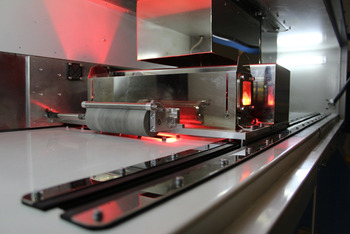
High Speed Sintering (HSS) is a novel, layer by layer, powder-based additive manufacturing (AM) process. The process retains the benefits of AM processes whilst simultaneously eliminating drawbacks such as machine cost and process speed (Fig. 1). Reference Hopkinson and Erasenthiran1,Reference Thomas, Hopkinson and Erasenthiran2
The high speed sintering machine.

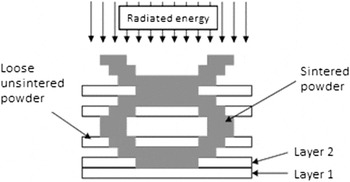
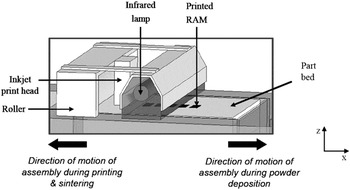
Similar to laser sintering (LS) in the powder deposition stage of the process, the powder must also be able to flow at elevated temperature effectively. This is required to produce a layer of powder with uniform thickness, typically 100 µm. Despite requiring similar powder flow properties, the mechanism by which sintering is initiated is markedly different. Rather than using a laser to scan a cross-sectional area, HSS uses an InkJet printer (Huntingdon, Cambridgeshire, UK) which deposits radiation absorbing material (RAM) on the surface of the powder which is followed by irradiation of the entire build surface by an infrared (IR) lamp. Figure 2 depicts this schematically and also shows how the HSS process is a self-supporting manufacturing technique with the unsintered powder acting as a support structure.
The HSS process (reproduced with permission) Reference Hopkinson, Hague and Dickens3 .

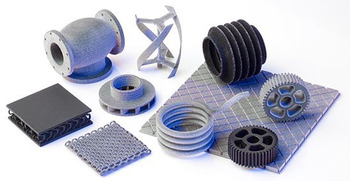
The area on the powder surface printed with RAM absorbs IR significantly more than areas without, this absorption of energy is sufficient to elevate the temperature of the underlying powder to its melting point and allow sintering to occur. Therefore, to prevent sintering of the entire build bed there must be a significant difference in IR absorption between the RAM and the powder. Examples of HSS parts are shown in Fig. 3.
Parts built by HSS.

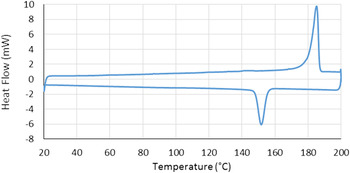
Once sintering has taken place it is imperative that the polymer does not cool down below its crystallization temperature as this will cause the polymer to solidify, induce thermal stresses and warp causing the build to fail. Therefore, it is preferable for the polymer to possess supercooling behavior, that is, the crystallization temperature is preferably lower than that of the melting temperature. Reference Gogolewski, Czerntawska and Gastorek4 This behavior can be identified by differential scanning calorimetry (DSC). This is a thermoanalytical technique designed to measure the heat flow to and from a sample as it is gradually heated across a broad range of temperatures thus identifying phase changes. Reference Kong and Hay5 Figure 4 shows an example DSC curve identifying the melting temperature of ∼185 °C and the crystallization temperature of ∼150 °C.
DSC trace of DuraForm® HST10.

The gap between these two temperatures has been identified by Vasquez et al. as the super cooling process window. Reference Vasquez, Haworth and Hopkinson6 The process of powder deposition, RAM printing and sintering is then repeated until the build is complete and any unsintered powder is removed. A key advantage of HSS is build speed, by using an InkJet printhead and an IR lamp rather than a laser, a large cross-sectional area may be sintered in one swathe. This also dictates that time per layer remains constant, regardless of the size and shape of the two-dimensional (2D) cross section in each layer. This advantage will have further benefits when using HSS as a manufacturing technology. It also provides the ability to scale the process up by simply using an array of printheads and IR lamps. Reference Majewski, Oduye, Thomas and Hopkinson7
II. PROBLEM DEFINITION
As HSS is a novel technology itself, little material development has been performed compared with more established powder-based AM technologies such as LS. Thus, material identification and processability for HSS remain an area requiring investigation. Due to similar powder flow and thermal properties of LS and HSS, it is a logical step to high speed sinter materials which have been shown to be successful for LS. This ensures that the powder feedstock is both super cooling and able to flow at elevated temperatures, as such, it would be expected that a material processable by LS would also be processable by HSS. Reference Tiwari and Pande8,Reference Shi, Li, Sun, Huang and Zeng9 Therefore, the purpose of this research is to establish if indeed this is the case and to compare mechanical properties of HSS parts with that of LS.
As Nylon-12 occupies a large percentage of the total polymer sintering market this was a sensible material with which to begin; to span a broad range of material properties two alternate forms of Nylon, namely a filled Nylon, DuraForm® HST10 by 3D Systems and an elastomeric form of Nylon, TPE 210-S by ALM, were identified. Both of these powders are commercially available as LS grade materials and present the opportunity to manufacture tensile test specimens by HSS with various properties. TPE 210-S is a commercial thermoplastic elastomer with low modulus and high yield strain widely processed by injection molding and used in automotive and household appliances industry. TPE 210-S parts are widely used in automotive applications to produce both exterior and interior parts. These also include automotive applications such as front-wheel drive components and air ducts. Reference Harper10 TPEs also have a growing interest from the consumer industry, namely footwear industry to produce customized footwear and sneaker soles. Reference Wohlers11 DuraForm® HST10 is a polymer composite powder possessing high specific stiffness, elevated temperature resistance, and anisotropic mechanical properties. HST is an acronym for ‘high strength and temperature’.
III. EXPERIMENTAL WORK
A. HSS machine setup
The HSS process may be broken down into a number of distinct steps required for each build. The first is the production of the CAD model which may be produced using standard CAD software. The CAD model is then digitally sliced into 2D cross sections and outputted as bitmap images where each image represents one layer. The powder and the machine itself must also be prepared; the machine contains two beds, build and feed. The process operates by transferring powder from the feed bed to the build bed. The feed bed is raised above the machine surface and the build bed lowered by the same amount. A roller travels across the machine surface to transfer the powder from the feed bed and deposits on the build bed. Thus, the feed bed must be filled with powder; the build bed is also charged with approximately 10 mm depth of powder to prevent powder being deposited on to the metal surface. Both beds are heated from underneath and all sides by a heating jacket; the surface of the powder is heated by overhead heaters. The temperature of the build bed is maintained just below the melt temperature of the powder, to preserve the powder in the feed bed this is maintained at a lower temperature. It is necessary to heat the powder in the feed bed to prevent cold powder being deposited onto the hot surface of the build bed. Once the powder has been allowed to reach the desired temperature the build may begin. The first operation is to deposit a layer of powder, the carriage travels from one side of the machine to the other to transfer powder from the build bed to the feed bed. The carriage then travels in the opposite direction deposits RAM, sinters the deposited area, and returns to its starting position (Fig. 5).
Schematic of the current HSS setup (reproduced with permission Reference Majewski, Hobbs and Hopkinson12 ).

The process of depositing powder in one direction and printing and sintering in the other is then repeated until the build is complete. The parts are left to cool and removed from the powder cake using compressed air and glass media.
B. Machine parameters
Both LS and HSS are capable of tailoring build parameters to improve mechanical properties. Various studies have shown increasing the laser power improved the mechanical properties of a laser sintered part (e.g., ultimate tensile strength and elongation at break). Reference Gibson and Shi13–Reference Zarringhalam, Hopkinson, Kamperman and De Vlieger15 In parallel to this, it has also been shown that IR lamp power and bed temperature also strongly influence mechanical properties of high speed sintered parts. Reference Majewski, Hobbs and Hopkinson12 Within the current HSS setup, parameters of particular interest are build and feed overhead and jacket temperatures, the preheat stroke speed and lamp power, the sintering stroke speed and lamp power and the gray scale value. The build bed temperature is the temperature of the jacket enveloping the build volume, the build overhead is used to keep powder on the surface just below its melting point prior to sintering. DSC analysis is used to determine the melting and recrystallization temperature of the polymer. This provides valuable information as it is crucial the build bed temperature is maintained between the recrystallization and melting temperature. The build bed must remain above the recrystallization to prevent rapid cooling and part curling and close enough to the melt temperature so that melting may be achieved. The feed bed jacket and overhead are used so that cold powder is not deposited on to the warm build bed causing rapid cooling and warping of the part underneath. It is crucial that when a new layer of powder is deposited it does not cool the layer underneath and cause the part to curl. The preheat stroke is to impart energy in to the freshly deposited layer for the same reason. The sintering stroke is to cause the areas deposited with ink to sinter. In both cases, the lamp power and speed can be adjusted to fine tune the amount of energy the build surface receives from the IR lamp.
The grayscale value is a number within the range of 0–255, where 0 represents a fully dense black print and 255 represents white, in this case 142 and 170 represent depositing half and one third of the RAM compared with a fully black print. Table I displays the HSS machine parameters used to manufacture tensile test specimens for each material.
HSS build parameters for each chosen material.

C. Tensile test specimens and mechanical testing
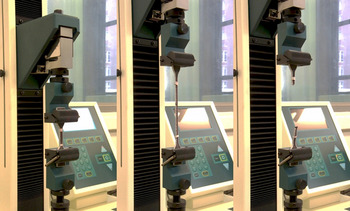
At least 6 type IV ASTM standard tensile test specimens were fabricated on the HSS machine using each material. Tensile tests were carried out according to ASTM D638-96 Standard Test Method for Tensile Properties of Plastics using a Tinius Olsen H5K-S universal testing machine (Surrey, UK) equipped with model 500LC extensometer and HT36 grip under ambient conditions operating at 5 mm extension per minute for DuraForm® PA and DuraForm® HST and 20 mm per minute for ALM TPE 210-S. 16 This is shown in Fig. 6. The tensile test data reported for LS were sourced from the manufacturer's specification sheet.
TPE 210-S under mechanical testing.

IV. RESULTS AND DISCUSSION
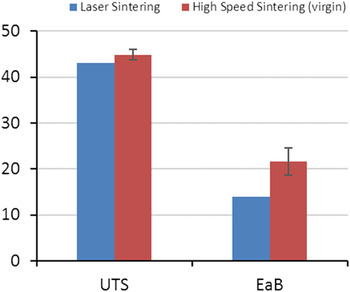
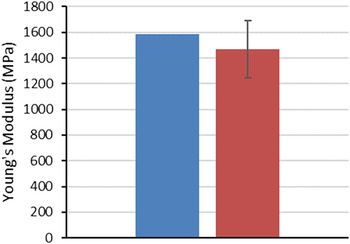
Figures 7 and 8 show mechanical properties for tensile test specimens manufactured by HSS using the parameters in Table I.
Ultimate tensile strength and elongation at break for DuraForm® PA.

Young's modulus for DuraForm® PA tensile test specimens.

As shown in Fig. 7, HSS has an ultimate tensile strength of 44.9 MPa compared with 43 MPa for LS. Regarding elongation at break, laser sintered DuraForm® PA has a value of 14%, whereas HSS has an increased value of 21.7%. Previous work has shown that degree of particle melt (DPM) affects mechanical properties in laser sintered parts, with a higher DPM yielding increased elongation at break and tensile strength but much less of an effect on Young's modulus. Reference Majewski, Zarringhalam and Hopkinson17 The DPM itself is dictated by the amount of energy the adjacent particles are able to absorb. Reference Majewski, Zarringhalam and Hopkinson18,Reference Moeskops, Kamperman and van de Vorst19 As the differing sintering mechanism of HSS and LS dictates a significant difference in the amount of time, particles are exposed to the heat source, sintering time and kinetics are an important consideration. Haworth et al. have shown that for polyamide Nylon-12, the sintering time increases with the percentage of used powder in the mixture. Virgin powder possesses a sintering time of approximately 1 s, with time gradually increasing to approximately 8 s for 100% recycled powder. Reference Haworth, Hopkinson, Hitt and Zhong20 This is a direct reflection of the increased molecular weight of recycled powder which directly affects viscosity and therefore sintering time according to the Frenkel equation. Reference Frenkel21 In LS, the time a polymer particle is exposed to the laser is typically around 66 microseconds, whereas for HSS the time is approximately 1 s. Reference Vasquez22 Thus, in HSS, adjacent particles are exposed to heat for a much greater portion of the sintering time. It is thought that this increased percentage exposure over the course of the sintering time gives rise to superior properties.
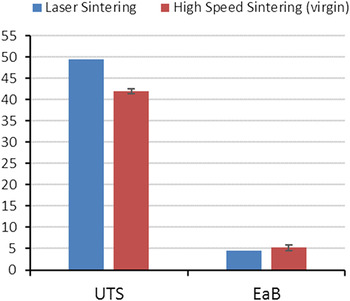
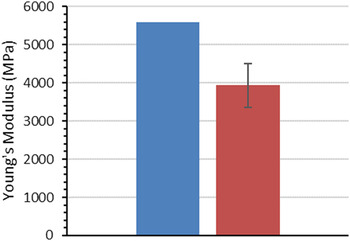
The mechanical properties of the first of the previously untested powders, DuraForm® HST10, are presented in Figs. 9 and 10.
Ultimate tensile strength and elongation at break for DuraForm® HST.

Young's modulus for DuraForm® HST10.

HSS showed tensile strength of 41.6 MPa compared with 49 MPa for LS. These values are all above that of DuraForm® PA as expected due to the nature of the material. In this case, HSS is not able to achieve values beyond that of LS. For HSS, elongation at break is comparable with LS, with a value 4.9%. High speed sintered tensile test specimens showed Young's modulus of 3933 MPa compared with 5600 MPa for LS. For this material, there is a difference in mechanical properties between HSS and LS, it is possible that the nature of the material affects the sintering process. The filled material may affect the melt behavior and give rise to different sintering mechanics and thus influence mechanical properties of the parts.
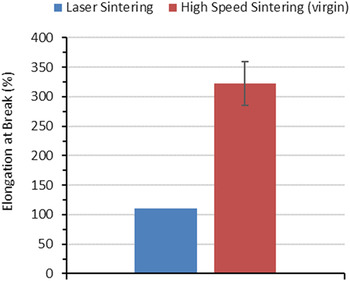
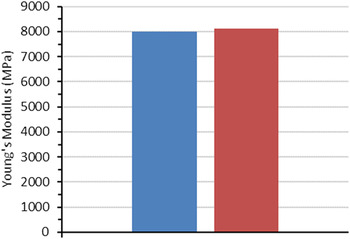
To investigate the potential of HSS to process an elastomeric material, TPE 210-S was chosen. Figures 11 and 12 show the mechanical properties, as this is an elastomeric ultimate tensile strength is not reported.
Elongation at break for TPE 210-S.

Young's modulus for TPE 210-S.

Figure 11 shows the largest disparity between LS and HSS mechanical properties observed thus far. LS of TPE 210-S gives an elongation at break of 110% whereas HSS gives 265%. It is speculated that this profound difference is caused by the nature of the HSS sintering mechanism. Sintering time of adjacent particles increases with viscosity, as such, HSS is able to provide a sintering mechanism more conducive to viscous materials. It is possible in this case that HSS is able to impart a higher DPM than LS. This is due to the higher proportion of time the particles are exposed to the heat source throughout the sintering process. This represents a significant advantage of HSS for viscous materials, the lamp speed can be controlled to ensure that adjacent particles are exposed to heat for the entire sintering time rather than a fraction of it. It should also be noted that the data obtained for Young's modulus were consistent to the point at which error bars become almost impossible to discern, in this case HSS shows similar stiffness to LS.
V. SUMMARY AND CONCLUSIONS
The evidence presented above combined with the similar powder requirements indicates that HSS is capable of successfully processing LS grade polymeric powders. It is predicted that, due to the differences in the sintering mechanics, HSS may in fact be capable of processing powders which LS is not. To further improve the mechanical properties of HSS parts, the efficiency of the heat transfer between the RAM and the IR lamp must be enhanced. This may be increased by tuning the absorption spectrum of the RAM and the emission spectrum, greater overlap of these spectra would allow a more efficient energy transfer and lead to better improved performance. The difference in heat exposure time allowed HSS to produce elongation at break of more than double that of LS for an elastomeric material. This is a significant result and represents a real step forward for the processing of elastomers, combined with the scalability of HSS this may offer a substantial opportunity for high volume production of elastomeric parts. Further work into other elastomers would further clarify the increased elongation at break, though it is anticipated that this increase would not occur for only the material reported here but also for other elastomeric materials.