




No CrossRef data available.
Article contents
Quantitative microstructure analysis for solid-state metal additive manufacturing via deep learning
Published online by Cambridge University Press: 24 June 2020
Abstract
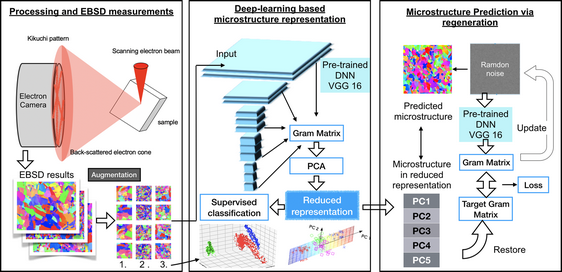
Metal additive manufacturing (AM) provides a platform for microstructure optimization via process control, but establishing a quantitative processing-microstructure linkage necessitates an efficient scheme for microstructure representation and regeneration. Here, we present a deep learning framework to quantitatively analyze the microstructural variations of metals fabricated by AM under different processing conditions. The principal microstructural descriptors are extracted directly from the electron backscatter diffraction patterns, enabling a quantitative measure of the microstructure differences in a reduced representation domain. We also demonstrate the capability of predicting new microstructures within the representation domain using a regeneration neural network, from which we are able to explore the physical insights into the implicitly expressed microstructure descriptors by mapping the regenerated microstructures as a function of principal component values. We validate the effectiveness of the framework using samples fabricated by a solid-state AM technology, additive friction stir deposition, which typically results in equiaxed microstructures.
Information
- Type
- Article
- Information
- Journal of Materials Research , Volume 35 , Issue 15: Focus Issue: Additive Manufacturing of Metals: Complex Microstructures and Architecture Design , 14 August 2020, pp. 1936 - 1948
- Copyright
- Copyright © Materials Research Society 2020
References
Gibson, I., Rosen, D.W., and Stucker, B.: Additive Manufacturing Technologies : 3D Printing, Rapid Prototyping and Direct Digital Manufacturing, 2nd ed. (Springer, New York; London, 2015).CrossRefGoogle Scholar
Hehr, A. and Norfolk, M.: A comprehensive review of ultrasonic additive manufacturing. Rapid Protyp. J. 26(3), 445–458 (2019).CrossRefGoogle Scholar
Griffiths, R.J., Perry, M.E., Sietins, J.M., Zhu, Y., Hardwick, N., Cox, C.D., Rauch, H.A., and Hang, Z.Y.: A perspective on solid-state additive manufacturing of aluminum matrix composites using MELD. J. Mater. Eng. Perform. 28, 648–656 (2019).CrossRefGoogle Scholar
Yu, H.Z., Jones, M.E., Brady, G.W., Griffiths, R.J., Garcia, D., Rauch, H.A., Cox, C.D., and Hardwick, N.: Non-beam-based metal additive manufacturing enabled by additive friction stir deposition. Scr. Mater. 153, 122–130 (2018).CrossRefGoogle Scholar
Yadollahi, A. and Shamsaei, N.: Additive manufacturing of fatigue resistant materials: Challenges and opportunities. Int. J. Fatigue 98, 14–31 (2017).CrossRefGoogle Scholar
Wang, Z., Palmer, T.A., and Beese, A.M.: Effect of processing parameters on microstructure and tensile properties of austenitic stainless steel 304L made by directed energy deposition additive manufacturing. Acta Mater. 110, 226–235 (2016).CrossRefGoogle Scholar
Frazier, W.E.: Metal additive manufacturing: A review. J. Mater. Eng. Perform. 23, 1917–1928 (2014).CrossRefGoogle Scholar
Schwartz, A.J., Kumar, M., Adams, B.L., and Field, D.P.: Electron Backscatter Diffraction in Materials Science (Springer, Boston, MA, 2000).CrossRefGoogle Scholar
Humphreys, F.: Characterisation of fine-scale microstructures by electron backscatter diffraction (EBSD). Scr. Mater. 51, 771–776 (2004).CrossRefGoogle Scholar
Maitland, T. and Sitzman, S.: Electron Backscatter Diffraction (EBSD) Technique and Materials Characterization Examples (Springer, Berlin, 2007).Google Scholar
Mason, J. and Schuh, C.: The generalized Mackenzie distribution: Disorientation angle distributions for arbitrary textures. Acta Mater. 57, 4186–4197 (2009).CrossRefGoogle Scholar
Mason, J. and Schuh, C.: Hyperspherical harmonics for the representation of crystallographic texture. Acta Mater. 56, 6141–6155 (2008).CrossRefGoogle Scholar
Johnson, O.K., Lund, J.M., and Critchfield, T.R.: Spectral graph theory for characterization and homogenization of grain boundary networks. Acta Mater. 146, 42–54 (2018).CrossRefGoogle Scholar
Fullwood, D.T., Niezgoda, S.R., Adams, B.L., and Kalidindi, S.R.: Microstructure sensitive design for performance optimization. Prog. Mater. Sci. 55, 477–562 (2010).CrossRefGoogle Scholar
Patala, S.: Understanding grain boundaries – The role of crystallography, structural descriptors and machine learning. Comput. Mater. Sci. 162, 281–294 (2019).CrossRefGoogle Scholar
Mason, J.K. and Patala, S.: Basis functions on the grain boundary space: Theory. arXiv preprint arXiv:1909.11838 (2019).Google Scholar
Guo, T., Lohan, D.J., Cang, R., Ren, M.Y., and Allison, J.T.: An indirect design representation for topology optimization using variational autoencoder and style transfer. In AIAA/ASCE/AHS/ASC Structures, Structural Dynamics, and Materials. 210049 edn, American Institute of Aeronautics and Astronautics Inc, AIAA, AIAA/ASCE/AHS/ASC Structures, Structural Dynamics, and Materials Conference, 2018, Kissimmee, United States, 1/8/18.Google Scholar
Chen, Y., Jiang, H., Li, C., Jia, X., and Ghamisi, P.: Deep feature extraction and classification of hyperspectral images based on convolutional neural networks. IEEE Trans. Geosci. Remote Sens. 54, 6232–6251 (2016).CrossRefGoogle Scholar
Lv, Y., Duan, Y., Kang, W., Li, Z., and Wang, F.-Y.: Traffic flow prediction with big data: A deep learning approach. IEEE Trans. Intell. Transp. Syst. 16, 865–873 (2014).Google Scholar
Chen, X.-W. and Lin, X.: Big data deep learning: Challenges and perspectives. IEEE Access 2, 514–525 (2014).CrossRefGoogle Scholar
LeCun, Y., Bengio, Y., and Hinton, G.: Deep learning. Nature 521, 436 (2015).CrossRefGoogle ScholarPubMed
Krizhevsky, A., Sutskever, I., and Hinton, G.E.: Imagenet classification with deep convolutional neural networks. Adv. Neural Inform. Process. Syst. 1, 1097–1105 (2012).Google Scholar
He, K., Zhang, X., Ren, S., and Sun, J.: Deep residual learning for image recognition. In 2016 IEEE Conference on Computer Vision and Pattern Recognition (CVPR), (Las Vegas, NV, 2016); pp. 770–778.CrossRefGoogle Scholar
Szegedy, C., Liu, W., Jia, Y., Sermanet, P., Reed, S., Anguelov, D., Erhan, D., Vanhoucke, V., and Rabinovich, A.: Going deeper with convolutions. In 2015 IEEE Conference on Computer Vision and Pattern Recognition (CVPR), (Boston, MA, 2015); pp. 1–9.Google Scholar
Long, J., Shelhamer, E., and Darrell, T.: Fully convolutional networks for semantic segmentation. In 2015 IEEE Conference on Computer Vision and Pattern Recognition (CVPR), (Boston, MA, 2015); pp. 3431–3440.CrossRefGoogle Scholar
Liu, W., Anguelov, D., Erhan, D., Szegedy, C., Reed, S., Fu, C.-Y., and Berg, A.C.: SSD: Single Shot Multibox Detector. In Computer Vision – ECCV 2016. ECCV 2016. Lecture Notes in Computer Science, vol 9905, Leibe, B., Matas, J., Sebe, N., and Welling, M., eds. (Springer, Cham, 2016); pp. 21–37.CrossRefGoogle Scholar
Ren, S., He, K., Girshick, R., and Sun, J.: Faster R-CNN: Towards real-time object detection with region proposal networks. In IEEE Transactions on Pattern Analysis and Machine Intelligence, (vol. 39, no. 6, 2017) pp. 1137–1149.Google Scholar
Redmon, J., Divvala, S., Girshick, R., and Farhadi, A.: You only look once: Unified, real-time object detection. In 2016 IEEE Conference on Computer Vision and Pattern Recognition (CVPR), (Las Vegas, NV, 2016); pp. 779–788.CrossRefGoogle Scholar
He, K., Gkioxari, G., Dollár, P., and Girshick, R.: Mask R-CNN. In 2017 IEEE International Conference on Computer Vision (ICCV), (Venice, 2017); pp. 2980–2988.CrossRefGoogle Scholar
Azimi, S.M., Britz, D., Engstler, M., Fritz, M., and Mücklich, F.: Advanced steel microstructural classification by deep learning methods. Sci. Rep. 8, 2128 (2018).CrossRefGoogle ScholarPubMed
Chowdhury, A., Kautz, E., Yener, B., and Lewis, D.: Image driven machine learning methods for microstructure recognition. Comput. Mat. Sci. 123, 176–187 (2016).CrossRefGoogle Scholar
Kitahara, A.R. and Holm, E.A.: Microstructure cluster analysis with transfer learning and unsupervised learning. Integr. Mater. Manuf. Innov. 7, 148–156 (2018).CrossRefGoogle Scholar
Gao, Q. and Roth, S.: Texture synthesis: From convolutional RBMs to efficient deterministic algorithms. In Structural, Syntactic, and Statistical Pattern Recognition. S+SSPR 2014. Lecture Notes in Computer Science, vol 8621, Fränti, P., Brown, G., Loog, M., Escolano, F., and Pelillo, M., eds. (Springer, Berlin, Heidelberg, 2014); pp. 434–443.Google Scholar
Gatys, L., Ecker, A.S., and Bethge, M.: Texture synthesis using convolutional neural networks. Adv. Neural Inf. Process. Syst. 1, 262–270 (2015).Google Scholar
Cang, R., Xu, Y., Chen, S., Liu, Y., Jiao, Y., and Yi Ren, M.: Microstructure representation and reconstruction of heterogeneous materials via deep belief network for computational material design. J. Mech. Des. 139(7), 071404 (2017).CrossRefGoogle Scholar
Liu, R., Kumar, A., Chen, Z., Agrawal, A., Sundararaghavan, V., and Choudhary, A.: A predictive machine learning approach for microstructure optimization and materials design. Sci. Rep. 5, 11551 (2015).CrossRefGoogle ScholarPubMed
Li, X., Zhang, Y., Zhao, H., Burkhart, C., Brinson, L.C., and Chen, W.: A transfer learning approach for microstructure reconstruction and structure-property predictions. Sci. Rep. 8, 13461 (2018).CrossRefGoogle ScholarPubMed
Liu, R., Agrawal, A., Liao, W.-K., Choudhary, A., and De Graef, M.: Materials discovery: Understanding polycrystals from large-scale electron patterns. In 2016 IEEE International Conference on Big Data (Big Data), (Washington, DC, 2016); pp. 2261–2269.CrossRefGoogle Scholar
Kaufmann, K., Zhu, C., Rosengarten, A.S., Maryanovsky, D., Harrington, T.J., Marin, E., and Vecchio, K.S.: Paradigm shift in electron-based crystallography via machine learning. arXiv preprint arXiv:1902.03682 (2019).Google Scholar
Jha, D., Singh, S., Al-Bahrani, R., Liao, W.-K., Choudhary, A., De Graef, M., and Agrawal, A.: Extracting grain orientations from EBSD patterns of polycrystalline materials using convolutional neural networks. Microsc. Microanal. 24, 497–502 (2018).CrossRefGoogle ScholarPubMed
Karras, T., Laine, S., and Aila, T.: A style-based generator architecture for generative adversarial networks. In 2019 IEEE/CVF Conference on Computer Vision and Pattern Recognition (CVPR), (Long Beach, CA, USA, 2019); pp. 4396–4405.CrossRefGoogle Scholar
Kirillov, A., Wu, Y., He, K., and Girshick, R.: PointRend: Image segmentation as rendering. arXiv preprint arXiv:1912.08193 (2019).CrossRefGoogle Scholar
Lubbers, N., Lookman, T., and Barros, K.: Inferring low-dimensional microstructure representations using convolutional neural networks. Phys. Rev. E 96, 052111 (2017).CrossRefGoogle ScholarPubMed
Simonyan, K. and Zisserman, A.: Very deep convolutional networks for large-scale image recognition. arXiv preprint arXiv:1409.1556 (2014).Google Scholar
Deng, J., Dong, W., Socher, R., Li, L.-J., Li, K., and Fei-Fei, L.: Imagenet: A large-scale hierarchical image database. In 2009 IEEE Conference on Computer Vision and Pattern Recognition, (Miami, FL, 2009); pp. 248–255.CrossRefGoogle Scholar
Mesnil, G., Dauphin, Y., Glorot, X., Rifai, S., Bengio, Y., Goodfellow, I., Lavoie, E., Muller, X., Desjardins, G., and Warde-Farley, D.: Using Recurrent Neural Networks for Slot Filling in Spoken Language Understanding. In IEEE/ACM Transactions on Audio, Speech, and Language Processing, (vol. 23, no. 3, 2015) pp. 530–539.Google Scholar
Chi, J., Walia, E., Babyn, P., Wang, J., Groot, G., and Eramian, M.: Thyroid nodule classification in ultrasound images by fine-tuning deep convolutional neural network. J. Digit. Imaging 30, 477–486 (2017).CrossRefGoogle ScholarPubMed
Abadi, M., Barham, P., Chen, J., Chen, Z., Davis, A., Dean, J., Devin, M., Ghemawat, S., Irving, G., and Isard, M.: Tensorflow: A system for large-scale machine learning. In 12th {USENIX} Symposium on Operating Systems Design and Implementation ({OSDI} 16), (Savannah, GA, USA, 2016); pp. 265–283.Google Scholar
Pedregosa, F., Varoquaux, G., Gramfort, A., Michel, V., Thirion, B., Grisel, O., Blondel, M., Prettenhofer, P., Weiss, R., and Dubourg, V.: Scikit-learn: Machine learning in Python. J. Mach. Learn. Res. 12, 2825–2830 (2011).Google Scholar
Griffiths, R.J., Garcia, D., Song, J., Vasudevan, V.K., Steiner, M.A., Cai, W., and Yu, H.Z.: Solid-state additive manufacturing of aluminum and copper via additive friction stir deposition: Process-microstructure linkages. (Materialia, 2020). (under review).Google Scholar
Cortes, C. and Vapnik, V.: Support-vector networks. Mach. Learn. 20, 273–297 (1995).CrossRefGoogle Scholar
Suykens, J.A. and Vandewalle, J.: Least squares support vector machine classifiers. Neural Process. Lett. 9, 293–300 (1999).CrossRefGoogle Scholar
Chambolle, A.: An algorithm for total variation minimization and applications. J. Math. Imaging Vis. 20, 89–97 (2004).Google Scholar
Byrd, R.H., Lu, P., Nocedal, J., and Zhu, C.: A limited memory algorithm for bound constrained optimization. SIAM J. Sci. Comput. 16, 1190–1208 (1995).CrossRefGoogle Scholar
Melcher, A., Unser, A., Reichhardt, M., Nestler, B., Pötschke, M., and Selzer, M.: Conversion of EBSD data by a quaternion based algorithm to be used for grain structure simulations. Tech. Mech. 30, 401–413 (2010).Google Scholar
Beausir, B. and Fundenberger, J.: Analysis tools for electron and X-ray diffraction. ATEX software (2017). Available at: www.atex-software.eu (accessed May 22–June 12, 2019).Google Scholar
- 42
- Cited by