INTRODUCTION
Real independence with a harmonious development of all the potentialities is not achieved once and for all, by magic formulas. It is an always unstable equilibrium … a task that is never completed. (Léopold Senghor Reference Senghor1964: 6)
History is not an accumulation or a juxtaposition of intentions. History consists in deeds, concrete deeds and their interrelations with one another. History is continuity of actions and deeds and the relationships between these actions and deeds. (Sékou Touré n.d. a: Reference Touré47)
As president of Senegal, Léopold Senghor was well placed to observe the need to constantly reconfigure international cooperation, given his role in cooperating with Sékou Touré of Guinea, Modibo Keita of Mali and Moktar Ould Daddah of Mauritania over the Senegal river. Cooperation between these countries explored the frontiers of sovereignty, including its subjugation under Pan-Africanism and its exercise during fraught intra-basin relations. They chose to cooperate to manage the challenges they faced from their colonial legacy and an unforgiving environment prone to drought (Derrick Reference Derrick1977; Mortimer Reference Mortimer1972). It remains the only international basin worldwide in which the riparians have reduced their sovereignty. The countries' willingness to forego unilateral control over water, incur national debt for works in neighbouring countries, and predicate their economic development on joint water management strategies, is encapsulated in the benefit-sharing principle (Alam et al. Reference Alam, Dione and Jeffrey2009). Despite problematic development practices, I argue that the Senegal basin experience is successful because of how the riparian states managed sovereignty at the inter-governmental level, by contrast with conventional practice in international basins: they chose to subjugate sovereignty and ‘remove’ political boundaries to build infrastructure in comparatively optimal locations.
This cooperative approach to the basin illustrates an alternative means to managing the global water crisis. Climate change, poor management and increasing demand are reducing the availability of good-quality water. With two thirds of the world's fresh water deriving from rivers shared by two or more countries (Giordano & Wolf Reference Giordano and Wolf2003), the pressure on these rivers is increasing as nations compete to stave off the socio-economic chaos associated with an uncertain supply. The Senegal river countries' experience of sharing the benefits of development has influenced other international initiatives such as the Nile Basin Initiative (NBI).Footnote 1 While it is unremarkable for countries to have conflict or for political leaders to argue, it is remarkable that they have continued to cooperate despite enmities between them. Given Africa's reputation for weak institutions, the Senegal basin organisations' ability to function despite periods of stasis remains significant.
The Senegal basin cooperation remains understudied, and given the paucity of material, I rely on Jeanjean (Reference Jeanjean2004), LeMarquand (Reference LeMarquand1982) and Maïga (Reference Maïga1995) for the cooperation between riparian states, and use the Pan-Africanism literature from the 1950s and 1960s rather than the later critiques to understand the attitudes prevailing after independence. I also draw on my experience of working on the Senegal basin with the United Nations (UN) and the World Bank. In seeking to explain why intra-basin cooperation was so intense, I note the conventional management practices for international rivers, and examine the history of the Senegal basin, leading to the Organisation pour la mise en valeur le fleuve Sénégal (OMVS), also known as l'espace OMVS, detailing intra-basin tensions and cooperation. I put forward three issues the coalescence of which, I contend, explains the level of cooperation: the Pan-African principle, francophonie, and leaders' attitudes.
HOARDING SOVEREIGNTY
The lack of water in households, industrial units and fields makes clear its importance to sustaining life. A government's inability to control water can be destructive. For example, Kenya experienced severe floods and drought in quick succession, costing 11% and 16% of gross domestic product respectively (World Bank 2005). Unlike other natural resources which are static, water flows, creating a hydrological link between users in a basin. Thus, a dam upstream will affect water quality and quantity downstream. International boundaries complicate matters. Governments try to enforce their sovereignty over ‘their’ portion of a shared river, but are stymied by an ever-present hydrological interdependence. Africa's colonial legacy left its major rivers crossing several countries (with, for example, eleven riparian states sharing the Nile), and individual countries having to manage several international rivers (Guinea shares fourteen international rivers). Interestingly, the 1884–5 Berlin Conference on Africa did not characterise the Senegal as an international river because it was entirely within French jurisdiction (Alam et al. Reference Alam, Dione and Jeffrey2009).
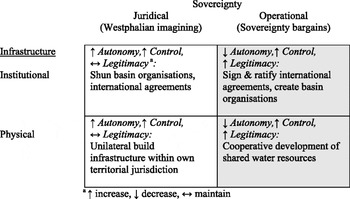
While recognising their international obligations, governments often interpret sovereignty as affording them control over, and autonomy to act vis-à-vis, the resources within their territorial jurisdiction. This Westphalian or juridical interpretation is challenged by Litfin (1997 in Alam et al. Reference Alam, Dione and Jeffrey2009), who argues that sovereignty comprises three components: autonomy, control and legitimacy. Litfin's operational interpretation views governments as trading-off reduced autonomy for greater legitimacy or control during international negotiations. Using this interpretation, Alam et al. (Reference Alam, Dione and Jeffrey2009) note an interplay between different interpretations of sovereignty and infrastructure. Thus, governments using the Westphalian interpretation will maximise autonomy to control national resources by unilaterally building physical infrastructure. Governments using an operational interpretation will trade autonomy for basin-wide control by establishing institutional infrastructure. In practice, as the shaded sections in Figure 1 show, governments use both interpretations to create regional institutions while simultaneously constructing physical infrastructure nationally. A consequence of this double interpretation is ineffectual basin organisations such as the Lake Chad Basin Commission (LCBC) and the Gambia river organisation (OMVG), which are powerless to contain national water plans. As Gould & Zobrist (Reference Gould and Zobrist1989: 1718) point out with regard to another long-established West African basin organisation, the Niger Basin Authority, ‘the national governments act independently of the NBA, although superficial political support is given to the concept of regional planning’. Thus, as the regional hegemon, Nigeria has unilaterally built dams while circumventing a basin-wide development plan.
Conventional practice in international basins

Similar attitudes prevail even between countries with good relations. For example, despite cooperating within the European Union, the Water Framework Directive (WFD) and bilateral water treaties, Spain and Portugal manage their five shared rivers unilaterally. The competitive nature of Iberian water management is illustrated by the number of dams on the Guadiana river – up to ninety-eight existing dams, with Spain and Portugal each planning another twenty-five (see Alam et al. Reference Alam, Dione and Jeffrey2011). Thus, Spain and Portugal's double interpretation vis-à-vis infrastructure mirrors Figure 1. On the Columbia river, the USA and Canada also configure their interpretation of sovereignty in accordance with Figure 1, albeit with a twist. Under the 1961 Columbia River Treaty, Canada can build dams to regulate flow upstream and the USA can build dams to generate hydropower downstream. Unusually, the USA agreed to share the electricity generated with Canada, as well as make a one-off payment towards the cost of the dams in return for greater flood control (Giordano & Wolf Reference Giordano and Wolf2003). Though the countries implement a form of benefit-sharing (Alam et al. Reference Alam, Dione and Jeffrey2009), they do so without subjugating their sovereignty.
The Senegal riparians chose to handle their sovereignty in a starkly different fashion. By using an operational interpretation vis-à-vis their institutional and physical infrastructure, they actively subjugated national sovereignty for basin-wide control. The shaded sections in Figure 2 illustrate their choice. As a consequence, they embraced the hydro-interdependency created by the river, and by extension their own integration, rather than attempting to sever it as Spain and Portugal sought to do (Alam et al. Reference Alam, Dione and Jeffrey2011). The Senegal riparians have thus instituted a paradigm shift in international basin management by allocating the outputs of joint development rather than the water. In this article, I ask why the countries chose this path, given the propensity in international basins for unilateral control over a key resource.
Managing hydro-interdependency in the Senegal basin

CREATING L'ESPACE OMVS
Unity?
The Senegal basin story is one in which Touré, Keita, Ould Daddah and Senghor cooperated despite their on-going conflicts and tensions. The primary axis of conflict and cooperation lay between Touré and Senghor. Their relationship would ebb and flow for more than two decades, enacting an intensity of cooperation that would be threatened, on more than one occasion, when relations were strained. Yet the two instances of international territorial disputes were between Mali and Mauritania soon after independence,Footnote 2 and between Mauritania and Senegal in 1989.
The repercussions of President de Gaulle's 1958 referendum affected newly independent Guinea's relationships with its peers and France (Johnson Reference Johnson1970; Schmidt Reference Schmidt2009). Touré (Reference Touré1959: 603; emphasis in original) sought to cut ties to France since, ‘decolonisation does not consist merely in liberating oneself from the presence of the colonisers: it must necessarily be completed by the total liberation from the spirit of the “colonised”, that is to say, from all the evil consequences, moral, intellectual and cultural, of the colonial system’. By contrast, Mali, Mauritania and Senegal would gain independence without a similar rupture and maintained better relations with France, such that Senghor believed Africa would benefit from collaborating as equals with the former coloniser due to its stronger markets. The different attitudes to France, and to manifesting Pan-Africanism including the notion of negritude, would divide Touré and Senghor.
As the Poet-President, Senghor (Reference Senghor1959: 545; emphasis in original) believed that culture was essential to social development, stating:
Our development plan must not be solely economic: It must be social in the broadest sense of the word – political, economic, social, and cultural as well. We insist on this last word. African politicians have a tendency to neglect culture, to make it an appendage of politics. This is a mistake. These two areas, like the others, are certainly closely connected, each reacting on the other. But if one stops to reflect, culture is at once the basis and the ultimate aim of politics … Culture is also basic in the socialist connotation of the word. It is the sum of objects, ideas, symbols, beliefs, feelings, values, and social forms that are transmitted from one generation to another in a given society … Culture is the very texture of society.
Senegal and Soudan sought independence as a federation (Barry Reference Barry, Gifford and Louis1988; Segal Reference Segal1964). The Mali Federation was to have included Dahomey (Benin) and Haute Volta (Burkina Faso) (Maïga Reference Maïga1995; Sow Reference Sow2008). However, when Dahomey's Legislative Assembly refused to ratify the plans, Haute Volta withdrew as well. The Federation was created on 4 April 1959, with Senghor as Head of the Federal Assembly and Keita as President of the Federal government. Senghor (Reference Senghor1959) regarded the Federation as the first step towards a united francophone state. In December 1959, de Gaulle agreed to the Federation's request to negotiate its independence while remaining within the Communauté franco-africaine. By 4 April 1960, Senegal and the Soudan had effective independence. On 20 June 1960, the new Malian Constitution was adopted by the Federal Assembly which formally declared its independence. Though Keita and Senghor publically invited Guinea to join the Federation, Touré refused, as this would have meant entering into an association under the Communauté franco-africaine (Jeanjean Reference Jeanjean2004).
The Federation was politically fragile. In July 1959, the Soudan had wanted immediate independence and Guinea to join, whereas Senegal insisted on first consulting France. Differences in the leaders' expectations and their societies' characteristics caused further tensions. The Soudanese sought closer integration between the party and government, which the Senegalese refused (Jones Reference Jones1976). More urbanised and industrialised than Soudan, Senegal was also closely affiliated with France. It had a political tradition of pluralism and reform, whereas Soudan was ruled by a single party. Threats to Senegalese or Soudanese interests were seen as threats to Senghor and Keita's personal authority (Kurtz Reference Kurtz1970). Fearing the destruction of their political base, Senghor and Mamadou Dia enacted a bloodless coup de force on 19 August 1960 (Jones Reference Jones1976). On 20 August 1960, Senegal proclaimed its independence, and Mali followed on 22 September 1960 (Jones Reference Jones1976; Sow Reference Sow2008). The Federation's demise meant that ‘the first attempts at political and economic integration in post-war Africa had failed’ (Kurtz Reference Kurtz1970: 406). As Senghor (Reference Senghor1964: 5) was to acknowledge later, the Federation was not simple to implement:
If we were right to defend the principles of independence in 1958 at the Consultative Constitutional Committee, and to claim effective independence in 1959, we were naïve to believe that a federation was possible in 1959 between states that had been disunited in 1957. We underestimated the present strength of territorialism, of micro-nationalism in Africa. We forgot to analyse and understand the sociological differences among the territories of what used to be French West Africa, differences that the colonial administration had reinforced.
By the early 1960s, despite intra-basin tensions running high, the riparians had requested the UN's technical assistance in assessing the basin's development potential (Maïga Reference Maïga1995). In 1962, Senghor began a political rapprochement using the river which he saw as a ‘common bond’, travelling to Guinea in May, and beginning to normalise relations with Mali in June (Jeanjean Reference Jeanjean2004; LeMarquand Reference LeMarquand1982). Senghor had conceived of the riparians becoming a unified entity since 1954, to counter the break-up of the Fédération d'Afrique occidentale française (AOF) (Mortimer Reference Mortimer1972). The UN's assessment was presented in July 1962 in Guinea at Mauritania's suggestion (Maïga Reference Maïga1995). The creation of the Organisation of African Unity (OAU) in May 1963 helped to accelerate the rapprochement. Keita and Senghor cemented their renewed friendship in June 1963, symbolically meeting on the railway bridge over the Falémé river (Mytelka Reference Mytelka1974). At the meeting Senghor stated: ‘One country by itself cannot find sufficient capital and technical expertise to make for a successful enterprise. By collective effort, this river can be used in an integrative manner throughout its course. It will constitute an inexpensive means of transportation for the delivery of our products. It will be able to be used for irrigation and the supply of hydro-electricity’ (A. Touré n.d. in LeMarquand Reference LeMarquand1982: 104).
On 26 July 1963, the riparians signed the Convention relative à l'amenagement général du bassin du fleuve Sénégal, acknowledging the river's international status and establishing the Comité inter-états pour l'aménagement du fleuve Sénégal (CIE). The CIE could negotiate directly with donors, and the countries had to submit any plans affecting the river to it. Projects could only proceed if unanimous approval was given, thus handing each riparian a veto. On 7 January 1964, the Convention relative au statue du fleuve Sénégal established the river development's institutional arrangements. At the Heads of State (HoS) meeting in November 1965, the riparians sought to embed their hydro-interdependency and harmonise their economies further. A HoS meeting in 1966 envisaged extending cooperation to all of West Africa's major rivers originating in Guinea's highlands (Bornstein Reference Bornstein1972; LeMarquand Reference LeMarquand1982; Maïga Reference Maïga1995; Mytelka Reference Mytelka1974; Yansane Reference Yansane1977).
However, tensions between Senegal and Guinea resurfaced when, in November 1965, Touré accused Senghor of complicity in a plot against his government (Jeanjean Reference Jeanjean2004). On 29 January 1967, Guinea suspended its participation in the CIE (Mortimer Reference Mortimer1972). While Mali and Mauritania sought to defuse the political impasse, the CIE Secretariat continued to function. Senghor and Touré reconciled their differences, and a HoS meeting was held in November 1967 (Jeanjean Reference Jeanjean2004). The February 1968 Council of Ministers (COM) meeting agreed to establish a more ambitious organisation to underpin a grouping of West African states en route to African unity (Maïga Reference Maïga1995). On 24 March 1968, the Organisation des états riverains du fleuve Sénégal (OERS) was created with an expanded mandate necessitating unprecedented levels of cooperation and integration (Mytelka Reference Mytelka1974; Yansane Reference Yansane1977). As Keita stated, each citizen was to ‘regard themselves as citizens of the Senegal River states rather than as Malian, Guinean, Mauritanian, or Senegalese’ (Africa Research Bulletin in LeMarquand Reference LeMarquand1982: 121). Decisions would require unanimity and the OERS strategy would use equality, equity and solidarity.
On 19 November 1968, a coup d’état overthrew Keita's regime (Sow Reference Sow2008). An extraordinary COM was convened, but Mali's absence blocked any political decisions, though the Executive Secretariat continued to function (Maïga Reference Maïga1995). Poor relations between Mali and the other riparians continued throughout 1969 (Jeanjean Reference Jeanjean2004). A rapprochement was made at the January 1970 COM meeting, and Mali's new president, Moussa Traoré, attended the subsequent HoS meeting in February 1970 (Maïga Reference Maïga1995). With relationships restored, the four countries held meetings between the different ministries of each economic sector during 1970 to start the process of integration, with donors providing technical assistance.
A second political crisis erupted which was to prove fatal to basin-wide cooperation. Guinea's support of independence movements such as the Partido Africano para a independência da Guiné e Cabo Verde (PAIGC) prompted Portugal's attack on Conakry on 22 November 1970. In accusing Senegal of harbouring insurgents, a new rift opened up (Arieff Reference Arieff2009; Plave-Bennett Reference Plave-Bennett1975). Touré and Senghor would only be reconciled in March 1978, and in October 1979, Touré visited Senegal. As Maïga (Reference Maïga1995: 209–10) notes, Touré also framed his complaints in terms of the OERS:
• Face à l'ignoble agression de l'impérialisme et du colonialisme portugais contre la souveraineté du people de Guinée, les quatre États de l'OERS auraient du instantanément se considérer comme touchés directement.
• Ceux-ci continuent leurs activités criminelles sur le sol sénégalais … Dans ces conditions, l'OERS peut-elle vivre?
• En attendant la réaction des trois autres peuples intéressés par les objectifs de l'OERS, la République de Guinée constate l'incompatibilité entre sa qualité de membre de l'OERS et le refus délibère du gouvernement du Sénégal d'honorer les obligations qui découlent de la charte de cette organisation.
Guinea refused to attend OERS meetings in 1971 and 1972, preventing any decisions from being taken (Jeanjean Reference Jeanjean2004; Mytelka Reference Mytelka1974). On 23 January 1971, Senegal recalled its ambassador from Conakry, and by November 1971, it had also retreated from the OERS (Jeanjean Reference Jeanjean2004). The June 1971 COM meeting sought to preserve the OERS' technical functions until the political crisis could be resolved. Unfortunately, the impasse proved insurmountable.
OMVS
On 11 March 1972, Ould Dadda, Traoré and Senghor signed three resolutions and two conventions (Godana Reference Godana1985). The first resolution annulled the 1963 and 1964 Conventions; the second resolution annulled the countries' membership of the OERS, which thus ceased to exist; and the third resolution promised to create the OMVS through two conventions. Mauritania and Senegal ratified these Conventions on 13 October 1972, and Mali did so on 25 November 1972. Senghor reiterated that membership was open to every riparian accepting the spirit and letter of the Conventions. Significantly, Guinea did not condemn the creation of the OMVS. Learning from the OERS experience, the OMVS had a narrower mandate and a stronger decision-making process. The executive organs were strengthened, enabling the HoS to intervene if a unanimous decision could not be reached.
Amidst the political turmoil, successive Sahelian droughts between 1968 and 1984 devastated the physical and socio-political landscape (Black & Sessay Reference Black and Sessay1996; Magistro Reference Magistro1993; Parker Reference Parker1991; Robinson Reference Robinson1978). Mauritania was particularly hard hit. The 1972–4 drought reduced river levels so greatly that the Atlantic Ocean intruded 200 km upstream, and flood-plain farming was severely damaged (Derrick Reference Derrick1984). The droughts changed Mauritania's population from 80–5% nomads in the late 1960s to 17–23% by 1985 (Parker Reference Parker1991). Facing dire economic conditions due to its territorial dispute with Morocco, drought and public debt, Mauritania focused on the Senegal valley's agricultural potential to improve its finances. However, this increased tensions with Senegal, which was also struggling (Parker Reference Parker1991).
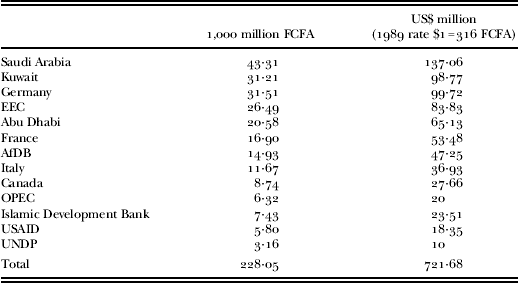
The January 1973 COM meeting initiated a development programme costing US$ 2,000 million and a search for donors (Derrick Reference Derrick1984; Plave-Bennett Reference Plave-Bennett1975). All the countries wanted hydropower; Mali also wanted navigation; and Mauritania and Senegal wanted more irrigation. Thus, the Manantali dam would generate hydropower, regulate flow, develop irrigation, reduce grain imports, and allow permanent navigation; and the Diama dam would stop saltwater intrusion and expand irrigation (LeMarquand Reference LeMarquand1982). An amendment on 13 April 1973 permitted the OMVS to receive funds directly from international sources, take out loans, and request technical assistance (Maïga Reference Maïga1995). The Malian military junta, the Military Committee for National Liberation (MCNL), believed that the riparians' differing foreign policy outlooks could drive development (Leith-Crum Reference Leith-Crum1984). Thus, Mali would ask China to build the Manantali dam, and the World Bank, European Development Fund and USAID would be approached for other projects. Financed by the donor countries (see Table 1), the Manantali and Diama dams were ‘hailed as the perfect elixir for the economic woes’ (Magistro Reference Magistro1993: 215), even though they would cost 160,000 million FCFA (US$ 506 million) and 33,000 million FCFA (US$ 104 million) respectively (Maïga Reference Maïga1995). Mauritania privatised land in the valley to the disadvantage of local farming communities (Parker Reference Parker1991). The Manantali dam became operational in 1990, but did not generate electricity until 2002 through the World Bank's 1997 Regional Hydropower project. As a condition of this project, the countries signed the Water Charter (Alam & Dione Reference Alam, Dione, Fox and Liebenthal2006; Vick 2006). Mauritania's connection to Manantali was to be via a transmission line to Dakar; however, Mauritania insisted on a direct connection (Vandermotten Reference Vandermotten2004).
A breakdown of donor contributions to the common works
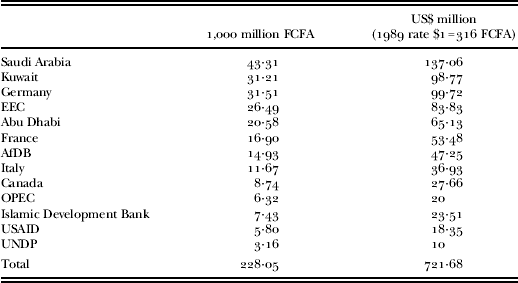
Source: After Maïga Reference Maïga1995.
The Dakar and Bamako Conventions outlined how the joint infrastructure would be managed (Godana Reference Godana1985). On 21 December 1978, in Dakar, the Convention relative au statut juridique des ouvrages communs established the common works' legal status and the countries' obligations. On 12 May 1982 in Bamako, the Convention relative aux modalités de financement des ouvrages communs specified that the works would be financed through riparian contributions, international loans contracted by the countries and given to the OMVS, donor funding, and loans taken out by the OMVS with or without guarantees by the riparians.
Acting as a single community, the countries established the Clé de repartition or burden-sharing formula, which could be reviewed by a written request to the COM. Consequently, control over the joint infrastructure was removed from each riparian's individual jurisdiction, even though they remained liable for OMVS' debts (Godana Reference Godana1985). At the 1974 COM, the countries had decided that each member would provide a 100% guarantee to any OMVS loans, resulting in a 300% guarantee (LeMarquand Reference LeMarquand1982). The OMVS had been exploring how to distribute the joint works' costs since 1975, and together with Utah State UniversityFootnote 3 derived an acceptable formula (Godana Reference Godana1985). The burden-sharing formula was devised in accordance with two principles: ‘solidarity’, which meant joint fiscal responsibility for their shared infrastructure even if the immediate outcomes did not benefit all states; and ‘equity’, which meant a share in the benefits that was congruent with each country's needs. The formula ensured that the riparians could guarantee and repay the loans according to the costs and benefits received by sector and country. Thus, though it guaranteed the loan, Mali would not repay any outstanding debt for Diama dam as it would not benefit from the expanded irrigation. The donors could conclude agreements directly with each country responsible for its share of the total loan repayment. Any OMVS debt was to be serviced by revenues generated from the infrastructure, and any shortfall would be covered by advances from the riparians which would be reimbursed when the OMVS had sufficient funds (Maïga Reference Maïga1995).
However, between 1975 and 1992, the countries' frequent economic crises led to structural adjustment programmes – Senegal in 1980, Mauritania in 1985, and Mali in 1987. Their stagnant economies meant that by 31 December 1991, the countries collectively owed the OMVS 1,096 million FCFA. Yet, this amount was only a fraction of the organisation's budget, given that its primary support for the common works was drawn from international aid (Maïga Reference Maïga1995). With the countries prioritising their national problems, the OMVS was a fragile institution that was deeply affected by the 1989 Mauritania–Senegal conflict. The restoration of relations on 23 April 1992 and the countries' use of l'espace OMVS heralded a new era.
The dispute between Mauritania and Senegal highlighted the vague location of their international border. This became a problem with the Senegal valley's population doubling between 1972 and 1988, and the influx of development funds. Both countries planned to use the valley's agricultural potential to manage their dire socio-economic situation (Vandermotten Reference Vandermotten2004). In reiterating the river's international status under the OMVS, Mauritania and Senegal had sidestepped the issue. In 1975, issues regarding some islands in the river were resolved when Senghor travelled to Mauritania. Leservoisier (1993 in Vandermotten Reference Vandermotten2004) notes that Senghor ‘avait déclaré que les limites frontalières entre les deux États, fixées au temps de la colonisation, étaient floues. Mais il ajouta que le problème était dépassé dans le cadre de l'OMVS qui stipule l'internationalisation du fleuve’. A violent conflict was sparked in April 1989, drawing on old enmities including race (Black & Sessay Reference Black and Sessay1996, Reference Black and Sessay1998; Lahtela Reference Lahtela2003; Magistro Reference Magistro1993; Parker Reference Parker1991; Pazzanita Reference Pazzanita1992; Schraeder Reference Schraeder1997). By May 1989, hundreds of thousands of refugees had either fled or been expelled from both sides. With diplomatic relations severed, trade embargoes and the militarisation of the border, both countries sought concessions. Mauritania demanded compensation for the loss of property, livestock and having its bank accounts frozen. Senegal demanded that the international border should be fixed in accordance with the 1933 colonial decree. By December 1989, both countries stood poised for war.
The attenuation of border hostilities in 1991 and 1992 began a bilateral dialogue to restore diplomatic ties (Magistro Reference Magistro1993). According to the High Commissioner, l'espace OMVS helped to normalise relations between Mauritania and Senegal by reminding the presidents that they shared valuable physical infrastructure, and continuing to function as usual, senior officials from both countries met in a neutral environment (Alam et al. Reference Alam, Dione and Jeffrey2009). As Mortimer (Reference Mortimer1972: 292) presciently noted with reference to the OERS but equally true for the OMVS, ‘a successful concrete venture, such as a hydroelectric complex or an irrigation system, would reinforce the value of the Organisation to the members'. The July 1991 agreement between Mauritania and Senegal recognised, in part, their shared interests in the jointly owned dams (Alam & Dione Reference Alam, Dione, Fox and Liebenthal2006). Mauritania's Maayouya Ould Sid’ Ahmed Taya and Senegal's Abdou Diouf issued a joint statement on 22 April 1992 in Dakar: ‘Conscients que les événements douloureux d'avril 1989 ont porté un grave préjudice aux relations fraternelles qui ont toujours existé entre les deux peoples, Désireux de rétablir le climat de confiance mutuelle fondé sur le bon voisinage, la solidarité et la coopération fraternelle entre les deux peoples, au fil des âges, par l'histoire et la géographie’ (Vandermotten Reference Vandermotten2004: 122). Diplomatic relations were formally restored on 2 May 1992 (Maïga Reference Maïga1995).
The demise of the OERS split the basin into two groups: Guinea, and the OMVS countries. Despite the rupture, all four countries maintained a dialogue which resulted, in 1992, in the Protocole d'accord-cadre de coopération entre la République de Guinée et l'OMVS, granting Guinea observer status. Intra-basin cooperation intensified in May 2002 with the signing of the Charte des eaux du fleuve Sénégal (Alam & Dione Reference Alam, Dione, Fox and Liebenthal2006; Vick 2006). This Water Charter was designed to guide allocations between different sectors within the OMVS, and acknowledged Guinea's interests in the river. It called for an inclusive framework of participation in decision-making extending ‘horizontally’ to include Guinea, and ‘vertically’ to include the public. In parallel with political initiatives, the basin countries cooperated on a Global Environment Facility (GEF) project funded in 2003. As the High Commissioner stated at the subsequent reception, it was significant that he had signed on behalf of Guinea and the OMVS countries. As an indication of willingness to cooperate, the first basin-wide Inter-Ministerial Committee for over thirty years was created, leading to Guinea's participation in the HoS Summit in Mauritania in May 2003, with Prime Minister Lamine Sidime attending on behalf of President Lansana Conté (Alam & Dione Reference Alam, Dione, Fox and Liebenthal2006). The dialogue initiated at the Summit resulted in Guinea joining the OMVS in 2006 (Le Soleil 21.3.2006).
EXPLAINING L'ESPACE OMVS
Given the intra-basin tensions, and the propensity for governments to act unilaterally to safeguard control over their water resources, why did the Senegal riparians repeatedly insist on subjugating their sovereignty? In seeking an explanation, the coalescence of three issues perpetuated the intensity of cooperation espoused in l'espace OMVS – the unifying ethos of Pan-Africanism, the shared experience of being French colonies (francophonie), and the leaders' attitudes.
Pan-Africanism
Centred on creating a unified and strong Africa, Pan-Africanism gained considerable traction in the pre- and post-independence eras. Articulated by President Kwame Nkrumah at Ghana's independence in 1957, Pan-Africanism was adopted by other leaders including Keita, Touré and Senghor. In a speech to Guinea's newly independent National Assembly on 2 October 1958, Touré (Reference Touré1962: 213) was to proclaim: ‘L'indépendance de la Guinée ouvre une ère nouvelle pour la formation d'un État Africain puissant. Notre choix dépasse donc le cadre du territoire. C'est une option au nom de tous les peoples coloniaux d'Afrique. C'est un tremplin au développement des peoples d'Afrique Noire, de leur originalité et de leur civilisation.’
The attraction of Pan-Africanism could lie in what Mamadou Dia (Reference Dia1962: 522), Senegal's first Prime Minister, argued was the African ‘cult of solidarity’ that prioritised the community above individuals. Consequently, ‘this community-based conception of life which most people see as evidence of simplicity has in reality created a social and economic organisation more advanced than is generally admitted’. Touré (Reference Touré1959: 609) agreed with this analysis: ‘Africa is essentially a country of community government. Collective life and social solidarity give its habits a fund of humanism which many peoples might envy.’ This interpretation of unity was evident in Nkrumah's £10 million gift to Guinea to counter France's abrupt withdrawal of economic support in 1958 (Maïga Reference Maïga1995).
Having gained independence abruptly, Guinea sought to institute the Pan-African principle through a series of compacts. The 1958 Union with Ghana would focus on economic issues. In May 1959, Nkrumah proposed expanding the union to all independent African states, which would maintain their internal structures as sovereignty was progressively abandoned. Liberia was invited to join and signed the 1959 Friendship Convention. Despite the demise of the Mali Federation, Keita remained receptive to Pan-Africanism and joined the Union on 24 December 1960. The Ghana–Guinea–Mali Union would harmonise defence, finance and foreign policies, and form the nucleus for a United States of Africa (Jeanjean Reference Jeanjean2004; Maïga Reference Maïga1995). In his welcome address to Nkrumah and Keita in Conakry, Touré (n.d. a: 144) said: ‘our people is proud of the ties of cooperation which unite it to the peoples of Africa and in particular to the brother peoples of Ghana and Mali, with whom our people declares itself clearly in favour of the closest union, even a union involving the complete renunciation of individual sovereignty’.
Unfortunately, the Unions failed to achieve any functional purpose, due to different languages and cultures, and the strong personalities of their leaders. Nonetheless, the ethos of solidarity and unity remained. When Nkrumah was deposed in February 1966, Touré appointed him as Guinea's co-president (Lewin 1984 in Jeanjean Reference Jeanjean2004). Touré would continue to seek unions with Guinea's neighbours: in 1972, for example, a union was suggested with Liberia (Jeanjean Reference Jeanjean2004).
Though the principle of unity was accepted, questions as to its manifestation were highly contentious, with disagreement on relations with the former colonisers, and whether to follow panafricanisme minimaliste or maximaliste (Maïga Reference Maïga1995; Magee Reference Magee1971; Ngodi Reference Ngodi and Adandé2007). The Casablanca group containing Guinea and Mali sought separation from ex-colonisers and an immediate relinquishing of sovereignty to form a political union; and the Brazzaville/Monrovia group including Mauritania and Senegal sought closer ties to ex-colonisers and to retain sovereignty while collaborating at a functional level. The Casablanca group's attempts to establish an economic common market in 1962 were superseded by the formation of the OAU (Haile Selassie 1963). On the eve of the OAU's foundation, Touré noted that ‘Africa needed a “useful minimum” of co-operation, since “maximum cooperation” was not possible’ (Thompson Reference Thompson1969: 430 in Magee Reference Magee1971).
As the Cold War deepened, African leaders leant either towards the West or the Socialist Bloc, affecting the Pan-African movement. Touré's (n.d. a: 103) panafricanisme ‘maximaliste’ envisioned a united Africa in tune with the Socialist Bloc and a concomitant subjugation of national sovereignty:
It is because we regard freedom and sovereignty not as final objectives but as essential means for our emancipation and as the most effective instruments for our evolution that, as soon as October 1958, we stated that Guinean independence would be made to hasten African independence. It is because we are fully aware of the fact that sovereignty could not be exerted in favour of the people if it is divided and isolated in an Africa otherwise under foreign rule that our Constitution allows for the partial or total abandonment of sovereignty in the interest of African unity.
However, Senghor's (Reference Senghor1959: 528) panafricanisme ‘minimaliste’ sought a functional collaboration between independent nations aligned with the West: ‘What unites us is a common resolve to build step by step a federal State, better still, a Negro-African nation, freely associated with France in a confederation.’ Senghor (Reference Senghor1962: 193) believed that cooperation had to begin with ‘the financial, economic, technical, cultural, and scientific spheres, and on the political side to be content with harmonising our policies on the international plane. For to begin with the political aspect would mean advancing with our heads on the ground and our feet in the air.’
Yet Touré (n.d. b: 48) would remain unconvinced:
Naturally and undoubtedly, all Africans unanimously support the idea of the unity of our continent. Unfortunately however, there are deep-seated divergences of opinion as to the methods of achieving this sacred unity. Some maintain that the economy is the factor that can achieve this Unity while others consider that is common culture. It is our opinion that two countries may have the same culture and language without however being united; two ethnic groups with the same language and common customs may still not be united. Similarly, two countries may be confronted with the same economic problems without being united for Unity presupposes mutual confidence, mutual respect and active solidarity. Unity is the determination to live together, achieve common objectives, and face up to History in solidarity.
The demise of the Mali Federation supports the view of Pan-Africanism as a glorious myth, because newly independent states guard their sovereignty and, therefore, rather than cultivating unity, Pan-Africanism hastened the balkanisation of Africa (Magee Reference Magee1971; Tevoedjre 1965 in Yansane Reference Yansane1977; Waters Reference Waters1970). Pineau (Reference Pineau2008) argues that ownership of integrated projects in Africa is often limited to official agreements, loans, government and donor discourses. However, I contend that this argument belies the willingness of the political leaders to find a common path guided by Pan-Africanism. In the aftermath of the Federation's demise, Mali struggled economically and Senegal, rather than ignoring its neighbour's problems, not only extended credit to it but also promoted a rapprochement between Mali and France (Leith-Crum Reference Leith-Crum1984). Similarly, under the OAU, Guinea, Niger, Senegal and Togo mediated a peaceful solution to Mali's border dispute with Upper Volta (now Burkina Faso) in 1975. As Leith-Crum (Reference Leith-Crum1984: 484) notes, regional cooperation within West Africa has ‘been the rule’ over economic issues, defence, the Sahelian drought, the Food and Agriculture Organisation's (FAO) cereal stocking programme, and the OMVS. The Senegal riparians' embrace of Pan-Africanism was written into their constitutions (Alam et al. Reference Alam, Dione and Jeffrey2009; Keita Reference Keita1961; Schraeder Reference Schraeder1997; Snyder Reference Snyder1967).
Though Pan-Africanism can be dismissed as a romantic dream unable to counter sovereignty, the idea of unity had considerable traction which was missing from Asia's independence struggles. ‘In the eyes of the believers the case for Africans unity rests not only on such utilitarian grounds as the need to collaborate and to establish a common front against Africa's enemies, but also on the mystique of the conviction that Africans are born to share a common destiny’ (Emerson Reference Emerson1962: 275). But had the principle alone driven the Senegal experience, other African basins would have experienced equally intense cooperation. The Niger basin, which includes Guinea and Mali, has struggled to move beyond the rhetoric of cooperation (Gould & Zobrist Reference Gould and Zobrist1989). Dams in the basin have been built as part of national programmes, not as common infrastructure constructed for communal interests with collective guarantees from the nine riparians.
Francophonie
Building on the common experience of education and political groupings under France's rule, Senghor spearheaded a global association of francophone countries intended to ‘convert the French language into an instrument of technological and economic development’ (Mortimer Reference Mortimer1972: 298). The premise driving francophonie was that a common language created shared cultural experiences, understanding and values. Despite Senghor's enthusiasm, the project failed to gain much traction. Nonetheless, I use the idea of a shared cultural experience to examine French colonial institutions such as education and political federations that helped to shape l'espace OMVS.
The French used education to create an elite who would become effective colonial administrators, and ‘the mission of the schools was political – to diffuse spoken French to rid colonial administrators of the troublesome need for interpreters and to legitimate French rule’ (Kelly Reference Kelly and Kelly2000: 211). Ecole William Ponty, a teacher-training college, was the most prestigious (Sabatier Reference Sabatier1978; Schachter Reference Schachter1961). As Senghor and Keita acknowledged in 1959, irrespective of origin, the francophone African elite and independence leaders had received the same training for half a century. According to the future presidents, this created strong ties, a single will and common aspirations (Foltz 1965 in Kurtz Reference Kurtz1970). At independence, the presidents of Mali, Niger, Dahomey (Benin) and Côte d'Ivoire, and the Senegalese Prime Minister, were all Ponty graduates (Sabatier Reference Sabatier1978).
Two federations had been established in 1904 to organise the African colonies and administer cross-subsidies – L'Afrique occidentale française (AOF) which included the Senegal basin countries, and L'Afrique équatorial française (AEF) (Robinson Reference Robinson1978; Yansane Reference Yansane1977). As Kurtz (Reference Kurtz1970: 411) explains, ‘the most important point about the co-operation of West African élites in interterritorial associations is that these institutional arrangements for contacts, discussion, and programme development did exist’. The fora within which the elite could interact included the French National Assembly, the territorial assembly within which many independence leaders were active, the AOF and AEF civil services, and the French army African corps. The pan-federation political party, Rassemblement démocratique africain (RDA), encouraged African leaders to engage regionally (Emerson Reference Emerson1962). The French also built physical infrastructure to unite the region such as the Dakar-Bamako railway (Kurtz Reference Kurtz1970).
Regional cooperation was to offset the challenges that the newly independent countries faced, resulting in numerous regional organisations. Commenting on the establishment of the Comité inter-états de lutte contre la sechéresse dans le Sahel (CILSS), Robinson (Reference Robinson1978: 581) noted that the group's shared colonial legacy had a ‘tradition of participation in a variety of regional, administrative, economic, and political groupings. As such, the formation of yet another organisation to deal with a set of shared problems was to a certain extent the natural outgrowth of an established pattern.’ Within West Africa, no other international river combines a basin organisation with rule by a single colonial power. The Senegal riparians' success in securing funds inspired the Gambia basin countries (which included Guinea and Senegal) to establish the Organisation pour la mise en valeur de le fleuve Gambie (OMVG) in 1978 (Webb Reference Webb1992). Despite a similar development programme, the OMVG has been less successful. As Robson (Reference Robson1965: 395) observed, although ethnically Senegalese and Gambians are the same, the experience of living under different colonial systems created ‘divergences in administrative as well as cultural and economic patterns which are important obstacles to a closer association of these two countries'. As with Pan-Africanism and the leaders' attitudes, on its own francophonie does not explain the Senegal riparians' cooperation. Had a shared colonial experience been sufficient to illicit a subjugation of national sovereignty, then other territories occupied by a single coloniser would also have cooperated as intensely. For example, India and Pakistan, former British colonies, would have jointly developed the Indus basin by incurring national debt for infrastructure in one other's territory, rather than dividing it through a fractious but enduring treaty (Alam Reference Alam2002).
Leaders' attitudes
The foreign policy analysis literature examines politicians' personality and their decision-making by focusing on leaders' need for power, belief in their ability to control external events, and the complexity of the issues involved (Dyson Reference Dyson2006; Greenstein Reference Greenstein1967; Hermann Reference Hermann1980; Steinberg Reference Steinberg2005). Though the process is important, a leader's ideological stance and enthusiasm for certain ideas also influence decisions. The weak institutions of newly independent African states meant that individual leaders had greater influence than in more mature institutional settings. Cartwright (Reference Cartwright1983) noted that charismatic leaders could strengthen political institutions by conferring their personal popularity on them. Peaceful decolonisation also meant that African leaders could establish their credentials without having to manage animosities generated by a violent struggle or bankrupt economy.
While examining each leader's decision-making in the basin is beyond the remit of this article, I argue that the four riparian leaders championed regional cooperation because it supported their national interests and, for some, a personal belief in Pan-Africanism. For Keita, Senghor and Touré, in particular, the Pan-African principle was both the end and means by which their economies would develop. Touré, along with Nkrumah, ‘beat the Pan-African drums insistently and repetitiously. Their radical nationalism embraced a vague and somewhat mystical concept of African unity involving an African personality, an African ideology, and increasingly something called “African socialism” in a union of African states. They were more or less successful at the doctrinal level in investing African nationalism with an essentially supranationalist quality for the first wave of new national leaders' (Rivkin Reference Rivkin1963: 162).
Ould Daddah, who led Mauritania from 1960 until the 1978 coup d’état, had a lower Pan-Africanist profile. Nonetheless, he sought to position Mauritania as a bridge between the Arab and African communities to protect its nascent sovereignty against a hostile Arab reaction (Mortimer Reference Mortimer1972; Parker Reference Parker1991; Pazzanita Reference Pazzanita1992). The three other leaders were more vociferous in their support for regional cooperation as framed by Pan-Africanism, even when faced with difficulties in implementing it. As already noted, the Mali Federation was to embody the contradiction between desire and reality over African unity. As Kurtz (Reference Kurtz1970: 421) notes, both ‘Senghor and Keita sincerely wanted the Mali Federation to work. Senghor had staked his political career on the issue of federation.’ Keita (Reference Keita1961: 435–6), speaking less than a year after the Mali Federation's demise, acknowledged these difficulties:
We are convinced that the States of Africa will never be independent, in the full sense of the word, if they remain small States, more or less opposed to one another, each having its own policy, its own economy, each taking no account of the policy of others. Our Constitution therefore provides for a total or partial abandonment of sovereignty in favour of a grouping of African States, but such an abandonment of sovereignty demands an identity of views with our fellow States. One cannot build a complete whole with contradictions.
Similarly, in 1960, Touré (in Rivkin Reference Rivkin1963: 167) declared: ‘Guinea is not just an area of 250,000 square kilometres; Guinea is not just three million people; Guinea shares the interests of the totality of African peoples and, as may be required, shares jointly the destiny of all of Africa. This is why we shall never make any decision which would not be historically valid as a factor in increasing the liberating power of African people.’
However, the leaders' ability to implement regional cooperation was also shaped by domestic politics. Many of Guinea's political paradoxes could be explained by Touré's personality, which could veer from extreme violence to great friendship (Jeanjean Reference Jeanjean2004). In facing domestic opposition to his increasingly authoritarian rule, Touré at turns sought to isolate and then engage with Guinea's neighbours. Senghor's domestic challenges included an assassination attempt but as a pragmatist, he would engage with different interests, depending on how they might influence the Senegalese polity (Hayward & Dumbuya Reference Hayward and Dumbuya1984). For example, though Senghor fought to create the Mali Federation, he dismantled it when it threatened his personal power. In effect, Senghor ‘proved a cautious broker, swaying delicately back and forth between conflicting interests, but making no effort to reach beyond these interests to create a new synthesis' (Cartwright Reference Cartwright1983: 141). In response to his domestic challenges, Keita sought to shore up his position by engaging more intensely with Mali's neighbours. Though Keita was eventually toppled in a coup, his successors continued their engagement in the basin organisations (Leith-Crum Reference Leith-Crum1984). Though Mauritania began to turn towards the Arab world during Ould Daddah's regime, the country remained committed to cooperation over the Senegal river (Pazzanita Reference Pazzanita1992).
Regional cooperation persisted despite conflicts, as evidenced in the 1989 Mauritania–Senegal dispute, and also in Senegal's border dispute with Guinea-Bissau which became more urgent when oil was discovered in the disputed area during the 1980s. Though Senegal had won two rounds of international arbitration which Guinea-Bissau rejected, to resolve the border dispute and halt the Casamance region's secessionist movement, Senegal gave Guinea-Bissau a percentage of the oil profits in return for recognising Senegalese sovereignty over the territory and ceasing to provide refuge to the Casamance movement (Schraeder Reference Schraeder1997). An agreement was signed on 12 June 1995. Had regional cooperation been merely an expression of political leaders' early ardour for unity just after independence, it would have faltered either as the political realities of governing emerged, or when the political leaders died or were deposed. Yet, in 2006, Guinea formally joined the OMVS (Le Soleil 21.3.2006).

In this article I have sought to explain why Guinea, Mali, Mauritania and Senegal repeatedly, and successfully, cooperated over their common river. I agree with Snyder (Reference Snyder1967) and Vatn (Reference Vatn2007) that the countries' narration of cooperation facilitated the willing subjugation of each country's sovereignty to the common cause, manifesting both tangible services needed for economic development, and non-tangible benefits that provided them with a mechanism to deal with issues threatening political stability in the basin. In examining this cooperation, I juxtaposed it against other shared rivers in West Africa and beyond, noting that the norm is for countries to safeguard their sovereignty by unilaterally building physical infrastructure to control ‘their’ portion of the shared waters. I argue that the Senegal riparians' remarkable cooperation arose because three elements – Pan-Africanism, francophonie and leaders' attitudes – coalesced around the time of independence to initiate the process, and later sustain it for several decades. Each element by itself would have been insufficient to initiate and sustain the intensity of cooperation. Mortimer (Reference Mortimer1972: 304) is correct in stating that the ‘linkage between national development and the international environment seems unquestionable; what does remain questionable is whether new and often fragile nations can achieve a more constructive interrelationship by forging a common political will to confront common needs’. The plethora of regional organisations in West Africa suggests that the will exists to act in unison, even if government ownership of integrated projects is often limited to the rhetoric of official agreements, loans, government and donor discourses (Mytelka Reference Mytelka1974; Pineau Reference Pineau2008). However, the Senegal basin experience shows that the OMVS moved beyond simple rhetoric to embody a spirit of integration unparalleled within Africa or elsewhere.