Alice: ‘I think it very important for the perpetrators to face public trial. If they confess publicly it will be better because the people may end up feeling pity for them and understanding why they committed the crimes they did. But if we just forget about it, [the memory] will always be painful. You will be thinking one thing and the perpetrator will be thinking another.’
Beatrice: ‘I think it is better for us to forget about [violence in the past]. Right now we do not know some of the offenders … If they are going to appear for a public trial all that pain will be revived. For now we comfort ourselves by saying that our brothers disappeared during a time of war … Digging those things up may be too painful to bear.’
Extract from a transcript of a focus group discussion among women in Matabeleland North, July 2009, conducted by the Mass Public Opinion Institute, Harare, Zimbabwe (MPOI 2009). The names of the speakers have been changed.INTRODUCTION
What explains popular reactions to state-sponsored political violence? Do people prefer to reveal the truth about human rights abuses, or to forget what happened in the past? Do they wish to hold perpetrators of violence to account, or to provide them with amnesty? What determines their willingness to consider a strong, or retributive, form of transitional justice?
This article investigates these questions in the context of Zimbabwe, whose politics have been steeped in violence since well before independence. It surveys the situation following the brutal presidential election campaign in 2008 and the inauguration of a fragile power-sharing truce between rival political elites in 2009. On the assumption that ordinary people are the main victims of state-sponsored violence, and that they stand to gain from the redress of human rights abuses, transitional justice is examined from a public opinion perspective. A main finding is that Zimbabweans would countenance the prosecution and punishment of human rights abusers but, in the context of an uncertain political transition, presently prefer peace above justice.
In explaining the origins of popular attitudes to transitional justice, the article confirms the commonplace observation that individuals who are exposed to acts or threats of violence are most likely to demand that abusers are held to account. Yet a central theme is that politics matter too. Where citizens are deeply divided into polarised camps, and where one set of partisans associated with state power is responsible for most abuses, mass preferences are profoundly shaped by party political allegiances. The partisans of a democratic opposition are vigorous in calling for legal redress, while loyalists of the old ruling group are strongly resistant. Yet a puzzle arises in the Matabeleland region of Zimbabwe, an early epicentre of political violence and a current opposition stronghold, where residents are cautious about candidly insisting on a retributive form of justice. The article explains this seeming anomaly, and the public's prioritisation of peace above justice, in terms of inherent political obstacles – notably the risk of a reactionary backlash, especially against marginal ethnic minorities – in a context where a regime transition is far from complete.
DILEMMAS OF TRANSITIONAL JUSTICE
The pursuit of justice, which is foundational to social life (Lerner Reference Lerner1980; Rawls Reference Rawls1971), takes on distinctive intensity during periods of political regime change. Indeed, the field of study now known as transitional justice emerged as an attempt to systematise knowledge and practice about protecting human rights in the context of transitions from authoritarian rule (Arthur Reference Arthur2009; Bassiouni Reference Bassiouni2000; Boraine et al. Reference Boraine, Levy and Scheffer1994; Elster Reference Elster2004; Grodsky Reference Grodsky2010; Hayner Reference Hayner2001; Kaminski et al. Reference Kaminski, Nalepa and O'Neill2006; Kritz Reference Kritz1995; Zalaquett Reference Zalaquett1989). The field deals with a set of measures – prosecuting abusers in courts of law, revealing the truth about atrocities under the old regime, reforming security sector agencies, and compensating and memorialising victims – which together aim to provide a sense of justice (Bickford Reference Bickford and Slelton2004; ICTJ 2008). Rather than emphasising the general features of political regimes or the dynamics of institutional reform, transitional justice draws attention to specific illegal acts – including murder, abduction and torture – committed by political agents. In an international context of human rights norms and as an impetus to democratisation, investigations of transitional justice ask whether and how officials of the old authoritarian regime can be held accountable in the present for their misdeeds in the past.
With regard to what he calls ‘the torturer problem’, Samuel Huntington (Reference Huntington1991: 211) asks whether the appropriate course is ‘to prosecute and punish or to forgive and forget’. People of goodwill – such as the ladies from Matabeleland quoted at the outset – may honestly disagree on how to resolve this dilemma. On one hand, the successor regime has a duty to reveal the truth about what happened, punish crimes against humanity, establish a rule of law, and deter future violations. On the other hand, steps towards democracy are predicated on reconciliation, which entails willingness to compromise and may require the exercise of selective memory and the prioritisation of peace and stability.
This article argues that, in the real world – where authoritarian resilience is as common as the installation of democracy – the prospects for transitional justice are shaped forcefully by politics. In other words, the distribution of power between incumbent and emergent elites during the transition period has a large impact on whether abusers can be held to account. If officials of strong authoritarian regimes engineer their own exit from power, they can usually arrange legal immunity and thus evade responsibility. By contrast, authoritarians whose collapsing regimes are summarily displaced by a popular uprising may suddenly find themselves facing prosecution in a court of law. Alternatively, in cases where regime transition is a gradual process of negotiation, equally matched adversaries often arrive at conciliatory solutions in which non-retributive forms of justice – such as a truth commission, a programme for national healing, or compensation for victims – are substituted for prosecution and punishment.
The recent record of political transitions shows that many new regimes fall well short of democracy (Carothers Reference Carothers2002; Levitsky & Way Reference Levitsky and Way2010; Schedler Reference Schedler2006), thus reducing the likelihood of just outcomes. And even where democracy is successfully installed, political elites have often found it more convenient to bury the past rather than vigorously hold wrongdoers to account. Despite the selective prosecution of instigators of genocide in ad hoc national tribunals or the International Criminal Court, most perpetrators of state-sponsored violence have been able to obtain amnesty or to otherwise evade punishment (Nalepa Reference Nalepa2010). Instead, regime transitions routinely involve the convocation of truth commissions or community courts that aim more at social reconciliation than at criminal justice (Asmal et al. Reference Asmal, Asmal and Roberts1994; Biggar Reference Biggar2001; Brahm Reference Brahm2007; Hayner Reference Hayner1994; TRC 1998). Especially when truth telling threatens to provoke a military coup, the prudent political calculations of power elites too often mean that the past is glossed over in the name of getting on with the future.
Even if usually resolved on pragmatic political grounds, the dilemmas of transitional justice still draw attention to competing moral imperatives: how to balance legitimate claims for fair treatment with equally legitimate claims for political stability or peace (Zartman & Kremenyuk Reference Zartman and Kremenyuk2005). Guillermo O'Donnell and Philippe Schmitter (Reference O'Donnell and Schmitter1986: 30) insist on a reckoning:
It is difficult to imagine how a society can return to some degree of functioning which would provide social and ideological support for political democracy without somehow coming to terms with the most painful elements of its own past … The ‘least worst’ strategy in such extreme cases is to muster the political and personal courage to impose judgment upon those accused of gross violations of human rights under the previous regime.
They clarify the stakes in transitional justice by extending the frame of reference beyond the inner circle of political elites to embrace a wider society that also includes the population at large (ibid.):
We are here in a situation of most difficult ethical, as well as political, choice … transitional actors must satisfy not only vital interests but also vital ideals – standards of what is decent and just. Consensus among leaders about burying the past may prove ethically unacceptable to most of the population.
A PUBLIC OPINION PERSPECTIVE
This article explores what is, and what is not, ‘acceptable’ to ‘most of the population’ with regard to justice for human rights abusers in a country in the throes of a protracted, violent and uncertain regime transition. A guiding assumption is that ordinary people face the same dilemma as political elites, namely whether it is better to prosecute and punish or to forgive and forget. The quandary is just as sharp for citizens because, either way, they risk harsh consequences: if people accept the prevailing distribution of power, they allow incumbents to continue to act with impunity; but if they insist on legal accountability, the onset of prosecution could provoke a violent political backlash. Thus any exploration of public opinion about transitional justice must take into account the highly politicised character of the subject, the ever-present threat of violence, and the strong popular appeal of competing values such as peace and prosperity.
To date, most analyses of transitional justice have focused on the orientations and behaviour of political elites. Scant attention is paid to the preferences of ordinary citizens. To be sure, we have begun to learn from several path-breaking micro-studies, but these remain few and far between. James Gibson brings theories of justice down to earth by exploring how the concept of justice is understood in ‘commonsense’ terms, meaning that people care whether legal and political outcomes are fair, both to themselves and to others (Gibson Reference Gibson2009: 4; see also Gibson Reference Gibson2004; Gibson & Gouws Reference Gibson and Gouws2003). Particularly important is the distinction between ‘retributive’ justice, which refers to the criminal prosecution and punishment of wrongdoers, and ‘restorative’ justice, where victims receive compensation or are otherwise made whole (Braithwaite Reference Braithwaite2002; Judah & Bryant Reference Judah and Bryant2004; Miller Reference Miller2001). While this study tests the limits of support for a hard, retributive form of transitional justice, it also explores whether people prefer softer restorative versions. As van de Merwe (Reference van de Merwe, van de Merwe, Baxter and Chapman2009: 120) comments, ‘how victims view these contrasting options in a transitional justice context has not been sufficiently empirically evaluated and remains the subject of intense debate’.
Indeed, the slim literature on public attitudes to transitional justice raises as many questions as it answers. Analysts of post-apartheid South Africa now wonder whether truth commissions lead to a sense of just outcomes among victims or to political tolerance across racial groups (Backer Reference Backer and Ndulo2007, Reference Backer2010; Gibson Reference Gibson2004). With reference to Rwanda, other researchers doubt whether judicial proceedings – whether international or indigenous – lead to popular perceptions of fairness or contribute to the psychological recovery of victims (Brounéus Reference Brounéus2010; Longman forthcoming; Pham et al. Reference Pham, Weinstein and Longman2004; Uvin Reference Uvin, Bloomfield, Barnes and Huyse2003; see also Mendeloff Reference Mendeloff2009; Snyder & Vinjamuri Reference Snyder and Vinjamuri2004). By contrast, research in both Rwanda and the Czech Republic suggests that the punishment of perpetrators and their apologies to victims can promote reconciliation, thus attenuating some of the dilemmas inherent in the search for a way forward (Clark Reference Clark2010; David & Choi Reference David and Choi2006).
To date, studies on mass attitudes to transitional justice are unified by a retrospective point of view. After a regime change has been completed and a process launched to seek a reckoning, researchers ask citizens to consider ex post facto whether extant institutions or policies have supplied acceptable outcomes. Largely missing from the literature – with important exceptions (ICTJ 2007; NURC 2003; Stover & Weinstein Reference Stover and Weinstein2004; UBO 2007; Vinck et al. Reference Vinck, Pham, Baldo and Shigekane2008) – are ex ante inquiries into the preferences of citizens during uncertain periods of political transition. Yet surely we need to know about popular demands for transitional justice before mechanisms are put in place for righting past wrongs. This is so regardless of whether the international community or incoming state authorities assert a retributive urge to prosecute perpetrators, prefer moderate restorative measures, or decide to sweep abuses under the carpet. But it is especially necessary if citizens, including victims of past political violence, seek to gain ownership and control over the dispensation of justice.
WHY ZIMBABWE?
Contemporary Zimbabwe provides a relevant setting for investigating popular attitudes to justice during a political transition. The suitability of the case arises firstly from the country's long history of intermittent but systematic political violence. A template for state coercion was established by harsh colonial conquest and rule, culminating in a bitter independence war between white settlers and two national liberation movements (1966–79). During this period, all sides were responsible for politically motivated atrocities, especially against a largely defenceless peasant population caught in the middle (CCJPR 1977; Kriger Reference Kriger1992; Moorcroft & McLaughlin Reference Moorcroft and McLaughlin2008; Sithole Reference Sithole1999).
Since independence in 1980, there have been numerous episodes of state-sponsored violence initiated by the ruling Zimbabwe African National Union-Patriotic Front (ZANU-PF). All were accompanied by significant human rights violations. First, the Matabeleland massacres of the 1980s – known locally as Gukurahundi – used the pursuit of ‘dissidents’ as an excuse for up to 20,000 civilian deaths, as well as beatings, torture, rape and disappearances (CCJPZ 2007). Second, invasions of commercial farmland in the early 2000s displaced some 200,000 farm workers and their families, ostensibly for aligning with white farm owners in support of a new opposition party known as the Movement for Democratic Change (MDC) (Kibble & Vanlerberghe Reference Kibble and Vanlerberghe2001; Willems Reference Willems2004). Third, Operation Murambatsvina in 2005, a campaign of destruction against informal businesses, affected up to 700,000 persons and was widely interpreted as ZANU-PF retaliation against urban voters, who had come out overwhelmingly for MDC in the 2005 presidential election (Bratton & Masunungure Reference Bratton and Masunungure2007; Potts Reference Potts2006; Tibaijuka Reference Tibaijuka2005). Finally, in every election season, especially after 2000, opposition sympathisers suffered state-sponsored intimidation or retaliation (Kriger Reference Kriger2005; LeBas Reference LeBas2006; McGregor Reference McGregor2002; Staunton Reference Staunton2009).
The catalytic event for the present study was the violent campaign in the second round of Zimbabwe's presidential election of 2008 (Masunungure Reference Masunungure2009a). In the first round, ZANU-PF lost control of the National Assembly to the combined wings of the MDC and, after a suspicious five-week delay, the Zimbabwe Electoral Commission announced that, while Morgan Tsvangirai had gained more votes than Mugabe in the presidential race, he had failed to achieve an absolute majority, thus triggering a constitutionally mandated run-off. In the run-up to the second round, ZANU-PF and its security force and militia allies commenced a vicious crackdown that resulted in the deaths of some 200 MDC officials and supporters, thousands of politically motivated beatings, and the displacement of 200,000 mainly rural people (AI 2008; HRW 2008; Impunity Watch 2008; SPT 2008). Fearing for his life and for the safety of his supporters, Tsvangirai withdrew from the election, thus allowing Mugabe to grasp a hollow victory from a brutalised and shrunken electorate.
The second reason for the relevance of the Zimbabwe case is that some sort of political transition is underway, albeit incomplete and uncertain. By mid 2008, a rupture had occurred in the old regime. ZANU-PF had plainly lost popular, legal and international legitimacy; yet MDC-T had still been unable to ascend to power via elections. Thus both parties had little choice but to accede to pressures from South Africa, acting on behalf of the regional Southern Africa Development Community, to enter a power-sharing pact. Signed in September 2008, a Global Political Agreement (GPA 2008) led to the formation of a transitional government of national unity (GNU) in February 2009, with Mugabe as President and Tsvangirai as Prime Minister.
Civic organisations, long concerned to quietly protect victims of violence, now began to cautiously raise transitional justice as a public issue (SPT 2009; Zimbabwe Human Rights NGO Forum 2006). Even the GPA (2008, Clause 7·1c) acknowledged the need for what it called ‘national healing’:
The Parties hereby agree that the new Government … shall give consideration to the setting up of a mechanism to properly advise on what measures might be necessary and practicable to achieve national healing, cohesion and unity in respect of pre and post independence political conflicts.
In April 2009, the government inaugurated an Organ for National Healing, Reconciliation and Integration headed by three ministers of state, one from each political party. And in June 2010, a Constitutional Parliamentary Committee (COPAC) launched an outreach programme to solicit citizens’ views on constitutional reforms, including measures to guarantee basic political and civil rights. But the Organ lacks a clear mandate, an enabling law, or adequate operating resources, and is widely perceived by local civic organisations as a means of smoothing over, rather than openly confronting, the issue of transitional justice. And COPAC ran well behind schedule, not only because of financial and organisational constraints, but due to violent disruptions sponsored by the former ruling party (SW Radio Africa 2010).
Nonetheless, the transitional government achieved a welcome measure of social peace and economic stabilisation, at least compared with the deep crisis of 2008. But the GNU foundered on the shoals of political reform. At the time of writing, the protagonists were deadlocked in protracted struggles over constitutional, judicial, security, fiscal and media powers, driven mainly by Mugabe's extreme reluctance to surrender the prerogatives of the executive presidency. Nevertheless, for the first time in thirty years, ZANU-PF's hegemony was challenged, and political and institutional power was partially divided. Reflecting uncertainty, however, analysts could not agree on whether the onset of the transition represented an irreversible change (Masunungure Reference Masunungure2009b) or a harbinger of inevitable continuity (Kriger Reference Kriger2008).
THE DATA
In September 2009 – one year after the GPA and six months after the formation of the GNU – the Mass Public Opinion Institute (MPOI) based in Harare, with funding from Freedom House, conducted a representative sample survey of public attitudes to transitional justice in Zimbabwe. It was motivated by an assumption that ‘justice issues are not simply matters to be dealt with at a later stage; they are themselves political issues affecting the current stalemate’ (Du Plessis & Jolyon Reference Du Plessis and Jolyon2008). The questions in the survey instrument focused on the respondents’ experience with violence, their demographic characteristics and political affiliations, and their preferences with regard to the competing models of transitional justice. The answers that Zimbabweans provide have potentially profound implications: on one hand, popular support for a programme of justice could help to legitimise a new political order; on the other hand, overly aggressive public appeals for retribution could disrupt a fragile political transition.
The survey involved 1,200 Zimbabweans aged eighteen years or older who were randomly selected using a multistage, stratified, probability sample that represents the national adult population. A sample of this size allows inferential descriptions of the population with a margin of error of plus or minus 3 percentage points at a confidence level of 95%. Interviews were conducted by trained fieldworkers in the language of the respondent's choice (whether English, ChiShona or SiNdebele) in all ten provinces of the country. Fieldwork took place from 4 to 16 September 2009, and was completed without political or logistical disruptions. The data were weighted to correct for varying population sizes in primary sampling units based on census enumeration areas. Details on survey methodology, sample distributions and field conditions are available on request from MPOI or from the author, who served as technical advisor to the survey.
Measuring support for retributive justice
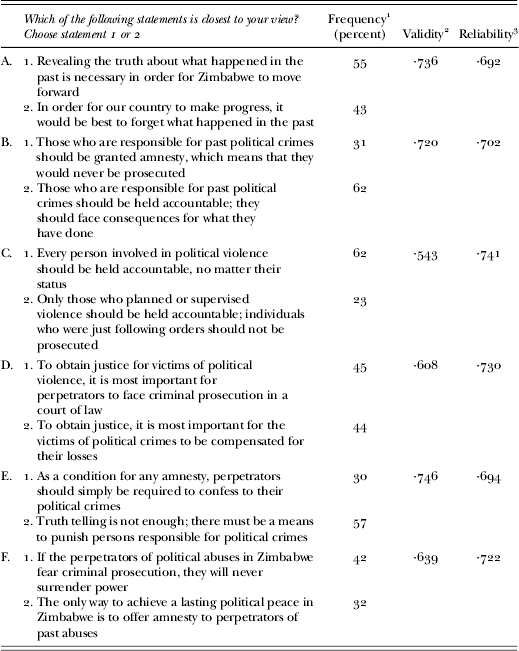
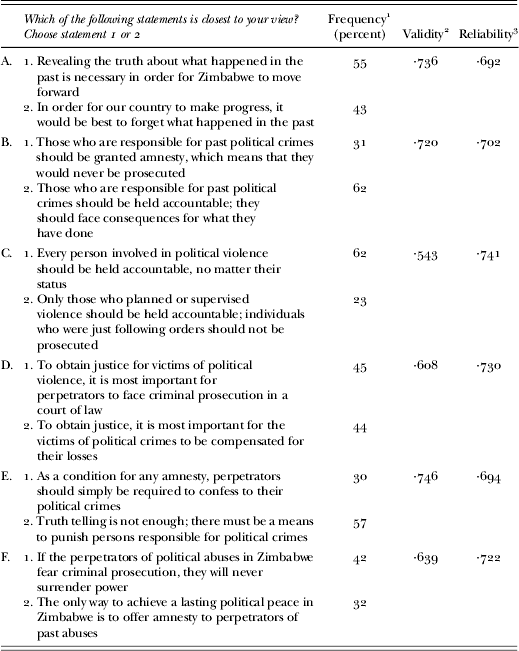
The object of explanation is public support for retributive justice, that is, the form of transitional justice that aims at criminal prosecution and legal punishment. When the possibility of this sort of accountability for wrongdoers is made explicit in interview questions, evidence emerges of popular support (see Table 1, frequency column).
An index of popular support for retributive justice: component items
Notes:
1 Percentages may not add up to 100 due to missing values, including ‘do not agree with either’ and ‘don't know’.
2 Component scores from factor analysis. A principal components analysis produces one factor (Eigenvalue 2·7) that explains 45% of the variance in the above six items. Note: items A, C and E were reversed in order to standardise valence for purposes of factor analysis.
3 Cronbach's Alpha scores if the item is deleted from index. Taken together, the six items produce a reliable index (Alpha =·750).
To begin with, a preponderance of Zimbabweans agrees that it is desirable to shine a public light on human rights abuses: 55% prefer to ‘reveal the truth’, versus 43% who wish to ‘forget what happened in the past’. More explicitly, an even larger majority backs criminal proceedings against perpetrators of political violence: 62% want to hold legally accountable those responsible for past crimes (who ‘should face the consequences for what they have done’), versus just 31% who favour amnesty (‘which means they would never be prosecuted’). And the net should be cast widely: many more Zimbabweans told survey interviewers that ‘every person involved in political violence should be held accountable’ (62%) than favoured excusing junior agents who ‘were just following orders’ (23%).
To test the depth of these popular preferences, the survey probed whether a popular appetite for prosecutions would hold up against alternative justice approaches. As it happens, the population is closely divided in a head-to-head comparison of retributive and restorative measures: whereas 45% attach most importance to putting criminals on trial, 44% would prefer to place the emphasis on compensating victims. At minimum, commitments among Zimbabweans to hold abusers accountable for their crimes are thus leavened with concern to ensure that victims receive due settlement for their losses.
But, faced with a different choice, this time between punishment and the revelation of truth (say through a truth commission), 57% of Zimbabweans hold that ‘truth telling is not enough’; only 30% say they would be satisfied if public confessions of guilt were the only sanction for human rights violations. Finally, the popular inclination for prosecution remains firm, even when compared to the prospect that such measures would cause incumbent rulers to dig in their heels and ‘never surrender power’. Even under these demanding conditions, Zimbabweans continue to favour prosecution above amnesty (42% versus 32%). Note, however, that fully one quarter of respondents cannot make up their minds on this issue, which reflects a realistic dilemma in a world where the old authoritarian regime still dominates the balance of power.
As for the period to be covered by any inquiry into political crimes, most Zimbabweans focus on the immediate past. A majority (53%) wants to concentrate investigations in the period since 2000, though there are smaller constituencies that favour going back to independence in 1980 (21%), or even to the war waged after the unilateral rebellion by white settlers in 1965 (7%). As expected, respondents in the north-east Mashonaland and Manicaland provinces want to investigate the last decade, a period in which they were increasingly exposed to electoral violence. But in the south-west Matabeleland provinces, people want to extend the period for investigations to encompass Gukurahundi in the 1980s. It should also be noted that opinion is most deeply divided in Matabeleland, where some 30% want ‘no investigation of past political crimes’, a rate twice the national average (14%). We return to this unexpected result later.
What form should accountability take? By September 2009, only one out of five Zimbabweans had heard of the official Organ for National Healing, and almost two thirds of those thought it would add ‘little or nothing’ to the attainment of justice. Even fewer (17%) had heard of South Africa's Truth and Reconciliation Commission. Yet, among those who had – and notwithstanding the common concern that ‘truth telling is not enough' – most saw it as a relevant archetype for Zimbabwe.
Offered various options for prosecution and asked to choose one, 47% of respondents said ‘try [perpetrators] in a Zimbabwean court of law’; 26% said ‘try them in an international court of law’; and only 5% said ‘create a system of community courts to try them’, or ‘have them face a traditional system of justice’. At least two surprises emerge from this list. First, Zimbabweans still apparently find that the formal judicial system is reliable enough to render fair judgements in sensitive political trials. Second, respondents are sceptical of socially embedded justice mechanisms, for example along the lines of Rwanda's local gacaca tribunals in which communities sit in judgement over their own wayward members. In recent years, Zimbabwe has seen the politicisation of senior judges and ‘traditional’ leaders; the Supreme and High Courts are now packed with ZANU-PF appointees, and chiefs and headmen have been bought off with salaried posts, electricity connections and 4×4 vehicles. Yet Zimbabweans, especially rural dwellers, seem to be more concerned about the political affiliations of chiefs than of judges; thus, they are more willing to place responsibility for justice in the hands of the latter than the former.
Peace or justice?
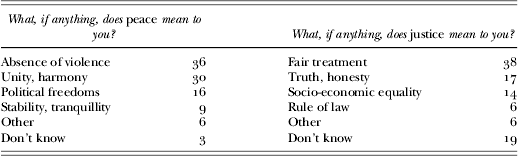
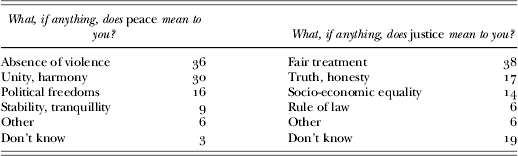
In a bid to anchor concepts in shared meanings, the survey asked respondents to define key terms in their own words: ‘What, if anything does peace mean to you?’; and ‘What, if anything does justice mean to you?’ All responses were post-coded into the broad categories displayed in Table 2.
Popular conceptions of peace and justice
Notes:
Column headings report exact question wording.
Cell entries are percentages of respondents offering this answer.
N=1,200.
Zimbabweans most commonly regard peace as the absence of violence. This negative derivation includes the cessation of both overt acts of physical aggression and intimidating threats of abuse. The 36% of respondents who defined peace in these terms often called for relief from the political terror that prevailed in the 2008 presidential election. A further 30% of respondents see peace in a more positive light, as an atmosphere of unity, harmony or mutual respect among citizens. This conception imagines moments of political consensus when people are able agree on how to attain collective welfare for community or nation. Smaller minorities make reference to peace in terms of political freedoms of conscience, speech, association and assembly (16%), or offer synonyms such as political ‘stability’ or social ‘tranquillity’ (9%). Importantly, almost everyone interviewed could offer a definition of peace (97%): just 3% said ‘don't know’.
There was less clarity about justice. Consistent with popular understandings of the term in other parts of the world (Hochschild Reference Hochschild1981), a plurality of Zimbabweans (38%) associate justice with a fundamental sense of fairness. Whether the point of reference for fairness is interpersonal relations or institutional procedures, the gist of popular definitions is that all individuals deserve even-handed treatment. Other respondents associated justice with truth telling, openness and transparency (17%) or with equality of socio-economic living standards (14%). Notably, however, only a small minority associated justice with the rule of law, raising the question of whether Zimbabweans really regard formal state procedures as reliable means of establishing a fair society. Finally, it is worth noting that far fewer survey respondents were able to conceptualise justice than peace: some 81% could offer a definition but 19% said they ‘didn't know’ what justice meant.
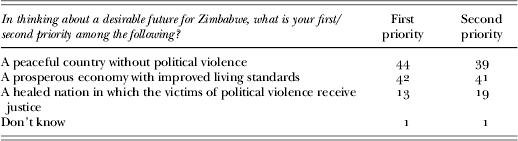
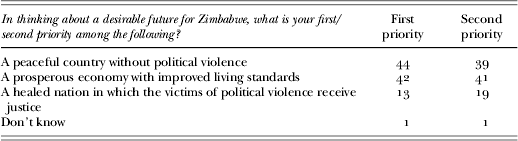
Moreover, as analysts, we cannot tell a priori which principle – peace or justice – people hold most dear. As it happens, the present research provides a clear answer for Zimbabwe. Table 3 displays a hierarchy of values in response to a question about the type of future desired for the country. People were almost equally divided in placing ‘a peaceful country without political violence’ at the top of the list, followed by a ‘prosperous economy with improved living standards’. In a distant third place, Zimbabweans opted for ‘a healed nation in which the victims of political violence receive justice’. This result echoes a finding from a 1998 University of Zimbabwe survey in which respondents listed ‘peace’ as the aspect of the country of which they were proud, even if this pride was ‘engendered more by the fear of a replay of an ugly past than confidence in the rosiness of the future’ (Masunungure Reference Masunungure1998: 19). It is therefore important to test whether, as of September 2009, Zimbabweans were willing to trade off, or at least defer, transitional justice against higher order values such as social peace and economic development.
Popular value priorities, including transitional justice
Notes:
Cell entries are percentages of respondents offering this answer.
N=1,200.
explanatory factors
This section turns from description to analysis. It asks which factors explain the willingness of citizens to support a retributive form of transitional justice. Specifically, who within Zimbabwean society is willing to countenance the strictest forms of accountability, that is, legal penalties against criminal wrongdoing? The analysis is built on four main hypotheses. These propositions are stated in general form since they are assumed to be relevant in situations well beyond the present case.
H1: Individuals who value peace above justice are less likely to call for legal retribution. As established above, Zimbabweans say they prefer peace above justice, even when the latter is described in the restorative terms of national ‘healing’. This popular hierarchy of values can be expected to inflect people's willingness to seek retribution for political crimes; individuals whose preference orderings prioritise peace will be less likely than their fellow citizens to call for hauling abusers before a court of law. Their justification might be that any attempt to convene criminal trials would only provoke a negative reaction from hardliners in government. In short, for those who place peace uppermost, retributive justice is counterproductive. While they do not rule out restorative measures, their litmus test is whether these are effective at promoting a tranquil political order and possibly even social reconciliation.
H2: Victims of political violence are more likely than other citizens to support a retributive form of transitional justice. The logic of this hypothesis is that persons most directly affected by violence will have the strongest commitments to holding perpetrators accountable. In other words, individuals will have strong incentives to seek retribution to the extent that they have personal experience of political abuse. This instrumental logic does not preclude the possibility that affected individuals could also hold an altruistic concern for the welfare of others. Nor does it eliminate the prospect that the experience of a threat (rather than an actual act of violence) would be sufficient to prompt a citizen to call for legal redress. But it does draw a straight line connecting experience of abuse, including incidents of political intimidation, to attitudes about justice.
H3: People who express political fear are less likely to call for retributive justice. Violence is hypothesised to have indirect as well as direct effects. Even if people are not personally victimised, they may be acutely aware that violence is abroad in the land, and that it could potentially be visited upon them. A widespread context of violence may be sufficient to make people afraid to openly express their true opinions, especially on political matters. It can create a generalised climate of political fear that may be sufficient to shape popular preferences for justice, probably by reducing people's willingness to opt for aggressive measures of legal accountability. Of course, it is always possible that fearful people find the inner strength to overcome their apprehensions and to call for retributive justice anyway. But for the purposes of this analysis, the hypothesis is that political fear will have a negative effect on demands for accountability.
H4: Partisans of a democratic opposition movement are more likely than other citizens to support retributive justice. In an essay on political polarisation in Zimbabwe, LeBas (2006: 420) suggests that ‘Zimbabweans view … political and economic developments through the heavily tinted lenses of party affiliation’. If so, citizens who say they feel close to political parties other than the former ruling party (ZANU-PF) should be most likely to express demands for accountability for past political abuses. Although the major political parties in Zimbabwe signed a ‘unity’ accord in 2008 and rival leaders entered an ‘inclusive’ government in 2009, the followers of the MDCs continue to see themselves as members of a democratic ‘opposition’. For that reason, this article refers to them as ‘opposition partisans’, mainly to accentuate their distinctive political identity. Indeed, the logic of opinion formation for this group is decidedly political. They calculate that a full transition to democracy in their country requires a vigorous prosecution of leaders – civilian and military – who, in the past, perpetrated acts of political violence against their fellow countrymen. In this regard, they see retributive justice as an essential component of genuine democratisation.
Violence, fear and partisanship
Beyond the popular predilection for peace, which was discussed earlier, this section explores the factors hypothesised to affect popular justice preferences: notably violence, fear and partisanship.
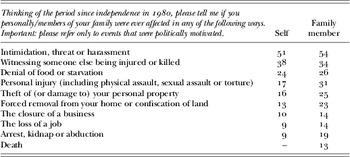
First: political violence. Because violence is a touchy topic, survey interviewers were trained to offer respondents the option of skipping questions on the subject, a choice taken by 28% of all adults interviewed (33% of women). The remainder – some 867 respondents – were primed to think about whether they were personally affected by politically motivated actions or events in the period since independence in 1980. Table 4 shows that over half (51%) reported that they had been directly intimidated, threatened or harassed; 38% reported witnessing someone else being injured or killed; 17% alleged that they had suffered a personal injury; and 13% claimed that a family member had been killed. Taken together, these data suggest that the authoritarian practices of the old regime exacted a heavy toll on Zimbabweans. Fully two out of three (66%) reported experience of at least one incident of violence, and almost one in five (19%) claimed personal exposure to four or more incidents, including politically motivated destruction of personal property, denial of food or forced population movement.
Victimisation by political violence, 1980–2009

Notes:
Cell entries are percentages of respondents answering positively.
N=867. Excludes 333 persons who elected not to answer questions about victimisation and violence.
Who are the perpetrators? While most political violence in Zimbabwe has been state-sponsored, it has usually been subcontracted from official state agencies to informal auxiliaries. As evidence, more adult Zimbabweans say they feel unsafe when meeting militia groups (47%) than when meeting uniformed soldiers (28%) or police (19%). Indeed, respondents are most likely to report exposure to violence from the Zimbabwe National Liberation War Veterans Association (43%) or graduates of the National Youth Training Service, colloquially known by the colour of their fatigues as the ‘green bombers' (40%). Among the respondents most likely to tolerate political violence – ‘it is sometimes necessary to use violence in support of a just cause' – are older, male ZANU-PF supporters who were socialised into politics during the era of the national liberation war.
In reaction against their country's turbulent past, however, most Zimbabweans strongly reject political violence. A solid majority (76%) prefers to ‘find lawful solutions to problems, even if it takes longer’, rather than ignoring the law in order to ‘solve problems immediately using other means’. An even larger majority (82%) disagrees that ‘whenever politics is involved, violence is inevitable’; rather they opine that ‘politics need not be dangerous; people can learn to work together in peaceful ways’. The strongest majority (86%) is reserved for the condemnation of violence as a political instrument: almost all Zimbabweans insist that ‘the use of violence is never justified in Zimbabwean politics’.
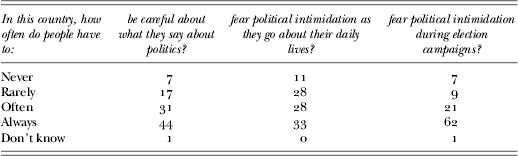
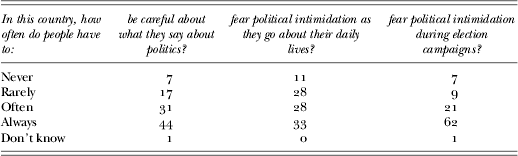
Second: political fear. To begin with, there is ample evidence of generalised social distrust. Even before we asked cooperating respondents any questions about violence, two thirds (67%) agreed that they must ‘be very careful of other people since I don't know what they might do to me’. Only half as many (31%) felt that they could ‘trust other people to behave respectfully towards me’. It should be noted, however, that low levels of generalised social trust are not unusual in African countries. But the survey also detects popular political fear. Table 5 shows that three out of four Zimbabwean adults (75%) feel that, ‘always’ or ‘often’, people must ‘be careful about what they say about politics’. This result in September 2009 reflects an improvement over an Afrobarometer survey in October 2005, when 87% felt this way. But fearfulness about free expression remains higher in Zimbabwe than in almost any other African country where this question has been asked.
Political fear
Notes:
Column headings display exact question wordings.
Cell entries are percentages of respondents offering this answer.
N=867. Excludes 333 persons who elected not to answer questions about victimisation and violence.
Political fear is commonly a response to pressures exerted by party zealots, as reflected by the 83% who said they feel these fears ‘during election campaigns’. Accordingly, fear of intimidation has a strongly partisan cast. Supporters of the MDCs are significantly more likely than those of ZANU-PF to say that they ‘often’ or ‘always’ worry about undue political pressures on a day-to-day basis (63% versus 48%). This gap is even wider during election campaigns (86% versus 68%). Notably, however, supporters of former opposition parties are not alone; up to two thirds of ZANU-PF loyalists also express concern about political intimidation, including from their own party. In that sense, they are also victims of a widespread atmosphere of strong-arm politics.
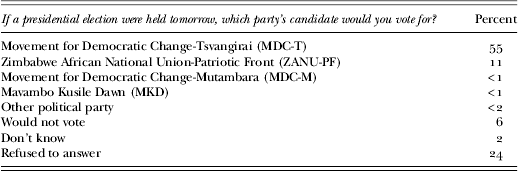
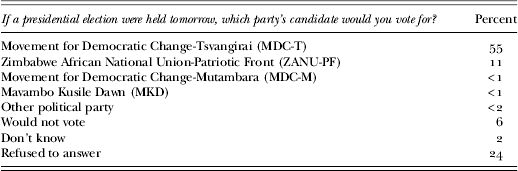
Third: political partisanship. This concept is measured by a question about voting intentions: ‘If a presidential election were held tomorrow, which party's candidate would you vote for?’ As of September 2009, 55% openly opted for MDC-Tsvangirai and 11% for ZANU-PF (see Table 6). This result tends to confirm the distribution of voting intentions from the same question reported by the Afrobarometer from May 2009, of 57% MDC and 10% ZANU-PF. The slight difference in results falls within the margin of survey sampling error. Importantly, in both surveys about one quarter of respondents chose not to reveal their partisan preferences. For purposes of analysis, this article measures whether an individual is an ‘opposition partisan’, meaning a supporter of MDC-T, MDC-M, MKD, ZAPU or any party other than ZANU-PF. Since the proportion that refused to reveal a voting intention undoubtedly contains some fearful opposition partisans, the indicator therefore underestimates the extent of opposition to the old regime, and constitutes a conservative test of whether partisanship is affecting popular preferences for justice.
Political partisanship (September 2009)
Note: N=1,200.
explaining support for retributive justice
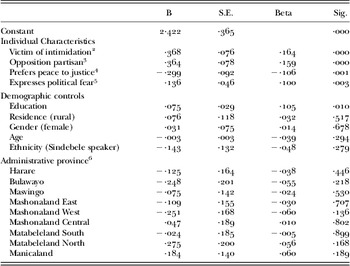
Obviously, public opinion about a topic as controversial as justice – especially when this is conceived to involve criminal prosecutions – is not spread evenly across society. In this article, a multivariate ordinary least-squares regression model is employed to explain who wants legal accountability (see Table 7). The dependent variable is popular support for retributive justice (measured as an average index of the justice preferences arrayed in Table 1). The main explanatory variables are grouped into three categories: individual characteristics (reflecting the four major hypotheses), some standard demographic controls, and dummy variables for administrative province (to test for possible sub-regional effects).
Explaining popular support for retributive justice1 in Zimbabwe: multivariate OLS regression

Notes:
R squared=·145.
Standard error of the estimate=1·050.
N=867. Excludes 333 persons who opted out of answering questions about political violence.
1 The dependent variable (retributive justice) is measured on an average index of the six items in Table 1.
2 For indicator of victim of violence (dummy variable, 0 or 1) see Table 4, line 1.
3 For indicator of opposition partisan (dummy variable, 0 or 1) see Table 6, lines 1, 3, 4 and 5.
4 For indicator of peace preference (dummy variable, 0 or 1) see Table 3, line 1.
5 The index of political fear is an average scale of three items in columns 2, 3 and 4 in Table 5.
6 The excluded category is Midlands.
The results are presented in order of importance. By a narrow margin, the most important factor driving an individual to pursue retributive justice in Zimbabwe is whether he or she has been a victim of political intimidation. A person who has personally encountered political violence has a 37% greater likelihood of wanting legal redress than one who has never directly experienced such harassment. This result provides strong evidence to support H2. It suggests that exposure to acts of political intimidation induces individuals to seek satisfaction by exacting punishment on those deemed responsible. The impulse to settle scores is widespread, in that victims of intimidation are especially likely to argue that all perpetrators should be punished, as opposed to limiting sanctions to those who issue orders for violence.
Central to the argument in this article, and consistent with H4, political factors are almost equally influential. Compared with adherents of the old ruling party, being a partisan of the democratic opposition in Zimbabwe increases the likelihood of demanding justice by some 36%. The gulf in justice preferences reflects deep political polarisation between followers of the MDCs (who present their goals in the language of civil and political rights and the rule of law), and ZANU-PF (whose ideology has always justified, even glorified, revolutionary violence). Individuals who developed their political affiliations during the rise of a broad-based democratic movement in late 1990s and early 2000s are the most vigorous today in demanding that ZANU-PF functionaries and their auxiliary shock troops be held to account. MDC supporters may be acutely aware that any mention of prosecutions could intensify the determination of old-guard elements to resist all change. But, regardless of such risks, these opposition partisans remain committed to retributive justice as an essential pillar of democratic change.
H1 is also confirmed. As indicated by the negative sign on the regression coefficient, those who place a higher value on peace than on justice are some 30% less likely to call for legal retribution. One plausible argument is that this group of Zimbabwean citizens recognises that an overly energetic search for prosecution is likely to provoke a political backlash. Many senior military and civilian leaders currently in power in Zimbabwe, as well as numerous foot soldiers in the formal and informal rank and file, have reason to worry that evidence of their misdeeds has been recorded and awaits presentation in a court of law. Should their hold on power become insecure, this group of incumbents is therefore poised to resort again to violence, especially during any periodic election or constitutional referendum. And, in the extreme, hardliners – military, civilian, or a combination thereof – continue to hold the wild card of an illegal seizure of power at the top. For those who value peace above justice, the risk of a reactionary coup accompanied by a violent crackdown is simply too heavy to bear.
The test of H3 yields an unexpected result. Political fear was predicted to suppress popular inclinations towards transitional justice. In practice, however, the plus sign on the regression coefficient indicates that feelings of political fear actually stand in a positive relationship to the demand for justice. To be sure, the relationship is not very strong, but it is statistically significant. One can interpret this result as a victory of popular courage over mass trepidation. While people in Zimbabwe do worry that they will be penalised for exercising freedoms of speech and electoral choice, they are able to overcome these concerns. Persons who express political fear still insist on the just settlement of past political crimes. Thus, even if ZANU-PF has sometimes managed to induce some people to express acquiescent political loyalty or to force some dissenters to exit the political arena, it has not succeeded in silencing popular voices.
Finally, the analysis reveals that standard demographic controls have few significant impacts on attitudes to justice. Men are no more likely than women to support retributive justice measures. Nor are older people or urban dwellers. Instead, the only relevant demographic factor is education: commitment to retributive justice rises with years of formal schooling. This result is intuitive to the extent that education raises an individual's cognitive awareness of the norms of democratic governance and of the institutional remedies available to discipline errant leaders.
the matabeleland puzzle
Perhaps the most surprising empirical result in the Zimbabwe data is the lack of statistical significance of ethnicity and administrative province. Speakers of Sindebele as a language of origin (a proxy for persons of Ndebele ethnicity) and residents of the Matabeleland region (defined as those who live in Bulawayo, Matabeleland North and Matabeleland South, including many Shona-speakers and ethnic minorities) are no more likely than other Zimbabweans to demand retributive justice. Indeed, the negative signs for Sindebele speakers and Bulawayo residents suggest that they are somewhat less likely to want justice.
This outcome flies in the face of reasonable expectations. Given the history of systematic and widespread political atrocities in the Matabeleland region during the 1980s, it is logical to expect that people in the south-west part of the country would be more vigorous than other Zimbabweans in calling for legal accountability. Perhaps the survey respondents were thinking only about the most recent rounds of political violence; in the second round election of 2008, for example, ZANU-PF abuses were concentrated in its former political strongholds in the north-east provinces. But, as noted earlier, respondents in the south-west provinces say that they want the temporal scope of transitional justice investigations to encompass the Gukurahundi atrocities that began almost three decades ago. Thus, historical memory persists.
So what is going on? In an effort to unravel this puzzle, the survey was supplemented by twelve focus group discussions conducted by the Mass Public Opinion Institute at three Matabeleland locations in July 2009 (MPOI 2009), and by half a dozen in-depth interviews by the author with elite informants from NGOs working in the region in May 2010. These materials confirm the existence of abiding popular preoccupation with political violence; as one interlocutor said, ‘in Matabeleland, the past is the present’; or, in the words of another, ‘the region is still in shock’. In short, the residents of the region are not ready to forgive and forget, for example by supporting a general amnesty for abusers. Instead, some sort of transitional justice remains high on the region's popular agenda.
Rather, the informants and focus group discussants proposed three plausible interpretations of the Matabeleland puzzle. The first is generation. The grievance of Gukurahundi may burn most deeply for those who experienced it directly. As one NGO leader suggested, older people who were adults in the 1980s ‘have hatred in their hearts’. For the generational argument to hold, one would expect a positive relationship between age and the index of demand for retributive justice. As it happens, however, there is a negative bi-variate relationship between age and support for this kind of justice, not only in the Zimbabwe sample as a whole (r=−·106, p<·001) but also in the Matabeleland sub-sample (r=−·138, p<·001). Thus older people in Matabeleland are especially unlikely to call for legal redress.
Second, residents of the region may be particularly afraid to express true opinions to a survey interviewer whom they do not know. In other words, while secretly they want to vigorously pursue retributive justice, they pretend otherwise to the interviewer. But fewer Matabeleland residents expressed political fear than Zimbabweans from other provinces (62% versus 75%). The gap was even wider in the May 2009 Afrobarometer survey (46% versus 65%). So, at face value, political fear would seem to play a smaller role in Matabeleland than elsewhere. Moreover, the bi-variate association between political fear and a preference to pursue retribution is positive in the Zimbabwe sample (r=·123, p<·001). This positive association is even stronger (r=·133, p<·001) in the Matabeleland sub-sample. Thus fear cannot be suppressing demand for this kind of justice in Matabeleland.
Third and finally, people in Matabeleland may calculate that, until there is a democratic transition plus a change of national leadership, they will never obtain justice. Rather, by raising the subject prematurely, they might invite further collective punishment as a minority ethnic group. In this interpretation, people are neither forgetting the past nor censoring their answers. Instead they arrive at a rational conclusion to let sleeping dogs lie. In other words, it is simply not worth demanding justice, especially a retributive form, if the likely consequence is that, as a marginalised minority, they will be ignored or, at worst, visited again with the heavy hand of state coercion.
Ethnic identities run high in this region. The survey asked respondents to choose whether they define themselves more in terms of their ethnic group or nationality. In Matabeleland, people are three times more likely than other Zimbabweans to put their ethnic group – for example, Ndebele, Kalanga, Venda or Tonga – above their national identity (41% versus 13%). Outside Bulawayo, the main urban centre in the region, almost half (48%) of all respondents in the two rural provinces say they see themselves mainly in ethnic terms. In addition, there is a stronger sense of ethnic grievance in Matabeleland than anywhere else in the country. According to the Afrobarometer survey of May 2009, residents of this region are more than twice as likely as citizens elsewhere in Zimbabwe to say that: their ethnic group is ‘often or always’ treated unfairly by government (34% versus 16%); that their ethnic group's economic condition is worse than that of other groups (37% versus 16%); and that their ethnic group has less political influence than other groups (61% versus 24%). Such feelings of political exclusion lead to a sense of defensive solidarity along with calls for administrative devolution and murmurings of separatist sentiment (Ndlovu-Gatsheni Reference Ndlovu-Gatsheni2009; USM 2010).
The elite interviews and focus group discussions bear out the interpretation that ethnic minorities lack confidence that justice can be obtained under the current power structure. A male focus group discussant in Bulawayo opined: ‘As long as Mugabe is there, they [the perpetrators] will be sentenced today and tomorrow he will pronounce an amnesty and they will be free again.’ One NGO leader confirmed that power sharing among political elites was not an adequate solution: ‘even under the inclusive government, we in Matabeleland feel exposed without a protector’. Reflecting deep-seated social divisions, another stated:
The people of Matabeleland have never felt part of Zimbabwe. Mugabe made it very tribal; people were killed because they couldn't speak Shona. Now they don't believe that a Shona-dominated government – even one headed by Morgan Tsvangirai – will ever help them. They feel like orphans or stepchildren.

Zimbabweans have long wanted peace. Indeed, they first voted for Robert Mugabe in 1980 in good part because they saw ZANU-PF as the only party able to bring the liberation war to an end. Now, three decades later, they still regard peace as their top political priority, though now they also see democratisation – which implies a leadership turnover – as the best means to achieve this overarching goal. Power sharing is not enough. In the September 2009 sample survey on which this article is based, fewer that one in five Zimbabweans (17%) said that the country's interim power-sharing arrangement was ‘a good alternative’ that should permanently replace competitive elections as the preferred means of choosing governments.
But because the outcome of the current political transition is incomplete and far from certain, Zimbabweans recognise that prospects for peace are distant. The old authoritarian regime, while wounded and weakened, still holds the upper hand in the country's interim government. While power sharing has contributed to a reduced frequency of intimidation and violence, the formal and informal apparatus for coercion remains largely intact throughout the territory. There is widespread fear and growing evidence that armed militias will remobilise – with logistical support from the uniformed forces – as campaigns get underway for a constitutional referendum or general election. Under these circumstances, citizens face acute dilemmas: how to balance truth and amnesia, prosecution and amnesty, punishment and forgiveness. These predicaments are not unique to Zimbabwe, but reflect the tensions generally inherent in parlous and protracted regime transitions.
As this article has shown, most citizens of Zimbabwe are willing to countenance a form of retributive justice for perpetrators of past political abuses. A sentiment for legal prosecution is especially marked among those who have personally experienced violence. And the urge to punish the guilty is equally strong among individuals who affiliate politically with country's democracy movement. But, for those who worry that premature attention to ‘the torturer problem’ will disrupt the country's fragile peace, and for ethnic minorities who doubt the sincerity of any majority-led government, the excessive risk of a state-sponsored backlash is a step too far. For these individuals, the dossiers on the subject of transitional justice cannot and should not be opened until a transition to democracy is itself complete.
One last thought: the relationship between peace and justice, and any possible trade-off between the two, should therefore be seen within the context of time. In the short run, people will quite reasonably prefer to put an end to on-going violence, even if this means putting justice on a back burner. But over the longer term, and once political conditions allow, they are likely to acknowledge that a permanent peace is impossible without close attention to justice.