




No CrossRef data available.
Article contents
Ship-based Weather Routing Using Dynamical Meteorology
Published online by Cambridge University Press: 23 November 2009
Extract
Many vessels trading on North Atlantic routes are equipped with weather facsimile receiving devices of various types. Ship-masters engaged on regular voyages in this area are thus able to conduct their own passage planning using the information readily available from these intruments. The capital cost in relation to other ship operation costs is negligible; in US dollars (1983) it is likely to be of the order:
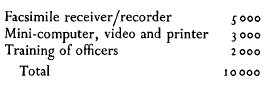
There would be no problem in planning a vessel's route across an ocean if it were possible to forecast with total accuracy the actual sea state existing for the duration of a voyage. Such an ideal circumstance does not yet exist and a method must thus be used which incorporates flexibility to modify a voyage plan as actual weather varies from the prognosis. This means that a subjective approach to storm avoidance may, on occasions, be preferable to the stringent demands of a least-time track. The obsession of routing agencies with the latter method may be one reason why weather routing has not achieved the success it perhaps deserves.
A ship may be damaged or delayed by the action of sea waves on her hull or structure. Hull form and ship dimensions are usually selected on the basis of calm-water performance, rather than for sustained sea-speed.
Information
- Type
- Research Article
- Information
- Copyright
- Copyright © The Royal Institute of Navigation 1983
References
REFERENCES
1Green, J. S. A. (1970). Transfer properties of the large-scale eddies and the general circulation of the atmosphere. Q. JI R Met Soc, 96, 175.Google Scholar
2Motte, R. (1974). Air motion and vorticity in an extra-tropical cyclone. Safety of Sea International, 38, 28.Google Scholar
4Heijboer, D. (1974). Weather routeing – a modern aid to navigation. Fairplay International, March, 8.Google Scholar
5James, R. W. (1957). Applications of Wave Forecasts to Marine Navigation. US Navy Hydrographic Office, SP 1, Washington DC.Google Scholar
- 1
- Cited by