During the 1996 presidential campaign, incumbent Bill Clinton proposed a new form of aid lodged in the nation’s tax code to make higher education more affordable. Even though Clinton’s Hope Scholarship and Lifetime Learning Credits targeted middle-class families who felt the squeeze of rising college tuition, some Democrats and education advocates criticized them as an inefficient way of achieving generally laudable goals. Essentially, the credits would not help those who needed assistance most or those whose decision about whether to attend college hinged on financial aid.Footnote 1 Why would Clinton choose an inefficient tool, like tax expenditures, to achieve generally agreed-upon policy goals? The question points to a weakness in the literature on policy tools. Although we know a great deal about the variety of tools and their relative efficiency, we have a much harder time explaining how and why particular instruments are chosen.
Conventional wisdom and policy insiders tell us that Clinton’s decision was “political”: in an election year, the president proposed to give the country both a tax cut and a social program all in one. Scholarly research on tax expenditures likewise points to their attractive features: they can be tucked into omnibus revenue bills, do not require additional bureaucracies, may be framed as tax relief or social welfare, and have hidden costs.Footnote 2 Although these accounts at first blush are persuasive, they do not provide scholars with a way of analyzing why a particular tool is chosen at a given time or over other options. In other words, if tax expenditures are so attractive, why were they not employed for higher education in the 1970s, or, alternatively, why did even more policies enacted in the 1990s not use them?
To understand why policymakers choose particular tools, we need to look not only to the context surrounding political decisions at any one point in time (a “snapshot” of policy decisions) but also to take into account previous policy choices that may constrain current choices (a “moving picture” approach).Footnote 3 In other words, we cannot understand tool choice without understanding the past. Past decisions are neither irrelevant nor merely background to current controversies. Instead, “initial moves in a particular direction encourage further movement along the same path. Over time, ‘the road not chosen’ becomes an increasingly distant, increasingly unreachable alternative.”Footnote 4 Thus, to understand Clinton’s decision (and policymakers’ decisions more generally), this article examines the politics behind policy design in one area—aid for higher education—over time. Drawing on political scientist Paul Manna’s concepts of capacity, or the ability to execute programs, and license, political justification, I show how these two variables operate jointly within policy areas to narrow the range of tools policymakers are willing to consider at any historical point in time and determine which of the remaining tools is most likely to be selected. Ultimately, I find policymakers often can achieve their policy goals if they are willing to compromise on the means to achieve them.
POLITICS AND TOOL CHOICE
The shifting emphasis in the public policy literature from state agencies to policy instruments or tools has opened up new ways of thinking about policy execution, broadening the focus from state administrators to networks that include private and nonprofit organizations.Footnote 5 The burgeoning literature on policy instruments has addressed extensively what categories of tools are available to policymakersFootnote 6 and how effective they are in achieving their policy goals,Footnote 7 but it has yet to make inroads into why tools are chosen. The question of why, in particular, requires analysis over time.
The extensive literature on categories and their effectiveness means that questions of policy design are instead often answered as applications of classificatory frameworks.Footnote 8 As Lester Salamon explains, “The choice of program tool is a political, and not just an economic, issue: it involves important questions of power and purpose as well as of equity and efficiency.”Footnote 9 A smaller body of literature on tool choice separates it from the classificatory frameworks and efficiency arguments. Instead, these authors situate policy design within the larger international framework, arguing that tool choice converges across nations or that tool choice reflects the complexity of networks.Footnote 10 Some scholars argue that the choice of policy tools is the ultimate political act. Fellowes and Wolf find that members of Congress reward business campaign contributors with “favorable regulatory and tax policy votes” rather than through direct expenditure programs, while Hacker and Pierson argue that political actors “reward their base” through favorable—and somewhat deceptive—policy design in the tax code.Footnote 11
In sum, understanding the categories of tools and how effective they are has long been the domain of public administration scholars. They have not, however, paid as much attention to the question of tool choice.Footnote 12 Political scientists, in turn, have developed frameworks that may shed light on the types of decisions that policy actors make.Footnote 13 Paul Manna, for example, suggests that policymakers are strategic actors, but they are constrained in their choices depending on the resources they can marshal. He focuses on two particularly important resources: capacity and license. Capacity refers to the availability of infrastructure to achieve policy goals. It consists of financial resources, bureaucratic organization, and expertise.Footnote 14 Building on the concept of capacity, we see that policymakers may employ tools that they have the administrative ability to create and execute. In contrast, license is the strength of arguments used to justify government action. It includes political capital, frames, constitutional authority, and past policymaking.Footnote 15 In contrast to capacity, license is the political justification that allows policymakers to take action.
In this article, I argue that capacity and license are important in the ways they vary within policy areas and across time. When policymakers set out to design new programs, they are constrained both by the capacity and license within the particular policy area as well as what resources government can marshal at any particular point in time. For example, capacity and license may be strong in some policy areas but weak in others, so that at the same time the federal government spends billions of dollars for direct provision of veterans’ health care, it provides only indirect loans and subsidies to the nation’s college students. Likewise, capacity and license may be weak for government generally, as was the case in the early republic,Footnote 16 or with the push toward retrenchment in social policy in the 1980s and 1990s. Capacity and license may be weak for both the policy area and government action, as Clinton faced in the mid-1990s.
By combining these analyses to look at a single policy area over time, we can separate out the structural effect of weak license and capacity in a policy area from the political effects of strong or weak governments at any particular points in time. In this way, policy design is not arbitrary and subject to random political events; instead, past policy decisions limit the options available to political actors. In short, policymakers operate with a much smaller toolbox than general categorizations or economic arguments about efficiency would have us believe.
METHODS AND CASES
The dependent variable in this study is tool choice. The independent variables of interest are measures of capacity (the administrative ability of the federal state) and license (the types of arguments that policy actors make) along two different dimensions—within policy area and at particular moments in time. To understand how license and capacity affect tool choice along these two dimensions, this study examines a single policy area—higher education—from World War II to the present. Within higher education, I chose to examine three additional major pieces of legislative action (prior to Clinton’s credits) where the federal government made education more affordable: aid to veterans through the education provisions of the GI Bill of 1944, aid to low- and moderate-income Americans with work-study provisions of the Higher Education Act of 1965, and Pell Grants in 1972. These cases represent typical examples of the federal government’s postwar intervention into education policy.Footnote 17
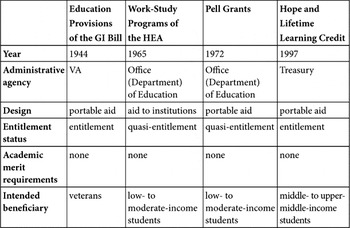
Ostensibly, all four serve the same goal: making higher education more affordable. Three provide portable aid to students to attend the school of their choice; only work-study is given to institutions. All four also have entitlement or quasi-entitlement status, meaning the aid is not subject to the normal appropriations process. Finally, none of the programs has requirements of academic merit. Yet for all of their broad similarities, these programs also have important differences. Most fundamentally, they were created at different points in American history, with differing secondary goals—easing the transition to peacetime, fighting poverty, promoting civil rights, and reducing taxes.Footnote 18 Beyond that, the programs are administered by different federal departments (Veterans Affairs, Department of Education, and the Treasury). And though there is overlap, they serve different clientele (veterans, low- to moderate-income Americans, and middle- to upper-middle-class taxpayers).
Key Features of U.S. Education Programs

To compare cases, I began by reconstructing the creation of the four policies by gathering several sources of data: government documents, including commission reports, public speeches, and congressional histories where available, to determine what action was taken and why. Further, I use published legislative histories by historians and political scientists to flesh out alternative policy choices that were not taken. Finally, I conducted in-person and telephone interviews with key staffers and legislators on Pell Grants and tax expenditures, and (where appropriate) also had access to their records. The interviewees all had firsthand knowledge of the creation of education programs. They worked in executive agencies, legislative offices, or for interest groups at the time the legislation was passed. After reconstructing the policy debates, I compared the political decision making in these cases to analyze why a particular policy tool was chosen. I looked at the range of options under consideration and reasons that supporters gave for choosing the option they did (including a host of political considerations). I specifically asked what options were under consideration and why other options were not also considered. I ruled out alternative explanations that did not fit across all four cases. What became clear is that though the political context and policy tools varied substantially across cases, the features of the tools themselves remained remarkably consistent. Short descriptions and the context of each of the cases are provided below.
The GI Bill of Rights, 1944
At the time, the Serviceman’s Readjustment Act of 1944—more commonly known as the GI Bill of Rights—was the federal government’s largest foray into higher education. Prior to the GI Bill, federal aid to higher education extended as far as the Morrill Acts, which created land-grant colleges and vocational education for disabled veterans.Footnote 19 As early as 1942, when President Franklin Delano Roosevelt signed the Selective Service Act, which extended the draft to eighteen- and nineteen-year-olds and interrupted the studies of many young Americans, federal lawmakers began to address continuing education for American soldiers. Past experience with the inadequate transition for World War I veterans, along with fears about massive dislocation with the return of soldiers from abroad, led to serious—albeit quiet—study of how best to prepare for a peacetime economy.Footnote 20 Two important commissions, the Conference on Postwar Readjustment of Civilian and Military Personnel (appointed by the National Labor Relations Board) and the Armed Forces Committee on Post-War Educational Opportunities for Service Personnel (also known as the Osborn Committee), made similar sets of recommendations in 1943, which FDR called on Congress to pass.Footnote 21
The key issue for veterans’ education was which department would best administer the program—the Office of Education or the Veterans Administration (VA). The White House neglected to specify the particular agency that would house veterans’ education, preferring instead to leave this to the discretion of the president. The administration-backed bill, introduced by Senator Elbert D. Thomas (D-Utah) in 1943, proposed placing veterans’ education benefits in the Office of Education, which pleased education groups and educators but was not equally favored by either World War I veterans in Congress or anti–New Dealers. Early in 1944, the American Legion, a veterans’ organization, changed the debate by skillfully crafting and lobbying on behalf of a comprehensive omnibus bill for veterans that covered unemployment, housing, and farming as well as education. The American Legion proposed placing veterans’ education—along with the many other programs—in the Veterans Administration rather than the Office of Education.Footnote 22 The final legislation was a modified version of the Legion proposal. It provided one year of schooling (tuition, fees, and stipend) to all veterans who had served at least ninety days, and up to three additional years for members of the armed services whose schooling was interrupted. The VA was charged with determining eligibility and administering the program.Footnote 23 Congress unanimously passed the GI Bill of Rights and President Roosevelt signed it into law on June 22, 1944.
Work-Study Provisions of the Higher Education Act, 1965
Although President Johnson labeled the 88th Congress (1963) as the “Education Congress,” the work of Congress in the two subsequent years far surpassed that benchmark. Work-study provisions were originally supported by President Kennedy and proposed in 1963, with no action. They were enacted in 1964 under the Economic Opportunity Act, and with the Higher Education Act they were moved to the Office of Education.Footnote 24 Work-study became an important (and relatively uncontroversial) part of the scholarship-work-loan tripod that formed the basis of the federal government’s guarantee to open the doors of higher education facilities to low- and moderate-income students in the Higher Education Act of 1965.Footnote 25 Under work-study, the federal government and local colleges and universities would split the cost of part-time employment for eligible students. In 1965, the federal government would pay 90 percent of the costs, while colleges and universities picked up the remaining 10 percent.Footnote 26
During the hearings on the HEA, the federal loan guarantees and scholarship provisions garnered the most controversy and attention. Banking associations disapproved of federal loan guarantees because the federal government would set the maximum interest rates. Scholarship provisions had long been controversial in Congress and members of the education subcommittee seemed more at ease with the current recommendations that were not full scholarship but relied on multiple sources of aid. Work-study breezed though the debate. The major alternative to the HEA was tax credits for students and their parents.Footnote 27 Although Johnson carefully targeted the plan to low-income Americans, Congress expanded it to low- and moderate-income families, authorizing even more than Johnson had originally requested.Footnote 28 Congress passed the Higher Education Act with broad bipartisan support, and it was signed into law on November 8, 1965.
Basic Educational Opportunity Grants: (BEOG)/Pell Grants, 1972
Attached to the reauthorization of the HEA, the Basic Educational Opportunity Grant provided—on a scale second only to the GI Bill—needs-based grants to students to attend institutions of higher education. The grants have a quasi-entitlement status, meaning that once funds have been appropriated and future commitments made, students are guaranteed an amount based on their college costs minus their expected family contribution. Although the original HEA had established many important campus-based education programs, such as student loans and work-study, it did not guarantee a minimum of funding to financially needy students.Footnote 29 Beginning in 1969, independent and government committees as well as advocates in Congress pushed for expanded student aid to make federal assistance more equitable and college more affordable to Americans.Footnote 30 In 1970 and 1971, President Richard Nixon sent Congress higher-education bills, emphasizing grant-based aid to students that had fewer federal strings and were more equitable. Both the House and Senate considered their own higher-education bills in 1970, and adopted omnibus education reauthorization in 1971.Footnote 31
The key controversy surrounding the grants was whether merely to expand the campus-based programs already in place or to devise a new system that emphasized individuals over institutions.Footnote 32 Senator Claiborne Pell, chief proponent and architect of Basic Educational Opportunity Grants as well as their future namesake, envisioned a program to extend college scholarships to individuals, a type of “GI Bill” for low- to moderate-income Americans.Footnote 33 With his skillful presence, the BEOG program was included in the Senate omnibus legislation. Debate in the House was markedly different. The House legislation did not include Basic Educational Opportunity Grants and instead bolstered federal aid programs already in place, giving increased federal funds to colleges and universities, which would then determine how best to spend it.Footnote 34 After much political maneuvering, with the aid of House Democrats and Republicans, Senator Pell prevailed in the conference committee.Footnote 35 Basic Educational Opportunity Grants became part of higher education funding with the president’s signature on June 23, 1972.Footnote 36
POSTWAR AID TO INDIVIDUALS FOR HIGHER EDUCATION
After World War II, American policymakers significantly expanded federal assistance to individuals for higher education through the GI Bill, work-study, Pell Grants, and the Hope Scholarship. With similar goals—making college education more affordable—but different means and administrators, they essentially created parallel programs for educational aid, a “patchwork quilt” rather than a coordinated policy.Footnote 37Table 1, which illustrates the key features of the programs, reinforces the fact that even though there are important differences, the programs share many features in common. What motivates policy actors to create three programs that stress portable aid to students and one to institutions, each using different administrators? Importantly, the question posed here is not why policy is different, which assumes that policymaking is (or ought to be) rational or coherent.Footnote 38 Rather, what accounts for this particular pattern in policy design over time?
I argue that the unique pattern of federal aid illustrated in Table 1 is the result of limited capacity and license in the higher education arena. Without extensive administrative ability or political justifications for direct federal government involvement in education, policymakers have limited their intervention to tools that give students and universities maximum control and minimize the appearance of a federal role: grants, loans, work-study, and tax expenditures. Policymakers wishing to make higher education more affordable start with a limited toolbox, in those instruments that are indirect and noncoercive. From there, political factors—such as strength of the governing party and overall support for welfare-state expansion—determine which tool will actually be chosen from this smaller subset. At times when support for government involvement is highest, as is the case during unified Democratic control of national institutions, the tools chosen are the most extensive. And when support for government programs is lowest, as is the case during divided government—split partisan control of national institutions—the tools are minimal. It should come as no surprise that Johnson’s unified government in 1965 would pass more institutionalized programs than the divided (and hostile) Congress President Clinton faced in 1996.
Although education analysts often point to the twin concerns of (1) separation of church and state and (2) fear of an intrusive federal government as the defining features that limit aid to higher education, the limited role of the federal government in higher education was not a forgone conclusion. Indeed, I argue that the federal government had the opportunity to expand significantly the capacity and license in the higher education arena with the GI Bill. However, the placement of GI education provisions in the VA rather than the Office of Education permanently associated the government’s efforts with “veterans’ policy” rather than higher education. Policymakers could not expand the constituencies served by the GI Bill beyond veterans and they could not justify future government involvement as anything other than helping other needy constituencies. The GI Bill set federal funding to making college more affordable along a particular path where future actions reinforced it. In other words, the GI Bill created a model to replicate, but it could never be expanded. The GI Bill of 1944 casts a long shadow over U.S. higher education policy, limiting both capacity and license of policymakers to create and extend education programs after World War II.
Defining Capacity: The GI Bill of 1944
With broad bipartisan support for returning soldiers, the federal government had the opportunity to pass an education bill that would lay the foundation for future education policy. But faced with the opportunity to make higher education affordable to Americans generally or to please a specialized constituency, policymakers chose to provide very generous benefits to a narrow range of people. This decision would create a pattern of constituency-based aid that characterizes federal higher education programs still today. Although administration officials in the early 1960s, members of Congress in 1972, and President Clinton in 1997 referred to their programs as “GI Bills” for low- to moderate-income Americans and middle-class families, respectively, the 1944 GI Bill effectively ended the possibility of a GI Bill for everyone. Creating aid for higher education for a particular group (veterans) administered by a specialized agency (VA) contributed to a patchwork quilt for educational aid, where future programs (like work-study, Pell Grants, and the Hope Scholarship) were added one piece at a time for a particular group administered by a specialized agency rather than expanding existing programs or formulating a comprehensive plan.Footnote 39 The success of the GI Bill made it a model to follow for other needy groups at the same time its policy design meant that it could be similarly replicated but not expanded.
The GI Bill established that the federal government could successfully aid an individual’s education. It “was seen as a model. … Even as Congress started sizing up proposals in the … ’50s, much of it came from the GI Bill.” At the same time its design, which benefited a particular constituency administered by an exclusive agency, meant that the GI provisions could not be expanded to other nonmilitary constituencies. The American Legion, which crafted and named the GI Bill, ensured that it would be the enclave of military personnel alone. Indeed, the Legion-backed bill differed from the administration-backed bill on two key points. First, it differed on whether merchant seamen would be included.Footnote 40 Limiting the bill to members of the armed forces, to the exclusion of merchant seamen, meant that the positive outpouring of public support would be reserved only for veterans of the armed forces.Footnote 41 Although the president and members of Congress were willing to provide more generous aid, the Legion and the VA steadfastly opposed any measure that might dilute the pool of recipients and provide a toehold for nonveterans.Footnote 42
Second, it differed on whether the Office of Education or Veterans Administration would administer the program. Placing programs in the VA meant that strict entry requirements (military service) essentially created a firewall between “deserving” beneficiaries and others at home. Although the original GI Bill has been extended for soldiers in other U.S. military interventions and their dependents, it has not been extended to the public more generally. In the VA, generous aid could be given to one group of people and reasonably denied to others.Footnote 43 The net effect was to split public support for the soldiers from increased social welfare programs for the public more generally.Footnote 44 The fight over the GI Bill’s proper administrative home—the Office of Education or the VA—was more than merely an administrative concern. It cut to the heart of piecemeal aid for higher education that developed in the United States. For future policymakers, the GI bill would serve as a model to follow in providing constituency-based aid for additional groups.
Limited Capacity in Higher Education: Work-Study and Pell Grants
In large part, what policymakers would propose in the years following the GI Bill was limited by the capacities already in place. Although policymakers looked to the GI Bill for inspiration, at no point was there any discussion of extending, modifying, or combining the GI benefits with the Higher Education Act, Pell Grants, or later tax expenditures. The choices made earlier in the design of the GI Bill of 1944 made a comprehensive plan for grant-based educational aid nearly impossible. The American Legion’s maneuver to have GI provisions all within the VA has meant that executive agencies, along with legislative committees that oversee the benefits and agencies that administer them, are focused on veterans rather than education.
Although the VA was criticized for not consulting more with higher education groups and the Office of Education in administering GI benefits,Footnote 45 its insular attitude has protected any further encroachment by other agencies. Notably, proposals for educational aid do not come out of the VA, but from the Department of Health, Education, and Welfare. One HEW staffer noted, “The funny thing is it [the GI Bill] has never been considered in the context of [our discussion about] student aid.”Footnote 46 Likewise, on the legislative side, the committee structure of Congress separates members who sit on the House and Senate Committees on Veterans Affairs, which oversee the GI Bill and the VA, from those on the Education committees,Footnote 47 which oversee the Higher Education Act and the Office/Department of Education. As one longtime education expert explained, “Committees are geared toward jurisdictional jealously.”Footnote 48 The features that were so important to the American Legion have proven over time to keep veteran’s benefits on a track fully separate from aid for higher education more generally.
The constituency-based approach to aiding higher education is reflected in the limited options policymakers had when they began to focus on low-income Americans in the 1960s and 1970s. Policy actors first addressed low-income Americans with the HEA in 1965, which sought to make college education more affordable through a series of campus-based aid programs. The HEA programs were based on campuses and put responsibility for choosing recipients of aid on college communities. Although Education Commissioner Francis Keppel called on the GI Bill as a model to follow—“It will be necessary to expand student-aid legislation to something approaching the universality of the GI bills. … The GI bills represented the most comprehensive effort in the Nation’s history to insure higher education to qualified students, and it is well to bear in mind all the precedent-setting benefits derived from this legislation”Footnote 49—nonetheless they set about creating in the HEA two new programs and consolidating two others to target low-income Americans.Footnote 50 Johnson and his advisers made clear that the intent of work-study and scholarships were to give “a helping hand to students qualified for a higher education who are members of poor families,” not aiding education more generally.Footnote 51
Although Johnson’s original proposal targeted families living in poverty that made less than $3,000 per year, by all accounts the program did not actually reach these students. According to one education expert, “There was evidence by 1969 or 1970 that existing programs that were supposed to be broadening educational opportunity contained built-in biases. They created unfairness.”Footnote 52 In order to make college education more readily available for those most needy, policymakers had several options. They could alter and expand existing campus-based programs to make them more equitable, or they could create new ones. Members of Congress were divided into two schools of thought. Edith Green (D-Ore.), chair of the House higher education committee, backed by the higher education lobby (with the exception of the College Board), sought to modify the existing campus programs, making them more generous and better serving the students who take advantage of them. The Senate, led by Claiborne Pell, and a faction in the House wanted to move away from campus-based aid (with its potentially discriminatory and inequitable outcomes) and toward a model of aid that helped students individually without undue federal intervention.
Ultimately, policy actors chose to create something new, but they did not start from scratch. The faction in the House that wanted a new way to solve the problem looked again to the GI Bill as a successful model of federal intervention and a viable alternative to existing campus-based aid. According to one congressional staffer, “The GI Bill is the precursor [to Pell Grants]. We would give vouchers to [students] to take anywhere. It helped them. It was a new idea in the Higher Education Act—until then we just gave it to the colleges. We wanted to figure out a way to give it to the students.”Footnote 53
This time, the model that policy actors in the Department of Health, Education, and Welfare, the Nixon administration, and members of Congress chose to follow had even more features of the GI Bill of 1944. Policymakers “took from the GI Bill … the rosy glow of remembrance to send low-moderate income individuals to college.”Footnote 54 They treasured particular features of GI benefits—universality, portability, and simplicity—and hoped to replicate its success.Footnote 55 Basic Grants would be portable aid given to students without regard to merit, and the criteria would be set at the national level. The grants’ most ardent supporters in the House and Senate even considered “education beyond high school” to be “a matter of right, a matter of entitlement” and wished to make the program a full entitlement, like the GI Bill.Footnote 56
Defining License: The GI Bill
The GI Bill democratized higher education, effectively demonstrating that, given the chance, average Americans from immigrant and working-class families could succeed in what had been viewed as the domain of the elite.Footnote 57 When proposed, the education provisions of the GI Bill met with stiff resistance from two notable skeptics, Harvard President James B. Conant and University of Chicago President Robert M. Hutchins, both of whom worried about diluting the student population pool. Conant was apprehensive about the “least capable” veterans “flooding the facilities for higher education,” while Hutchins worried that the provisions would “demoralize education and defraud the veteran.”Footnote 58
Yet far from dragging down higher education, veterans proved to be ideal students. Benjamin Fine of the New York Times noted that nearly all educators in a 1949 Times survey of sixty typical college campuses expressed supportive attitudes similar to Yale Dean William Clyde DeVane: “The veterans have brought maturity and seriousness to the campus. They have … set standards of achievement.” And they have “pushed the standards higher than usual.”Footnote 59 Veterans’ unexpected performance in the nation’s colleges and universities altered the way that Americans thought about opportunity and success. Even skeptic Conant changed his tune, calling the GIs “the most mature and promising students Harvard has ever had.”Footnote 60 Leading college presidents and deans praised not only the work ethic and maturity of veterans, but, based on their experience with the GI Bill, began to question what accessibility of universities for an even broader population might mean.Footnote 61
Although the GI Bill seemed to lend legitimacy to the federal role in higher education, in fact it reinforced a particular kind of role. Funding for higher education at the federal level requires a number of tools that allow for maximum federal dollars with the appearance of minimal federal involvement. Operating under the cloud of a quasi-illegitimate federal role in this area, policy design is crucial to build coalitions “across a range of interested parties that may otherwise have little in common.”Footnote 62 Presidents and members of Congress who wish to achieve their goals must design policy with an eye both to meeting the objectives of aiding higher education and toeing the line by limiting federal involvement.
Debates over the GI Bill point to a delicate balance between federal involvement and state autonomy. The Osborn Committee stated that “the traditional State and local control of education should be fully respected, and that the Federal Government should not inject itself into these processes beyond the degree necessary to assure that the funds it may make available are providently spent,”Footnote 63 while the Senate Education and Labor Committee’s report strikes a similar chord that a “Federal program must not result in any interference whatsoever with the freedom of the educational institutions or with the traditional right of the States and localities to meet the problems of education as a local concern.”Footnote 64 Proponents of aid for veterans’ education were careful to make the point that increased federal involvement would not infringe upon either the states or the colleges.
If scholars could rerun history and house GI benefits in the Office of Education rather than the VA, we might see a very different pattern of federal aid to higher education. But though it was the federal government’s largest foray into higher education assistance and had tremendous popular support, legislators in the 1940s did not assert federal control over higher education but rather talked of a limited federal role. This very same framing of the federal role would dominate the debates in the decades following. Paradoxically, as federal involvement grew significantly, the language of a limited federal role remained. The echoes of this limited license extended to work-study and Pell Grants.
Limited License: Work-Study and Pell Grants
The historical contexts for LBJ in 1965 and Richard Nixon in 1972 were quite different, but the concern over the encroachment of the federal government into what was still at the time considered a state issue limited the type of administration federal policymakers would propose and the arguments they would muster to support their claims. Regardless of the party, the language of limited federal involvement played an important role in debates. LBJ, his Secretary of Health, Education and Welfare, and his Commissioner of Education were very careful to spell out a limited role for government in this particular area. On signing the HEA at Southwest Texas State College on November 8, Johnson explained the difficulty people have thinking about the federal government in higher education: “Too many people, for too many years, argued that education and health and human welfare were not the Government’s concern.” He went on to make the case for a federal role but was careful, explicit, and emphatic that its role would be limited.
I want to make it clear once and for all, here and now, so all that can see can witness and all who can hear can hear, that the Federal Government—as long as I am President—intends to be a partner and not a boss in meeting our responsibilities to all the people. The Federal Government has neither the wish nor the power to dictate education. We can point the way. We can offer help. We can contribute in providing the necessary and needed tools. But the final decision, the last responsibility, the ultimate control, must, and will, always rest with the local communities.Footnote 65
Although the HEA was landmark legislation, significantly expanding the federal reach into higher education—increasing the number of dollars channeled from the federal coffers to higher education institutions—policymakers at the national level were careful to talk about the role as limited and continue to give deference to the states. Legislators were concerned about the appearance of an intrusive role—one that gave tax expenditure advocates an upper hand.Footnote 66 The policy tools they chose reflected these concerns. Likewise, in creating Pell Grants, not only would low- to moderate-income Americans have a chance to go to college, but, equally important, they would do so without excessive federal bureaucracy. By all accounts, Nixon was not committed to aiding higher education, but the potential for giving grants to students (without more entangled bureaucracy) was appealing.Footnote 67 As with the Higher Education Act of 1965, policymakers were painfully aware of potential federal intrusion on the states as well as on educational institutions. One congressional staffer who worked on Pell Grants noted, “Back then, we were worried about what is the best idea: philosophy, principle, and the states (states rights). In education, it is all about the states.”Footnote 68
With the creation of the GI Bill lodged in the VA, future policymakers could neither expand nor dismantle it to create a comprehensive program of aid to higher education. Instead, policy actors have chosen to replicate key features of it as with constituency-based aid and indirect tools like grants, loans, and tax expenditures. In all cases, federal aid to higher education would come only if it was carefully crafted and limited. In 1965, with a majority in both houses and strong political support for the War on Poverty, Johnson had the opportunity to craft monumental legislation to aid higher education. The resulting work-study programs are the most direct and coercive of all four programs. Even still, they minimize the federal role, giving colleges and universities the autonomy and authority to distribute aid.
POLITICS OF LICENSE AND CAPACITY: A RETURN TO TAX EXPENDITURES
A review of three higher education policies after World War II shows that even though they faced very different national politics, policy actors shared capacity and license constraints. They expand federal intervention first by identifying a new needy constituency and second by choosing from a narrow range of policy tools that minimize the appearance of federal intervention. In this section, I return to the question that originally framed this article: Why would Clinton choose an inefficient tool, like tax expenditures, to achieve generally agreed-upon policy goals? Within a broader framework of the kinds of tools that were likely to be employed in this area, we can see that Clinton had limited options from which to choose.
In part, Clinton’s critics, who claim that education credits are merely “political,” are correct. Thinking in terms of a “snapshot” frozen in time, Clinton faced a hostile Congress and chose a tool (tax expenditures) that would appeal to both middle-class voters and to the legislature. But it was political as a “moving-picture” or long-term historical account as well. The federal government had limited capacity, relying extensively on individual colleges and universities to administer aid programs, as well as limited license—to the extent it was involved in higher education, it was considered “veteran’s policy” or “aid to students.” Like FDR, LBJ, and Nixon, education policymakers compromised on the means to achieve their preferred ends.
Clinton had to design policy with an eye to minimizing federal intervention, but this time in the context of creating a “faster government [that] has fewer layers of bureaucracy. … A better government … responsible to its citizens and responsible to its taxpayers. A cheaper government [that] needs fewer dollars to carry out its work.”Footnote 69 With strong constituencies sustaining the GI Bill for veterans of other conflicts, and with the political support that Pell Grants provided legislators, a radical overhaul of the education system would be unlikely. Instead, like his predecessors, Clinton decided to target another constituency that was left out of federal largesse—this time it was the middle class.
Public opinion polls showed that middle-class tax credits for education played well with the electorate, and Secretary of Education Richard Riley noted, “The HOPE scholarship and the $10,000 tax deduction picks up where Pell lets off and goes through the middle income range. People can be in the middle income range now where they don’t qualify for Pell and still be educationally poor.”Footnote 70 Likewise, a White House staffer explained: “In a real sense, the middle class is being squeezed. There are grants for lower income Americans and higher income Americans can afford to pay for school, but the middle is squeezed. It was a political response but it wasn’t really a bad thing.”Footnote 71 The middle class felt the pressure of the rising costs of higher education and supported efforts to reduce their burden. Although Clinton’s tax expenditures were a “new” way to provide aid for students, they shared many of the same features that policymakers had employed at least since 1944: they minimized the appearance of federal government involvement.
Although tax credits for higher education have been a part of the political landscape for five decades, President Bill Clinton put them front and center in his reelection bid in 1996.Footnote 72 Clinton proposed to reduce taxes for the middle class and make college more affordable with a series of tax cuts for education, the two most prominent of which were the Hope Scholarship, a two-year $1,500 tax credit designed to make community college affordable to all Americans, and Lifetime Learning Credit, a $2,000 maximum deduction first proposed in his 1996 budget.
Reputedly modeled on the Georgia Hope Scholarship, which guaranteed tuition remissions to all Georgia high school students maintaining a “B” average, the president’s Hope Scholarship came under fire for being too unwieldy to administer and making the tax code more complicated. As enacted, the Hope Scholarship provides for 100 percent of the first $1,000 of qualified education expenses and 50 percent of the next $1,000 for a maximum credit of $1,500 per student for the first two years of postsecondary education. In the final legislation, the controversial grade requirements were dropped. The Lifetime Learning Credit, proposed by Clinton earlier, allows taxpayers to deduct 20 percent of the first $10,000 in qualified education expenses.Footnote 73
Both the Hope and Lifetime credits garnered support in Congress from conservatives, who praised Clinton for marking “the beginning of a new era which the Republicans have long promised and which President Clinton articulated when he said that the days of big government are behind us” and from moderate Democrats, who were “thrilled” with the “investment in education.”Footnote 74 Many education advocates and liberal Democrats, however, were disappointed because the credits were both inefficient and came at the expense of existing underfunded programs, especially Pell Grants.Footnote 75 Ultimately, Democrats expanded the reach of the tax credits in the Republican bill to match their own proposals (and that by Clinton). Part of an omnibus bill, the Taxpayer Relief Act of 1997 and the Budget Reconciliation Act passed both houses of Congress by wide margins and Clinton signed them into law on August 5, 1997.Footnote 76
Clinton’s tax credits to ease the burden of higher education were not a new idea. Tax expenditures as a means of aiding educational expenses had been floating around within policy circles and in Congress for the previous five decades with “no equal for endurance and vitality.”Footnote 77 As early as 1941, educators feared that wartime taxes—newly expanded to most working adults—would “equal or exceed the tuition at many colleges” and proposed tuition tax credits.Footnote 78 Tax expenditures surfaced again in policy circles in the 1950s.Footnote 79 They were proposed (but defeated) in the Senate in 1964 and 1966 before Senator Abraham Ribicoff’s (D-Conn.) measures finally passed the Senate (but died there) in both 1967 and 1969, to be followed by Ribicoff and Fritz Hollings’s (D-S.C.) credits in 1971.Footnote 80 The House thwarted similar legislation.
What is most remarkable about the tuition tax credits is that they were not passed earlier in the 1970s when conservative policymakers in Congress proposed tax credits as a means of limiting the size of the welfare state. Unlike assistance to low-income Americans (the Earned Income Tax Credit) and assistance for job training (the Targeted Jobs Tax Credit), higher education was able to stave off tax expenditures and promote “visible” welfare-state programs, albeit limited. By all accounts, Carter’s Middle Income Student Assistance Act (MISAA) was a response to very real threats that tax expenditures would finally pass both houses. Carter’s plan included a $250 grant for families earning between $15,000 and $25,000, which mirrored the $250 tax credit proposal. He further sweetened the legislation with an expansion of work-study programs and an increase in the income eligibility for student loans.Footnote 81
Carter introduced his plan with a strong warning: “Congress must choose between the tuition tax credits and the far more beneficial increases in Federal student assistance programs that I am requesting. This nation cannot afford, and I will not accept both.”Footnote 82 The tone in the House Higher Education Subcommittee hearings was decidedly defensive. In response to witness testimony that “that ‘other body’ has had a long history of passing tuition tax credits,” Subcommittee chairman Bill Ford (D-Mich.) responded with a sense of urgency: “While it is true that the Senate has passed tax credit bills over the years, the climate is entirely different now.”Footnote 83 The Democrats won a hard-fought victory in MISAA. But the next time, supporters of more direct forms of government assistance would not be so lucky.
President Bill Clinton, then, was not the first Democrat or the first president to tie tax credits to higher education. He was, however, the first Democratic president with a divided government and a backlash against public programs to do so. Clinton dropped his bid for middle-class Pell Grants and instead chose to marry increased Pell Grant funding for low-income Americans to tax credits for the middle class. Within the narrow toolbox, the choice of particular policy instrument rests on party majorities, support for welfare-state programs, and crafty political actors.
In the 1965 debates over the Higher Education Acts, the Johnson administration was able to thwart tax credits by painting them as serving a less-needy constituency. Commissioner of Education Francis Keppel explained: “I do not wish to suggest that all of us are not sympathetic with the problems of middle-income families with large numbers of children attending college. Obviously, we are. The problem is what is the wisest public policy at this time.”Footnote 84 For LBJ, 1964 and 1965 were banner years for the War on Poverty. In higher education, Johnson was able to push through program tools that Kennedy had supported (scholarships and work-study) but which Congress was reticent to pass just two years earlier. In 1972, the architects of Pell Grants were able to create government programs by using Democratic control of the House. Republicans—as the seemingly permanent minority party in Congress—accepted that their preferred tax credits were not likely when Democrats were in control. Representative Al Quie (R-Minn.), one of the House education committee members, noted that “if Republicans were in the majority, we would see more tax credits, increases in loans, and also scholarships on a merit basis.”Footnote 85
Clinton’s Hope Scholarship tax credit was “political” in many of the same ways. Although education advocates wanted to see expansions in the Pell Grant program, in the words of one longtime education staffer, Clinton “had to have tax credits. The Republicans controlled Congress. I talked to [Marshall] Mike Smith, in the Department of Education, and asked ‘Why not Pell Grants?’ He said it was not in the cards.”Footnote 86 Clinton lacked capacity, license, and political support for increased direct social welfare programs. He chose to target a new constituency (the middle class) with a new policy tool (tax expenditures), thereby marrying popular policy goals to satisfactory means in an omnibus tax bill best summed up by the House Ways and Means as “proceed[ing] from an unalterable truth: the people who know best how to spend their money are the people themselves.”Footnote 87
CONCLUSION
Looking at capacity and license within a policy area like higher education alongside traditional measures of “politics” is instructive for separating the politics applicable to higher education funding generally from the politics of one policy area or tool. Christopher Howard points to many important features of tax expenditures that make them attractive: their inclusion in omnibus revenue bills, utilization of existing federal bureaucracy, framing as tax relief and social welfare simultaneously, and hidden costs. All of these features make tax expenditures politically attractive, but only one—inclusion in omnibus revenue bills—is exclusive to expenditures. The other features are consistent across the cases I examined here and are indicative of the politics surrounding this issue area more than just the policy tool.
I have found that higher education funding operates under important constraints. The GI Bill set the capacity for future education debates by creating a successful model of higher education funding that could be replicated but not expanded. Thus, federal aid has been constituency-based in a piecemeal fashion rather than having a comprehensive program, much as Jacob Hacker shows with U.S. healthcare.Footnote 88 As much as the GI Bill changed higher education, it did not expand license. Indeed, each time legislators seek to step into the arena of higher education funding, they must find ways and use policy tools that appear to have limited federal involvement. Policymakers routinely choose tools that are portable (such as grants and loans) or that devolve decision making to the individual institutions (such as work-study programs). Above and beyond any general political pressure to reduce the size of government, policymakers in the field of education worry about the size and scope of federal bureaucracy in this area.
The politics of higher education funding means that policy actors sit down to craft legislation in this area with a limited toolbox filled with policy designs that downplay federal intervention. According to the National Center for Education Statistics, the Department of Education’s on-budget support for postsecondary support (including postsecondary and research support) in 2005 was $45.5 billion. But the off-budget support and nonfederal funds generated by federal legislation reached $80 billion.Footnote 89 Even though the federal government may not be directly involved with postsecondary education, it makes higher education affordable for millions of Americans.
My analysis of postwar federal funding for higher education suggests two important conclusions about policy design and tool choice. First, policy design is responsive to identifiable features of the policy arena. That is, policy actors design public policy in response to both the policy area under consideration and the politics of the times. Federal policymakers are inclined to choose portable aid, such as vouchers or tax expenditures, when they are operating in an environment inhospitable to government intervention due to a perceived deficit in federal license in a policy, as was the case throughout the history of higher education, or when government action in general is seen as illegitimate or unwarranted, as was the case for national policymakers in the 1990s with a push to “reinvent government,” devolve decision making to the states, and to shrink the size of federal bureaucracies. In these cases, tools that mask, hide, or reduce federal intervention—as were common in higher education—are likely to be employed. Clinton faced both.
Second, tools that increase federal dollars with minimal federal involvement must leverage the resources of other actors. Although Manna suggests that national policymakers “borrow strength” from other levels of government to achieve their ends, they also leverage the resources of nongovernment actors in universities and colleges as well as individuals. That is, federal aid to higher education shows the enormous network of nongovernment providers that under federal guidelines, regulations, and influence make higher education for the nation’s students possible, from banks to college administrations. By relying on a class of policy tools that minimizes the federal role for the states and institutions, it maximizes the work that individuals carry out in order to implement policy. Although we do not usually think of individuals as part of policy networks, the case of education—especially with tax expenditures—relies on the work of moms, dads, grandparents, and individuals to know the law, apply the rules to their situation, and be responsible to the Internal Revenue Service when they get it wrong.Footnote 90
Ultimately by examining aid for higher education after World War II, we can see that policymakers can get what they want (general policy goals) if they are willing to compromise on the means to achieve it (the tools they use). Even though the policy toolbox is extensive, for any particular policy at any point in time the options likely to be chosen are much smaller. Policy history is particularly appropriate for studying this dynamic because it unfolds over time.
The focus on constraints in the analysis of education presented here, however, should not give the impression that education programs are predetermined or that policy actors have no true choices in the design of higher education funding. Quite the contrary. Low capacity and license do not indicate that the federal government will never be more directly involved; they only point to the particular kinds of circumstances (such as high student loan defaults or wide-scale college corruption in administering financial aid) that might be necessary to overcome these constraints. Large political majorities as LBJ had may not be enough. Yet even within the capacity constraints of constituency-based aid and license constraints of limited federal involvement, policy actors like the American Legion in 1944 and members of the House education subcommittee (who went around chair Edith Green) in 1972 exercise considerable influence with the tool choice they find both most convincing and appropriate.Footnote 91