


Over the past few decades, the use of punishment has spread from the criminal justice system to other areas such as welfare and migration, especially in the UK where this article focuses (Bosworth Reference Bosworth2019; Knotz Reference Knotz2018; O’Grady Reference O’Grady2022; Starke and Wenzelburger Reference Starke and Wenzelburger2025). Politicians often justify this in instrumental terms. They claim that through the deterrent effect of punishments, such as benefits sanctions or immigration detention and deportation programs, undesired behavior will be reduced. Benefits claimants will be more likely to find work, and would-be migrants will decide against trying to cross borders. The last British government, for instance, introduced a policy of deporting migrants to Rwanda for their cases to be processed, in an effort to “stop the boats.”Footnote 1 Prime Minister Rishi Sunak claimed in April 2024 that “if people come to our country illegally, but know that they won’t be able to stay there, they are much less likely to come, and that’s why the Rwanda scheme is so important.”Footnote 2
These policies also attract widespread support from voters. Yet accumulated evidence now shows that do not reliably act as a deterrent in the ways that politicians claim (Abdelaaty Reference Abdelaaty2023; Pattaro et al. Reference Pattaro, Bailey, Williams, Gibson, Wells, Tranmer and Dibben2022). Do the public have faith that these policies work as intended? Or do they have other motives for supporting punishment? To answer these questions, I draw on work about crime and punishment, where two key theories of support for punishment have been developed. First, people may want to use punishment to deter undesired behavior. Second, they may instead have a desire for retribution, using punishment to restore society’s moral boundaries, emphasising the superiority of the average voter to marginalised populations deemed to be violating society’s rules. I call these two theories Punishment-as-deterrence and Punishment-as-retribution.
I present findings from two vignette survey experiments designed to separate out these two motives for supporting punitive policies in migration and welfare. Hypothetical migrants and benefits claimants were described, with undesired behavior subject to varying degrees of punishment. Respondents believed that migrants and benefits claimants are slightly more likely to refrain from undesired behavior in response to some punishments, but were sceptical that there are deterrence payoffs from the harshest policies. In addition, when respondents believed that migrants and benefits claimants will behave in ways that fall short of their own behavioral standards, punishment was seen as fair which, in turn, fed into more general support for punishment in public policy. Thus a modest belief in deterrence sits alongside support for harsher punishment as retribution, to symbolically uphold moral boundaries.
This paper begins by reviewing work on the effectiveness of punishment in public policy and on drivers of support for it, outlining the theories of punishment-as-deterrence and punishment-as-retribution. I then develop hypotheses for testing, and describe the experimental setups. The results of the experiments highlight how people feel about punishing migrants and benefits claimants, and how such feelings feed into more general support for punitiveness. I end with a discussion of the implications of the moralisation of punishment for both the literature and for improving public policy.
The Ineffectiveness of Punitive Policies
As the use of punitive policies to change the behavior of marginalised populations has grown, so has evidence that they rarely act as effective deterrents. Benefits sanctions generally do not lead to claimants obtaining stable and high-quality employment, or engaging more effectively with benefits agencies (Dwyer et al. Reference Dwyer, Scullion, Jones, McNeill and Stewart2023; Fording et al. Reference Fording, Schram and Soss2013; Geiger Reference Geiger2017; Pattaro et al. Reference Pattaro, Bailey, Williams, Gibson, Wells, Tranmer and Dibben2022; Reeves Reference Reeve2017; Taulbut et al. Reference Taulbut, Mackay and McCartney2018; Welfare Conditionality 2018; Wright et al. Reference Wright, Fletcher and Stewart2020). Measures directly preventing the arrival of migrants, such as better enforcement of border controls, are generally effective but more punitive policies including migrant detention, deportation, family separation and the denial of rights to work or claim benefits do not reliably deter further migration (Abdelaaty Reference Abdelaaty2023; Ambrosius and Leblang Reference Ambrosius and Leblang2025; Bohn and Pugatch Reference Bohn and Pugatch2015; Crawley and Hagen-Zanker Reference Crawley and Hagen-Zanker2019; Hatton Reference Hatton2020; Helbling and Leblang Reference Helbling and Leblang2019; Hiskey et al. Reference Hiskey, Córdova, Malone and Orcés2018; Leerkes and Kox Reference Leerkes and Kox2017; Lessem Reference Lessem2018; Ortega and Peri Reference Ortega and Peri2013; Ryo Reference Ryo2013, Reference Ryo2021; Thielemann Reference Thielemann2004; Wong Reference Wong2018). This echoes decades of research in criminal justice showing that swift, certain and predictable detection and apprehension of offenders deters crime, but longer sentences and tougher prison regimes have little or no impact on crime rates and reoffending (Butler et al. Reference Butler, Steiner, Makarios and Travis2017; Chalfin and McCrary Reference Chalfin and McCrary2017; Durlauf and Nagin Reference Durlauf and Nagin2011; Nagin Reference Nagin2013; Paternoster Reference Paternoster2010; Petrich et al. Reference Petrich, Pratt, Jonson and Cullen2021).
Deterrence presupposes that misplaced incentives are the core problem. For it to work, those affected by sanctions must know they exist, weigh up their costs and benefits, and conclude that the risk of punishment outweighs the benefits of undesired behavior (Robinson and Darley Reference Robinson and Darley2004; Ryo Reference Ryo2018). Some or all of these conditions are frequently violated with welfare sanctions or the denial of rights to migrants.
Potential migrants do not typically “shop around” for the most lenient jurisdictions. They often do not know which policies are in place and have little choice about where to go, with factors like family ties exerting greater influence on their decisions (Crawley and Hagen-Zanker Reference Crawley and Hagen-Zanker2019; Day and White Reference Day and White2002; Gilbert and Koser Reference Gilbert and Koser2006; Havinga and Böcker Reference Havinga and Böcker1999; Hiskey et al. Reference Hiskey, Córdova, Malone and Orcés2018). Benefits sanctions affect vulnerable populations for whom welfare systems are difficult to understand and navigate. They may not know the rules, and can find it harder to respond rationally to incentives than policymakers anticipate (Hasenfeld et al. Reference Hasenfeld, Ghose and Larson2004; Reeve Reference Reeve2017; Senghaas et al. Reference Senghaas, Köppen and Röhrer2025). Frontline bureaucrats in welfare systems enjoy some discretion and do not always impose punishments reliably or consistently; sanctioning is not always swift and certain (Fletcher Reference Fletcher2011; Soss et al. Reference Soss, Fording and Schram2011; Zacka Reference Zacka2017). Migration policies such as deportations are subject to legal disputes and delays. Many migrants evade detention or circumvent rules to prevent them working, and punitive measures often simply displace them onto riskier migration routes rather than deterring them altogether (Bansak et al. Reference Bansak, Hall Blanco and Coon2022; Chambers et al. Reference Chambers, Boyce, Launius and Dinsmore2021; Hiemstra Reference Hiemstra2019).
Punishments also have adverse consequences and leave intact underlying drivers of behavior, further limiting their effectiveness. Benefits sanctions do not remove structural barriers to working and impede claimants’ ability to find work by worsening poverty, stress and mental health, sometimes leading them to disengage with the benefits system or exit labor markets altogether (Busk Reference Busk2016; Dwyer et al. Reference Dwyer, Scullion, Jones, McNeill and Stewart2023; Geiger Reference Geiger2017; Patrick et al. Reference Patrick, Mead, Gregg and Seebohm2011; Reeves and Loopstra Reference Reeves and Loopstra2021; Williams Reference Williams2021). Barriers to migration can increase net migration by encouraging temporary and seasonal entrants to seek permanent residence, and do not address push factors such as poverty (Czaika and de Haas Reference Czaika and de Haas2017; Docquier et al. Reference Docquier, Peri and Ruyssen2014; Massey et al. Reference Massey, Durand and Pren2016; Schon and Leblang Reference Schon and Leblang2021).
For all of these reasons, punitive measures aimed at deterring migration or lack of effort from jobseekers do not reliably achieve their objectives in practice. There is a particular lack of evidence that ever more severe penalties – as opposed to enacting them with greater swiftness and certainty – will deter more. And even if they were to succeed relative to a counterfactual where the policies are not in place, the public may still look at aggregate rates of joblessness, economic inactivity or migration and conclude that the policies are ineffective (Czaika and de Haas Reference Czaika and de Haas2013; Helbling and Leblang Reference Helbling and Leblang2019).
Punishment-as-Deterrence Versus Punishment-as-Retribution
Nonetheless, policies that punish migrants and welfare claimants are very popular with the public, as demonstrated in the surveys below. Do voters believe that the policies work as deterrents, or do they have other motives?
Past studies show that older, higher-income and more authoritarian voters show stronger support for punitive benefits sanctions. Benefits users, and people with more education or more left-wing values are more opposed (Barrett et al. Reference Barrett, Gray and Farrall2023; Halling et al. Reference Halling, Herd and Moynihan2023; Kootstra and Roosma Reference Kootstra and Roosma2018; Rossetti and Meuleman Reference Rossetti and Meuleman2023; Rossetti et al. Reference Rossetti, Abts, Meuleman and Swyngedouw2021). Normative beliefs, the perceived deservingness of users, as well as perceptions and stereotypes about their behavior matter too. Sanctions are more popular, and seen as fairer, when claimants are more personally culpable for their situation through lack of effort, or when they have not paid into social insurance in the past (Abraham et al. Reference Abraham, Rottmann and Stephan2023; Buss Reference Buss2019; Meuleman et al. Reference Meuleman, Van Hootegem, Rossetti and Abts2024; Rossetti et al. Reference Rossetti, Meuleman and Baute2022). These situations involve a desire to punish free riders who have not sufficiently contributed to society (Aarøe and Petersen Reference Aarøe and Petersen2014; Cavaillé Reference Cavaillé2023; van Oorschot Reference van Oorschot2006). Consistent with this, the stigmatisation of benefits claimants and associated changes in public perceptions of their deservingness has led to a greater willingness to support sanctioning (Barrett et al. Reference Barrett, Gray and Farrall2023; O’Grady Reference O’Grady2022).
There is an implicit deterrence logic in some of these accounts. Free-riding is prevented through the threat of sanctions. Work on public good games and evolutionary biology demonstrates that, at least in experimental and theoretical settings, punishments do achieve cooperative behavior (Fehr and Gächter Reference Fehr and Gächter2000; Hauert et al. Reference Hauert, Traulsen, Brandt, Nowak and Sigmund2007; Ostrom et al. Reference Ostrom, Walker and Gardner1992). Support for sanctioning could, therefore, be instrumental: people like it as a means to an end. Yet these studies do not address the question of whether the public believe that sanctions work in this way.
Likewise, people would prefer to restrict immigration from low-skilled workers as well as groups that appear more culturally distant (Hainmueller and Hopkins Reference Hainmueller and Hopkins2015; Naumann et al. Reference Naumann, Stoetzer and Pietrantuono2018). The same desire to prevent free-riding from groups perceived as not having contributed to society can also motivate opposition to immigration (Cavaillé Reference Cavaillé2023). But past work has not addressed what types of restrictions they believe would be effective in deterring them. Rare pieces of polling that try to separate out support for punitiveness from beliefs about its effectiveness are hard to interpret. A majority of the British public supported the Rwanda deportation plan but simultaneously said that it would not reduce migration (More in Common 2023). This divergence could indicate specific scepticism about its deterrent effects, or a more general scepticism of governments’ ability to implement effective policies and achieve their aims, especially in migration where governments are widely seen as lacking competence. Addressing this requires a research design that isolates the deterrent effect of policies on the behavior of individual migrants.
To address these issues, I draw on literature about crime and punishment. There, a belief in deterrence forms part of an instrumental motivation for punishment whereby people are anxious about crime and support punishment to reduce risks of victimisation through its deterrent effect on potential criminals (Gerber and Jackson Reference Gerber and Jackson2015). Circumstantial evidence for the importance of deterrence comes from the fact that people mention it to justify their own punitive attitudes (Carlsmith Reference Carlsmith2008; Payne et al. Reference Payne, Gainey, Triplett and Danner2004). It is particularly widely cited as a justification for supporting the death penalty, with up to half of Americans endorsing the idea that it deters criminal acts (Ellsworth and Gross Reference Ellsworth and Gross1994; Gross Reference Gross1997; Kort-Butler and Ray Reference Kort-Butler and Ray2019).
Despite this, studies comparing motives for punishment find that a desire for retribution is a much more important driver of punitiveness than instrumental beliefs in deterrence (Carlsmith Reference Carlsmith2006; Carlsmith et al. Reference Carlsmith, Darley and Robinson2002; Crockett et al. Reference Crockett, Ozdemir and Fehr2014; Keller et al. Reference Keller, Oswald, Stucki and Gollwitzer2010). In this view, punishment is about restoring justice after laws have been broken. It is retrospective not prospective, concerned with what has happened in the past rather than what might happen in the future. Punishment-as-retribution involves two, not incompatible, motivations. First, a “just deserts” motive whereby the offender pays back to society in proportion to the harm of their offence, rebalancing the scales of justice. Second, a “revenge” motive, making the offender suffer as a consequence of the suffering they have caused (Gerber and Jackson Reference Gerber and Jackson2013).
Underlying these basic human instincts are concerns about moral breakdown in society, perhaps linked to wider insecurities arising from rapid economic and social change. Offences threaten long-standing rules and values. Punishment then reasserts the old consensus and the need to play by the rules, expressing moral outrage. It labels the offence as morally wrong, allows people to feel comforted that fundamental values are being upheld, and confirms both their own sense of superior behavior and the transgressive nature of what offenders have done (King and Maruna Reference King and Maruna2009; Okimoto and Wenzel Reference Okimoto and Wenzel2009; Tyler and Boeckmann Reference Tyler and Boeckmann1997; Wenzel and Thielmann Reference Wenzel and Thielmann2006). The latter become an out-group, outside the moral boundaries of society. These feelings are further motivated by right-wing authoritarian values. A substantial fraction of people want to live in a rule-bound, orderly society where people obey authorities and traditions are respected. This motivates them to support punishments that reinforce obedience; authoritarians are more likely to endorse retribution (Gerber and Jackson Reference Gerber and Jackson2015; McKee and Feather Reference McKee and Feather2008).
The notion that fears of moral breakdown and rapid change underlie punitiveness outside the penal system is plausible. Authoritarian values also strongly predict opposition to both immigration and welfare provision (Busemeyer et al. Reference Busemeyer, Rathgeb and Sahm2022; Cavaillé Reference Cavaillé2023; McArthur Reference McArthur2023; Perseman et al. Reference Perseman, Carroll and Bäck2021). With immigration, for instance, the British public prioritise feeling that the system is under control. The more that they sense a lack of control over immigration, the more opposed to it they become (Ford Reference Ford2024; Harell et al. Reference Harell, Soroka and Iyengar2017). Punishment then appears fair because it reasserts control, restoring the status quo ante where rules were understood and followed. It symbolically expresses moral outrage against outgroups who have transgressed, serving as a public reminder of the importance of good behavior.
There are, therefore, two major ways to conceive of the role of punishment in welfare and migration: as a deterrent that prevents free-riding (punishment-as-deterrence) or as retribution in response to actions that are seen as threatening order, morality and social cohesion (punishment-as-retribution).
Hypotheses
To assess the importance of these two motives for punishment, I tested their underlying observable implications using vignette experiments. The experiments are described in more detail in the next section of this paper. Respondents assessed the likely behaviors of hypothetical migrants and benefits claimants in response to punitive sanctions of varying severity. In addition, as a way to measure the possibility that migrants and welfare claimants are falling short of desirable behavior, respondents also assessed how they themselves would respond to the same sanctions, which serves as a measure of accepted conduct.
The first hypothesis is that people believe that punishment is effective in deterring undesired behavior:
Hypothesis 1: Deterrence of target populations. People believe that punitive sanctions make it less likely that the target population will engage in behaviors targeted by the sanctions.
If this hypothesis is correct, people believe that would-be migrants will be less likely to migrate and benefits claimants will be more likely to return to work when they are punished for failing to undertake desired actions (not migrating, finding a job). And people should believe that the deterrent effect scales with the severity of punishment: as the severity of sanctions rises, the assessed likelihood of a desired response also rises.
Hypotheses 2, 3, 4 and 5 test – in a sequence of steps – the observable implications of punishment-as-retribution. First, people may believe that they themselves would respond rationally to the threat of punishment, but the targeted populations would not.
Hypothesis 2: Personal deterrence. People believe that punitive sanctions make it less likely that they themselves would engage in behaviors targeted by the sanctions, but do not make it less likely that targeted populations will do so.
Third, people may believe that punishments do not have a deterrent effect on anyone (themselves or the target population), but simply think that they themselves would always behave more virtuously than the targeted populations. That is, they feel that migrants and benefits claimants would behave in ways that society generally considers less morally virtuous compared to their own behavior, regardless of punishment. In the cases of migration and welfare, this would imply that they would be more likely to get a job when claiming benefits or refrain from migration, compared to benefits claimants and migrants. This reflects general societal preferences for lower migration and use of benefits, as well as that people should follow rules and refrain from attempting to, for instance, migrate via routes that are generally considered illegal. Such a perception of superior behavior is especially likely in the case of the stigmatised groups covered in this study. Psychological research on social projection shows that the more distant a group is perceived to be, the less likely people are to believe that their own behavior will be mirrored in the behavior of the outgroup (Krueger Reference Krueger2007; Robbins and Krueger Reference Robbins and Krueger2005). They think of themselves as engaging in superior behavior:
Hypothesis 3: Superior Behavior. People believe that they would engage in virtuous behavior regardless of the level of sanctions, but the target populations of these policies are much less likely to do so.
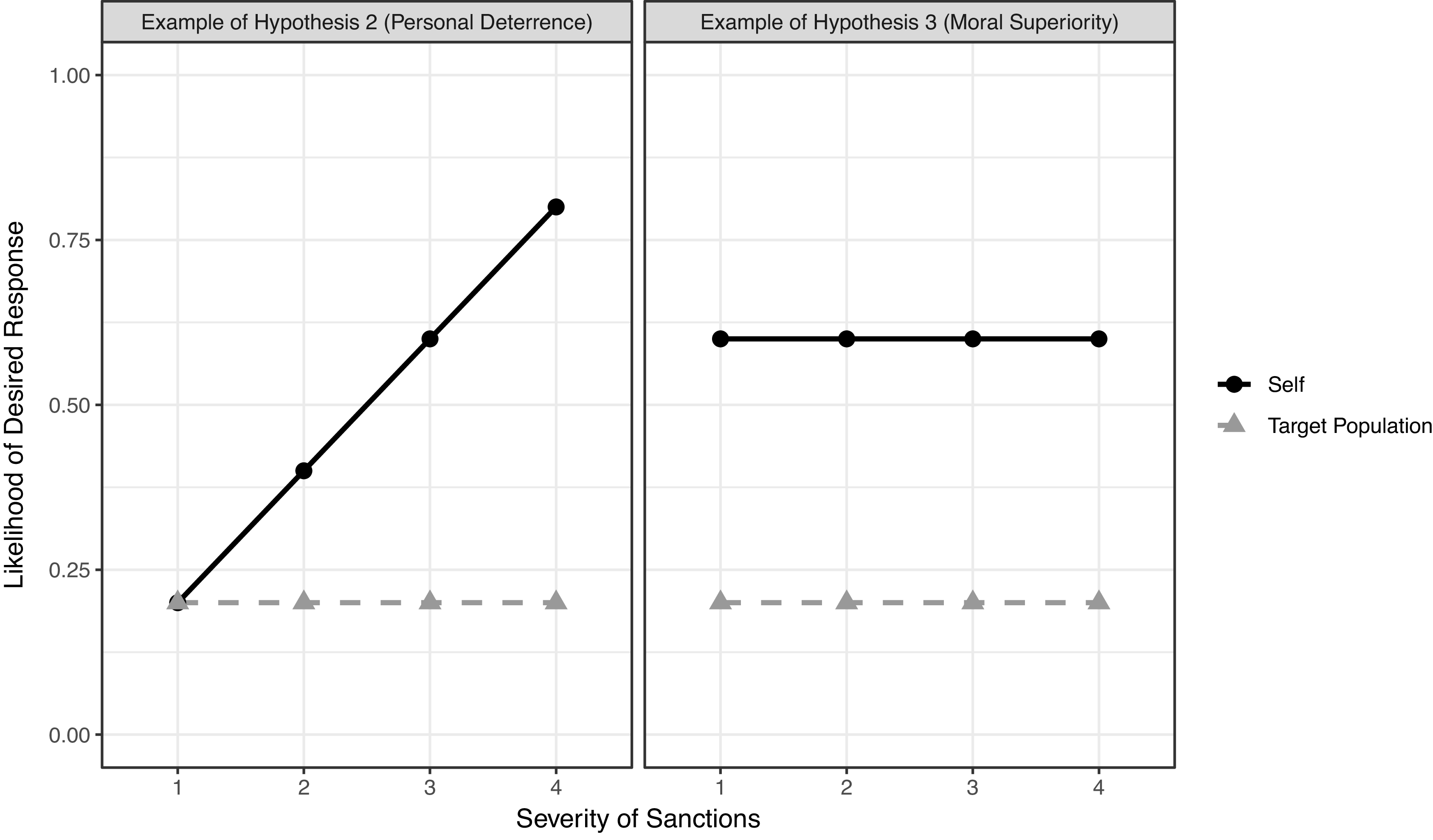
Figure 1 shows a schematic version of what Hypotheses 2 and 3 could look like, where higher values on the x axis indicate greater severity of sanctions, and higher values on the y axis indicate a higher likelihood of the behavioral response that sanctions are intended to induce. It is possible for both to be true at once, namely that the “self” line in Figure 1 is upward-sloping and there is a positive gap between the “self” and “target population” lines for all levels of sanction. At least one of these two situations should exist for the punishment-as-retribution theory to be true, since they imply that people believe that the populations targeted for punishment exhibit inferior behavior to their own.
Examples of Hypotheses 2 and 3.
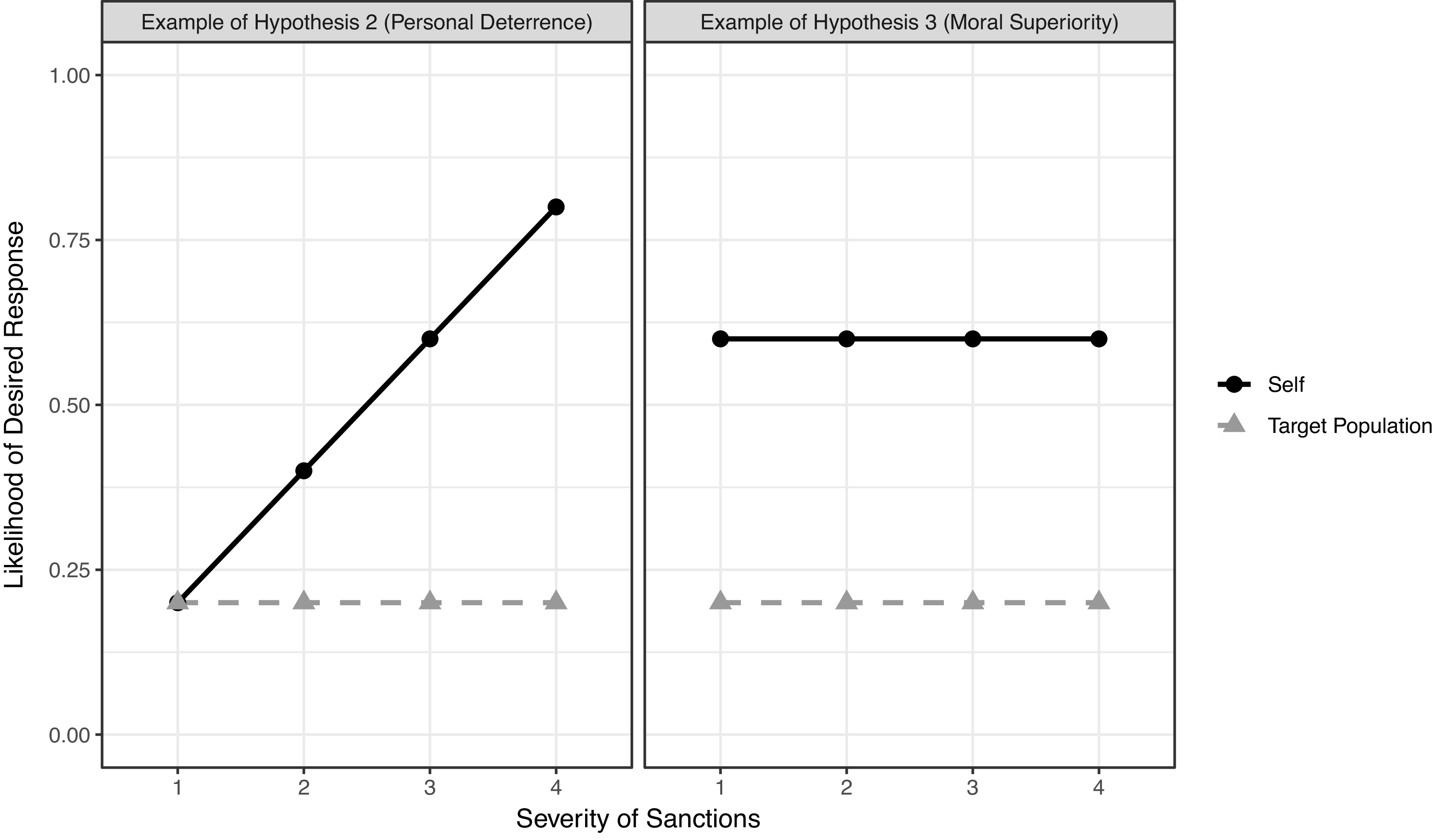
Figure 1. Long description
The image contains two line graphs side by side. Panel A, titled ‘Example of Hypothesis 2 (Personal Deterrence)’, shows a line graph with the x-axis labeled ‘Severity of Sanctions’ ranging from 1 to 4 and the y-axis labeled ‘Likelihood of Desired Response’ ranging from 0.00 to 1.00. The graph includes two lines: one for ‘Self’ represented by black circles and another for ‘Target Population’ represented by gray triangles. The ‘Self’ line shows an upward trend, indicating an increase in the likelihood of desired response with the severity of sanctions. The ‘Target Population’ line remains flat, indicating no change in the likelihood of desired response. Panel B, titled ‘Example of Hypothesis 3 (Moral Superiority)’, also shows a line graph with the same axes and labels. The ‘Self’ line remains flat, indicating no change in the likelihood of desired response with the severity of sanctions. The ‘Target Population’ line also remains flat, indicating no change in the likelihood of desired response.
Hypotheses 4 and 5 test two further observable implications of the theory of punishment-as-retribution. First, punishment should be seen as fair because people view themselves as behaving in superior ways: it is motivated by a desire to take symbolic revenge against actions deemed immoral or threatening to social order:
Hypothesis 4: Fairness due to personal deterrence or perception of superior behavior. Sanctions are seen as fairer when people believe that they themselves would be deterred by sanctions, or would behave in superior ways.
In addition, for the punishment-as-retribution theory to be correct, people who believe in both the fairness of punishments and their own behavioral superiority (i.e. they satisfy hypothesis 4) should have higher levels of authoritarian values, believing in the importance of following rules and respecting authority:
Hypothesis 5: Authoritarian Values. People who believe in fairness due to personal deterrence or superior behavior are more authoritarian than those who do not.
Finally, I test whether personal deterrence or perceptions of superior behavior explain more general support for punitiveness in public policy. Can perceptions of behavior as measured within the experiments explain support for sanctions measured outside of them?
Hypothesis 6: General Support for Punitiveness. General support for punitiveness is explained by personal deterrence or perceptions of superior behavior.
Setup of the Experiments
To test these hypotheses, two experiments were fielded with the survey company YouGov, in June and July 2025, on representative samples of the population of Great Britain (n = 2228 and n = 2013 respectively). The first was about punitiveness in immigration policy and the second was about punitiveness in welfare policy. Both were factorial vignette experiments, a popular approach to testing preferences for social policy used in recent studies such as Abraham et al. (Reference Abraham, Rottmann and Stephan2023) and Buss (Reference Buss2019). Specifically, respondents were shown a single description of a migrant or benefits claimant, with features of the description randomised. The severity of sanctions imposed for misconduct was varied at random across respondents.
Vignette experiments have a number of advantages for studying the motives behind punishment. They have greater realism than survey questions asking hypothetically whether punishment serves as a deterrent, since respondents must instead evaluate a realistic case that is described to them. Asking them directly whether they believe that deterrence works would risk conflating ideological support for punitiveness, or dislike of those being punished, with beliefs about its effectiveness. Compared to a single question, more than one feature can also be randomly varied at once, allowing assessment of each one independently, and richer descriptions of those being punished become possible. Characteristics such as race that might otherwise be guessed at by the respondents, and could affect their answers, can be specified and allowed to vary at random. In addition, with a vignette experiment it is harder for respondents to detect the intentions of the surveyor. In the vignettes used in this paper, the sanctions were one of only a number of features described in the vignette, meaning that it is less likely that respondents will assume they are the main focus of the study. This reduces social desirability bias. Respondents were also only asked about one profile. Beliefs about deterrence were measured by comparing across respondents exposed to profiles featuring differing severities of punishment, rather than asking them to compare multiple profiles. Respondents therefore could not know that features of the vignette were being varied.
Experiment 1: Immigration
The survey experiment began with a question designed to capture general support for punitiveness against migrants, asking:
To what extent do you agree or disagree with the following statement? “People who come to the UK on small boats from France should be detained in an immigrant detention centre and then sent back to their home country.”
with a five-point response scale (strongly support, somewhat support, neither support nor oppose, somewhat oppose, strongly oppose).Footnote 3 This question relates to a highly salient, extremely well-publicised (and politicised) issue in Britain which has featured very prominently in media coverage and on social media.Footnote 4 Migrants have been arriving on the UK’s south coast from France on small vessels, a route deemed illegal by the British government, and the visible nature of this irregular migration has attracted major controversy, leading to both the current and previous UK governments to pledging to “stop the boats.”
After this, respondents were told “please read this description of a potential immigrant to the UK, and answer the questions about them below.” Each respondent was then shown a single vignette describing the migrant, with the following format, where randomised elements are shown within brackets, in italics:
[Name] is an immigrant considering migrating to the UK by crossing the English Channel on a small boat. [He/she] is [reason for migrating]. If [he/she] arrives in the UK on a small boat, [he/she] will [level of sanction].
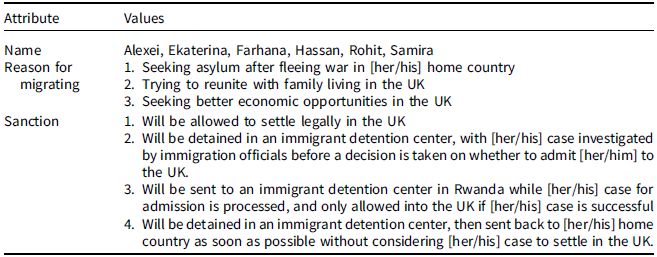
Table 1 shows the possible attributes for the randomised elements. With six names, three reasons for migrating and four possible sanctions, there were seventy-two possible profiles in total, all appearing with an equal probability. One example of a complete vignette would be the following:
Alexei is an immigrant considering migrating to the UK by crossing the English Channel on a small boat. He is trying to reunite with family living in the UK. If he arrives in the UK on a small boat, he will be sent to an immigrant detention centre in Rwanda while his case for admission is processed, and only allowed into the UK if his case is successful.
Attributes and their possible values in the immigration experiment
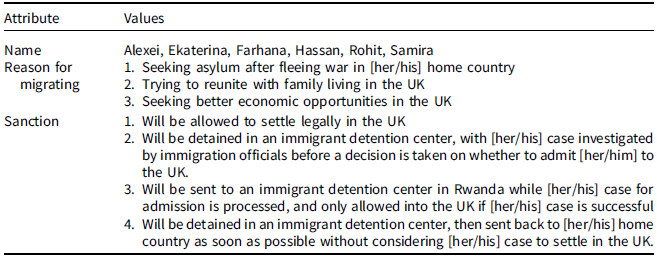
Table 1. Long description
A table with three columns and six rows, detailing attributes and their possible values in an immigration experiment. The columns are labeled ‘Attribute’, ‘Values’, and ‘Sanction’. The ‘Attribute’ column lists ‘Name’, ‘Reason for migrating’, and ‘Sanction’. The ‘Values’ column lists names Alexei, Ekaterina, Farhana, Hassan, Rohit, Samira, reasons for migrating including seeking asylum, reuniting with family, and seeking better economic opportunities. The ‘Sanction’ column lists possible sanctions such as being allowed to settle legally, detained in an immigrant detention center, sent to an immigrant detention center in Rwanda, or detained and sent back to the home country.
The names do not form part of the analysis but were added for greater realism, supplying racial cues that might otherwise have been guessed at by respondents. The reasons for migrating involve different levels of personal culpability for their situation on the part of the migrant. This has been a core focus of past literature on the desire to punish free-riding and is therefore included both to add further realism and to show how the results compare to past findings. The main interest for this paper is in the different levels of sanction, which range from non-existent (option 1) to extremely harsh (option 4). If sanctions have a deterrent effect, migration should be perceived as less likely, the more the severity of sanctions increases.
To measure perceptions of fairness and the likelihood of migration, three follow-up questions were asked (in a randomised order). One question asked about perceptions that the migrant would try to come to the UK, with another asking how the respondent believes they themselves would behave in the same circumstances (to test Hypotheses 1–3). In designing these two questions there was the potential for consistency bias (perceived pressure to give the same answer to both questions) or satisficing (giving the same response to both as a way to save time). To avoid this possibility, the two questions were worded slightly differently, with different responses scales, as follows:
How likely or unlikely do you think it is that [name] will try to migrate to the UK on a small boat? [Very likely, Somewhat likely, Somewhat unlikely, Very unlikely]
To what extent do you agree or disagree with the following statement – “If I were in [name]’s position, I would try to migrate to the UK on a small boat” [Strongly agree, Somewhat agree, Somewhat disagree, Strongly disagree]Footnote 5
Nonetheless, using slightly different response scales and wordings might render the two questions less comparable, which is important for Hypothesis 3. As a result, the welfare experiment (presented in the next part of the paper) instead worded these two questions the same, with identical question response scales. As the results section will show, the results in terms of Hypothesis 3 are virtually identical for both experiments, suggesting that this design decision is not consequential for the results. In addition to these two questions, respondents were also asked:
How fairly or unfairly do you think [name] is being treated by the immigration system? [Very fairly, Somewhat fairly, Somewhat unfairly, Very unfairly]
The survey experiment ended by measuring respondents’ authoritarian values, using Feldman and Stenner (Reference Feldman and Stenner1997)’s 4-item scale of child-rearing values, yielding a measure ranging from 0 to 4. The measure is well-suited for this paper in that it conceives of authoritarianism as a personality trait or predisposition that is fundamentally about rule-following and obedience to authority, measured without asking explicitly political questions. Recent methodological work in the UK and US confirms its validity (Engelhardt et al. Reference Engelhardt, Feldman and Hetherington2023; Vasilopoulos and Robinson Reference Vasilopoulos and Robinson2025), and it is also standardly used in the British Election Study to measure authoritarianism (Fieldhouse et al. Reference Fieldhouse, Green, Evans, Mellon, Prosser, Bailey, de Geus, Schmitt, van der Eijk, Griffiths and Perrett2024). Its construction is described in more detail in the Appendix.
Experiment 2: Benefits
This experiment had a very similar setup to the immigration experiment. It began with a question designed to capture general support for punitiveness against benefit claimants, asking:
To what extent do you agree or disagree with the following statement? “People claiming unemployment benefits who fail to accept an offer of a suitable new job should be sanctioned, meaning that their benefit payments are stopped for a period of time.”
with a five-point response scale (strongly support, somewhat support, neither support nor oppose, somewhat oppose, strongly oppose). The question references a real policy currently in operation in the British benefits system (Universal Credit) where people who fail to accept reasonable offers of work may be sanctioned. In the same way as for the immigration experiment, respondents were then shown a vignette about a benefits claimant, with the following structure:
[Name] was made redundant three months ago [reason for redundancy]. [He/she] is now claiming Universal Credit through [her/his] local JobCentre due to being unemployed. As a condition of receiving this benefit, [he/she] is required to be available for work, including accepting any offers of suitable new jobs. [Her/his] behaviour is monitored by JobCentre staff. [Level of Sanction]
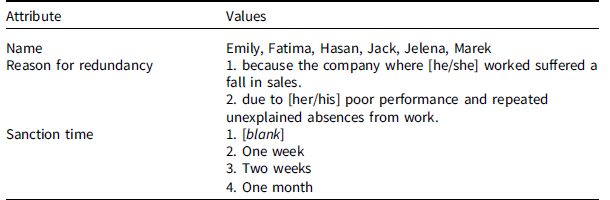
Table 2 shows the possible attributes for the randomised elements. With six names, two reasons for losing the job and four possible sanctions, there were forty-eight possible profiles in total. The most lenient level for the sanction attribute left it blank (i.e., no sanction is mentioned, with the vignette simply ending with the statement that their behavior will be monitored by JobCentre staff), with the other three representing increasing levels of severity that reflect real penalties used in the British benefits system.Footnote 6 For these three sanctions, the text was as follows:
If [he/she] refuses a suitable job offer without good reason, he/she will be sanctioned. This means that her/his payments will be stopped for a period of [sanction time], so that [he/she] receives no unemployment benefit during that time.
Attributes and their possible values in the welfare experiment
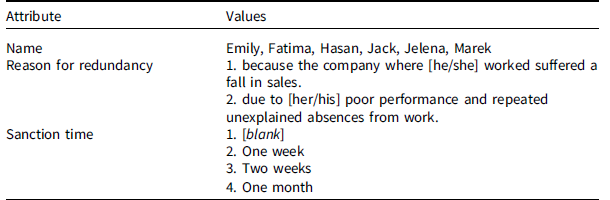
Table 2. Long description
A table with two columns: Attribute and Values. The table lists attributes and their corresponding possible values. The first row under Attribute is Name, with values Emily, Fatima, Hasan, Jack, Jelena, Marek. The second row under Attribute is Reason for redundancy, with values 1. because the company where [he/she] worked suffered a fall in sales, 2. due to [her/his] poor performance and repeated unexplained absences from work. The third row under Attribute is Sanction time, with values 1. [blank], 2. One week, 3. Two weeks, 4. One month.
Thus one example of a complete vignette would be the following:
Emily was made redundant three months ago due to her poor performance and repeated unexplained absences from work. She is now claiming Universal Credit through her local JobCentre due to being unemployed. As a condition of receiving this benefit, she is required to be available for work, including accepting any offers of suitable new jobs. Her behaviour is monitored by JobCentre staff. If she refuses a suitable job offer without good reason, she will be sanctioned. This means that her payments will be stopped for a period of one week, so that she receives no unemployment benefit during that time.
Here, the main interest for this paper is again in the differing severity of sanctions, which range from non-existent (option 1) to withdrawing benefits for one month (option 4). If sanctions have a deterrent effect, refusing a job offer should be perceived as less likely as the severity of sanctions increases. Three follow up questions were then asked, again in a randomised order, which were similar to those for the immigration experiment but with the difference that the two questions about the likelihood of accepting a job offer had the same format and response scale, as follows:
How likely or unlikely do you think it is that [name] will accept any offer of a suitable new job, in line with the rules for Universal Credit? [Very likely, Somewhat likely, Somewhat unlikely, Very unlikely]
Suppose you were in [name]’s position. How likely or unlikely do you think it is that you would accept any offer of a suitable new job, in line with the rules for Universal Credit? [Very likely, Somewhat likely, Somewhat unlikely, Very unlikely]
Unlike in the immigration experiment, it was not possible to ask about authoritarian values in this survey, and so the third and final question asked:
How fairly or unfairly do you think [name] is being treated by the JobCentre? [Very fairly, Somewhat fairly, Somewhat unfairly, Very unfairly]
Results: Punishment-as-Deterrence and Punishment-as-Retribution
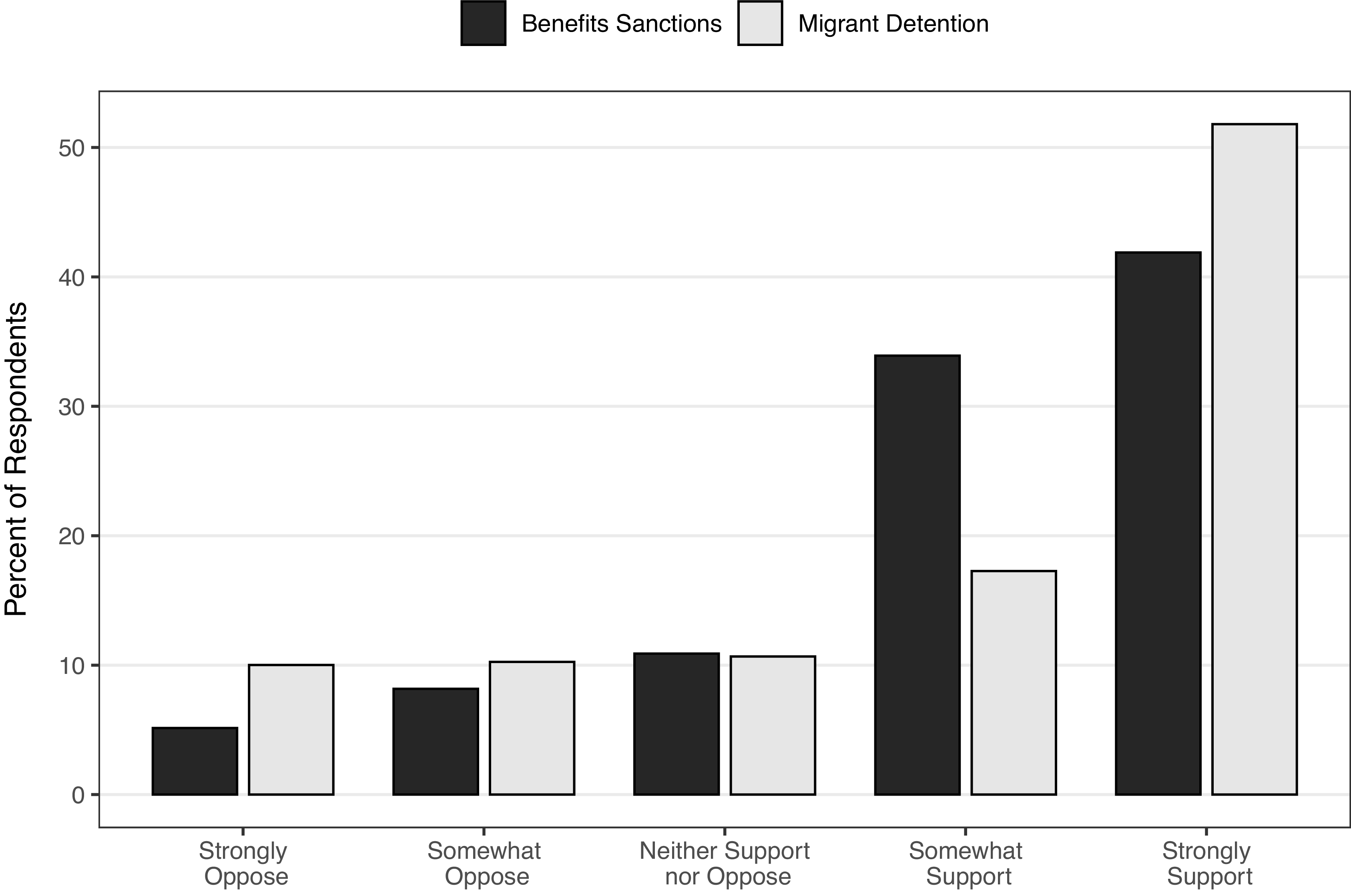
This section tests Hypotheses 1–6.Footnote 7 First of all, in both experiments, punitive policies were very popular. Figure 2 shows the distribution of responses to the two opening questions that asked about support for detaining and deporting migrants, and benefits sanctions for people who refuse job offers. 73% either somewhat or strongly supported the migrant deportation plan. For benefits sanctions, the corresponding figure was 79%. This underlines the fact that, in spite of the limited effectiveness of these policies in changing behavior, they are strongly endorsed by voters in the abstract.
Support for detention of migrants and benefits sanctions.
Note: Immigration question asks for level of support for detaining migrants arriving in the UK on small boats and then sending them back to their home country. Welfare question asks for level of support for temporarily stopping benefits payments for claimants who fail to accept a suitable job offer.
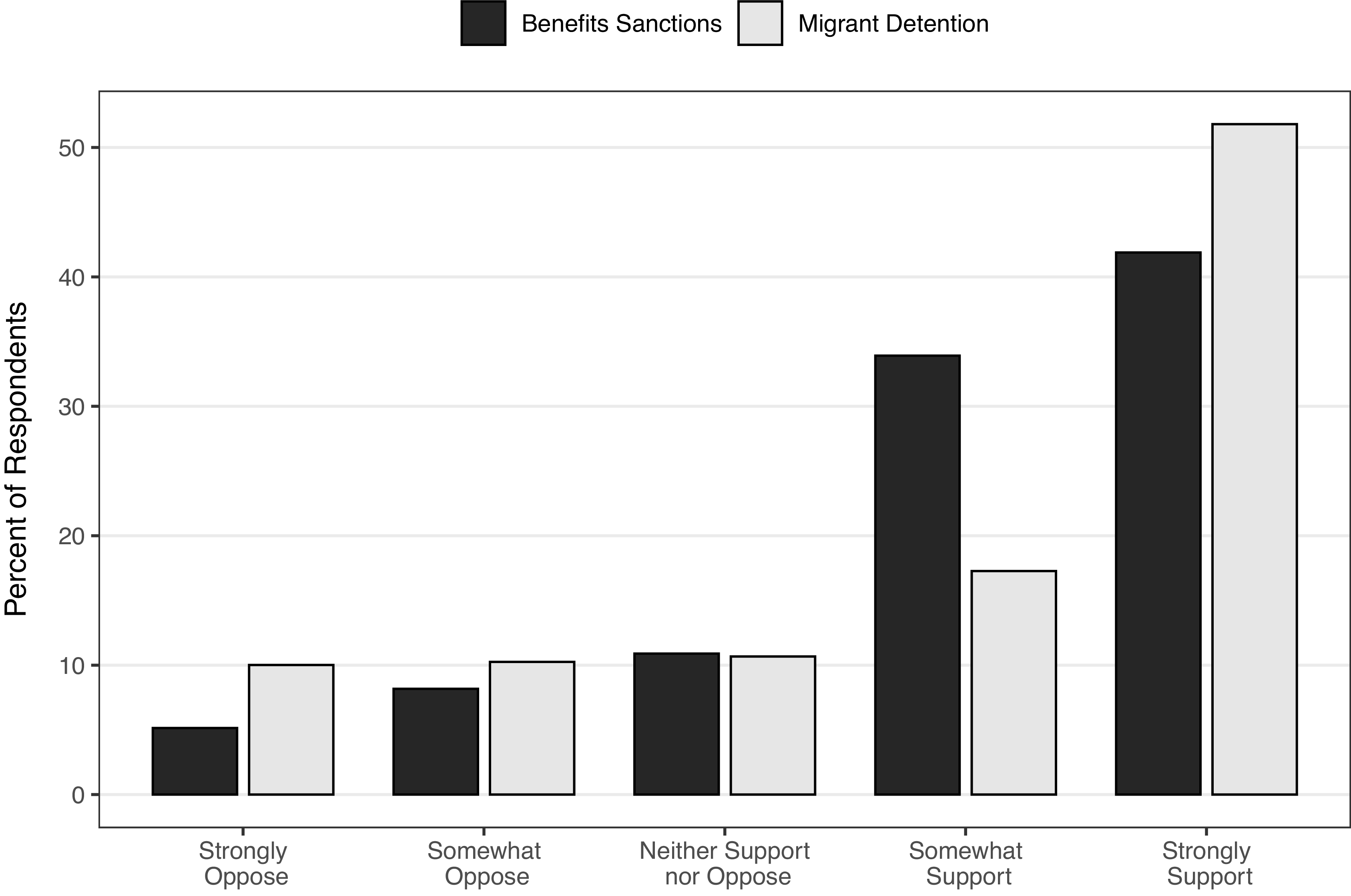
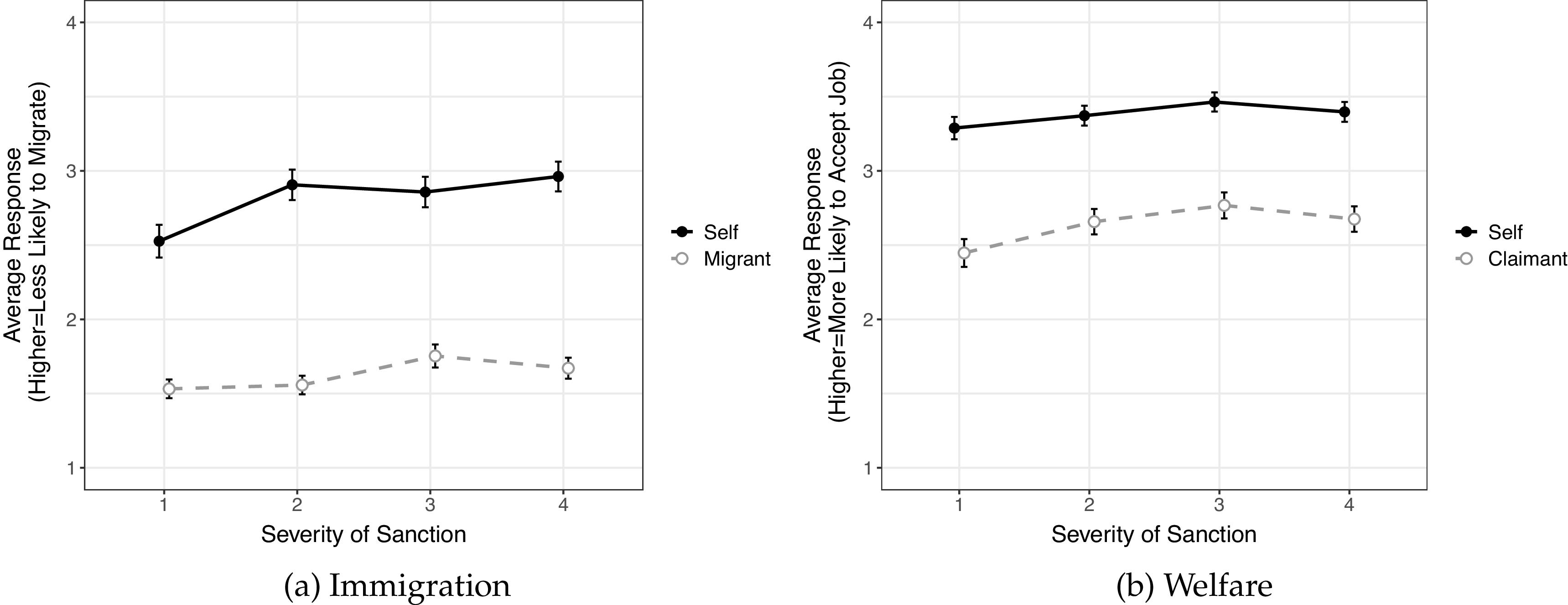
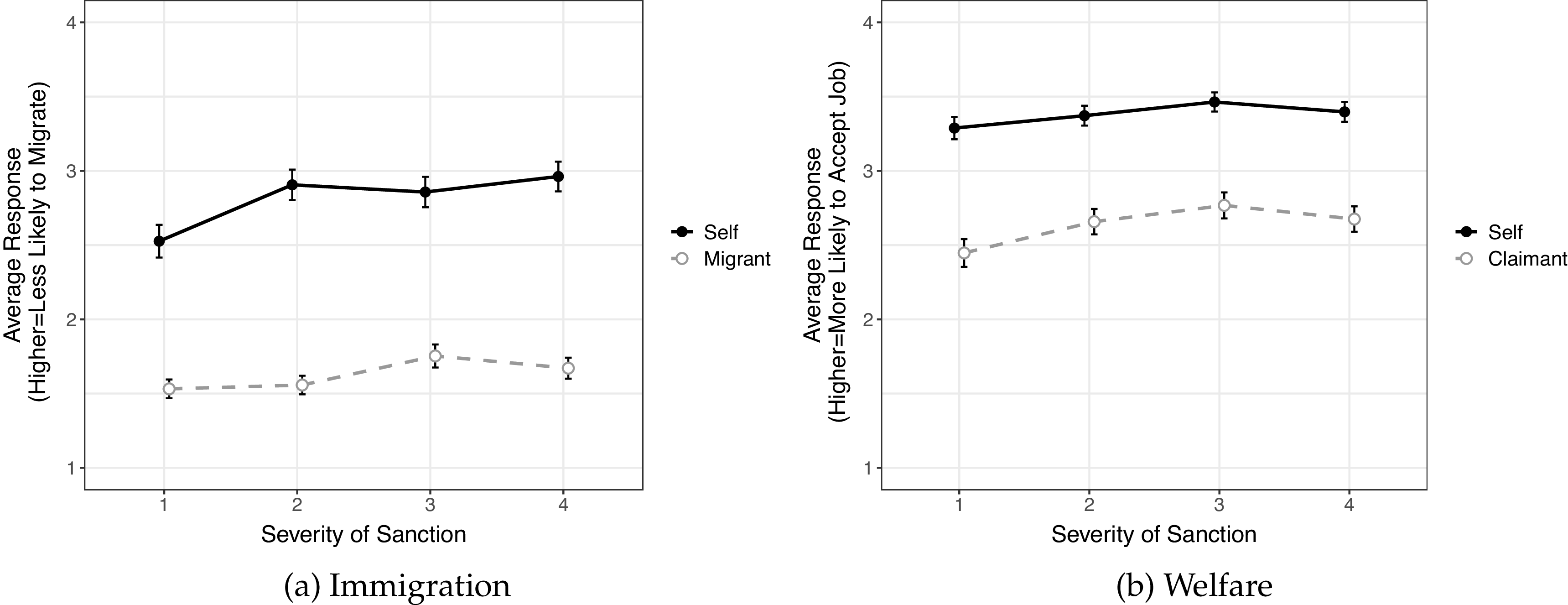
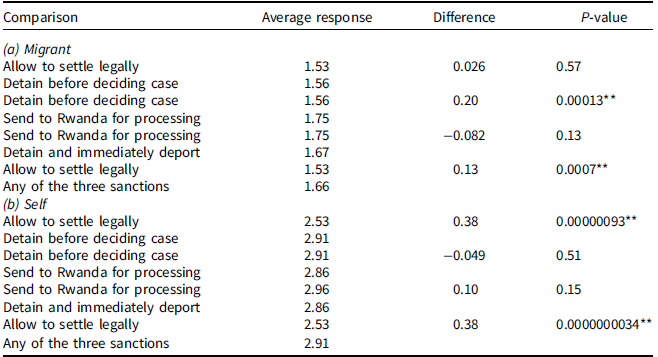
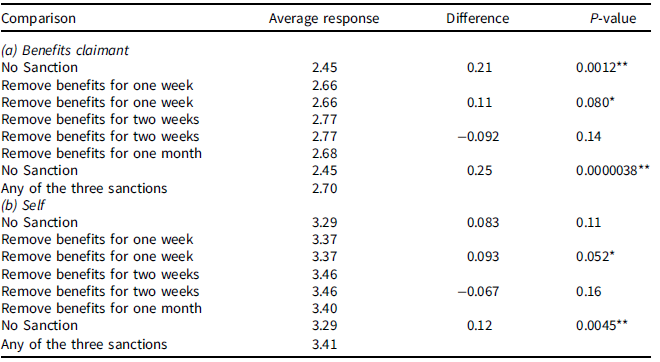
Figure 3 shows key results from the two experiments for Hypotheses 1–3. In each case it plots the average level of belief that either the target population or the respondent themselves would exhibit the desired behavior (not migrating, accepting a job offer), for each of the four randomly assigned levels of severity of punishments in the vignettes. In these and all other analyses in the paper, the response scales to the survey questions are treated as continuous variables.Footnote 8 Tables 3 and 4 show whether or not these differences between the punishment levels are statistically significant, using a series of pairwise t-tests between adjacent levels. In the bottom row, they also compare no punishment (level 1) to any punishment (levels 2, 3 or 4).
Perceived likelihood of desired behavior as severity of sanctions increases, for targeted populations and self (mean scores and 95% Confidence Intervals).
Note: The x axis shows each of the four possible levels of punishment in each experiment, as shown in Tables 1 and 2. In both cases, “1” indicates no punishment and “4” is the most severe.
Immigration deterrence comparisons
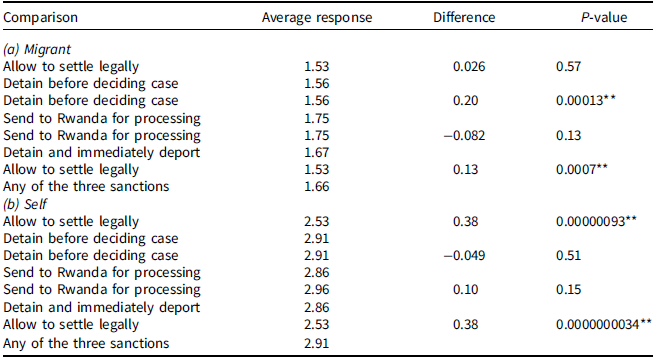
Table 3. Long description
The table compares average responses to different scenarios involving migrants and self-punishment. It has four columns: Comparison, Average response, Difference, and P-value. The table is divided into two main sections: (a) Migrant and (b) Self. Each section lists different scenarios and their corresponding average responses, differences, and p-values. For example, under (a) Migrant, scenarios include ‘Allow to settle legally’, ‘Detain before deciding case’, and ‘Send to Rwanda for processing’. Under (b) Self, scenarios include similar options but focused on personal responses. Notable p-values are highlighted, indicating statistical significance.
**=Significant at 5% level; *=Significant at 10% level.
Welfare deterrence comparisons
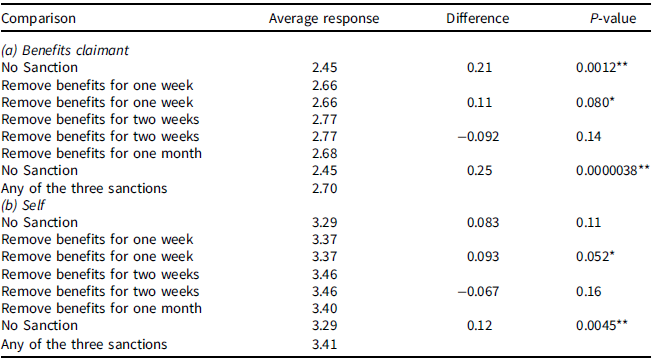
Table 4. Long description
A table comparing welfare deterrence across different sanctions and responses. The table has four columns: Comparison, Average response, Difference, and P-value. It is divided into two main sections: (a) Benefits claimant and (b) Self. Section (a) has six rows comparing different sanction scenarios and their effects on benefits claimants. Section (b) has six rows comparing the same sanction scenarios but focusing on the self. Each row lists the comparison, average response, difference in response, and the P-value indicating statistical significance. Notable comparisons include the effect of removing benefits for one week versus no sanction, and removing benefits for two weeks versus one week, with corresponding differences and P-values.
**=Significant at 5% level; *=Significant at 10% level.
Starting with the behavior of hypothetical benefits claimants and migrants, in both experiments there is a statistically significant, but small, difference between punishment and no punishment. For migration, people perceive no difference between allowing migrants to settle legally or detaining them. Sending them to Rwanda for processing elicits an increase in the perceived deterrent effect, but immediate deportation has no further perceived payoff. For welfare, there is a small perceived effect of modest sanctions but no difference between sanctioning for two weeks or one month. Thus people do believe in the deterrent effect of some punishment, but there is less evidence that the perceived likelihood of desired behavior scales with the severity of punishment. Indeed in both cases, the highest sanction level actually elicits a lower average belief in desired behavior than the third-highest, and not all of the pairwise comparisons yield statistically significant differences. Hypothesis 1 is therefore weakly supported, in line with evidence on the deterrent effects of these policies in the real world.
The top lines in Figure 3 and the bottom halves of Tables 3 and 4 test Hypothesis 2 (personal deterrence). In the case of immigration, there is greater evidence for deterrence when comparing no sanctions to the lowest level of sanction. Respondents quite strongly believe that the threat of detention would discourage themselves from migrating. However, there is no evidence of a deterrent effect beyond this, for the more severe sanctions. By comparison, there is little evidence for a personal deterrence effect in the case of welfare, with just a small difference between sanctions and no sanctions, and no increase in the deterrent effect with their severity. Thus, Hypothesis 2 is only weakly supported.
There is strong evidence for Hypothesis 3 (superior behavior). Regardless of the severity of punishment, respondents are much more likely to say that they would behave in the desired way than that the targeted populations would. The differences are much larger than those between the different levels of sanctions and are clearly statistically significant. This is as true when there is no punishment as when the punishment is most severe, indicating that they believe that they would always behave more virtuously, even in the absence of any punishment. This evidence is in line with the deterrence-as-retribution theory. People feel that migrants and benefits claimants engage in inferior conduct, falling short of respondents’ own behavioral standards.
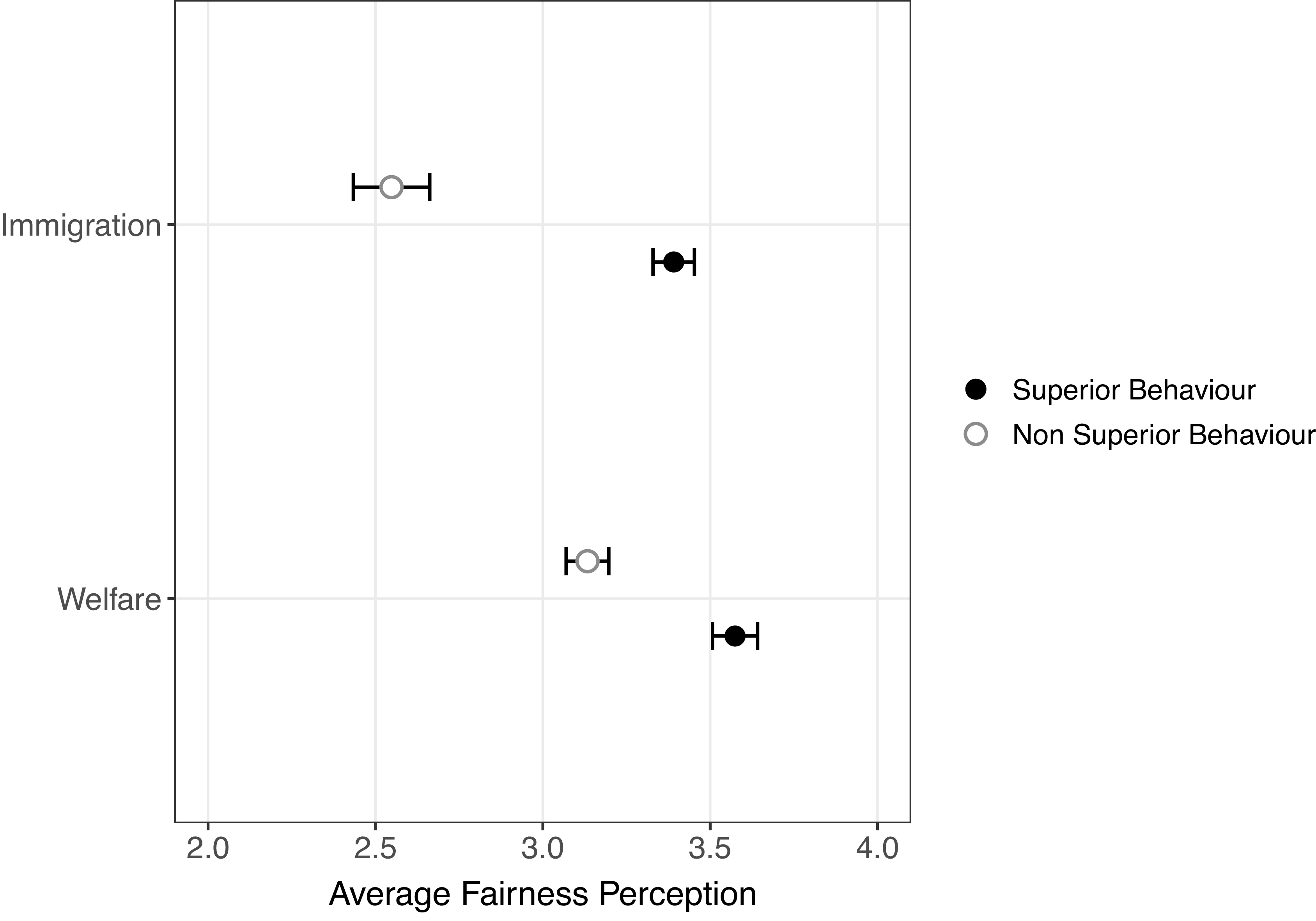
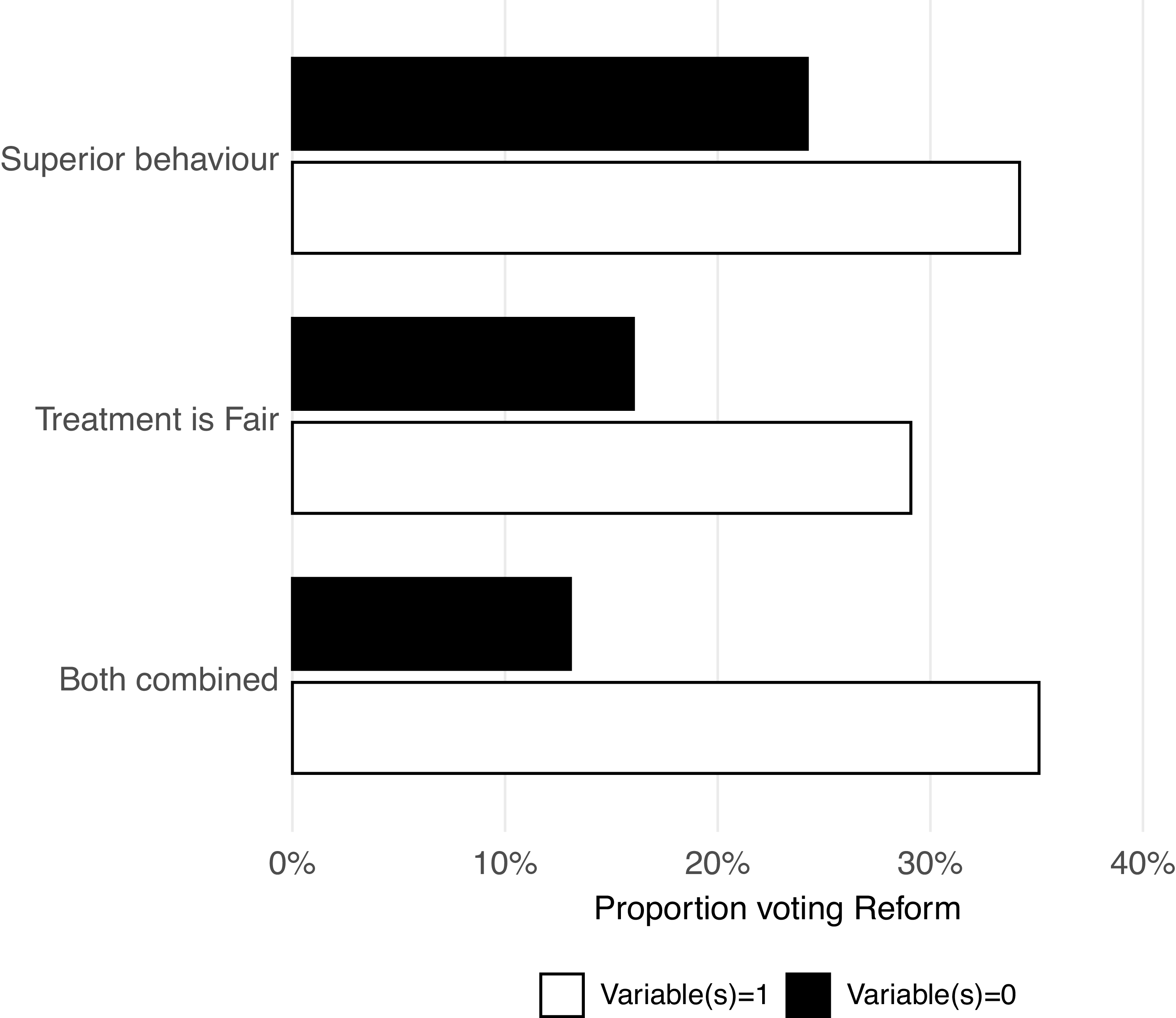
Next, Figure 4 tests Hypothesis 4: that perceptions of superior behavior are important in explaining the perceived fairness with which the groups are being treated. Looking only at those assigned to one of the three experimental conditions involving sanctions, it displays differences in the mean perception that the migrant or welfare claimant is being treated fairly between those who perceived that their behavior is superior and those who did not. “Superior behaviour” is a binary variable coded as 1 if a respondent perceived a higher likelihood, on the 1-4 response scales, that they would engage in the targeted behaviors (not migrating, accepting a job offer) compared to the migrant or benefits claimant.Footnote 9
Average perceptions of fair treatment, by behavioral superiority (mean scores and 95% Confidence Intervals).
Note: Includes only those assigned to one of the three treatments involving punishment.
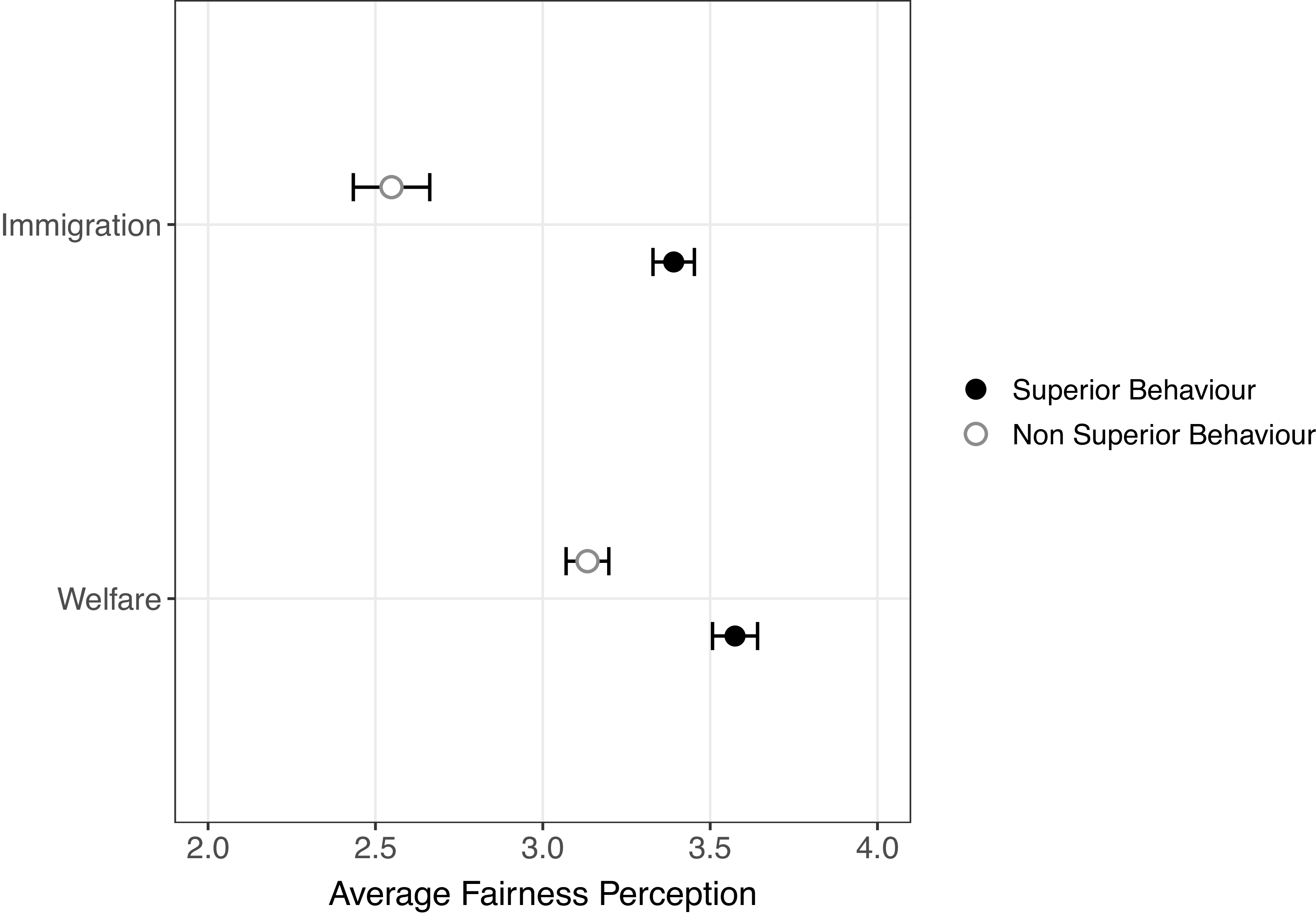
In both cases, and especially for immigration, those perceiving that marginalised groups would be less likely than themselves to engage in the targeted behaviors, despite the threat of punishment, view their treatment as much fairer. Thus punishment appears much fairer when those being punished are seen as failing to live up to the respondent’s own behavioral standards. This is consistent with a worldview that it is unfair for people to be able to get away with behavior that falls below typical standards, in line with the deterrence-as-retribution theory.
Perceiving that one’s behavior is superior is not an experimentally randomised variable. It could be correlated with other demographic or political characteristics that affect fairness perceptions. Table A1 in the Appendix shows that the results from Figure 4 change little when controlling for all background variables that were available in the survey including authoritarianism, age, gender, education and social class. As a further check, Figure A2 in the Appendix presents a placebo test where the same analysis as Figure 4 is carried out, but instead only for people assigned to the experimental conditions without any sanctions. Here, the difference in fairness perceptions between those who do and do not perceive their behavior as superior is greatly reduced, almost to zero in the case of the welfare experiment. This suggests that the sense of superior behavior is specifically related to perceiving punishments to be fair as opposed to, for instance, a general outlook that the world is a fair place.
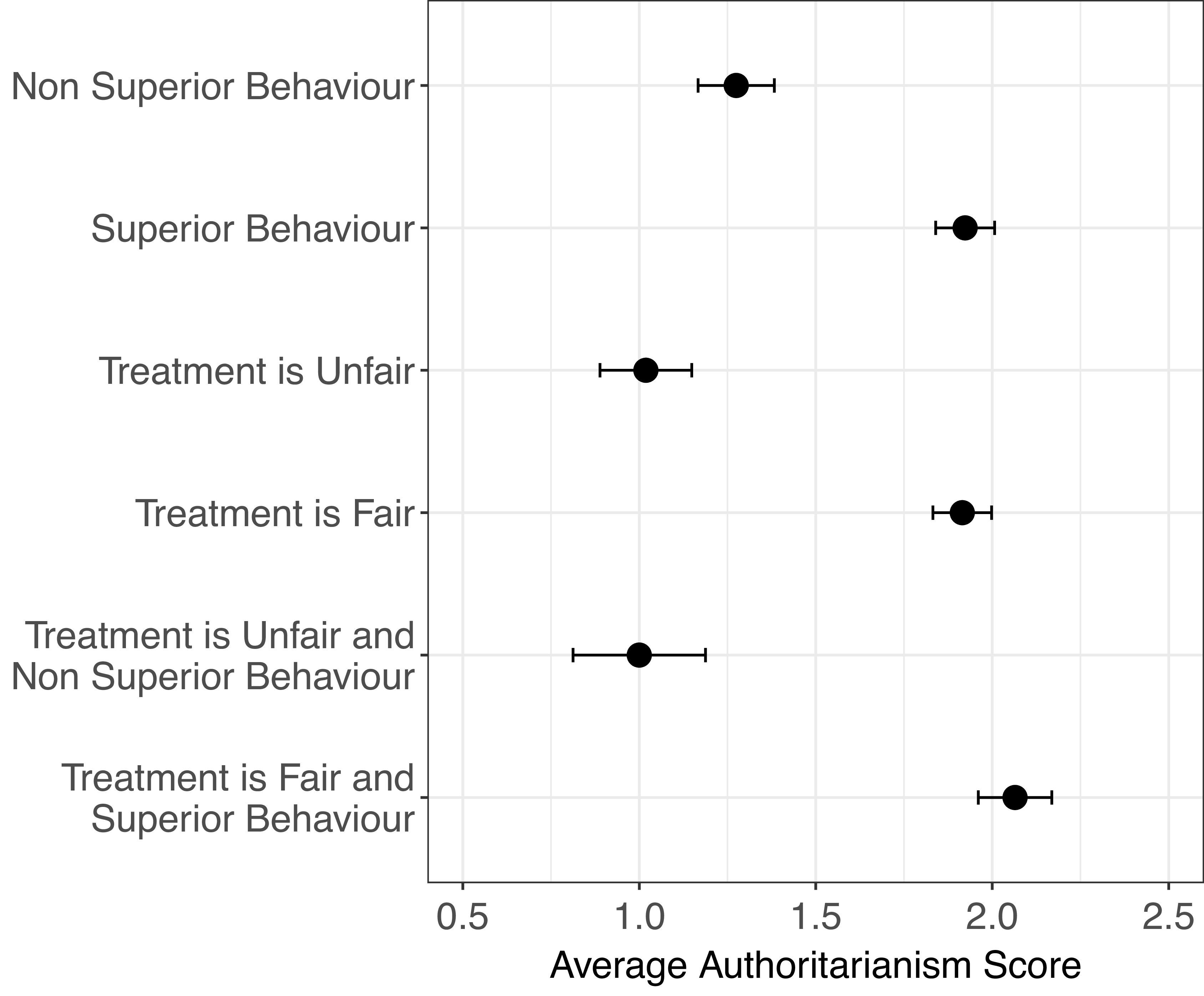
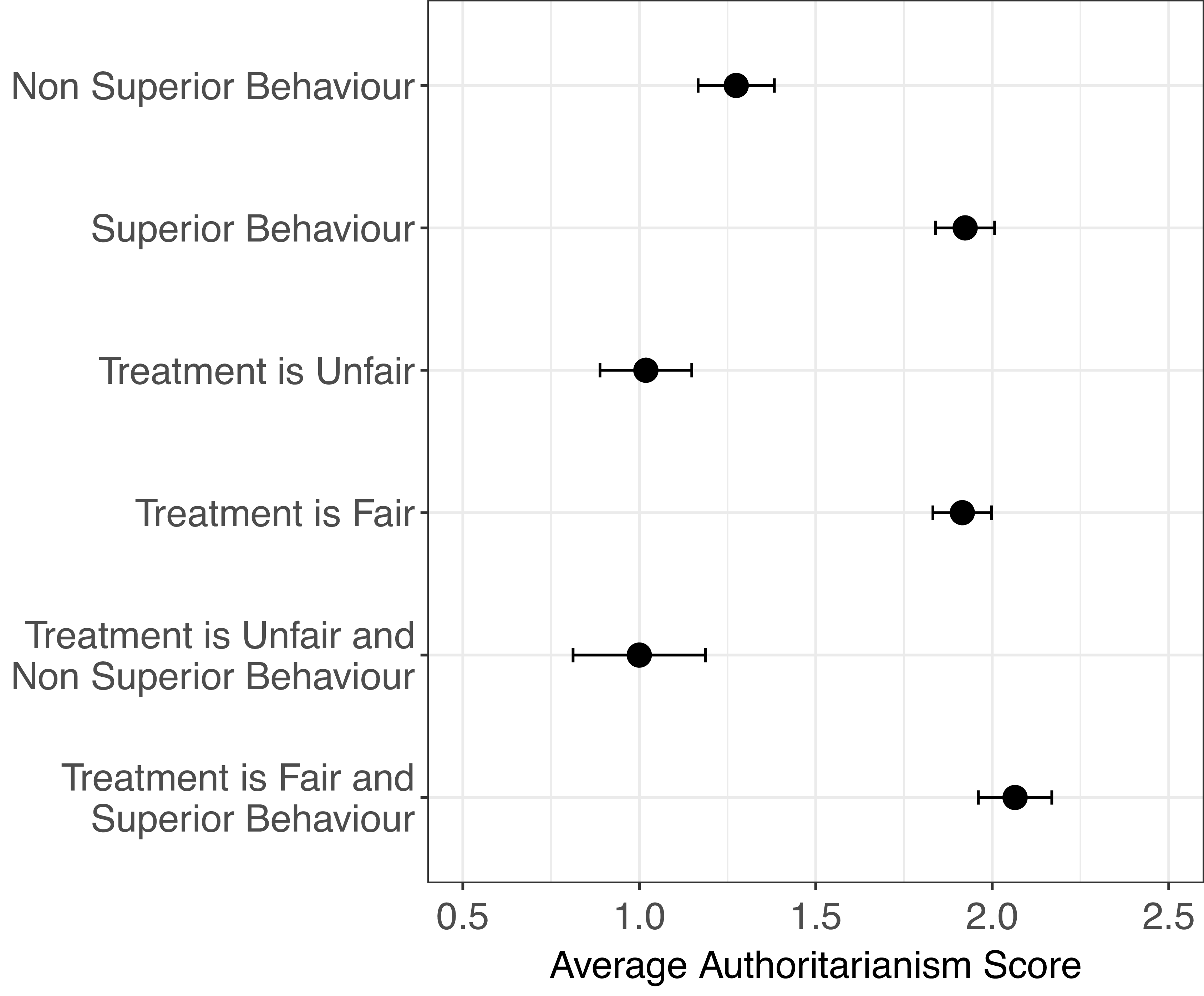
The notion that this reflects a retributive worldview is reinforced by testing Hypothesis 5, on authoritarian values. It was only possible to measure authoritarian values in the immigration experiment, and so Figure 5 shows respondents’ average authoritarianism, as measured on the values scale defined above (ranging from 0 to 4) for selected groups in the immigration experiment who were assigned to vignettes featuring one of the three sanctions. Those who perceive themselves as behaving in morally superior ways are substantially more authoritarian than those who are not. The standard deviation of the authoritarianism scale was 1.35, meaning that those who perceive themselves as having superior behavior are almost half a standard deviation more authoritarian. The gap widens further when comparing those who feel the treatment of the migrant is fair to those who do not (those who responded that they were being treated “somewhat” or “very” fairly), and even further still when comparing respondents who are most and least likely to be motivated by punishment-as-retribution: those that both perceive themselves as behaving in morally superior ways and who also feel that the treatment is fair, compared to those who fulfill neither condition. Here, the difference is more than three-quarters of a standard deviation.
Authoritarianism in the immigration experiment, by perceptions of superior behavior and fair treatment (means and 95% Confidence Intervals).
Note: Includes only those assigned to one of the three treatments involving punishment.
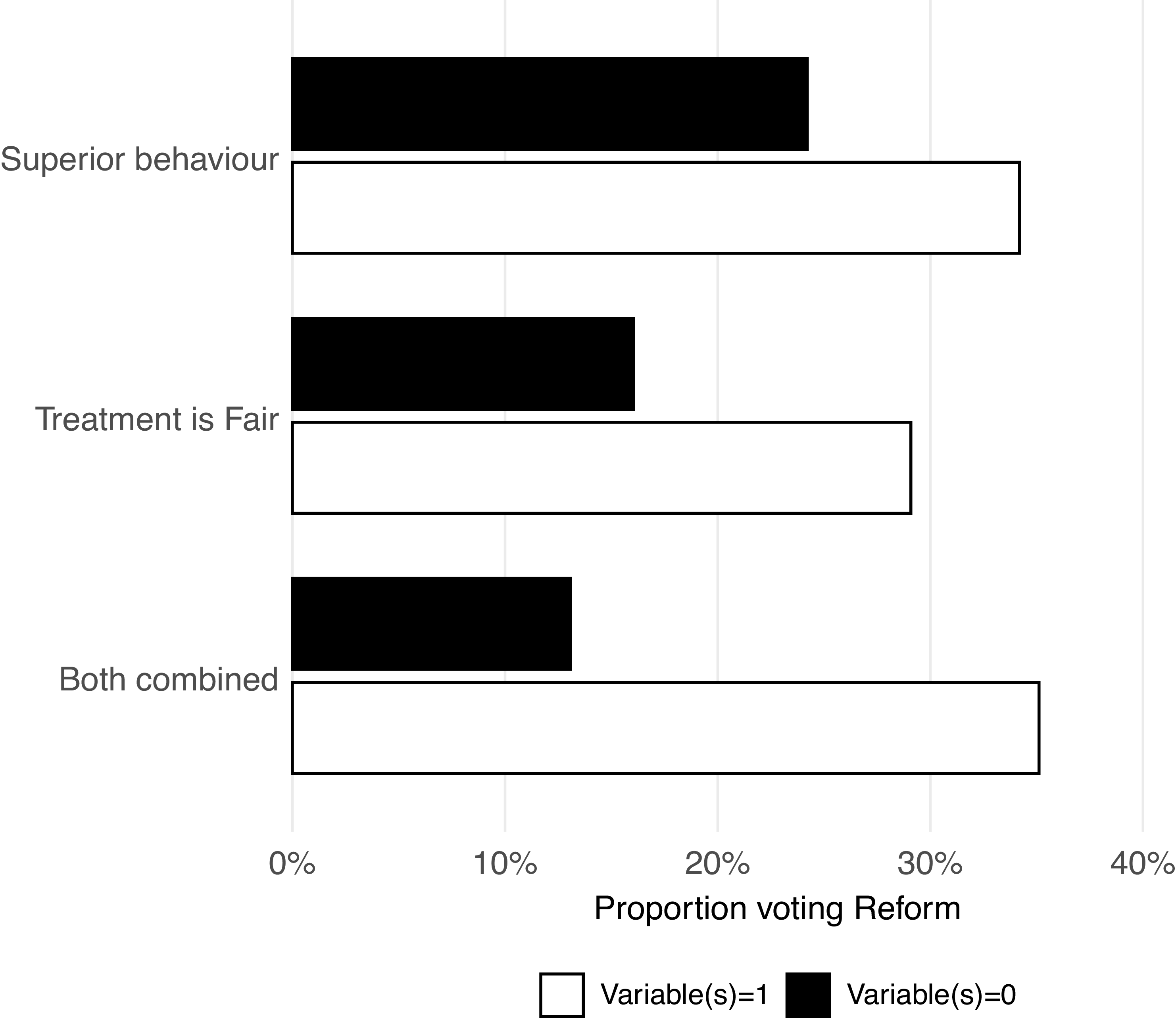
Although the authoritarian values measure was unavailable in the welfare experiment, it is possible to instead analyse the nearest available proxy for authoritarianism scale: a variable equaling 1 if the respondent reported that they intended to vote for the Reform Party at the next election and 0 otherwise. Reform are the UK’s radical right party, which has taken hardline stances across a range of issues, notably immigration, attracting highly authoritarian voters. Figure 6 therefore carries out similar comparisons to Figure 5, comparing the percentage of those who do or do not support Reform for the same superior behavior, perception of fair treatment and combination variables. The same patterns are apparent: those who perceive their own behavior as superior or who perceive the benefits claimants as being fairly treated in the vignettes featuring sanctions are much more likely to be Reform voters, and the gap further widens when both variables are considered jointly. As with immigration, attitudes associated with retribution are most likely to be found amongst voters with an authoritarian outlook.Footnote 10
Reform party support in the welfare experiment, by perceptions of superior behavior and fair treatment.
Note: Includes only those assigned to one of the three treatments involving punishment.
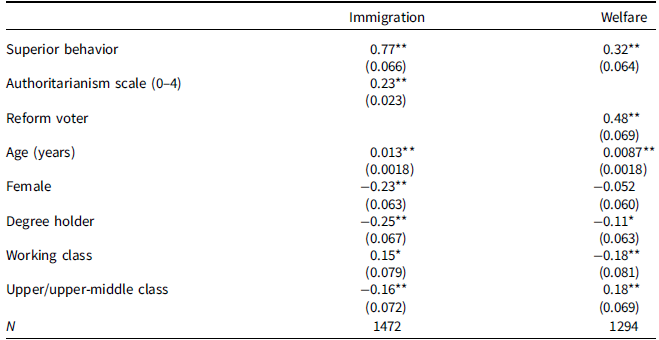
Finally, Table 5 tests Hypothesis 6, that perceptions of superior behavior should feed through into more general support for punitiveness in public policy, using linear regressions.Footnote 11 It returns to the two questions on general support for migrant deportation and benefits sanctions that were asked prior to the vignette experiments and were analysed in Figure 2. Both have 1–5 response scales, with higher values indicating greater support for punishment. In each case, the model relates these measures of general punitiveness to perceptions of superior behavior, as well as the same range of covariates discussed earlier: age (in years), sex (female = 1), social class (lower = 0 and upper/middle = 1),Footnote 12 education (degree = 1, 0 otherwise) and either authoritarianism or being a Reform voter. Therefore the aim is to find out whether perceived superiority measured within the experiment can predict support for punitiveness measured outside of it, controlling for a range of plausible confounders.
Regression results explaining support for punitive policies (1–5 scale)
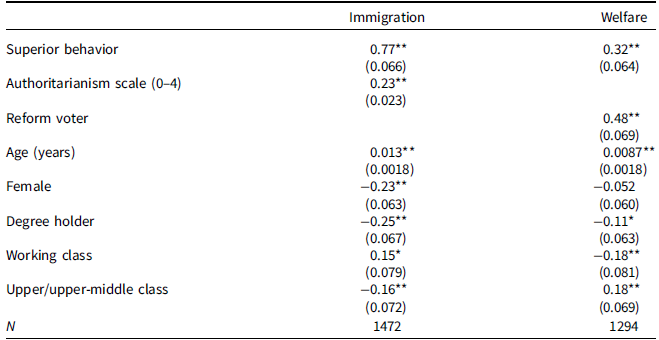
Table 5. Long description
A table with regression results explaining support for punitive policies on a 1-5 scale. The table has 12 rows and 3 columns. The columns are labeled ‘Superior behavior’, ‘Immigration’, and ‘Welfare’. Each row represents different variables and their corresponding values. Row 1: Superior behavior, Immigration 0.77, Welfare 0.32. Row 2: Authoritarianism scale (0-4), Immigration 0.23 (0.066), Welfare 0.23 (0.064). Row 3: Reform voter, Immigration 0.48 (0.023), Welfare not applicable. Row 4: Age (years), Immigration 0.013 (0.023), Welfare 0.0087 (0.069). Row 5: Female, Immigration -0.23 (0.0018), Welfare -0.052 (0.0018). Row 6: Degree holder, Immigration -0.25 (0.063), Welfare -0.11 (0.060). Row 7: Working class, Immigration 0.15 (0.067), Welfare -0.18 (0.063). Row 8: Upper/upper-middle class, Immigration -0.16 (0.079), Welfare 0.18 (0.081). Row 9: N, Immigration 1472 (0.072), Welfare 1294 (0.069).
**=Significant at 5% level; *=Significant at 10% level.
In both cases there is strong evidence that perceived behavioral superiority predicts support for sanctions. The outcome scales range from 1 to 5, with standard deviations of 1.39 and 1.15 respectively, and so perceiving one’s behavior to be superior is associated with being over one quarter to one half a standard deviation more punitive, considerably larger than the relationship with being degree-educated. In line with the theory of punishment-as-retribution, perceiving migrants or welfare claimants as engaging in morally inferior behavior strongly predicts support for punitive policies.
Figures A4 and A5 in the Appendix present the results of sensitivity analysis using the methodology of Cinelli and Hazlett (Reference Cinelli and Hazlett2020), which asks how much of the Superior Behaviour variable and the outcomes would have to be explained by a confounder in order to reduce its effect to zero (or to statistical insignificance). These show that confounders would have to be have very high explanatory power, 4–5 times as large as the authoritarian values or reform voter variables, in order to render SuperiorBehaviour insignificant. Thus the results are robust to confounding of realistic sizes.
Discussion
This paper set out to understand popular support for punitive policies in both migration and welfare, asking whether the public perceive punishment as a deterrent that effectively discourages undesired behavior, or as retribution for violating society’s moral standards. Two vignette experiments showed a small perceived deterrent effect from some punishment but little confidence that escalating sanctions deter more. Alongside this, the results are consistent with a model whereby people form judgments about the behavior of marginalised groups and then, when they are perceived to be behaving in ways that fall short of correct behavior, the use of punishment as retribution appears fair, especially amongst people with an authoritarian worldview. It rebalances the scales of justice, reinforcing moral standards and a rule-bound, orderly society. Some belief in deterrence from smaller punishments therefore coexists with a desire to punish for its own sake. This could sustain support for harsher punishments even when they are perceived to have only a limited effect on people’s behavior. These findings have implications both for the literature on migration and welfare, and for political strategies.
First, it is noteworthy that across two experiments on very different policy areas, the findings were very similar. Migration and welfare are typically studied separately, yet this study has found underlying, common motives for supporting punishment across both policy areas that have also been found in past work on criminal justice. This suggests a common foundation to support for punishment that is rooted in fundamental human instincts, and highlights the value of considering punitiveness as a phenomenon that transcends individual policy areas, contributing to a growing literature explaining the spread of punitiveness across multiple areas of policy (Barrett et al. Reference Barrett, Gray and Farrall2023; Carvalho et al. Reference Carvalho, Chamberlen and Lewis2020; Starke and Wenzelburger Reference Starke and Wenzelburger2024; Wacquant Reference Wacquant2009). This similarity also suggests that punishments are not supported simply because they remove people from the relevant systems. Although some forms of migrant detention and deportation can lead to permanent exclusion, no such possibility of permanent exclusion was offered in the experiment: people could be excluded from the system for at most one month.
These findings also suggest a refinement of ideas about the importance of free-riding in driving perceptions of fairness. In previous work, the extent of benefits claimants’ control over their own situation has emerged as a key determinant of their perceived deservingness (e.g., Cavaillé Reference Cavaillé2023; van Oorschot Reference van Oorschot2006). The more that people are seen to be voluntarily choosing to live on benefits, the more undeserving they seem. Sanctions can then be justified as a way to prevent free-riding because they ensure cooperative behavior, requiring that people contribute to society before having access to the welfare system. And indeed, Figure A6 in the Appendix shows that greater control over the situation increased the popularity of sanctions in the experiments in this paper. It displays average fairness perceptions for the different randomly assigned reasons for migrating or using benefits amongst those assigned to one of the vignettes involving punishment. In both cases, greater agency – migrating for economic reasons, and losing a job due to poor performance and absence from work – leads to their treatment being perceived as fairer, in line with past findings.
However, the experimental subjects supported punishing free-riding with harsh sanctions even though they thought the harshest punishments have little additional benefit in terms of preventing it from happening. This suggests that punishment is thought about in retrospective terms (punishing past free-riding), more than prospective (preventing future free-riding). With a deterrence logic, punishment appears fair because it ensures cooperation, but with a retributive logic this is because it has been earned due to violations of social norms by groups outside society’s moral boundaries. Punishment-as-retribution is in line with the idea of punishment as a repayment of debt to society, a public spectacle and a reaffirmation of shared norms and beliefs that helps soothe the “collective conscience,” deliberately degrading offenders, re-empowering the society that punishes and serving as a public statement of society’s values (Durkheim Reference Durkheim1984; Garland Reference Garland1990; Gerber and Jackson Reference Gerber and Jackson2013; Okimoto et al. Reference Okimoto, Wenzel and Feather2011).
This, in turn, has implications for political campaigning. Policies such as the Rwanda deportation policy of the last British government have little deterrent effect in practice, and can have very negative consequences for people affected by them. Those campaigning to better align these policies with evidence on their effectiveness would do well to remember that the public may see them in moralised terms. Rather than appealing to evidence that they do not act as a deterrent, persuading the public to back different, less punitive measures might require using arguments that engage with ideas of right and wrong, reframing the debate in moral rather than practical terms.
There are also some limitations to this paper’s approach, as well as further extensions of it, that could be addressed by future research. First, although the respondents readily offered comparisons between their own perceived behavior and that of migrants or benefits claimants, it may still be difficult for them to truly imagine or empathise with what it might be like to be a migrant or welfare claimant. Future work could look for other, more unobtrusive, measures of the perceived behavioral inferiority of marginalised groups. Second, future work could focus on broader types of character or behavior from these populations, such as possible criminal behavior on the part of migrants, which are a regular feature of political discourse, especially from anti-immigration parties. It may be that the perceived criminality of marginalised groups strongly affects the desire to punish them.
Third, it would be worthwhile to examine a more limited type of deterrence, namely that punishments might not deter undesired behavior from migrants and benefits claimants before they are punished but rather that they correct the future behavior of those who have been punished, in line with patrimonial motives of using benefits sanctioning as redemptive “tough love”, correcting character flaws (Horn et al. Reference Horn, Kevins and van Kersbergen2023). Fourth, although the UK is a paradigmatic case of the spread of punishment, carrying out similar experiments in other contexts would provide further tests of the theory. Fifth, it would be interesting to find out whether the results extend to other policy areas featuring punitive measures, such as the management of homelessness, school truancy or probation. Finally, it would be worthwhile to investigate ways of measuring beliefs about deterrence within individual survey responders in addition to comparing across them, as well as directly manipulating other cues related to fairness and retribution. There is much still to be learned about support for punitiveness in public policy, but this paper’s findings contribute to these ongoing debates.
Supplementary material
The supplementary material for this article can be found at https://doi.org/10.1017/S0143814X26101317
Data availability statement
Replication materials are available in the Journal of Public Policy Dataverse at https://doi.org/10.7910/DVN/9ILS3D
Acknowledgements
I am grateful to seminar participants at Cambridge, Strathclyde and UCL for helpful comments on earlier drafts of this article.


 Open access

