IntroductionFootnote 1
This article draws on recent comparative budgets literature, as well as theories of agenda-setting, veto players and European Union (EU) institutional empowerment to analyse the modifications to the budgetary powers of the EU under the Lisbon Treaty of 2009. These have been the most significant changes to the EU's budgetary powers since the 1970s. Under the changes, the budget becomes more inflexible with a tendency towards spending reductions. Constitutional changes that govern budgetary arrangements are rare but in this case help generate hypotheses that could be applied empirically in later research on budget change in the EU or other political systems.
Although the EU is the world's largest internal market, 17 of whose members share a single currency at the time of writing, its budget is much smaller than budgets of decentralised federations like the United States or Switzerland, and is currently set at just 1 per cent of its member states’ collective gross national income (GNI). Whether it is directed to fund side-payments that secure economic integration, for example towards agriculture, or public goods investment that develop the market, this small budget has helped to provide positive integration,Footnote 2 which has allowed the EU to be more than a free trade area focused on de-regulation. Apart from the money that 1 per cent of GNI totals, the budget's contribution towards positive integration is what makes it controversial and is why changes in the rules for deciding it could lead to a different type of market.
What are the principal modifications that the Lisbon Treaty provides? First, Article 312 of the Treaty on the Functioning of the European Union (TFEU) constitutionalises long-term budget planning and alters its decision-making rules. Second, the new annual budgetary procedure resembles the co-decision procedure for deciding ordinary EU law, whereby the Council of the EU, which represents the national governments, co-decides with the European Parliament (EP). On the first occasion for the use of these new powers following ratification of the Lisbon Treaty, the initial failure to agree an annual budget for the year 2011 revealed that equality results in a loss in the EP's capacities to pursue reform. Given the impact of the global financial crisis that commenced in 2008, new budgetary rules that increase veto powers, reduce flexibility and reduce the amounts spent could affect the ability of the world's largest internal market to provide the public goods and side-payments necessary for continuing to secure economic integration. Public goods investment includes energy and transport infrastructure, technology or research; investment provided more efficiently at European level without being directly redistributive.
The first part of the article analyses some of the literature on legislative and budgetary politics in the EU, as well as relevant comparative budgets literature that can help explain the effect of change to the budget powers of the EU. Following the presentation of some hypotheses, the rest of the article then analyses the gains and losses in power in the multiannual financial framework (MFF),Footnote 3 annual budget and reversion point budgets, by comparing the new arrangements with the status quo ante and asking whether they contribute to flexibility or inflexibility. The section finds that the annual budget has moved from a situation where the Council and EP could overrule each other in different areas of spending, to one where they must each agree on everything thus facilitating mutual veto. Finally, a number of scenarios are analysed to compare the ability of the institutions to increase or reduce spending before and after the ratification of the Lisbon Treaty. A concluding discussion summarises the findings and explains their significance in affecting the EU and in relation to what is known from the comparative budgets literature.
Budgetary and constitutional decision making
Which budgetary powers are available to legislatures? Across parliamentary and presidential systems, Wehner (Reference Wehner2010a, 21, Reference Wehner2010b, 213) provides a catalogue: an unfettered power to make changes without limit; the power to amend but not above an overall ceiling or a ceiling for each policy area or above a limit that would increase the deficit; the power to accept or reject without amendment; or the power to amend but limited to cuts only. It is “cuts only” powers that lead particularly to lower spending and prevent increases.
If the legislature rejects or there is no agreement, the result cannot be the status quo if budgets need annual approval. Instead, the reversion point applies, which could be zero spending (no budget), the previous year's budget perhaps with reductions or caps, or the executive's proposal (Wehner Reference Wehner2010a, 28). The interest of the executive is to propose a budget to the legislature, which the executive would accept and which the legislature will prefer compared with the reversion budget.
In the world of EU annual budgetary politics, the EP exercises legislative powers and the European Commission is part of the executive. The role of the Council is ambiguous and stretched between executive and legislative. The EU's annual budget is one where the EP has the power to reject or to amend but only within ceilings previously agreed for each policy area. The reversion point is a roll-over of the previous year's budget subject to monthly re-approval. The Lisbon Treaty reduces the powers of the EP to making reductions only to the reversion monthly budgets thus making the reversion result much less palatable to the EP. This runs counter to the general view that the Lisbon Treaty increased the powers of the EP (c.f. Benedetto and Hix Reference Benedetto and Hix2007, 115; Hix and Høyland Reference Hix and Høyland2011, 53), for example by extending the use of co-decision over ordinary legislation.
While Bjørn Høyland and I (Benedetto and Høyland Reference Benedetto and Høyland2007) have shed light on the power change for the EP ensuing from the transformation of the annual budgetary procedure, we did not analyse a number of features addressed here. These include the deflationary effect of the changes and the effect of provisional twelfths, the system of temporary monthly amounts that make up the reversion budget, as well as the roles of the institutions in deciding multiannual spending. Although I cover some of these areas elsewhere (Benedetto Reference Benedetto2012), in this article I also present a number of scenarios that go beyond the power of the EP to measure whether the rule changes create inflexibility or lead to reduced spending. The scenarios evaluate several hypothetical policy preferences between the EP and the Council.
In analysing the changing legislative powers of the EU institutions, Tsebelis (Reference Tsebelis1994, Reference Tsebelis2002) and Tsebelis and Garrett (Reference Tsebelis and Garrett2000) propose useful veto player and agenda-setting theories, which Tsebelis et al. (Reference Tsebelis, Jensen, Kalandrakis and Kreppel2001) test empirically. This is complemented by the path dependence of EU budget rules (Lindner and Rittberger Reference Lindner and Rittberger2003; Lindner Reference Lindner2006) and the strategic calculations of governments (Rittberger Reference Rittberger2003, Reference Rittberger2005) and Members of the EP (MEPs) (Hix Reference Hix2002) in empowerment of the EP. With Høyland (Benedetto and Høyland Reference Benedetto and Høyland2007), I have also applied veto player theory to analysis of the EU's annual budgetary procedure. Theories and research beyond the realm of EU politics are also useful with regard to constitutional design (Ostrom Reference Ostrom1990, Reference Ostrom2010) or comparative budget analysis (Persson and Tabellini Reference Persson and Tabellini2003; Cheibub Reference Cheibub2006; Wehner Reference Wehner2010a, Reference Wehner2010b).
Tsebelis and Garrett (Reference Tsebelis and Garrett2000, 25) contend that the co-decision procedure, in which the EP and Council “co-decide” EU legislation, operates well so long as neither institution has a bargaining advantage. Since an absolute majorityFootnote 4 in the EP is more difficult to achieve than a qualified majority vote (QMV)Footnote 5 in the Council, the EP has a bargaining advantage under co-decision. By the same token, the rules of the new budgetary procedure appear to give more power to the EP, but work as a bargaining advantage for the Council. Unlike co-decision, the new budgetary procedure allows only for a single reading in the EP and extremely tight deadlines for making agreement.
The new procedure may give the EP less clout than it had under either the old procedure or co-decision. However, even pure co-decision would create a stronger status quo biasFootnote 6 than was the case under the old budgetary procedure since it requires a supermajority (Tsebelis and Garrett Reference Tsebelis and Garrett2000, 25). The type of agenda-setting power that is lost includes the power to make a proposal, which another institution finds it easier to accept than reject.
During the period leading to the agreement on the Amsterdam Treaty in 1997, the EP maximised its de facto powers over legislation and the appointment of the President of the European Commission (Hix Reference Hix2002). With a five-year term, the EP also had longer time horizons than some of the electorally conscious national governments and was therefore better able to afford the consequences of rejected legislation than were the governments (Rittberger Reference Rittberger2000). Although Hix (Reference Hix2002) and Rittberger (Reference Rittberger2000) refer to the development of the EP's power in the 1990s, the same principle is true of the EP's battle with the Council over the budget before the establishment of seven-year budgetary packages starting with Delors I in 1988. In order to make a point the EP rejected the annual budgets of 1980 and 1985. Just as the EP credibly threatened non-co-operation with the Council in areas where it sought to secure its de facto powers during the 1990s, so did it use its existing powers to sabotage annual budgets in the 1980s in order to secure control over a longer-term budget that better reflected its spending priorities. The Lisbon Treaty has lessened the EP's ability to agenda-set by reducing its ability to amend the annual budget or to safeguard its spending priorities under the reversion point budget (or provisional twelfths mechanism) if no annual budget is agreed.
While the rules governing budget decision making have changed, budgetary amounts may stay frozen. In other words, changing the rules can reinforce the policy status quo. Ostrom et al. (Reference Ostrom1994, 46) distinguish between higher, constitutional-choice rules and the lower collective-choice and operational rules, which they govern and constrain. Deeper constitutional rules are more costly to change and encounter more opposition, which was the case with the Lisbon Treaty's budget articles. The status quo has different effects on differing actors and there will be disagreement when constitutional rule changes have distributional effect (Ostrom Reference Ostrom2010, 210). Actors calculate potential costs and benefits by comparing proposed changes to their perception of the status quo (Ostrom Reference Ostrom1990, 197). Sometimes actors miscalculate and this may have happened during the Convention and intergovernmental conferences that produced the Lisbon Treaty. Giving power to national governments or the Council makes reform more difficult if it creates more veto players with heterogeneous preferences (Tsebelis and Garrett Reference Tsebelis and Garrett2000). Policy change is less likely if there is a reduction in agenda-setting power and an increase in veto power. The EP has lost agenda-setting power but, together with the Council, has gained veto power.
What may have been the preferences of national governments and MEPs who drafted the budget rules of the Lisbon Treaty? Cheibub (Reference Cheibub2006, 353) asserts that budgets are more likely in balance in presidential systems regardless of whether the executive is single party or a coalition, while Persson and Tabellini (Reference Persson and Tabellini2003, 23) find that budgets are larger in parliamentary systems because powers are more concentrated than in presidential systems characterised by separation of powers. With implicit reference to US politics, Grossman and Helpman (Reference Grossman and Helpman2008) find that when the executive has a broad constituency, spending tends to be “liberal”. For Wehner (Reference Wehner2010a, 25), legislatures are more profligate because they have more members than executives and are more heterogeneous, although the most significant variable is not the system type but the power of the legislature to amend the budget (Wehner Reference Wehner2010a, 95). The number of actors making demands in the system can have effect but this is conditional on the amending power of the legislature (Wehner Reference Wehner2010b, 212).
The Council is both a broad based executive and a legislature anxious to limit revenue. However, it cannot reduce or reallocate budgets without damaging entrenched clienteles. The Lisbon Treaty has not changed this since revenue and the MFF continue to require unanimity for changes to be made. The Commission, which proposes and implements budgets, is a heterogeneous and potentially extravagant executive, while the separate EP is a heterogeneous legislature, prone to profligacy. Despite the EU's separation of powers, it is likely to have extravagant budgets contrary to the findings of Cheibub (Reference Cheibub2006, 353) on presidential systems. What constrain EU budgets are rules on spending ceilings that own resources and the MFF establish. The ability of the EP to amend, a significant variable for Wehner (Reference Wehner2010a, Reference Wehner2010b), is reduced by the Lisbon Treaty.
Institutional power changes and the financial procedures of the Lisbon Treaty
Given the discussion above of powers of EU institutions and comparative budgets, it is now appropriate to present some hypotheses, which are derived from the existing literature as well as this study. As will be shown below, during the drafting of what would become the Lisbon Treaty, some member state governments sought to limit spending through rule changes along the lines of the sort of reduced budgetary amendment powers that Wehner (Reference Wehner2010a, Reference Wehner2010b) identifies. The changes reduced the EP's power of amendment and introduced tighter rules for ceilings on spending, of which neither were resisted effectively by the EP. Following a period of budgetary expansion between the commencement of the single market programme in 1988 and the accession to the EU of eight new and poorer states from Central and Eastern Europe in 2004, net contributor member states were either lucky or highly skilled in using the constitutional moment of the future Lisbon Treaty to secure lower budget spending in the new rules and in making the budgetary relationship between the EP and the (executive) Council more similar to that of a presidential system.
Hypothesis 1: The rules in the Lisbon Treaty make the budget more inflexible and harder to change, reinforcing the status quo in terms of expenditure policy.
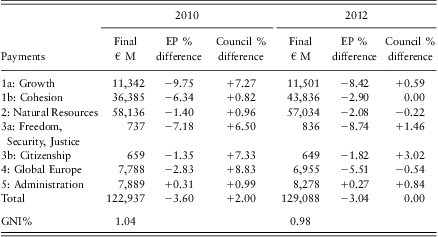
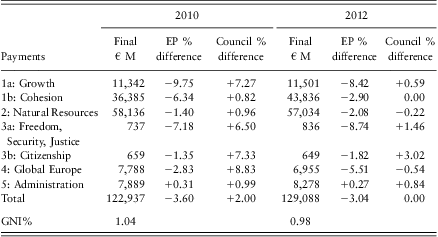
In comparing the amounts approved for the annual budget of 2010, the last one largely negotiated under the old rules, and the annual budget of 2012, the first one negotiated under the new rules that did not run aground during the conciliation process, we can see that the EP appears to lose and that there is a deflationary effect (Table 1).
Amounts voted for each heading in the 2010 and 2012 budgets of the EU
Source: Official Journal of the European Union and author's own calculations.
The payments approved for the 2010 budget were almost €123 billion, equivalent to 1.04 per cent of GNI. This was 3.6 per cent less than the total demanded by the EP at its first reading (under the old rules) but was 2 per cent above the total demanded by the Council in the draft budget. The closer these percentages are to zero, the less an institution “loses” in the budgetary struggle. In 2012, the EP lost more significantly and the amounts in real terms fell. The 2012 budget approved payments of €129 billion or 0.98 per cent of GNI. This figure was exactly the amount demanded by Council but 3.04 per cent below what the EP had requested.
Which policy areas are affected? Heading 1b (Cohesion) and heading 2 (Natural Resources), most of which is directed to agriculture, represent traditional redistribution. Council members tend to target other policy areas for reductions, which the EP historically tries to defend. These can be defined as public goods such as research and development. Heading 1a (Growth), which includes technology, Trans-European Networks, and research was hard hit: although the EP lost by 9.75 per cent and the Council by 7.27 per cent in 2010, the loss was nearly all on the side of the EP in 2012 by 8.42 per cent to only 0.59 on the part of the Council. If budgets are lower and the EP's power of amendment is reduced, these preliminary findings suggest a success in reducing legislative power over the budget of the type that Wehner (Reference Wehner2010a, Reference Wehner2010b) identifies. Indeed a separation of powers with greater influence for the executive Council could lead to smaller budgets (Cheibub Reference Cheibub2006). These preliminary findings allow me to present the next two hypotheses.
Hypothesis 2: The Lisbon Treaty reduces the power of the EP to amend the MFF and the annual budget.
Hypothesis 3: The rules in the Lisbon Treaty have a deflationary effect, reducing the amounts approved for spending.
All three hypotheses will be evaluated in the pages that follow through analysis of the details of Article 312 TFEU, which governs the MFF, Article 314 on the annual budget and Article 315, which governs the provisional monthly budgets that can be passed if no annual budget is yet in place for the start of a financial year. The details in terms of agenda-setting and veto powers of these three treaty articles will be analysed compared with the situation before the Lisbon Treaty came into force.
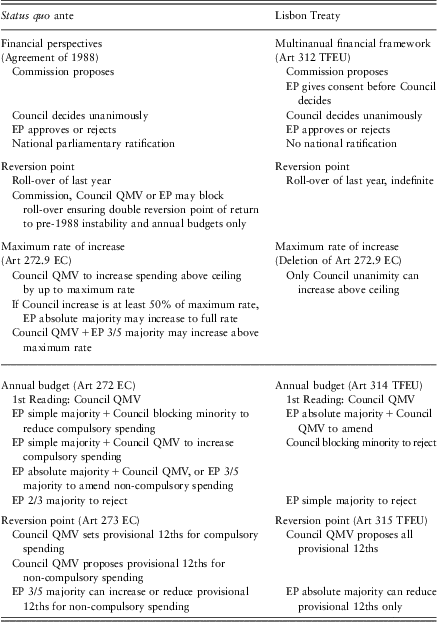
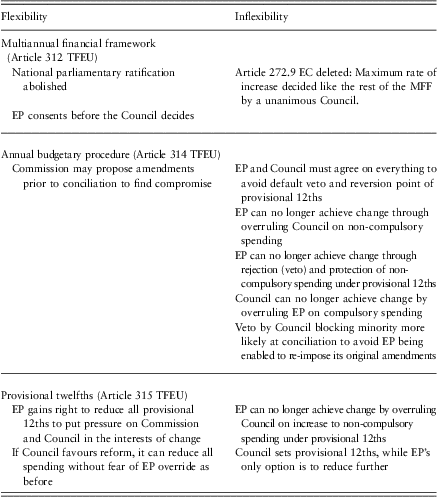
Table 2 lists and compares the powers of the EU institutions over multiannual spending and the annual budgets under the status quo ante (the rules before the Lisbon Treaty) and following the Lisbon Treaty's ratification. Table 3 analyses how the Lisbon Treaty either assists budgetary reform or reinforces the budgetary policy status quo rather than rules (making reform more difficult than previously) in aspects of the financial powers of the EU.
The status quo ante versus the Lisbon Treaty

Does the Lisbon Treaty make the budget more or less flexible?
1 The MFF
The MFF is the new long-term spending package that sets ceilings within which the EU can agree annual budgets. It is not a budget itself, merely a series of limits for commitments to expenditure, which are then authorised in each annual budget (Piris Reference Piris2010, 292). The Interinstitutional Agreement between the Commission, Council and EP of 1988 established its predecessor, the financial perspective, which Lindner (Reference Lindner2006) analyses extensively. Until the Lisbon Treaty was ratified, the EP had a right of veto only, with member state governments reaching agreement unanimously and requiring national ratification. The procedures for the financial perspective before ratification of the Lisbon Treaty and of the MFF thereafter, as well as their effects, are illustrated in Figure 1 and Tables 2 and 3.
From the financial perspectives to the multiannual financial framework (MFF): what changes?
The rules on the MFF are more difficult to amend than the financial perspective – and therefore more stable. Whereas the agreement of 1988Footnote 7 was subject to revision by the EP, Commission and a unanimous Council, the new Article 312 (which replaces it) can only be changed by an intergovernmental conference and ratification by every member state. This makes it constitutionally binding rather than just legally binding.
The reversion point in the event of non-agreement on a new framework was to carry over indefinitely the ceilings from the final year of the previous period, unless one of the three institutions actively terminated the agreement (Interinstitutional Agreement 2006, paragraph 30). Article 312.4 removes that right of termination, reinforcing the budgetary status quo. Only one member state is required to block agreement and all existing expenditure ceilings will remain in place, preventing increases beyond inflation, or decreases or reallocation. Article 312.2 describes how the MFF will be agreed: “The Council shall act unanimously after obtaining the consent of the European Parliament”. This increases the agenda-setting power of the EP though the change may not be significant. In the past, the Commission and Council had to agree before passing the text to the EP, which had a power to reject (Figure 1 and Table 2). The EP may be able to use this power of prior consent as a de facto power of proposal besides its veto, which it exercised in January 2006. That veto concerned the Council's draft financial perspective for 2007–2013, which initially fixed spending commitments at a level that the EP deemed too low.
Article 312 also removes the need for national parliamentary ratification of the MFF. This is a significant move in favour of change since it removes some national level veto players, while increasing the ability of the EP and Commission to set agendas together with national governments.
The ceiling for spending used to be flexible. Since ratification of the Lisbon Treaty, Article 312.3 imposes expenditure ceilings, thus constraining flexibility in the annual budget:
The financial framework shall determine the amounts of the annual ceilings on commitment appropriations by category of expenditure and of the annual ceiling on payment appropriations.
Before the Lisbon Treaty, the old Article 272.9 EC (European Communities Treaty), now deleted, allowed for a maximum and actual rate of increase in the budget for non-compulsory expenditureFootnote 8 to be agreed annually by the Commission, Council and EP:
A maximum rate of increase in relation to the expenditure of the same type to be incurred during the current year shall be fixed annually for the total [non-compulsory] expenditure…
The Commission shall… declare what this maximum rate is…
If, in respect of [non-compulsory] expenditure… the actual rate of increase in the draft budget established by the Council is over half the maximum rate, the European Parliament may, exercising its right of amendment, further increase the total amount of that expenditure to a limit, not exceeding half the maximum rate.
Whereas the European Parliament, the Council or the Commission consider that the activities of the Communities require that the rate determined according to the procedure laid down in this paragraph should be exceeded, another rate may be fixed by agreement between the Council, acting by a qualified majority, and the European Parliament, acting by a majority of its Members and three fifths of the votes cast.
This process is illustrated in Figure 2. Taking into account three economic factors, the Commission would propose a maximum rate of increase each year. If in the annual budget, the Council accepted an increase of at least half that amount in non-compulsory spending; the EP could in turn propose yet a higher increase equivalent to not more than half of the maximum rate calculated by the Commission. Alternatively, the maximum rate could be exceeded if a qualified majority in the Council so agreed with a three-fifths majority in the EP.
Maximum rate of increase, old treaty article 272.9, now deleted
These measures allowed for increases. We can see that deletion of the old Article 272.9 has an inflexibility effect, which reduces spending. Perhaps this should not be overestimated since exceeding the maximum rate required the consent of both the Council and the EP. That said, since the Lisbon Treaty, the MFF can be amended only with a unanimous rather than a QMV decision of the Council. The consequence of these provisions is to reduce budgetary flexibility thus contributing to a confirmation of Hypothesis 1.
For the most part, the Lisbon Treaty reinforces the status quo with respect to the MFF. Agreement on new long-term spending will still require unanimity among the governments. Non-agreement will still result in a reversion point of the amounts from the final year of the pre-existing framework being rolled over indefinitely without increase above inflation. The Council will agree any rate of increase by unanimity rather than QMV. Changes in spending outcomes become easier in two respects: the Council will decide on the MFF only after the EP has granted its consent allowing a reform-oriented EP to propose solutions; and national parliamentary ratification of the new MFF will not be necessary. Although the EP wins with a de facto power of proposal, it loses on the maximum rate of increase. The outcomes of future MFF agreements are likely to be deflationary compared with the status quo ante in view of the changes to the maximum rate of increase through the deletion of the old article 272.9.
2 The annual budgetary procedure and provisional twelfths
Elsewhere (Benedetto and Høyland Reference Benedetto and Høyland2007; Benedetto Reference Benedetto2012), Høyland and I have provided detailed analysis of the changes to the annual budgetary procedure of the Lisbon Treaty. Those changes are summarised in Tables 2 and 3 and the figures in Scenarios 1–3. Below I describe the changes before analysing their effects in the next section.
The European Parliament wants more and the Council (by QMV) wants less
Redistribution versus Public Goods (PGs). Council qualified majority to protect agricultural spending and to reduce PGs. EP majority to protect PGs but to reduce agriculture
Deflation or can the European Parliament win if it wants to reduce even more than the Council?
The Council adopts or amends the proposed budget by QMV (Article 314.3). The EP may only amend by absolute majority (Article 314.4) in a single reading, otherwise the budget is adopted. Previously, it could make amendments to reduce or shift compulsory expenditure by a simple majority, which could only be blocked by a qualified majority on Council (Benedetto and Høyland Reference Benedetto and Høyland2007).
Under the Lisbon rules, a conciliation committee drawn from the Council and EP convenes if the Council and EP do not agree on all amendments (Article 314.5). The conciliation committee has three weeks to find a solution, during which three meetings are foreseen. In practice it is very difficult for the budget ministers to spend three days in Brussels during negotiations. The pressure on all three institutions is more intense under the conciliation arrangements than under the old procedure,Footnote 9 considering that in 2009, the institutions had to agree on 480 amendments across 1,700 budget lines (Piris Reference Piris2010, 297). This could lead to suboptimal outcomes. Under the old procedure, the Council and EP could impose decisions against the will of the other respectively on compulsory and non-compulsory spending. The EP also had the option to reject the entire budget by a two-thirds majority. The new Article 314 replaces these features with a procedure requiring mutual agreement on everything, of which the default option is mutual veto. Either a blocking minority of governments in the Council that prevents a qualified majority or a simple majority of the MEPs in the conciliation committee can block an agreement. Amendments are more difficult to pass, while rejections of the entire budget are highly plausible if there is disagreement. Given these rules, the budgetary status quo in terms of amounts to spend is less likely to change. Veto powers have increased at the expense of agenda-setting powers given the need for supermajorities.
There is a further twist. The final stages of the new procedure appear to be unrealistic, but this is precisely their significance in reducing the power of an EP that may favour reform and in increasing the bargaining power of an anti-QMV blocking minority of governments in the Council. Following the successful conclusion of the conciliation committee, the EP and Council have the option to approve or reject the text in final sittings. If the Council approves the text, it can still be rejected by an absolute majority in the EP (Article 314.7c). If the Council rejects the text, while the EP approves it, not only would the joint text pass, but the EP would gain the right to re-impose all of its original amendments by a three-fifths majority (Article 314.7d). “When can the Council be expected to find a qualified majority to reject a text that a qualified majority had just agreed at conciliation? Why would this qualified majority in the Council ever prefer the EP's re-imposed amendments, which it previously rejected, to the outcome of the conciliation committee, which a qualified majority in the Council had already accepted?” (Benedetto and Høyland Reference Benedetto and Høyland2007, 585–586). The answer is that the Council would never reject a text provisionally agreed by its delegation to the conciliation committee, which for the budget often consists of ministers in any case. At conciliation, the member state governments will be more inflexible negotiators than the MEPs. The EP's delegation can make a provisional agreement with the Council knowing that the plenary of the EP will still have the power to reject that agreement. However, the apparently extreme power of the EP to re-impose all of its original amendments if the Council changes its mind will never come to fruition because this rule will constrain the Council at conciliation only to make an agreement that meets the demands of a qualified majority of the governments. Either that or a Council blocking minority will use its power to reject the budget by simply failing to make an agreement during the conciliation process, which is what occurred in November 2010 regarding the annual budget of 2011. When supermajorities across two rival legislative institutions are needed to pass legislation or budgets and there is disagreement, the chance of veto is reinforced (Tsebelis and Garrett Reference Tsebelis and Garrett2000).
Was this the intention of those who wrote the rules? In 2003, the Convention on the Future of Europe proposed a budgetary procedure that would have been similar to that for non-compulsory expenditure under the old rules but with aspects of co-decision. If there were no agreement at conciliation, the EP with a three-fifths majority would have had the power to re-impose all of its original amendments. Failing this, for each heading, the reversion amount adopted would have been the figure voted by the Council. During the autumn of 2003, the Council of Economics and Finance Ministers adopted a position originally proposed by the British, Dutch and Swedish governments.Footnote 10 In the event of non-agreement at conciliation, the reversion amount adopted for each heading would have been the lower amount as preferred by either the EP or the Council, unless the previous year's amount were higher. This would have created continuity, with reductions or increases possible only if both institutions agreed. The EP reacted to this initiative with hostility and MEPs insisted either on co-decision for the budgetFootnote 11 (which reduced their own power) or the final word in terms of imposing amendments on the Council.Footnote 12 In December 2003, the Italian presidency re-tabled the Convention's proposal but with a symbolic extra power for the Council. The reversion point would be the amount voted by the EP with a three-fifths majority unless the Council vetoed the entire budget by a qualified majority (Benedetto Reference Benedetto2006, 255). In practice this was unlikely and was a good deal for the EP, offering it more power than the procedure eventually adopted for what became the Lisbon Treaty under the Irish presidency in 2004 and described above. However, the introduction of an unusable Council veto meant that the EP lost its final word on the budget and this was unacceptable to Elmar Brok, one of the EP's representatives to the intergovernmental conference:
The Parliament would be crazy to accept it. The Italian proposal still weakens Parliament's position and gives the Council the final say. Every parliament since parliaments were invented has had overall budgetary rights.Footnote 13
The procedure adopted in 2004 for what would become the Lisbon Treaty increases the Council's bargaining advantage more so than under the old budgetary procedure. If the EP favours changing the budget, such change is now less likely. Increasing the veto power of a minority of governments is unlikely to work in a pro-reform direction since the EP keeps its own veto power but loses its agenda-setting powers.
This pattern is repeated in the changes to the “provisional twelfths” reversion mechanism. Until an annual budget is agreed, on a monthly basis the Council and EP can agree to spend no more than one-twelfth of the previous year's amounts (Articles 273 EC and 315 TFEU). Under the old treaty, the Council would set the amounts each month and the EP could increase or decrease non-compulsory amounts only within the ceiling set in the multiannual budgetary package. In 1980 and 1985, this allowed the EP to block the budget but to secure finance for its own priorities under non-compulsory spending on a monthly basis. Under Lisbon, this power is reduced to blocking increases or voting for decreases only, but is extended to all areas of expenditure. The EP gains more power to decrease but loses any power to increase.
It seems that the new Articles 314 and 315 make budget change more difficult (Table 3 and Scenarios 1–3) while facilitating rejection. In the next section, I look at whether this will lead to smaller budgets.
Before and after the Lisbon Treaty: spending scenarios under the annual budget
The following three scenarios compare the outcomes of the annual budget under the rules for compulsory and non-compulsory spending of the budget treaties of 1970–1975 with those agreed in the Lisbon Treaty according to the possible preferences of the EP – whether under a simple, absolute, three-fifths or two-thirds majority – and of the Council – whether by QMV or a blocking minority.
1 The EP wants to spend more and the Council wants to spend less
In Scenario 1, the EP wants to spend more than the Council, which appears to have been the case for the annual budgets of 2010 and 2012. Under the different procedures, the Commission proposes a budget, which is amended by QMV in the Council at first reading. The Council chooses to reduce everything. Next, for compulsory spending, the EP can vote by a simple majority, but for non-compulsory spending or under the Lisbon rules, an absolute majority is necessary. Under all procedures, the Council next votes to block the EP's amendments and can do so by finding a blocking minority of member states to prevent QMV. At this point, the three rules for agreement differ.
For compulsory spending, the amounts as set by Council prevail unless the EP rejected the whole budget by a two-thirds majority. For non-compulsory spending, the EP by a three-fifths majority could re-impose its amendments to increase the budget. Each institution could overrule the other on the compulsory and non-compulsory parts of expenditure, allowing the EP to go as high as the ceilings in non-compulsory spending if it wanted. By a two-thirds majority, an unhappy parliament could even veto the budget and still protect non-compulsory during the application of provisional twelfths.
Under the new rules of the Lisbon Treaty, a blocking minority in the Council has a very strong incentive to prevent agreement during the conciliation procedure, which is the next stage. Each institution has to agree on everything with the other. No agreement means no budget and the application of provisional twelfths. Here, however, the EP can no longer protect spending increases in what was non-compulsory spending. A Council in favour of reductions may choose to set provisional twelfths at any level it likes and the only option of the EP is to make further reductions.
If under the Lisbon rules, the conciliation committee makes an agreement, the EP can reject that agreement, in which case provisional twelfths will apply until a budget is agreed. If, however, the EP approves a conciliation text and the Council votes against it, the text will still prevail and the EP would gain the right to re-impose its original amendments on the budget. This is the incredible situation described in the preceding section and by Benedetto and Høyland (Reference Benedetto and Høyland2007). The cost for the Council of this happening is so high that the Council will never agree anything at conciliation on a provisional basis, strengthening its negotiating position. Assuming the Council wants to spend less and the EP wants to spend more, the cost to a Council blocking minority in failing to agree at conciliation is low. After all, Council can determine the levels of spending in provisional twelfths at which point the only option of the “profligate” EP is to reduce amounts available at provisional twelfths.
The above scenario seems to show that flexibility is reduced, the EP loses and spending could fall. What do two other scenarios show?
2 Redistribution versus public goods – a Council qualified majority wants to protect agriculture and to reduce public goods, while a parliamentary majority wants to do the opposite
Scenario 2 is more complicated. Here the Council wants an overall reduction and the EP wants an overall increase. The EP wants to prioritise public goods for that increase and to reduce traditional redistribution in agriculture. Meanwhile the Council would target public goods for its desired reduction while protecting agriculture. In the negotiations for the 2007–2013 and 2014–2020 multiannual frameworks, this differing approach between the Council and EP was evident. It also neatly divides compulsory spending (which was dedicated mostly to agriculture) from non-compulsory spending (which included public goods). For the sake of simplicity in analysing the old rules, I assume that the EP wishes to reduce compulsory and to increase non-compulsory, while the Council would desire the opposite. Who wins?
As before, the Commission proposes and the Council adopts a draft budget by QMV. Under the old rules and Lisbon, it votes to reduce public goods. Next, the EP votes by simple majority to reduce agricultural spending as part of compulsory expenditure. Under non-compulsory spending, the EP votes by an absolute majority to increase spending on public goods, and under the Lisbon rules it votes again by absolute majority to reduce agriculture and increase public goods. Under the old rules, the Council would vote for the last time. Concerning compulsory spending, a blocking minority of governments opposed to high levels of spending in agriculture could prevent the Council from reversing the EP's reductions. Alternatively, a blocking minority might be absent and QMV in the Council could reverse the reductions. This would conclude the old procedure for agricultural spending, with an EP-imposed reduction dependent on a sympathetic blocking minority in the Council. What happens to public goods in non-compulsory spending? Here a Council blocking minority could have rejected the EP's amendments, at which point in the second reading for non-compulsory spending the EP could have re-imposed its increases to public goods by a three-fifths majority.Footnote 14 If the EP cared more about public goods increases than reductions for agriculture, it would have had no incentive to vote by a two-thirds majority to reject the budget, since the old rules allowed it to set increased levels of spending for public goods despite the views of the Council and at a lower threshold of a three-fifths majority than the two-thirds required for a rejection. Under the old rules, the EP would win on public goods and the Council might win on agriculture. Does the Lisbon Treaty reduce spending?
Under the Lisbon rules, the EP would have increased spending on public goods and reduced spending on agriculture, which the Council would have blocked. The budget would then pass to the conciliation committee. Here a blocking minority on the Council could prevent agreement in order to protect agriculture and prevent increases for public goods. If this happens, non-agreement would create instability but provisional twelfths would allow the Council to set the temporary reversion budgets, reducing spending on public goods. In provisional twelfths, the EP would, however, be able to reduce further any priorities of the governments including agriculture. This could result in an unpredictable environment with reduced spending. Given the credibility of a veto threat from a blocking minority on Council during the conciliation process, the EP could accept a deal dictated by the Council. This might take the form of a concession whereby public goods spending and the overall budget are reduced but by less than the Council had previously proposed. The advantage for the national governments in making a small concession to the EP is to avoid the uncertainty of temporary reversion budgets and the risk that the EP could reduce temporary spending in an area prized by the governments. A conciliation text dictated by the veto threat of a blocking minority in the Council would hardly be opposed by the Council at the approval stage. The loss for the EP in voting to reject the deal after conciliation would be in losing any concession gained at conciliation with the Council resorting to reducing key budget headings during the application of provisional twelfths. Compared with the old rules, the result is to reduce spending and the influence of the EP.
3 Deflation – or can the EP win if it wants to cut even more than the Council?
Is the EP always the loser or is it the case that whoever wants less will win? Scenario 3 evaluates the hypothetical case of whether the EP can win if it wants to cut even more than the Council. Since the 1970s this has never occurred, but a more Eurosceptic EP in the future could be in this position. Let us suppose that the Commission proposes a budget, that Council opts to cut by 2 per cent and that the EP opts to cut by a further 2 per cent. Under compulsory spending, the EP could do this by simple majority. Under non-compulsory spending or the rules of Lisbon, it could do so only by an absolute majority.
In its second reading for compulsory spending, a Council blocking minority could protect the EP's amendments reducing spending by the total of 4 per cent. Alternatively, by QMV the Council could reverse those more severe reductions, restoring the level to the Council's preferred reduction of only 2 per cent. In non-compulsory spending, the EP with a three-fifths majority could enforce its full 4 per cent reduction. The EP would never use its power of veto at this stage since it would already have had its way with non-compulsory spending and may have succeeded even in reducing compulsory spending by 4 per cent with the agreement of a Council blocking minority. A veto would have resulted in the uncertainty of provisional twelfths in which the austere EP would have no influence over the monthly budgets for compulsory spending. An EP committed to radical austerity would have won under the old rules, which could have been quite deflationary.
How do the Lisbon rules change this hypothetical situation? Again, non-agreement between Council and EP would result in conciliation. Here a Council blocking minority against super-austerity could ensure non-agreement and the use of provisional twelfths. However, the problem for the pro-expenditure blocking minority in Council is that it would want a budget and not get one by blocking. Next, although the Council could set monthly reversion budgets at slightly below the level that the Commission originally proposed, the EP could then exercise its unlimited power for further reductions in spending in provisional twelfths. That Council blocking minority would therefore want to avoid a non-agreement. In fact, the only loss for the super-austere EP in non-agreement would be that despite not liking to spend it may recognise that a budget will be necessary at some point. This austere EP could make a provisional agreement with some concessions for the Council at conciliation keeping open its options to reject the agreement after conciliation, at which point provisional twelfths would allow it to reduce all spending to its desired level.
This farfetched scenario shows us that it is sloppy to imagine that one institution could lose from a change in rules unless we allow for a change in the preferences of that institution. Scenario 3 in fact shows the EP with increased budgetary powers under the Lisbon Treaty but only if it wants to reduce even more than the Council. It is also a scenario that again shows that the Lisbon rules lead to lower spending than the old rules.
Conclusion
Earlier in this article, I presented three hypotheses, which are consistent with my evaluation of Articles 312 to 315 of the Lisbon Treaty. The hypotheses suggested that: the budget rules would make the budget more inflexible, reinforcing the status quo for spending; the EP would lose power to vary the budget or secure reform; and the amounts available for spending would be reduced. The analysis concludes that although the EP may have gained further powers over ordinary EU legislation, in budget policy its powers have generally weakened.
The changes to the budgetary rules of the EU make changes to spending outcomes less likely. The EP may not always be an agent for change or reform, but if it favours reform, it loses its leverage on the annual budget and the reversion budget of provisional twelfths in order to secure it unless the EP wishes only to cut spending. Linked to this are two treaty changes that reduce expenditure. First, the deletion of the old Article 272.9 EC now requires Council unanimity for increases in the multiannual spending ceiling, and second, the change to provisional twelfths under the new Article 315 TFEU allows the Council to set the reversion budget with the EP having only the power to make reductions and not increases. These changes matter because the powers of the EU institutions over the budget affect the nature of the world's largest internal market and its potential response to the challenges of the Eurozone crisis.
In terms of the wider comparative literature, Cheibub (Reference Cheibub2006, 353) and Persson and Tabellini (Reference Persson and Tabellini2003, 23) find that in separation of powers systems, of which the EU is an example, public spending is lower for institutional reasons, although Wehner (Reference Wehner2010a, 95) also suggests that this depends on the extent to which the legislature can amend the budget. The authors of the Lisbon Treaty produced new rules that appear to reduce spending by diminishing the amendment power of the legislative EP vis-à-vis the Council (which represents national executives) and allowing amendments in favour of reductions only to be made with respect to the reversion budget. During the composition period of the future Lisbon Treaty, position papers presented by the British, Dutch and Swedish governments and discussed in this article show that the desire of some national governments to achieve this end was clear, while representatives of the EP either welcomed a version of co-decision or defended the concept of the EP exercising an unusable “final word” on the budget as more important than other considerations. Moreover, this finding is contrary to the wider view that the EP gained power as a result of the Lisbon Treaty (c.f. Benedetto and Hix Reference Benedetto and Hix2007, 115; Hix and Høyland Reference Hix and Høyland2011, 53). Indeed, historically the EP's first real power was the one to amend or reject the budget gained in 1970 (Rittberger Reference Rittberger2005) well before it could impose amendments on ordinary legislation. Greater legislative power from the Lisbon Treaty has accompanied diminishing budgetary power.
In the annual budget, the EP, Council and alliances of individual governments gain the power of mutual veto at the expense of agenda-setting. Change is less likely because a multiplication of veto players with diverse preferences tends to result in policy stability (Tsebelis and Garrett Reference Tsebelis and Garrett2000; Tsebelis Reference Tsebelis2002). It becomes more difficult to pass amendments, which require the active approval of both the EP and QMV in the Council.
There is nuance. Overall, the EP loses budgetary power but this loss is not absolute. The Parliament gains an agenda-setting possibility to propose the MFF before the Council decides and the EP's preferences may be easier to accept given the removal of national parliamentary ratification for each new budget deal. When annual budgets or the long-term budgetary packages have dissatisfied the EP, it uses its power to reject as in 1980, 1985 and 2006. This balance does not change since the EP retains its pre-existing powers of rejection. The only context in which the EP gains power in the annual budget is if it wishes to reduce spending by even more than the Council contributing to a deflationary outcome.
The new budgetary rules reinforce mutual veto. Future reforms as radical as the creation of the EU's revenue system in 1970 or the financial perspectives in 1988 are no more likely under these new rules. This is because the powers of the EP to set agendas and influence matters through the annual budget and provisional twelfths are curtailed, while the MFF will continue to be decided unanimously. Further research into the annual budget events of the autumns since 2010 is necessary to discover the extent to which change in institutional rules led either to breakdown in negotiation or a reduced budget. Other factors may have interacted with the rules, for example the wish of the governments of net contributor states to impose austerity during the economic crisis.
Taken together, institutional change and the urge for austerity could shape a very different budget in the future, indirectly affecting the nature of market integration in the EU.