Introduction
The Stability and Growth Pact (SGP) of the European Union (EU) is the major policy responsible for maintaining economic stability throughout the common market of the EU. The policy’s guidelines were designed to safeguard the Economic Monetary Union (EMU) of the EU by ensuring that member states follow sound fiscal policy. Yet, the SGP fails to fully maintain compliance with the major provisions intended to secure stability. Research on the SGP has identified a number of reasons why compliance with major provisions of the SGP has faltered, including an inability to punish members (de Haan et al. Reference de Haan, Berger and Jansen2004; Heipertz and Verdun Reference Heipertz and Verdun2010), forced deviation due to economic shocks (Beetsma and Uhlig Reference Beetsma and Uhlig1999; Beetsma and Giuliodori Reference Beetsma and Giuliodori2010), and the ability of large countries to circumvent the EU (de Haan et al. Reference de Haan, Berger and Jansen2004; Varela and Prado-Dominguez Reference Varela and Prado-Dominguez2012). While these works have provided valuable insights to date, there has not been an evaluation of which explanation holds the most weight. The goal of this article is to provide an analysis that fills this gap in the literature and determine the weight that each theory holds in explaining country deviations from the two main provisions of the SGP.
The analysis is carried out using Bayesian binary models that test for the probability of violating each of the two major clauses of the SGP. The Bayesian technique utilised here allows for maximum leverage due to the relatively small number of cases contained in the data set. In addition, the credible intervals obtained in the models allow for more specificity when determining the impact of crucial independent variables. Results indicate that there are a number of variables that impact deviation. These variables include the relative power of a country in the Council of Ministers, a country’s membership position, geographic diffusion, economic strain and the government’s ideology. However, one theory contains the largest amount of explanation with regard to variance in country deviation. Countries that are in economic need are much more likely to violate the SGP. This result is present even when controlling for the substantive effect of the other theories.
The analysis put forward in this article is integral to understanding policy incentives and outcomes. Namely, if scholars understand the mechanisms that lead to a country deviating from EU policy, they could better understand the projected impact of a policy’s outcome. Further, economic policy in the EU is an important topic. Currently, the main European currency, the Euro, is facing a serious crisis – a fact carrying important implications for other markets throughout the world. Therefore, an analysis that explores the ability of this supranational organisation to enforce important economic policies should shed light on mechanisms that could circumvent further economic strain on both EU and global markets. The major theories related to the SGP deviation explored here examine a country’s potential power to deviate, a government’s ideological disposition towards deviation, the necessity to deviate due to economic strain, and deviation as a learned behaviour.
Why study policy compliance? The results conveyed here begin to elucidate important mechanisms for determinants of policy divergence. It goes without saying that ensuring that policy is implemented is a main function of the executive branch of every government. In addition, the policy deviation analysis presented here targets a supranational organisation, while previous studies usually focus on a specific country. For those scholars attempting to discover how the EU could prevent deviation, this analysis provides a starting point. In fact, Borzel et al. (Reference Borzel, Hofmann and Panke2012) argue that studying EU policy deviation provides important insight about the mechanisms of policy deviation for several other European decision-making arenas, including local and state level policy.
This article proceeds as follows. The first section discusses the SGP and research on EU compliance. This discussion includes attention to the two main clauses of the SGP, which are the units of analysis in this article, as well as the current state of the literature on the SGP and the EU. Section 2 introduces the theories and hypothesis that are thought to explain country deviation of the SGP. The following section presents the methodology and operationalisation of variables. The final section presents the results and discusses the substantive importance of the findings.
SGP
The SGP, passed in 1998, was intended to coordinate fiscal matters throughout EU member states. According to the EU, the idea was “to safeguard sound public finances, based on the principle that economic policies are a matter of shared concern for all Member States” (EU 2013). The SGP contains two arms designed to achieve this idea. There is the preventive arm, which is a country-specific budgetary objective that each country must follow. The other arm is the corrective arm, which contains a procedure for correcting excessive deficits. Both of these are meant to combat the breaking of two important clauses in the SGP. These clauses apply to all EU countries, and all EU members agreed to the SGP (EU 2012, 2014). However, there are additional provisions contained in the SGP that only apply to euro area members and are subject to change through qualified majority voting (Hodson Reference Hodson2011; EU 2012, 2014):
-
1. Deficit Clause – “The deficit must not exceed 3 percent of gross domestic product”.
-
2. Debt Clause – “Public debt must not exceed 60 percent of gross domestic product, or at least diminish sufficiently towards the 60 percent” (EU 2013).Footnote 1
Why did the EU pursue the SGP? EMU was the single most important policy goal of the EU in the early years of the organisation (Heipertz and Verdun Reference Heipertz and Verdun2010; Talani Reference Talani2014), and the SGP was the main policy meant to ensure a stable common market (Beetsma and Uhlig Reference Beetsma and Uhlig1999; Chang Reference Chang2004; Bagus Reference Bagus2010). Today, the EU’s economic union represents the largest financial market in the world. Bagus (Reference Bagus2010) argues that the clauses of the SGP maintain a needed level of stability throughout the market. In particular, high inflation countries that may enter the EU later are especially susceptible to debt and deficit problems, and the EU made it clear that violations would not go unpunished (Chang Reference Chang2004; Bagus Reference Bagus2010). Further, the claim has been made that Germany’s participation in the EMU endeavour was contingent on having clear and set rules (Marzinotto Reference Marzinotto2008; Bagus Reference Bagus2010). It could be argued that, without Germany’s participation, the policy would not have gone forward, and that maintaining high standards is crucial for convincing a country like Germany, that did not benefit from losing the Deutschmark, to participate.
Another motivation for the SGP was to prevent countries from deviating from economic union rules during periods of country-specific economic shock (Beetsma and Giuliodori Reference Beetsma and Giuliodori2010). Monetary unification means giving up monetary policy as an instrument for the stabilisation of the country due to asymmetric shocks. Therefore, members recognised that a rule, such as the SGP, is needed in order to prevent countries from running up deficits during times of economic distress. For instance, Beetsma and Giuliodori (Reference Beetsma and Giuliodori2010) argue that, during times of rapid unemployment, countries usually combat the problem by running up deficits in order to alleviate the problem in the short term. Therefore, the SGP was created in order to maintain fiscal responsibility in individual member states facing economic shock so that their short-term actions do not have repercussions for the rest of the euro area.
Similarly, Heipertz and Verdun (Reference Heipertz and Verdun2010) argue that the SGP was created in order to prevent member states from freeriding when it came to economic success in the EMU. Beetsma and Giuliodori (Reference Beetsma and Giuliodori2010) argue that the idea behind the pact is to use the enforcement of penalties by some member states to force other members to commit to a low-debt policy before monetary union. This is a necessary result of the fear that a high-deficit member country, or a member country in a recession, may successfully pressure the European Central Bank into loosening its monetary policy (Leblond Reference Leblond2006; Cafruny and Ryner Reference Cafruny and Ryner2008). In turn, this would create additional inflation that could have a real effect on the entire union (Beetsma and Giuliodori Reference Beetsma and Giuliodori2010). In order to maintain compliance with the law, the EU created punishments that could lead to an imposition of sanctions for member countries (EU 2013). These punishments can involve annual fines or possible suspension of Cohesion Fund financing (EU 2013). The important point here is that punishments for deviations of the SGP are not minuscule. Indeed, the punishments threatened and carried out by the EU could be considered quite substantial if the EU chooses to enforce them.
While the underlying framework of the SGP was to enshrine budgetary discipline by automatically imposing fines on delinquents, the SGP suffers from weaknesses that undermine this logic. Mainly, the politicised nature of the SGP falls short of producing mechanisms of automatic sanctions, but rather leads to a political pledge to aim for lower deficits (Heipertz and Verdun Reference Heipertz and Verdun2010). Therefore, member states do not perceive the guidelines set out by the SGP to be hard and fast rules. Heipertz and Verdun (Reference Heipertz and Verdun2010) argue that this is one possible explanation for why member states agreed to the SGP in the first place. Members had an incentive to join because they thought the SGP would remain rather flexible.
de Haan et al. (Reference de Haan, Berger and Jansen2004) similarly claim that the mechanisms for encouraging compliance with the SGP are based on soft laws. The authors argue that the benefits for relying on soft laws are fourfold. First, soft laws reduce the negotiating cost upon implementing the treaty. Second, soft laws reduce the probability of reductions in sovereignty for member states. Third, in the case of uncertainty, soft laws are always preferred to hard laws, because countries will not have the type of information needed to agree to hard laws. Finally, soft laws are a tool for compromise between countries that have differing power in the EU (de Haan et al. Reference de Haan, Berger and Jansen2004, 238–239). Therefore, the creation and structure of the SGP is a product of these benefits. However, several authors argue that, these benefits aside, reliance on soft laws has created a situation in which member states are able to more easily deviate from EU policy (de Haan et al. Reference de Haan, Berger and Jansen2004; Talani and Casey Reference Talani and Casey2008). The major claim than is that the weakness of the enforcement mechanism has caused the SGP to be an utter failure.
One final mechanism believed to force members to comply with the SGP also deserves attention here. The stigma that arises from breaking the SGP may have been very strong in the early days of economic union. For instance, there were a number of advertisements in EU member countries that pointed out the embarrassing state of affairs in Greece. The fact that newspapers in the United Kingdom were poking fun at both Greece and Germany for their ineptitude at handling financial policy was obviously not desirable for either country. However, the stigma went beyond advertisements. This was especially true early on before countries began to break the SGP with some regularity. By breaking the SGP, a country may lose their status as a bargaining partner on financial matters in areas of EU policy (Aksoy Reference Aksoy2012). This is even more apparent when deviation is seen as being at the expense of another EU country (Aksoy Reference Aksoy2012). The goal of this section was to give specifics on the SGP. The next section provides a broader overview on research dealing with the SGP.
Theory and hypotheses
There are a number of intricate, plausible explanations present in the literature for explaining SGP country deviation. However, to the best of my knowledge, a test is not conducted where all of the theoretical reasons are tested simultaneously in order to determine which theory is most accurate. The argument put forth here contends that all available explanations can be grouped into four broad explanatory categories. First, there is a country-power explanation (Herne and Nurmi Reference Herne and Nurmi1993; Bohn and Inman Reference Bohn and Inman1996; de Haan et al. Reference de Haan, Berger and Jansen2004; Turnovec Reference Turnovec2008; Aksoy Reference Aksoy2012; Varela and Prado-Dominguez Reference Varela and Prado-Dominguez2012). Previous research contends that scholars must keep in mind the relative power of the countries in the EU when attempting to understand policy outcomes. A number of factors were discussed that could potentially impact a country’s relative power. These factors include whether a country is an EU founding member, the amount a state contributes to the EU economy and the position of the country in the Council of Ministers. The second category is the ideological orientation of the country’s governing party or coalition. Alesina et al. (Reference Alesina, Roubini and Cohen1997) and Hallerberg et al. (Reference Hallerberg, Strauch and von Hagen2009) assert that, by taking into account the ideological orientation of a country’s governing party or coalition, insight is gained into whether the country views the EU as legitimate. In addition, governing ideology may indicate important differences in country-specific economic policy. Both of these factors could have an effect on policy deviation. Third, an obvious explanation for deviation from policy is the fact that some countries may not have a choice but to deviate. For instance, one might expect that a country in economic decline would not be able to meet specific economic requirements (Beetsma and Uhlig Reference Beetsma and Uhlig1999; de Haan et al. Reference de Haan, Berger and Jansen2004; Debrun et al. Reference Debrun, Hauner and Kumar2009; Beetsma and Giuliodori Reference Beetsma and Giuliodori2010; Lodge and Rodriguez-Vives Reference Lodge and Rodriguez-Vives2013). This explanation indicates economic need or strain. A final explanation is that policy deviation is spread through diffusion. Perhaps countries are learning from neighbours that deviating from a policy means that the gain is higher than the punishment (Simmons et al. Reference Simmons, Dobbin and Garrett2006; Shipan and Volden Reference Shipan and Volden2008; Volden et al. Reference Volden, Ting and Carpenter2008; Maske and Volden Reference Maske and Volden2011). Diffusion represents the idea that members are learning from the behaviour of other members with regard to the ability to violate EU policy.
Country-power
The first factor related to the country-power theory is that founding members of the EU will be more likely to break the SGP.Footnote 2 Though the literature provides differing rationales, the reason is relatively straightforward. Founding members of the EU have had the most time to learn how to successfully navigate the legislative terrain. For instance, Dimitrakopoulos (Reference Dimitrakopoulos2001) argues that, over time, members states are able to learn how to successfully navigate around EU legislative policies that they do not find appealing, which could lead to noncompliance. For instance, member states may have more information about the process of logrolling in the EU, which means that they are more effectively able to negotiate a position closer to their desired point. Varela and Prado-Dominguez (Reference Varela and Prado-Dominguez2012) show that, although the Lisbon Treaty left all countries worse off in absolute terms, particular member states were able to secure a more profitable position. When exploring the countries that made out better, there is a trend towards the countries that were the original founders of the EU. Further, Borzel et al. (Reference Borzel, Hofmann and Panke2012) point out that the legitimacy of the EU might effect compliance with the law. The argument here is that founding states are the most likely to view the EU as legitimate since they were the creators of it. However, it is important to recognise that this theory conflates legitimisation during the founding years with the current situation at crucial points in the analysis; this claim may be incorrect. Therefore, the analysis conducted in this article tests this theory in order to demonstrate the relative explanatory power of these claims. In sum, a reasonable argument could be made that founding members of the EU are advantaged by their long-term operation within the EU. Therefore, the first hypothesis related to the country-power theory is as follows:
(H1a) The probability of a founding member state violating the SGP is higher than that of other EU members.
A second factor related to the country-power theory argues that SGP violations will be more likely to occur by the countries providing the most to the EU economic community. These countries are more likely to violate the SGP because they are more likely to secure favourable treatment upon violation; the EU will be less likely to punish countries contributing the most to the EU agenda. Turnovec (Reference Turnovec2008) discussed the ability of members to bargain in the EU decision-making process when members have an advantage in a particular policy area. In fact, one of Turnovec’s (Reference Turnovec2008) findings is that relative power in a specific EU policy domain would allow a member more power when it comes to decisionmaking on that policy. Intuitively, one would expect that countries that contribute a great deal to the European economic market would have a greater ability to negotiate a policy closer to their own preferred outcome. In addition, Talani (Reference Talani2008) argued that the most powerful economic member states prevail over smaller states when crafting policy. In terms of the SGP, Heipertz and Verdun (Reference Heipertz and Verdun2010) successfully demonstrated that countries with large economies and contributions to the European economic community were successful in securing reform of the pact in 2005. Mainly, Germany, with the largest economic activity in Europe, was able to successfully push for reform that came close to their most preferred policy position after repeated violation of the SGP (Heipertz and Verdun Reference Heipertz and Verdun2010). In other words, even after violating part of the economic agreement, Germany was still able to negotiate a preferred position with regard to punishment because of the country’s power within the policy arena.
One could extend this logic of country bargaining power based on economic activity to argue that members contributing largely to the European market will have an easier time being forgiven for their indiscretions if they violate parts of economic agreements. Again, the major reform of the SGP in 2005 came about because countries with powerful markets were able to negotiate reforms in the wake of violating the agreement. Punishing members that contribute a large sum to the EU economically would potentially damage economies in countries that the common market heavily relies upon. Thus, punishing these members would have adverse effects on the overall goals of the EU. No matter the particular mechanism, these arguments suggest that those members contributing most economically to the European market are most likely to violate the SGP. This line of thinking leads to the second country-power hypothesis:
(H1b) Countries with the largest economic activity or contribution in the European market are most likely to violate the SGP.
Third, a few scholars have pointed out that enhanced power in different branches of the EU allows a country to gain more favourable treatment (Bomberg and Peterson Reference Bomberg and Peterson1998; Mastenbroek and Keading Reference Mastenbroek and Keading2006; Borzel et al. Reference Borzel, Hofmann and Panke2012; Cross Reference Cross2013). For example, Marzinotto (Reference Marzinotto2008) argued that Germany violated the pact because it had the political capital and institutional positioning to do so. Many of these arguments are premised on the fact that institutional decisionmaking is constrained by veto players (Mastenbroek and Keading Reference Mastenbroek and Keading2006; Borzel et al. Reference Borzel, Hofmann and Panke2012). For instance, Bomberg and Peterson (Reference Bomberg and Peterson1998) pointed out that the Council of Ministers plays a significant role in the decisionmaking process. The authors argued that the fact that the Council is composed of officials elected to their respective national governments means that the Council is mainly concerned with national interests. This is different from the European Parliament where representatives are elected to only the European body and are supposed to put aside their national biases. Therefore, members in the Council of Ministers will likely not allow the Council to punish their transgressions if the members hold enough power to sway the decision. This means that asymmetric power relations in the Council should translate into differing outcomes when it comes to following the EU’s fiscal policy.
Additionally, a number of scholars have argued that position in the Council of Ministers is important for understanding deviations of the SGP. de Haan et al. (Reference de Haan, Berger and Jansen2004) contended that big countries are less susceptible to peer pressure than smaller countries in the Council, as larger countries are unlikely to lose their influence over EU policies. As evidence, the authors showed that most large states did not reduce their deficits enough at the start of EMU. Varela and Prado-Dominguez (Reference Varela and Prado-Dominguez2012) argued that, when creating and deciding the direction of EU policy, larger states have a defacto veto on decisions in the Council. The authors insisted that this was the main reason that larger states were able to obtain a more favourable economic climate under the Lisbon treaty. Bohn and Inman (Reference Bohn and Inman1996) agreed with this interpretation, and argued that the implementation of the SGP under qualified majority voting was a mistake. The authors gave two reasons why this claim is valid. First, in the Council, finance minsters are reluctant to cast a negative vote on their colleagues because they fear “retaliation” in the future (Bohn and Inman Reference Bohn and Inman1996, 30). Second, according to qualified majority voting, large countries were able to implement actions that were favourable towards their own position. Aksoy (Reference Aksoy2012) provided yet another example of how relative power in the Council is a determinant for violating the SGP. In this case, the author reasoned that a countries’ ministers are able to utilise their allocated votes to negotiate positions and penalties that are closest to their ideal points. The main conclusion is that larger countries should always have an easier time avoiding a penalty or negotiating a policy that is closest to their preferred policy:
(H1c) Countries that are more powerful in the Council of Ministers are more likely to violate the SGP.Footnote 3
Country’s governing ideology
The next two possible explanations for SGP violation are related to the political ideology of each member state’s government. First, as Borzel et al. (Reference Borzel, Hofmann and Panke2012) have discussed, the perceived legitimacy of the EU could have an important impact on whether a member follows EU law. When a member state’s government perceives the EU’s legitimacy on a particular policy area as unjust, the member state will be more likely to circumvent EU law. This same observation holds for instances where a member state perceives the EU’s policy position on an issue as detrimental to the member state’s interests. Further, Sedelmeier (Reference Sedelmeier2008) noted that the acceptance of EU norms and the impact of elites’ perceptions of the EU could impact whether a state follows EU law. For instance, one may expect that a person elected to a state’s national government under a platform of “reigning in the EU” would be less likely to comply with EU law. Gelderman et al. (Reference Gelderman, Ghijsen and Schoonen2010) argued that resistance to any given policy, especially if the source is viewed as illegitimate, would lead to greater noncompliance. Therefore, in countries where the ruling party, or parties, do not accept the EU as legitimate, one would expect more violations. Further, a party that ran for election under a platform of anti-EU sentiment would be less likely to follow EU laws.
In addition, there may be an ideological component motivating parties to follow or defect from the economic rules set out in the SGP. This finding is confirmed by scholars that have found a relationship between ideology and policy outputs in other regions of the world (Sugiyama Reference Sugiyama2008; Huber and Stephens Reference Huber and Stephens2012). Perhaps it is the case that conservative governments are less likely to hold debt because they provide fewer social programs. Or, it may be the case that leftist governments hold less debt because they are more adapt at balancing tax-to-debt ratios. Interestingly, both of these outcomes are easily viewed in other contexts. Historically, however, it is the leftist governments in Europe that acquire the highest amounts of debt. Alesina et al. (Reference Alesina, Roubini and Cohen1997) alleged that left governments in Europe seek to keep unemployment permanently low, which leads to high inflation during the tenure of left governments when compared to right governments. In addition, the authors argued that the propensity of left-wing parties to support expansionary social policies leads to policies that force the government to take on more debt (Alesina et al. Reference Alesina, Roubini and Cohen1997, 253). Finally, Hallerberg et al. (Reference Hallerberg, Strauch and von Hagen2009) determined that, when ideological differences emerge between countries on fiscal governance, delegation does not work well for solving fiscal problems. When looking at governing coalitions across European national governments, it is clear that there is a wide dispersion of ideological positions on a left-right continuum. Therefore, one would expect that countries will approach compliance with EU policy differently based on the ideological composition of their national government. In particular, more rightist governments should be less likely to break the SGP. The hypotheses for the country governing ideology theory are developed concretely below:
(H2a) Countries with ruling parties that do not view the EU as legitimate are more likely to deviate from the SGP.
(H2b) Leftist governments are more likely to break the SGP when compared with rightist governments.
Economic need
One of the most straightforward theories predicting which countries will break the SGP deals with economic strain. Borzel et al. (Reference Borzel, Hofmann, Panke and Sprungk2010) made the case that the most efficient states are most likely to comply with EU law. It would be relatively easy to argue that those countries that are already making strides in a particular policy field will be the ones that find it easiest to comply with a specific law. For instance, countries with a centralised education system and a high amount of resources will have an easier time implementing a mandatory EU education curriculum than countries without a high level of education funding. In addition, Falkner et al. (Reference Falkner, Hartlapp, Leiber and Treib2004) found that noncompliance is due to administrative shortcomings. In particular, they found that countries without administrative structures for a given policy area are the least capable of enforcing EU law. Lodge and Rodriguez-Vives (Reference Lodge and Rodriguez-Vives2013) contended that a country’s capacity to change course is the most important determinant of whether a country is able to follow the fiscal rules implemented by the EU. If these findings are correct, it is possible that countries facing severe economic distress are the most likely to break the SGP. It may also be the case that countries are violating the SGP only when they have no other realistic option, not because they simply desire to. If this is true, one would expect that the violators are the countries in the most economic distress.
In fact, the literature regarding the failure of the SGP is quite explicit in blaming economic strain. de Haan et al. (Reference de Haan, Berger and Jansen2004) have shown that countries facing favourable economic development have managed to stick to the objectives. Further, Lodge and Rodriguez-Vives (Reference Lodge and Rodriguez-Vives2013) affirmed that low rates of GDP growth, low output gap, inflation rates and interest rates could have negative consequences for countries’ ability to follow the SGP. Beetsma and Uhlig (Reference Beetsma and Uhlig1999) and Debrun et al. (Reference Debrun, Hauner and Kumar2009) each made a convincing argument that the number of economic shocks a country faces creates lasting effects on a country’s ability to follow strict economic guidelines. In addition, Beetsma and Uhlig (Reference Beetsma and Uhlig1999) noted that increasing the number of shocks to a government’s economy puts some pressure on reducing the punishment parameters for the country to zero (569). This means that countries facing economic distress will not be punished as severely as they would have been under more advantageous circumstances. Again, this observation is demonstrated empirically following the 2008 economic crises. The EU chose not to severely punish violating members. Nevertheless, the expectation is that countries facing economic distress will be more likely to violate the SGP:
(H3) The countries facing severe economic distress are more likely to violate the SGP.
Diffusion
The final theory predicting violation of the SGP deals with diffusion. Sabatier (Reference Sabatier2007) showed that states emulate policies of other states in order to achieve an economic advantage, or to avoid being disadvantaged. Further, Simmons et al. (Reference Simmons, Dobbin and Garrett2006) argued that countries learn from each other’s policies and actions. This learning results in the implementation of a new policy after a state views the success of a similar policy in a different state. Shipan and Volden (Reference Shipan and Volden2008) also picked up on the idea of diffusion through learning. The authors demonstrated that the probability of adopting a policy increases when neighbours implement the policy and it succeeds. In this instance, one would expect that, if a neighbouring state violates the SGP, an adjacent state would be more likely to defect because it would lessen the punishment received. Maske and Volden (Reference Maske and Volden2011) argued that this neighbour-based diffusion implies that, as the proportion of neighbouring states that have previously adopted a given policy increases, a state will be more likely to adopt that policy.
Similarly, Maske and Volden (Reference Maske and Volden2011) recognised that learning-based diffusion does not necessarily involve neighbouring countries. The authors revealed that, as the number of states that have previously adopted a given policy increases, other states are more likely to adopt that policy. Interestingly, the authors also found support for both the neighbour-based and learning-based diffusion hypotheses when exploring 27 policy innovations adopted by states in the United States (US). The latter theory gets at the grade school idea that, “if everyone is doing it, they cannot punish us all”. In the EU context, a majority of countries would need to agree to punish a deviating country. Therefore, if a large number of countries are deviating, it is unlikely that the deviators would agree to punish themselves. Sanctions under the deficit procedure of the SGP must be approved by the Council. Since deviating states will not be inclined to vote for sanctions against other noncomplaint member states, the fact that there are other high-deficit members increases the likelihood of a coalition blocking the imposition of sanctions. This would make it safer for an individual country to run an excessive deficit. Therefore, as the number of deviating countries increases in a given year, the likelihood of a country deviating in the next year increases. Still, one potential problem with this theory is that it does not indicate why the first country deviated.
There are significant concerns present when attempting to theorise the impact of diffusion through learned behaviour. Volden et al. (Reference Volden, Ting and Carpenter2008) argued that much of the evidence in favour of diffusion could instead arise through a process of similar governments responding to a common policy independently – without learning from one another’s experiences. In the game theoretic model that the authors formalised, the result is that, in similar states, the same policy may come about even if learning is not actually occurring (Volden et al. Reference Volden, Ting and Carpenter2008). This means that countries may simply be facing similar situations that have forced them to implement the same policy. In the case of the SGP, if diffusion through learning about the lack of punishment is not driving countries to deviate, the result should be that the other theories tested in the analysis hold more explanatory power. For instance, if the driving theory behind SGP deviation is economic distress, the result should be that the variable representing this theory explains a higher proportion of the variance in the dependent variable than does the diffusion variable:
(H4) Members are more likely to violate the SGP as the number of countries that violated the year before increases.
Operationalisation: independent variables
Country-power theory
The first hypothesised relationship for the country-power theory is that a founding member state is more likely to violate the SGP than other EU members.Footnote 4 In order to capture whether a country was a founding member, a 1 was coded for all countries that were founders and a 0 was given to all other countries.Footnote 5 The founding members included Belgium, France, Italy, Luxembourg, the Netherlands and Germany. The second hypothesised relationship is that countries with the largest economic activity or contribution in the European market are most likely to violate the SGP. In order to capture economic activity, the log of gross domestic product (GDP) is given for each country for each year.Footnote 6 Since economic resources in the EU are allocated to countries that are less well-off than countries that are comparatively well-off, this variable is a reasonable proxy for economic well-being when comparing across countries.Footnote 7
The hypothesised relationships related to EU legislative position deal with a country’s relative power in the Council of Ministers. The variable operationalising relative power in the Council of Ministers is the proportion of Council votes that the country is allocated in the given year.Footnote 8 Since each country is allocated a different number of votes, it is reasonable to assume that countries with a large number of votes will be more effective at obtaining outcomes that are beneficial to them. This means that larger countries will have an easier time logrolling smaller countries due to the allocation of votes.Footnote 9 This measure is supported by previous analyses conducted by Bohn and Inman (Reference Bohn and Inman1996) and Aksoy (Reference Aksoy2012), which showed that the number votes translates nicely into the amount of power a country contains in the Council.Footnote 10
Country’s governing ideology
There is some debate over how to capture a government’s ideological composition. In particular, Alesina et al. (Reference Alesina, Roubini and Cohen1997) claimed that it may be useful to take into account the timing of elections when attempting to ascertain the ideological makeup of the government. This is because a government will have an incentive to act, or not act, on their ideological economic positioning based on how this action, or inaction, will effect their chances for reelection. For instance, the authors noted that before an election the government might implement policies that are profitable in the short term in order to win reelection, but have damaging consequences shortly thereafter.Footnote 11 However, they concluded that the rate of economic growth is the most explanatory economic variable for reelection. In addition, the authors argued that a partisan model based on ideology is more explanatory that a model built on opportunism in order to win reelection.
In order to account for ideology, the hypotheses were calculated from data obtained from the Party Manifesto Project (Volkens et al. Reference Volkens, Lacewell, Lehmann, Regel, Schultze and Werner2012). The first hypothesised relationship argues that countries with governments that take anti-EU positions are more likely to violate the SGP. In order to calculate this variable, the anti-EU score from the party manifesto project was taken as the value. This score is calculated by exploring the proportion of anti-EU statements contained in the ruling party’s manifesto. However, in instances where there was a coalition government, more calculations were necessary in order to account for the difference in the proportion of power inherent in each party in the coalition. The equation used to calculate the difference in power for coalition governments is presented below. The equation is the sum of each coalition party’s vote share divided by the overall vote share, multiplied by the anti-EU score:
 $$\mathop{\sum}\limits_{i={\rm coalition }\,{\rm party}} {\left( {{{{\rm party}\,{\rm vote}\,{\rm share}} \over {{\rm overall }\,{\rm coalition}\,{\rm vote}\,{\rm share}}}} \right)} {\times}{\rm Anti{\hbox-}EU}\,{\rm Manifesto}\,{\rm Score}$$
The hypothesis measuring the ideology of the government’s ruling party is calculated in much the same way. This measure was acquired from the Party Manifesto Project and was calculated according to Laver and Budge (Reference Laver and Budge1992). Again, where there was only one party, the value from the Party Manifesto Project was entered. However, if there was a coalition government, the equation below was used to calculate an overall score. Both this measure and the anti-EU score involved searching through news sources and other secondary sources on coalition government formation following each country’s national legislative elections:Footnote 12
 $$\mathop{\sum}\limits_{i={\rm coalition }\,{\rm party}} {\left( {{{{\rm party}\,{\rm vote}\,{\rm share}} \over {{\rm overall}\,{\rm coalition}\,{\rm vote}\,{\rm share}}}} \right)} {\times}{\rm Ideological}\,{\rm Manifesto}\,{\rm Score}$$
Economic need
Economic need theory suggests that violators of the SGP are not making an active decision to ignore EU law. Instead, violators may simply be countries that had no other choice but to break the law. In this case, the main explanatory variable is that the countries who violate are those in extremely poor economic situations. Therefore, one proxy for economic distress is the unemployment rate of the country.Footnote 13 The idea is that countries facing severe economic distress will have high unemployment.Footnote 14 Unemployment rates throughout the EU have a very large range from about 1.9–26%, which allows us to see how economic incapacity affects violations of the EU’s SGP. Beetsma and Giuliodori (Reference Beetsma and Giuliodori2010) argued that unemployment rate is a reasonable economic statistic to use, as high unemployment represents a significant shock to a member countries’ economy. In fact, the authors showed that external shocks caused by rapid unemployment may create an incentive for a country to run up a deficit. An additional measure for economic distress used in this article is GDP growth.Footnote 15 A negative GDP growth rate could have a significant effect on a country’s ability to adhere to the clauses of the SGP. Lodge and Rodriguez-Vives (Reference Lodge and Rodriguez-Vives2013) demonstrated that a low rate of GDP growth could have a large, negative effect on fiscal policy implementation. In addition, a continuing low rate of GDP growth could significantly impact a country’s ability to change course once the country has already broken a clause (Lodge and Rodriguez-Vives Reference Lodge and Rodriguez-Vives2013).Footnote 16
Diffusion
Finally, it was hypothesised that diffusion through learning from the violations of other member states may play a significant role in the choice to violate the SGP. There are several ways diffusion could be measured. For instance, diffusion as economic competition would require calculating the most significant economic competitors for each of the 27 EU members states for each year between 1998 and 2012. However, this measure would be incredibly difficult to obtain. For simplicity, and in line with the theoretical reasoning present in the literature, the measure of diffusion was the number of countries that broke the particular clause of the SGP in the prior year.Footnote 17 This variable was lagged in order to determine whether there was either a “race to the bottom” occurring where countries decide to break the rule in order to compete with their neighbours, or learning where a country realises that their probability of punishment increases with other countries’ deviation. This is an effective technique used in Shipan and Volden’s (Reference Shipan and Volden2008) study on cities in the US.Footnote 18
Method and dependent variable
This article tests the aforementioned theories using Bayesian binary models. Bayesian models are used because the assumptions under frequentist statistics are not useful. Mainly, the fact that country-level data is the unit of analysis means that the universe of cases is present. Therefore, assumptions about repeated sampling, which are present in frequentist statistics, are not applicable (Jackman Reference Jackman2009). One of the main differences between frequentist and Bayesian inference is that Bayesians assume the data are fixed and parameters are variable, whereas frequentists assume that data come from some infinitely repeatable generating process with constant, fixed parameters. As stated, this assumption would not hold here where the universe of cases is known. This means that the stability of the coefficient estimates can be assessed given the data without appealing to the dubious thought experiment of infinite repeatability.
All of the models include an account of the 2005 reform as a control variable.Footnote 19 Heipertz and Verdun (Reference Heipertz and Verdun2010) argued that the SGP significantly changed following reform in 2005. This was done after Germany and France recorded excessive deficits, with the intent behind the reform being to lessen the punishments for deviation. Therefore, any model attempting to explore the variables that impact a country’s propensity to deviate must take into account the fact that, in 2005, it may have become easier or more acceptable to deviate. Therefore, a dummy variable that represents the time periods before and after the reform was included. The variable was coded a 1 for each year from 2005 to 2012, and a 0 for 1998 to 2004.
There were four models estimated in all. For each of the clauses of the SGP, two separate models were estimated. The first set of models explored the probability of violating the debt clause, which states that a country’s public debt cannot exceed 60% of GDP (EU 2013). Then, the second set of models explored the likelihood of violating the deficit clause, which states that a country’s deficit must not exceed 3% of GDP (EU 2013). The first model estimated for each clause contained a lagged dependent variable (t−1), which represents whether the country broke the clause the year before. The variable was coded as 1 for prior year violation, and 0 for no violation. This was done in order to determine the effect that breaking the clause the year before had on the likelihood of breaking the clause again. While this is useful information, it does not explain why the clause was broken in the first place. Therefore, an additional model was estimated without the lagged variable.Footnote 20 The equations for estimating the first Debt Breach models are shown here:Footnote 21
 $$\eqalignno{ {\rm log}\left( {{{{\rm Pr(Debt}\,{\rm Breach)}} \over {1{\minus}{\rm Pr(Debt}\,{\rm Breach)}}}} \right)=\, & \beta _{0} {\plus}\beta _{1} \,Debt\,Breach_{{t{\minus}1}} {\plus} \beta _{2} \,{\rm Founding}\,{\rm Member}\cr &{\plus} \beta _{3} {\rm Council}\,{\rm Votes}^{2} {\plus} \beta _{4} \,{\rm log{\hyphen}GDP}\,&&{\plus} \beta _{4} \,{\rm log}\,{\rm GDP}{\plus} \cr & {\plus} \beta _{5} \,{\rm Anti{\hbox-}EU}\,{\rm Score}{\plus}\beta _{6} \,{\rm Ideology}\,{\rm Score}\cr & {\plus} \beta _{7} \,{\rm Unemployment}\,{\rm Rate}{\plus} \beta _{8} \,{\rm GDP}\,{\rm Growth}\cr & {\plus} \beta _{9} \,{\rm Learned}\,{\rm Diffusion}& \cr &{\plus}\beta _{{10}} \,2005\,{\rm Reform}\,{\rm Dummy} $$
 $$\eqalignno{ {\rm log}\left( {{{{\rm Pr}({\rm Debt}\,{\rm Breach})} \over {1{\minus}{\rm Pr}({\rm Debt}\,{\rm Breach})}}} \right)= & \beta _{0} {\plus}\beta _{1} \,{\rm Founding}\,{\rm Member}\cr & {\plus} \beta _{2} \,{\rm Council}\,{\rm Votes}^{2} {\plus}\beta _{3} \,{\rm log}\,{\rm GDP} \cr & {\plus}\beta _{4} \,{\rm Anti{\hbox-}EU}\,{\rm Score}{\plus}\beta _{5} \,{\rm Ideology}\,{\rm Score}\cr & {\plus}\beta _{6} \,{\rm Unemployment}\,{\rm Rate}{\plus}\beta _{7} \,{\rm GDP}\,{\rm Growth}\cr & {\plus} \beta _{8} \,{\rm Learned}\,{\rm Diffusion}\cr &{\plus}\beta _{9} \,2005\,{\rm Reform}\,{\rm Dummy} $$
The Bayesian models discussed here were estimated in JAGS version 3.4.0.Footnote 22 The prior variance for each variable was set at multivariate normal with the mean vector equalling zero and a precision matrix that is diagonal, such that the prior variance was 10. The prior means for each variable were set at zero when estimating the models. It is important to note that, for each model, two additional models were estimated. The first additional model set the prior mean for each variable as either +1 or −1 depending on the directionality of the theoretical expectations of the variable. For instance, the founding member variable’s prior mean was set at +1, because the theory expects that being a founding member has a positive effect on violating the clauses of the SGP. Then, another model was estimated where the prior mean for each variable was set as the opposite of the first model (i.e. founding member prior mean set at −1). This was done in order to test the robustness of the prior specification. In particular, one would want to know whether the probability distributions of the estimated Markov Chains for the three models were statistically different from each other in any meaningful way that could skew the results. The Kolmogorov-Smirnov tests indicated that the probability distributions of the models were not statistically different from one another, which means that prior mean specification did not bias the results received here. In addition, when plotting the posterior distributions of the chains, the distributions overlapped quite closely. Finally, the models presented here were estimated by using a burnin of 500,000 and a sample of 800,000 that was thinned by 120.Footnote 23
Results/Findings
Before discussing the substantive results, it is important to provide some discussion on model convergence. First, each parameter for both chains of all models passed Gelman and Rubin, Geweke, and Heidelberger and Welch tests. The Gelman and Rubin test statistics gave a potential scale reduction factor of 1 for all parameters. This indicates that there was no need to run the chains longer in order to improve convergence of the stationarity distribution, since statistics of 1.2 or higher are the cutoff. The Geweke diagnostic test statistics indicated that the means of the parameters from two different locations in the chains converged to a standard normal distribution. All parameters passed the stationarity and half-width tests of the Heidelberger and Welch test. In addition, trace plots of the Markov chains showed that there was no trending present for the chains, or the individual parameters for each chain. Lastly, density plots conveyed that the distribution of the posterior parameters were normally distributed.
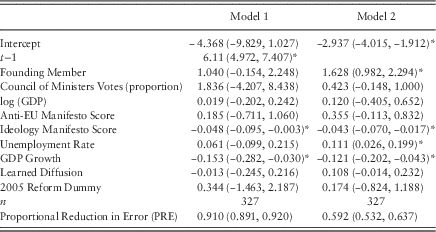
The coefficients, credible bounds and proportional reduction in error (PRE) for the Debt Breach models are presented in Table 1. Model 1, which includes the lagged dependent variable, has a PRE of 0.91. This statistic is very high, but is most likely caused by the explanatory power of the lagged dependent variable. For this model, the results convey that the lagged dependent variable, country governing ideology and GDP growth have an effect on the probability of violating the debt agreement of the SGP. When plotting the predicted probabilities, it is clear that some variables have a much larger substantive effect on the dependent variable than do others.Footnote 24 For instance, when taking into account 95% confidence bounds, the lagged dependent variable displays a large effect of 0.6 in the probability of breaking the debt clause when going from not violating the prior year to violating. The effect of moving from extreme value to extreme value for the other variables is much more difficult to ascertain given relatively large confidence bounds around the predicted probability means. However, there are two substantive results that are conveyed by the predicted probabilities of the remaining independent variables. First, rightist governments are less likely than liberal governments to break the clause. Second, countries with positive GDP growth rates are less likely to break the clause. The probability of breaking the clause when a country has a negative GDP growth rate contains very large variance – from 0.1 to 0.9. This occurs because there are relatively few instances under which countries faced extremely negative GDP growth. Therefore, the calculation of predicted probabilities leads to large confidence bounds at these values.
Stability and Growth Pact: Debt Breach Models

95% credible intervals are in parentheses.
*Indicates that coefficients are statistically significant.
GDP=gross domestic product.
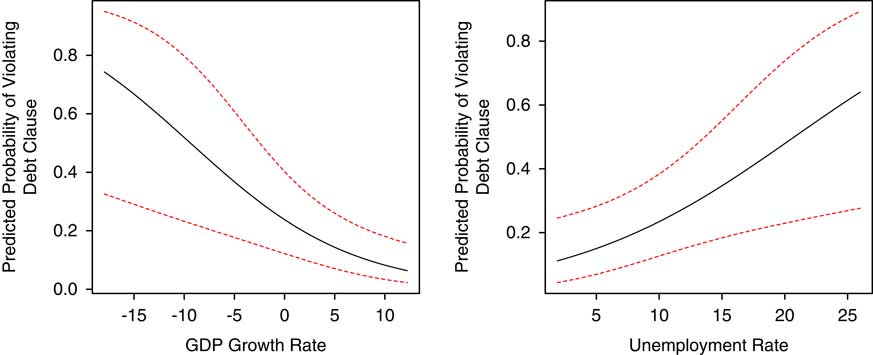
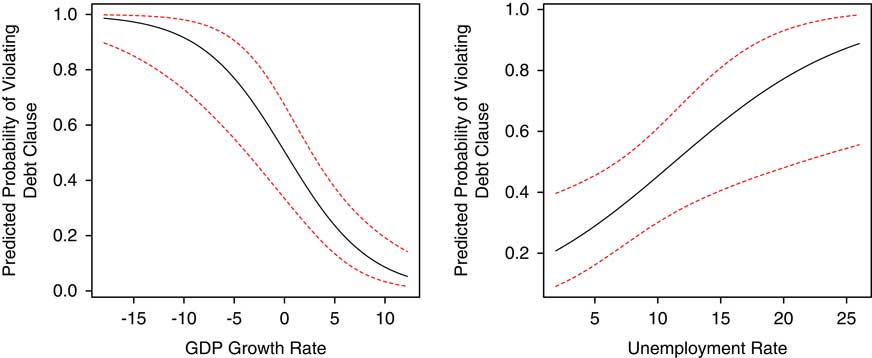
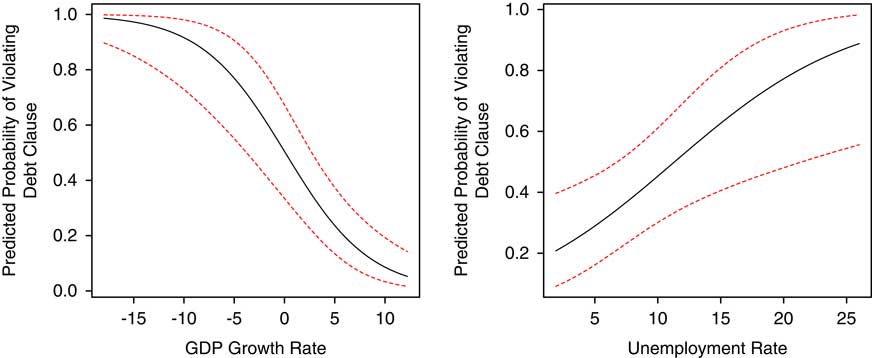
Model 2 was estimated without the lagged dependent variable. The PRE value is still fairly high at 0.592. Founding EU membership, a country’s governing ideology, unemployment and GDP growth are significant in this model. Taken together, the effects of these variables are quite meaningful. First, being a founding member of the EU increases a country’s probability of breaking the debt clause by about 0.05. Second, when moving from the most liberal to the most conservative ideological governments, there is a decrease in the probability of breaking the clause of about 0.2. Finally, unemployment rate and GDP growth combined have an effect of 0.5 or more on the probability of breaking the debt clause of the SGP when moving from low GDP growth and high unemployment to high GDP growth and low unemployment. The predicted probabilities of these two variables are presented in Figure 1. Even when accounting for the fairly large 95% confidence bounds, it is clear that economic need has a sizable effect on breaking the debt clause. The effect from this theory is much larger than the effect that is seen when exploring any of the other theories estimated in the model. The take away when comparing across models is that the variables that are statistically significant across both models contain the most explanatory power. Thus, it is clear that GDP growth is a major factor in the violation of the debt clause.
The effect of economic need on breaking the Debt Clause.
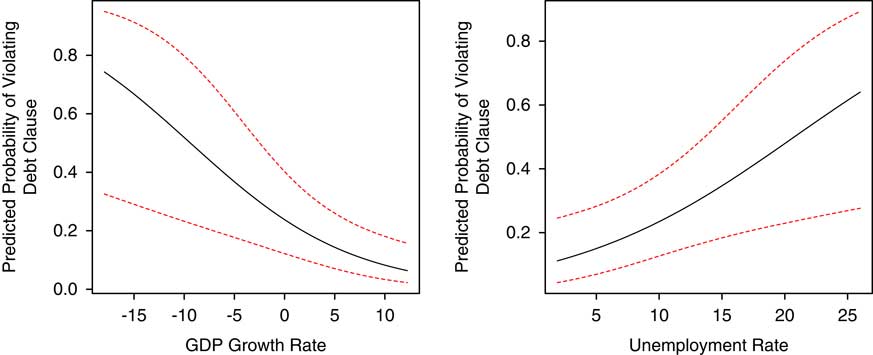
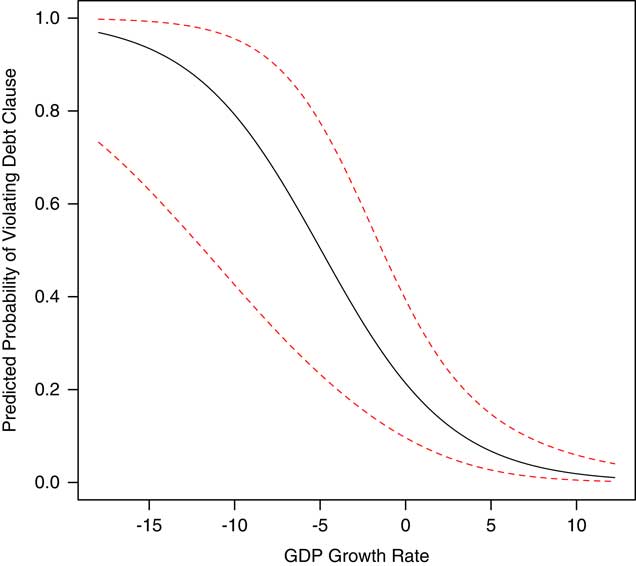
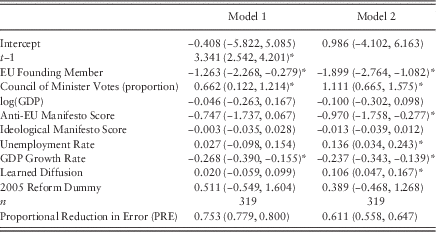
The coefficients, credible bounds and PRE for the Deficit Breach models are presented in Table 2. The first model, which includes the lagged dependent variable, has a proportion correctly predicted of 0.753. Again, the strength of this statistic is most likely a function of the lagged dependent variable. Indeed, the substantive effect of the lagged dependent variable is an increase of 0.4 in breaking the deficit clause of the SGP when compared with clause compliance and breaking the clause the prior year. It is important to point out that the effect of this variable is much weaker for the deficit clause than the debt clause. The other variables that are significant in Model 1 of the Deficit Breach Clause include founding EU membership, votes in the Council of Ministers and GDP growth. First, being a founding member of the EU has almost no effect on the probability of breaking the deficit clause. When plotting the predicted probabilities, there is relatively little information gained about the effect of this variable given the large confidence bounds. However, when moving from the smallest proportion of Council of Minister’s votes to the largest number, there is an increase of 0.1 in breaking the deficit clause. In contrast, the effect of GDP growth is very large. In fact, when moving from the lowest rate of GDP growth to the highest rate, there is a decrease of about 0.8 in the probability of violating the deficit clause. The predicted probabilities for this variable are presented in Figure 2. This result provides further evidence that economic need is the driving force behind violating the clauses of the SGP.
The effect of gross domestic product (GDP) growth on breaking the deficit clause (t−1).
Stability and Growth Pact: Deficit Breach models
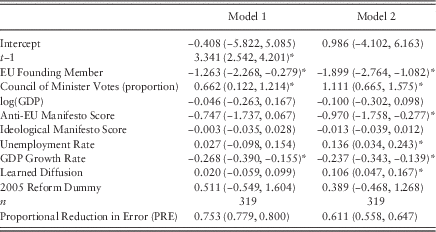
95% credible intervals are in parentheses.
*Indicates that coefficients are statistically significant.
GDP=gross domestic product.
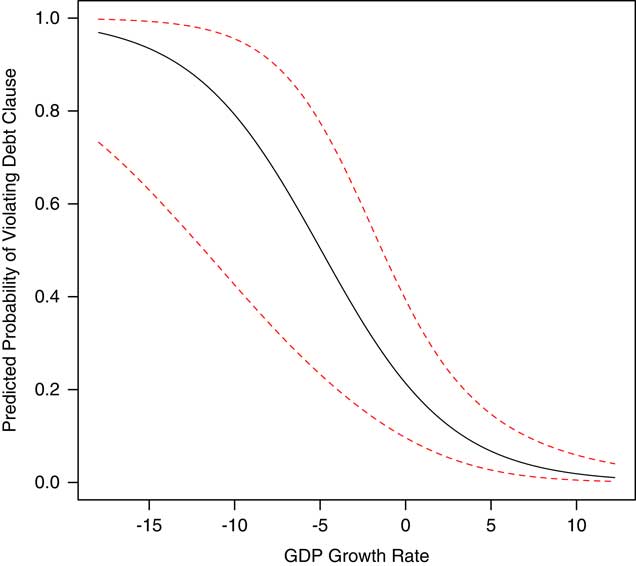
Model 2 presents the results for the model estimating the probability of violating the deficit clause without the lagged dependent variable. Again, the PRE statistic is quite large at 0.611. In addition, the results from this model indicate that EU founding membership, votes in the Council of Ministers, anti-EU governing ideology, unemployment rate, GDP growth and learned diffusion have an effect on the probability of violation. First, the effect of EU founding membership is again difficult to obtain because of incredibly large confidence bounds around the predicted probabilities. Second, when moving from the lowest proportion of Council of Minister’s votes to the highest, there is an increase of about 0.5 in violating the deficit clause. This effect is fairly large and was not present when exploring violation of the debt clause. Third, when moving from the most extreme anti-EU manifesto score to positive EU scores, there is a decrease of about 0.2 in the probability of violating the clause. Fourth, the effect of diffusion when moving from zero countries violating the prior year to the largest amount of violators leads to an increase of about 0.3 in violating the deficit clause. Finally, the effects of violating the clause caused by a country’s unemployment rate and GDP growth are, again, very large. The predicted probabilities for these two variables are presented in Figure 3. The effect of unemployment when moving from the lowest rate to the highest appears to be an increase of about 0.4 in the probability of violating the deficit clause. In addition, the effect of GDP growth when moving from the most negative growth to the highest growth is a decrease of about 0.9 in the probability of violating the cause. The effect of this variable demonstrates that, holding all other continuous variables at their median and dummy variables at one, this variable accounts for almost all of the variability in the probability of violating the deficit clause.
The effect of economic need on breaking the deficit clause.
The results here present a more complete picture for explaining the violation of the two main clauses of the SGP. SGP violations are not solely explained by bad enforcement mechanisms that encourage countries to violate simply because they can. Instead, it is clear that the countries that violate the SGP do so because they have no other alternative. Economic need is the single most powerful explanation for a country’s deviation from both the deficit and debt clauses of the SGP. Although several variables representing the country-power, governing ideology and diffusion theories are significant, these variables only explain a small fraction of the variance of the dependent variable. The substantive effects of these variables provide support for many of the claims in the literature. However, the results clearly indicate that claims of country power overriding collective economic policy may be overstated. In addition, although governing ideology plays some role in explaining the approach to following EU economic law, there are other factors that supercede ideological orientation. Finally, diffusion was only significant in the deficit clause model where the lagged dependent variable was not included. This model did indicate a fairly sizable effect when many countries were violating a deficit clause, but the effect was minuscule in comparison to the effect of unemployment and GDP.
Conclusion
In sum, several of the variables explored in the analysis have substantive effects on whether a country violates either clause of the EU’s SGP. First, violation the prior year significantly increases the probability of violating in subsequent years. Next, countries that have more votes in the Council of Ministers or are founding members of the EU are slightly more likely to violate either clause. Third, in terms of economic need, countries with negative GDP growth and high unemployment are substantially more likely to violate either clause. Fourth, ideology plays a very minor role in encouraging the violation of the clauses of the SGP. In particular, anti-EU and leftist ideologies are associated with a very small increase in the probability of violation. Finally, diffusion represented as the number of countries violating the previous year has almost no substantive effect on the probability of violating the SGP.
The analysis presented here set out to identify which theories best explain a country’s defection in either of the two mains clauses of the SGP. Through the use of Bayesian statistical analysis, this article advances the current literature by testing multiple theories simultaneously in order to calculate the precise explanatory power of each theory. The tests performed in this paper confirm that economic need is the driving force behind noncompliance of the SGP. The results are strengthened by the fact that the universe of cases was used in conjunction with Bayesian inference. In this light, existing analyses that focus solely on the calculation of a country’s power within the European Community, or on a country’s governing ideology, may benefit from extending their analyses to include more variables that account for economic shocks.
One avenue for future research is to determine whether economic need explains policy defection in other areas of EU economic law. This would be the first step for confirming that economic need is the driving force behind economic policy deviation. Another avenue to pursue for future research is extending comprehensive tests that explore multiple theories to analyses that look at compliance with non-economic EU law. Since the main explanatory theory found here is economic need, the present analysis cannot explain why EU countries deviate from non-economic EU law. Therefore, more research would need to be done in order to understand if there is some underlying latent variable that explains EU policy noncompliance in other critical areas of EU law.
Acknowledgements
The author will share all data and coding for replication purposes upon request. The author would like to thank David A. Armstrong II, Jennifer L. Clemens, Jennifer K. Smith, Natasha Borges Sugiyama, the members of his dissertation committee, and the editors of the Journal of Public Policy, as well as the four anonymous reviewers, for reading drafts and offering their valuable critiques and suggestions. An earlier version of this article was presented at the 2014 Annual Meeting of the Midwest Political Science Association.