As the size and complexity of the federal government have grown, Congress and the President have increasingly relied on major independent regulatory boards and commissions to design and implement policy. Given both the pivotal role played by these institutions and the increasing political polarisation, it is no surprise that they have been the subject of increased media and public scrutiny. For example, in recent years, controversial issues such as election timing for unions, unionisation for college athletes, net neutrality and payday loan rules have led to greater media attention on the National Labor Relations Board (NLRB), the Federal Communications Commission and the Consumer Product Safety Board (Strauss 2014; Baker Reference Baker2015; Ruiz 2015; Shear and Silver-Greenberg 2015).
With increased attention being given to the substance of these boards, the nominating process has become increasingly controversial. Specifically, low confirmation rates for major independent regulatory commission (IRC) nominees have become commonplace in recent years. In the 112th Congress, only 45 of President Obama’s 76 nominations to independent boards and commissions were confirmed by the Senate (Greene Reference Greene2015). When nonconfirmation is coupled with widespread delay, the result is a significant increase in empty seats on major boards. A high vacancy rate may simply decrease the capacity of several major boards, but in some extreme cases it has led to the board being unable to render decisions due to quorum requirements. This issue was exacerbated by a 2014 Supreme Court decision in Noel Canning versus NLRB, which upheld the practice of using pro forma congressional sessions to restrict the President’s use of recess appointments to fill vacant seats (Ostrander Reference Ostrander2015).Footnote 1 In the past several decades, such recess appointments have been used especially for filling vacancies in major IRCs (Corley Reference Corley2006; Black et al. Reference Black, Madonna, Owens and Lynch2011).
The increasing salience of both the substance and the membership of major independent boards calls for a closer examination of institutional design. In this article, we examine how such bureaucratic structures influence the stability and confirmation dynamics of major independent regulatory boards. Specifically, we focus on holdover provisions present in the authorising statues of these agencies. Using two unique data sets, we draw two primary conclusions. First, an examination of board composition reveals that not all vacancies are created equal. In nearly 60% of months where a seat on a major independent regulatory board is vacant due to either an expired term or an announced resignation, a member is still serving in some capacity. This substantially alters the calculus behind nominations. Second, we find that the presence of holdover provisions is associated with a much faster nominating process while allowing the boards to continue to serve at or near full capacity.
Nominations and conflict
As the nominating process has gotten more contentious, it has been accompanied by more scholarly attention. Much of this recent work has focussed on the increasing length of “confirmation delay”, specifically examining the time that passes between a formal nomination and the date a nomination is confirmed by the Senate (Bond et al. 2009). The logic here is relatively straight-forward. The longer a nominee is unconfirmed, the less time he or she is spending passing policies favoured by the executive branch. McCarty and Razaghian (Reference McCarty and Razaghian1999) find, consistent with others, that the presence of large numbers of senators who are not in the President’s party increases the amount of delay in the nomination. Binder and Maltzman (2002) reinforce this finding, demonstrating that institutional constraints such as divided government and the ideological distance between the President and the opposition party median play a pivotal role in delaying the confirmation of a nominee.
Additional work has suggested that the policy environment (Moe Reference Moe1985; Nixon and Bentley Reference Nixon and Bentley2006; Dull et al. Reference Dull, Roberts, Keeney and Choi2012) and the timing of a nomination during the President’s term can significantly increase the length of a nomination (Spriggs and Wahlbeck Reference Spriggs and Wahlbeck1995; Barrow et al. Reference Barrow, Gryski and Zuk1996; Nixon and Haskin Reference Nixon and Haskin2000; Binder and Maltzman 2002). The length of a nomination is further exacerbated by a Senate faced with an increasing number of confirmations, as the number of appointed positions grows and appointees are shortening the length of their service (Light Reference Light1995; Lewis Reference Lewis2008). Finally, others suggest that increased scrutiny from outside the federal government has led to an increase in the amount of time vetting potential nominees (Deering Reference Deering1987; King and Riddlesperger Reference King and Riddlesperger1996; Nixon Reference Nixon2001; Durant and Resh Reference Durant and Resh2010). This has served to increase both confirmation time and vacancy length (the length of time from a vacancy to confirmation). Overall, research is beginning to suggest that the nominations process is taking longer to complete and is more likely to end in failure (O’Connell Reference O’Connell2015).
In recent decades, presidents have increasingly relied on the recess appointment clause to fill certain vacancies (Corley Reference Corley2006; Black et al. Reference Black, Madonna, Owens and Lynch2007, Reference Black, Madonna, Owens and Lynch2011). Article II, Section 2 of the Constitution states that “The President shall have Power to fill up all Vacancies that may happen during the Recess of the Senate, by granting Commissions which shall expire at the End of their next Session”. Recess appointees have the same formal authority as Senate-confirmed nominees. Black et al. (Reference Black, Madonna, Owens and Lynch2007) find that presidents primarily use their recess appointment power to fill seats on major independent regulatory boards and commissions. This, they argue, is a product of both the limited term of service and the fact that the small size of the board increases the importance of one or two recess appointees.Footnote 2 Ultimately, presidents were able to use recess appointments as a kind of unilateral power (Howell Reference Howell2003) for bypassing the requirements of Senate confirmation.
The recent decision in Noel Canning versus NLRB coupled with the 2013 reform of Senate cloture rules may forever alter presidential nomination politics by removing the ability or need for recess appointments (Ostrander Reference Ostrander2015). Specifically, in periods of divided government, pro forma sessions will remove the ability of presidents to rely on recess appointments. In periods of unified government, presidents will be able to take advantage of simple majority cloture in the Senate for agency nominations in order to gain confirmation for their desired appointments. These combined changes to the nomination process suggest that presidents will rely far more frequently on the routine confirmation process.
Recognising that vacancies frequently exist in the absence of a nomination, scholars have taken to more detailed examinations of vacancy rates in recent years. In a study of executive agency vacancies from President Carter to President George W. Bush, O’Connell reports that “by one measure, Senate confirmed positions were empty (or filled by acting officials), on average one-quarter of the time over these administrations” (Reference O’Connell2009, 914). Looking specifically at vacancy delay (defined as the time between an expired term and a confirmation) on two specific independent regulatory boards, scholars have found higher vacancy delay when an appointment could alter the partisan composition of the board (Nixon Reference Nixon2001; Nixon and Bentley Reference Nixon and Bentley2006).
Reversion points and Senate obstruction
Although scholars have increasingly focussed on how political factors influence confirmation delay to bureaucratic and judicial institutions, comparably less work has examined the role played by the structure of those institutions. In what follows, we examine how the presence or absence of different types of holdover provisions influences confirmation delay to major independent regulatory boards.Footnote 3 Appointments to these boards and commissions are important for a number of reasons. First, these boards and commissions make substantial policy decisions. Second, their small size suggests that any one nomination can drastically alter the board’s composition. Finally, nearly all major boards and commissions limit the number of seats that can be filled by members of one political party (Nixon Reference Nixon2001; Lewis Reference Lewis2003). Such conditions tend to increase the amount of scrutiny major board nominees face in the Senate.
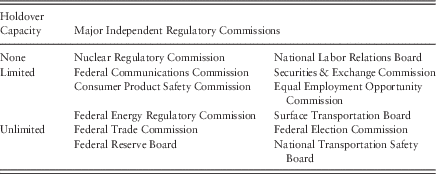
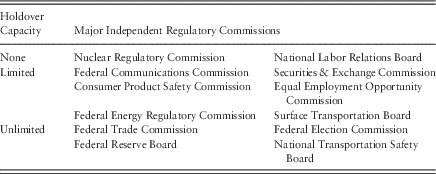
As major boards tend to be small, any vacancy can have a large influence on their composition. The notion of a vacancy, however, is not a dichotomous concept. Commissioners can serve after terms have expired either through recess appointments or through statutory holdover provisions. The length of time a member is allowed to serve on an independent regulatory board or commission after the term has expired depends on the statute. Most commissions fall into one of three categories: unlimited holdover capacity (the member may serve until a successor takes office), limited holdover capacity (the member may serve until a successor takes office, but for no longer than one year or in some cases the end of the next session of Congress) or no holdover capacity (the member must leave office upon the expiration of the term). The status of each major commission can be found in Table 1. If the confirmation process can be viewed as a bargain between the branches, the level of holdover capacity can be seen as strongly influencing the reversion point for both the President and the Senate.
Distribution of holdover capacity within major boards
Scholars have argued that the executive is most likely to be blamed for the performance of an agency (Lewis Reference Lewis2003). Thus, presidents are incentivised to be responsive to a completely vacant seat lest a key board loses the capacity to operate. Although seemingly innocuous, vacancies in major commissions can be costly; because of quorum requirements, multiple vacancies can lead to extreme reversion points in which a board cannot legally operate. Since 2005, the NLRB has twice become nonfunctional because of multiple vacancies. Presidents are likely to be even more motivated if the vacant seat could be replaced by a fellow partisan.
In contrast, accountability for individual members of the Senate is less clear. No individual senator can be blamed for the loss of a board’s quorum, and individual obstruction efforts are often difficult to uncover. This is especially true where nominations are obstructed through the issuing of anonymous holds (Howard and Roberts Reference Howard and Roberts2015). Moreover, the importance of floor time and a long-standing norm of protecting minority rights in the Senate makes it less likely the chamber would quickly respond to extreme reversion points in the same manner as the executive branch.
The United States (US) Senate allows its members to obstruct chamber business by consuming valuable floor time (or, more commonly, threaten to consume valuable floor time). Efficient use of Senate floor time is especially valuable, given the significant changes since the 1970s in how the institution operates (Smith et al. Reference Smith, Ostrander and Pope2013). These two changes have resulted in a greater number of bills being introduced, more members seeking floor time for debate and a wider range of viewpoints and issue areas being presented and considered. This has caused an increase in the time spent considering the larger number of trivial measures and protracted debate needed for the increased numbers of controversial ones. Scholars have speculated that such time demands have led to substantial policy costs, as legislative sessions end before legislation can be considered and passed (Oppenheimer Reference Oppenheimer1985).
Although Senate Democrats in 2013 used a reform by ruling (the so-called “nuclear option”) to reduce cloture requirements from 60 votes to a simple majority for most executive nominations, nominations are still subject to the traditional and time-consuming cloture procedure. To begin, a cloture petition must lie over for two calendar days before it is voted on. Then, for much of the chambers’ history, an additional 30 hours of debate and amending activity can occur before a final vote is taken on the measure. The majority of leaders are constrained by holds because there is not enough floor time available to spend on cloture for all nominations. For example, according to the Senate’s website THOMAS, the 113th Congress contained 1,050 civilian nominations. Forcing 30 hours of debate for each nomination would take 31,500 hours. This is an order of magnitude greater than the 2003 total hours that the Senate actually spent in session that Congress.
Because of the value of Senate time, obstruction becomes more potent. Indeed, the majority is further hampered by the fact that the more obstruction is used, the more valuable time becomes (Oppenheimer Reference Oppenheimer1985). For example, minority party Republicans in the 113th Congress did refuse to yield back post-cloture debate time after the new cloture precedent was set. This led to high vacancy rates for many ambassador and state department posts as Democrats in the 113th Congress were unable to reach unanimous consent agreements or carve out time for those nominees. As Senator Michael B. Enzi (R-WY) noted in objecting to one proposed unanimous consent request, “We used to pass ambassadors and all kinds of people en bloc like that, but we have this nuclear option now that the majority chose so it takes a little longer to do that whole process” (Lesniewski Reference Lesniewski2014). This in turn, creates a scarcity of time to consider other nominations.
In response to the increasing value of time, Senate majority leaders have increasingly relied on unanimous consent agreements to manage routine chamber business (Smith and Flathman Reference Smith and Flathman1989; Ainsworth and Flathman Reference Ainsworth and Flathman1995). This requires them to work with opponents, frequently resulting in delay. In the absence of any agreement, leaders will often abandon a nomination in exchange for an item that has universal support. No nomination battle is fought in a vacuum, and time spent on any nomination cuts into time that could be spent on policy proposals with great salience. Thus, threats to obstruct individual nominations are generally taken seriously by the Senate majority leader. Moreover, these threats do not necessitate a broad base of opposition (as measured by something such as a filibuster pivot).
The data are broadly supportive of this point. From the 107th–110th Congresses, President Bush submitted 426 nominations to 33 regulatory boards and commissions. Of these, 274 were confirmed by the Senate (or 64.32%).Footnote 4 Despite the low success rate and highly contentious politics surrounding nominations to regulatory boards and commissions, there were no cloture votes on any of these nominees during this period. Although by no means definitive, this suggests that many nominations were killed by time constraints, as opposed to an organised and sizable opposition.
However, although the importance of time gives individual senators a great deal of influence, this influence is not absolute. Howard and Roberts (Reference Howard and Roberts2015) demonstrate that a number of factors influence the decision of individual senators to place “holds” on bills and nominations or object to unanimous consent agreements (and the success of those efforts). This includes the ideology of the senator, the timing in the session and party status. Accordingly, senators are most likely to use their individual powers to block nominations when the benefits of doing so are most readily available.
Given this, we believe holdover provisions will lead to faster confirmations for three reasons. First, the presence of holdover provisions may serve to increase uncertainty over the policy implications of a given nominee. Specifically, it has made identifying the reversion point on an independent regulatory board or commission extremely difficult. In a five-member board with staggered terms, it is relatively easy to identify the policy implications of a given nominee. If, for example, a board has three Democrats and two Republicans and one Democrats’ term is expiring, a Republican replacement could shift the board’s policy output until the next Republican’s term is set to expire. This nomination would be referred to as a “critical” nomination (Ruckman Reference Ruckman1993). In the absence of a holdover provision, the reversion point would be similarly easy to determine. However, when one or multiple members are serving in holdover capacity, the impact of any one nominee is less clear.
Second, and related, holdover provisions mitigate the threat posed by extreme reversion points. Put simply, for boards with no holdover capacity, the reversion point is a vacant seat. Policy opportunities may be gained by actively delaying any nominee to fill the vacant seat, and hence such nominations are often the targets of strategic delay. If, however, a nomination is made to a seat that is presently held by a member serving in a holdover capacity, no such value is gained. This is most apparent in situations where the status quo would be a board crippled by the lack of a quorum. Indeed, the White House accused Senate Republicans of blocking NLRB nominees in order to ensure that the board would not be able to reach a quorum and function properly.Footnote 5 With holdover capacity, such extreme status quo points are much less likely.
Third, holdover provisions facilitate the pairing of nominees together for a single vote. If a Republican seat becomes vacant on a board with no holdover capacity, Republicans would have a strong incentive to fill the seat and Democrats would have an equal incentive to leave the seat vacant. One way senators have sought to address these types of impasses is by combining multiple appointments together (Ho Reference Ho2007; Devins and Lewis Reference Devins and Lewis2008).Footnote 6 When board members have the opportunity to continue sitting after their term has expired, they will frequently wait until an opposing partisan board member leaves to do the same. In certain instances, members will stay on in response to requests from fellow partisans. For example, Securities and Exchange Commissioner Harvey Goldschmid announced he would stay on longer in response to requests from Senators Charles Schumer (D-NY) and Harry Reid (D-NV). The Democrats were worried that Goldschmid’s departure would create a 2–1 Republican advantage on the five-member board, leading to a number of pro-Republican decisions (Labaton 2005). Pairing nominations in this manner helps ensure neither party gets a short-term advantage or through such advantage is motivated to obstruct.
In sum, we anticipate that both nomination and confirmation delay are responsive to the absence or presence of holdover capacity. In the next two sections, we adopt a two-pronged approach to better examine our theory. First, we provide broad data for holdover provisions on major independent boards. Specifically, we identify whether a given board seat was completely vacant or if the term had merely expired. We then examine confirmation more systematically, by comparing confirmation duration on boards with no holdover capacity with those with either expiring or unlimited holdover provisions. Empirical evidence suggests that (1) members serving in holdover capacity are quite common, (2) they serve to mitigate instances of absolute vacancies in independent regulatory boards and (3) holdover provisions seem to reduce senatorial delay in the confirmation process. This suggests to us that holdover provisions can help mitigate the potential for partisan obstruction that plagues the US Senate.
Investigating holdover capacity
There are two key types of data that can be used to analyse questions related to holdover capacity and the nominations process. Many studies (Nixon Reference Nixon2001; O’Connell 2009; Hollibaugh Reference Hollibaugh2015) of the nominations process have used vacancy data in which the unit of analysis is an individual office. This kind of analysis is useful for investigating the total time that a position stays vacant, regardless of any other factors. The total time is an important concept because there can be much delay in the prenominations process before a president ever formally announces a nominee. Furthermore, it may be the case that several nominations must be made before a position is actually filled. The disadvantage of this measure is that it is unclear whether the President or the Senate is to blame for any given delay, and the vacant seats may cross key temporal and institutional boundaries such as Congresses.
To study delay caused by senatorial obstruction, studies such as those of McCarty and Razaghian (Reference McCarty and Razaghian1999) used the formal nomination as sent by the President to the Senate to define the list of cases. Using formal nominations allows one to examine the delay caused by the Senate in exclusion of the activities of the prenomination process. Furthermore, such nominations are limited temporally to a single Congress. As such, this unit of analysis is ideal for measuring the delay due to senatorial obstruction but it cannot measure presidential obstruction.
In the following analysis, we use both kinds of data to understand the influence of holdover capacity on the nominations process for major IRCs. When examining vacancies, we use office-level data. When we are examining senatorial delay, we use the nomination itself as the unit of analysis. By merging both kinds of data into the same investigation, we gain insights from each while mitigating the disadvantages. A few studies have used both measures, and as such most studies were only looking at a part of the nominations process.
Holdovers and vacancies
To provide a broad overview of vacancy rates in major independent regulatory boards, we examined six representative boards from the 107th (2001–2003) to the 110th Congresses (2007–2009) and identified when member terms expired, when members departed from seats, when nominations were submitted and when members served in recess appointments. The data include two boards where no holdover provisions exist (the Nuclear Regulatory Commission and the NLRBs), two boards where members are allowed to serve until the end of the next session of Congress (the Federal Communications Commission and Securities and Exchange Commission) and two boards where members are allowed to serve until a successor replaces them (the Federal Trade Commission and the Federal Election Commission). We then tracked presidential action time (the number of months per Congress between a vacancy and the presidential nomination if one was made), Senate confirmation time (the number of months per Congress between a presidential nomination to Senate confirmation or return to the President) and total vacancy time (months per Congress between a vacancy and Senate confirmation or the nomination being returned at the end of the session).
A “vacancy” may occur when either the nomination expires or the nominee formally announces his or her future resignation. Although announced resignations do not necessarily imply a vacant office, it is the case that a president may begin formal procedures for announcing a new appointment.Footnote 7 In both instances, the President has a clear opportunity/incentive to find a nominee for the seat. Using a combination of newspaper accounts, commission websites and press releases, we then determined whether a vacant seat was completely empty or filled by a member in holdover capacity or as a recess appointee. The preliminary data underscore how important recess appointees and members serving in holdover capacity have been in avoiding completely vacant seats.
Between the 107th and the 110th Congresses, we identify 107 seats where a vacancy occurred.Footnote 8 This translated into 946 total months where a vacancy existed in one of the given major independent regulatory boards. Of the 946 months where a vacancy existed, the seat was completely vacant 40.27% of the time (or 381 months). This suggests that the majority (59.73%) of time in which we might consider a seat “vacant” there is actually an individual occupying that seat in some irregular capacity. Such evidence suggests that members serving in a holdover capacity are a common feature of the nominations process.
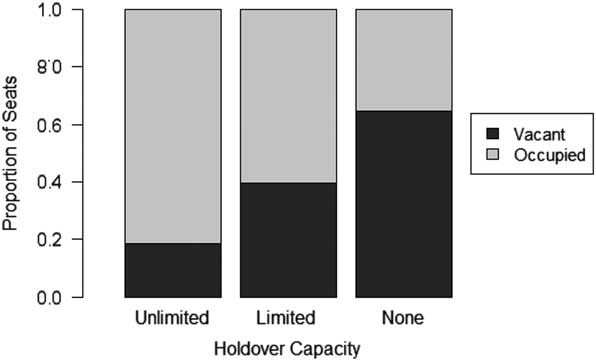
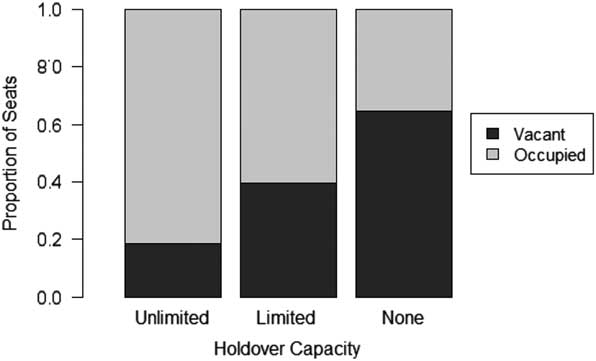
As we would expect, the completely vacant seats were heavily concentrated among the two boards with no holdover capacity. Specifically, for the boards with unlimited holdover capacity, seats were completely vacant in just 18.38% of months (or 66 of 359 months). For boards with limited holdover capacity, this number increased to 39.45% (or 101 of 256 months). Finally, for boards with no holdover capacity, seats were completely vacant in 64.65% of months where a term had expired (or 214 of 331 months). These findings can be compared side by side in Figure 1.
Months with complete vacancies by holdover capacity: 2001–2009
As vacancies are created within the ranks of major IRCs, the first step in filling an empty chair is for the President to nominate a successor. Scholars have posited that the President is more likely to be blamed for poor agency performance (Lewis Reference Lewis2003). Hence, we should expect the President to nominate a successor more quickly when a seat is completely vacant, as opposed to being temporarily held by a member serving an expired term or recess appointment. Furthermore, we may expect presidents to act with greater haste to fill board positions vacated by their own copartisans.
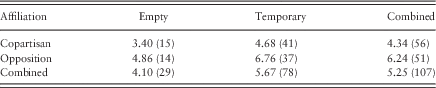
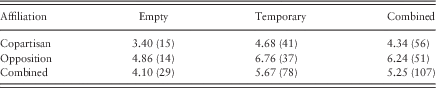
Table 2 provides data on the time in months between a major IRC vacancy and a presidential nomination during the period between the 107th and the 110th Congresses. These data include 107 vacancies to the six representative IRCs noted above. In each case, we code the affiliation of the departing official as either a copartisan of the President or a member of the opposition as well as whether the position was completely vacant (empty) or filled via a recess appointment or holdover capacity (temporary). During this period, Table 2 shows that President Bush took an average of 5.2 months to select a nominee to the seat, although he was slightly faster in nominating replacements to completely vacant seats (4.10 months) than those where a member was serving in some expired or temporary capacity (5.67 months).Footnote 9 As we might expect, partisan factors also play a role. President Bush was much quicker (by almost two months) in nominating someone to a seat vacated by a fellow Republican.Footnote 10
Average months from vacancy to presidential nomination: 107–110th congresses
In addition, as critics of the Canning decision suggest, the number of completely vacant seats is likely to rise in the absence of recess appointees. For 169 of the 946 months where a term had expired or a member had announced their resignation (or 17.86% of the time), a member was serving on the board as a recess appointee. We believe that these descriptive data help give us a broad overview of how holdover capacity influences board composition. However, in an effort to more systematically examine the effect of holdover capacity on executive nominations, we turn to confirmation duration.
Holdovers and Senate delay
The dependent variable of interest when investigating Senate delay is the length of time it takes the Senate to confirm or deny a nominee. In order to investigate this measure of delay, we examine all formal nominations to major IRCs between 1987 and 2012 (100th to the 112th Congresses). In particular, we examine the time to decision, or the length of time between a formal nomination and some manner of disposition whether it be successful confirmation, failure, withdrawal or being “returned to the President” at the end of a Congress. These data are available on the congressional website THOMAS.gov.Footnote 11 The time frame was chosen to encompass the “post-Bork” era of executive nominations politics. With this measure, we can examine the patterns of senatorial delay occurring after presidents issue formal nominations.
When considering delay in the Senate, our key independent variable is whether and what type of holdover capacity a major board has by statute. Holdover capacity can be measured within three primary categories: none, limited and unlimited. As noted above, boards with no holdover capacity do not have any measures in place to allow board members to serve beyond their initial term of appointment. Limited holdover capacity allows a major board to keep a member with an expired term for a certain period of time, until the congressional session ends, or until a replacement is found. With unlimited holdover capacity, a board may retain a member with an expired term for as long as it takes to find a replacement. Although theoretically unlimited, this final category is practically bounded by the patience and lifespan of the board member.
In order to capture the influence of presidential contexts on the speed of the nomination process, several control variables are necessary. First, we code whether a president was issuing a cross-party nomination. Because of party balancing requirements or traditions, presidents are often forced to nominate a member of the opposite party.Footnote 12 We simply note when the nominee is from an opposed party. Second, presidential approval is measured by aggregating public approval of the President for the month in which the nomination was made. Third, because presidents are often given wider leeway in terms of nominations at the beginning of their term in office, we note whether a nomination was issued within the first 180 days of a presidency. Fourth, presidential election years are coded as a dichotomy with “none” serving as the baseline category to identify the effects of elections. Fifth, because of the expected loss of political capital, we code whether a given nomination was issued while the President was a lame duck. We operationalise this concept by including a dummy variable for the last 18 months of a presidential term.
Next, we want to capture the influence of Senate political contexts on the nomination process. First, because this study concerns only Senate-confirmed positions, divided government is a measure of the difference between the Senate and the President only (i.e. divisions with only the House are not included). Second, polarisation is measured within each Congress using the differences in the estimated party means in the first dimension of Poole and Rosenthal (Reference Poole and Rosenthal1997) NOMINATE scores.Footnote 13 Third, we include a measure for Senate workload. Similar to previous studies, we measure the number of roll call votes within the Senate during the month of the nomination. This provides a measure for how active the Senate was at the time of the nomination.
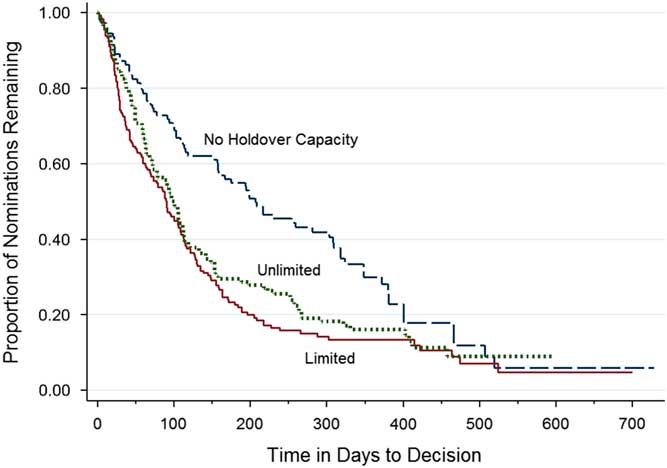
Figure 2 shows the Kaplan-Meier survival functions for major boards with different levels of holdover capacity available to outgoing members. The three types of holdover capacity shown are as follows: no holdover capacity, limited holdover capacity and unlimited holdover capacity. A Kaplan-Meier survival function demonstrates the proportion of cases in each category that are still under consideration after a given number of days has passed. Figure 2 shows that, in general, nominations to major boards with no holdover capacity tend to take longer than boards that have either some or unlimited holdover capacity. The differences between the nomination durations for limited and unlimited holdover capacity are quite small. The Kaplan-Meier survival functions suggest, however, that after 100 days under consideration there are approximately 70% of cases for major boards with no holdover capacity still under consideration, whereas the proportion for boards with at least some holdover capacity is just above 40%. Similarly, after 300 days of consideration, about 40% of cases with no holdover capacity remain, while under 20% remain for boards with some holdover capacity.
Kaplan-Meier survival function for major boards: 1987–2012
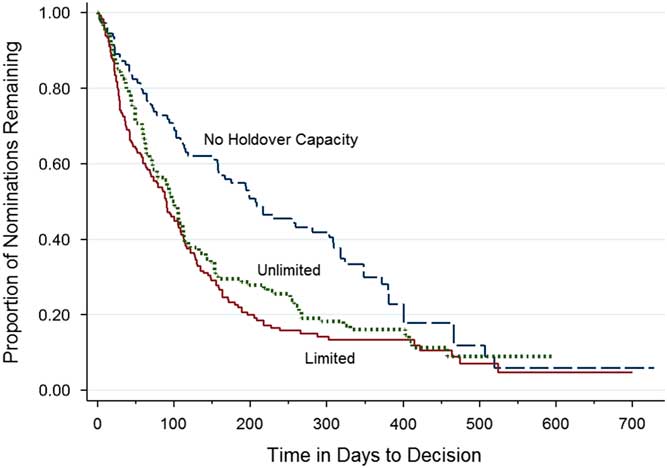
The descriptive data in Figure 2 suggest that nominations with at least some holdover capacity do in fact receive quicker Senate action than those nominations to major boards without any holdover capacity. Although the difference between the boards having at least some holdover capacity is small, the difference between having at least some holdover capacity versus having none is quite stark. This suggests that the true effect of holdover capacity may be more dichotomous than a true spectrum.
The standard method employed in studying delay times is a duration or survival model.Footnote 14 Such models are particularly useful for modelling cases that have right censorship (due to the ending of congressional sessions). Although the most common model is perhaps the Cox proportional hazards model, the data for nominations contain a high proportion of tied cases, which poses a difficulty for Cox models (Box-Steffensmeier and Jones Reference Box-Steffensmeier and Jones2004).Footnote 15 Because of their strengths, Weibull duration models have been used by McCarty and Razaghian (Reference McCarty and Razaghian1999) as well as by many others in the study of confirmation delay. We thus also adopt the Weibull model.
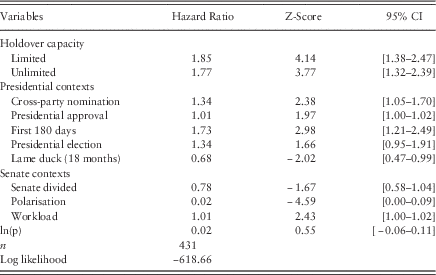
Table 3 shows the results of a Weibull duration model on the time each nomination was under consideration by the Senate.Footnote 16 The estimates of the duration model are given in terms of hazard ratios (exponentiated coefficients) in order to aid interpretation. The hazard ratio can be read as increasing or decreasing the hazard of ending the nominations process with the baseline for comparison being 1.00. Therefore, a hazard ratio of 2 indicates that a unit increase in the independent variable will make a nomination two times more likely to exit the process (likely by confirmation) each day, whereas a hazard ratio of 0.50 suggests that a nomination will be half as likely to exit.
Duration of major board nominations in the senate: 1987–2012
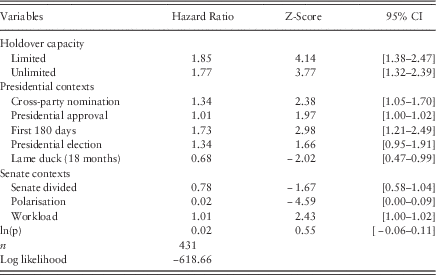
These results comport well with intuition. With respect to our key expectation, the decisions for boards with either limited or unlimited holdover capacity were found to proceed significantly faster than boards with no holdover provision.Footnote 17 These findings strongly suggest that the structure of the institution influences the likelihood of senatorial obstruction. Importantly, these results suggest that adding holdover capacity to existing boards may reduce both the overall confirmation time for these key nominations as well as the potential for vacancy-provoked shutdowns.
In terms of presidential contexts, we find that cross-party nominations do in fact proceed more quickly than when presidents are nominating allies. Perhaps this suggests that opposition senators are less likely to obstruct their own copartisans. Furthermore, the expedited process may be a result of prenomination bargaining and these nominations may be more likely to form a part of a “package” of nominations. Ultimately, these findings demonstrate support for the intuition that cross-party nominations proceed differently.
Presidential approval also appears to give some small benefit to the speed of nominations. This finding comports well with previous research as well as intuition. Similarly, these findings meet expectations, given that nominations made within the first 180 days of a presidency do indeed proceed more quickly. New presidents are often given more leeway to choose their team. Conversely, nominations made by lame duck presidents in their final 18 months are in fact slower. No significant relationship was found concerning the presidential election cycle.
Senate political contexts also largely conform to expectations. Although divided government does not significantly influence delay time, it is to be expected, given that the rules of the Senate imply that a small minority of senators is all that is needed to delay a nomination. Hence, the control of the chamber may not be a good measure for how much obstruction a nominee will face. Polarisation, however, is shown to significantly slow the nominations process for major board nominees. Perhaps counter-intuitively, a high workload in the Senate is found to predict faster confirmation. This suggests that when the Senate is working hard, they are also working through nominations. These findings are similar to those of McCarty and Razaghian (Reference McCarty and Razaghian1999).
Conclusion
Our analysis suggests that the structures of bureaucratic institutions play an important role in determining the nature of the nominating process. Because of the decision delivered in Noel Canning versus NLRB, holdover capacity will become an increasingly important feature for understanding the politics of executive nominations to major boards. Without recourse to recess appointments, and given the prevalence of vacancy rates, members serving in a holdover capacity will increasingly be the difference between a functional or a decommissioned commission. The majority opinion in Canning suggested as much, noting that if Congress wanted to “alleviate such problems [stemming from high vacancy rates], it could certainly create Board members whose service extended until the qualification of a successor” (Noel Canning v. NLRB, 705 F.3d 490, 492–93 (D.C. Cir. 2013)). Our analysis suggests that the influence of holdover capacity demonstrates the power that institutional design can have on political incentives and policy outcomes. To date, however, holdover capacity has been overlooked and understudied by scholars of the nominations process.Footnote 18
Our findings demonstrate that holdover capacity is both a common institutional feature and an important means through which major boards are staffed. Our study also notes several instances in which holdover capacity appears to influence the nature of the executive nominations process. In particular, we find that major boards with any kind of holdover capacity seem to enjoy significantly faster Senate action as compared with boards that do not have any holdover provisions. This comports well with our intuition regarding reversion points under which a member is already serving in a seat through holdover capacity.
By examining holdover capacity, we also come to several new conclusions concerning the nominations process. Perhaps most importantly, the concept of a “vacancy” is more than a dichotomy. Many members on major boards are serving in either a holdover capacity or as a recess appointee. This changes how we should think about the nomination process. For example, most previous studies of nominations to major boards are concerned with only “median shifting” nominations. However, it is unclear whether a given nomination is median shifting or not, given that the board may have three complete vacancies or several members serving in a nonconfirmed capacity. Ultimately, we believe that all nominations to major boards are potentially “critical” given the unstable nature of present board compositions and the uncertainty about entry and exit times of new members. Our research suggests that future investigations must take into account these unique qualities when examining the executive nomination process for major regulatory boards.
This analysis also indicates that presidents and the Senate perceive the value of time differently, and furthermore that this difference influences their behaviour in the nomination process. Presidents, who are often blamed for the success or failure of an agency, often have an incentive to fill vacant seats quickly. On the other hand, senators are unlikely to be individually blamed for the failure of an agency and as such they have less incentive to act. Time, however, is quite valuable in the Senate, given the necessity to use unanimous consent agreements for managing the schedule on the floor. As such, any opposition to a nomination, even if it comes from an extreme minority of just one senator, has a good chance of delaying confirmation.
These findings suggest several avenues for future research. In particular, individual-level data concerning serving commissioners could be used to predict presidential delay under circumstances where the executive is advantaged by a favourable board composition. It may also be the case that presidents take holdover capacity into account when deciding what kind of nominee to name for a given agency. Perhaps with the more extreme status quo point of a fully vacant seat, presidents can gain a more ideologically allied appointment. Furthermore, the broader point that “vacancy” can be a complex consideration may be extended to studies of interim appointments and acting officials. The ability of an organisation to use such temporary officers may equally reduce the temptation or advantage of senatorial obstruction.
Acknowledgements
An earlier version of this article was presented at the 2013 Annual Meeting of the Midwest Political Science Association and the 2014 Annual Meeting of the Southern Political Science Association. The authors thank Kristen Coopie Allen, Edward Burmila, Henry Hogue, David Nixon, Mark E. Owens and Andy Whitford for their valuable comments.