


Introduction
Public policy scholarship has long been dominated by frameworks that prioritize technical rationality, evidence-based decision-making, and formal bureaucratic logic (Howlett and Ramesh Reference Howlett, Ramesh and Perl2020; Sabatier Reference Sabatier2021). Within this paradigm, particularly in Global North contexts, politics is often theorized as an external variable that disrupts otherwise neutral administrative processes, a concept tracing back to the classic dichotomy thesis (Wilson Reference Wilson1887). However, this conceptualization fails to capture the governance realities of many Global South nations, where politics is not a sporadic interference but an endemic, systemic logic deeply embedded within state institutions and policy processes (Andrews Reference Andrews2013; Azhar et al. Reference Azhar, Sabharwal and Rahman2026; Onyango and Jamil Reference Onyango and Jamil2025; Yan et al. Reference Yan, Saguin and Coban2026).
Indonesia presents a critical case of this condition. Despite significant democratic and administrative reforms since 1998, its policy landscape is defined by a persistent paradox: consistently high scores on formal performance metrics, such as the Government Agency Performance Accountability System (SAKIP) and digital governance indices, coexist with stagnant or inequitable outcomes in public service delivery (Misran et al. Reference Muallidin, Nanaman and Prasetyo2022; Murphy Reference Murphy2026; Neelayapalem Reference Neelayapalem2026). This disconnect reveals a system where technocratic reforms are subverted by deeper political logics, creating what Moynihan and Soss (Reference Moynihan and Soss2014) identify as a cycle of performative governance that prioritizes legitimacy signals over substantive problem-solving.
Existing research on Indonesian policy processes has illuminated various facets of this political reality in a fragmented manner. Studies have highlighted elite dominance in agenda-setting (Grindle Reference Grindle2017), strategic bureaucratic behavior (Ongaro Reference Ongaro and Hannah2020), the isomorphic pressures of donor-driven reform templates (Benson and Jordan Reference Benson and Jordan2011; McCourt Reference McCourt2018), the ritualistic nature of performance compliance, and the exclusionary design of digital governance initiatives (Heeks Reference Heeks2022; Murphy Reference Murphy2026). While valuable, these insights remain siloed within specific sectors, levels of government, or localized analyses. A significant theoretical and empirical gap therefore persists: no integrated framework exists to analyze how these distinct dimensions of politicization interact and reinforce one another as a coherent, self-sustaining system at the national level.
This study fills that gap by adapting a Global South perspective to the analysis of policy politicization in Indonesia. Rather than treating politicization as a deviation from Northern-centric ideals of rational administration (Howlett and Ramesh Reference Howlett, Ramesh and Perl2020; Sabatier Reference Sabatier2021), we follow scholars who argue that governance realities in post-colonial contexts require conceptual frameworks grounded in local political logics (Andrews Reference Andrews2013; Azhar et al. Reference Azhar, Sabharwal and Rahman2026). Adapting a Global South perspective means: (1) questioning the universal applicability of concepts like “accountability,” “performance,” and “transparency” as defined in Northern scholarship; (2) reconceptualizing politicization not as exogenous interference but as endemic and constitutive of policy processes; and (3) demonstrating how formal governance instruments (SAKIP metrics, digital platforms, donor templates) are repurposed for political legitimation rather than technical problem-solving.
To operationalize this Global South perspective, we develop an integrated five-dimensional framework that synthesizes the interplay of: (1) elite-driven agenda-setting, (2) bureaucratic strategic adaptation, (3) donor-induced institutional isomorphism, (4) metric-focused symbolic compliance, and (5) the digital governance paradox. The five dimensions are not new concepts; each has appeared in existing scholarship. What is new is their deliberate integration into a single systemic model that captures how they interact as a coherent, self-sustaining logic. This integrated framework serves as the analytical vehicle for our Global South reorientation, moving from asking “how can Indonesia approximate Northern governance models?” to asking “what political logic governs policymaking in Indonesia, and how does it differ from Northern assumptions?” This reframing leads to three research questions, presented below.
To guide this systemic investigation, the study addresses the following research questions:
-
1. RQ1: How do the five dimensions of policy politicization manifest and interact to form a coherent logic within Indonesia’s national policy system?
-
2. RQ2: What specific mechanisms explain the resilience of this politicized logic against technical-administrative reform pressures?
-
3. RQ3: What theoretical and practical implications does this integrated analysis yield for understanding governance and designing context-sensitive reforms in Indonesia and comparable Global South contexts?
The remainder of the paper is structured as follows. Section Theoretical framework elaborates the integrated theoretical framework, anchoring each dimension in established scholarship. Section Research methodology details the qualitative interpretive methodology. Section Findings presents empirical findings structured by the five dimensions. Section Discussions discusses the theoretical contributions and policy implications, and Section Conclusion concludes.
Theoretical framework
Genealogy of public policy definition: from North Globe to South Global critique
Public policy has historically been conceptualized through lenses largely shaped by the Global North, emphasizing rationality, technical expertise, and formal institutional processes (Howlett and Ramesh Reference Howlett, Ramesh and Perl2020; Sabatier Reference Sabatier2021). Classical models assume that policy problems are objectively identifiable, solutions can be designed through systematic analysis, and implementation proceeds through neutral bureaucratic channels (Lasswell Reference Lerner, Lasswell, Lerner and Lasswell1951; Simon Reference Simon1976). These paradigms have profoundly influenced administrative reform frameworks, including New Public Management (NPM), which prioritize efficiency, accountability, and performance measurement as central indicators of policy success (Dunleavy et al. Reference Dunleavy, Margetts, Bastow and Tinkler2006; Hood Reference Hood1991). The North-centric orientation implicitly assumes a universality of administrative rationality and policy logic, often disregarding historical, cultural, and political particularities in governance environments outside these contexts.
However, scholarship emerging from the Global South has problematized these assumptions, highlighting the situated nature of policy making in environments marked by institutional fragility, clientelism, and sociopolitical complexity (Andrews Reference Andrews2013; Azhar et al. Reference Azhar, Sabharwal and Rahman2026, Yan et al. Reference Yan, Saguin and Coban2026). In these contexts, policy cannot be adequately understood solely as a technical instrument or as a rational response to societal needs; it is simultaneously a social and political construct, reflecting local power relations, historical trajectories, and normative expectations. For example, what constitutes a “successful policy” in Indonesia may differ significantly from definitions rooted in European or North American bureaucracies, as formal compliance may coexist with substantive shortcomings in service delivery (Christensen Reference Christensen2002).
The Global South critique also challenges the epistemological foundations of policy studies (Yan et al. Reference Yan, Saguin and Coban2026). Conventional North-based models emphasize linear causality between policy design, implementation, and outcomes, often relying on quantitative evaluation metrics (Pérez-Durán Reference Pérez-Durán2024; Pollitt Reference Pollitt2016). In contrast, interpretive scholarship foregrounds the contingent and context-dependent nature of policy, arguing that political, cultural, and social forces shape both the process and perceived effectiveness of policy interventions (Schwartz-Shea and Yanow Reference Schwartz-Shea and Yanow2012; Yanow Reference Yanow2000). In Indonesia, for instance, performance indices such as SAKIP or SPBE capture formal adherence to administrative norms but frequently mask underlying inequities or selective implementation shaped by political incentives (Murphy Reference Murphy2026).
Moreover, the Global South perspective underscores that public policy is inseparable from governance structures, historical legacies, and societal hierarchies (Grindle Reference Grindle2017; Lodge and Wegrich Reference Lodge and Wegrich2014). Policies are enacted within webs of patronage, local elites’ influence, and bureaucratic survival strategies, meaning that formal policy design is often only one dimension of a much broader political and social process. Recognizing this, contemporary scholarship emphasizes the need to examine not just policy texts or official procedures, but also the power dynamics, resource allocations, and informal mechanisms that shape outcomes on the ground (Andrews Reference Andrews2013; Azhar et al. Reference Azhar, Sabharwal and Rahman2026).
In sum, the genealogy of public policy definitions reveals a tension between normative, North-centric ideals of rationality and technical efficiency and the contextual realities of policy making in the Global South. Understanding this tension is critical for analyzing the politicization of policy in Indonesia, where formal structures often intersect with deeply embedded political and social dynamics, producing outcomes that diverge from conventional notions of policy success (Christensen Reference Christensen2002). This critique sets the stage for subsequent discussion on how political mechanisms shape public policy and its implementation across sectors.
Politicization as systemic logic: theorizing the anatomy of “the political” in public policy
Understanding politicization requires moving beyond treating it as a mere descriptor of political interference. We must theorize its anatomy, the specific forms, mechanisms, and logics through which politics permeates policy processes. In Global South contexts like Indonesia, politicization operates not as isolated acts of distortion, but as a constitutive system that shapes governance outcomes. This section develops such a theory by synthesizing critical scholarship to propose an integrated, five-dimensional framework.
The conceptual starting point is recognizing that in hybrid governance systems, “the political” cannot be understood through North-centric binaries that oppose rational administration to political interference. Instead, following Grindle (Reference Grindle2017) and Andrews (Reference Andrews2013), we must examine how political and administrative logics are inextricably fused within institutional practices. This fusion produces what Moynihan and Soss (Reference Moynihan and Soss2014) identify as a policy feedback loop: administrative systems themselves become political instruments that shape power distributions, which in turn reshape those same systems. In Indonesia, this creates a governance reality where, as Hupe and Hill (Reference Hupe and Hill2016) argue, the “implementation deficit” is not a failure of execution but a logical outcome of a system where political calculations routinely override technical designs.
Building on this foundation, we contend that analyzing this systemic reality requires disaggregating “the political” into its constituent dimensions. Scholarship has approached these dimensions in fragmented ways: studies of elite power (Baumgartner et al. 2021: Beyer et al. Reference Beyer, Breunig, Klüser, van Gerven, Rothmayr Allison and Schubert2023), bureaucratic agency (Lipsky Reference Lipsky2010), international influence (Benson and Jordan Reference Benson and Jordan2011), performance ritualism (Pollitt Reference Pollitt2016), and technological politics (Cordella and Tempini Reference Cordella and Tempini2015; Muallidin and Supratikta Reference Muallidin and Supratikta2026). However, the critical theoretical gap, and this study’s core contribution lies in integrating these dimensions to show how they interact as a coherent system. The following subsections elaborate each dimension, not as isolated categories but as interconnected components of a singular logic of politicization.
Dimension 1: elite agenda-setting – the politics of priority and inattention
How do issues come to matter in policy? Traditional models suggest rational problem recognition, but political science reveals a more contentious reality. Cairney (Reference Cairney2019, JPP) demonstrates that policymakers operate under conditions of “bounded rationality” and “attention scarcity,” making agenda-setting inherently a struggle over whose problems get seen. In Indonesia, this struggle is profoundly shaped by what Lukes (Reference Lukes2005) terms the “third face of power,” the ability to shape what is considered a legitimate issue in the first place. Political elites deploy what Baumgartner et al. (2021) call “venue shopping” and “issue framing” to steer attention toward projects that yield political dividends while systematically neglecting less visible but critical social needs. This dimension thus establishes the primary political filter through which all subsequent policy processes must pass.
Dimension 2: bureaucratic strategic adaptation – the micropolitics of implementation
If elites set the political direction, how is it translated into action? Here, the crucial insight from Lipsky’s (Reference Lipsky2010) street-level bureaucracy is that bureaucrats are not passive implementers but strategic agents with significant discretion. In politicized environments like Indonesia, this discretion is exercised within what Moynihan (Reference Moynihan2008) identifies as “perverse incentive structures” that reward visibility over effectiveness.
Bureaucrats become adept at what Hood (Reference Hood1991) terms “gaming” producing the appearance of compliance while minimizing substantive effort. This behavior is not mere corruption but a rational adaptation to a system where, as Ongaro (Reference Ongaro and Hannah2020) show, career advancement depends more on political alignment than technical competence. Thus, the bureaucracy becomes a transmission belt that converts political signals from Dimension 1 into administrative realities, often through distortion.
Dimension 3: donor-induced isomorphism – the global–local interface of reform
No analysis of Indonesian governance is complete without considering the transnational dimension. International donors promote “best practice” templates, but as Benson and Jordan (Reference Benson and Jordan2011) argue, policy transfer is rarely neutral. Applying DiMaggio and Powell’s (Reference DiMaggio and Powell1983) theory, we see donors creating powerful isomorphic pressures coercive (through conditionalities), mimetic (through benchmarking), and normative (through expert networks). The result, as Andrews (Reference Andrews2013) powerfully demonstrates, is often “isomorphic mimicry”: adopting the forms of modern institutions without their functional substance. In Indonesia, this means SAKIP metrics or digital platforms are adopted not because they solve local problems, but because they signal conformity to global norms. This dimension provides the transnational script that domestic actors (Dimensions 1 and 2) appropriate for their own purposes.
Dimension 4: symbolic compliance – the ritual life of performance metrics
This dimension examines the crucial intersection where political priorities, bureaucratic behaviors, and donor templates crystallize into measurable “performance.” Drawing on Meyer and Rowan’s (Reference Meyer and Rowan1977) classic concept of “decoupling,” we see how formal evaluation systems like SAKIP often become ceremonial rituals.
As Moynihan and Soss (Reference Moynihan and Soss2014) explain, metrics in politicized systems serve less as tools for improvement and more as “legitimacy signals” to various audiences. The Indonesian bureaucracy masters what Pollitt (Reference Pollitt2016) calls “indicatorology,” the science of producing favorable numbers regardless of actual outcomes. This creates the core paradox: a system that scores well on its own metrics while failing its citizens. Dimension 4 thus represents the accountability theater where the previous dimensions’ logics are performed and validated.
Dimension 5: the digital governance paradox – technology as political amplifier
Finally, we must account for how new technologies are absorbed into this system. Digital tools promise transparency and efficiency, but as Cordella and Tempini (Reference Cordella and Tempini2015) warn, they often “reproduce rather than disrupt” existing power relations. In Indonesia, digital platforms become what Fung (Reference Fung2015) might call “technologies of political spectacle” dashboards that display politically favorable data, or apps that service connected communities while excluding others.
This creates a digital paradox: tools meant to solve governance problems become new arenas for political contestation and exclusion. Dimension 5 shows how technological innovation gets domesticated by the preexisting logic of politicization.
The conceptual relationship between these five dimensions is mapped out visually in the theoretical model presented in Figure 1 below.
Politicization as systemic logic in public policy, 2025.

Figure 1. Long description
A flowchart illustrating the process of politicization as systemic logic in public policy. The flowchart starts with the central concept of politicization as systemic logic. From this central concept, five branches extend to different processes: Elite Agenda-Setting, Bureaucratic Strategic Adaptation, Donor-Induced Isomorphism, Symbolic Compliance, and The Digital Governance Paradox. Each of these processes leads to further outcomes. Elite Agenda-Setting leads to the Primary Political Filter. Bureaucratic Strategic Adaptation leads to the Transmission Belt. Donor-Induced Isomorphism leads to the Transnational Script. Symbolic Compliance leads to Accountability Theater. The Digital Governance Paradox leads to Technologies of Political Spectacle. All these outcomes then feed into the Policy Feedback Loop, which loops back to the central concept of politicization as systemic logic.
Therefore, Figure 1 does not merely summarize isolated concepts but maps the complete and tiered system of political logic. This model illustrates how political logic operates as a coherent and self-reinforcing cycle. Beginning with the filtering of agendas by elites, this logic is then strategically translated by the bureaucracy, framed by global scripts, validated through symbolic accountability performances, and ultimately amplified by digital technologies. Each dimension feeds into and strengthens the others, creating a systematically politicized governance architecture, where public policy is no longer merely a rational instrument for welfare, but a field for the reproduction and legitimation of power. Thus, this figure serves as a roadmap for tracing how politicization becomes embedded, perpetuated, and evolves throughout every stage of the policy process.
Research methodology
This study employs a qualitative interpretive design centered on secondary data analysis. Given that the research aims to uncover the underlying systemic logic of politicization, a phenomenon embedded in meanings, discourses, and institutional practices, primary data collection such as surveys or interviews was deemed less appropriate than deep, critical engagement with existing textual evidence (Yanow Reference Yanow2000).
Data Sources. The secondary data corpus comprised three tiers of documents. The first tier consisted of official government performance reports from the Ministry of Administrative and Bureaucratic Reform (PANRB), specifically the Performance Accountability Reports (LAKIP) for 2023 and 2024, totaling 645 pages with documented performance data across multiple strategic indicators, including SAKIP scores, SPBE maturity assessments across 638 institutions, and WBK/WBBM achievements.
The second tier comprised audit and oversight documents from the Supreme Audit Agency (BPK), performance reports from the Corruption Eradication Commission (KPK), specifically its 2025 Performance Accountability Report, and from the Ombudsman of the Republic of Indonesia, specifically the Compliance Assessment Reports for 2023, 2024, and the Maladministration Assessment Report for 2025.
The third tier comprised academic literature identified through systematic keyword searches in Scopus and Web of Science using the terms: “Indonesia” combined with “bureaucratic reform,” “SAKIP,” “SPBE,” or “politicization.”
Corpus and Selection Criteria. The final analytical corpus consisted of 47 documents: two LAKIP reports (2023, 2024), three BPK audit reports, one KPK LAKIP report (2025), three Ombudsman reports (2023, 2024, 2025), and 38 peer-reviewed articles published 2015–2024. The time period covered is 2022–2025, capturing the final four years of Indonesia’s 2020-2024 National Medium-Term Development Plan (RPJMN) and the initial year of the subsequent administration.
Documents were included based on three criteria: official authorship by government institutions or recognized development partners, direct empirical relevance to Indonesia’s performance management or digital governance systems at the national level, and availability of complete and verifiable data. Documents were excluded if they focused exclusively on sub-national case studies without national-level implications or were opinion pieces without empirical grounding.
Coding Nodes by Dimension. A deductive coding framework was developed based on the five theoretical dimensions. For Dimension One (elite-driven agenda-setting), we coded for budget allocation patterns, presidential directives, and statements linking policy choices to visibility calculations. For Dimension Two (bureaucratic strategic adaptation), we coded for evidence of bureaucratic resistance to change, strategic gaming of performance indicators, and the persistence of old administrative practices that undermine reform efforts (Maulana et al. Reference Maulana, Indriati and Hidayah2022; Widowati et al. Reference Widowati, Setyowati and Suharto2023). For Dimension Three (donor-induced isomorphism), we coded for references to foreign-funded platforms and integration failures. For Dimension Four (metric-focused symbolic compliance), we coded for decoupling between reported performance and service outcomes. For Dimension Five (digital governance paradox), we coded for evidence of digital platforms functioning as political spectacle rather than participation tools, including findings that performance information is used primarily for internal reporting rather than public accountability (Akbar, Santoso, and Choirunnisa, 2026).
Data Analysis Procedures. Data analysis proceeded in three iterative, nonlinear phases guided by Interpretive Policy Analysis (Schwartz-Shea and Yanow Reference Schwartz-Shea and Yanow2012). The first phase, Thematic Analysis for Dimension Identification, involved repeated reading and paragraph-level coding of all documents according to the five-dimensional framework. Evidence was categorized by dimension based on keywords and thematic relevance. This phase answered RQ1 by establishing how each dimension manifests in the Indonesian policy context.
The second phase, Process Tracing for Systemic Logic, examined within-case sequences to reconstruct causal pathways between dimensions (Collier Reference Collier2011). For each policy domain, budgeting, SAKIP reporting, digital platform deployment, we traced the temporal and logical sequence: elite agenda signal (D1), bureaucratic response (D2), donor involvement or platform dysfunction (D3), performance metrics (D4), and digital visualization (D5). This phase answered RQ2 by constructing the empirical model of interconnected cycles.
The third phase, Discourse Analysis for Unpacking Meaning, examined how key terms such as “accountability,” “reform,” and “digital transformation” are deployed in official texts, SAKIP reports, budget speeches, and audit findings, not merely as technical descriptors but as discursive tools for political legitimization following Fairclough’s (Reference Fairclough2013) dialectical-relational approach to critical discourse analysis.
Validity. To ensure trustworthiness, we employed three strategies: source triangulation comparing LAKIP data with BPK audits and KPK reports, negative case analysis by actively seeking instances of genuine reform success, and researcher reflexivity documented in an audit trail acknowledging positionality as Indonesia-based scholars. This tripartite analytical strategy ensured findings are grounded in empirical evidence while achieving the interpretive depth necessary to theorize politicization as systemic logic.
Findings
The systemic anatomy of politicization in Indonesia’s policy terrain
Politicization in Indonesia operates as a systemic feature rather than sporadic interference. This section examines this logic, moving beyond the superficial narrative of “implementation gaps” to analyze the deliberate, structured, and self-perpetuating processes through which political logics shape public policy. The evidence drawn from Indonesia’s own performance records, budgetary choices, reform trajectories, and oversight institutions (BPK, KPK, Ombudsman RI) reveals a consistent pattern: the instruments of modern governance (SAKIP, digital platforms, strategic plans) have been systematically hollowed out and repurposed as tools for political control, legitimacy production, and resource distribution within elite networks (Grindle Reference Grindle2017; Misran et al. Reference Muallidin, Nanaman and Prasetyo2022).
This politicization is neither random nor merely corrupt. It represents a rational adaptation to a hybrid institutional environment where formal Weberian ideals collide with informal patronage realities (Evans Reference Evans1995). The result is a pervasive decoupling, where a “world of metrics” showcasing efficiency and reform (e.g., rising SAKIP scores, proliferating e-government applications) coexists with a “world of outcomes” marked by stagnant service quality and persistent inequality (Turner et al. 2019). This chasm reflects not a failure of management but the predominance of a different logic: political survival over public problem-solving.
The drivers of this system are multidimensional and mutually reinforcing. Elite agendas filter which problems become “policy-worthy,” prioritizing visible, quick-win projects over complex, long-term social investments (Andrews Reference Andrews2013). The bureaucracy, far from being a neutral implementer, becomes a strategic player in this game, mastering the art of gaming performance indicators to satisfy political masters while minimizing substantive effort (Lipsky Reference Lipsky2010; Moynihan Reference Moynihan2008). The Ombudsman’s Reference Ombudsman2024 compliance assessment documented how provinces such as Sulawesi Utara and districts such as Magelang and Wonogiri systematically adapted their administrative practices, conducting socialization campaigns, technical guidance, and innovation awards, to improve their compliance scores, illustrating rational bureaucratic response to external performance pressure (Ombudsman Reference Ombudsman2024). International donors, meanwhile, often inadvertently fuel this dynamic. Their “best practice” templates, when imposed without regard to local political economies, lead to isomorphic mimicry, the adoption of the form of reform without its functional substance (Andrews Reference Andrews2013).
Consequently, the landscape of Indonesian public policy is characterized by a fundamental paradox: a system increasingly proficient at measuring and reporting its own performance, yet demonstrably ineffective at improving the welfare of its citizens. This paradox captures what scholars have termed accountability theater (Pollitt Reference Pollitt2016) and the digital governance paradox (Cordella and Tempini Reference Cordella and Tempini2015), where technology and metrics amplify political spectacle rather than enabling genuine transparency or participation. The Ombudsman’s Reference Ombudsman2025 assessment reinforces this paradox: despite 84 percent of entities achieving “green zone” compliance status by 2024, the national average service quality remained only 74.64, categorized as “Medium,” with nearly 11 percent of entities still in yellow and red zones (Ombudsman Reference Ombudsman2023; Reference Ombudsman2024; Reference Ombudsman2025).
This chapter provides an analytical mapping of this system. It addresses three questions. First, how do the five dimensions of politicization manifest concretely in the Indonesian context (Section Mapping manifestations: the anatomy of five-dimensional politicization in Indonesian policy)? Second, how do these dimensions interconnect to form a resilient, self-reinforcing systemic logic (Section The systemic logic: deconstructing the causal architecture of politicization)? Third, building on this diagnosis, what normative alternatives exist? How might a “repoliticization” harness political energy for democratic deepening and equitable development in the Global South (Section Normative future: toward a democratic repoliticization of policy in the Global South)? By tracing the anatomy of this system, we aim not merely to critique it but to identify pressure points where transformative intervention might begin.
Mapping manifestations: the anatomy of five-dimensional politicization in Indonesian policy
To comprehend the contemporary face of Indonesian governance, one must dissect the paradox that defines it: a state that is formally becoming more measurable, digitalized, and aligned with global reform frameworks, yet continues to grapple with classic policy maladies, skewed resource allocation, stagnant public services, and an unresponsive bureaucracy. Conventional analysis often labels this an “implementation gap” or a “capacity constraint.”
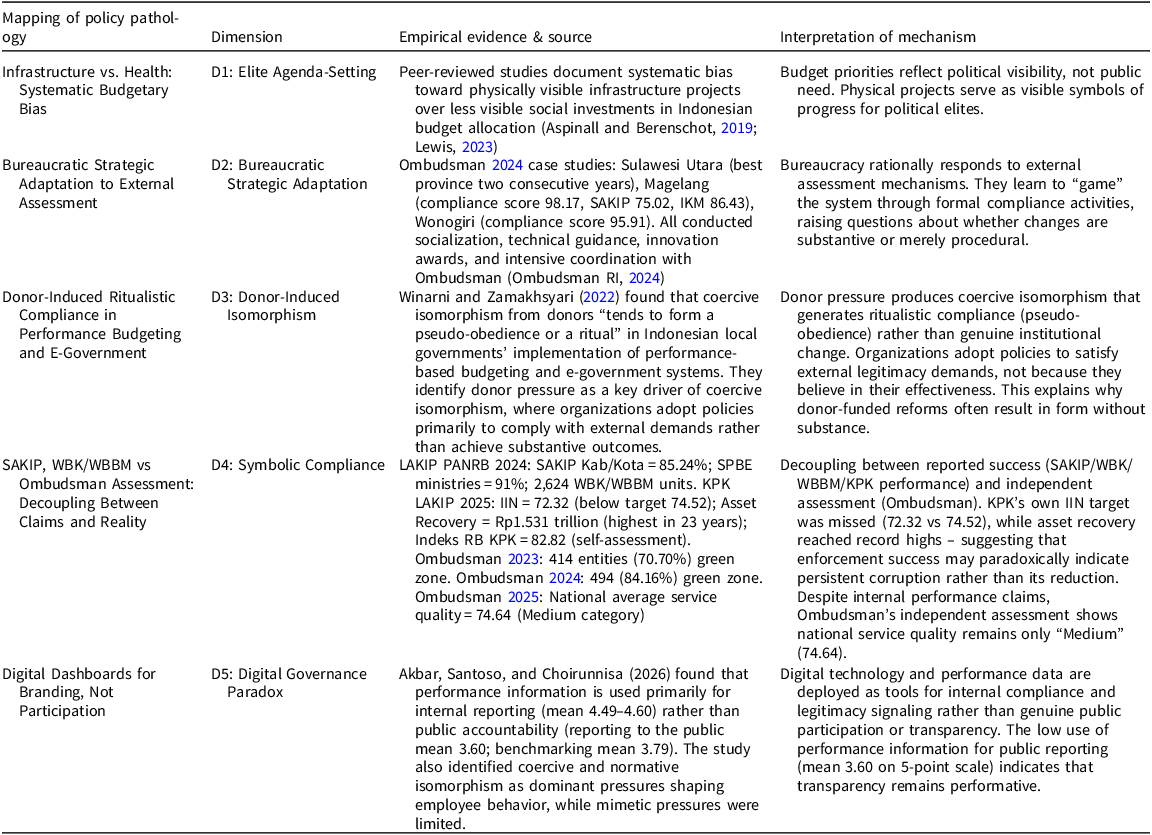
However, such a diagnosis misses the core pathology. These recurring policy failures are not symptoms of a broken system, but rather the stable and predictable outputs of a system operating under a dominant political logic. This section maps the empirical manifestations of that logic, demonstrating how the five theoretical dimensions of politicization materialize within specific Indonesian policy arenas. The following table synthesizes the concrete evidence, linking observed pathologies to their underlying political dimensions and mechanisms, drawing exclusively from official documents (LAKIP PANRB, BPK, KPK, Ombudsman RI) and peer-reviewed literature.
Based on the empirical evidence mapped in Table 1, a paradoxical yet systematic reality of Indonesian governance is revealed. Official performance metrics from LAKIP PANRB demonstrate formal progress in SAKIP scores, SPBE maturity, and WBK/WBBM achievements. The Ombudsman’s compliance assessments, however, tell a more nuanced story. Between 2023 and 2024, the percentage of entities in the green zone increased from 70.70 percent to 84.16 percent, while red zone entities declined from 6.64 percent to 3.92 percent (Ombudsman Reference Ombudsman2023, Reference Ombudsman2024). Yet the 2025 Maladministration Assessment found the national average service quality to be only 74.64, placing it in the “Medium” category, with 29.22 percent of loci rated “High” quality, 6.49 percent “Low,” and 4.22 percent “Very Low” (Ombudsman Reference Ombudsman2025). This partial convergence, improving compliance scores alongside persistently medium service quality, suggests that formal compliance does not automatically translate into substantive service improvement. This decoupling between reported performance and substantive outcomes reflects what Meyer and Rowan (Reference Meyer and Rowan1977) identified as institutional decoupling: formal metrics become ceremonial rituals rather than tools for genuine improvement.
Empirical correspondence: policy pathologies and dimensions of politicization in Indonesia

Table 1. Long description
A table comparing policy pathologies and dimensions of politicization in Indonesia. The table has 10 rows and 5 columns. The columns are labeled Mapping of policy, Dimension, Empirical evidence & source, Interpretation of mechanism, and AQI. The rows are labeled with different policy mappings and dimensions. Row 1: Mapping of policy, Systemic Budgetary Bias; Dimension, O 1 Elite Agenda-Setting; Empirical evidence & source, Re-examined studies document systematic bias in budgetary allocations, investments in Indonesian regions (Resosudarmo et al., 2019; Lewis, & Bemsahctz, 2019); Interpretation of mechanism, Budget prioritization reflects political visibility, not development needs; projects serve as visible symbols to appease political elites. Row 2: Mapping of policy, Bureaucratic Strategic Allocation; Dimension, O 2 Bureaucratic Strategic Adaptation; Empirical evidence & source, Ombudsman 2023 Case Study: West Java, Best practice two; Interpretation of mechanism, Managing compliance through performance awards, technical assistance, and intensive monitoring (Ombudsman, 2023). Row 3: Mapping of policy, Bureaucracy rationally assesses compliance costs; Dimension, O 3 Donor Induced Realistic Compliance; Empirical evidence & source, Donor funds are allocated to merely ‘substantiate a merely symbolic commitment to a policy’ (Lewis, 2019); Interpretation of mechanism, Donor pressure produces cosmetic compliance rather than genuine reform. Organizations adopt formal policies to secure external legitimacy, but compliance is often symbolic, resulting in form without substance. Row 4: Mapping of policy, SAKIP 74.64, WBK/WBBM vs Ombudsman Performance Claims and Reality; Dimension, D 4 Symbolic; Empirical evidence & source, LAKIP PANRB 2024, SAKIP 84.16 percent, WBK/WBBM 84.16 percent, Ombudsman 2025; Interpretation of mechanism, Decoupling between reported outcomes and substantive performance. Row 5: Mapping of policy, Decoupling between reported outcomes and substantive performance; Dimension, D 5 Digital; Empirical evidence & source, Alker, Evetts, and Christensen (2005) found that digital information is used to demonstrate compliance rather than to improve performance. Row 6: Mapping of policy, Digital technology and digitalization; Dimension, D 6 Digital; Empirical evidence & source, Digital technology and digitalization are deployed as tools for symbolic compliance rather than genuine public service improvement. The low correlation between digitalization and transparency remains a critical issue.
Source: Compiled by authors from secondary data 2022–2025.
The BPK audit finding that 43 percent of foreign-funded e-government platforms remain inactive exemplifies donor-induced isomorphism (D3). Coercive pressure from donors, linking funding to technology adoption, pushes the government to import sophisticated digital platforms as form without substance, to satisfy donor progress reports and signal “modern governance” to international audiences.
Bureaucratic strategic adaptation (D2) further reinforces this system. The Ombudsman’s Reference Ombudsman2024 case studies of Sulawesi Utara, Magelang, and Wonogiri demonstrate how local governments rationally respond to external assessment mechanisms. These entities conducted socialization campaigns, technical guidance sessions, innovation awards, and intensive coordination with the Ombudsman to improve their compliance scores (Ombudsman Reference Ombudsman2024). While Magelang reported that its improved Ombudsman compliance score correlated with rising SAKIP and IKM scores, this very correlation raises critical questions: does this represent genuine service improvement, or have bureaucracies learned to “game” the system through formal compliance activities? Peer-reviewed studies consistently document how “powerful forces resisting reform” and the persistence of New Order-era administrative habits have slowed deeper structural change (Turner et al. 2019; Widowati et al. Reference Widowati, Setyowati and Suharto2023). Civil servants rationally adapt to protect their career interests within a politicized incentive structure.
These dimensions do not work in isolation. They interlock in a self-reinforcing cycle. Donor pressure produces isomorphic mimicry (D3), creating templates that bureaucracies adopt as form without substance. Bureaucratic strategic adaptation (D2) ensures that even well-designed reforms are subverted to protect institutional interests. The result is symbolic compliance (D4), where performance scores rise, whether SAKIP scores or Ombudsman green zone designations, without corresponding improvements in service quality, as evidenced by the persistently medium national average (74.64) in the 2025 Ombudsman assessment. The digital governance paradox (D5) is further evidenced by Akbar, Santoso, and Choirunnisa (2026), who found that while performance information is actively used for internal purposes, planning (4.60), evaluation (4.54), and reporting to elected officials (4.49), its use for public accountability remains low: reporting to the public averaged only 3.60. The study also identified that coercive and normative isomorphic pressures dominate employee behavior, while mimetic pressures remain limited. This suggests performance data and digital platforms serve primarily as tools for internal compliance and legitimacy signaling rather than public transparency.
The Supreme Audit Agency’s own assessment reinforces this paradox. In its 2023 internal publication, BPK acknowledged that “fraud is hidden” and that “there are many ways to hide fraud, including through information technology,” while simultaneously developing digital forensic capabilities to address these risks (BPK 2023, pp. 7–8). This self-awareness, that the digital platforms meant to enhance transparency also create new avenues for fraud, epitomizes the digital governance paradox.
The systemic logic: deconstructing the causal architecture of politicization
The preceding analysis has successfully mapped the five distinct dimensions through which politicization manifests in Indonesian public policy. However, a critical question remains: how do these seemingly separate dimensions relate to one another? Do they operate as isolated pathologies, or do they form part of a larger, coherent system? To move from a taxonomy of symptoms to a diagnosis of the disease, we must trace the connections between them.
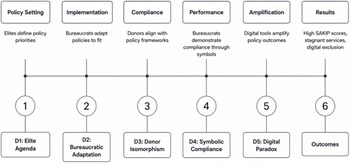
This section reveals that politicization is not a collection of random faults but a logical, self-perpetuating system, a chain reaction where the output of one dimension becomes the essential input for the next, creating a closed loop that consistently converts political power into administrative form while voiding it of public substance. To unravel this complex architecture, we turn to a visual model that maps the causal flow of political logic through the policy machinery.
Based on the causal flow depicted in Figure 2, the reality of Indonesian policy can be deconstructed as a regulated production cycle. This cycle begins with the political sovereignty of elites in setting the agenda (D1). In the Indonesian context, this setting is rarely based on deep technical needs analysis, but rather on a calculus of visibility and short-term political dividends. For example, the choice to channel massive budgets into physical infrastructure projects like toll roads or dams, which can be inaugurated and photographed, while neglecting significant budget increases for stunting reduction, whose results are not visible within a single term of office. This politically filtered agenda is not just a list of programs; it creates the operative reality and incentive structure for the bureaucracy. It implicitly declares what is considered “successful” in governance.
The causal chain of politicization in Indonesian public policy.

This political signal is then received and processed by the bureaucracy through the mechanism of strategic adaptation (D2). The arrow from D1 to D2 represents the core of this theoretical transmission belt. Bureaucrats, as rational actors, read the incentives created by the elite agenda. They understand that career safety and promotion depend on their ability to demonstrate progress on politically set indicators, regardless of their relevance to solving public problems. Their adaptation is thus strategic: they become experts in the “art of simulation.” For instance, a district health office might report “100% of villages have implemented posyandu” (an output indicator that is easy to achieve and report), while simultaneously neglecting a more difficult outcome indicator like “reduction in anemia rates among pregnant women.” Effort is diverted from substantive service improvement to achieving administrative targets that look good on paper.
This process then gains legitimacy and material reinforcement through donor alignment (D3). The key phrase in this model is “Donors align with policy frameworks.” This inverts the common narrative that reform in Indonesia is dictated by foreign donors. Instead, what occurs is active isomorphism: international donors align their programs and funding with the priority frameworks already set by domestic elites. They provide reform scripts, such as performance accountability systems and e-government platforms, that fit the “modernization” and “good governance” agenda already promoted by the elites. By funding and giving international legitimacy to these initiatives, donors indirectly validate and entrench the domestic political agenda, while injecting new resources that strengthen the cycle (Andrews Reference Andrews2013; Benson and Jordan Reference Benson and Jordan2011).
The convergence of political agenda, bureaucratic adaptation, and donor legitimacy then crystallizes into a culture of symbolic compliance (D4). This is the stage where performance is enacted. The SAKIP system becomes the primary tool for this performance. The bureaucracy produces reports, data, and presentations demonstrating perfect compliance with procedures and target achievement. A ministry may achieve a SAKIP score of 90 with immaculate documentation, but that score reflects its team’s skill in “indicatorology,” the art of selecting and meeting easy metrics more than any improvement in the quality of regulation or service delivered. This compliance satisfies two masters: political superiors (D1) who need proof of success for legitimacy, and donors (D3) who need progress reports for project accountability. Thus, the metric system transforms in function from a tool for improvement into a legitimacy ritual.
Digital technology then enters not as a reformer, but as an amplifier (D5) that increases the capacity and speed of the entire cycle. Real-time government performance dashboards make the accountability theater (D4) more spectacular and accessible. Digital reporting platforms make it easier for the bureaucracy (D2) to generate data for symbolic compliance. Government social media becomes a powerful channel for projecting the elite agenda (D1) and “achievements” already reported in SAKIP. However, this amplification is biased. The technology is more effective at reinforcing control and narrative from the top than opening channels for participation from below. The result is the digital paradox: rapid progress in government IT infrastructure coincides with deepening exclusion for communities lacking digital literacy or access, and an expanding state surveillance capacity.
Ultimately, this entire causal chain produces the paradoxical outcomes precisely listed under “Results.” “High SAKIP scores” are the direct product of D4 (Symbolic Compliance). “Stagnant services” are the logical consequence of D2 (Bureaucratic Adaptation), where energy is diverted from substantive improvement to performance simulation. “Digital exclusion” is the outcome of D5 (The Digital Paradox), which designs technology to serve political logic rather than inclusion logic. Therefore, every pathology in the results box is not an isolated failure, but a predictable output programmed by a specific dimension within the system. This reality explains why Indonesia is trapped in a governance paradox: the better its SAKIP scores, the more digital platforms it has, yet the less improvement its people feel. The system is functioning perfectly, not to solve public problems, but to produce political legitimacy and perpetuate the existing cycle of power. Understanding this systematic interconnection is the key to dismantling the logic of politicization and, more importantly, to identifying the leverage points where this deadly cycle can be broken.
This empirical model of interconnected cycles serves as the definitive validation and operationalization of the theoretical framework presented in Figure 1 (Politicization as Systemic Logic). Where the theoretical framework posited abstract dimensions and a generic feedback loop, this analysis reveals the precise Indonesian mechanisms through which these concepts materialize. The “Primary Political Filter” (D1) is observed in action as the elite’s visibility calculus shapes the budget. The “Transmission Belt” (D2) is identified in the bureaucratic art of simulation. The “Transnational Script” (D3) is seen in the donor alignment that provides reform templates. The “Accountability Theater” (D4) is performed on the stage of the SAKIP system. The “Technologies of Political Spectacle” (D5) are witnessed in the biased amplification of digital dashboards.
Most significantly, the theoretical notion of a “Policy Feedback Loop” is empirically substantiated and specified as not one but three interlocking cycles (Agenda-Performance, Reform-Implementation, Digital Amplification) that reinforce the system’s logic. Thus, the findings presented here do not merely apply a foreign theoretical model to Indonesia; they demonstrate how the Indonesian context breathes life into, confirms, and elaborates upon that model, proving that politicization indeed operates as a systemic not sporadic logic within the country’s public policy.
Normative future: toward a democratic repoliticization of policy in the Global South
The preceding sections diagnose politicization as the systemic logic of public policy in Indonesia, producing a cycle of symbolic governance. Given its ineradicable nature in the Global South, the critical question shifts from elimination to redirection. This section proposes a normative recalibration: the future lies not in a futile pursuit of a technocratic utopia, but in deliberately channeling political energy toward inclusive, substantive, and accountable ends, a process termed democratic repoliticization.
The imperative is twofold. First, technical solutions are neutralized by the existing political logic (the Reform-Implementation Trap). Second, an apolitical administration is unrealistic and potentially anti-democratic. The task is to reclaim “the political” as a domain for democratic struggle, not elite capture. This requires reimagining each dimension of our framework.
First, in agenda-setting (D1), the aim is to democratize the “political filter” through public reason. Institutional innovations like participatory budgeting and citizen assemblies can inject grassroots priorities. Indonesia’s Musrenbang must become a genuine arena for deliberative priority-setting with mandated follow-through.
Second, the bureaucracy (D2) must be reconceived as “civic infrastructure.” Incentive structures should reward substantive problem-solving and accountability. Performance metrics (SAKIP) must incorporate community-defined outcomes, and career advancement tied to public impact, not political loyalty. Bureaucratic autonomy is essential.
Third, the interface with global actors (D3) must transition to problematized translation. Support should go to locally driven processes of problem-driven iterative adaptation (Andrews Reference Andrews2013), not isomorphic mimicry. Success should be measured by solving local problems, not compliance with external blueprints.
Fourth, the accountability (D4) arena must evolve into a pluralistic ecosystem. The monopolistic “theater” of SAKIP reports must be supplemented by horizontal and downward mechanisms: independent audits, community scorecards, and open data for public scrutiny. Civil society and media must be strengthened as critical audiences.
Finally, technology (D5) must be infrastructure for democratic deepening. Digital tools should be evaluated on inclusion, transparency, and empowerment prioritizing open data, participatory platforms with real feedback, and privacy-by-design to prevent surveillance.
In conclusion, democratic repoliticization calls for a different kind of politics: overt, inclusive, substantive, and accountable. In the Global South, the technical-administrative project is doomed to capture. The sustainable path is to democratize governance’s political channels and recalibrate its purposes. For Indonesia, this means a second generation of reform, moving beyond technical fixes to SAKIP metrics or digital dashboards, targeting the very political-institutional logic that shapes policy. This is the future politicization worth striving for.
Discussions
This study set out to theorize politicization not as a pathology but as the systemic logic of public policy in Indonesia. The findings confirm this core argument but also demand a critical discussion that moves beyond the Indonesian case to engage with broader debates in public administration and policy theory. This discussion section addresses three pivotal themes, each framed as a theoretical intervention into ongoing scholarly conversations.
Beyond the implementation gap: politicization as a systemic production cycle
The most significant theoretical contribution of this research is its direct challenge to the dominant “implementation gap” paradigm that has long dominated policy analysis in developing contexts (Howlett and Ramesh, Reference Howlett, Ramesh and Perl2020; Pressman and Wildavsky Reference Pressman and Wildavsky1984). While this paradigm attributes policy failure to technical disjunctures between design and execution, our findings reveal something more systemic: what appears as a “gap” is actually a logical output of a sophisticated production cycle where political power is efficiently converted into legitimizing administrative forms.
This forces a recalibration of core concepts that bridges institutional theory with critical policy studies. Following Meyer and Rowan’s (Reference Meyer and Rowan1977) seminal work on decoupling, we observe that the separation between formal structure (SAKIP metrics) and actual practice (service delivery) in Indonesia is not an organizational failure but a strategic achievement. However, we extend this theory by showing how decoupling operates not in isolated organizations but as an inter-institutional system involving elites, bureaucrats, and transnational actors. Similarly, while Andrews (Reference Andrews2013) powerfully critiques “isomorphic mimicry” in development, our study reveals its political functionality: the mimicry of global templates (D3) provides crucial legitimacy resources that fuel domestic political games (D1, D2, D4).
This perspective necessitates what we term a bifurcated theory of policy success. We must always ask: success according to which logic? The findings suggest that in highly politicized systems, the technical-rational logic of public problem-solving (emphasized by Lasswellian and Weberian traditions) is systematically subordinated to a political logic of legitimation and survival. This echoes but specifies Grindle’s (Reference Grindle2017) argument about the limits of “good governance” paradigms in the Global South. What is traditionally labeled “implementation failure” is, within this system, resounding “political success” – a realization that fundamentally challenges the normative foundations of mainstream public administration theory.
The global south dilemma: hybridization as a new theoretical category
The Indonesian case illuminates a central theoretical dilemma in comparative public administration: what happens when global isomorphic pressures collide with deeply entrenched domestic political logics? Our study moves beyond the simple dichotomy of global norms versus local resistance (Sahlin and Wedlin Reference Sahlin, Wedlin, Greenwood, Oliver, Suddaby and Sahlin2008) to theorize a more complex process of strategic hybridization.
This finding critically engages with the policy transfer literature. While Dolowitz and Marsh (Reference Dolowitz and Marsh2000) and Benson and Jordan (Reference Benson and Jordan2011) provide frameworks for understanding transfer processes, they often assume a degree of intentional learning and problem-solving. In contrast, our analysis suggests that in contexts of high politicization, transfer becomes less about learning and more about legitimacy-seeking appropriation. Donor-prescribed reforms are not implemented but performed, and their successful performance becomes a valuable political resource. This aligns with but extends Azhar et al. (Reference Azhar, Sabharwal and Rahman2026) observations about ritualistic compliance in Global South public administration by connecting it explicitly to building global public administration knowledge.
The resulting “hollow reform” syndrome represents what we conceptualize as institutional holograms: structures that project the image of modern governance but lack substantive depth. This concept bridges the literature on NPM diffusion (Dunleavy et al. Reference Dunleavy, Margetts, Bastow and Tinkler2006) with political economy analyses of the post-colonial state (Evans Reference Evans1995). The hologram serves multiple masters simultaneously, satisfying donor conditionalities while preserving domestic patronage networks, creating a perverse equilibrium that explains the persistent resilience of dysfunctional governance in the Global South despite decades of reform efforts. Thus, our five-dimensional framework offers an analytical tool specifically designed for Global South contexts where politicization is systemic rather than episodic, responding directly to calls for context-sensitive governance theories grounded in Southern realities (Andrews Reference Andrews2013; Azhar et al. Reference Azhar, Sabharwal and Rahman2026).
Reflexivity, limitations, and future research directions
While the five-dimensional framework provides a powerful explanatory model, engaging reflexively with its limitations opens productive avenues for future theory-building. First, in portraying a coherent system, we risk what Flyvbjerg (Reference Flyvbjerg2001) might call rationalistic over-unification. Indonesia’s governance landscape contains pockets of genuine reform that operate against this systemic logic, what O’Donnell (Reference O’Donnell1993) might term “brown areas” of state effectiveness. Future research should probe these zones of exception to develop a more nuanced theory of contingent politicization that accounts for variation and agency.
Second, our reliance on secondary data, while methodologically aligned with interpretive tradition (Schwartz-Shea and Yanow Reference Schwartz-Shea and Yanow2012), necessarily limits insight into subjective experiences. This represents a deliberate trade-off between systemic breadth and ethnographic depth, a classic tension in social science methodology (King et al. Reference King, Keohane and Verba1994). Future ethnographic work could enrich our model by exploring what Lipsky (Reference Lipsky2010) called the “micropolitics” of bureaucratic decision-making, potentially revealing how street-level bureaucrats navigate the tension between political pressures and professional ethics.
Finally, the normative proposal for “democratic repoliticization” engages with emerging debates about participatory and deliberative turns in governance (Fung Reference Fung2015; Gaventa and Barrett Reference Gaventa and Barrett2012). However, as Baiocchi and Ganuza (Reference Baiocchi and Ganuza2017) caution, participatory institutions can themselves be captured and ritualized. Our contribution is to insist that any democratic deepening must directly confront and transform the five-dimensional system identified here, merely adding new participatory layers without changing the underlying political logic risks creating what Cornwall (Reference Cornwall2008) terms “participation’s ritualistic shell.” This points toward a research agenda that connects institutional design with political economy analysis, moving beyond technical fixes to engage with what Törnquist (Reference Törnquist2013) calls the “democratic developmental state” project.
Conclusion
This study has illuminated the deeply ingrained and multifaceted nature of politicization in Indonesia’s public policy landscape, emphasizing its systemic roots within the country’s historical, political, and sociocultural contexts. The research reveals how political elites shape policy agendas and priorities strategically, often privileging electoral gains and power consolidation over pressing social needs. Bureaucratic actors, in turn, adapt their behaviors to politicized incentives, resulting in selective implementation, ritualistic compliance, and a divergence between formal performance metrics and substantive public service outcomes. Furthermore, the influence of external donors and international reform templates, while ostensibly aimed at improving governance, can unintentionally reinforce politicization and symbolic compliance, perpetuating governance gaps rather than ameliorating them.
The study underscores that reforms rooted solely in technocratic models or quantitative performance measurement are insufficient for addressing the complex realities of governance in Indonesia. It argues for an integrated approach that recognizes politicization as an endemic structural feature, necessitating contextually aware, politically sensitive, and normatively grounded reform strategies. Such approaches should prioritize inclusivity, social equity, and public trust alongside administrative efficiency and accountability. Digital governance, while offering transformative potential, must be aligned with local political and social dynamics to avoid reinforcing existing disparities.
Ultimately, by situating Indonesian public policy politicization within a Global South perspective, this research offers three theoretical contributions. First, it reframes politicization not as sporadic interference or a deviation from Northern-centric ideals of rational administration, but as a systemic logic of governance, endemic, constitutive, and self-perpetuating. Second, it develops an integrated five-dimensional framework (elite-driven agenda-setting, bureaucratic strategic adaptation, donor-induced isomorphism, metric-focused symbolic compliance, and the digital governance paradox) that captures how these dimensions interact as a coherent, self-reinforcing cycle. Third, it introduces the concept of “institutional holograms” to describe governance structures that project the image of modern public administration, complete with performance metrics, digital dashboards, and anti-corruption branding, yet lack substantive depth in service delivery and citizen welfare. These contributions respond directly to calls for context-sensitive governance theories grounded in Southern realities, moving beyond the universal application of Northern-centric models to recognize the distinct political logics that shape policy processes in Indonesia and comparable Global South contexts (Andrews Reference Andrews2013; Azhar et al. Reference Azhar, Sabharwal and Rahman2026).
The findings highlight the imperative for scholars and policymakers to develop nuanced frameworks that reconcile political realities with effective governance, advancing reforms capable of fostering resilient, equitable, and legitimate public institutions in Indonesia and similar contexts. Without confronting the five-dimensional system identified here, technical reforms, whether improving SAKIP indicators, adding digital platforms, or expanding WBK/WBBM certification, will continue to serve as accountability theater rather than engines of substantive change.
Data availability statement
This study does not employ statistical methods and no replication materials are available.


 Open access

