

“My neighbors would often yell ‘Here comes the white women!’ and ‘She's too white to associate with us!’ as I walked to work in the morning.”—Mary, 20, Coloured South African, Atlantis, Cape Town Municipality
“When my children were young, my sister-in-law wouldn't even let her children play with their cousins at school because, to her, they were ‘too dark’.”—Sharon, 58, Coloured South African, Claremont, Cape TownFootnote 1
A long tradition of political science research has shown that racial and ethnolinguistic groups tend to vote as cohesive blocks either because of psychic benefits associated with voting for one's group or because voters expect politicians to favor their own group once in office (Chandra Reference Chandra2004; Dawson Reference Dawson1994; Ferree Reference Ferree2011; Posner Reference Posner2005; Telles Reference Telles2004). However, the correlation between group membership and political preferences is far from perfect (Horowitz Reference Horowitz2019; Hutchings and Valentino Reference Hutchings and Valentino2004; Ichino and Nathan Reference Ichino and Nathan2013). For example, in South Africa and the United States, two countries in which race is highly politicized, find that between 52 and 81% of a racial groups’ members vote together in a given election.Footnote 2 Why is it that between 19 and 48% of individuals in these contexts do not conform with their group given the empirical findings that group members vote together and the descriptive (Gay Reference Gay2002) and material benefits (i.e., services, jobs, etc.) voters can receive from voting along group lines? I argue that variation in how people experience their identity, as illustrated by the above quotes, influences the likelihood that individuals will vote with their group.
Previous studies of race and ethnicity have focused on ideology, partisanship, prejudice, strategic voting, or class differences within racial or ethnic groups to explain within-group variation in political preferences (Baker et al. Reference Baker, Jones, Tate and Hutchings2014; Dawson Reference Dawson1994; Griffin and Keane Reference Griffin and Keane2006; Grootes Reference Grootes2013; Hutchings and Valentino Reference Hutchings and Valentino2004; Ichino and Nathan Reference Ichino and Nathan2013). However, these studies, because they focus on shared identities and in- versus out-group dynamics rather than variation within groups, overlook the diversity of ways in which individuals identify with their group. Studies that do consider within-group variation in identity tend to only do so in terms of identity salience (e.g., McLaughlin Reference McLaughlin2007), which is difficult to reliably measure and endogenous to elections as individuals tend to identify more strongly with their ethnic group closer to elections (Eifert, Miguel and Posner Reference Eifert, Miguel and Posner2010). Because studies focus on groups rather than how individuals relate to their group identity, they have looked beyond identity to other variables (i.e., strategic considerations, partisanship, etc.) as explanations of why some voters do not toe the group line. While these variables are consequential, scholarly focus on them has led us to overlook the variation in how individual identities are constructed and their influence on vote choice. To fully consider the effects of identity, we must take seriously the consequences of variation in identity within groups in a way that moves beyond the amorphous concept of identity salience. This is precisely what this paper seeks to do.
Of the various branches of identity studies in political science, studies of race have arguably made the most progress in considering within-group variation in identity and its effects on political outcomes largely because these studies disaggregate race into its constituent parts and focus on how skin tone affects racial experiences (Sen and Wasow Reference Sen and Wasow2016). These studies argue that lighter-skinned African Americans should have divergent stances on political and policy issues from the rest of the African American community because they do not suffer from the same degree of discrimination. However, the empirical support for this theory is mixed with the balance suggesting a null relationship (Bowman, Muhammad and Ifatunji Reference Bowman, Muhammad and Ifatunji2004; Hochschild and Weaver Reference Hochschild and Weaver2007; Hutchings et al. Reference Hutchings, Jefferson, Lewis and Yadon2016; Seltzer and Smith Reference Seltzer and Smith1991). This is puzzling because studies have found that skin tone substantially affects individuals’ daily lives, life prospects, and political targeting/behavior in a variety of countries (Adhikari Reference Adhikari2009; Ahuja, Ostermann and Mehta Reference Ahuja, Ostermann and Mehta2016; Erasmus Reference Erasmus2001; Hunter Reference Hunter2005; Maddox and Gray Reference Maddox and Gray2002; Telles Reference Telles2004; Wade, Romano and Blue Reference Wade, Romano and Blue2004). This literature shows that skin tone substantially affects individuals’ life chances; therefore, it is worth understanding its social and political consequences. I build on this literature in three ways.
First, I build on the argument that daily life experiences influence the ways in which individuals construct their identity, but I look beyond heavier discrimination against those with darker skin tones. To do so, I develop the concept of racial distance, which is the degree to which an individual's skin tone is prototypical of her group regardless of if her skin tone is darker or lighter than the prototype. Racial distance provides a new theoretical perspective and a relatively exogenous measure of racial identity construction. Importantly, this approach allows us to take seriously the notion that race is constructed but also establish a causal relationship between socially constructed race and vote choice. This new approach considers how skin tone influences identity construction: if an individual's skin tone sends an unclear signal of her racial identity, then she will be treated differently compared with the rest of her group, which can undermine her sense of belonging. I propose a social treatment mechanism to explain how the everyday identity construction process weakens some individuals’ racial identities and reduces the likelihood of voting along racial lines.
Second, this study explores the role of skin tone beyond the literature's focus on African Americans by investigating the relationship between racial distance and vote choice among the three largest race groups in South Africa and the United States. Evidence is primarily drawn from original panel survey data of the South African Coloured community. This panel survey brackets South Africa's 2014 national election campaigns to test the effect of racial distance on the probability of changing one's vote due to an election campaign. To test the generalizability of the findings, I engage original exit poll survey data from South Africa's 2016 local elections and the 2012 American National Election Study (ANES).
Third, I empirically measure and test the effects of racial distance. To measure racial distance, I use original survey data that include enumerator assessments of skin tone (as is done in the 2012 ANES), which control for variation across coders. I then measure the divergence between each respondent's skin tone and the modal skin tone in the sample. I also empirically control for threats to the exogeneity of this measure: enumerator assessment bias, racial heritage, and political socialization. The empirical results show that as an individual becomes more racially distant from her group, she is less likely to vote with her group and that the proposed relationship applies most readily to minority groups with a relatively weak sense of solidarity and to majority groups. In addition, I find that an individual who is more racially distant from her group is also more likely to change her vote due to an election campaign, which suggests that such voters are more likely to be swing voters. I test a number of mechanisms and find support for the argument that social treatment and its effects on identity construction mediate the above relationships. These findings suggest that scholars should rethink their approach to race and its electoral consequences by considering degrees of group membership and inclusion rather than simply group membership.
The next section presents the theoretical framework. I then introduce the concept of racial distance, discuss case selection, and introduce the Coloured community as the core case. Thereafter, I introduce the empirical strategy and discuss results. Before concluding, I test the generalizability of the results in the United States and the broader South African population.
IDENTITY CONSTRUCTION AND VOTE CHOICE AND CHANGE
The argument begins from a simple observation, which is illustrated in the introductory quotes: individuals within a racial group vary in the degree to which their racial attributes send a clear or noisy signal of their group membership. Individuals with skin tones that are less typical of their group are likely to be treated as distinct (whether positively or negatively so) from the rest of their group regardless of whether they are among the darkest or lightest (Adhikari Reference Adhikari2009).
As an individual's racial attributes diverge more from her group's prototype, she is less readily categorized as a member of that group. Given that skin tone is a heuristic for racial identity and, unfortunately, conditions social treatment (Adhikari Reference Adhikari2009; Fryer and Jackson Reference Fryer and Jackson2008; Hill Reference Hill2000; Maddox and Gray Reference Maddox and Gray2002), the degree to which individuals receive treatment that differentiates them from the rest of the group increases as an individual's skin tone diverges from the group prototype.Footnote 3 This is the case because individuals with less typical attributes are more likely to be inaccurately categorized. The link between skin tone and social treatment is clearly illustrated in South Africa through the above quotes: the calls of “White woman!” that Mary receives and the discrimination against Sharon's family. Mary also indicated that at work she often receives special, positive treatment due to her lighter skin tone. It is further illustrated among African Americans by accusations that light-skinned Black women are not authentically black (Hunter Reference Hunter2005) and by the lighter punishments less “stereotypically-black” defendants receive (Eberhardt et al. Reference Eberhardt, Davies, Purdie-Vaughns and Lynn Johnson2006). Some of these examples show that differential treatment need not always be negative/discriminatory.
If an individual is not identified as a member of her group by others because her phenotype does not clearly communicate her racial identity, then her group identity attachment is likely weakened. This is the case because the way she identifies herself is constantly challenged/questioned by how others identify her. This contradiction between the person's chosen and externally assigned racial identities emerges most frequently for those with less prototypical attributes because others perceive them to be different enough to warrant placement in an alternative group (Nosofsky Reference Nosofsky1986; Terry et al. Reference Terry, Hogg and White1999). As previous research has found, because social identities are constructed by both chosen and externally assigned identities, when a contradiction between the two exists, it influences the (usually weaker) group identity individuals construct for themselves (Chandra Reference Chandra2012; Davenport Reference Davenport2018; Dominguez Reference Dominguez1986). The weaker identity attachment that emerges from “miscategorization” should then reduce the influence of race when casting a ballot.
In contexts with racialized elections, weaker identity attachments could influence vote choice for the less racially typical members of a group through a variety of channels. First, if individuals vote expressively, then those with less typical attributes may receive a weaker psychic benefit from the election of a co-racial because they are less likely to see the elected individual as reflective of themselves (Chandra Reference Chandra2004; Gay Reference Gay2002). Second, those who have weaker identity attachments may incur a lower anxiety cost associated with violating group-prescribed behavior (Dickson and Scheve Reference Dickson and Scheve2006). Third, weaker identity attachments may reduce one's sense of group consciousness and thus willingness to work toward group aims (Miller et al. Reference Miller, Gurin, Gurin and Malanchuk1981), which may reduce their willingness to vote with the group. Given these core explanations in the literature all suggest that weakened identity attachments reduce willingness to vote with the group, I do not determine which of these channels is operational. Rather, I focus on establishing the relationship between racial attributes (distance) and vote choice, which has been overlooked in the literature.
The quotes above illustrate this relationship. Mary and Sharon, who both lack prototypical skin tones, were singled out as different from the rest of their group. In the interviews, they also expressed weak attachments to the Coloured identity and a low likelihood of voting for their group's preferred party. In contrast, a third, more prototypical respondent, said “I look like all the other Coloureds, so why would I be treated differently?,” identified more strongly as Coloured, and expressed a greater willingness to vote for the group's party. These anecdotes suggest, and evidence below will further substantiate, that skin tone does in fact condition social treatment for Coloureds, which in turn influences identity and vote choice.
A weaker identity attachment makes these individuals political “free agents” who are less bound to vote with the group. Campaigns are more likely to sway these voters because race is less likely to condition the reception of the appeals (Adida et al. Reference Adida, Gottlieb, Kramon and McClendon2017). Once an individual is less attached to her racial identity, race likely no longer filters how appeals are received, which in turn allows the voter to consider appeals from parties she would have dismissed if her racial attachments were stronger. Those with weaker racial attachments will be less likely to reject a party's claims/appeals simply because of its racial association, which should then make her more likely to change her vote than those with relatively stronger racial attachments.
In sum, those who are more racially distant from their group are less likely to engage in bloc voting because the treatment they receive in their daily lives signals they are different from the rest of the group. However, this relationship is not deterministic: skin tone does not determine one's vote from birth. Rather, skin tone influences the type of social treatment one is likely to receive, which in turn influences the type of racial identity she constructs and its political consequences.Footnote 4
Contrary to this logic, it is possible that individuals who are not immediately identified as members of their group try to manipulate their identity to more clearly signal their membership in the group. This is precisely what social identity theory would suggest given that individual self-esteem is tied to one's sense of belonging to a group (Tajfel and Turner Reference Tajfel and Turner1979). Further, such individuals may be more likely to vote with the group because political behavior that aligns with the group is another way to signal their belonging (as suggested by optimal distinctiveness theory (Brewer Reference Brewer1993)). There is some evidence in South Africa that vote choice can be closely linked with one's identity such that a Zulu may no longer be seen as a Zulu if she no longer votes for the Zulu party (Jung Reference Jung2000), which suggests that how individuals vote may actually signal a rejection or acceptance of their identity. However, if the theory proposed above is correct, then we should expect differential social treatment to weaken identity and decrease the likelihood of voting with the group rather than the opposite as proposed by this alternative. But, these are empirical questions, which this paper seeks to investigate for the first time.
I also consider two conditions under which those not identifiable as members of their group are more rather than less likely to vote for their group's preferred party: individual ability to assert an identity and minority group solidarity.Footnote 5 First, some individuals may be better able, because of their other attributes, to resist being seen as different. Consider Trevor Noah (South African and host of the Daily Show) who is of mixed-race heritage (Black mother, White father). Growing up, Noah was often perceived to be Coloured. However, he was raised by his Black mother and spoke numerous Black languages, which enabled him to assert his chosen black identity and challenge/reject the idea that he is Coloured (Noah Reference Noah2016). An individual's other attributes—language, religion, etc.—are important in identity construction, and I control for these other identities in the analysis below.
In addition, when minority groups are threatened or discriminated against, differential social treatment may not be sufficient for racially ambiguous individuals to break politically with the group. African Americans are heavily discriminated against and feel a greater need to vote with the group due to a sense of linked fate (Dawson Reference Dawson1994). White South Africans feel threatened by their week political position (small numbers and apartheid stigma). In both instances members are not likely to break ranks simply due to differential treatment because strong group solidarity or consciousness holds the group together politically (e.g., Miller et al. Reference Miller, Gurin, Gurin and Malanchuk1981; Hochschild and Weaver Reference Hochschild and Weaver2007). I turn to this empirically in the Section “Generalizability.”
DEFINING RACIAL DISTANCE
The racial distance concept developed here accounts for the importance of racial groups while also accounting for blurred group boundaries. I draw from Chandra's (Reference Chandra2012) work on ethnicity and race that defines these identities as rooted in descent-based attributes (attributes given at birth). I define racial distance as the degree of skin tone (racial attribute)Footnote 6 similarity between an individual and the prototypical member of her group. I define the prototypical members of a racial group as the individuals who have the modal attributes of their racial group. Therefore, an individual's racial distance increases as her skin tone decrease in similarity to her group's modal skin tone.Footnote 7
I refer to more racially distant individuals as the “border members” of a group to illustrate that individuals who are not readily associated with their group constitute a blurry line between racial groups. As illustrated by previous studies (e.g., Barth Reference Barth1969; Dominguez Reference Dominguez1986) and the introductory quotes, the border between groups is often a fine line that may not clearly differentiate groups. Border members could fit within multiple groups in society given the noisy signal their racial attributes send regarding their racial identity.
Understanding race through racial distance provides two advantages. First, rather than focus on race as a zero-one indicator of group membership, it focuses on relational attributes that better captures variation in how individuals relate to and construct their identity. By considering each individual's placement relative to the modal members of her group, we move beyond group membership, while still accounting for it. While groups exist and people have a general sense of the boundaries between groups, these boundaries are not perfectly delineated and thus there is room for disagreement regarding who belongs (Harris and Findley Reference Harris and Findley2014). Racial distance then more accurately captures the complexity of race by considering individual variation within groups and the imperfect boundaries that delineate them.
Second, racial distance provides a way to measure race in an exogenous manner because it is rooted in attributes given at birth, which are difficult to change (Telles and Paschel Reference Telles and Paschel2014).Footnote 8 One's skin tone is likely more exogenous than survey reported group membership or identity salience, which is the norm for assessing identities and salience (Eifert, Miguel and Posner Reference Eifert, Miguel and Posner2010; Nobles Reference Nobles2000; Shayo Reference Shayo2009). I return to exogeneity in the Section “Empirical Strategy.”
Racial distance relies on skin tone similarity to ensure that the concept is rooted in the defining characteristics of a racial group rather than something related to race such as culture or discrimination. These latter characteristics are not defining of the group but consequences of group membership (Abdelal et al. Reference Abdelal, Herrera, Iain Johnston and McDermott2006). Membership in a racial group is determined by a membership rule, which is at least partially based on attributes given at birth/transmitted from parent to child (Chandra Reference Chandra2012). For example, the African American identity is constructed as those with at least “one drop” of African blood (although this rule is weakening (Davenport Reference Davenport2016)) and the Coloured community in South Africa is constructed as those with at least one Coloured parent or parents of different races.Footnote 9 Socially, satisfying a membership rule is inferred by the attributes associated with that rule (Chandra Reference Chandra2012): the attributes of “dark” and “brown” skin are associated with the African American and Coloured membership rules, respectively, which are then used to (likely unconsciously) infer one's ancestry and thus group membership. Skin tone and racial distance do not determine racial group membership; it is determined by meeting a membership rule (see Barth (Reference Barth1969) for a culture-based membership rule).
While this definition of race rests on the idea that descent/biology establish one's racial group membership, it does not assume or predict that race is immutable from birth; racial identities change. Importantly, the daily interpretations of racial attributes are what make race relevant for political outcomes. As Chandra (Reference Chandra2012, 149–150) states, “biology determines the shade of skin we have. But how we ‘see’ that objectively given shade is a product of socially constructed interpretations … saying that constructivism matters is saying at the same time that ‘biology does matter.’ The question is how.” (emphasis in original).
I employ the prototypical member of each group as the target for comparison when determining racial distance because people tend to define groups in society based on group prototypes (Fryer and Jackson Reference Fryer and Jackson2008; Shayo Reference Shayo2009). Importantly, when categorizing another individual, people place that individual in the group to which the individual is most similar (Nosofsky Reference Nosofsky1986), and “similarity” is likely determined by comparing an individual to the group's prototype (Terry et al. Reference Terry, Hogg and White1999). I operationalize the group's prototypical attribute as the group's modal attribute because the mode is the most frequent attribute, and the most frequent attribute in a group is likely to have the greatest influence in shaping people's concept of what constitutes the group prototype.Footnote 10 Therefore, individuals with the group's modal skin tone are the prototypical members of the group, and as an individual's skin tone becomes darker or lighter than the mode, her racial distance from that group increases. While the modal skin tone of groups may not be precisely agreed upon, I assume that individuals tend to converge on the “objective” modal skin tone of groups in society (Dominguez Reference Dominguez1986). This in turn assumes that individuals have interacted with “enough” people from each group that their perceived modal skin tone mode for each group is roughly similar to the “objective” mode (see Appendix 13 for an extended discussion of prototypes).
CASE SELECTION
South Africa is ideal for investigating the proposed relationship between racial distance and vote choice for several reasons. First, race continues to be an important factor in electoral politics (Ferree Reference Ferree2011). Importantly, the ruling African National Congress (ANC; Nelson Mandela's party, which liberated the country from Apartheid rule) and the main opposition party (the Democratic Alliance, DA; which is a reformed, apartheid-era opposition party) primarily gain support from Black and White voters, respectively, and perpetuate the political divisions between these two groups (although the DA is diversifying).Footnote 11 Second, the 2014 national elections provided an opportunity to test the theory (see Section “Empirical Strategy”).
And finally, the Coloured community within South Africa is well situated for this study because the group provides key analytical leverage in two ways: the group has high variation in political preferencesFootnote 12 and has relatively high levels of racial attribute variation. Coloured tend to vote for the DA and see it as the party that best represents them (Ferree Reference Ferree2011). In my sample, 63% report voting for the DA and 87% stated that the DA is the Coloured party. However, Coloured support for the DA is not as strong as the preferences of other communities. According to Afrobarometer Round 5 data, 52% of the Coloured community voted for the DAFootnote 13 compared with 70% of Black support for the ANC and 67% of White support for the DA. The Coloured community presents more variation in vote choice.
The Coloured community also provides important variation in the independent variable of within-group racial distance because the Coloured community was historically constructed by the colonial and apartheid governments through the census and official identity documents as anyone who was mixed race or not clearly Black or White (Adhikari Reference Adhikari2009; Erasmus Reference Erasmus2001). Therefore, a racially diverse group of people were placed together into a single group. While racial attributes vary within all racial groups, the higher level of within-group racial attribute variation within the Coloured community provides greater empirical leverage. It is important to note that while the Coloured community is an amalgamation of various groups, today it is a well-recognized racial group (Erasmus Reference Erasmus2001) with some general agreement of what makes someone “Coloured” (Dolby Reference Dolby2001; Posel Reference Posel2001). Coloureds do not face the same degree of identity crisis as mixed-race individuals in the United States because unlike mixed-race Americans (Davenport Reference Davenport2016), Coloured South Africans have long been a distinct group of their own.
The Coloured community maintains its apartheid position as intermediate in South Africa's racial hierarchy: Whites (9% of the population) on top, Indians (3%) and Coloureds (9%) in the middle, and Blacks (76%) at the bottom. Zimitri Erasmus cogently sums up the Coloured situation: “for me, growing up coloured meant knowing that I was not only not white, but less than white; not only not black, but better than black” (Erasmus Reference Erasmus2001, 2). Apartheid, like Jim Crow in the United States, ingrained in people's psyche a notion of white supremacy. The apartheid regime actively enforced its hierarchy. For example, education funding was based on this hierarchy: in 1976, the apartheid government's per pupil expenditure by race group was $560 White, $164 Indian, $122 Coloured, and $37 Black (Gordon et al. Reference Gordon, Blighaut, Moroney and Cooper1978). This hierarchy persists today despite post-apartheid progress: universal suffrage and some economic progress for the Black community (though most Blacks and Coloureds remain in poverty). Blacks therefore enjoy political power given their large numbers, but Whites, much like other racial minorities, have very little political power. Whites do control a substantial fraction of wealth, which can prove advantageous. Given the hierarchy's persistence, voting today largely follows group lines.Footnote 14
EMPIRICAL STRATEGY
To investigate the role of racial distance in predicting voting behavior, I conducted a panel survey of the Coloured population of Cape Town Municipality in Western Cape Province.Footnote 15 This section describes the survey design and the survey based measure of racial distance. The baseline survey was conducted in October 2013, and the follow-up survey started immediately after the May 7, 2014 National and Provincial Elections. This is the first study that gathers the degree of detail on racial identity necessary to investigate the effects of racial distance.
I conducted a stratified random sample; see Appendix 1 for more details. The survey was conducted in Cape Town Municipality because 34% of South Africa's Coloured population resides there, and it has the highest municipal concentration of Coloureds in the country. Further, elections in Cape Town have been relatively competitive in the past.
The baseline survey includes 1,170 individuals (83% response rate), and we successfully re-contacted 1,000 respondents in the follow-up survey (85% response rate; see Appendix 2). The two surveys were timed to bracket the May 2014 election campaigns. The first survey was completed roughly 2 months before campaigning began in earnest. The follow-up survey was conducted immediately after the elections to capture respondent opinions after the campaign and elections. By positioning the 2014 election campaign as a treatment, the panel survey enables estimation of vote change due to campaigns.
While the 2014 elections were relatively competitive, little changed: the ANC remained in power nationally and the DA remained in power in Western Cape Province. Racial appeals were largely focused on the Black/White division. However, parties did appeal racially to the Coloured community such as the ANC, during the campaign, legally allowing Coloureds to claim ownership of land seized during colonization (Nicolson Reference Nicolson2014). While at a rally in Cape Town, President Zuma (ANC) said to a mostly Coloured audience that “Blacks and Coloureds are the same” thus making an explicit racial appeal. Further, the Western Cape ANC campaign repeatedly accused the DA of only looking out for the White community.
On the other hand, the DA rarely appealed to race. When the DA did appeal to race, it focused on convincing voters of its diversity and inclusiveness. However, the party did make efforts to subtly target the Coloured vote. Helen Zille and other prominent party leaders visited Coloured communities and emphasized the DA-provided development projects. It also prominently presented Cape Town Mayor Patricia De Lille, a Coloured women, at campaign events and on posters. Given that mention of racial identities inadvertently brings up the DA's whiteness, it is understandable that the DA's racial appeals are more subtle.
To measure and test the effect of racial distance in the context of the 2014 elections, I measured respondent's skin tone in the baseline survey by asking enumerators to place each respondent on a skin tone scale at the beginning of each survey, which is the procedure used in the 2012 ANES.Footnote 16 I rely on enumerator assessments because they more closely approximate (relative to self-assessment) the external evaluations upon which social treatment is based. I then took the absolute value of the difference between each individual and the observed modal skin color in my sample. Therefore, the resulting variable, Racial Distance, ranges from zero to one (standardized from a 0–16 scale) and increases as an individual becomes less modal in her skin tone and is agnostic regarding whether the person's skin color is darker or lighter than the mode. Theoretically, the distance between the individual's skin tone and the group prototype is key, not the direction of attribute divergence. However, in Appendix 8, I do estimate models that consider the direction of divergence. While social treatment is doing the theoretical work, I measure skin tone to leverage plausibly exogenous variation in social treatment. In this approach, skin tone determines the identity construction pathway(s) one is likely to take, and rather than measure the identity construction process, I measure the first step in the process.
There are three key ways in which the plausible exogeneity of the racial distance measure could be undermined. First, given that the enumerators assess skin tone, enumerator bias is a concern. To limit this, enumerators assessed skin tone before respondents answered any questions. While enumerators could be biased in their skin tone assessment by respondent characteristics (e.g., dress, accent, etc.), I find no evidence that this is the case. In Appendix 7, I regresses the racial distance measure on a variety of indicators and find that racial distance is not predicted by economics, education, or gender of the respondent.
To control for bias in and ensure comparability across enumerator skin tone assessments, each enumerator, during training, placed three anonymous men on the skin tone scale. The assessments are averaged for each enumerator and control for different enumerator assessments of “dark” and “light” in the analysis. The results are unchanged when using enumerator fixed effects or enumerators’ average skin tone assessments for the sample as controls.
Exogeneity could also be undermined by the correlation between one's skin tone (which is determined by her racial heritage) and political socialization. For example, Coloured individuals who have relatively more Black heritage (e.g., a Black mother and Black maternal grandparents) may receive different political socialization through their Black relatives compared with an individual who has no Black heritage. To address this issue, I control for racial heritage in the analysis below, which controls for one's political socialization and more fully isolates the social treatment consequences of the racial distance measure. In the survey, each respondent was asked for the racial, linguistic, religious, and region of origin attributes of her parents and maternal grandparents, and this information is used to measure heritage proportions for each of these identities.Footnote 17 Empirically, racial distance and political socialization are only weakly correlated. When regressing racial distance on racial heritage and parental partisan affiliation, I find that these variables are not significant predictors of the racial distance measure (see Appendix 7). This may be the case because even though more racially distant individuals likely have more racially distant parents, often the skin tone of siblings can diverge greatly from each other and their parents (Alcoff Reference Alcoff2006) despite being similarly politically socialization. A high degree of variation in skin tone within a single family is well documented among the Coloured population (Adhikari Reference Adhikari2009).
Closely related, ethnic attributes beyond skin tone could also undermine the exogeneity of the racial distance measure because they are often correlated with skin tone and influence categorization and social treatment. For example, as Trevor Noah illustrates, skin tone is not the only attribute used to determine if an individual is prototypical; language may also matter. Importantly, Coloured membership is also signaled by language. Therefore, in the analysis below, I control for whether or not an individual has the modal attributes of their group in terms of language, religion, and region of origin to isolate the effect of racial distance as measured by skin tone (see Appendix 6 for measurement details).
Given these considerations, I argue that, at least in the case of Coloured South Africans, skin tone is plausibly exogenous when controlling for enumerator bias, racial heritage, and other attributes. Engaging skin tone in this way also satisfies the conditions necessary for making race-based causal claims using a “within-group study” design, which “singles out a specific constitutive element of race that can be observed to vary within a group” (Sen and Wasow Reference Sen and Wasow2016, 513). Importantly, Sen and Wasow (Reference Sen and Wasow2016, 515) state that “as with other studies relying on observational data, researchers using within-group designs should consider experimental analogies” and further state that this “is particularly worthwhile for those specifically interested in race.” This is precisely the approach taken here.
ANALYSIS AND RESULTS
In this section, I empirically test the propositions that border members are less likely to vote with their group and more likely to change their vote due to an election campaign. The main focus is to establish the relationship between skin tone and vote choice; however, I do test the proposed theoretical mechanism of social treatment and a number of alternatives. The models estimated below control for rural/city origin, age, gender, and the identity controls discussed above, but they do not include variables such as education, economic conditions, and policy preferences. These variables introduce post-treatment bias into the analysis because skin tone (the treatment) influences one's life chances and policy preferences (Davenport Reference Davenport2016). Including these variables is problematic; however, including them does not change the results of the models estimated below; see Appendix 11. In all models, standard errors are clustered at the ward level.Footnote 18
We should expect Coloured border members to be less likely to vote for their group's political party. More generally, in contexts in which groups tend to support a certain party, border members should be less likely to support that party (or to abstain or protest vote if that is the group's preference). Therefore, given that the DA was the most-preferred party among Coloureds in the sample (overwhelmingly so—at 63% voting for the DA—even if less strongly nationally at 52%) and that 87% identified the DA as the “Coloured party,” we should expect more distant Coloured individuals to be less likely to vote for the DA. A corollary of this prediction is that these voters should be more likely to vote for alternative parties; therefore, I will also investigate the probability of voting for the ANC, the viable alternative.Footnote 19 The dependent variables, Vote DA and Vote ANC, are two dummy indicators that take the value of one if the respondent would vote for the DA or the ANC “if national elections were held today,” respectively.Footnote 20 I estimate logit models predicting vote choice for each party, but the results are also robust to estimating multinomial logit regression that also predicts abstention (see Appendix 8, Tables 6 and 7). As expected, respondents tend to support the DA: 63% of respondents plan to vote for the DA compared with only 11% for the ANC (21% would not vote/were unsure and 3% would vote for a third party).
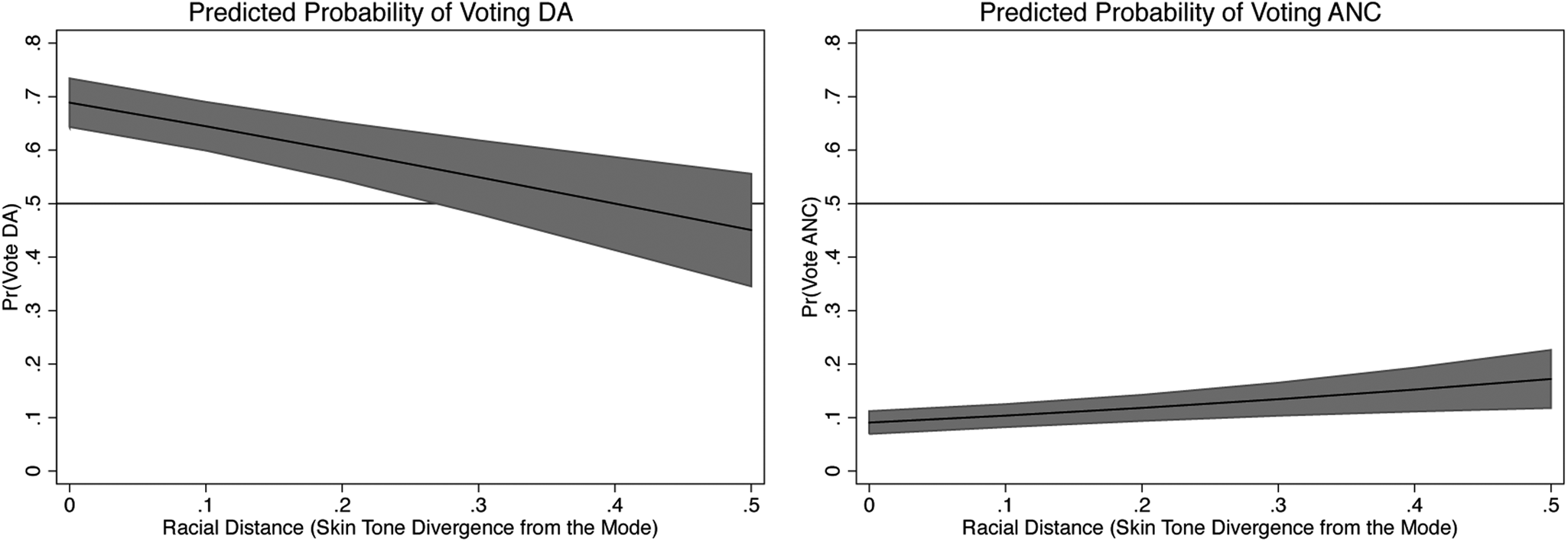
Based on the results of the logit analysis, Figure 1 plots the predicted probability of voting for each party due to greater divergence from the modal Coloured skin tone.Footnote 21 The plots also include a line indicating a 50% chance of voting for each party as a point of reference. These results show that as individuals become more racially distant, the probability of voting for the DA decreases and the probability of voting for the ANC increases. These effects are significant at the 1% level. Substantively, we see that that those who are the most proximate have nearly a 70% chance of voting for the DA compared with those who are the most distant who have less than a 50% chance of voting for the DA. This effect shows that racial distance from one's in-group influences who are and are not core supporters of the group's party. In addition, the most distant are nearly twice as likely to vote for the ANC than the most proximate Coloureds (17% compared with 9%). These results are robust to using provincial vote choice, thermometer party ratings, closeness to each party, and a preference index as dependent variables (see Appendix 8).
Estimated marginal effect of racial proximity on voting for the DA and ANC. The graph on the left plots the estimated probability (and 95% confidence interval) of voting for the DA as racial distance to the Coloured community increases based on multivariate logit regression analysis. The graph on the right does the same for the ANC.

To ensure the results are detecting the effect of racial distance and not proximity to an out-group or darkness of skin tone, I re-estimate the analysis on each side of the mode separately. If the effects persist on both sides of the mode, then we can be sure that the effects are driven by in-group racial distance. The results in Appendix 8 show that regardless of whether an individual is lighter or darker than the mode, as racial distance increases, her willingness to vote for the DA decreases. Importantly, greater proximity to the White community does not differentially predict one's willingness to vote for the party that most whites support (the DA); what matters is one's proximity to her in-group. Those who are lighter than the mode likely do not vote with the most proximate out-group because that group (White) prefers the same party as their group. In fact, in Appendix 8, I find that those who are lighter than the mode are more likely to abstain than those who are darker than the mode, which suggests that rather than vote with the White community/their own community, fair-skinned Coloureds prefer to abstain or vote with the Black community. Thus, voters do not seem to align racially with the most proximate out-group.
The theoretical expectations also predict that the more racially distant an individual is, the more likely she will be to change her vote. To test this relationship, I estimate logit regression models that predict changes in vote choice using the same measures of racial distance and the above-mentioned controls. To measure change in vote choice, I use a dummy indicator of whether or not a respondent changed her vote choice from the baseline (prospective 2014 national vote choice) to the end-line survey (retrospective 2014 vote).
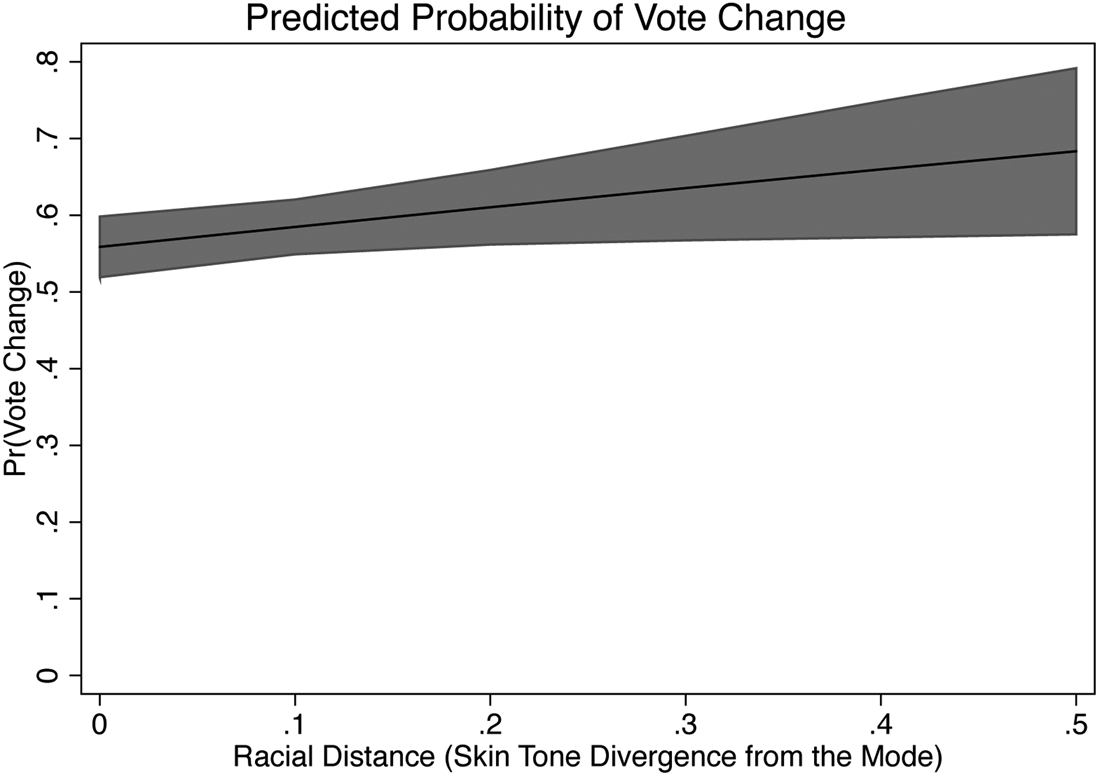
The results indicate that those with more distant skin tones are also more likely to change their vote due to an election. This effect falls just short of conventional levels of statistical significance (p = .054). Figure 2 plots the marginal effect of skin tone on vote change. We find that the most racially distant individuals are 12 percentage points more likely to change their vote compared with the most proximate group members. This is substantial given that the prototypical group members have a 55% chance of changing their vote and the least proximate group members have nearly a 70% chance of changing their vote.Footnote 22
Estimated marginal effect of racial proximity on vote change. This figure plots the predicted probability (and 95% confidence interval) of an individual changing her vote based on distance from the group's modal skin tone based on multivariate logit regression analysis.

When using the 2014 election campaign as treatment, we see effects of racial distance on propensity to change one's vote in line with our expectations.Footnote 23 We find that border members are more likely to change their national vote choice than those who are relatively more prototypical. These results do reach the 5% significance level when using changes in provincial vote choice, thermometer ratings, closeness to each party, and a preference index across the two surveys as dependent variables (see Appendix 9).
In Appendix 9, I investigate the alternative explanation that border members are not more predisposed to persuasion, as argued above, but rather that they have higher rates of exposure to the campaign, which could be endogenous to skin tone. I find no empirical support for this alternative explanation.Footnote 24 Further, in Appendix 10, I find the vote choice and change results are robust to measuring racial distance at the local level, measuring party preferences at the local level, and controlling for local diversity (e.g., Ichino and Nathan Reference Ichino and Nathan2013; de Kadt and Sands Reference de Kadt and Sands2019).
It is important to note that, in the models above, racial distance influences vote choice and change but other identities (language, religion, etc.) and racial heritage do not (see Tables 4 and 10 in the appendix). This is not surprising given that race dwarfs other identities in political importance for the Coloured population. Future research should investigate the effects of other identities when race is less salient.
The results have established the proposed relationship between racial distance and vote choice/ change, which I argued above is driven by differential treatment of border members leading to weaker identity attachments. There is suggestive evidence that this is the case, which is reported in Appendix 12. These results are from two-tailed difference of means tests comparing border members with prototypes.Footnote 25 In the 2016 South Africa exit poll (explained in detail below), I asked respondents if they are treated positively or negatively by others, and I find that border members are significantly less likely to report positive social treatment (62% compared with 70% of modal members; p < .01), which I use as a proxy for receiving treatment that reinforces one's identity. This is not a perfect proxy as positive treatment does not always reinforce one's identity, but this is the best measure available in the survey data. I also asked each respondent how they primarily identify themselves. The question was open-ended, and respondents were able to choose any identity (occupation, gender, race, etc.). If the theory is correct, then border members should be less likely to identify in racial terms (as rejection from one identity often leads to stronger identification with an alternative identity (Masuoka and Junn Reference Masuoka and Junn2013)), which signals a weaker racial identity attachment. When comparing the prototypical members of each group (Black, Coloured, White) with the border members, I find that border members are significantly less likely to identify themselves in racial terms (20% compared with 27% of modal members; p < .01). Thus, we have evidence that border members are treated differently and have weaker racial identity attachments than more prototypical members.
I also test nine alternative mechanisms—including strategic voting, manipulating one's identity, policy preferences, and network effects—using the same approach, but I find no empirical evidence to support these alternatives. A complete discussion of these mechanisms (including measurement) is given in Appendix 12. Taken together, the null results regarding alternative mechanisms and the theory consistent results regarding the social treatment mechanism suggest that the proposed mechanism is the most likely driver of the main results.
GENERALIZABILITY
To investigate the generalizability of the above results, I replicate the above vote choice analysis for more groups in South Africa (Black, Coloured, White)Footnote 26 and the three largest groups in the United States (White, Black, Latino). While the skin tone measure may be less exogenous for these additional groups (e.g., Latinos vary by country of origin, which may be correlated with vote choice and skin tone), the goal of this analysis is to establish the consistency of the above negative relationship between racial distance and vote choice. To do so, I engage (1) original survey data from an exit poll of the 2016 South African local elections (N = 1,140) in Tshwane Municipality and (2) the 2012 ANES face-to-face survey (N = 1,500).
These cases allow me to test the theory in diverse contexts among multiple groups that vary in their position in society (majority/minority). South Africa and the United States are good comparison cases because both have racial identities and hierarchies that are relatively fixed, and both have histories of segregation and anti-miscegenation laws (Marx Reference Marx1996). These contexts are different in a number of ways; however, if the racial distance argument is to apply outside South Africa, it should apply in the highly racialized United States.Footnote 27
For this analysis, I estimate logit models that use racial distance to predict voting for the group's party and the next viable alternative party. Skin tone is measured using the same scale for the 2016 exit poll, but a slightly different scale is used in the United States (see Appendices 3 and 4). Racial distance is calculated identically to the above. Given that these samples contain respondents from multiple race groups, I interact group membership with the racial distance indicator. This provides a way to estimate the effect of racial distance within a group and compare behavior across groups, conditional on within-group distance.
When possible, I include all control variables that are present in the main analysis. Appendix 15 presents a full discussion of control variables and modeling choices. For each sample, I estimate three sets of models: one that interacts the racial distance measure with membership in the majority, “middle” minority, or minority group. I categorized groups in this way to maximize comparability across cases. The majority is Black in South Africa and White in the United States. I identify minority groups as those that are not “middle” and not majority: White in South Africa and Black in the United States. The “middle” minority groups are those that are sandwiched between black and white on the skin tone spectrum: Coloured (South Africa) and Latino (United States).Footnote 28 While Coloured and Latino may be relatively less cohesive groups, these identities are relevant for daily life and politics. In both cases, the majority enjoy political power while middle and minority groups have less influence.
For each country, I identify the following group preferences using the majority/plurality preference from the surveys.Footnote 29 In South Africa, Blacks prefer the ANC, and Coloureds and Whites prefer the DA. In the United States, Blacks and Latinos prefer the Democrats (81 and 63%, respectively in the 2012 ANES) and Whites prefer the Republicans. Whites in the United States only marginally prefer the Republican party: 38% compared with 35% for the Democrats. While not all whites see the Republican party as their own, it is arguably the case that the Republican party of late has been associated with the white majority as evidenced by the party's worry of losing elections due to increasing diversity (RNC 2012). Further, the 2012 ANES data shows that the Democratic party received 71% of minority votes compared with 13% for Republicans.
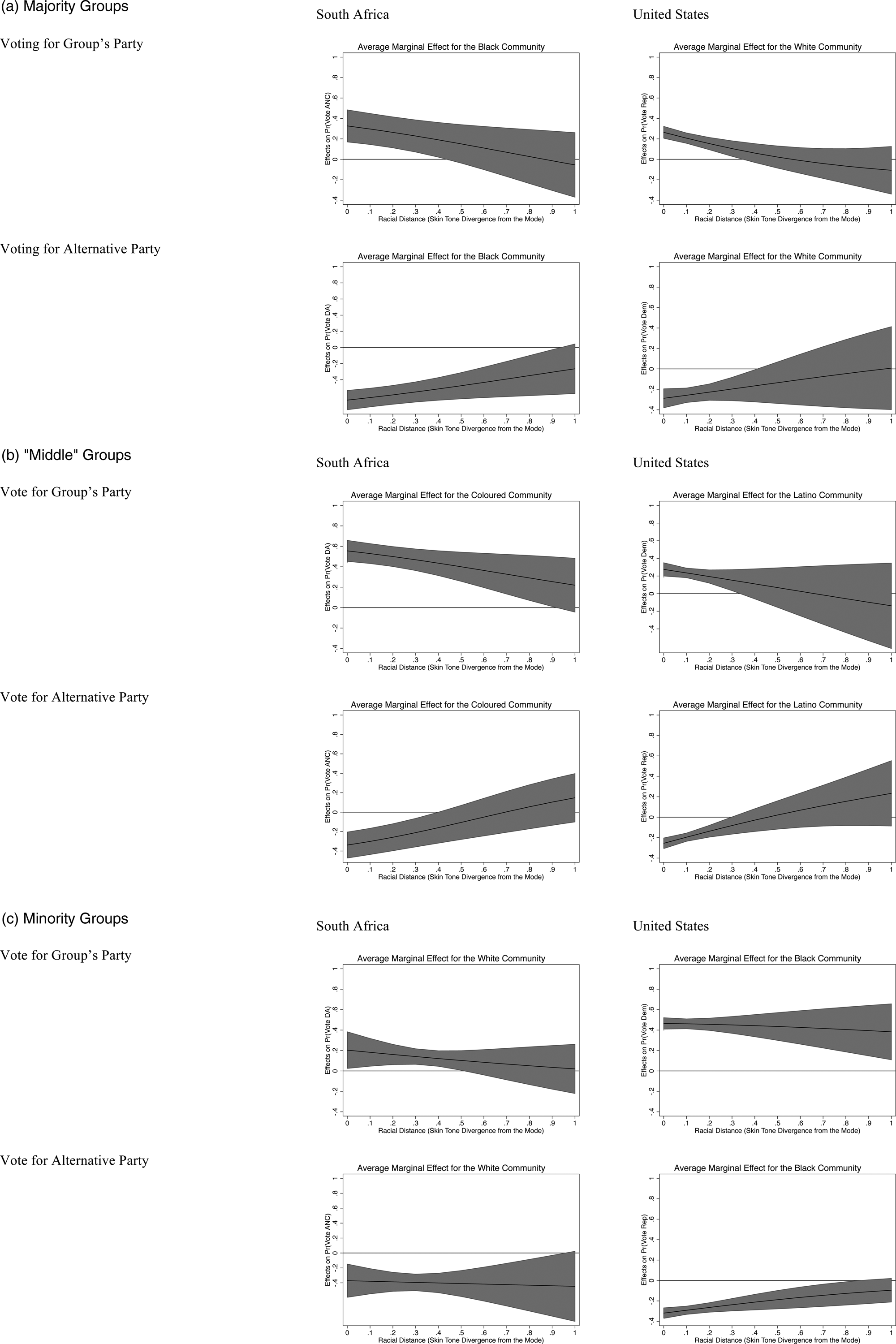
The marginal effects of group membership conditional on racial distance from each model are presented in Figure 3. Each plot in the figure indicates the degree to which group membership influences the probability of voting with the group at each level of racial distance. If group membership has a stronger positive effect for the most proximate relative to the most distant, then the main argument is supported. Given that these plots are based on interaction models, these figures present the marginal effect of racial distance for the specified group relative to the other groups in the sample that prefer a different party. These figures indicate the level of distance from the group's modal skin tone at which in-group members become indistinguishable from out-group members in their vote choice: when the 95% confidence intervals in the plots in Figure 3 cross zero.
The effects of skin tone on vote choice. This figure presents the plots for the marginal effect of group membership conditional on racial proximity based on multivariate logit regression analysis. Each plot represents a different model.

First consider the majority groups in Figure 3(a). In both countries, group membership among the most proximate members significantly increases the probability of voting with the group as evidenced by the positive and significant effect associated with the lower range of the racial distance variable. In line with the theory, the positive effect of group membership decreases in magnitude as racial distance increases. Further, there is no positive effect of group membership on voting with the group for those who are more than .45 away from the mode in South Africa and more than .35 away from the mode in the United States. Finally, as expected, group membership for more prototypical individuals has a stronger negative effect on voting for the alternative party in both contexts.
The results for the “middle” groups (Figure 3(b)) confirm the above findings from the 2014 Coloured sample and illustrate the applicability of the theory to the Latino community. We see that as racial distance increases, the probability of voting for the group's party decreases (the effect is not statistically significant in the United States case) and the probability of voting for the alternative party significantly increases. From the plots in Figure 3(c), we find no clear support for the theory for minority groups. Among White South Africans and African Americans, there is no effect of racial distance on voting for or against one's group.
These results show that the theory applies to majority and “middle” groups in both countries. As speculated above, racial distance is not a significant predictor of vote choice among minorities with a strong sense of racial solidarity (although direct evidence is needed to establish that solidarity drives the null results). Further, given that Black is majority in South Africa and minority in the United States and yet the findings are consistent for majority and minority groups across both contexts, a group's majority/minority status may be more important than the actual race of the group, despite the empirical focus on skin tone.
CONCLUSION
This paper introduced and measured racial distance to explain the role racial identity attachments play in determining variation in vote choice within groups. The analysis shows strong support for the argument that those who are more distant from their own racial group are significantly less likely to vote for their group's party and more likely to change their vote choice due to an election campaign. The results also provide suggestive evidence that the mechanisms of differential social treatment and weaker identity attachments for border members drive the main results. Future research should continue exploring the mechanisms. In short, racial distance conditions the role that race plays at the ballot box.
The comparative empirical evidence provides scope conditions for these conclusions. We find that the theory likely does not readily apply to minority groups with a greater sense of solidarity. This study's theory and results are most readily applied to contexts, like those studied here, in which race is a key political cleavage and racial group boundaries are well established through historical segregation/discrimination. Future studies should seek to investigate further how race is experienced and evoked in different contexts and how different types of treatments influence group attachments to further establish the generalizability of the findings.
The results illustrate the importance of measuring race in a way that facilitates a serious consideration of the constructed nature of race. How individuals relate to and construct their identities is important for understanding the role of race in elections, which cannot be accurately investigated if scholars overlook within-group variation in identity. The racial distance approach allows us to integrate the identity construction process into our theories of racial bloc voting, which future research must consider.
SUPPLEMENTARY MATERIAL
The supplementary material for this article can be found at https://doi.org/10.1017/rep.2019.35