




No CrossRef data available.
Article contents
L(Q)-preservation theorems
Published online by Cambridge University Press: 12 March 2014
Extract
Much effort has been spent to prove that the reduced product operation preserves, and sometimes even strengthens the L-equivalence of structures, where L is some infinitary language. A similar result is suggested by the following well-known fact:
Assume D is a nonprincipal ultrafilter on ω and, for n Є ω, Cn is a set. If the ultra-product ΠωCn/D is infinite, it has a cardinality ≥  Hence, by Łos' theorem, (i) if
 and φ(x) is a first-order formula, then
 iff

 where Q is the unary quantifier “there are many.”
We shall prove some generalizations of (i). In particular, we show
(ii) if D is a nonprincipal ultrafilter over I = ω, and  then
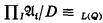
 where L(Q) is the language obtained from the first-order language by adding the quantifier Q.
(ii) remains true, if D is an ω-regular or an atomless filter over a set I.
Lipner [7] proved that if is regular, then the L(Q)-equivalence is preserved under direct products. We show that the assumption “ is regular” is necessary.
Information
- Type
- Research Article
- Information
- Copyright
- Copyright © Association for Symbolic Logic 1975
References
REFERENCES
[1]Benda, M., Reduced products and non-standard logics, this Journal, vol. 34 (1969), pp. 424–436.Google Scholar
[2]Ehrenfeucht, A., An application of games to the completeness problem for formalized theories, Fundamenta Mathematicae, vol. 49 (1961), pp. 129–141.CrossRefGoogle Scholar
[3]Feferman, S. and Vaught, R., The first-order properties of algebraic systems, Fundamenta Mathematicae, vol. 47 (1959), pp. 57–103.CrossRefGoogle Scholar
[4]Flum, J., Generalized quantifiers and reduced products, Notices of the American Mathematical Society, vol. 21 (1974).Google Scholar
[5]Flum, J., On Horn theories, Mathematische Zeitschrift, vol. 138 (1974), pp. 205–212.CrossRefGoogle Scholar
[6]Keisler, H. J., Formulas with linearly ordered quantifiers, The syntax and semantics of infinitary languages, Lecture Notes in Mathematics, vol. 72 (1968), pp. 96–130.CrossRefGoogle Scholar
[7]Lipner, L. D., Some aspects of generalized quantifiers, Thesis, University of California, Berkeley, 1970.Google Scholar
[8]Skolem, T., Untersuchungen über die Axiome des Klassenkalküls und über die “Productations und Summationsprobleme”, welche gewisse Klassen von Aussagen betreffen, Skrifter utgit av Videnskapsselskapet i Kristiania, I. Klasse no. 3, Oslo 1919.Google Scholar
[9]Vinner, S., A generalization of Ehrenfeucht's game and some applications, Israel Journal of Mathematics, vol. 12 (1972), pp. 279–298.CrossRefGoogle Scholar
[10]Wojciechowska, A., Generalized products for Q-languages, Bulletin de l'Académie Polonaise des Sciences, vol. 17 (1969), pp. 337–339.Google Scholar