

Hostname: page-component-7b7567c8c-kwt9d Total loading time: 0 Render date: 2026-11-12T18:37:25.642Z Has data issue: false hasContentIssue false

CODING IN GRAPHS AND LINEAR ORDERINGS

Published online by Cambridge University Press:  18 June 2020

JULIA F. KNIGHT
Affiliation:
DEPARTMENT OF MATHEMATICS UNIVERSITY OF NOTRE DAME NOTRE DAME, IN, USA E-mail: knight.1@nd.edu
ALEXANDRA A. SOSKOVA
Affiliation:
DEPARTMENT OF MATHEMATICAL LOGIC SOFIA UNIVERSITY SOFIA, BULGARIA E-mail: asoskova@fmi.uni-sofia.bg E-mail: stefanv@fmi.uni-sofia.bg
STEFAN V. VATEV
Affiliation:
DEPARTMENT OF MATHEMATICAL LOGIC SOFIA UNIVERSITY SOFIA, BULGARIA E-mail: asoskova@fmi.uni-sofia.bg E-mail: stefanv@fmi.uni-sofia.bg
Rights & Permissions [Opens in a new window]

Abstract

Core share and HTML view are not available for this content. However, as you have access to this content, a full PDF is available via the 'Save PDF' action button.

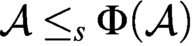
There is a Turing computable embedding $\Phi $ of directed graphs $\mathcal {A}$ in undirected graphs (see [15]). Moreover, there is a fixed tuple of formulas that give a uniform effective interpretation; i.e., for all directed graphs $\mathcal {A}$, these formulas interpret $\mathcal {A}$ in $\Phi (\mathcal {A})$. It follows that $\mathcal {A}$ is Medvedev reducible to $\Phi (\mathcal {A})$ uniformly; i.e., $\mathcal {A}\leq _s\Phi (\mathcal {A})$ with a fixed Turing operator that serves for all $\mathcal {A}$. We observe that there is a graph G that is not Medvedev reducible to any linear ordering. Hence, G is not effectively interpreted in any linear ordering. Similarly, there is a graph that is not interpreted in any linear ordering using computable $\Sigma _2$ formulas. Any graph can be interpreted in a linear ordering using computable $\Sigma _3$ formulas. Friedman and Stanley [4] gave a Turing computable embedding L of directed graphs in linear orderings. We show that there is no fixed tuple of $L_{\omega _1\omega }$-formulas that, for all G, interpret the input graph G in the output linear ordering $L(G)$. Harrison-Trainor and Montalbán [7] have also shown this, by a quite different proof.

Information

Type
Articles
Copyright
© The Association for Symbolic Logic 2020