

Hostname: page-component-7b7567c8c-wxvwp Total loading time: 0 Render date: 2026-11-13T14:56:50.608Z Has data issue: false hasContentIssue false

A note on some intermediate propositional calculi

Published online by Cambridge University Press:  12 March 2014

Branislav R. Boričić*
Affiliation:
University of Beograd, Kamenička 6, 11000 Beograd, Yugoslavia

Extract

This note is written in reply to López-Escobar's paper [L-E] where a “sequence” of intermediate propositional systems NLCn (n ≥ 1) and corresponding implicative propositional systems NLICn (n ≥ 1) is given. We will show that the “sequence” NLCn contains three different systems only. These are the classical propositional calculus NLC1, Dummett's system NLC2 and the system NLC3. Accordingly (see [C], [Hs2], [Hs3], [B 1], [B2], [Hs4], [L-E]), the problem posed in the paper [L-E] can be formulated as follows: is NLC3a conservative extension of NLIC3? Having in mind investigations of intermediate propositional calculi that give more general results of this type (see V. I. Homič [H1], [H2], C. G. McKay [Mc], T. Hosoi [Hs 1]), in this note, using a result of Homič (Theorem 2, [H1]), we will give a positive solution to this problem.

NLICnand NLCn. If X and Y are propositional logical systems, by X ⊆ Y we mean that the set of all provable formulas of X is included in that of Y. And X = Y means that X ⊆ Y and Y ⊆ X. A(P1/B1, …, Pn/Bn) is the formula (or the sequent) obtained from the formula (or the sequent) A by substituting simultaneously B1, …, Bn for the distinct propositional variables P1, …, Pn in A.

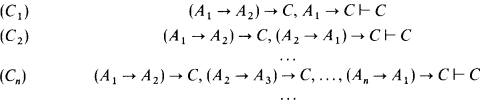
Let Cn(n ≥ 1) be the string of the following sequents:

Having in mind that the calculi of sequents can be understood as meta-calculi for the deducibility relation in the corresponding systems of natural deduction (see [P]), the systems of natural deductions NLCn and NLICn (n ≥ 1), introduced in [L-E], can be identified with the calculi of sequents obtained by adding the sequents Cn as axioms to a sequential formulation of the Heyting propositional calculus and to a system of positive implication, respectively (see [C], [Ch], [K], [P]).

Information

Type
Research Article
Copyright
Copyright © Association for Symbolic Logic 1984

Access options

Get access to the full version of this content by using one of the access options below. (Log in options will check for institutional or personal access. Content may require purchase if you do not have access.)

Article purchase

Temporarily unavailable