


Hostname: page-component-7b7567c8c-9cwtv Total loading time: 0 Render date: 2026-11-19T16:42:59.324Z Has data issue: false hasContentIssue false

Solution of a problem of Tarski

Published online by Cambridge University Press:  12 March 2014

John Myhill*
Affiliation:
University of California, Berkeley

Extract

We presuppose the terminology of [1], and we give a negative answer to the following problem ([1], p. 19): Does every essentially undecidable axiomatizable theory have an essentially undecidable finitely axiomatizable subtheory?

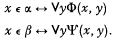
We use the following theorem of Kleene ([2], p. 311). There exist two recursively enumerable sets α and β such that (1) α and β are disjoint (2) there is no recursive set η for which α ⊂ η, β ⊂ η′. By the definition of recursive enumerability, there are recursive predicates Φ and Ψ for which

We now specify a theory T which will afford a counter-example to the given problem of Tarski. The only non-logical constants of T are two binary predicates P and Q, one unary operation symbol S, and one individual constant 0. As in ([1], p. 52) we define

The only non-logical axioms of T are the formulae P(Δm, Δn) for all pairs of integers m, n satisfying Δ(m, n); the formulae Q(Δm, Δn) for all pairs of integers m, n satisfying Ψ(m, n); and the formula

T is consistent, since it has a model. It remains to show that (1) every consistent extension of T is undecidable (2) if T1 is a finitely axiomatizable subtheory of T, there exists a consistent and decidable extension of T1 which has the same constants as T1.

Information

Type
Research Article
Copyright
Copyright © Association for Symbolic Logic 1956

Access options

Get access to the full version of this content by using one of the access options below. (Log in options will check for institutional or personal access. Content may require purchase if you do not have access.)

Article purchase

Temporarily unavailable