
Hostname: page-component-7b7567c8c-tnzcf Total loading time: 0 Render date: 2026-11-14T21:22:18.579Z Has data issue: false hasContentIssue false

A theorem on deducibility for second-order functions1

Published online by Cambridge University Press:  12 March 2014

C. H. Langford*
Affiliation:
University of Michigan

Extract

It is known that the usual definition of a dense series without extreme elements is complete with respect to first-order functions, in the sense that any first-order function on the base of a set of postulates defining such a series either is implied by the postulates or is inconsistent with them. It is here understood, in accordance with the usual convention, that when we speak of a function on the base , the function shall be such as to place restrictions only upon elements belonging to the class determined by f; or, more exactly, every variable with a universal prefix shall occur under the hypothesis that its values satisfy f, while every variable with an existential prefix shall have this condition categorically imposed upon it.
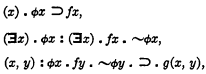
Consider a set of postulates defining a dense series without extreme elements, and add to this set the condition of Dedekind section, to be formulated as follows. Let the conjunction of the three functions,

be written H(ϕ), where the free variables f and g, being parameters throughout, are suppressed. This is the hypothesis of Dedekind's condition, and the conclusion is

which may be written C(ϕ).

Information

Type
Research Article
Copyright
Copyright © Association for Symbolic Logic 1939

Access options

Get access to the full version of this content by using one of the access options below. (Log in options will check for institutional or personal access. Content may require purchase if you do not have access.)

Article purchase

Temporarily unavailable

