


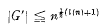
 , and it is mv aim in this paper to take a first step towards closing the gap. This first, step is study of BFC p-groups: in a sequel I hope to show how the results proved here can be used to obtain improved bounds for arbitrary BFC groups.


Crossref Citations

This article has been cited by the following publications. This list is generated based on data provided by Crossref.
Vaughan-Lee, M.R
1974.
Breadth and commutator subgroups of p-groups.
Journal of Algebra,
Vol. 32,
Issue. 2,
p.
278.
Bachturin, Yu. A.
1974.
Identities in the universal envelopes of Lie algelras.
Journal of the Australian Mathematical Society,
Vol. 18,
Issue. 1,
p.
10.
Atkinson, M. D.
1975.
Ordering finite groups by involvement.
Journal of the Australian Mathematical Society,
Vol. 19,
Issue. 4,
p.
431.
Vaughan-Lee, M. R.
1977.
Finiteness conditions on commutators.
Archiv der Mathematik,
Vol. 28,
Issue. 1,
p.
340.
Wall, G. E.
1978.
Topics in Algebra.
Vol. 697,
Issue. ,
p.
137.
Кочетов, Михаил Викторович
and
Kochetov, Mikhail Viktorovich
2003.
Тождества smash-произведения универсальной обертывающей супералгебры Ли и групповой алгебры.
Математический сборник,
Vol. 194,
Issue. 1,
p.
87.
MANN, AVINOAM
and
SEGAL, DAN
2007.
BREADTH IN POLYCYCLIC GROUPS.
International Journal of Algebra and Computation,
Vol. 17,
Issue. 05n06,
p.
1073.
Usefi, Hamid
2013.
Lie identities on enveloping algebras of restricted Lie superalgebras.
Journal of Algebra,
Vol. 393,
Issue. ,
p.
120.
Bergen, Jeffrey
Riley, David
and
Usefi, Hamid
2013.
Lie superalgebras whose enveloping algebras satisfy a non-matrix polynomial identity.
Israel Journal of Mathematics,
Vol. 196,
Issue. 1,
p.
161.
Khuhirun, Borworn
Misra, Kailash C.
and
Stitzinger, Ernie
2015.
On nilpotent Lie algebras of small breadth.
Journal of Algebra,
Vol. 444,
Issue. ,
p.
328.
Liebeck, Martin W.
and
Praeger, Cheryl E.
2022.
Peter Michael Neumann, 1940–2020.
Bulletin of the London Mathematical Society,
Vol. 54,
Issue. 4,
p.
1487.
Bahturin, Yuri
and
Witherspoon, Sarah
2023.
Delta Sets and Polynomial Identities in Pointed Hopf Algebras.
Algebras and Representation Theory,
Vol. 26,
Issue. 1,
p.
97.