We partner with a secure submission system to handle manuscript submissions.
Please note:
You will need an account for the submission system, which is separate to your Cambridge Core account. For login and submission support, please visit the
submission and support pages.
Please review this journal's author instructions, particularly the
preparing your materials
page, before submitting your manuscript.
Click Proceed to submission system to continue to our partner's website.
To save this undefined to your undefined account, please select one or more formats and confirm that you agree to abide by our usage policies. If this is the first time you used this feature, you will be asked to authorise Cambridge Core to connect with your undefined account.
Find out more about saving content to .
To send this article to your Kindle, first ensure no-reply@cambridge.org is added to your Approved Personal Document E-mail List under your Personal Document Settings on the Manage Your Content and Devices page of your Amazon account. Then enter the ‘name’ part of your Kindle email address below. Find out more about sending to your Kindle.
Find out more about saving to your Kindle.
Note you can select to save to either the @free.kindle.com or @kindle.com variations. ‘@free.kindle.com’ emails are free but can only be saved to your device when it is connected to wi-fi. ‘@kindle.com’ emails can be delivered even when you are not connected to wi-fi, but note that service fees apply.
The Schwarzschild Interior Solution represents a static sphere the proper density of which has the same value throughout. Though it is sometimes referred to as an “incompressible” sphere it is physically unacceptable since (formally) the speed of sound within it is infinite. Perhaps the most natural analogue of the classical incompressible sphere is therefore a sphere such that the speed of sound is everywhere just equal to the speed of light. This paper investigates spheres of this kind in some detail.
One elementary proof of the spectral theorem for bounded self-adjoint operators depends on an elementary construction for the square root of a bounded positive self-adjoint operator. The purpose of this paper is to give an elementary construction for the unbounded case and to deduce the spectral theorem for unbounded self-adjoint operators. In so far as all our results are more or less immediate consequences of the spectral theorem there is little is entirely new. On the other hand the elementary approach seems to the author to provide a deeper insight into the structure of the problem and also leads directly to the spectral theorem without appealing first to the bounded case. Besides this, our methods for proving uniqueness of the square root and of the spectral family seem to be new even in the bounded case. In particular there is no need to invoke representation theorems for linear functionals on spaces of continuous functions.
Let X be a topological space equipped with a binary relation R; that is, R is a subset of the Cartesian square X×X. Following Wallace [5], we write Deviating from [7], we shall follow Wallace [4] to call the relation R continuous if RA*⊂(RA)* for each A⊂X, where * designates the topological closure. Borrowing the language from the Ordered System, though our relation R need not be any kind of order relation, we say that a subset S of X is R-decreasing (R-increasing) if RS ⊂ S(SR ⊂ S), and that S is Rmonotone if S is either R-decreasing or R-increasing. Two R-monotone subsets are of the same type if they are either both R-decresaing or both Rincreasing.
A Symplectic lattice L is a free Z-module of finite rank endowed with a non-degenerate alternating bilinear form. Thus we have a bilinear mapping Φ of L × L into the domain of integers Z; we donote Φ (α, β) by α · β (where α, β ∈ L). Then α2 = 0 and α·β = −β·α.
Let G be a finite group of order g having exactly k conjugate classes. Let π(G) denote the set of prime divisors of g. K. A. Hirsch [4] has shown that By the same methods we prove g ≡ k modulo G.C.D. {(p–1)2 p ∈ π(G)} and that if G is a p-group, g = h modulo (p−1)(p2−1). It follows that k has the form (n+r(p−1)) (p2−1)+pe where r and n are integers ≧ 0, p is a prime, e is 0 or 1, and g = p2n+e. This has been established using representation theory by Philip Hall [3] (see also [5]). If then simple examples show (for 6 ∤ g obviously) that g ≡ k modulo σ or even σ/2 is not generally true.
The problem of finding the most economical coverings of n-dimensional Euclidean space by equal spheres whose centres form a lattice, which is equivalent to a problem concerning the inhomogeneous minima of positive definite quadratic forms, has been discussed recently by Barnes and Dickson [1]. The reader is referred to [1] for a complete background on the problem. Terms and notations used will be as in that paper.
A number of studies [1] have concerned themselves with properties of artificial poly-peptide chains, which differ from naturally occurring poly-peptides in two ways: There is only one kind of amino-acid in each polymer chain, but that acid occurs both in its right-handed and in its left-handed (D and L) forms, with some random order of L and D constituents.
Let Q(x1, …, xn) be an indefinite quadratic form in n-variables with real coefficients, determinant D ≠ 0 and signature (r, s), r+s = n. Then it is known (e.g. see Blaney [2]) that there exist constants Γr, s depending only on r and s such for any real numbers c1, …, cn we can find integers x1, …, xn satisfying
Recently Orrin Frink (see [2]) gave a neat internal characterization of Tychonoff or completely regular T spaces. This characterization was given in terms of the notion of a normal base for the closed sets of a space X. A normal base for the closed sets of a space X is a base which is a disjunctive ring of sets, disjoint members of which may be separated by disjoint complements of members of . In a normal space the ring of closed sets is a normal base.
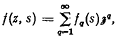
Let Ω be the group of the functions ƒ(z) of the complex variable z, analytic in some neighborhood of z = 0, with ƒ(0) = 0, ƒ′(0) = 1, where the group operation is the composition g[f(z)](g(z), f(z) ∈ Ω). For every function f(z) ∈ Ω there exists [4] a unique formal power series where the coefficients ƒq(s) are polynomials of the complex parameter s, with ƒ1(s) = 1, such that and, for any two complex numbers s and t, the formal law of composition is valid.

In [4], Hanson has obtained necessary conditions and sufficient conditions for optimality of a program in stochastic systems. However, in many cases, especially in a general treatment, a program satisfying these conditions cannot be determined explicitly, so that the question of existence of an optimal program in such systems is significant. In this paper, we obtain conditions sufficient for existence of an optimal program by applying the direct methods of the calculus of variations [9], [6] and the theory of optimal control [7], [5].
Recall that the spectrum, σ(T), of a linear operator T in a complex Banach space is the set of complex numbers λ such that T—λI does not have a densely defined bounded inverse. It is known [7, § 5.1] that σ(T) is a closed subset of the complex plane C. If T is not bounded, σ(T) may be empty or the whole of C. If σ(T) ≠ C and T is closed the spectral mapping theorem, is valid for complex polynomials p(z) [7, §5.7]. Also, if T is closed and λ ∉ σ(T), (T–λI)−1 is everywhere defined.