We partner with a secure submission system to handle manuscript submissions.
Please note:
You will need an account for the submission system, which is separate to your Cambridge Core account. For login and submission support, please visit the
submission and support pages.
Please review this journal's author instructions, particularly the
preparing your materials
page, before submitting your manuscript.
Click Proceed to submission system to continue to our partner's website.
To save this undefined to your undefined account, please select one or more formats and confirm that you agree to abide by our usage policies. If this is the first time you used this feature, you will be asked to authorise Cambridge Core to connect with your undefined account.
Find out more about saving content to .
To send this article to your Kindle, first ensure no-reply@cambridge.org is added to your Approved Personal Document E-mail List under your Personal Document Settings on the Manage Your Content and Devices page of your Amazon account. Then enter the ‘name’ part of your Kindle email address below. Find out more about sending to your Kindle.
Find out more about saving to your Kindle.
Note you can select to save to either the @free.kindle.com or @kindle.com variations. ‘@free.kindle.com’ emails are free but can only be saved to your device when it is connected to wi-fi. ‘@kindle.com’ emails can be delivered even when you are not connected to wi-fi, but note that service fees apply.
Let f(x, y, z) be an indefinite ternary quadratic form of signature (2, 1) and determinant d ≠ 0. Davenport [3] has shown that there exist integral x, y, z with, the equality sign being necessary if and only if f is a positive multiple of f1(x, y, z) = x2 + yz.
Let x = (x1, x2,…, xn) be a normal random vector with zero expectation vector and with a variance-covariance matrix which has 1 for its diagonal elements and ρ for its off-diagonal elements. Consider the quantity where.
About 14 years ago A. C. Zaanen [7] published a series of papers on compact symmetrisable linear operators in Hilbert space. Four years later I was encouraged by Dr. F. Smithies to study the spectral properties of general symmetrisable operators in Hilbert space and the resulting research formed the basis of part of a dissertation I submitted to the University of Cambridge in 1952 [4]. For various personal reasons I have not previously been able to, publish these results more widely, although I believe some of them, at least, to be of general interest.
In his paper on sets of primes with intermediate density Golomb1 proved the following theorem: Let 2 < p1 < P2 < … be any sequence of primes for whichfor every i and j. Denote by A (x) the number of P's not exceeding x. Then.
In continuation of the two previous papers (10; 11), this paper was originally written at the Indian Institute of Technology, Kharagpur and revised at the University of Sydney under the advice of Prof. T. G. Room. Although the altitudes of a general simplex S(A) in n-space (n > 2) do not concur as they do for a triangle (n = 2), yet we observe that its Monge point, M (1; 5), is an appropriate analogue of the orthocentre of a triangle such that M coincides with its orthocentre when it is orthogonal (or orthocentric). In consistency with the previous papers (10; 11; 13; 15) we shall call M as the S-point of S(A) and denote it as S as explained in § 1.2. The altitudes of S(A) are all met by the (n − 2)-spaces normal to its plane faces at their orthocentres, each parallel to of them, thus indicating the associated character of the altitudes as discussed separately in 2 other papers (12; 16). Before we introduce an orthogonal simplex and develop its properties in regard to its γ-altitudes and associated hyperspheres, we come across a number of intermediate ones of special interest. Two special types are treated here and the other two are developed in 2 other papers (13; 15).
The great theorem on convergence of integrals is due in its usual form to Lebesgue [2] though its origins go back to Arzela [1]. It says that the integral of the limit of a sequence of functions is the limit of the integrals if the sequence is dominated by an integrable function. This paper investigates the converse problem — if we know that we may take limits under the integral sign, then what can we say about the convergence? The answer is found for functions of a real variable, but it is easily extended to any space with a countably additive measure. Finally the result is illustrated by an application to Fourier series.
If f(z) is a power series convergent for |z| < ρ, where ρ > 0, then f(z) is said to have a fixpoint of multiplir a1 at z = 0. In the (local) iteration of f(z) one studies the sequence {fn(z)}, n = 0, 1, 2, … in a neighbourhood of z = 0, fn(z) benig defined by For many values of the multiplier a1, including 0 < |a1| < 1 and |a1| > 1, the local iteration of f(z) is completely mastered by the introduction of Schröder's functional equation.
In a recent paper [1] on scales of functions (which will be called SF for short) P. Erdös C. A. Rogers and S. J. Taylor developed the theory of scales of functions and used the Continuum Hypothesis to establish the existence of scales of functions having certain desirable properties. One of these properties was that of being dense in a certain sense. In the course of some joint work Taylor and I have felt the need for scales which are dense in a rather stronger sense. The object of this note is to indicate how the methods of SF can be used to show that the Continuum Hypothesis implies the existence of scales with the required properties.
In this paper we shall discuss the boundary value problem consisting of the nonlinear ordinary differential equation of the second order, and the boundary conditions.
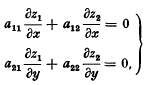
It is known that the theory of Cauchy's problem for differential equations with two independent variables is réducible to the corresponding problem for systems of quasi-linear equations. The reduction is carried further, by means of the theory of characteristics, to the case of systems of equations of the special form first considered by H. Lewy [1]. The simplest case is that of the pair of equationswhere the aii depend on z1 and z2. The problem to be considered is that of finding functions z1(x, y), z2(x, y) which satisfy (1) and which take prescribed values on x + y = 0.
Let f1(x), f2(x), … be a sequence of functions belonging to the real or complex Banach space L, (see S. Banach: [1] (The results can be generalised to functions on any space that is the union of countably many sets of finite measure). We are concerned with various properties that such a sequence may have, and in particular with the more important kinds of convergence (strong, weak and pointwise). This article shows what relations connect the various properties considered; for instance that for strong convergence (i.e. ║fn — f║ → 0) it is necessary and sufficient firstly that the sequence should converge weakly (i.e. if g is bounded and measurable then f(fn(x) — f(x))g(x)dx → 0) and secondly that any sub-sequence should contain a sub-sub-sequence converging p.p. to f(x).
The object of this note is to extend Dini's theorem about (monotonic) sequences of continuous functions on a compact topological space to the case where the underlying domain is an abstract group which is free from topological restrictions. Continuous functions are replaced by almost periodic real-valued functions and the main result may be stated as follows: If a monotonically increasing sequence (fn) of almost periodic real-valued functions on a group G converges pointwise to an almost periodic function f on G, then the sequence converges to f uniformly. The basic idea of the present (elementary) proof is due to v. Kampen [2] and A. Weil [4], i.e., every almost periodic function on a group induces a kind of compact topology in it, relative to which the function is continuous. We modify this idea with the aid of the mean-value of an almost periodic function and obtain a pseudometric topology. This topology facilitates convergence proofs greatly. Moreover, it turns out to be equivalent with the previous one (Lemma 1). No use will be made of the theory of bounded matrix representations. This is significant as any use of the ‘Approximation Theorem’ [3, p. 66, see also p. 226] would violate the claim of an elementary proof.
Let G be a group of order pn where p is some prime. Denote by nr (G) the number of subgroups of G of order pr. If H is the elementary abelian group of order pn, then.
A method is proposed for obtaining a uniformly valid perturbation expansion of the solution of a non-linear partial differential equation, involving either a large or small parameter, when the solution exhibits boundary layer type dependence on the parameter. The method differs from those previously in use in that it is not based on drawing a distinction between points in the boundary layer and points in the remainder of the field. Each point is treated as belonging to both regimes and this enables a stricter control to be maintained on the error terms in the expansions. The method is devised so as to ensure that all forms of error terms are reduced in order at each step in the expansion and not merely those error terms which are mathematically most significant for limiting values of the parameter. The perturbation series can then be used for a wider range of the parameter and provides a solution even when the boundary layer is not particularly thin.
The method is presented through its application to a problem which arises in the theory of the large deflexion of thin elastic plates but the principles underlying the method are more widely applicable.
The fractional iteration of ex and solutions of the functional equation have frequently been discussed in literature. G. H. Hardy has shown (in [3], and in greater detail in [4]) that the asymptotic behaviour of the solutions of (1) cannot be expressed in terms of the logarithmico-exponential scale, although they are comparable with each member of the scale.1 Hence solutions of (1) provide a remarkably simple instance of functions whose manner of growth does not fit into the scale of L-functions but requires non-elementary orders of infinity for an accurate representation. This raises quite naturally the question whether there exists a most regularly growing solution of equation (1) which might serve as a prototype for this kind of growth. In a slightly more general context we may ask whether there exists a ‘best’ family of fractional iterates fσ(x), satisfying.
This paper is chiefly concerned with inequalities for the numbers of subgroups of a finite p-group. The following are typical results. Let G be a p-group of order pa, and let nG(pk) denote the number of subgroups of G of order pk.
A topological space is paracompact if and only if each open cover of the space has an open locally finite refinement. It is well-known that an unusual normality condition is satisfied by each paracompact regular space X [p. 158, 5]: Let α be a locally finite (discrete) family of subsets of X, then there is a neighborhood V of the diagonal Δ(X) (in X × X), such that V[x] intersects at most a finite number of members (respectively at most one member) of {V[A]: A ∈ α} for each x ∈ X. In this not we will show that a variant of this condition actually characterizes paracompactness. Among other results, an improvement to a recent result of H. H.Corson [2] is given so as to accord with a conjecture of J. L. Kelley [p. 208, 5] more prettily, and we connect paracompactness to metacompactness [1]
In the preceding paper 1) one of us has proposed a definition for the “best” or most regularly growing fractional iterates of logarithmico-exponential type functions. The definition was essentially based on two observations. First, that the functional equation has exactly one solution with the property that is totally monotonic for every x > 0. Secondly, that if f(x) is a logarithmicoexponential function such that then the Abel equation has (apart from the arbitrariness of an additive constant) exactly one solution with the property that exists) and the same is true for any reasonably well-behaved function with property (3) whose manner of growth does not transcend Hardy's scale of L-functions. Thus every such function has a uniquely determined family of fractional iterates given by and these fσ(x) may be regarded as the most regularly growing iterates of f(x).






Expectation values of one-particle and two-particle operators are evaluated in the quasi-chemical equilibrium (pair correlation) approximation to statistical mechanics. Earlier work was restricted to the case of extreme Bose-Einstein condensation of the correlated pairs; the new formulas are not so restricted, but are correspondingly more complicated to evaluate practically. However, a simple result can be obtained for the expectation value of the number of particles.

