Introduction
Parkinson’s disease (PD), typically conceptualized as a movement disorder, and normal aging have been associated with visual, perceptual, and cognitive deficits, including changes in visual acuity, contrast sensitivity, color vision, face perception, object and space perception, visuospatial attention, and executive function (PD reviewed in Armstrong, Reference Armstrong2011; Cronin-Golomb, Reference Cronin-Golomb2010, Reference Cronin-Golomb2013; Dirnberger & Jahanshahi, Reference Dirnberger and Jahanshahi2013; aging reviewed in Grady, Reference Grady2012; Owsley, Reference Owsley2011; Sampaio et al., Reference Sampaio, Bobrowicz-Campos, André, Almeida, Faria, Januário and Castelo-Branco2011). In regard to PD, these and other non-motor symptoms are as disabling as the motor symptoms and may be better predictors of quality of life (Cahn et al., Reference Cahn, Sullivan, Shear, Pfefferbaum, Heit and Silverberg1998; Clark, Neargarder, & Cronin-Golomb, Reference Clark, Neargarder and Cronin-Golomb2008; Davidsdottir, Cronin-Golomb, & Lee, Reference Davidsdottir, Cronin-Golomb and Lee2005; Uc et al., 2005; Witjas et al., Reference Witjas, Kaphan, Azulay, Blin, Ceccaldi, Pouget and Chérif2002).
In light of these deficits, the question arises as to whether PD and aging also affect the ability to resolve perceptual ambiguity, a feature of the visual world that emerges under conditions of suboptimal lighting or contrast, object occlusion, and other everyday occurrences of visual degradation. The resolution of perceptual ambiguity is necessary to the successful identification of objects and the ability to navigate in space. There is substantial evidence from studies with young healthy adults using a variety of methodologies that supports the involvement of both low-level basic vision and higher-order cognitive abilities in the resolution of perceptual ambiguity (Intaite, Koivisto, & Castelo-Branco, Reference Intaite, Koivisto and Castelo-Branco2014; Klink et al., Reference Klink, van Ee, Nijs, Brouwer, Noest and van Wezel2008; Kornmeier, Hein, & Bach, Reference Kornmeier, Hein and Bach2009; Leopold & Logothetis, Reference Leopold and Logothetis1999; Long & Toppino, Reference Long and Toppino2004). Understanding how those with PD resolve perceptual ambiguity may provide insight into mechanisms underlying the emergence of visual and cognitive deficits (Díaz-Santos et al., 2015). Research has shown that visual degradation of stimuli, simulating poor contrast sensitivity and visual acuity, may contribute to the development of visual illusions and hallucinations in this population (Meppelink, Koerts, Borg, Leenders, & van Laar, Reference Meppelink, Koerts, Borg, Leenders and van Laar2008; Meppelink et al., Reference Meppelink, de Jong, Renken, Leenders, Cornelissen and van Laar2009). Hallucinations affect from 8% to 40% of PD adults throughout the course of the disease and are a risk factor for dementia and nursing home placement (Barnes & David, Reference Barnes and David2001; Fenelon, Mahieux, Huon, & Ziegler, Reference Fenelon, Mahieux, Huon and Ziegler2000; Goetz, Leurgans, Pappert, Raman, & Stemer, Reference Goetz, Leurgans, Pappert, Raman and Stemer2001).
A potential factor contributing to the resolution of perceptual ambiguity is visual dependence, which is defined as the tendency to rely on externally provided (visual) information to guide behavior, as occurs in PD (Azulay, Mesure, Amblard, & Pouget, Reference Azulay, Mesure, Amblard and Pouget2002; Davidsdottir, Wagenaar, Young, & Cronin-Golomb, Reference Davidsdottir, Wagenaar, Young and Cronin-Golomb2008; Young et al., Reference Young, Wagenaar, Lin, Chou, Davidsdottir, Saltzman and Cronin-Golomb2010). Several studies have found that enhancing low-level physical properties of a stimulus, such as contrast, may normalize the cognitive performance of individuals with PD relative to healthy younger and older adults (Amick, Cronin-Golomb, & Gilmore, Reference Amick, Cronin-Golomb and Gilmore2003; Cools, Rogers, Barker, & Robbins, Reference Cools, Rogers, Barker and Robbins2009; Laudate et al., Reference Laudate, Neargarder, Dunne, Sullivan, Joshi, Gilmore and Cronin-Golomb2012; Toner et al., Reference Toner, Reese, Neargarder, Riedel, Gilmore and Cronin-Golomb2012). Although there is less research regarding normal aging and visual dependence, we have found that healthy older adults may benefit from the provision of low-level cues when performing cognitive tasks requiring visual search (Laudate et al., Reference Laudate, Neargarder, Dunne, Sullivan, Joshi, Gilmore and Cronin-Golomb2012; Toner et al., Reference Toner, Reese, Neargarder, Riedel, Gilmore and Cronin-Golomb2012). Because there are problems in basic vision and perception in aging and PD, as well as increased visual dependence at least in PD, an intriguing possibility is that low-level visual cues might help individuals in these groups resolve perceptual ambiguity by enabling them to exert better control over the visual stimuli.
In the current study, we used the Necker cube—a bistable ambiguous figure that can be seen as either facing up and left or down and right—under passive viewing and two volitional-control conditions (hold one face percept in front; and switch: speed up the alternation between the two face percepts). We increased the thickness of the lines of one face of the cube to examine whether low-level cues may help individuals with PD and healthy older adults to exert volitional control. A further manipulation was in presenting low-level visual cues that were consistent or inconsistent with the desired interpretation. That is, if the cue highlighted the lower right cube face, and the observer was instructed to hold the lower right cube face in front (cue-consistent condition), performance would be better (longer dominance duration) than if the lower right cube face was highlighted but the observer was instructed to hold the upper left cube face (cue-inconsistent condition) (Peterson & Gibson, Reference Peterson and Gibson1991).
Because of known visual dependence and known reduction in basic visual abilities in PD relative to age-matched healthy adults, we hypothesized that those with PD would benefit more from the cues than healthy older adults (having more room for improvement because of their original deficits). Similarly, we hypothesized that the provision of low-level cues would provide a larger benefit for older than younger adults. We operationalized the predictions as follows: First, the PD group compared to the healthy older group would increase their dominance durations in the Hold cue-consistent condition (but not cue-inconsistent condition) and decrease their dominance durations in the Switch condition. Second, the healthy older adult group would benefit more from the low-level cue in the Hold cue-consistent (but not cue-inconsistent) condition and Switch condition than the younger adult group.
Methods
Participants
The study included 27 participants with idiopathic PD (15 women, 12 men), 23 age-and education-matched normal control adults (NC; 13 women, 10 men), and 20 younger adults (YA; 9 women, 11 men). Participants with PD were recruited from the Parkinson’s Disease Clinic at the Boston Medical Center, the Michael J. Fox Foundation Trial Finder, and local support groups. The NC group was recruited from the community. YA were undergraduates at Boston University. Participants were interviewed to rule out confounding diagnoses such as stroke, head injury, and serious medical illness (e.g., diabetes), surgery affecting the thalamus, basal ganglia, or other brain regions, and ocular/optical abnormalities. As part of a larger study, PD and NC participants underwent detailed neuro-ophthalmological examination at the New England Eye Institute in Boston. None of the PD or NC participants was found to have any ocular abnormalities that would have influenced performance on the visual measures of interest. All participants were screened binocularly at 16 inches for Snellen acuity (obtaining 20/40 or better) and near contrast sensitivity using the Functional Acuity Contrast Test.
PD and NC were matched for age, education and ratio of women to men. PD had an average age of 64.5 years (6.2) and NC 64.4 (6.8) years (t[48]=.09; p=.93). The PD group had slightly (non-significant) higher education levels than NC (t[48]=1.77; p=.08). Both groups had a significantly higher education level than the YA group (mean 12.6 [1.1]), although the latter were college students who would be expected to eventually attain higher education levels. PD and NC participants were non-demented as indexed by their scores on the Mini-Mental State Exam (MMSE; Folstein, Folstein, & McHugh, Reference Folstein, Folstein and McHugh1975). PD mean score on the MMSE was 28.7 (0.8) and NC 28.7 (1.0) (t[48]=.16; p=.87). Significant PD-NC differences were found on the Beck Depression Inventory II (BDI-II: Beck, Steer, Ball, & Ranieri, Reference Beck, Steer, Ball and Ranieri1996) and the Beck Anxiety Inventory (BAI: Beck Anxiety Inventory, Beck, Epstein, Brown, & Steer, Reference Beck, Epstein, Brown and Steer1988); PD scored higher on both scales. On the BDI-II, PD scored on average 5.5 (3.6); NC 2.2 (3.1) (t[45]=3.33; p<.002; partial η2=.20; 95% confidence interval {CI} [1.28, 5.22]). On the BAI, PD scored 5.1 (2.7) on average, and NC 1.5 (1.8) (t[45]=5.23; p<.001, partial η2=.38; 95% CI [2.19, 4.92]).
PD participants were staged according to the Hoehn and Yahr scale of motor disability (Reference Hoehn and Yahr1967). The median score was 2 (1–3 range). Disease severity was determined with the use of the Unified Parkinson’s Disease Rating Scale (UPDRS, Fahn & Elton, Reference Fahn and Elton1987). PD had mean UPDRS total of 30.1 (9.7) denoting mild–moderate disease severity. All participants were taking medication for their parkinsonian symptoms and at the time of testing were in their “on” period (levodopa equivalent dosage [LED] mean: 474 [298] mg/day).
Materials and Procedures
Experimental Tasks and Conditions
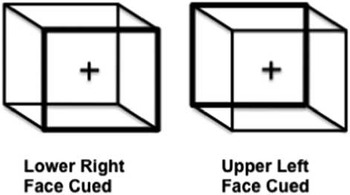
A right-face forward-down Necker cube (width=8° of visual angle) with a fixation cross in the center was presented on a white background in the center of a 21-inch LCD monitor. To examine the role of cues, we increased the contrast of the lines highlighting the left cube face for half of the trials and highlighting the right cube face for the other half of the trials (Figure 1). This cue was chosen from three piloted with young adults (e.g., shaded plane [light and dark gray] and colored lines [red, blue, green]); it alone decreased the tendency of the cues to merge with the background, which would cause the lines to disappear, or to “freeze” the alternation between the cubes, forcing the observer to exert control over the cube during passive viewing.
Necker cubes in study: (1) A Necker cube highlighting the lower right cube by thickening the lines depicting the right cube face; (2) A Necker cube highlighting the upper left cube by thickening the lines depicting the left cube face. Each cube was used in the Passive, Hold, and Switch conditions. “+” is the fixation cross.

Observers were instructed to maintain fixation throughout each 60 s trial. A chin rest was used to maintain head stability at a viewing distance of 62 cm. We tracked eye movements (dominant eye) with an Applied Science Laboratories (ASL) eye-tracking system. The model D6 camera array was placed underneath the stimulus monitor and used infrared light to discern the pupil and corneal reflection. The reflections at these two points were consistently monitored through EyeTrac software and remote head tracking software and hardware. The camera had a sampling rate of 60 Hz, and the system used an ASL EYE-TRAC 6 Control unit (system accuracy is 0.5° of visual angle, and resolution is 0.25°). We were unable to collect reliable eye movement data from all participants for reasons including bumpy sclera, or small pupils or eyes; 17 PD, 15 NC, and 11 YA provided reliable data. Participants with eye-tracking data did not significantly differ in demographic characteristics or performance during the Necker cube experiments from those who did not provide (reliable) eye-tracking data.
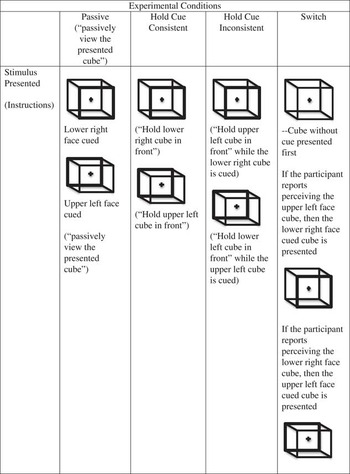
Participants were tested in a passive viewing condition (looking at the cube passively without any manipulation) and two volitional control experimental conditions: Hold and Switch. For the Hold cue condition, we followed Peterson and Gibson (Reference Peterson and Gibson1991), who found that healthy young observers were more successful at holding the interpretation consistent with the cue than the interpretation inconsistent with the cue. That is, if low-level visual cues highlighted the lower right cube face, and the observer was instructed to hold the lower right cube face in front (cue-consistent condition), performance would be better (longer dominance duration) than if the lower right cube face was highlighted but the observer was instructed to hold the upper left cube face (cue-inconsistent condition). We extended this design to include a cue-inconsistent condition (e.g., cue highlighting the lower right cube face, but instructions were to hold the upper left cube face). Half the Hold trials were cue-consistent and half were cue inconsistent. For each, participants were instructed to attempt to “hold the lower right cube in front for as long as possible” for half the trials, and to “hold the upper left cube in the front as long as possible” for the other half of the trials.
For the Switch condition, participants were initially presented with the Necker cube without a cue, until their first percept was reported. Once participants reported the first percept (either upper left or lower right cube face), the line thickness of the unreported percept changed to cue that cube interpretation. The cue switched between the two cube percepts depending on the participant’s response. By applying this paradigm (similar to that used by Arrighi, Arecchi, Farini, & Gheri, Reference Arrighi, Arecchi, Farini and Gheri2009), we explored whether alternating the cue depending on the participants’ report increased their alternation rate (equivalent to shorter dominance durations). Initially we did not inform the participants that the line would thicken, but found that some seemed uncertain of what to do when this occurred. We consequently changed the instructions, asking participants to report when the cube with the thickening line was the cube that they were perceiving, and compared the results with initial versus changed instructions (PD early=5, PD later=18; NC early=5, NC later=17; YA early=2, YA later=17). No differences in performance were found for any group (Mann-Whitney U test, all p’s>.26); therefore, all data were included in the analyses.
Procedures
Data were obtained in compliance with regulations of the Institutional Review Board of Boston University. After providing informed consent, participants received a comprehensive interview and screening assessment, and then completed mood assessments (BDI-II, BAI). Clinical data (e.g., MMSE, UPDRS, H&Y) and perceptual data were collected within 6 months of each other.
Participants were initially presented with two three-dimensional (3D) models of a cube and asked if they had seen these types of cubes before. The experimenter then explained that the same cube could have different interpretations depending on the viewing angle if the person were to rotate it. After viewing the 3D models, participants were presented with a 2D graphic of an ambiguous Necker cube on an 11×8.5" piece of paper and asked whether they could perceive the two possible cube interpretations. Once the participant reported both percepts, the experimenter showed another 2D graphic with three cubes: (1) an ambiguous Necker cube in the middle, (2) an unambiguous Necker cube denoting the right cube interpretation on the right (right face perceived to be in front), and (3) an unambiguous Necker cube denoting the left cube interpretation on the left (left face perceived to be in front). Participants were instructed, with the help of these drawings, to report aloud “right” every time the cube in the middle resembled the unambiguous cube on the right, and to say “left” every time the cube in the middle resembled the unambiguous cube on the left, all while maintaining fixation on a cross placed in the middle of the ambiguous Necker cube.
The experiment began with five 60-s learning trials of the Necker cube task to ensure reliable reporting of perceptual alternations. Participants were instructed to say “right” every time the cube in the middle resembled the one in the right, and to say “left” every time the cube in the middle resembled the one in the left, while maintaining fixation at the cross in the middle of the ambiguous Necker cube (Figure 2). For the first two practice trials, one graphic demonstrating the right cube interpretation and one representing the left cube interpretation were placed on either side of the computer monitor to ensure reliable reporting of reversals. The graphics were removed for the last three practice trials. Data were collected during all five practice trials for eye movements and behavioral responses of reversals.
Necker cube stimulus with cube interpretations (lower right cube and upper left cube) and outline of experimental conditions. “Lower right cube” refers to the lower right face being perceived in front (as shown by highlighting). “Upper left cube” refers to the upper right face being perceived in front (as shown by highlighting). “+” is the fixation cross.

Following practice, participants were introduced to the passive condition. The cube with the right face cued and the cube with the left face cued were each presented for three trials. Here they were instructed to “just look at the cube passively without trying to force any of the percepts.” The order of the three volitional conditions—Hold cue-consistent, Hold cue-inconsistent and Switch viewing—was counterbalanced across participants. In the two Hold conditions, participants were instructed to “attempt to hold either the lower right cube or the upper left cube for as long as possible” (three trials holding right and three trials holding left for cue-consistent; three trials holding right and three trials holding left for cue-inconsistent); in the Switch condition they were to “attempt to speed up between the two cube percepts for as long as possible.” Participants continuously monitored their perceptual state and reported perceptual reversals aloud (e.g., “right” for lower right cube or “left” for upper left cube) and the examiner pressed the respective key of the computer to record the response. During the Switch condition, the cube was presented for five 60-s trials.
Statistical Analysis
Absolute dominance durations were analyzed for each participant; that is, the average time in seconds spent perceiving either the left or right cube. Outlier trials were identified across participants. Dominance durations above or below two standard deviations from the group mean in each condition were eliminated from the analyses. Three individuals with PD were unable to perform under any of the four conditions, and four more were unable to perform under the Hold-inconsistent condition; one NC was unable to perform under both Hold conditions. Three YA were unable to perform under the Hold-inconsistent condition. Of the remaining PD data, 3.3% were eliminated (3/91 mean absolute dominance durations; each mean reflected 5–6 trials depending on the condition). For NC, 4.6% of the data were eliminated (4/88 mean dominance durations). For YA, 3.9% of the dominance durations were eliminated (3/77). After outlier elimination, the sample size per condition was as follows: Passive: 23 PD, 22 NC, 19 YA (total 64); Hold cue-consistent: 23 PD, 20 NC, 19 NC (total 62); Hold cue-inconsistent: 19 PD, 19 NC, 17 YA (total 55); Switch: 22 PD, 22 NC, 18 YC (total 62).
For each participant, data were normalized to the Passive condition and volitional modulation was calculated as (DX–DP)/DP*100, where DX is the mean dominance duration of one of the volitional control conditions (Hold or Switch) and DP is the mean dominance duration of the Passive condition. Note that the original absolute dominance durations were used in these computations and not the trimmed ones. Normalizing the data to passive viewing allows one to compare how participants increased or decreased their dominance durations in the Hold and Switch conditions relative to their performance in the Passive condition. For the Hold conditions, normalizing the data made it possible to evaluate whether cueing the face of the cube consistent with instructions resulted in higher dominance durations compared to cueing the face of the cube inconsistent with instructions. Outlier data were determined following the same procedure stated above. Three percent (2/67) of the normalized dominance durations data were eliminated in the PD group, 6.2% (4/65) in the NC group, and 6.0% (4/67 trials) in the YA group. After eliminating the outliers, 22 PD, 19 NC, and 17 YC (total 58) were included in the analysis with Hold cue-consistent and Switch normalized dominance durations. Mixed-model analyses of variance (ANOVAs) with group as the between subject factor and condition as the within subject factor were used to determine significant group differences between PD, NC, and YA on absolute and normalized dominance durations. The Huynh-Feldt correction was applied to analyses when the sphericity assumption was violated, resulting in adjusted degrees of freedom. Planned comparisons (independent groups t tests) were performed to compare the effect of group (PD vs. NC; NC vs. YA) on dominance durations. Paired sample t tests were conducted to examine within-group differences in performance for each volitional control condition relative to performance under passive viewing. Pearson correlations were used with eye movement data to examine the association between deviation from fixation and dominance durations for the Passive, Hold and Switch conditions.
Results
Passive Viewing Compared to Hold Cue-Consistent and Switch Conditions Using Absolute Dominance Durations
A mixed design ANOVA with three levels of group (YC, NC, and PD) and three levels of condition (Passive, Hold cue-consistent, Switch) was performed to examine differences in absolute dominance durations. Results revealed a significant main effect of condition (F[1.45, 83.96]=74.04; p<.001; partial η2=.56), and a significant interaction between condition and group (F[2.90, 83.96]=3.69; p<.02; partial η2=.11). There was no significant main effect of group (F[2, 58]=2.09; p=.13). Planned t tests were performed to examine group differences (i.e., PD vs. NC and NC vs. YA) on the Passive condition and to examine differences for each group across conditions (i.e., Passive vs. Hold cue-consistent, and Passive vs. Switch).
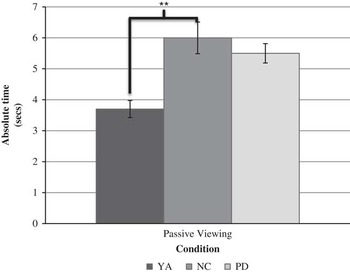
Planned independent groups t tests showed that NC and YA significantly differed during Passive viewing (t[31.54]=3.96; p<.001; partial η2=.27; 95% CI [1.13, 3.51]), whereas PD showed comparable dominance durations to NC (t[35.16]=.82; p=.42). Absolute dominance durations for passive viewing are presented in Figure 3. On average, the PD group reported a perceptual alternation every 5.5 s (1.5 s), NC every 6.0 s (2.4 s), and YA every 3.7 s (1.2 s).
Mean dominance durations of individuals with Parkinson’s disease (PD), matched normal control adults (NC), and younger adults (YA) during the passive viewing condition of the cued Necker cube. NC showed significantly higher absolute dominance durations than YA (**p<.01). No PD-NC differences were found. Error bars indicate the standard error of the mean.

Planned dependent groups t tests were conducted to determine whether each group was able to increase (Hold cue-consistent) or decrease (Switch) the dominance durations compared to their performance during Passive viewing. The ability to do so was significant in each case, for each group. On average, the PD group reported a perceptual alternation every 8.0 s (2.3 s) in the Hold cue-consistent condition and every 4.3 s (2.6 s) in the Switch condition. The changes relative to performance under Passive viewing were significant (Hold cue-consistent: t[22]=5.52; p<.001; partial η2=.85; 95% CI [1.57, 3.45]; Switch: t[21]=2.44; p<.024, partial η2=.22; 95% CI [.16, 1.96]. On average, the NC group reported a perceptual alternation every 7.6 s (3.8 s) in the Hold cue-consistent and every 3.4 s (2.7 s) during the Switch condition. The changes relative to performance under Passive viewing were significant (Hold cue-consistent: t[20]=2.91; p<.009; partial η2=.79; 95% CI [.47, 2.84]; Switch: t[21]=4.17; p<.001; partial η2=.45; 95% CI [1.28, 3.84]). The YA group perceived an alternation, on average, every 8.3 s (4.2 s) during the Hold cue-consistent condition and every 1.9s (.83 s) during the Switch condition. The changes relative to performance under Passive viewing were significant (Hold cue-consistent: (t[18]=5.14; p<.001; partial η2=.60; 95% CI [2.72, 6.48]); Switch: (t[17]=6.12; p<.001, partial η2=.69; 95% CI [1.19, 2.45]).
Comparison of Groups for Hold Cue-Consistent and for Switch Using Normalized Dominance Durations
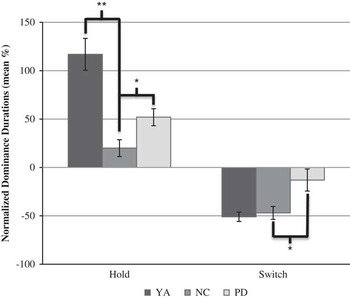
Normalized Hold cue-consistent and Switch dominance durations by group are presented in Figure 4. For each participant, data were normalized to the Passive condition as described above. A mixed design ANOVA with three levels of group (PD, NC, YA) and two levels of condition (Hold cue-consistent and Switch) revealed significant main effects of group (F[2,55]=13.40; p<.001; partial η2=.33), condition (F[1,55]=162.49; p<.001; partial η2=.75), and an interaction between group and condition [F(2,55)=16.55; p<.001; partial η2=.38].
Dominance durations normalized to passive viewing in individuals with Parkinson’s disease (PD), matched normal control adults (NC), and younger adults (YA). In the Hold condition (cue-consistent), PD and YA were able to significantly increase their dominance durations compared to NC (**p<.01; *p<.05). In the Switch condition, NC and YA, but not PD, were able to significantly reduce their dominance durations (*p<.05). Error bars indicate the standard error of the mean.

Planned independent groups t tests revealed that both the PD and YA groups significantly increased their dominance durations relative to the NC group in the Hold cue-consistent condition (PD vs. NC: t[42]=2.28; p<.03, partial η2=.11; 95% CI [.03, .49]; NC vs. YA: t[27.22]=5.18; p<.001, partial η2=.43; 95% CI [.54, 1.25]). In the Switch condition, NC significantly increased their ability to switch percepts relative to PD (t[42]=2.42; p<.02, partial η2=.12, 95% CI [.04,.47]), whereas the NC and YA groups performed comparably (t[37]=.63; p=.53).
Comparison of Hold Cue-Consistent and Hold Cue-Inconsistent Using Normalized Dominance Durations
A mixed design ANOVA compared group performance on the two Hold conditions and revealed a significant main effect of group (F[2,51]=15.07; p<.001; partial η2=.37). Neither the main effect of condition (F[1,51]=.67; p=.42) nor the group by condition interaction (F[2,51]=.66; p=.52) was significant. In the Hold cue-consistent condition, planned independent groups t tests revealed significantly longer dominance durations for the PD group than the NC group (t[42]=2.28; p<.03; partial η2=.11, 95% CI [.03, .49]) as well as longer dominance durations for the YA group than the NC group (t[27.22]=5.18; p<.001; partial η2=.43; 95% CI [.54, 1.25]). In the Hold cue-inconsistent condition, there was no PD-NC group difference (t[38]=.66; p=.52), but the YA group had significantly longer dominance durations than the NC group (t[23.44]=3.29; p<.003; partial η2=.26, 95% CI [.32, 1.39]). In addition, planned dependent groups t tests showed that no group exhibited a significant difference in performance in the Hold cue-consistent versus cue-inconsistent condition: PD (t[19]=.62; p=.55); NC (t[17]=1.25; p=.23); YA (t[15]=.56; p=.58). These results together suggest that cueing the opposite cube eliminated the PD-NC group difference seen in the Hold cue-consistent condition.
Eye Movements: Association between Deviation from Fixation and Dominance Durations
To assess the possible influence of eye movements on performance for those participants for whom eye movement data were reliable (17 PD, 8 NC, 11 YA), we calculated their ability to maintain fixation as the mean deviation from fixation (in degrees of visual angle) for each experimental condition (three deviation scores for horizontal eye movements; three scores for vertical movements). Positive values indicate eye movements to the right of center and above center, and negative values indicate left of center and below center.
For horizontal eye positions (equivalent to eye movements left/right of center), the three groups moved their eyes left of center in each condition. During the Passive condition, on average, PD moved their eyes 1.17° (1.08°), NC .65° (43°), and YA .43° (.42°). In the Hold condition, on average, PD moved their eyes .53° (.71°), NC .59° (.55°), and YA .35° (.40°). In the Switch condition, on average, PD moved their eyes by .23° (.68°), NC .62° (.80°), and YA 39° (.71°).
For vertical eye positions (equivalent to eye movements above/below the center), all three groups moved their eyes above center in each condition. During the Passive condition, PD moved their eyes an average of .84° (1.55°), NC .11° (1.29°), and YA .48° (1.47°). In the Hold condition, on average, PD moved their eyes by .87° (1.42°); NC .67° (.61°), and YA 1.0° (1.35°). In the Switch condition, PD moved their eyes by an average of .51° (1.66°), NC .92° (.80°), and YA .66° (1.60°).
A mixed design ANOVA with three levels for horizontal eye movements (Passive, Hold and Switch conditions), and three groups (PD, NC, YA) revealed no main effect of group (F[2, 34]=.63; p=.51). There was a significant main effect of condition (F[1.90, 64.43]=3.72; p<.03; partial η2=.10) and a group by condition interaction (F[3.79, 64.43]=3.19; p<.02; partial η2=.16). Planned independent groups t tests revealed that PD moved their eyes slightly more left of the center (non-significant) than NC during Passive viewing (t[22.86]=1.97; p=.06). No PD-NC group differences in horizontal eye movements were found for either Hold (t[28]=.47; p=.66) or Switch (t[29]=1.36; p=.18). No NC-YA group differences in horizontal eye movements were found for any condition; Passive (t[25]=.33; p=.75), Hold (t[22.71]=1.68; p=.11), Switch (t[23]=.69; p=.50).
A second mixed design ANOVA with three levels for vertical eye movements and three groups found no significant main effects (group, F[2,32]=.10; p=.90; condition, F[2,64]=1.02; p=.37) or the interaction between group and condition (F[4,64]=.89; p=.48).
We evaluated the association between the deviation from the fixation and performance (dominance durations). We found no significant correlations between horizontal eye movements and performance in PD (Passive: p=.88; Hold: p=.55; Switch: p=.70), NC (Passive: p=.15; Hold: p=.07; Switch: p=.10), or YA (Passive: p=.94; Hold: p=.40; Switch: p=.96). There were also no significant correlations between vertical eye movement and performance by any group (PD [Passive: p=.08; Hold: p=.31; Switch: p=.35]; NC [Passive: p=.98; Hold: p=.79; Switch: p=.99]; YA [Passive: p=.33; Hold: p=.33; Switch: p=.13]).
Discussion
We examined the role of low-level visual cues in the resolution of perceptual ambiguity in PD and normal aging. We hypothesized that under cue-consistent conditions, individuals with PD would improve their control over the Necker cube to a greater extent than NC, as would NC relative to YA, based on known visual dependence in PD and deficiencies in basic vision and perception in PD and NC. Although all three groups benefited from the low-level cue, the extent of the benefit depended on the task (Hold vs. Switch) and group. In regard to Hold, we found as hypothesized that PD benefited from task-consistent cues more than NC, but did not find a similar benefit for NC relative to YA; that is, PD and YA both increased their dominance durations significantly more than NC during the Hold cue-consistent condition. In regard to Switch, we found no support for the hypothesis that PD would benefit more than NC or NC benefit more than YA. Rather, the results suggested that NC benefited significantly more than PD from alternating the cue to expedite their switches, whereas NC and YA did not significantly differ in using the cue in the Switch condition; both groups benefited equally. We also found that cueing the opposite cube (Hold cue-inconsistent) eliminated the PD-NC group difference seen in the Hold cue-consistent condition, but did not reduce the ability of the YA group to increase their dominance durations more than NC.
Passive Viewing: Effects of Aging but not PD
Imaging studies have indicated that spontaneous viewing of a bistable image is supported by neural mechanisms that are distinct from those supporting volitional control. Specifically, these studies argued against the involvement of the dorsolateral prefrontal cortex (DLPFC) during passive viewing of a bistable structure-from-motion stimulus (de Graaf, de Jong, Goebel, van Ee, & Sack, Reference de Graaf, de Jong, Goebel, van Ee and Sack2011) and binocular rivalry (Frässle, Sommer, Jansen, Naber, & Einhäuser, Reference Frässle, Sommer, Jansen, Naber and Einhäuser2014). Our current findings that PD and NC showed comparable dominance durations, whereas YA showed significantly shorter dominance durations than NC (equivalent to faster perceptual alternations), suggest that mild-to-moderate PD does not have an impact on spontaneous (passive-viewing) bistable perception beyond the effects of aging (see also Díaz-Santos et al., 2015). These findings do not, however, refute the role of the DLPFC during passive viewing of ambiguous figures, as aging affects the fronto-parietal attentional circuitry including the DLPFC (Gazzaley & D’Esposito, Reference Gazzaley and D’Esposito2007; Goh, Beason-Held, An, Kraut, & Resnick, Reference Goh, Beason-Held, An, Kraut and Resnick2013). Future studies should use imaging to evaluate whether this network deactivates during bistable perception relative to YA.
Volitional Control: Differential Benefit of Low-Level Cues for PD and Healthy Older Adults
We hypothesized that low-level cues could compensate for perceptual deficits in PD and normal aging, based on the interaction of visual perception with higher-order cognitive processes in PD (Amick et al., Reference Amick, Cronin-Golomb and Gilmore2003; Cools et al., Reference Cools, Rogers, Barker and Robbins2009; Laudate, Neargarder, & Cronin-Golomb, Reference Laudate, Neargarder and Cronin-Golomb2013). Relative to NC, PD and YA demonstrated a significantly greater increase in dominance durations during the Hold cue-consistent condition compared to passive viewing. In the Switch condition, PD showed a significantly lower ability than NC to decrease their dominance durations with the use of the consistent cue, whereas NC and YA did not significantly differ in expediting their alternation by using the cue. We were not able to replicate the finding of Peterson and Gibson (Reference Peterson and Gibson1991) that YA have longer dominance durations under cue-consistent than cue-inconsistent conditions. We did find, however, that cueing the opposite face of the cube (cue-inconsistent condition) eliminated the difference between the PD and NC groups seen when cueing the cube consistent with instructions. Our results also indicated that overall each group benefited from the low-level cues to exert volitional control over bistable perception, but individuals with PD and healthy older adults benefited from the cues differently.
Our results are consistent with those of Amick and col-leagues (Reference Amick, Cronin-Golomb and Gilmore2003) for PD, and Toner and colleagues (Reference Toner, Reese, Neargarder, Riedel, Gilmore and Cronin-Golomb2012) for PD and normal aging. Amick and colleagues hypothesized that PD-related changes in contrast sensitivity degraded the initial perception of visual stimuli, which affected the ability to identify them. They found that individuals with PD performed normally on an object identification task when the contrast of the target stimulus was enhanced to compensate for the deficit of the particular participant. Toner and colleagues (Reference Toner, Reese, Neargarder, Riedel, Gilmore and Cronin-Golomb2012) examined the role of enhanced contrast on a visual search task. They reported that the strength of the stimulus affected the performance of all groups, including YA, NC, and PD; the groups did not significantly differ in their ability to search and detect the targets once the contrast level was adjusted to their individual contrast threshold. These observations raise the possibility that whether or not NC and PD are more visually dependent than YA, enhancement of low-level stimuli may result in improved image processing (Amick et al., Reference Amick, Cronin-Golomb and Gilmore2003; Aydin, Strang, & Manahilov, Reference Aydin, Strang and Manahilov2013; Laudate et al., Reference Laudate, Neargarder, Dunne, Sullivan, Joshi, Gilmore and Cronin-Golomb2012; Seichepine et al., Reference Seichepine, Neargarder, McCallum, Tabor, Riedel, Gilmore and Cronin-Golomb2012; Toner et al., Reference Toner, Reese, Neargarder, Riedel, Gilmore and Cronin-Golomb2012). Taken together with the present results from bistable image perception, these studies reveal interactions between low-level perception and higher-order cognitive processes in PD and normal aging, although the nature of the interactions appears to be different in the two groups. Cues facilitate the ability of individuals with PD to stabilize their perception when confronted with ambiguous stimuli (Hold condition) and healthy older adults’ ability to alternate between plausible perceptual interpretations (Switch condition).
Limitations of the Study
This study was subject to limitations. First, having the examiner record the participants’ verbal reports of perceptual state is a source of variability in the reaction time data. This design was dictated by the need to accommodate the motoric limitations of individuals with PD; it may be argued that using a motor response would have introduced more variability than did our design. Another potential limitation was that we did not provide the option (via key press) for the participant to view the Necker cube and choose neither face of the cube as their percept, that is, to allow reporting of a flat image. Sometimes participants reported one particular cube percept when in fact they were seeing a flat image of the cube. These instances could have introduced noise to the dominance duration data by increasing some of the cube durations.
Conclusions
The current study provided a bridge to the area of interventions by examining the use of cues that could potentially aid healthy older adults and individuals with PD in their ability to volitionally control the perception of ambiguous figures. The results indicated that the provision of low-level cues aided the resolution of perceptual ambiguity in PD and in healthy older adults. Low-level task-consistent cues helped all three groups improve their control over ambiguous perception (within-group comparisons). The PD group improved significantly more in their control in the Hold condition, relative to NC, and the NC group improved significantly more in their control relative to PD in the Switch condition. These results should alert researchers and clinicians that enhancing low-level properties of certain visual stimuli may have effects in PD that are different from in normal aging, and that only under specific task conditions may the use of such cues allow compensation for visuo-perceptual deficits and consequent ability to resolve perceptual ambiguity.
The use of low-level cues as we describe here is potentially important because reduced stimulus strength has been shown to interact with sensory and perceptual deficits in PD and normal aging, impairing cognition (e.g., Clay et al., Reference Clay, Edwards, Ross, Okonkwo, Wadley, Roth and Ball2009; Cronin-Golomb, Gilmore, Neargarder, Morrison, & Laudate, Reference Cronin-Golomb, Gilmore, Neargarder, Morrison and Laudate2007; Davidsdottir et al., Reference Davidsdottir, Wagenaar, Young and Cronin-Golomb2008). A positive converse of this relation is that visually based interventions may enhance cognitive performance. For example, we have shown that letter identification in PD and healthy older adults can be significantly improved by enhancement of stimulus contrast (Amick et al., Reference Amick, Cronin-Golomb and Gilmore2003; Cronin-Golomb et al., Reference Cronin-Golomb, Gilmore, Neargarder, Morrison and Laudate2007), and that these groups benefit from the provision of low-level cues when performing cognitive tasks requiring visual search (Laudate et al., Reference Laudate, Neargarder, Dunne, Sullivan, Joshi, Gilmore and Cronin-Golomb2012; Toner et al., Reference Toner, Reese, Neargarder, Riedel, Gilmore and Cronin-Golomb2012). In regard to PD specifically, a further consideration is that a subset develop visual hallucinations, and these individuals may have disproportionately extensive perceptual impairments (Davidsdottir et al., Reference Davidsdottir, Cronin-Golomb and Lee2005; Fenelon et al., Reference Fenelon, Mahieux, Huon and Ziegler2000, Koerts et al., Reference Koerts, Borg, Meppelink, Leenders, van Beilen and van Laar2010; Meppelink et al., Reference Meppelink, Koerts, Borg, Leenders and van Laar2008, Reference Meppelink, de Jong, Renken, Leenders, Cornelissen and van Laar2009). It is an empirical question as to whether those with hallucinations experience a reduced ability to resolve perceptual ambiguity, and whether such inability would respond to enhancement of object identification through use of low-level visual cues. Studies on this topic may shed light on the mechanisms subserving visual hallucinations, with the goal of addressing the poor prognosis (e.g., dementia, higher nursing home placements) in hallucinating individuals with PD (Barnes & David, Reference Barnes and David2001; Fenelon et al., Reference Fenelon, Mahieux, Huon and Ziegler2000; Goetz et al., Reference Goetz, Leurgans, Pappert, Raman and Stemer2001).
Acknowledgments
This research was supported in part by grants from the National Institute of Neurological Disorders and Stroke, including a Ruth L. Kirschstein National Research Service Award (F31 NS074892) to MDS and RO1 NS067128 to ACG; a Clara Mayo Foundation Fellowship from the Department of Psychological and Brain Sciences at Boston University (to MDS); the National Science Foundation (NSF SBE-0354378) to AY; and Office of Naval Research (ONR N00014-11-1-0535) to AY. The authors report no conflicts of interest affecting this manuscript.
We thank all the individuals who participated in this study. Our recruitment efforts were supported, with our gratitude, by Marie Saint-Hilaire, M.D., and Cathi Thomas, R.N., M.S.N., of Boston Medical Center Neurology Associates, by Boston area Parkinson’s disease support groups, and by the Michael J. Fox Trial Finder. We thank Laura Pistorino for her assistance in screening and scheduling participants; Yue Chen, Ph.D., and Ryan McBain, D.Sc., for assistance with experimental design; Mark O’Donoghue, O.D., for the eye examinations; and Daniel J. Norton, Lindsay Clark, and Michael Horgan for test administration and technical assistance.