1 Introduction
Our goal in this paper is to investigate the effects of morphological and phonological factors such as word position and contrast maintenance, together with purely phonetic factors (e.g. preceding segment, stress), in conditioning synchronic phonetic variation. Here we focus on the allophony of the voiced prepalatal (postalveolar) fricative phoneme /ʒ/ in Central Catalan, which has a particularly complex phonological distribution.
Whereas both word-medially and word-finally fricative /ʒ/ contrasts with affricate /ʤ/ between vowels (as in e.g. pluja [ˈpluʒə] ‘rain’ vs. platja [ˈplaʤə] ‘beach’; peix antic [ˈpeʒənˈtik] ‘ancient fish’ vs. roig antic [ˈrɔʤənˈtik] ‘ancient red’), in word-initial position and post-consonantally there is no phonological contrast, and both fricative and affricate variants are reported to occur as allophonic variants (whether in free variation or in complementary distribution, see Section 1.1). Furthermore, voiced and voiceless consonants contrast word-initially and word-medially, but not word-finally, where voicing is determined by the following context (e.g. baixa [ˈbaʃə] ‘low, short, fem.’ vs. vaja [ˈbaʒə] ‘interjection’, but baix [baʃ] ‘low, short, masc.’, Baix Camp [ˈbaʃˈkam] (toponym) vs. baix d'alçada [ˈbaʒðəlˈsaðə] ‘short of height’, Baix Empordà [ˈbaʒəmpurˈða] (toponym)).
An interesting question that arises is whether the existence or absence of a phonological contrast in a given morphological position conditions the phonetic realization of consonants. For instance, are the degree of constriction and voicing of [ʒ] in /VʒV/, /V#ʒV/, and /Vʒ#V/ affected by the possible phonological contrast with /ʤ/ and/or /ʃ/ in a given position or is the variation that we find conditioned only by phonetic factors?
Several recent studies have considered the effects of word boundaries or phonological contrast in conditioning consonant allophony in Romance languages. An effect of phonological contrast is reported by Ortega-Llebaria (Reference Ortega-Llebaria and Face2004), comparing Spanish and English /b/ and /ɡ/, and by Hualde, Nadeu & Simonet (Reference Hualde, Nadeu, Simonet, Colina, Olarrea and Carvalho2010), comparing Central Catalan and Majorcan Catalan /b/. Evidence for word-boundary effects is more mixed. Eddington (Reference Eddington2011), in an acoustic study including speakers from a number of Spanish dialects, found that intervocalic [β] and [ð] were less constricted when word-medial than when word-initial, but he found no effect for [ɣ]. Carrasco, Hualde & Simonet (Reference Carrasco, Hualde and Simonet2012) found a small effect of word boundaries on degree of constriction of /b d ɡ/ in Costa Rican Spanish, but no effect in their Madrid Spanish corpus. Similarly, Hualde et al. (Reference Hualde, Simonet and Nadeu2011) did not find an effect of word boundaries on the degree of constriction of intervocalic /b d ɡ/ or /p t k/ extracted from a corpus of Iberian Spanish. Hualde & Nadeu (Reference Hualde and Nadeu2011) also failed to find an effect of word boundaries in the lenition of intervocalic voiceless stops in Rome Italian. On the other hand, Hualde & Prieto (Reference Hualde and Prieto2014) find that in Madrid Spanish intervocalic /s/ is shorter and shows more voicing word-finally than word-initially or word-medially.
In this paper we extend the investigation to Central Catalan voiced prepalatals, which have a more complex allophony than the consonants examined in the studies reviewed in the previous paragraph. As previously mentioned, for the Catalan prepalatals word position is related to issues of phonological contrast, since different phonemic oppositions obtain in different word contexts.
In the next two subsections we describe the distribution of prepalatals in Central Catalan and the historical origin of the present-day situation. This is followed by reports on a pilot experiment and a corpus study. A first, pilot experiment with laboratory speech, reported in Section 2, allows us to gauge the amount of variation between fricative and affricate realizations to be found in positions of neutralization of this contrast and to establish the validity of our acoustic correlate of degree of constriction. Then, in Section 3, we report on a large-scale corpus study, where we consider the effects of word position and other factors in conditioning the degree of constriction, voicing, and duration of the target consonants. We end the paper with a discussion and summary of the findings.
1.1 Phonological contrast and morphophonological alternations involving the prepalatal consonants
Central Catalan has four consonant phonemes with a ‘prepalatal’ (alveolopalatal or postalveolar, see Recasens & Pallarès Reference Recasens and Pallarès2001, Recasens & Espinosa Reference Recasens and Espinosa2007) point of articulation. These phonemes contrast in voicing and in manner (affricate/fricative); that is, the inventory is /ʃ ʧ ʒ ʤ/. However, this four-way contrast is limited to the word-internal intervocalic position, as illustrated in (1a). Elsewhere, some contrasts are neutralized.
Word-initially, [ʒ] and [ʤ] do not contrast. Affricate realizations are usually found after pause (a position where fricatives may also occur), and are said to be preferred also after laterals and nasals; fricatives being found elsewhere, although with some variation (Fabra Reference Fabra1954: 79f.; Alarcos Reference Alarcos1983; Martí Reference Martí1985; Mier Reference Mier1986; Recasens Reference Recasens1991, Reference Recasens1993; Badia Cardús Reference Badia Cardús1993; Pradilla Reference Pradilla, Solà, Lloret, Mascaró and Saldanya2002). Thus, in the word-initial context, there is a single voiced prepalatal phoneme /ʒ/ [ʒ ~ ʤ] (i.e. a phoneme with fricative and affricate realizations), as shown in (1b).Footnote 1 As for the voiceless counterparts, we find a limited contrast between word-initial /ʃ/ and /ʧ/. There are a few words that are consistently pronounced with initial /ʃ/ in this Catalan variety, e.g. xarxa [ˈʃarʃə] ‘net’ (Mier Reference Mier1986). Some other words (all of them borrowings) are always produced with an initial voiceless affricate, e.g. txec [ʧɛk] ‘Czech’. For most words, however, we find variation between fricative and affricate, with a preference for the affricate, e.g. xocolata [ʧukuˈlatə] ~ [ʃukuˈlatə] ‘chocolate’ (although the fricative pronunciation of orthographic x- has, or used to have, greater overt prestige, Coromines Reference Coromines1974: 248). Word-initial voiced and voiceless prepalatals thus show a different distribution. For the voiced prepalatals, the choice between fricative or affricate realization is conditioned by the preceding phrasal context and there are no lexical exceptions. Regarding the voiceless prepalatals, instead, there is an incipient lexical contrast, with less influence of the phrasal context.
Word-finally, we find a phonemic contrast between fricative and affricate, but, as with all other obstruents, the contrast in voicing is neutralized in this position. Affricates and fricatives are realized as voiced before a vowel or voiced consonant and as voiceless before a voiceless consonant or pause, (1c).
After a consonant, the fricative/affricate contrast is neutralized, with variation in realization, with the same preferences as noted for the word-initial context (1d).Footnote 2 Finally, in word-final post-consonantal position, (1e), both the fricative/affricate and the voiced/voiceless contrasts are effectively neutralized, since voicing is conditioned by the following context and, as already mentioned, there is no fricative/affricate contrast post-consonantally.Footnote 3
-
(1)


Even in the intervocalic word-medial position, where the four-way phonemic opposition obtains, there is some tendency towards the loss of phonemic contrasts, through sporadic devoicing of the voiced affricate, as noted by Fabra (Reference Fabra1954) and Mier (Reference Mier1986). Sporadic devoicing of the affricate occurs mostly right before a stressed vowel and in posttonic position. This tendency to devoice appears to be related to increased duration. Several authors have pointed out that intervocalic word-medial affricates show lengthening or gemination (Wheeler Reference Wheeler1977, Reference Wheeler2005; Alarcos Reference Alarcos1983; Mascaró Reference Mascaró, Aronoff and Oehrle1984; Mier Reference Mier1986; Recasens Reference Recasens1991, Reference Recasens1993; Lamuela Reference Lamuela and Ferrando1992; Lloret Reference Lloret1992; Jiménez Reference Jiménez1996; Bonet & Lloret Reference Bonet and Lloret1998; Pradilla Reference Pradilla, Solà, Lloret, Mascaró and Saldanya2002; Recasens & Espinosa Reference Recasens and Espinosa2007). That is, word-medial /ʤ/ may be realized as [dːʒ] ~ [tːʃ] ~ [ʧ] in Central Catalan, at least in certain words, e.g. in me tg e ‘physician’ (which may become homophonic with metxa ‘wick’), mi tj ó ‘sock’.
The complexity of the phonemic distribution that we have described is increased by the existence of several patterns of morphophonemic alternation. Word-final consonants may become word-medial through morphological concatenation. This gives rise to complex morphophonological alternations, as illustrated in (2). We find four possible patterns involving the prepalatals, three of them affecting word-final affricates. Word-final /ʧ ~ ʤ/ may alternate with /ʧ/, /ʤ/ or /ʒ/, depending on the specific lexical family, whereas word-final /ʃ ~ ʒ/ always alternates with /ʃ/ in word-medial position.
-
(2)

As mentioned, in this paper we will focus on the voiced prepalatals. We investigate the extent to which acoustic measurements of degree of constriction and voicing support the traditional understanding of the allophony of these segments and the possible sources of variation in contexts such as the word-initial and post-consonantal ones, where variation has been reported. We also investigate the potential effects of word position (correlated with contextual neutralization) in low-level allophonic variation.
Before describing our experimental methods and results, a note of the historical origin of these consonants may be useful.
1.2 Origin of the voiced prepalatal fricative and affricate
Classical Latin did not have palatal or prepalatal consonants. These segments arose in Late Latin from a number of sound changes (see e.g. Loporcaro Reference Loporcaro, Maiden, Smith and Ledgeway2011: 143–150). In particular, a prepalatal voiced affricate /ʤ/ developed primarily from the fortition of syllable-initial glides (ianuariu > Italian gennaio ‘January’) and from the palatalization of voiced front velars and dentals (gente /ɡ-/ > It. gente /ʤ-/ ‘people’; diurnale > It. giornale ‘daily’). This consonant remains an affricate in Italian, but was later systematically lenited to a fricative /ʒ/ in French and Portuguese, cf. Fr. janvier, gens, journal; Port. janeiro, gente, jornal. Whereas the historical development in French and Portuguese shows across-the-board lenition of the old affricate /ʤ/ > /ʒ/, the Central Catalan present-day distribution reflects a process of lenition limited to the intervocalic context (both inside words and across word boundaries) and variably to syllable-initial post-consonantal and post-pausal contexts. Unlike French and Portuguese, Old Catalan, together with /ʤ/, may also have had geminate /dːʒ/ in words like metge < medicu ‘physician’ (see e.g. Lamuela Reference Lamuela and Ferrando1992), which, as is typically the case with geminates (see Kirchner Reference Kirchner2000), did not lenite, giving rise to the present-day contrast between fricative and affricate in word-internal intervocalic position:Footnote 4
-
(3)

This sound change produced a situation where word-initial [ʤ] and [ʒ] are now non-contrastive allophones that alternate depending on the preceding context in the phrase; but, word-internally, intervocalic /ʤ/ and /ʒ/ are different phonemes.
As mentioned, some variation between [ʤ] and [ʒ] has been described in contexts where there is no phonological contrast between affricate and fricative.
Word-final /ʤ ~ ʧ/ (where voicing is conditioned by the following context), as in boig [ˈbɔʧ] ‘crazy, masc.’ ~ boig amic [ˈbɔʤəˈmik] ‘crazy friend’, was not lenited before a vowel, so that the lenition of intervocalic /ʤ/ in morphologically related words, as in *bo[ʤ]a > boja [ˈbɔʒə] ‘crazy, fem.’, has created the morphophonological alternation between word-final /ʧ ~ ʤ/ and word-medial /ʒ/ in (2c) above.
Here we report on a corpus study that we have conducted in order to understand the nature of this variation and the degree to which it is conditioned purely by the phonetic context or also by phonological considerations such as the presence of word boundaries and the types of phonemic contrasts that are possible in a given position.
Before this, in Section 2 we describe a preliminary laboratory study where participants were asked to read sentences containing the phoneme /ʒ/ in different phonological contexts. In this study, tokens were first classified in a binary fashion, as fricatives or affricates. This pilot study was undertaken in order to determine to what extent variation is observed even in read speech and also to establish the validity of our method for determining degree of constriction. In the corpus study, degree of constriction and voicing were automatically extracted from the sound signal.
2 Allophony of voiced prepalatals: Pilot study
As we have seen, the voiced prepalatal fricative phoneme in Central Catalan has been described as presenting two allophones, fricative and affricate, partly in complementary distribution. As was also mentioned, some authors have pointed out the existence of a certain degree of free variation in some contexts (Recasens Reference Recasens1993: 160; Wheeler Reference Wheeler2005: 14). In a pilot study, reported in this section, we have first confirmed the accuracy of the traditional description. In this pilot study tokens were binarily classified as fricatives or affricates based on spectrographic inspection and auditory perception.
Five native speakers of Central Catalan, residing in different towns in Catalonia within the province of Barcelona (two male, three female, all in their 30s), participated in this experiment.Footnote 5 Participants were asked to read 16 sentences three times. In these sentences, the target phoneme /ʒ/ was preceded by one of the vowels /a u/, by the glide /w/, or by a consonant of the set /n l r s/. A second controlled factor was the position of the target consonants, word-medially or word-initially. Tokens of word-medial /ʤ/ were also elicited (after /a/) for comparison. Examples are given in (4).
-
(4)

The data recording took place in a quiet room in each participant's place of residence. Participants read the sentences printed on a computer screen. The sentences were presented three times, in three different blocks, with different presentation orders. The order of the blocks was also varied. Participants wore a Beyerdynamic head-mounted condenser microphone (Opus 55 Mk II). The recordings were digitized at 48 kHz (24-bit quantization) using a Samson Zoom H4n Handy Recorder. A total of 240 tokens of the target consonant were recorded and coded in Praat (Boersma Reference Boersma2001).Footnote 6 The tokens of the phoneme /ʒ/ thus obtained were classified as [ʤ] or as [ʒ] by one of the authors, depending on the presence of an occluded phase before the friction in the spectrogram. Unlike fricative realizations, affricates also tended to present a notable dip in intensity, so that the intensity of the frication portion was very low at the beginning and increased during approximately its first half, whereas fricatives presented a rather stable intensity throughout their duration. There were very few ambiguous cases (i.e. cases where the transcriber perceived an affricate, but the spectrogram was consistent with a fricative realization). In cases where perception and spectrographic inspection disagreed, transcriptions were consistent with the latter. Examples of a fricative and an affricate realization of word-initial /ʒ/ after /n/, produced by the same speaker, are given in Figure 1. Note the differences in the shape of the waveform in the friction portion in the two cases. Figure 2 shows examples of word-medial intervocalic /ʒ/ and /ʤ/ for comparison.
Waveforms and spectrograms of (a) a fricative and (b) an affricate realization of word-initial /ʒ/ after a nasal in the sentence Són germans ‘They are brothers’ (only the portion /on ʒə/ is shown).

Waveforms and spectrograms of (a) an intervocalic word-medial fricative in the word pluja ‘rain’ (only /uʒə/ is shown), and (b) an affricate in the word platja ‘beach’ (only the portion /aʤə/ is shown).

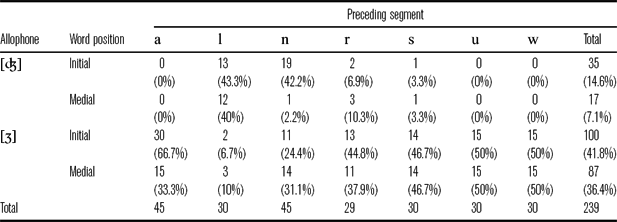
The total counts and percentages of affricate and fricative tokens by context are given in Table 1. The 30 tokens of word-medial /ʤ/ (not included in the table) were all realized as affricates (sporadically devoiced).
Pilot study. Affricate and fricative tokens of /ʒ/ by context. Percentages (by context) are given in parentheses.

As shown in Table 1, after the vowels /a u/ and after the glide /w/, all tokens were realized as [ʒ]. On the other hand, variation between [ʤ] and [ʒ] was found in all post-consonantal contexts, the affricate allophone being preferred after /l/ and /n/, and the fricative being preferred after /r s/. This is consistent with previous descriptions. Thus, Recasens (Reference Recasens2014: 240) notes that affrication is more common after /n/ than after /r/. In this position, the rhotic (orthographic <r>) was realized variably as a trill, as a tap, or as an approximant, with different preferences depending on the speaker (two speakers produced mostly trills and the other three mostly taps). Preceding /s/ behaved differently from other contexts in that many times there was complete assimilation to the following [ʒ] (or an intermediate realization between [z] and [ʒ], the result being a quite long fricative without a clear transition). However, as shown in the table, we did find two tokens of affricates in this context.
The existence of this variation justifies further investigation. Whereas visual inspection of spectrograms allows us to classify tokens in a binary fashion, as either fricatives or affricates, it is at least possible that the true nature of this allophony involves continuous variation in degree of constriction, affected by contextual factors; affricate realizations being at one end of the continuum. In the study that we describe in the rest of the paper we consider a continuous measurement of degree of constriction.
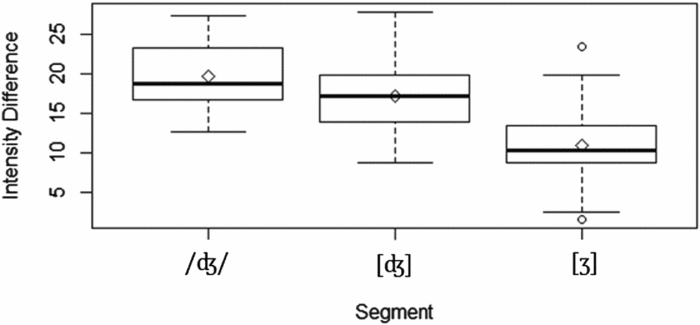
A number of previous studies in Romance languages have used relative amount of energy as an acoustic correlate of degree of constriction in the realization of obstruents that may vary in their allophonic realization from fully occluded stops to fricatives or approximants (Cole, Hualde & Iskarous Reference Cole, Hualde, Iskarous, Fujimura and Palek1999, Soler & Romero Reference Soler and Romero1999, Lavoie Reference Lavoie2001, Sorianello Reference Sorianello2001, Ortega-Llebaria Reference Ortega-Llebaria and Face2004, Villafaña Dalcher Reference Villafaña Dalcher2006, Colantoni & Marinescu Reference Colantoni, Marinescu and Ortega-Llebaria2010, Hualde et al. Reference Hualde, Nadeu, Simonet, Colina, Olarrea and Carvalho2010, Hualde & Nadeu Reference Hualde and Nadeu2011, Hualde et al. Reference Hualde, Simonet and Nadeu2011, Carrasco et al. Reference Carrasco, Hualde and Simonet2012). In these previous studies, several different calculations of relative intensity are proposed. We calculate the difference between the lowest intensity value in the consonant and the maximum in the following vowel from the intensity curve in Praat. The entire consonant was taken into account for the calculation of the intensity minimum. For affricates, the minimum always fell within the closure phase. Whereas previous work has used measurements taken from the intensity curve to examine the allophony of stops with fully occluded and non-occluded realizations, here we test the applicability of this calculation to the analysis of fricative/affricate variability. The difference in energy is expected to be largest in affricate realizations. To verify the validity of this measurement we have tested it against our binary classification of tokens obtained by visual inspection of spectrograms. The boxplots in Figure 3 show the results of applying this measurement to our data. There are three boxes in Figure 3: (a) word-medial contrastive /ʤ/, e.g. in words like platja ‘beach’, (b) tokens of /ʒ/ that were classified as affricates by visual inspection (noted as [ʤ]) and (c) tokens of /ʒ/ that were classified as fricatives by visual inspection (noted as [ʒ]). As can be seen, the results justify using intensity difference as an appropriate measurement for the feature that we are investigating. Taking automatic measurements from the intensity curve avoids the subjectivity that is inherent in classification by visual inspection of spectrograms.
Intensity difference between fricative or affricate and following vowel. The horizontal line indicates the median, and the diamond the mean: /ʤ/ = word-medial contrastive /ʤ/, [ʤ] = tokens of noncontrastive /ʒ/ classified as affricates by visual inspection, [ʒ] = tokens of noncontrastive /ʒ / classified as fricatives by visual inspection. A greater intensity difference value indicates a more constricted segment.

This pilot study has served to confirm the existence of variability in the degree of constriction of Catalan /ʒ/ even in reading style. In the corpus study reported in the remainder of this paper we consider other factors, in a addition to preceding context, as potentially conditioning this variation. In addition to degree of constriction, as calculated from the intensity curve, we also examine amount of voicing and duration, which are also features that may serve to distinguish fricative and affricate realizations.
3 Corpus study
3.1 Corpus
To investigate the factors that contribute to the allophony of Catalan /ʒ/ and /ʤ/ in further detail, we conducted a large-scale corpus study with data from Glissando, a corpus of Catalan and Spanish speech specifically developed for prosodic studies (Garrido et al. Reference Garrido, Escudero, Aguilar, Cardeñoso, Rodero, de-la-Mota, González, Vivaracho, Rustullet, Larrea, Laplaza, Vizcaíno, Estebas, Cabrera and Bonafonte2013). The Catalan part of this corpus contains both scripted and unscripted speech from 28 speakers of Central Catalan, including eight professional (radio announcers and advertisement/dubbing specialists) and 20 non-professional speakers, with an equal representation of both genders. The corpus is also stylistically diverse, as it contains three data sets. One of the data sets includes informal dialogs between two speakers. A second data set consists of radio news read by professional radio announcers. The third sub-corpus, ‘task-oriented dialogs’, is intermediate in degree of formality between the other two, as it consists of goal-oriented interaction between two speakers, and involves role playing with three topics: travel, university information, and transportation. In the ‘travel’ set, for instance, one of the speakers pretends to be a travel agent, and the other speaker pretends to be a costumer who wants to travel to Greece on vacation.
The corpus is fully transcribed at the word and phoneme level, with indication of lexically stressed syllables as well. In this transcription, the word-medial phoneme /ʒ/ (e.g. plu j a ‘rain’) as well as the word-initial and post-consonantal /ʒ/, which, as mentioned, may have affricate realizations (e.g. j ove ‘young’, men j a ‘(s/he) eats’), are transcribed as Z in the phoneme tier. This symbol is also used for word-final /ʒ ~ ʃ/ in contexts of voicing (e.g. mate ix amic ‘same friend’). Regarding contrastive affricates, word-medial /ʤ/ (e.g. me tg e ‘doctor’, pla tj a ‘beach’) as well as word-final /ʧ ~ ʤ/ in contexts of voicing (e.g. va ig a ‘(I) go to’) are transcribed as tZ with a division in the textgrid between the closure and fricative portions of the consonant. That is, for transcription purposes, the developers of the corpus have recognized a single phoneme Z = /ʒ/ and have treated the contrasting word-medial and word-final affricate as a sequence of two consonants. To obtain the intensity difference (see Section 3.4.1) and duration measurements in phonemic affricates, the boundary between t and Z was removed and the consonant was relabeled as /ʤ/.
Regarding word-final segments, the symbols Z = /ʒ/ and tZ = /ʤ/ have been transcribed by the developers of the corpus in contexts where, according to the standard distribution, there is voicing: when followed by another word starting with a vowel or a voiced consonant. That is, the word mateix ‘same’, for instance is transcribed as presenting final Z = /ʒ/ in a phrase such as mateix amic ‘same friend’, but not before silence or before a voiceless consonant, where it is transcribed with S = /ʃ/.Footnote 7
In the current version of the corpus, the alignment between acoustic signal and text is imperfect in some of the sub-corpora, as forced automatic alignment has not been corrected manually. Before taking any measurements, we have manually aligned all instances of the target consonant, making sure that the segmentation was correct in every token. To establish segment boundaries, we considered the presence of aperiodic energy. As in Smith (Reference Smith1997), the onset of the fricative was defined as the point where high-frequency noise became salient in the signal and its offset as the point of cessation of the noise. For tokens presenting affrication, a decrease in overall energy after more sonorous segments was used to determine the initial boundary. The following vowel was also manually aligned to ensure that the intensity maximum was within its boundaries, since we are taking relative measurements of energy. An example showing our segmentation is provided in Figure 2. When a prepalatal fricative followed an alveolar fricative, as in les joves [lə(z)ˈʒoβəs] ‘the young women’, the boundary between the two consonants most of the time could not be determined by examination of the acoustic signal (see Section 2). For this reason the two (underlying) consonants were marked as one segment for intensity and voicing analysis and were excluded from durational analysis, with the preceding context coded as ‘z’.
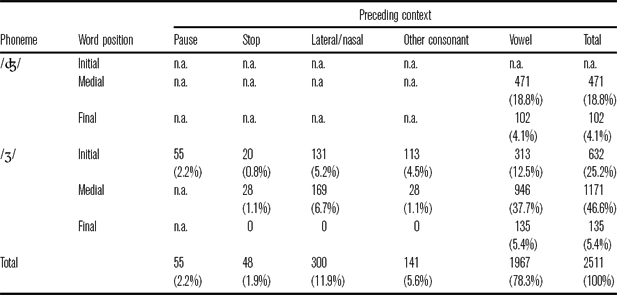
We obtained a total of 2651 tokens. We have excluded from the analysis foreign names, disfluencies, false starts, acronyms, and initials.Footnote 8 The words jo ‘I’ and ja ‘already’ have variable pronunciation in Central Catalan. Some speakers pronounce them with /ʒ/, according with the standard spelling, and others with /j/. Regarding these two items, we listened to the audio files to determine which realization was produced. Tokens pronounced with /j/ were removed. After these exclusions the total number of analyzed tokens was 2511: 1938 for /ʒ/ and 573 for /ʤ/. Notice that we use the symbol /ʤ/ to refer to the phonologically contrastively affricate segment and /ʒ/ for all other instances. That is, we adopt a phonological analysis where, in contexts where there is no phonological contrast between fricatives and affricates, all realizations are assigned to phonemic /ʒ/. Table 2 shows the number (and percentages in parentheses) of analyzed tokens of /ʤ/ and /ʒ/ by preceding context and position in word. In the table, ‘n.a.’ indicates contexts where a segment cannot be found because of phonotactic reasons. Leaving these contexts aside, notice that no tokens of post-consonantal word-final /ʒ/ were found. Although not impossible in Catalan, this context is found only in a handful of words (see Section 1.1).
Number and percentage of tokens by word position and preceding context in our corpus (percentages in parentheses).

3.2 Acoustic analysis
To examine the allophony of the prepalatal consonants, we focus on acoustic correlates of degree of constriction and voicing. In addition, we report on segment duration. Our correlate of degree of constriction is intensity difference, which was calculated as explained above in Section 2. That is, the minimum intensity during the target consonant was subtracted from the maximum intensity in the following vowel.
Amount of voicing in the target consonant has been calculated by creating cross-correlated pitch and point process objects and taking the fraction of locally unvoiced frames from the voice report in Praat. The cross-correlation method is recommended as optimal for voice research (see Praat manual for details, Boersma &Weenink Reference Boersma and Weenink2014). Gender-specific pitch floors and ceilings were used (50–200 Hz for males, 75–300 Hz for females). All other parameters were kept at default values. The default values for the pitch floor and ceiling are 75 Hz and 600 Hz, respectively. However, chance periodicity at high frequencies can occur in fricatives and be misinterpreted as voicing (Gradoville Reference Gradoville and Alvord2011). For this reason the ceiling was lowered to include only the frequencies where each gender could be expected to have f0. Several male subjects also had low f0, regularly at 60 Hz. If the pitch floor were kept at 75 Hz, fully voiced fricatives with fundamental frequency at 60 Hz would instead be labeled as fully devoiced. To avoid this, the pitch floor for males had to be lowered, despite the fact that this slightly increases the analysis window size. When the voice report is generated in Praat for a given segment, the percentage of that segment which is voiceless is given as the ‘fraction of locally unvoiced frames’. Because the number of frames is dependent on the duration of the segment analyzed, shorter segments have fewer possible values and therefore the measure loses resolution with decreasing duration and increasing window size. This fact was taken into account when the measurement was analyzed, as discussed in Section 3.5.2 below.
3.3 Research hypotheses
Regarding degree of constriction, the greatest effect is expected to be that of phonemic category in those positions where the fricative/affricate contrast obtains (after a vowel word-medially and word-finally). The phonemic affricate is expected to show greater constriction than the phonemic fricative.
In other environments (i.e. word-initially and after a consonant), our hypothesis is that both preceding context and stress will have an effect on constriction degree. Pradilla (Reference Pradilla, Solà, Lloret, Mascaró and Saldanya2002) notes that affrication is more common in word-initial stressed syllables.Footnote 9 Several studies on the lenition of /b d ɡ/ have found more constricted segments on the onset of a stressed syllable than elsewhere (Cole et al. Reference Cole, Hualde, Iskarous, Fujimura and Palek1999, Ortega-Llebaria Reference Ortega-Llebaria and Face2004, Eddington Reference Eddington2011, Carrasco et al. Reference Carrasco, Hualde and Simonet2012). We thus expect a higher degree of constriction preceding a stressed vowel (although see footnote 4 above).
The main question is whether, other things being equal, morphological boundaries and the existence or not of a phonological contrast have an effect in degree of constriction. In other words, is the realization of intervocalic /ʒ/ in e.g. pluja [ˈpluʒə] ‘rain’ (an environment where fricative /ʒ/ contrasts with /ʤ/, as in platja [ˈplaʤə] ‘beach’) phonetically different from the range of realizations in e.g. la jove [lə ˈʒobə] ‘the young woman’, where no such contrast is possible?
In post-consonantal contexts, there is no phonemic contrast between fricative and affricate either word-initially or word-internally, but a difference in degree of constriction could still be found between the two morphological environments, if morphological boundaries have an effect, regardless of the existence of phonological contrast. On the other hand, if the existence vs. neutralization of a phonological contrast between fricative and affricate had an effect on degree of constriction, we would expect to find a difference between VCV and V#CV, but not between CCV and C#CV.
As for voicing, the question that arises is whether word-internal intervocalic /ʒ/, as in plu j a ‘rain’ (which contrasts with /ʃ/), shows greater and more consistent voicing than word-final /ʃ ~ ʒ/ before a vowel, as in mate ix amic ‘same friend’. Is there less devoicing in VCV (where voicing establishes a phonological contrast) than in VC#V (where voicing is contextually determined)?
Regarding duration, we mentioned above that several authors have described a tendency for word-internal /ʤ/ to geminate. Thus, our hypothesis is that in this position the phonemic affricate will be significantly longer than the fricative. For the word-final position, where the fricative/affricate contrast also obtains (see (1c) above), we predict a smaller durational difference, since there are no comparable statements in the literature regarding gemination of affricates in this position. We are interested in determining to what extent duration contributes to the phonological contrast between /ʒ/ and /ʤ/ in these positions. Another question that arises is whether duration and degree of constriction correlate.Footnote 10
Since our corpus contains both scripted and non-scripted speech, we also test the influence of style in the allophony of the target segments. Other things being equal, a greater degree of constriction is expected in more formal speech, especially in the speech of professional speakers reading the news for an audience. The emphatic elocution that typically characterizes this style may lead to a somewhat greater frequency of partially devoiced tokens.
3.4 Statistical analysis
We performed all statistical analyses in R (R Core Team 2014). For intensity difference and duration we ran mixed effects linear regressions, using the package lmerTest (Kuznetsova, Brockhoff & Christensen Reference Kuznetsova, Brockhoff and Christensen2014). For voicing, preliminary observation of the data showed that almost 60% of all tokens were fully voiced. For this reason, we ran a mixed effects ordinal regression, instead, for this variable (see Section 3.5.2), using the package ordinal (Christensen Reference Christensen2013). The following factors were included in the analysis as fixed effects:
-
• Phoneme, with two levels: /ʒ/ and /ʤ/
-
• Preceding context, with five levels: pause, stop, lateral/nasal, other consonant, vowel
-
• Stress, with three levels: stressed, post-stress, unstressed
-
• Word position, with three levels: initial, medial, final
-
• Following context, with two levels: vowel, consonant
-
• Style, with two levels based on sub-corpus: news, dialogue
For preceding context, the ‘stop’ category was differentiated from the ‘other consonant’ category for the intensity difference analysis, but merged for the voicing and duration analyses.
For stress, we have separated three contexts depending on whether the target consonant occupies the onset of a stressed syllable (stressed, as in jove [ˈʒoβə] ‘young’), it follows a stressed vowel (post-stress, as in pàgina [ˈpaʒinə] ‘page’), or is flanked by unstressed vowels (unstressed, as in majoria [məʒuˈɾiə] ‘majority’).
Regarding following context, it should be noted that all preconsonantal tokens are word-final.
For the intensity difference analysis, only prevocalic tokens were included, as this measurement involves the different in intensity between the target consonant and a following vowel.
Speaker and word were included as random effects with random intercepts. Random slopes for each speaker were not included because they prevented the model from converging. This is not surprising given the unbalanced nature of observational data and the number of additional factors added to the model when including random slopes. For this reason, we believe that random intercepts represent the maximal random effects structure for our data.
In the case of linear regressions, p-values were obtained with the Kenward-Roger approximation; in the ordinal regression, p-values were obtained via likelihood ratio tests using the anova function in the ordinal package.
Some other details in the analysis of each of the dependent variables are included in the corresponding results subsection for ease of reading.
3.5 Results
To offer an overview of the results: phoneme identity, preceding context, and style were significant in every regression, while other factors varied in their significance across regressions. Word position and following context were significant only in the duration regression. Stress was significant only in the intensity difference regression. The results of each regression are presented in the following subsections.
3.5.1 Intensity difference results
Because intensity difference, as we are defining it, can only be measured for prevocalic tokens, preconsonantal tokens were excluded from the analysis, leaving N = 2393 tokens for the statistical analysis. Following context was not included in the regression because all tokens analyzed had the same level (prevocalic). Two regressions were run: one including both /ʒ/ and /ʤ/ tokens (N = 2393), in order to establish the difference in intensity difference between /ʒ/ and /ʤ/, and a second regression on just the tokens marked as /ʒ/ (N = 1860) to determine their relative degree of constriction. The degree of multicollinearity among the predictors was measured with the variance inflation factor (VIF). All predictors had a VIF under 5, indicating that none of them needed to be removed.
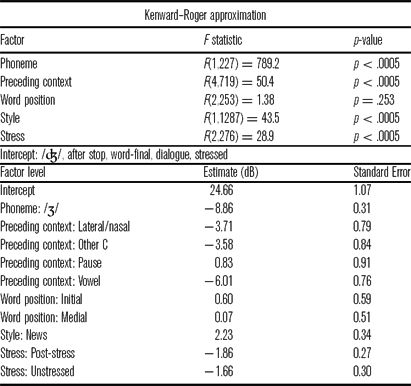
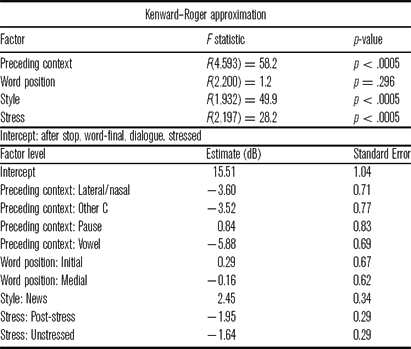
The results of the linear mixed effect regression on both phonemic affricates and fricatives together are shown in Table 3.Footnote 11
Intensity difference results (all tokens).

As can be seen in Table 3, phoneme identity, preceding context, style, and stress were all significant factors in the regression, but word position was not. For preceding context and stress, the magnitude of the effect and specific levels where significant differences occur requires further analysis, as these factors include more than two levels. We discuss these factors below (see Tables 5 and 6).
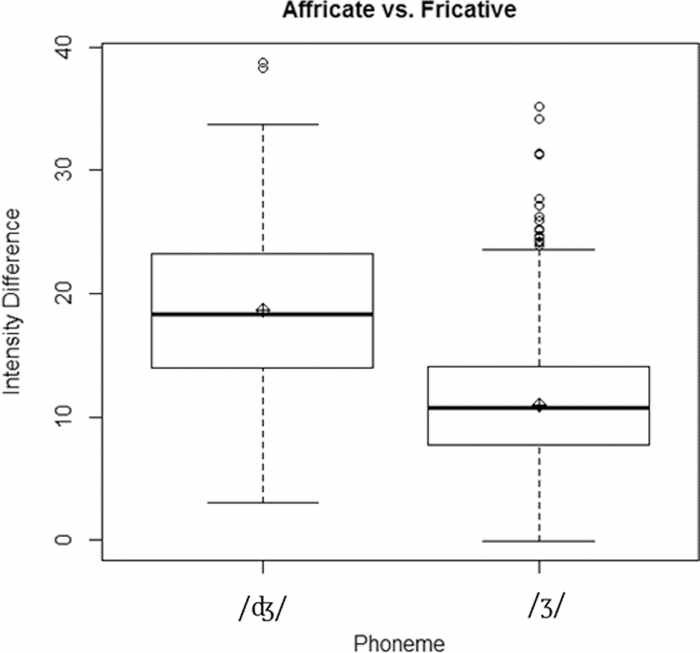
Most important from this first regression is that the largest difference is between phonemic /ʤ/ and /ʒ/: Phonemic affricates have an average intensity difference 8.86 dB higher than fricatives. Their distributions can be seen in Figure 4. We take this result as further validation of our intensity difference measurement as an acoustic correlate of degree of constriction.
Intensity difference between /ʤ/ or /ʒ/ and following vowel.

When we eliminate all tokens of the contrastive affricate /ʤ/, in order to focus on the realization of the fricative phoneme, a linear mixed effect regression returns the results in Table 4. For this second regression as well, word position was not significant, while preceding context, stress, and style were. Phonemic fricatives in the more formal news sub-corpus were more constricted than in the less formal dialogue sub-corpus, with an intensity difference 2.45 dB higher.
Intensity difference results (excluding contrastive affricates /ʤ/).

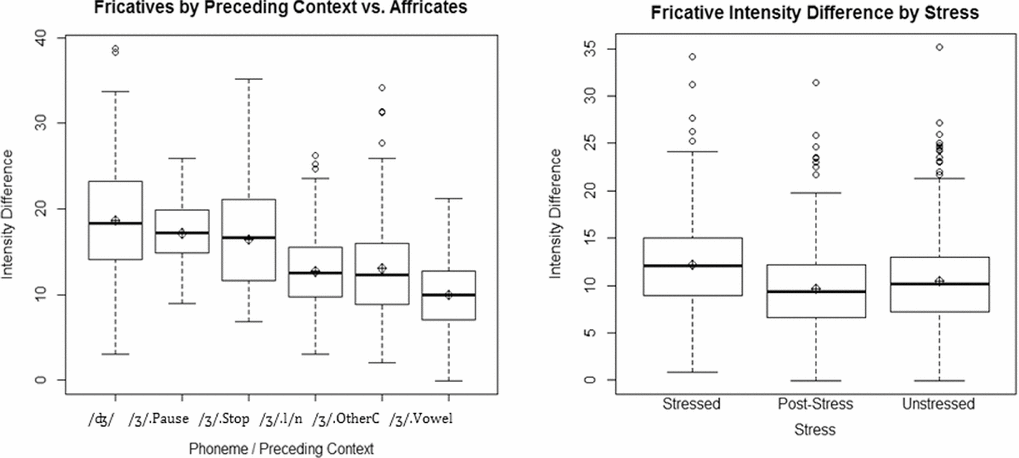
As noted, not all group differences for preceding context and stress can be observed in the model summary, since these factors have more than two levels and all levels are compared with the intercept in the regression. We first show the data visually in boxplots and then present the results of pairwise comparisons. The distributions by preceding context and stress are shown in Figure 5.
Intensity difference between /ʒ/, /ʤ/ and following vowel by preceding segment (left panel: contrastive /ʤ/ vs. /ʒ/ after pause vs. after a stop, vs. after /l n/ vs. after another consonant vs. after a vowel), and by position of segment relative to stress (right panel: in a stressed syllable vs. after the stressed syllable vs. between two unstressed vowels).

Starting with preceding context (left panel in Figure 5), it can be seen that tokens of /ʒ/ following a vowel are the least constricted, whereas those following a pause are the most constricted, so that they do not appear to be very different in their degree of constriction from phonemic /ʤ/. Tokens following a lateral, nasal, or consonant other than a stop are closer to those that follow a vowel, and those that follow a stop are closer to those that follow a pause. For stress both post-stress and unstressed tokens appear to be less constricted than stressed tokens (right panel).
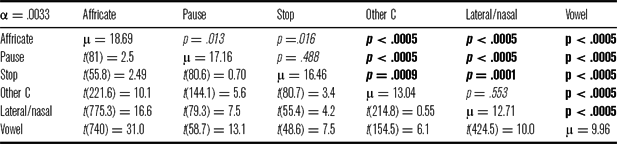
We now examine which of the differences among preceding contexts and stress conditions observable in Figure 5 are statistically significant. In order to see which group differences were significant, t-tests with a Bonferroni correction for the alpha level were run (because the number of observations is not balanced among the factor levels, Tukey's HSD was not an option). In the following statistical tables, t-tests below the means correspond to p-values above the means. A bolded p-value indicates significance to the alpha-level listed at the top-left of the table, and an italicized p-value indicates non-significance.
Fifteen pairwise comparisons with a Bonferroni correction of the alpha level were performed for preceding context. The results of these comparisons are shown in Table 5. These pairwise comparisons show that there are three groups ordered from most constricted to least according to the intensity difference values that we have obtained: /ʤ/, post-pausal and post-stop /ʒ/ > /ʒ/ after non-stop consonants > post-vocalic /ʒ/. That is, tokens of /ʒ/ after pause and following a stop were constricted to a similar degree as tokens of the phonemic affricate. The least constricted tokens were those after a vowel, and tokens after non-stop consonants occupied an intermediate position regarding degree of constriction.
Intensity difference by phoneme/preceding context. Post-hoc pairwise comparisons.

Regarding stress, the t-tests for the different levels of stress with a Bonferroni correction are presented in Table 6. The results of these tests show that all three stress groups were significantly different from each other, with the ranking from most to least constricted being stressed > unstressed > post-stress. That is, the greatest amount of constriction for the voiced fricative palatal phoneme is found when /ʒ/ is at the onset of a stressed syllable.
Intensity difference by stress. Post-hoc pairwise comparisons.

To summarize, then, the phonetic realization of the phoneme /ʒ/ before a vowel appears to be conditioned both by the preceding segment and by stress. After pause or following a stop consonant, /ʒ/ is as constricted as the phonemic affricate /ʤ/. The weakest realizations of /ʒ/ are found in intervocalic position. Regarding the effect of stress, the consonant /ʒ/ is most constricted on the onset of a stressed syllable and least constricted immediately following the stress. The results are consistent with those found in studies of the degree of constriction of voiced obstruents in Spanish that have used a similar methodology (see Section 3.3). We have not found an effect of word-position. That is, we may conclude that, in particular, in the intervocalic context, /VʒV/, /V#ʒV/, and /Vʒ#V/ do not differ in their degree of constriction, regardless of the fact that a phonological contrast between fricative and affricate is found in /VʒV/, and /Vʒ#V/, but not in /V#ʒV/. Style also turned out to have a significant effect, with the news reading style producing consonants that are more constricted.
3.5.2 Voicing results
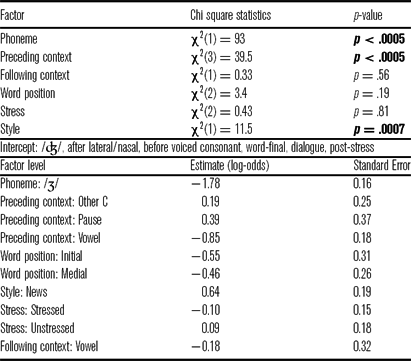
The distribution of the percent voiceless data was skewed, with 59.5% (N = 1494) of the data being completely voiced with a measure of zero. This many zeros masks the effects of predictors on the level of devoicing in the remaining 40.5% (N = 1017) of the tokens, and does not allow them to emerge as different from the zeros in a linear regression. To remedy this, an ordinal regression was run with an ordered factor as the response variable, where, as in Smith (Reference Smith1997), tokens 0–9% devoiced were labeled ‘voiced’, tokens 10–74% devoiced were labeled ‘partially devoiced’, and tokens 75–100% devoiced were labeled ‘devoiced’. While this binning in three categories takes out some of the fine-grained variation in the measure, it should also be noted that the possible values any individual instance can have for percent voiceless is determined by the number of frames of analysis in Praat, and thus depends on its duration, with longer consonants having more possible values. A finer-grained binning of the tokens (e.g. 0–9%, 10–19%, 20–29%, etc.) would only truly be meaningful for some tokens. Thus, distinguishing three voicing categories for the statistical analysis, as in Smith (Reference Smith1997), seems like the most adequate solution.
All tokens of /ʒ/ and /ʤ/ (N = 2511) were included in the mixed effects ordinal regression (clmm function in ordinal package). The p-values were obtained using the anova function in the ordinal package to perform six likelihood ratio tests, one for each of six models where only one of the fixed effects was removed.
The results of the ordinal mixed effects regression on the categorical classification (voiced, partially devoiced, devoiced) are given in Table 7. The clmm function in the ordinal package in R was used to run the regression, and six smaller models, each lacking one of the fixed effects, were compared to the larger model using the anova function to obtain p-values by likelihood ratio tests.
Voicing results (ordinal regression).

As shown in Table 7, phoneme identity, preceding context, and style emerged as significant predictors of the devoicing of voiced prepalatals while following context, word position, and stress did not. As with binomial logistic regression, the estimates in Table 7 represent the likelihood that tokens with that parameter will be in a different category from the intercept. A negative number indicates that tokens are more likely to be in a more voiced category and a positive number indicates that tokens are more likely to be in a less voiced category. Numbers further from zero indicate a larger effect. Thus, out of the three significant predictors, the strongest is phoneme identity: Fricatives tend to be more voiced than affricates. This is consistent with the reported tendency in the literature for the affricate to devoice. For preceding context, post-vocalic tokens are the most voiced and post-pausal tokens are the least, with the post-consonantal tokens somewhere in between. As for style, tokens in the more formal news sub-corpus are more devoiced than those in the less formal dialogue sub-corpus.
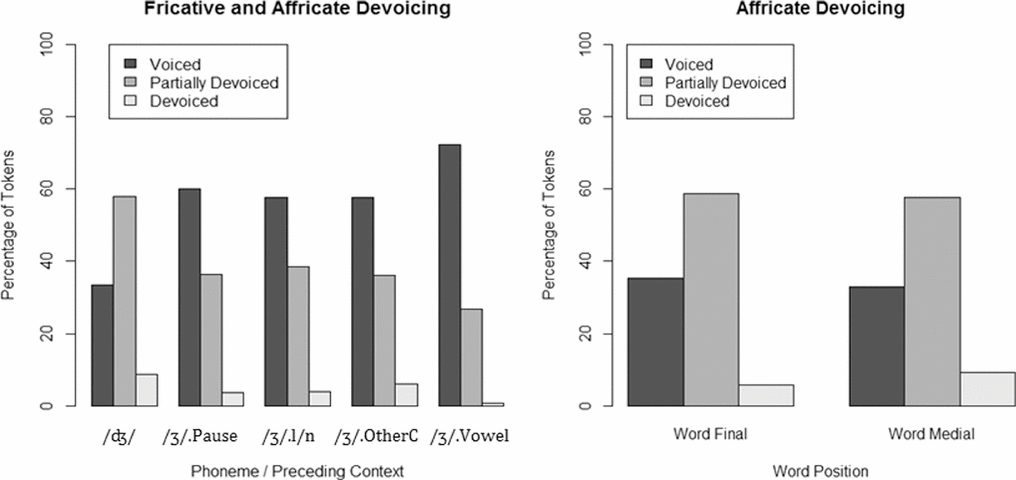
Figure 6 shows percentages of tokens in each of our three voicing categories. In the left panel, phonemic /ʤ/ is compared with /ʒ/ in different preceding environments. We may observe that the phonemic affricate /ʤ/ is more frequently realized as partially devoiced than as fully voiced, whereas the opposite is true for /ʒ/, regardless of the preceding context. Only 33% of /ʤ/ tokens are fully voiced. Regarding /ʒ/, 73% of intervocalic tokens fall in our ‘fully voiced’ category, whereas for all the other three preceding contexts the number of tokens in this voicing category hovers around 60%.
Left panel: percentage of fully voiced and (partially) devoiced tokens of /ʤ/ and of /ʒ/ by preceding context. Right panel: percentage of fully voiced and (partially) devoiced tokens of /ʤ/ by position in word: word-final vs. word-medial.

As mentioned, phonologically contrastive affricates are all post-vocalic but may be either word-medial or word-final. The right panel in Figure 6 shows that /ʤ/ undergoes very similar amounts of devoicing in both positions.
Regarding stress, Recasens (Reference Recasens2014: 264) notes that devoicing of /ʤ/ is especially frequent after the stress, as in platja ‘beach’, metge ‘physician’. In our analysis, which includes /ʤ/ and /ʒ/ together, we did not find an effect of stress on voicing. To check whether there was an effect for affricates in particular, we ran a post-hoc ordinal mixed effects regression on the affricate tokens. The results show that while post-stress /ʤ/ is more likely to devoice than both stressed and unstressed /ʤ/, the difference is not significant (χ2(2) = 4.6; p = .10) when lexical identity is accounted for by including word as a random factor. Devoicing of /ʤ/ may thus be somewhat lexicalized in Central Catalan.
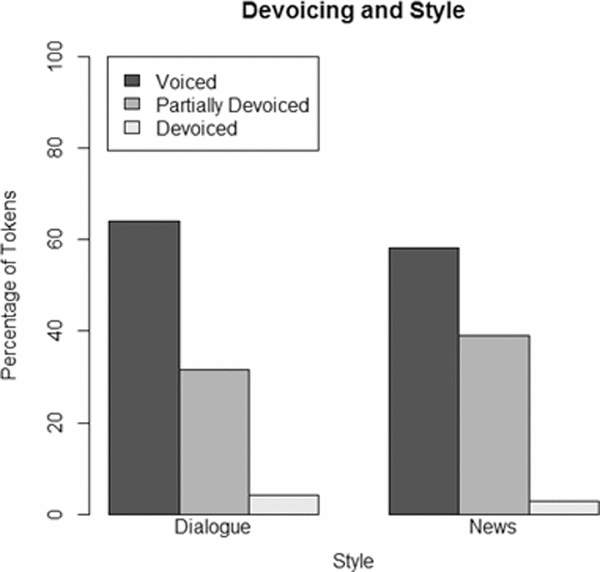
Our analysis also revealed an effect of style, with tokens in the news sub-corpus being more likely to be partially devoiced than tokens in the dialogue sub-corpus. Although statistically significant, the difference is not very large, as can be seen in Figure 7.
Percentage of fully voiced and (partially) devoiced tokens of /ʒ/ and /ʤ/ by style: dialogue vs. news.

Summarizing the devoicing results, the phonemic voiced affricate has a much greater tendency to devoice than the voiced fricative. In fact, the majority of tokens of /ʤ/, which are all intervocalic, fell in our ‘partially devoiced’ category, both those word-medial and those word-final. For the fricative phoneme, the preceding segment has an effect on its voicing, with the least amount of devoicing being found in the intervocalic position. Other than a relatively small effect of style (with more partially devoiced tokens in the news reading style), no other effects were found.
3.5.3 Duration results
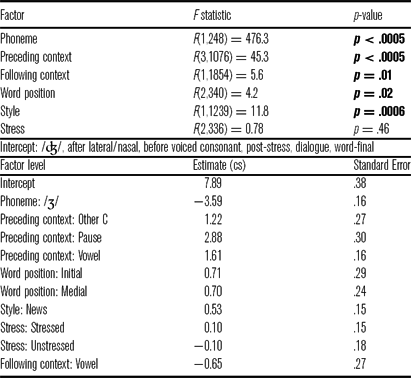
The regression analysis for duration included all tokens of /ʒ/ and /ʤ/ except, as indicated above, tokens of /ʒ/ which followed /z/, as no boundary could be reliably placed between the two consonants (N = 2412).Footnote 12
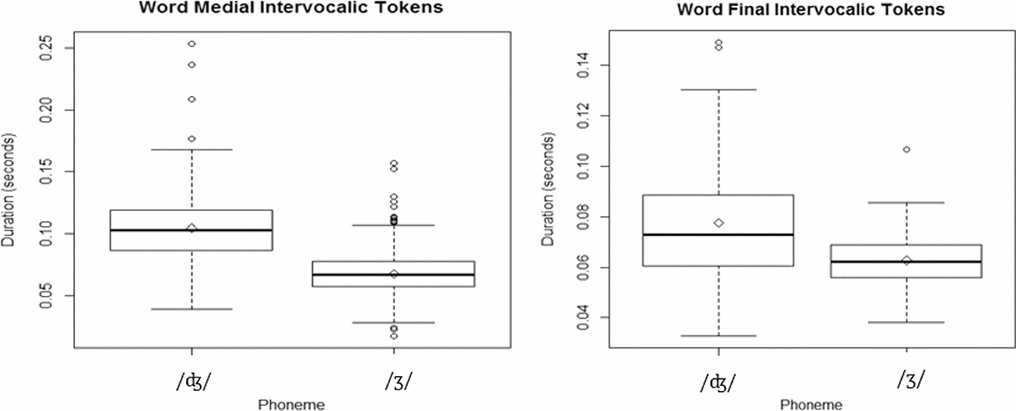
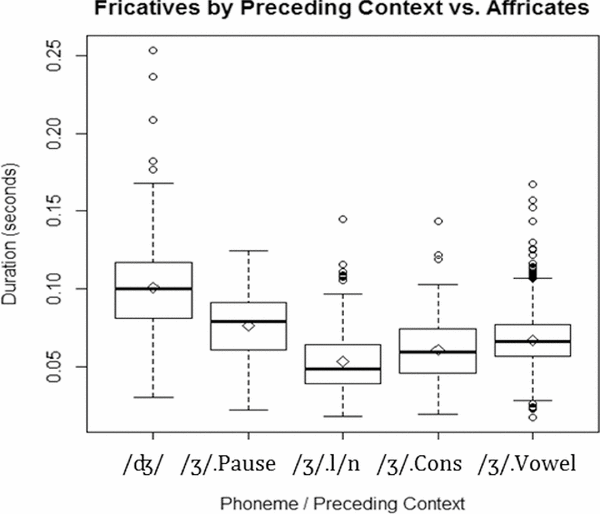
The results of the regression analysis of duration are shown in Table 8.Footnote 13 As shown in Table 8, all factors had a significant effect on duration, except for stress. However, some differences are also very small in absolute terms. The only factors with a magnitude of effect greater than ten milliseconds were phoneme identity and preceding context. Phonemic affricates are 35.9 ms longer than fricatives on average (note that values in Table 8 are in centiseconds). For preceding context, tokens after laterals and nasals are the shortest, and tokens after a pause are the longest, with a 28.8 ms difference. Post-vocalic tokens and tokens following consonants other than laterals and nasals fall in between.
Duration.

The factor with the greatest magnitude of effect is phoneme identity. The boxplots in Figure 8 (left panel) show duration measurements for intervocalic word-medial /ʤ/ (e.g. platja ‘beach’) and /ʒ/ (e.g. pluja [ˈpluʒə] ‘rain’). The distribution shows relatively little overlap. In addition to the word-medial position, voiced fricative and affricate are also in phonemic contrast word-finally and before a vowel or voiced consonant (see (1c) above), e.g. boix és [ˈboʒˈes] ‘boxbush is’ vs. boig és [ˈbɔʤˈes] ‘crazy is’ (the preceding context is always a vowel). In this position as well, phonemic affricates are longer than other tokens, but we find a greater overlap in duration than in medial position (compare the two panels in Figure 8).
Duration of intervocalic /ʤ/ and /ʒ/. Left panel: word-medial. Right panel: word-final.

Both intensity difference (see Section 3.5.1 and Figure 5, left panel) and duration (see Figure 8) thus emerge as very good predictors of the fricative/affricate contrast, e.g. [ˈpluʒə] ‘rain’ vs. [ˈplaʤə] ‘beach’. In the word-internal intervocalic position, both measurements – intensity difference and duration – are in fact highly correlated (ρ = .67). In other environments, on the other hand, the two measures are not so highly correlated.
Figure 9 shows the effects of different preceding contexts on duration. As can be seen, even the realizations of /ʒ/ in post-pausal position, which are the longest for this phoneme, are shorter on average than the (post-vocalic, word-medial or word-final) phonemic affricate.
Duration of /ʒ/, /ʤ/ by preceding segment: contrastive /ʤ/ vs. /ʒ/ after pause vs. after /l n/ vs. after another consonant vs. after a vowel.

To summarize this section, all tested factors were shown to have an effect on the duration of the target consonants, except for stress. However, most of these effects are small in terms of magnitude, under ten milliseconds. Only for phoneme identity and preceding context is the difference of potential linguistic significance. The longest tokens correspond to the phonemic affricate /ʤ/, followed by post-pausal tokens of /ʒ/.
4 Summary and discussion
The voiced prepalatal consonants of Central Catalan present considerable complexity in their allophony and morphophonological patterns. Although it is sometimes stated that this allophony is conditioned by the preceding context, a pilot study, limited to word-initial and word-medial consonants, revealed variation between fricative and affricate realizations after all consonants tested, for both word-initial and word-medial tokens.
To obtain a more complete understanding of the nature of the variation, we have performed an acoustic analysis of the allophony of the voiced prepalatal (postalveolar) fricatives and affricates in a large corpus of Central Catalan, considering degree of constriction (as estimated from the intensity curve), voicing, and duration. What makes the allophony of these consonants particularly interesting is the way phonological contrast interacts with word position. In particular, if we consider the intervocalic position, word-internally we find a four-way contrast in VCV. Word-initially, on the other hand, there is no fricative/affricate contrast in V#CV; and word-finally there is a fricative/affricate contrast, but no contrast in voice in VC#V. The affricate/fricative contrast is also neutralized in all post-consonantal positions.
We have tested the morphological/phonological effect of word position together with that of other factors such as preceding segmental context, stress, and style. Regarding the degree of constriction of /ʒ/, we found a significant effect of preceding context, stress, and style, all in the expected direction.
When we consider the preceding segment, the consonant /ʒ/ is most constricted after a pause or stop consonant, then after non-stop consonants, and then after a vowel. Consonants in stressed syllables are also more constricted than those between two unstressed vowels, which in turn are more constricted than those which follow a stressed vowel. This result is consistent with experimental work on the degree of constriction of /b d ɡ/ in Spanish. The overall degree of constriction was also found to be higher in read speech than in interactive speech, which may be a feature of the type of read speech that was examined: news reading by professional speakers.
On the other hand, we did not find an effect of word position, which, as mentioned, conditions the possibility of having a phonological contrast between fricatives and affricates as this contrast is found between vowels word-medially and word-finally, but not word-initially. That is, the contexts /VʒV/, /V#ʒV/, and /Vʒ#V/ do not differ in the degree of constriction of the consonant.
As for voicing, the preceding context was identified as the most important conditioning factor in the realization of /ʒ/, with some relatively small effect of style. The affricate phoneme /ʤ/ was also found to be more prone to devoicing than /ʒ/. Again, the presence/absence of word-boundaries did not have a significant effect in the degree to which prepalatals are devoiced. It is thus not the case that, for instance, voicing is less consistent in a word-final context such as mate ix amic ‘same friend’, where the voiced/voiceless contrast is phonologically neutralized and is conditioned by the following segment, than in word-medial intervocalic position, where the voiced vs voiceless phonological contrast obtains. This is consistent with the results for Catalan /z/ in Hualde & Prieto (Reference Hualde and Prieto2014). Unlike for degree of constriction, lexical stress did not have an effect on voicing.
Finally, regarding duration, /ʤ/ is significantly longer than /ʒ/. Leaving aside the phonemic affricates, durational differences among tokens of /ʒ/ in different contexts are smaller. The largest effect was due to the preceding context, post-pausal tokens being the longest.
To sum up, regarding our main research question, which has to do with the effects of nonphonetic factors on allophonic variation, we have not found an effect of word position in conditioning the allophony of Catalan prepalatals, regarding either their constriction or their voicing. To the very large extent that word position correlates with phonemic contrasts in our data, our results are also negative regarding the role of phonological contrast on phonetic variation. This of course leaves open the question of how phonological phenomena conditioned by word position (e.g. word-final devoicing, consonant lenition only within word domains) arise in sound change (see e.g. Hualde & Nadeu Reference Hualde and Nadeu2011, Hualde et al. Reference Hualde, Simonet and Nadeu2011, Hualde Reference Hualde2013, Cole & Hualde Reference Cole, Hualde, Chen and Slade2013, Hualde & Prieto Reference Hualde and Prieto2014 for discussion).
Perhaps the most surprising fact regarding the phonology of the voiced prepalatals in Central Catalan is that fricative and affricate are in phonological contrast word-internally between vowels, i.e. /VʒV/ vs /VʤV/, but not word-initially; in particular /V#ʒV/ does not contrast with /V#ʤV/. It seems sensible to expect that a fricative/affricate contrast restricted to the intervocalic word-medial position should tend to be either lost or extended also to the word-initial position, so that there is homogeneity regarding either the existence or the non-existence of a phonological contrast between fricative and affricate across these two syllable-onset positions. For the difference between fricative and affricate to become a phonological contrast in word-initial position, different words would have to start to behave in different ways. This could be triggered by language contact.
When we compare the distribution of voiced and voiceless prepalatals in Central Catalan, an important difference is that, in fact, for the voiceless prepalatals there is a(n) (incipient) lexical contrast between fricative and affricate word-initially. As was explained in Section 1.1., regardless of the phonetic context, a few words, all recent borrowings, are systematically produced with an initial voiceless affricate, (e.g. de tx ecs ‘of Czechs’) and many other words optionally so (e.g. la x ocolata [ʧ ~ ʃ]). In other words, whereas for voiced prepalatals in word-initial position their degree of constriction is conditioned by purely phonetic factors (so that an affricate realization after a vowel, as in la j ove ‘the young woman’, would be anomalous in this Catalan variety), for the voiceless consonants we find lexical conditioning as the main factor in their realization. Assuming that at some recent historical point the distribution of fricative and affricate realizations was the same for voiced and voiceless prepalatals, the fricative/affricate contrast has been extended to the word-initial context for the voiceless segments. It seems reasonable to think that contact with Castilian Spanish, where /ʧ/ does not have any salient phonetically-conditioned allophony, has favored the introduction of the voiceless prepalatal affricate as either the only or the preferred realization of the initial consonant of certain words, regardless of the phonetic environment. Following this reasoning, widespread knowledge of English, could eventually trigger the adoption of loanwords with invariant initial /ʤ/, causing phonological restructuring also for the voiced prepalatals. Such a process would involve non-phonetic means.
We believe this study, by providing a more complete description of variation in the realization of voiced prepalatal consonants in Central Catalan, also contributes to our understanding of allophonic variation in cases where phonological and morphological context determine the possibility of having a certain phonological contrast.
Acknowledgements
We are grateful to the participants in our pilot study, to J. Garrido for giving us access to the Glissando corpus, and to Joe Roy for help with the statistical analysis. We also want to thank our three anonymous reviewers for JIPA for their very helpful comments.