

Mbarrumbathama is a clan-named variety of Lamalama, a language of Cape York Peninsula, in the northeast of Australia. Together with Umbuygamu (Ogilvie Reference Ogilvie1994, Sommer Reference Sommer1998, Verstraete Reference Verstraete2017) and Rimanggudinhma (Godman Reference Godman1993), Lamalama forms the Lamalamic subgroup of Paman languages (Laycock Reference Laycock, Harris, Wurm and Laycock1969, Rigsby Reference Rigsby, McConvell and Evans1997, Verstraete Reference Verstraete2018), themselves a subgroup of Pama-Nyungan (Hale Reference Hale1964, Reference Hale1966; see also Bowern & Atkinson Reference Bowern and Atkinson2012). The language is no longer spoken, but it is traditionally associated with about 20 clans (as reconstructed by Rigsby Reference Rigsby1999, Reference Rigsby2014) belonging to the southern shores of Princess Charlotte Bay, on the east coast of Cape York Peninsula (see Figure 1). The clans’ estates are mainly coastal, extending from the Normanby River mouth in the east to about 10 km west of the North Kennedy River mouth, but they also include some inland estates (see Rigsby Reference Rigbsy, Dutton, Ross and Tryon1992: 356).
Lamalama and its closest relatives (relative locations, for reference purposes only; see Rigsby Reference Rigbsy, Dutton, Ross and Tryon1992 for more details).

The language and its dialects are known under a variety of labels. The most general label is Lamalama, an exonym (derived from the Umpila word lama ‘dry’, Rigsby Reference Rigbsy, Dutton, Ross and Tryon1992: 356) that refers to the language as a whole.Footnote 1 The other labels refer to specific varieties, and are in fact names of the different clans associated with the language. For instance, the two best documented varieties of Lamalama are known as Mbarrumbathama and Mbarrukarruw, which are the names of the associated clans, from the western and eastern ends of Lamalama country, respectively (both names are built on the Lamalama phrase mba arru ‘relation, friend’). The existing records show quite a bit of dialectal variation within the language, with mainly lexical and phonological differences that appear to be linked to specific clan varieties (see Rigsby Reference Rigsby, McConvell and Evans1997). However, since only a fraction of clan varieties is documented in the linguistic record, it is hard to tell exactly how dialectal variation maps onto the different clans.
There is little published work on the language (partial analyses in Laycock Reference Laycock, Harris, Wurm and Laycock1969; Rigsby Reference Rigbsy, Dutton, Ross and Tryon1992, Reference Rigsby, McConvell and Evans1997; and a sketch in Sommer Reference Sommer1999), but there is extensive documentation dating back to 1927 for written records, and to 1960 for sound recordings. In all, there are recordings of nine speakers representing four clans, mainly Mbarrumbathama, but also some Mbarrukarruw material, and limited amounts of Mbarrutoma and Mbarro’ay material. Recordings were made by La Mont West Jr in 1960, Bob Dixon in 1963, Don Laycock in 1964, Summer Institute of Linguistics in 1964, Bruce Rigsby in 1972, Bruce Sommer in 1972, David Thompson in 1975, and by the present author between 2007 and 2010. The analysis presented here is based on the Mbarrumbathama variety of Lamalama, as represented by three speakers in the corpus, viz. Daisy Salt (recorded by Bruce Rigsby in 1972 and by Bruce Sommer in the same year), Maudie Brown (recorded by Bruce Rigsby in 1972) and Daisy Stewart (recorded by the present author between 2007 and 2010). I take the speech of Daisy Salt as the point of reference for this analysis, as she represents the oldest generation of speakers in our corpus, and her materials form the largest part of the Mbarrumbathama subcorpus. There are some differences between the speakers, which are noted whenever relevant (speakers are marked systematically with the sound examples: DS for Daisy Salt, MB for Maudie Brown, and DSt for Daisy Stewart). All of the recordings, including the most recent ones, were made in field conditions, but Bruce Rigsby’s recordings of Daisy Salt (and Maudie Brown) have the least amount of background noise, so these are used whenever possible.
Consonants

Roots in Mbarrumbathama are monosyllabic, bisyllabic or trisyllabic. Obviously, monosyllables are the easiest context to find minimal or near-minimal pairs. Thus, the examples below illustrate the consonant contrasts in the onset of monosyllabic roots, except for the glottal fricative, which is illustrated in the onset of a bisyllabic root, and the trill, which is illustrated medially because it does not occur in root onsets. In some of these examples, the root is preceded by a classifier (mun for plant food, nya or ku for animals, or arrdharr for trees), which in elicitation contexts is used fairly frequently with nominals. In the examples, a phonemic representation is followed by a representation in practical orthography,Footnote 2 and an abbreviation for the relevant speaker (see below).

The consonant inventory of Mbarrumbathama is a very unusual one by Australian standards. I first comment on its architecture in a general sense, and then focus on the analysis of specific classes of sounds, including patterns of allophony.
Australian consonant inventories have often been described as remarkably uniform, with relatively many places of articulation and relatively few manners of articulation, typically paired plosives and nasals at five or six places of articulation, and approximants, laterals and trills for a smaller set of places of articulation (see further Evans Reference Evans and Goldsmith1995, Dixon Reference Dixon2002, Butcher Reference Butcher, Harrington and Tabain2006, Fletcher & Butcher Reference Fletcher, Butcher, Koch and Nordlinger2014). From this perspective, there are at least five interesting features in the consonant inventory of Mbarrumbathama: a voicing contrast for plosives, a glottal stop in the series of plosives, a series of prenasalized plosives, a series of fricatives, and a fricative trill in the series of fricatives.
Mbarrumbathama has a voicing contrast for bilabial, dental, alveolar and palatal plosives (but not for velars). Voicing contrasts are relatively rare in Australian languages generally (see surveys in Austin Reference Austin1988; Butcher & Reid Reference Butcher and Reid1989; Dixon Reference Dixon2002: 605–616; and Gasser & Bowern Reference Gasser, Bowern, Kingston, Moore-Cantwell, Pater and Staubs2014 for a recent correction), but they are found in several Paman subgroups of Cape York Peninsula (see Verstraete Reference Verstraete2017 for more details), including in Umbuygamu and Rimanggudinhma, the two other languages that with Lamalama make up the Lamalamic subgroup. They are not uniformly present in Lamalamic, however, as there are varieties of Lamalama that do not have a voicing contrast at all (see also Rigsby Reference Rigsby, McConvell and Evans1997). This is the case, for instance, in the Mbarrutoma variant, recorded from Minnie Kulla Kulla by the Summer Institute of Linguistics in 1964, as illustrated in (1), with the Mbarrutoma equivalents of the Mbarrumbathama lexems /ˈbaj/ bay ‘older sister’ (DS) and /ˈda/ da ‘lower leg’ (DS).
(1)


Within the series of plosives, a further notable feature is the presence of a contrastive glottal stop, which is relatively rare overall in the Australian context, but found in many languages of Cape York Peninsula (see Evans Reference Evans and Goldsmith1995; Dixon Reference Dixon2002: 615).
A third unusual feature in the inventory is the presence of a contrastive series of prenasalized plosives, historically derived from nasals (see below for more details). This is very rare in Australian languages, but it is found in several Paman subgroups of Cape York Peninsula, specifically in Lamalamic (Rimanggudinhma, Godman Reference Godman1993), Thaypanic (Kuku Thaypan, Rigsby Reference Rigsby2012, Alpher Reference Alpher, Verstraete and Hafner2016) and some Northern Paman languages (e.g. Yinwum, Hale Reference Hale and Sutton1976a, and Anguthimri, Crowley Reference Crowley, Dixon and Blake1981). In addition, several languages in the same regions also have prestopped nasals, either allophonically, as in Umbuygamu (Verstraete Reference Verstraete2017) or phonemically, as in Olkola (Hamilton Reference Hamilton1997) (see Verstraete Reference Verstraete2017 for more details).
A final unusual feature is the presence of a contrastive series of fricatives, again rare in Australian languages generally, but less so in Cape York Peninsula. Contrastive fricatives are found in Umbuygamu (Verstraete Reference Verstraete2017), in Thaypanic (e.g. Rigsby Reference Rigsby2012), in most Northern Paman languages (e.g. Hale Reference Hale and Sutton1976a, Crowley Reference Crowley, Dixon and Blake1981), and in the Western Torres Strait language just to the north of Cape York Peninsula (e.g. Hunter, Bowern & Round Reference Hunter, Bowern and Round2011). Within the series of fricatives, Mbarrumbathama has one further unusual item, viz. a fricative trill, with no clear attestations elsewhere in Australia (except possibly in Dhanggati; see Lissarague (Reference Lissarrague2000: 27–30), who also mentions a potential parallel with rhoticized obstruents in Daly River languages). The fricative trill in Mbarrumbathama is cognate with voiceless trills in other Lamalamic languages (see Verstraete Reference Verstraete2017 on Umbuygamu and Godman Reference Godman1993 on Rimanggudinhma), and has also been analysed as a voiceless trill in previous analyses of Mbarrumbathama (see Rigsby Reference Rigsby, McConvell and Evans1997, Sommer Reference Sommer1999). As I argue in more detail below, however, at least in the speech of Daisy Salt (the point of reference for this study), this item belongs in the class of fricatives because it has both voiced and voiceless allophones, and behaves like a fricative rather than a trill in terms of the distribution of voicing.
I now turn to the discussion of specific classes of sounds, with patterns of allophony. Given the nature of the corpus, it is not possible to represent all allophonic processes with alternating realizations of the same lexical item by the same speaker. Whenever a particular pattern is idiolectal, however, this is noted explicitly.
The series of ‘plain’ plosives in Mbarrumbathama shows a contrast between voiced and voiceless plosives, except for the velar plosive and, of course, the glottal stop. The velar plosive is found predominantly in voiceless form; voiced realizations are very rare, and usually found in connected speech, as illustrated in the first token of (2), although even there the voiceless realization is more typical, as illustrated in the second token. Note that this only applies to plain plosives: the velar prenasalized plosive only has the voiced realization (see further below).
(2)

The most notable pattern of allophony that is specific to ‘plain’ plosives (see below for patterns shared with other classes) is affrication for palatals. Affricate realizations are very frequent for the voiceless palatal (except in the speech of Daisy Stewart), especially but not exclusively in the onset of stressed syllables, but they are rarer for the voiced palatal, in any context. The examples in (3a, b) illustrate the marked patterns – voiceless plosive realization and voiced affricate realization – in contrast with the unmarked patterns in (3c, d).
(3)

In addition to voiced and voiceless plosives, Mbarrumbathama also has a contrastive series of prenasalized plosives. Phonetically, these consist of a nasal gesture followed by a plosive gesture, which is invariably voiced. Phonologically, they can be considered as one unit when they occur word- or root-initially, as in the examples following the consonant table. Nasal-plosive sequences are very rare beyond word- or root-initial contexts: in a set of about 630 roots, there are only 14 instances, two of which are illustrated in (4).
(4)

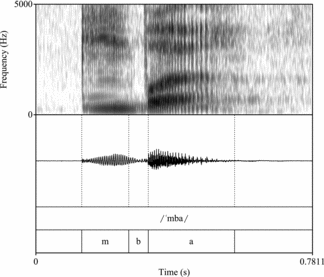
In such contexts, however, nasal–plosive sequences are phonetically very similar to prenasalized plosives in initial position: in both cases, they have a long nasal phase followed by a relatively short plosive phase, as illustrated in Figures 2 and 3, which mark the nasal and plosive phase separately.Footnote 3 This suggests that the most important reason for regarding prenasalized plosives as unitary segments is phonological, i.e. to allow uniform C onsets (see also Ladefoged & Maddieson Reference Ladefoged and Maddieson1996: 127). There may also be a secondary phonetic argument, in the sense that the plosive gesture in prenasalized plosives is invariably voiced, unlike with plain plosives, where voiced plosives contrast with voiceless ones, including in clusters (see also Sommer (Reference Sommer1998ː 10–11) for a similar argument).
Spectrogram and waveform for /ˈmba/ mba ‘person’ (DS), nasal and plosive phase of /mb/ marked separately.

Spectrogram and waveform for /waˈr̝imba/ warhimba ‘taipan’ (DS), nasal and plosive phase of /mb/ marked separately.

Historically, prenasalized plosives derive from nasals, as illustrated with relevant proto-forms and Umbuygamu equivalents in (5) and (6) below. I analyse them as prenasalized plosives rather than poststopped nasals, however, because they have the distribution of plosives (root-initially and -medially but not root-finally) and not of nasals (which can occur initially, medially and finally).
(5)
(6)


The nasal series in Mbarrumbathama does not show systematic prestopped allophones, unlike in Umbuygamu, where some speakers have prestopped realizations in particular contexts, most prominently the onset of stressed syllables (see Verstraete Reference Verstraete2017). There are no instances of consistent prestopping in the speech of Daisy Salt,Footnote 4 but there are two lexemes with consistent prestopping in the speech of Maudie Brown, illustrated in (7).
(7)

Obviously, this is not enough to regard this as a systematic pattern of allophony, but it is relevant to mention in the regional context, where prestopping is found in a number of languages, both allophonically and contrastively (see Alpher Reference Alpher1972 and Hamilton Reference Hamilton1997 on Southwest Paman, and Alpher Reference Alpher, Verstraete and Hafner2016 on Thaypanic). Nasals can also show lengthening and labialization, two processes that are shared with other categories of consonants, described in more detail at the end of this section.
The series of fricatives consists of five contrasting items, most of which show some variation in place of articulation (as is also the case in Umbuygamu, see Verstraete Reference Verstraete2017). In addition, all show a regular alternation between voiced and voiceless realizations, described in more detail below. The bilabial fricative, as in /ˈɸan/ fan ‘many’ (MB), occasionally alternates with a labiodental realization, as illustrated in (8).
(8)

The dental fricative has a consistently dental realization in the speech of Daisy Salt, as /ˈθun/ θun ‘tree species’ (DS), but in the speech of Maudie Brown the dominant allophone is (lamino-)alveolar, as shown in (9a, b) below, with only the occasional dental realization (as in (7a) above).
(9)

The same variation can be observed for the alveopalatal fricative: the speech of Daisy Salt has a consistently alveopalatal realization, as in (10a), but in the speech of Maudie Brown the dominant allophone is (apico-)alveolar, as in (10b).
(10)

The glottal fricative, finally, occasionally alternates with a velar fricative in root-initial position in the speech of Daisy Salt, as in (11).
(11)

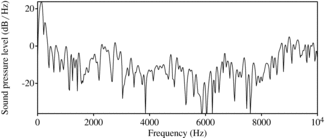
From an acoustic perspective, the fricatives discussed so far appear to be organized in terms of three basic types, depending on whether the oral cavity serves as a resonator or not, and whether formants are shared with adjacent vowels (as predicted in Johnson Reference Johnson2003: 129–132). This distinction can be illustrated with a basic spectral analysis, which appears to be one of the more consistent acoustic measures distinguishing fricatives (see Gordon, Barthmaier & Sands Reference Gordon, Barthmaier and Sands2002). Fricatives for which the constriction is located outside the oral cavity, like the two allophones of /ɸ/ and the dental allophone of /θ/, all have a fairly ‘flat’ spectrum without any obvious spectral peaks, as illustrated in Figures 4 and 5.
Spectral slice, 40 ms window at centre of fricative, for /ˈɸan/ [ˈɸɐn] fan ‘many’ (MB).

Spectral slice, 40 ms window at centre of fricative, for /ˈθun/ [ˈθun] θun ‘tree species’ (DS).

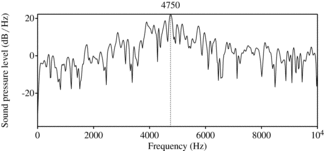
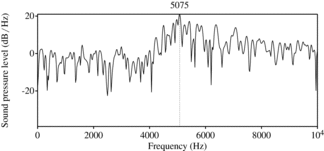
As the constriction moves into the oral cavity, the spectrum does show obvious peaks, as is the case for the alveolar allophone of /θ/ and both allophones of /ɕ/, illustrated in Figures 6, 7 and 8. The spectral peak is highest for the most forward articulation [s], as in /ˈɕaj/ [ˈsæj] shay ‘sleep’ (DS) (around 5075 Hz), somewhat lower for [s̻] as in /ˈθuar/ [ˈs̻uɐr] θuarr ‘two’ (DS) (around 4750 Hz), and lowest for [ɕ] as in /ˈɕucu/ [ˈɕucu] shutyu ‘knife’ (DS) (around 4250 Hz).
Spectral slice, 40 ms window at centre of fricative, for /ˈθuar/ [ˈs̻uɐr] θuarr ‘two’ (DS).

Spectral slice, 40 ms window at centre of fricative, for /ˈɕucu/ [ˈɕucu] shutyu ‘knife’ (DS).

Spectral slice, 40 ms window at centre of fricative, for /ˈɕaj/ [ˈsæj] shay ‘sleep’ (DS).

Finally, the glottal [h] shares the basic formant structure of the following vowel, as shown in Figure 9, which has led some authors to regard such glottals as vowel-like sounds rather than fricatives (e.g. Ladefoged & Maddieson Reference Ladefoged and Maddieson1996: 325–326).
Spectrogram and waveform for /ˈhapa/ hapa ‘firestick’ (DS).

Obviously, spectral slices for individual tokens provide only a rough indication for fricative acoustics, which would have to be followed up with more systematic work. Still, the tripartition observed for this set of tokens appears to be largely in line with what is known about fricatives cross-linguistically, as reported, for instance, in Gordon et al. (Reference Gordon, Barthmaier and Sands2002) and Johnson (Reference Johnson2003: 129–132).
All of these fricatives show an alternation between voiced and voiceless realizations. In utterance-initial position they are usually voiceless, as illustrated in (8)–(11) above. In clusters and intervocalically, they can also be voicedː occasionally for bilabial and dental fricatives, as illustrated in (12) and (13) below, and even predominantly for alveopalatal and glottal fricatives, as illustrated in (14) and (15).
(12)
(13)
(14)
(15)


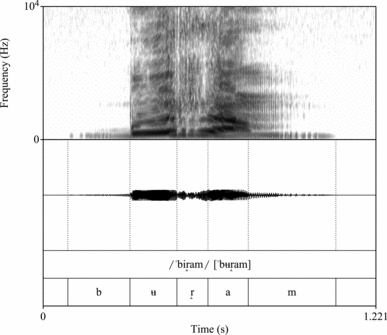
In addition to the four types discussed above, Mbarrumbathama also has a fricative trill, as in /ˈr̝aɹ/ rhar ‘sore’ (DS). From a comparative perspective, this is the equivalent of what is a voiceless trill in other Lamalamic languages (e.g. Umbuygamu, see Verstraete Reference Verstraete2017), and it has also been analysed as a voiceless trill for Mbarrumbathama (see Rigsby Reference Rigsby, McConvell and Evans1997, possibly also Sommer Reference Sommer1998). Phonetically, this element has both features of a trill and features of a fricative, as illustrated in Figures 10–12 below. All examples show at least one period of vibration, characterized by a closure phase followed by an open phase. In addition, they show the high-frequency energy typical of fricatives, in the open phases following closure and in a longer final fricative phase preceding the vowel (not unlike the Czech trill <ř>, described as a laminal trill by Ladefoged & Maddieson Reference Ladefoged and Maddieson1996ː 228–230). In some cases, this final fricative phase is followed by an approximant phase transitioning into the vowel (e.g. (16c) below, see Figure 12), presumably reflecting further lowering of the tongue after the fricative phase.
Spectrogram and waveform for /ˈr̝u/ [ˈr̝̥u] rhu ‘dilly bag’ (DS).

Spectrogram and waveform for /ˈbir̝am/ [ˈbʉr̝am] birham ‘red bream’ (DS).

Spectrogram and waveform for /ˈmunr̝uj/ [ˈmunr̝uj] munrhuy ‘stormbird’ (DS).

By itself, such mixed features could justify either a classification as a trill or as a fricative (see also Solé Reference Solé2002 on phonetic links between fricatives and voiceless trills). Crucially, however, the element is not uniformly voiceless, which obviously goes against previous analyses as a voiceless trill. In the speech of Daisy Salt, there is a regular alternation between voiceless and voiced variants,Footnote 5 with the same distribution as other fricatives in Lamalama: predominantly voiceless in utterance-initial position, as in (16a) below, and predominantly voiced intervocalically and in clusters, as in (16b, c). In this sense, a classification as a fricative appears to be the most natural solution. I use the symbol /r̝/ to represent this sound; this representation has also been used for Czech <ř>, which seems to be the closest equivalent typologically (although Howson, Komova & Gick Reference Howson, Komova and Gick2014 argue that tongue height is not the basic feature distinguishing <ř> in Czech).
(16)

Finally, the consonant inventory in Mbarrumbathama also has a trill, a lateral, and two approximants.Footnote 6 Within this set, one specific allophonic process concerns the trill, which can be voiceless in utterance-final contexts, as illustrated in the contrast between (17a) and (17b).
(17)

In addition to the specific cases of variation described so far, there are two general allophonic processes that deserve some comment. One concerns consonant lengthening, which can be found in elicitation, in the onset of stressed syllables. This is only an occasional allophone, however, which is not as frequent as in some of the Middle Paman languages neighbouring Lamalamic (see Verstraete & Rigsby Reference Verstraete and Rigsby2015: 73–74). Lengthening is illustrated in (18a–g), with one example for each major class of consonants.
(18)

The second process concerns labialization, which is found in two contexts. First, all labial consonants have optional labialization, most frequently in the onset of stressed syllables. This is audible as an offglide following the release phase of the consonant, as illustrated in the contrasts between plain and labialized consonants in (19)–(23).
(19)
(20)
Footnote 7(21)
(22)
(23)


The second context for labialization are high back vowelsː these can, again optionally, induce labialization on the preceding consonant in stressed syllables, most frequently for velars, as illustrated in (24a, b).
(24)

Of the same family of phenomena is the alternation between unrounded and rounded centralized vowels following labial consonants, described in section ‘Vowels’. From a diachronic perspective, labialization also figures in the development of the diphthong /ua/, which historically derives from a process of consonant labialization following a high back vowel, as attested in Umbuygamu (see further in the vowels section, and Verstraete Reference Verstraete2017 for the details on Umbuygamu).
Vowels

The examples below illustrate the vowel contrasts in the stressed syllable of monosyllabic roots and bisyllabic roots.

An inventory of three vowels, without contrastive length (shown in the first of the above vowel charts), is not unusual for an Australian language (see Fletcher & Butcher Reference Fletcher, Butcher, Koch and Nordlinger2014), but what is unusual is the presence of two diphthongs (shown in the second of the above vowel charts). I first comment on the major allophonic processes for the monophthongs, and then turn to the analysis of the diphthongs, specifically the arguments for analysing them as diphthongs rather than consonant clusters followed by a monophthong.
The high front vowel shows a broad range of variation. In the speech of Daisy Salt, the dominant allophones are centralized [ɨ], found mainly in stressed syllables, as illustrated in (25), and [ɪ], found mainly in unstressed syllables, as illustrated in (26) (I represent the vowel as /i/ in order to maintain unity with the diphthongs).
(25)
(26)


There are two exceptions to this pattern. Following labial consonants, [ɨ] can alternate with a rounded equivalent, e.g. [ʉ] or [ɵ], as in (27).
(27)

In the context of palatal consonants, we only find [i]: this applies both to contexts following a palatal, as in (28), and preceding one, as in (29). The set of items with this effect includes the alveopalatal fricative, as shown in (28b) and (29a), which confirms that phonologically it belongs with the palatal series.
(28)
(29)


In the speech of Maudie Brown, centralized vowels are rarer, and the dominant allophone in stressed syllables is [i], as illustrated in (30).
(30)

The high back vowel has a fairly restricted range of variation: [u] can alternate with [ʊ] in unstressed contexts, as shown in (30) above and (31) below, and with [uə] in vowel-final monosyllables, as illustrated in (32).
(31)
(32)


The low vowel, finally, is most typically realized as [a] or [ɐ], apparently in free variation; given that [a] is most frequent in tonic contexts, I use this as the phonemic label. Further allophones include schwa in unstressed syllables, both pretonically and posttonically, as illustrated in (33), as well as [æ], often in the context of palatals, as illustrated in (34). In the context of diphthongs, the low vowel can also alternate with [ɔ] and [ɛ], as discussed in more detail below.
(33)
(34)


Mbarrumbathama has no contrastive vowel length, but there is allophonic lengthening, mainly before trills. This is found both in pretonic contexts, as in (33) above, and in stressed syllables, as in (35).
(35)

The most unusual feature in the vowel inventory is the presence of two diphthongs, /ia/ and /ua/. Diphthongs are rarely posited in analyses of Australian languages: in most cases where vowel sequences could be recognized phonetically, they have been analysed as vowel-approximant sequences in the case of closing diphthongs (see, for instance, Round Reference Round2009ː 85–88), or as secondary articulations associated with the preceding consonant in the case of opening diphthongs (see Blevins & Garrett Reference Blevins and Garrett1998ː 537–539). At least from a historical perspective, the diphthongs in Mbarrumbathama most likely arise from secondary articulations associated with the preceding consonant. Roots with the sequence Cua or Cia in Mbarrumbathama (C standing for any initial consonant) invariably derive from forms with uCa and iCa, as shown by the Umbuygamu cognates and the proto-forms in (36) and (37) below. Moreover, in the case of uCa structures, Umbuygamu also shows consistent labialization of the consonant following /u/ (see Verstraete Reference Verstraete2017 for more details).
(36)
(37)


From a synchronic perspective, however, there are at least two reasons to recognize diphthongs rather than approximant–vowel sequences. One is variation in the realization of the first element: in stressed syllables, initial elements can be realized both as approximants and as vowels, as shown in the examples in (38), (39) and (40), (41) below.
(38)
(39)
(40)
(41)


The second reason is variation in the realization of the second element, which can be raised to [ɛ] in the case of /ia/, and to [ɔ] in the case of /ua/, as shown in (42) and (43), respectively.
(42)
(43)


By itself, this argument is not definitive, since an approximant consonant /j/ can also raise following vowels (see e.g. examples (7b) and (18g) above). In the case of diphthongs, however, the entire diphthong can alternate with a single raised vowel in rapid speech, which suggests that it is paradigmatically like a vowel. This type of alternation is found particularly frequently in the speech of Daisy Stewart, as illustrated in (44) and (45) below, but more rarely with the other speakers (see (10b) above for an example).
(44)
(45)


Stress
As with other Lamalamic languages (compare Verstraete Reference Verstraete2017), stress patterns in Mbarrumbathama depend on three parameters: (i) the distinction between roots and compound structures, and within roots, (ii) the size of the root and (iii) the nature of the initial element.
I first comment on the nature of roots, which in Mbarrumbathama are monosyllabic (about 25 percent), bisyllabic (about 50 percent), or trisyllabic (about 25 percent). The majority of roots are consonant-initial, but there is a significant portion of vowel-initial roots (about 20 percent). Monosyllabic roots and vowel-initial roots both derive from historical erosion of an initial syllable, but in different ways. Monosyllabic roots have lost an entire initial syllable, as illustrated in (46), with a cognate from Umbuygamu that retains part of the initial syllable in (46a), and a proto-form that show the entire initial syllable in (46b).
(46)

Vowel-initial roots, by contrast, are not the result of partial erosion of an initial syllable (as is the case in Umbuygamu, see Verstraete Reference Verstraete2017), but full erosion followed by prefixing. As shown in (47), the Umbuygamu cognates and the proto-forms suggest that the entire initial syllable has disappeared, and that the vowel-initial form is due to a subsequent process of prefixing with a vowel-initial form (/ar/ in all of these cases).
(47)

Both the size of the root and the nature of its initial element have an influence on the stress pattern. First, vowel-initial roots have stress on the second syllable, regardless of the size of the root, as shown in (48).
(48)

Secondly, for consonant-initial roots the size of the root also appears to play a roleː bisyllabic consonant-initial roots always have stress on the first syllable, as illustrated in (49), while trisyllabic consonant-initial roots have stress either on the first or on the second syllable, as illustrated in (50). At the moment, it is not clear what determines this.
(49)
(50)


For compound structures, which include compounds in the strict morphological sense of the term as well as, for instance, classifier structures, stress invariably falls on the stressed syllable of the second element, as shown in (51) (see also Verstraete Reference Verstraete2017 on compound structures and their stress pattern in Umbuygamu).
(51)

In most cases, this results in a stress pattern that is different from roots, except if the resulting form is trisyllabic (given the uncertainty about stress in trisyllabic roots described above). In cases of vowel hiatus, the initial vowel of the second element is dropped, as shown in (52).
(52)

Transcribed text
To illustrate Mbarrumbathama in connected speech, I use two short dialogues volunteered by Daisy Stewart in the course of our elicitation work in 2010. A narrative text by Daisy Salt would have been preferable, as her speech is the reference point for this study, but the few narrative texts in the corpus remain unanalysed, and without any remaining speakers it is not possible to analyse them to the level of detail that is required in this context.Footnote 9 The dialogues below were a creative solution by Daisy Stewart to deal with the unnaturalness of elicitation, providing a dialogic context for some of the structures being discussed. I provide a broad transcription of the dialogues, followed by a morphemic breakdown in practical orthography, interlinear glosses, and a free translation.
Text 1

Text 2

Abbreviations
Abbreviations used in the glosses are: 1, 2 = first, second person; acc = accusative; clf = classifier; dat = dative; gen = genitive; imp = imperative; inc = inclusive; instr = instrumental; nom = nominative; pl = plural; pot = potential; prs = present; pst = past; sg = singular.
Acknowledgements
I thank the late Daisy Stewart for teaching me about Mbarrumbathama, as well as the younger Lamalama people for their continuing support and encouragement. I am grateful to Bruce Rigsby for making available his recordings, and for discussions and mentorship over the years, as well as to Bruce Sommer and the Fryer Library at the University of Queensland for providing access to his recordings and materials. My own fieldwork was funded by the Research Foundation-Flanders, the Endangered Languages Documentation Programme (grant MDP0133) and the Research Council of the University of Leuven (grant GOA/12/007). Dana Louagie and Eva Vanermen prepared a number of sound files for re-transcription, with segmentation and transcription of English prompts. I thank Erich Round, Dana Louagie, two anonymous reviewers and JIPA’s editor for very detailed and useful comments on an earlier draft, which significantly improved both the description and the analysis. Thanks also to Peter Sutton for comments on a presentation that used part of this material, to Julia Miller for very helpful discussion of the acoustics of fricatives, and to Amanda Lissarrague for pointing out a potential parallel to fricative trills. The map in Figure 1 was made with Carto (https://carto.com/); Figures 2–12 were made with Praat (Boersma & Weenink Reference Boersma and Weenink2015). The vowel charts are adapted from http://bit.ly/2iiQ0zt.