1 Introduction
The effect of first-language (L1) experience on second-language (L2) learning has been extensively examined at the segmental level. Current models of L2 speech learning such as the Perceptual Assimilation Model (Best Reference Best1995, Best & Tyler Reference Best, Tyler, Munro and Bohn2007), the Speech Learning Model (Flege Reference Flege1995, Reference Flege, Burmeister, Piske and Rohde2002) and the Native Language Magnet model (Kuhl et al. Reference Kuhl, Williams, Lacerda, Stevens and Lindblom1992, Kuhl Reference Kuhl2000, Kuhl et al. Reference Kuhl, Conboy, Coffey-Corina, Padden, Rivera-Gaxiola and Nelson2008) agree that L1 experience interferes with L2 learning so that the relationship between the inventory of the L1 and the L2 can predict the difficulty non-native sounds will pose for the learner; L2 phonemes that are more similar to the phonemes used in L1 prove to be more challenging for the learner than the dissimilar ones (e.g. Flege Reference Flege1995, Guion et al. Reference Guion, Flege, Liu and Yeni-Komshian2000, Best, McRoberts & Goodell Reference Best, McRoberts and Goodell2001, Aoyama et al. Reference Aoyama, Flege, Guion, Akahane-Yamada and Yamada2004). Research on L2 prosody is vastly underrepresented when compared to research on L2 segmentals despite the fact that deviations in the production of L2 stress, rhythm and intonation may affect listeners’ judgments more than deviations in the production of L2 vowels and consonants (e.g. Munro Reference Munro1995; Derwing, Munro & Wiebe Reference Derwing, Munro and Wiebe1998; Munro & Derwing Reference Munro and Derwing1999, Reference Munro and Derwing2001; Jilka Reference Jilka2000; Hahn Reference Hahn2004; Kang Reference Kang2010; Kang, Rubin & Pickering Reference Kang, Rubin and Pickering2010).
This study examines the production of several aspects of L2 prosody, specifically (i) the use of tonal events, such as pitch accents and edge tones, and their alignment, (ii) speech rate, and (iii) pitch span and pitch level in English polar questions by intermediate Greek learners of English with the goal of testing L1 transfer effects at the initial stages of learning. By examining the acquisition of several suprasegmentals by the same learners we aim at establishing an overall prosodic profile of L2 learners at the early stages of acquisition and at the same time identifying which prosodic features are likely to be acquired, transferred or adjusted to interlanguage forms.
With respect to L2 intonation, earlier research focused mainly on describing the errors produced by learners without addressing the issue of why certain intonational features are problematic for a given L1 group while others are easily acquired (e.g. Backman Reference Backman1979, Willems Reference Willems1982). More recent research (e.g. Mennen Reference Mennen2006) stresses the need to adopt a generally-agreed upon framework for intonational analysis to better examine cross-linguistic similarities and differences in intonation. To this end, the autosegmental-metrical (AM) theory of intonational phonology (Pierrehumbert Reference Pierrehumbert1980, Beckman & Pierrehumbert Reference Beckman, Pierrehumbert, Ewen and Anderson1986, Ladd Reference Ladd2008) has been applied to the study of L2 intonation (Ueyama & Jun Reference Ueyama and Jun1998; Jilka Reference Jilka2000; Jun & Oh Reference Jun, Oh, Yuan, Huang and Tang2000; Grabe et al. Reference Grabe, Rosner, Garcia-Albea and Zhou2003; Atterer & Ladd Reference Atterer and Ladd2004; Mennen Reference Mennen2004, Reference Mennen2006). In the AM framework, a distinction is made between the underlying phonological representation of intonation (e.g. tonal inventory) and its phonetic manifestation (e.g. f0 peak alignment and scaling), which allows separating phonological from phonetic transfer effects in L2 intonational learning.
With respect to L2 proficiency, previous research focused on the acquisition of tonal alignment at an advanced level of L2 proficiency. For example, Mennen (Reference Mennen2004) examined the phonetic realisation of Greek pre-nuclear accentual rises by advanced Dutch learners of Greek. The two languages use comparable rising accents in declaratives but Dutch exhibits earlier peak alignment than Greek. The results showed that four out of five Dutch learners transferred their L1 alignment and only one learner showed native-like performance (see Atterer & Ladd Reference Atterer and Ladd2004 for similar results regarding German learners of English). These findings seem consistent with work on the acquisition of L2 segmentals according to which successful learning requires the learner to detect fine-grained phonetic differences between the target category and the closest L1 category (e.g. Flege Reference Flege1995, Best et al. Reference Best, McRoberts and Goodell2001, Kuhl et al. Reference Kuhl, Conboy, Coffey-Corina, Padden, Rivera-Gaxiola and Nelson2008). Since, for example, Dutch and Greek use phonologically comparable pre-nuclear rising pitch accents, it is reasonable to assume that Greek pre-nuclear rises were assimilated – to use a term from L2 segmental research – into Dutch ones, which led learners to apply the phonetic realisation of Dutch accents into Greek.
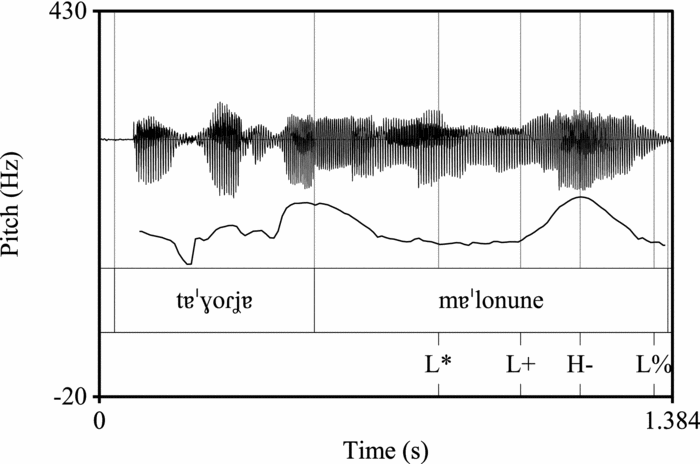
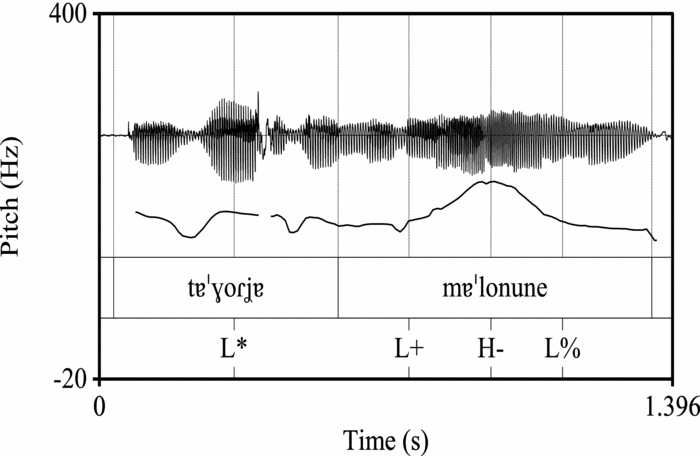
A question then arises as to whether and, if so, to what extent L1 transfer effects occur in cases where L1 and L2 use phonologically different tonal events to convey linguistic information. The case of Greek speakers’ production of English polar questions provides such an L1/L2 pair extending at the same time previous research on pitch accents to phrase accents. The two languages differ fundamentally in the combinations of discreet tonal events used to signal polar questions; Greek typically uses a melody that is realised as a series of tonal targets – which give rise to a low–high–low f0 contour – while British English has been reported to predominantly have three possible sets of tonal configurations, none of which is similar to Greek. Within the AM framework and using the conventions of the Greek ToBI system (GrToBI, see Arvaniti & Baltazani Reference Arvaniti, Baltazani and Jun2005), the Greek melody has been analysed as consisting of L* L+H- L%Footnote 1 (Arvaniti, Ladd & Mennen Reference Arvaniti, Ladd and Mennen2006, Arvaniti Reference Arvaniti, Giannakis, Baltazani, Xydopoulos and Tsangalidis2009): a low pitch accent (L*) on the focused item's stressed syllable, followed by a phrase accent starting low and rising to a peak (L+H-), which is in turn followed by a low boundary tone (L%) at the end of the utterance.Footnote 2 If the focused word is the final word of the utterance, the L* pitch accent (the nucleus of the question) co-occurs with the stressed syllable of the final word and the L+H- L% phrase accent and boundary tone occur on the last syllable of the utterance (Figure 1). If the focused item is not the final word of the utterance, the L* pitch accent appears again on the stressed syllable of the focused item, the L+H- phrase accent co-occurs with the stressed syllable of the final word (which in this case is not focused, and therefore not occupied by the L*) and the L% boundary tone appears again on the last syllable of the utterance (Figure 2).
Waveform, f0 contour, phonetic and tonal transcription of the Greek polar question /taˈɣoɾʝa maˈlonune/ ‘Are the boys FIGHTING?’ with focus on the final word (/maˈlonune/ ‘fighting’). The L* co-occurs with the stressed syllable of the focused item and the L+H- phrase accent and the L% boundary tone co-occur with the final syllable of the utterance.

Waveform, f0 contour, phonetic and tonal transcription of the Greek polar question /taˈɣoɾʝa maˈlonune/ ‘Are THE BOYS fighting?’ i.e. ‘is it the boys who are fighting?’ with focus on the second word (/aˈɣoɾʝa/ ‘boys’). The L* co-occurs with the stressed syllable of the focused item, the L+H- phrase accent with the stressed syllable of the utterance's final word and the L% boundary tone with the final syllable of the utterance.

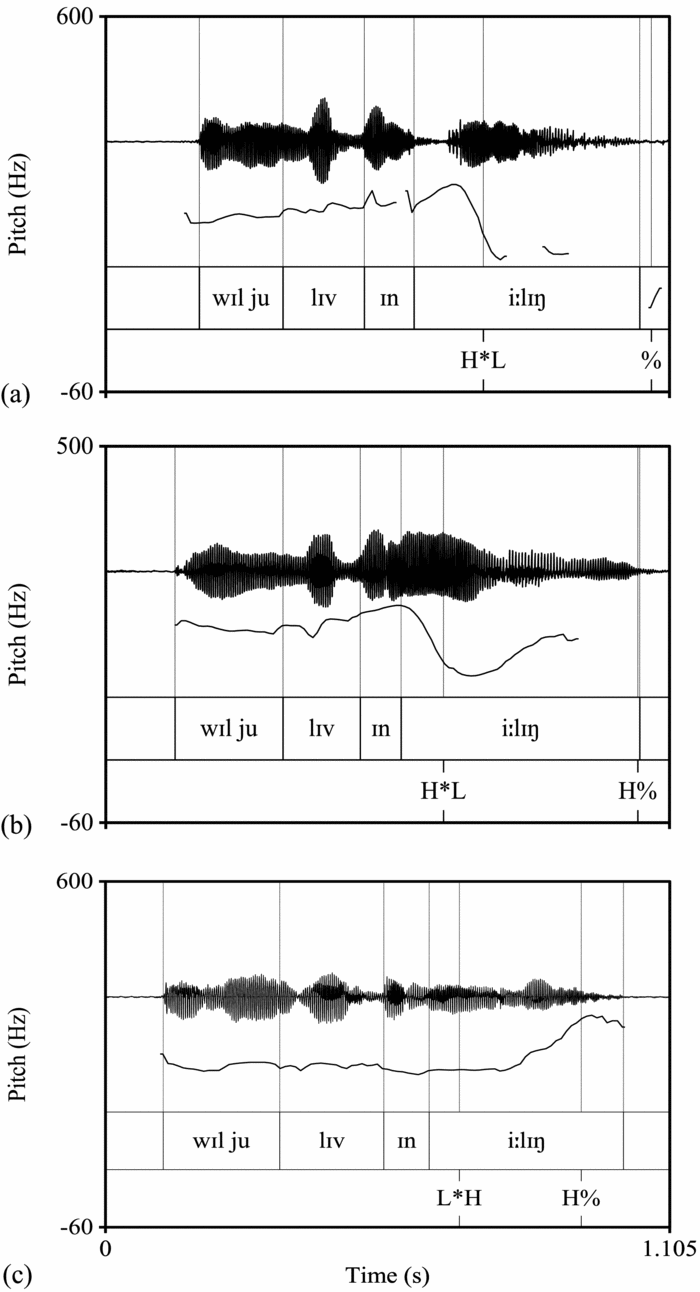
In their examination of intonational variation within English dialects in the IViE Corpus (http://www.phon.ox.ac.uk/files/apps/IViE/), Esther Grabe and colleagues (e.g. Grabe et al. Reference Grabe, Post, Nolan and Farrar2000, Grabe, Post & Nolan Reference Grabe, Post, Nolan, Puppel and Demenko2001, Grabe Reference Grabe, Gilles and Peters2004, Grabe, Kochanski & Coleman Reference Grabe, Kochanski, Coleman, Dziubalska-Kołaczyk and Przedlacka2005) present, among others, the intonation of English polar questions. Although the theoretical assumptions behind IViE and GrToBI are somewhat different (for example, the latter makes use of phrase accents while the former does not), the two systems still offer a clear description of the possible melodies in each language and can therefore be used as a means of comparison. From the dialects analysed in the corpus, Cambridge English was selected for the purposes of this study because it is a dialect very close to Standard Southern British English (SSBE; see Nolan Reference Nolan, Aarts and McMahon2006). Our participants were familiar with SSBE from the test materials of the Cambridge First Certificate in English. According to Grabe et al. (Reference Grabe, Post, Nolan, Puppel and Demenko2001), the three most common pitch contours used in Cambridge English polar questions are a falling contour H*L%, a falling-rising contour H*L H% and a rising contour L*H H% (Figure 3). The most common contour is H*L% (used 33% of the time in Cambridge English, 44% of the time across English dialects).
Waveform, f0 contour, phonetic and tonal transcription of the English polar question /wɪl ju lɪv ɪn iːlɪŋ/ ‘Will you live in Ealing?’ spoken with (a) a final fall, (b) a final fall-rise and (c) a final rise pitch configuration. Examples are taken from the IViE corpus together with the transcription labels and alignments.

Aside from the linguistic use of specific tonal events and their phonetic realisation, language-specific intonation is known to differ in yet another dimension, namely pitch range (dialectal differences are also reported, see e.g. Deutsch et al. Reference Deutsch, Le, Shen and Henthorn2009 for a comparison of pitch range used by speakers from two Chinese villages). Although the nature of pitch range (i.e. whether it directly reflects phonological or phonetic properties of language) is still open to debate (see Ladd Reference Ladd2008, Dilley Reference Dilley2010), it is generally accepted that it can be analysed along two dimensions, namely pitch level and pitch span (Ladd Reference Ladd2008). Pitch level refers to the height of a speaker's overall pitch and pitch span refers to the range of frequencies used. Several studies report cross-linguistic differences in the use of f0 range: German has been found to employ lower pitch level and narrower pitch span than British English (Gibbon Reference Gibbon, Hirst and Cristo1998, Mennen, Schaeffler & Docherty Reference Mennen, Schaeffler and Docherty2012); American English uses lower pitch level and narrower span than Mandarin (Keating & Kuo 2010) and Polish (Majewski, Hollien & Zalewski Reference Majewski, Hollien and Zalewski1972), while German and British English use lower pitch level and narrower span than Polish and Bulgarian (Andreeva et al. Reference Andreeva, Demenko, Wolska, Möbius, Zimmerer, Jόgler, Oleskowicz-Popiel and Trouvain2014). In addition to such cross-linguistic differences in the use of pitch range, there is some evidence that L2 learners use narrower pitch span (Backman Reference Backman1979, Willems Reference Willems1982, Ullakonoja Reference Ullakonoja2007, Busá & Urbani Reference Busá and Urbani2011, Zimmerer et al. Reference Zimmerer, Jügler, Andreeva, Möbius and Trouvain2014) and lower pitch level (Urbani Reference Busà and Stella2012) than native speakers. However, given the existence of cross-linguistic differences in pitch span and level, the use of a narrower pitch span and/or a lower pitch level in L2 may simply be due to L1 transfer, which makes it necessary to also obtain baseline measures of the learner's L1 pitch span and level to exclude this possibility.
One final aspect of L2 prosody that has received attention in the literature and can have important implications in the alignment of tonal targets is speech rate. A number of studies examining non-native speakers from different backgrounds including Korean, Chinese, Italian and French learners of English show that L2 speech is usually produced at a slower rate than L1 speech (Deschamps Reference Deschamps, Dechert and Raupach1980, Raupach Reference Raupach, Dechert and Raupach1980, Lennon Reference Lennon1990, Munro & Derwing Reference Munro and Derwing1998, Guion et al. Reference Guion, Flege, Liu and Yeni-Komshian2000, Baker et al. Reference Baker, Baese-Berk, Bonnasse-Gahot, Kim, van Engen and Bradlow2011, Trofimovich & Baker Reference Trofimovich and Baker2006). For example, Trofimovich & Baker (Reference Trofimovich and Baker2006) found that Korean inexperienced, moderately experienced and experienced learners of English residing in the United States all produced L2 speech at a slower rate than native speakers did in a delayed sentence-repetition task. Likewise, Guion et al. (Reference Guion, Flege, Liu and Yeni-Komshian2000) found that Italian and Korean learners of English produced longer sentences than native English speakers. In both studies, the non-native speakers’ speech rate was related to the age at which they were exposed to English, resembling findings at the segmental level (e.g. Munro, Flege & MacKay Reference Munro, Flege and MacKay1996). Importantly, the use of a slow speech rate by the learner can lead to perceived accentedness and have a detrimental effect on non-native speakers’ comprehensibility and intelligibility (Baker et al. Reference Baker, Baese-Berk, Bonnasse-Gahot, Kim, van Engen and Bradlow2011; Trofimovich & Baker Reference Trofimovich and Baker2006, Reference Trofimovich and Baker2007). The use of a slower speech rate and hence of longer vowel durations by non-native speakers can be especially relevant for cross-linguistic studies such as the current one, since peak alignment and segmental duration have been found to interact (Silverman & Pierrehumbert Reference Silverman, Pierrehumbert, Kingston and Beckman1990, Schepman, Lickley & Ladd Reference Schepman, Lickley and Ladd2006, Arvaniti & Garding Reference Arvaniti, Garding, Cole and Hualde2007, Ladd et al. Reference Ladd, Schepman, White, Quarmby and Stackhouse2009).
Examining the above-mentioned prosodic features at early stages of L2 acquisition can provide a baseline against which later stages of acquisition may be compared. Previous research has mainly focused on advanced L2 learners but such L2 learners are likely to have overcome, at least to some extent, L1 transfer effects (e.g. Shen Reference Shen1990). With respect to the production of L2 intonation, we hypothesised that L2 learners will transfer their L1 phonological and/or phonetic realisation of tonal events in L2; if so, a baseline of the stage of acquisition where no learning has taken place can be established. This hypothesis is based on the level of our participants’ proficiency in English and on the inherent difficulty of learning L2 intonation compared to the learning of L2 segmentals. An alternative hypothetical outcome is that L2 learners may show some degree of acquisition at the phonological and/or phonetic level, in which case the results unveil the early stages of intonational acquisition and learners’ interlanguage. This hypothesis is based on our selection of the particular L1/L2 pair and sentence type; the two languages employ distinct melodies to signal polar questions. Assuming that the premise of L2 models that dissimilar sounds are easier to acquire (e.g. Aoyama et al. Reference Aoyama, Flege, Guion, Akahane-Yamada and Yamada2004) applies to L2 intonation, then English polar questions should not pose much difficulty to Greek learners of English, since the English melodies used with polar questions are quite different from that used in Greek. Another reason for not excluding the possibility of finding traces of acquisition is that the participants were selected so that they would have some exposure to authentic English input albeit in the context of formal classroom-based setting (e.g. listening to British English recordings, watching British English films). Regarding speech rate, we hypothesised that, given the proficiency level of our participants, they would speak more slowly in English than in Greek. For pitch span and level, there are two possibilities, namely that generally L2 pitch span is narrower than L1 pitch span and L2 pitch level lower than L1 pitch level (thus language-independent features of the early stages of second-language acquisition) or that pitch span is only narrower and pitch level lower, if the speaker's L1 happens to have a narrower pitch span and a lower pitch level, respectively, in which case it would be another instance of transfer.
The main goal of the study is to examine L2 learners’ production of different prosodic features in order to establish an overall prosodic profile at early stages of L2 acquisition. The specific goals are the following: First, to test whether intermediate Greek learners of English have acquired (any of) the melodies of English polar questions, or whether they show a transfer of their L1 L* L+H- L% tune. Secondly, given the interaction between tonal target alignment and speech rate found in previous research, to examine whether the speech rate used by Greek speakers in Greek and English differs and, if so, how this affects Greek speakers’ tonal target alignment in Greek and English. Thirdly, to examine differences in pitch level and span between L1 and L2, and to compare these results to native English speakers’ pitch span and level.
2 Method
2.1 Speakers
The materials were recorded by eight native speakers of Standard Modern Greek (four male and four female, mean age = 14.3 years, range = 12–15 years). The speakers were recruited from an English language school in Athens, Greece; they all had between five and six years of formal English instruction and their proficiency level was intermediate (Cambridge First Certificate in English). They had very little, if any, interaction with native English speakers but, as mentioned above, had experience with authentic Southern British English in the form of TV programs, movies, CDs and the training for the listening component of the Cambridge First Certificate in English exam. None of the participants was proficient in any other language. Comparable materials for English polar questions spoken by eight native English speakers with a Cambridge accent (four male, four female, all participants were 17 years old) were taken from the IViE corpus (Grabe et al. Reference Grabe, Post, Nolan, Puppel and Demenko2001).Footnote 3
2.2 Speech materials and procedure
Recordings were made using a MicroTrack 24/96 digital recorder at a sampling rate of 44.1 kHz. Participants were tested individually in a quiet room on the same computer and were asked to read 50 polar questions (5 polar questions × 2 languages × 5 repetitions × 8 speakers = 400 in total) and 50 filler sentences (containing wh-questions and declaratives).
Examples of one polar question in L1 Greek and one in L2 English are given in (1) below. An example of a polar question in L1 English is given in (2).
-
(1) Native Greek speakers
-

-
(2) Native English speakers
-
L1: May I lean on the railings?Footnote 4
-
The sentences were matched for number of syllables and position of stress across languages (as much as possible given rhythmic differences between Greek and English; see Appendix for a list of the materials used, some sentences adapted from Arvaniti et al. Reference Arvaniti, Ladd and Mennen2006). The sentences were arranged in blocks by language and were randomised within each language and for each speaker. To avoid interference from Greek, English was elicited first. No instructions were given to the participants as to the placement of focus in either language.
For measuring pitch span and level, the participants were asked to read a passage of text. While pitch span and level could be measured from polar questions, a single type of sentence does not represent the span of pitch used in a language. For this reason we took pitch span and level measurements from a passage recorded by each speaker, which contained different types of sentences and was therefore considered to be more representative of a speaker's use of pitch span and level (e.g. Mennen, Schaeffler & Docherty Reference Mennen, Schaeffler and Docherty2007). The chosen passage was a version of the Cinderella story, taken from the IViE corpus, in which the same English speakers produced the polar questions and read the passage. The English version of the passage was translated into Greek. The English and the Greek versions were matched for type and length of sentences and contained similar numbers of statements, statements with exclamation marks, continuation rises and questions of different types. This was to ensure that any differences in pitch range between the two languages would be attributed to a switch from L1 to L2. Before recording the passages, the Greek speakers were asked to read it silently to familiarise themselves with the text, especially the English one.
2.3 Acoustic measurements
The intonation of Greek and English polar questions spoken by the Greek speakers was transcribed manually in Praat (Boersma & Weenink Reference Boersma and Weenink2012) using the GrToBI system (Arvaniti & Baltazani Reference Arvaniti, Baltazani and Jun2005). The GrToBI was also used for the transcription of L2 English polar questions because the Greek speakers used their L1 polar question intonation when speaking English. The prosodic transcription of the English polar questions uttered by native English speakers was taken from the IViE corpus.
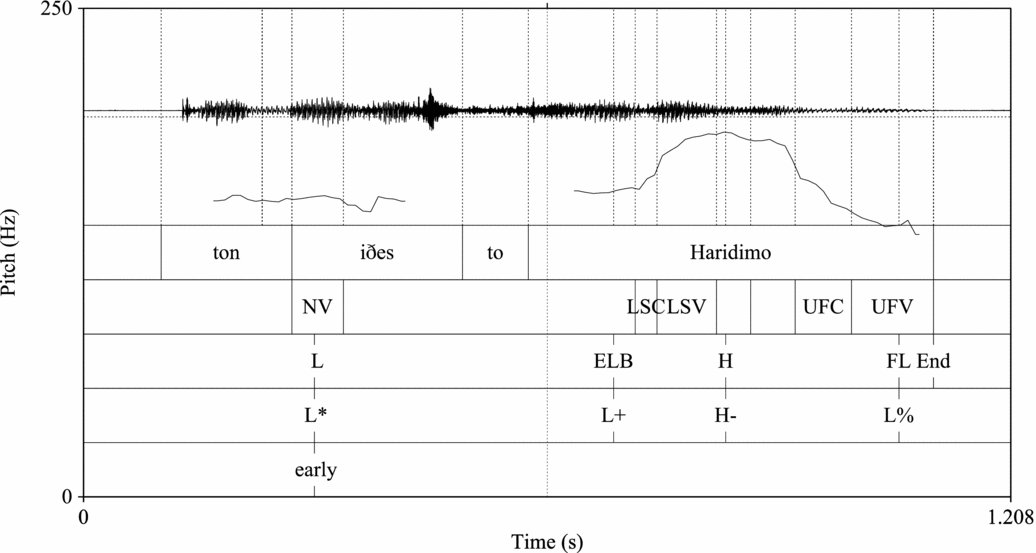
In each utterance the following landmarks were identified (see also Figure 4):
-
(i) the location of the L* was marked on the nuclear vowel (no precise alignment measurement could be made, see the low plateau in Figure 4)
-
(ii) the Low of the L+H- phrase accent was marked as the ELB (elbow), i.e. the turning point where the f0 low plateau linking the L* with the L+ finishes and makes an elbow to reach the High of the phrase accent
-
(iii) the High of the L*+H- phrase accent was marked as the highest peak within the last stressed vowel of the utterance
-
(iv) the L% of the boundary tone was also marked but because in many instances the end of the f0 descent was not easy to locate due to the segmental make-up of the words, its alignment with the segmental string was not analysed
Waveform, f0 contour, segmentation and annotation of the sentence /ton ˈiðes ton xaˈɾiðimo/ ‘Have you seen Haridimos?’ spoken by a male Greek speaker. The first tier is a transliteration of the sentence; the second tier shows the NV, LSC, LSV, UFC and UFV; the third and fourth tiers show the position of the tonal targets; and the fifth tier marks whether the focus has been placed early or late in the utterance (early in this case).

We measured the duration of the last stressed vowel (LSV) in each polar question. For example, in the sentence /tonˈiðes ton xaˈɾiðimo/ ‘Have you seen Haridimos?’ the LSV is the stressed vowel /i/ of the word /xaˈɾiðimo/ ‘Haridimos’. In cases where the focus was late, hence the nucleus of the sentence was the last word, that meant that the LSV was also the nuclear vowel of the sentence, and was thus marked as such (18/200 instances for English L2 productions, i.e. 9% of the overall corpus and 19/200 instances for Greek L1 productions, i.e. 9.5% of the overall corpus).
With respect to tonal target alignment, comparisons were only performed between the Greek speakers’ productions of Greek and English polar questions since, as noted before, the participants transferred the L* L+H- L% intonation into English polar questions. The alignment of the H target from the L+H- phrase accent was measured in two ways (see Figure 4):
-
(i) HtoLSVms: the distance between the H and the onset of the LSV in ms
-
(ii) HtoLSVperc: the alignment of the H as percentage of the LSV's duration (e.g. Silverman & Pierrehumbert Reference Silverman, Pierrehumbert, Kingston and Beckman1990, Ladd et al. Reference Ladd, Schepman, White, Quarmby and Stackhouse2009)
Speech rate was measured by dividing the number of spoken syllables in each polar question by the total duration of all syllables (i.e. the duration of the utterance) (see Munro Reference Munro1995, Towell, Hawkins & Bazergui Reference Towell, Hawkins and Bazergui1996, Trofimovich & Baker Reference Trofimovich and Baker2006). Since the resulting number expresses the ratio between the number of syllables and the duration of the utterance, a higher number indicates a faster speech rate.
For pitch level, mean f0 frequency from the read passage was calculated. Following Mennen et al. (Reference Mennen, Schaeffler and Docherty2007), three measurements were taken for pitch span: the difference between the 90th and the 10th percentile (80% span); the difference between the 75th and the 25th percentile (i.e. the interquartile range, IQR); and ±2 standard deviations around the mean (SD4). Pitch level was measured in Hz, following Mennen et al. (Reference Mennen, Schaeffler and Docherty2012). Pitch span was measured in semitones (ST) because it has been suggested that, compared to other psychoacoustic pitch scales (e.g. Bark, mel, ERB-rate scales), ST transformation best captures speakers’ intuitions about equivalence of f0 span across speakers (Nolan Reference Nolan2003). Pitch measurements were performed in Praat (Boersma & Weenink Reference Boersma and Weenink2012) using the program's algorithm for f0 tracking and were manually inspected and corrected for failures in Praat's f0 tracking (e.g. octave jumps and pitch halvings).
3 Results
3.1 Tonal constellations and speech rate
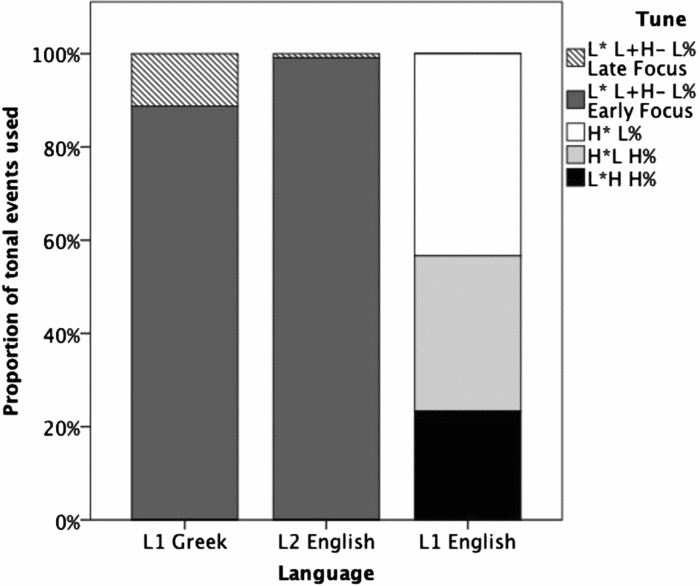
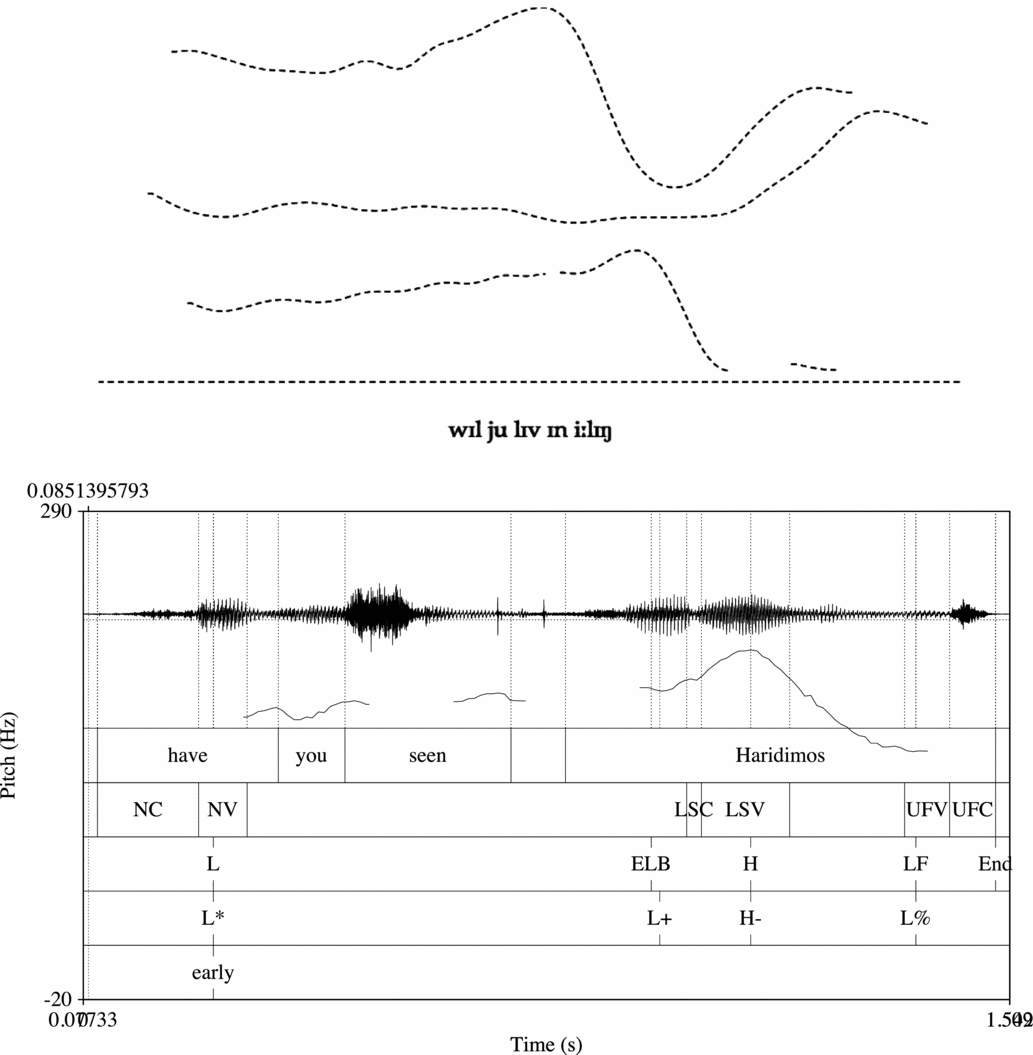
The series of tonal events used by the Greek speakers in Greek (L1) and English (L2) polar questions and by English speakers in English (L1) polar questions were initially analysed. Figure 5 displays in percentages how often each set of tonal events was used to mark polar questions by the Greek speakers (leftmost and middle columns for their Greek and English productions, respectively) and by English speakers (rightmost column). As expected, English speakers were found to use one of three sets of strings of tonal events, i.e. H*L H% (34% of the time), L*H H% (23% of the time) and H* L% (43% of the time). An H% boundary tone was, therefore, found 57% of the time in English polar questions. The Greek speakers signalled Greek polar questions using the anticipated L+H- L% combination of edge tones. The majority of the time (i.e. around 90%), focus was placed on the non-final wordFootnote 5 (early focus), showing a clear preference for this realisation when no instructions are given to the participants regarding focus placement. Importantly, the Greek speakers used exclusively an L* L+H- L% intonation in English polar questions, indicating transfer of the full L1 melody to L2. This strong L1 influence on L2 is further corroborated by the fact that the Greek speakers showed a clear preference for early focus in English, which mirrors their L1 behaviour (Figure 6).
Percentage selection of each set of intonational events used to mark polar questions by the Greek speakers in L1 (Greek) and L2 (English) and by the English speakers in L1 (English).

Waveform, f0 contour, segmentation and annotation of the English polar question Have you seen Haridimos? spoken by a male Greek speaker. When compared with Figure 4, it is clear that the Greek polar question intonation (early focus too) is being transferred to English. Real contours from productions of the polar question ʽWill you live in Ealing?ʼ by a native English speaker are also given for comparison (see also Figure 3).

Because potential differences in speech rate and hence vowel durations between L1 and L2 can affect peak alignment (see Section 2.3 above), before discussing peak alignment patterns, we first compared the rate of speech used by the Greek speakers in Greek and English polar questions, and then the duration of the LSV (i.e. the docking site for the H of the phrase accent) in L1 Greek and L2 English. The Greek speakers’ speech rate was faster in L1 Greek (M = 6.8) than in L2 English (M = 4.5), as shown by a paired-samples t-test with Language as a between-subject variable (t(96) = –25.416, p < .001). Moreover, the duration of the LSV was longer in L2 English (M = 151 ms) than in L1 Greek (M = 121 ms), as shown by a paired-samples t-test with Language as a between-subject variable (t(104) = 7.71, p < .001), which confirmed that a slower overall speech rate in L2 resulted in longer durations of the LSV in English than in Greek. Finally, we also compared the L2 English and the L1 English speech rate. This showed that the former was significantly slower than the latter (M = 4.5 vs. M = 6, respectively), as confirmed by an independent samples t-test (t(99) = –6.81, p < .01).
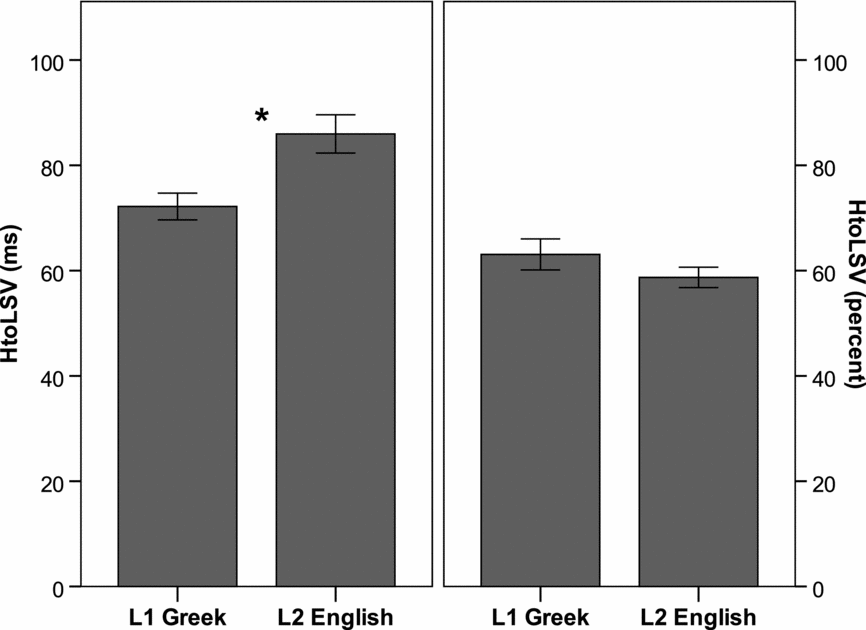
Turning to L2 tonal alignment, the precise phonetic realisation of tonal targets (with early focus) was examined by comparing the Greek speakers’ alignment of the peak of the L+H- phrase accent in Greek and English polar questions. Figure 7 displays the H alignment in L1 Greek and L2 English polar questions. When peak alignment was measured with respect to the onset of the LSV in ms, H aligned significantly later in L2 English than in L1 Greek (HtoLSVms = 91 ms vs. HtoLSVms = 73 ms, respectively) (t(101) = 4.21, p < .001). However, when peak alignment was measured proportionally with respect to the duration of the LSV, there was no difference in alignment between L2 English and L1 Greek (HtoLSVperc = 61% vs. HtoLSVperc = 64%, respectively), p > .05, indicating that despite producing longer vowels in L2 English, the Greek speakers aligned the H at around the same point in the segmental string across L1 and L2, i.e. approximately at 60% into the stressed vowel.
Alignment of the peak of the L+H- phrase accent with respect to the onset of the LSV expressed as an absolute value in ms (left panel) and as a percentage of the vowel's duration (right panel) in L1 Greek and L2 English polar questions produced by the Greek speakers. Error bars indicate standard error of the mean.

3.2 Pitch level and span
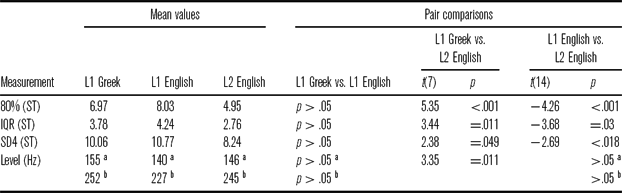
Table 1 shows mean values and statistical comparisons (Bonferroni-adjusted t-tests) for the span measurements (ST) and the pitch level measurement (Hz) obtained for the Greek speakers in L1 (Greek) and L2 (English) and for the native English speakers in L1 (English) from the read passages. Across measurements, L1 Greek and L1 English did not differ in terms of pitch span (there was a non-significant trend for wider pitch span in English than in Greek). The Greek speakers’ pitch span in L2 English was not only narrower than that of the native English speakers, but also narrower than their pitch span in L1 Greek. Similarly, the Greek speakers’ pitch level was significantly lower in L2 English than in L1 Greek in both males and females. A difference in pitch level between L1 Greek and L1 English did not reach significance either for males or females but these statistical comparisons (independent samples t-tests) should be treated with caution because of the small sample size (the L1 Greek vs. L2 English comparison, on the other hand, was tested via paired samples t-tests, which allows pooling the data obtained for all participants and increases statistical power).
Mean values of pitch span (ST) and pitch level (Hz) measurements for the Greek speakers in L1 (Greek) and L2 (English) and for the English speakers in L1 (English). The results of t-tests (Bonferroni adjusted) comparing mean values are also given.

a Male speakers; bFemale speakers
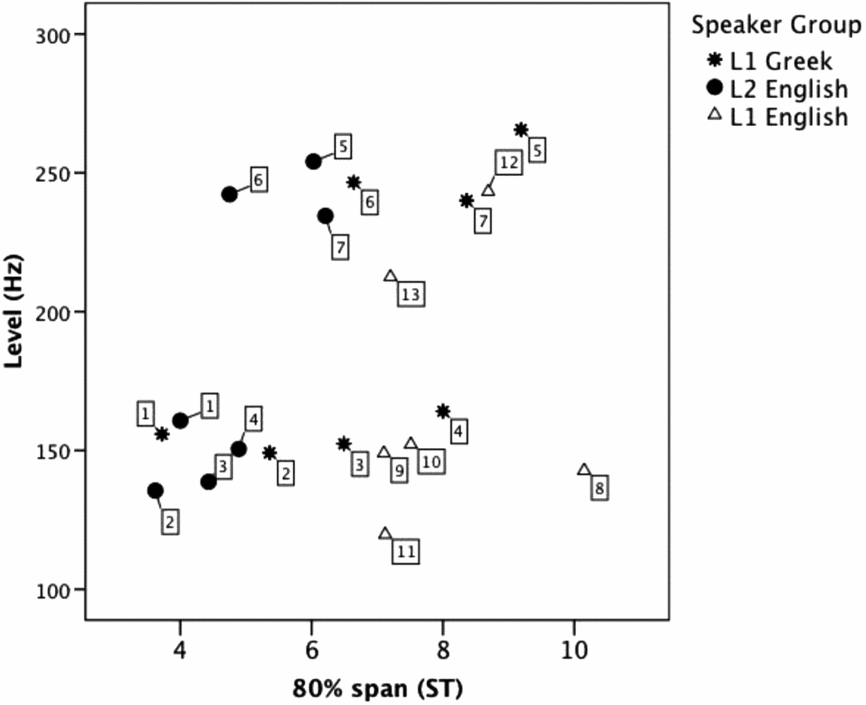
Taking into consideration recent research suggesting inter-speaker differences in the use of pitch (e.g. Mennen et al. Reference Mennen, Schaeffler and Docherty2012) and well-attested between-gender differences, Figure 8 plots pitch level and 80% span values for individual speakers. Each Greek speaker is shown twice, with L1 Greek indicated by an asterisk and L2 English indicated by a circle, while each English speaker is shown once in the graph. It can be seen that the mean pitch level and 80% span results reported in the t-tests hold for each individual speaker; the Greek speakers consistently used a narrower pitch span in L2 English than in L1 Greek and the English speakers showed a (non-significant) tendency for using a wider pitch range than the Greek speakers did.
Scatterplot showing pitch level (Hz) and 80% span (ST) for individuals. Each individual is marked by a number. Each Greek speaker is shown twice in the scatterplot (L1 Greek is indicated by an asterisk and L2 English is indicated by a circle) and each English speaker is shown once in the scatterplot (L1 English is indicated by a triangle).

4 Discussion
This study examined possible L1 transfer effects on the production of English intonation (tonal events and their alignment), speech rate, pitch level and span by Greek learners of English with the goal of establishing the prosodic profile of intermediate L2 learners. While previous studies have provided useful insights into different aspects of L2 prosody, very little research has examined the acquisition of several suprasegmental features by the same learners (e.g. Trofimovich & Baker Reference Trofimovich and Baker2006). The selection of the particular L1/L2 pair allowed testing a case where L2 learners are faced with phonological accents in L2 different from those used in L1, contrary to previous research examining similar L1/L2 phonological pairs (e.g. Atterer & Ladd Reference Atterer and Ladd2004, Mennen Reference Mennen2004). To this end, we compared the Greek speakers’ production of tones and their alignment in polar questions in Greek and English to polar questions produced by the native English speakers from the IViE corpus. We also compared participants’ rate of speech, pitch level and pitch span in L1 and L2. Pitch level and span from the readings of written passages in Greek and English were also compared to the pitch range employed by the native English speakers when reading the same passage.
The results concerning the production of polar questions showed strong L1 transfer effects on L2 intonation; the Greek speakers used the Greek L* L+H- L% polar question intonation in English. The tentative hypothesis that markedly different melodies could have been acquired in early stages of L2 learning was not confirmed, at least for intermediate learners of English who had received formal instruction in a foreign language setting and had no communicative interaction with actual British speakers. There was no evidence that the Greek learners of English have learned the melody used by native English speakers for signalling polar questions, nor any interlanguage patterns deviating from both L1 and L2. From the perspective of L2 acquisition, transferring the L1 tonal configuration to L2 production is important as it can cause a breakdown at the pragmatic level and lead to more miscommunication than e.g. phonetic differences in alignment; if a Greek asks a question without an auxiliary and with Greek polar question intonation, it will not sound like a question but rather like an oddly spoken declarative. Even if an auxiliary verb is used by the learner as a marker of polar question, an English speaker would still be puzzled by the intonation of the utterance. When the use of a totally different contour in polar questions is combined with wrong focus placement (our learners transferred their preference for placing the focus in the question's verb as they did in Greek, see also Arvaniti et al. Reference Arvaniti, Ladd and Mennen2006), it is expected that English native speakers will face great difficulty in correctly interpreting a polar question spoken by a Greek native speaker.
After establishing that learners transferred the whole Greek polar question melody to English, we compared tonal target alignment in L1 and L2, specifically the alignment of the H of the L+H- phrase accent with the segmental string. This was done in two ways: using an ms measurement taken from the onset of the segmental target (in this case the target was the onset of the last stressed vowel of the utterance) and using a proportional measure showing how far into the vowel's duration the H docked. When measured in ms, the Greek speakers aligned the H later in the stressed vowel in English than in Greek. This could be interpreted as a difference in the phonetic realisation of tonal events in L1 and L2, and thus as the first sign of an emerging interlanguage; in cases where phonological transfer has taken place, an L1 category is produced in the L2 with a deviating phonetic realisation. However, when H alignment was measured proportionally to the vowel's duration, the H was found to consistently align past the midpoint of the vowel (at approximately 60% of its duration) across L1 and L2. In other words, despite producing longer vowels in L2 (Deschamps Reference Deschamps, Dechert and Raupach1980, Raupach Reference Raupach, Dechert and Raupach1980, Lennon Reference Lennon1990, Munro & Derwing Reference Munro and Derwing1998, Guion et al. Reference Guion, Flege, Liu and Yeni-Komshian2000, Trofimovich & Baker Reference Trofimovich and Baker2006, Baker et al. Reference Baker, Baese-Berk, Bonnasse-Gahot, Kim, van Engen and Bradlow2011), the Greek speakers’ peak alignment in L2 mirrored their L1 alignment pattern (see Arvaniti et al. Reference Arvaniti, Ladd and Mennen2006 for a discussion on the location of the H in Greek polar questions). Such a strong L1 transfer effect on L2 intonation is compatible with research on L2 segmentals (e.g. Rochet Reference Rochet1995, Best et al. Reference Best, McRoberts and Goodell2001, Iverson et al. Reference Iverson, Kuhl, Akahane-Yamada, Diesch, Tohkura, Kettermann and Siebert2003, Flege & MacKay Reference Flege and Mackay2004, Iverson & Evans Reference Iverson and Evans2007, Lengeris Reference Lengeris2009, Lengeris & Hazan Reference Lengeris and Hazan2010) and previous research in L2 intonation (e.g. Jun & Oh Reference Jun, Oh, Yuan, Huang and Tang2000; Mennen Reference Mennen2004, Reference Mennen2006). The stability in alignment revealed when using the proportional measurement is in line with the notion of ‘proportional invariance’ of tonal target alignment according to which a tonal target is expected to be found at a fixed proportion of the segmental target (e.g. the onset or offset of a vowel, a syllable, a prosodic domain; see Atterer & Ladd Reference Atterer and Ladd2004, Arvaniti et al. Reference Arvaniti, Ladd and Mennen2006, Arvaniti & Garding Reference Arvaniti, Garding, Cole and Hualde2007, Mücke et al. Reference Mücke, Grice, Hermes, Becker, Barbosa, Madureira and Reis2008, Ladd et al. Reference Ladd, Schepman, White, Quarmby and Stackhouse2009). The choice of the appropriate metric may thus prove critical in unmasking alignment differences across experimental conditions, or lack thereof, and is particularly relevant in L2 intonational research given that L2 speech is usually spoken at a slower rate than L1 speech.
Our findings can be viewed in light of the Intonation Learning Theory (LILt), a working model of L2 intonation recently proposed by Mennen (Reference Mennen, Delais-Roussarie, Avanzi and Herment2015). Four dimensions are presented in the model along which cross-language differences in intonation can occur (i) the ‘systemic dimension’ (inventory of phonological elements and their distribution); (ii) the ‘realisational dimension’ (phonetic implementation of phonological elements); (iii) the ‘semantic dimension’ (function of phonological elements); and (iv) the ‘frequency’ dimension (frequency of use of phonological elements). While this study was not specifically designed to test the model, our results clearly support the importance of the semantic dimension when predicting the relative difficulty in learning L2 intonation since the Greek speakers used the wrong intonational contour and fully transferred the Greek focus patterns to their L2 productions.
While the Greek speakers’ use of tonal events and their alignment can be attributed to L1 transfer, the remaining prosodic features examined in this paper reveal a more complex picture regarding L2 prosody; slower speech rate together with deviating pitch range point to an emerging L2 interlanguage. Regarding speech rate, the Greek speakers’ L2 productions were slower than both their L1 and the native English speakers’ productions, i.e. different from both native and target language. With respect to pitch range, irrespective of the measurement employed, the Greek speakers used a narrower pitch span in L2 English than the native English speakers (Backman Reference Backman1979, Willems Reference Willems1982, Ullakonoja Reference Ullakonoja2007, Busá & Urbani Reference Busá and Urbani2011). Importantly, the Greek speakers’ pitch span in English was also narrower than the same speakers’ pitch span in Greek, which provides clear evidence that this was not the result of L1 pitch span transfer. Similarly, when comparing the Greek speakers’ level of pitch in L1 and L2 it was found that they used a lower pitch level in English than in Greek, a finding which again cannot be attributed to L1 transfer since the two languages did not differ in terms of level as shown by the comparison of Greek vs. English speakers. Overall, the L1 Greek vs. L1 English comparisons allow us to argue that the use of slower speech rate, narrower pitch span and lower pitch level are language-independent characteristics of the early stages of L2 learning (Zimmerer et al. Reference Zimmerer, Jügler, Andreeva, Möbius and Trouvain2014). A speculative explanation of why this happens would be that insecurity/uncertainty when speaking an L2, especially in the case of non-proficient learners, leads to more cautious (hence slower and more limited in terms of f0) productions compared to learners’ habitual use of speech rate and f0 in L1.
Taken together, the results of this study show that early in the acquisition process learners fully transfer their L1 intonation in L2 in terms of tonal events (and their alignment) but adopt a slower speech rate, a narrower pitch span and a lower pitch level than that used in L1. Irrespective of why such deviations occur (possible explanations include hesitation/uncertainty and other constraints relating to difficulties in processing phonological, syntactical and morphological information as well as difficulties in production, see e.g. Munro & Derwing Reference Munro and Derwing2001, Kormos & Csizer Reference Kormos and Csizer2014), learners adopt interlanguage forms in some prosodic aspects but show full L1 transfer in others. Learner's prosodic characteristics at later stages of acquisition are left to be explored in the future.
Acknowledgements
We thank Amalia Arvaniti and three anonymous reviewers for their constructive comments that greatly contributed to improving the paper.
Appendix. Sentence materials
-
Greek L1
-
Τον είδες τον Χαρίδημο;
-
‘Have you seen Haridimos?’
-
Μπορώ να φύγω μόνος;
-
‘May I leave alone? ’
-
Θα μείνεις στη Λήμνο;
-
‘Will you live in Limnos?’
-
Τη γνωρίζετε την Έλενα;
-
‘Do you know (have you been introduced to) Helena?’
-
Θα μείνεις εκεί;
-
‘Will you stay there?’
-
-
English L2
-
Have you seen Haridimos?
-
May I leave the meal early?
-
Will you live in Limnos?
-
Have you been introduced to Helena?
-
Will you stay at home?
-
-
English L1 (from the IViE corpus)
-
May I lean on the railings?
-
May I leave the meal early?
-
Will you live in Ealing?
-