





1. Introduction
It is well-established that segments may exert a localized influence on pitch, which is superimposed on an overall pitch contour. For example, pitch is higher during high vowels than during low vowels, and pitch is higher immediately following voiceless consonants than during voiced consonants. Co-intrinsic f0 of consonants (which we refer to as Cf0 following e.g. Di Cristo & Hirst Reference Di Cristo and Hirst1986), i.e. the effect that consonants have on the f0 of surrounding segments, has been documented in many languages with various kinds of laryngeal contrasts in obstruents (e.g. Hombert, Ohala & Ewan Reference Hombert, Ohala and Ewan1979). Cf0 is assumed to play a major role in tonogenetic sound change processes, where Cf0 is often assumed to have transphonologized into lexical tone with concomitant loss of the voiced–voiceless contrast (Hyman Reference Hyman, Devine and Stephens1976; Hombert et al. Reference Hombert, Ohala and Ewan1979).
Despite the substantial body of literature on Cf0, several open questions remain about the underlying mechanisms. It remains an open question how exactly Cf0 interacts with other more and less localized sources of prosodic modification. It also remains unclear to what extent Cf0 is actively controlled or an automatic by-product of e.g. laryngeal gestures aimed at inhibiting or sustaining phonation. If it is primarily the latter, it is still not clear what exactly those gestures might look like. Given that some extent of Cf0 appears to be near-universal (Ting et al. Reference Ting, Clayards, Sonderegger and McAuliffe2025) and can demonstrably have crucial downstream consequences for phonological systems, understanding these mechanisms is important for the phonetic sciences and the study of sound change. In this paper, we approach some of these open questions by revisiting Cf0 in Danish, where both the prosodic phonology and the laryngeal contrast in stops have properties that make it a suitable language for approaching these questions.
Danish is an interesting case in terms of Cf0 for at least the following reasons:
-
1) The laryngeal contrast in stops is somewhat unusual, contrasting a series of voiceless aspirated stops [pʰ tʰ kʰ] with a series of voiceless unaspirated stops [p t k] (Hutters Reference Hutters1985; Puggaard-Rode, Horslund & Jørgensen Reference Puggaard-Rode, Horslund and Jørgensen2022). Unlike the corresponding unaspirated stops in most other Germanic languages, the Danish voiceless unaspirated stops are actively devoiced (Beckman, Jessen & Ringen Reference Beckman, Jessen and Ringen2013), in the sense that voiceless realizations are the norm even in intervocalic position (Puggaard-Rode et al. Reference Puggaard-Rode, Horslund and Jørgensen2022), and this is enforced through (light) glottal spreading (Fischer-Jørgensen & Hirose Reference Fischer-Jørgensen and Hirose1974a; Hutters Reference Hutters1985). This makes Danish particularly suitable for testing whether Cf0 is caused by active adjustment to enhance a phonological contrast (in which case we would not expect to see pitch raising after the unaspirated stop series), or whether it is caused by gestures inhibiting voicing (in which case we might expect to see pitch raising after both stop series).
-
2) The Danish stops have been studied very extensively, both in terms of acoustic realization (Fischer-Jørgensen Reference Fischer-Jørgensen1954; Mortensen & Tøndering Reference Mortensen and Tøndering2013; Puggaard-Rode et al. Reference Puggaard-Rode, Horslund and Jørgensen2022; Puggaard-Rode Reference Puggaard-Rode2022) and physiology, using methods such as fiberoptic laryngoscopy (Fischer-Jørgensen Reference Fischer-Jørgensen1969; Hutters Reference Hutters1978, Reference Hutters1984, Reference Hutters1985), electromyography (Fischer-Jørgensen & Hirose Reference Fischer-Jørgensen and Hirose1974a; Hutters Reference Hutters1984, Reference Hutters1985), and various measures of airflow and air pressure (Fischer-Jørgensen Reference Fischer-Jørgensen1969). This allows us to generate particularly concrete hypotheses and to compare the observed Cf0 patterns with what is already known about Danish laryngeal articulation.
-
3) There is reported regional variation in Danish in the location of the pitch peak relative to stress (e.g. Thorsen & Nielsen Reference Thorsen and Nielsen1981; Thorsen Reference Thorsen1982, Reference Thorsen1988; Grønnum Reference Grønnum1989, Reference Grønnum1990), making it possible to tease apart the respective influence of focus and high pitch on Cf0, by comparing varieties where pitch peak and stress coincide with varieties where they do not.
-
4) Danish has a voice quality contrast (known as stød) which is, among other things, cued by pitch differences immediately after an initial consonant (e.g. Petersen Reference Petersen1973; Fischer-Jørgensen Reference Fischer-Jørgensen1989; Peña Reference Peña2022), making it possible to investigate how Cf0 interacts with other localized pitch modifications.
Cf0 has already been investigated in Danish (Jeel Reference Jeel1975; Petersen Reference Petersen1978a, Reference Petersen1983); these studies suggest that Cf0 is indeed found in Danish (although cf. Fischer-Jørgensen Reference Fischer-Jørgensen1969), but the studies were not designed with the aforementioned open questions in mind, and thus cannot directly be used to approach them. Perhaps just as importantly, these studies are frequently cited despite being based on limited data and having certain methodological shortcomings by today’s standards, which makes a larger-scale replication study valuable.
Our results show that both series of stops raise f0, although the temporal extent and magnitude of the effect differs between the two series, suggesting that gestures that inhibit voicing exhibit a scalar influence on f0 rather than a categorical one. We find some evidence of global, intonational high pitch targets enhancing Cf0, but we also find a tendency for the reverse effect when there are competing phonological demands on the local pitch level. This suggests a complicated relationship between Cf0 and macroprosodic demands on pitch that cannot straightforwardly be explained in terms of a single synergistic or antagonistic mechanism.
The following two subsections review the general literature on Cf0, especially pertaining to the open questions we are interested in here, and the relevant literature on the Danish laryngeal contrast, regional variability in stress and pitch peak alignment, and the implementation of stød. Our research questions and hypotheses are presented in Section 1.3. Our experimental design, participants, recording methodology, and statistical methodology are presented in Section 2. We present the results of the study in Section 3, and discuss them in light of our research questions and hypotheses in Section 4.
1.1. Co-intrinsic f0
1.1.1. General overview
Cf0 was observed as early as the late 19th century by Meyer (Reference Meyer1897) and first studied in English by House & Fairbanks (Reference House and Fairbanks1953). It has been documented in a very wide range of languages (see e.g. the overview in Ting et al. Reference Ting, Clayards, Sonderegger and McAuliffe2025). Some have suggested that f0 is raised following voiceless stops due to gestures that inhibit voicing, such as stiffening or vertical tensing of the vocal folds (Halle & Stevens Reference Halle and Stevens1971; Hombert et al. Reference Hombert, Ohala and Ewan1979), in particular tensing of the cricothyroid muscle (Löfqvist et al. Reference Löfqvist, Baer, McGarr and Seider Story1989; Hoole & Honda Reference Hoole, Honda, Clements and Ridouane2011), or due to abrupt activity of the vocalis muscle to initiate voicing (Hoole, Reference Hoole2006; Hoole & Honda Reference Hoole, Honda, Clements and Ridouane2011). Others have suggested that f0 is lowered following voiced stops due to gestures that promote closure voicing, such as larynx lowering (e.g. Ewan & Krones Reference Ewan and Krones1974; Ewan Reference Ewan1976) with concomitant vocal fold slackening (Ohde Reference Ohde1984; Honda et al. Reference Honda, Hirai, Masaki and Shimada1999), or that f0 lowering in this context is an active adjustment to perceptually enhance the voicing contrast (Kingston & Diehl Reference Kingston and Diehl1994; Kingston Reference Kingston, Gussenhoven and Riad2007). Note that these two mechanisms may not be mutually exclusive. When comparing post-stop f0 trajectories to a suitable baseline, Cf0 effects in the direction of f0 raising after voiceless stops are typically found to be more temporally extensive than f0 lowering (Hanson Reference Hanson2009). Lowering is often found only during the stop closure itself (Kirby & Ladd Reference Kirby and Ladd2016), although Maspong, Burroni & Kirby (Reference Maspong, Burroni, Kirby, Chen, Chen and Arvaniti2024) do find evidence of this effect extending into the initial parts of the vowel in Italian.Footnote 1 An alternative explanation of Cf0 holds that the effects are caused by intraoral air pressure differences after voiced and voiceless stops (e.g. Ladefoged Reference Ladefoged1967; Ohala Reference Ohala and Hyman1973; Hombert Reference Hombert, Thompson, Whistler, Edge, Jaeger, Javkin, Petruck, Smeall and Van Valin1976); this explanation is attractive since it in principle accounts for both f0 lowering and f0 raising, but it arguably fails to predict the scope of f0 modifications, especially that f0 raising can be quite long-lasting (see Hombert et al. Reference Hombert, Ohala and Ewan1979). Such an aerodynamic account would also predict covariation between especially positive voice onset time (pVOT) and the extent of f0 raising, which many studies do not find evidence for (e.g. Dmitrieva et al. Reference Dmitrieva, Llanos, Shultz and Francis2015; Kirby & Ladd Reference Kirby and Ladd2016; Pinget & Quené Reference Pinget and Quené2023), although cf. Shultz, Francis & Llanos (Reference Shultz, Francis and Llanos2012) and Kirby & Ladd (Reference Kirby and Ladd2015).
Cf0 appears to be relatively independent of how exactly laryngeal contrasts are implemented. The overall effect – namely that f0 is higher following ‘less voiced’ stops than ‘more voiced’ stops (in a very broad sense) – is found in ‘aspiration languages’, where the main cue to the laryngeal contrast is post-aspiration in the voiceless series of stops, such as English (e.g. House & Fairbanks Reference House and Fairbanks1953) and German (e.g. Kohler Reference Kohler1982; Kirby et al. Reference Kirby, Kleber, Siddins and Harrington2020a), and in ‘true voice languages’, where the main cue to the contrast is the presence of glottal pulsing during the closure in the voiced series of stops, such as Italian (Kirby & Ladd Reference Kirby and Ladd2015, Reference Kirby and Ladd2016), French (ibid.; Fischer-Jørgensen Reference Fischer-Jørgensen1969), Spanish (Dmitrieva et al. Reference Dmitrieva, Llanos, Shultz and Francis2015), and Dutch (Löfqvist et al. Reference Löfqvist, Baer, McGarr and Seider Story1989; Pinget & Quené Reference Pinget and Quené2023). It is also found in languages which primarily distinguish stops through closure duration, such as Swiss German (Ladd & Schmid Reference Ladd and Schmid2018; Zebe-Sheng et al., Reference Zebe-Sheng, Watter, Schmid and Robert Ladd2025) and Salentino (Burroni, Lee-Preechathammarach & Maspong Reference Burroni, Lau-Preechathammarach and Maspong2022), and in languages where both pre-voicing and aspiration ostensibly play a role in the contrast, such as Swedish (Kirby & Tan Reference Kirby, Tan, Skarnitzl and Volín2023; although cf. Ting et al. Reference Ting, Clayards, Sonderegger and McAuliffe2025).Footnote 2 This is less straightforward in languages with more complex laryngeal contrasts. For example, while post-aspiration generally serves to raise f0 in languages with two-way contrasts, it has sometimes been shown to lower f0 in languages which contrast both voicing and aspiration, such as Nepali and Bengali (Clements & Khatiwada Reference Clements, Khatiwada, Trouvain and Barry2007; Reetz, Mikuteit & Lahiri Reference Reetz, Mikuteit, Lahiri, Calhoun, Escudero, Tabain and Warren2019).
Cf0 effects should be thought of as deviations from an overarching pitch contour, so when studying them, it is crucial to ensure that they are compared to a suitable baseline, and that the prosodic context is controlled. Modally voiced sonorant consonants are not expected to cause f0-perturbations, since their articulatory configuration should not provide any obstructions to airflow, so unlike in e.g. voiced stops (Solé Reference Solé2018), we have no reasons to expect additional articulatory adjustments to support voicing. For this reason, nasals in particular are often recorded in a comparable context in studies of Cf0, and f0 following nasals serves as a baseline condition (e.g. Hanson Reference Hanson2009; Kirby & Ladd Reference Kirby and Ladd2016; Ladd & Schmid Reference Ladd and Schmid2018). The prosodic context is typically controlled by having items produced in citation form (e.g. Kirby et al. Reference Kirby, Ladd, Gao and Elliott2020b) or embedding them in a controlled carrier phrase (e.g. Lehiste & Peterson Reference Lehiste and Peterson1961; Silverman Reference Silverman1986; Hanson Reference Hanson2009; Kirby & Ladd Reference Kirby and Ladd2016; Gao & Arai Reference Gao and Arai2019).
Xu & Xu (Reference Xu and Xu2021) further argue that it is important to compare equivalent time points within the syllables of interest, stressing that pitch peaks in intonation contours are not necessarily timed to the onset of voicing after a stop; if pitch peaks are e.g. timed relative to the beginning of the syllable and f0 is compared at voicing onset, it will inevitably result in an overestimation of the temporal extent of Cf0 (see also Wong & Xu Reference Wong, Xu, Trouvain and Barry2007). Xu & Xu (Reference Xu and Xu2021) in fact hypothesize that pitch trajectories are always synchronized to syllables. Due to the potential influence of these timing relationships on the reported results, we discuss this question further in light of the data in Section 2.6.
1.1.2. Interaction with other demands on pitch
Several studies have found that the scope of Cf0, in terms of both magnitude and temporal extent, is larger in environments with high pitch, such as when the word in question is uttered in a focus condition (e.g. Kohler Reference Kohler1982; Hanson Reference Hanson2009; Kirby & Ladd Reference Kirby and Ladd2016). The results of Chen (Reference Chen2011) also suggest that there is synergy between Cf0 and other pitch targets in a lexical tone language, viz. Shanghai Chinese: co-intrinsic f0 raising is enhanced in high pitch environments, while co-intrinsic f0 lowering is enhanced in low pitch environments. On the basis of this, she hypothesizes Cf0 effects are more prominent when there is congruency between the vocal fold stiffness required by a tonal pitch target and that specified by a consonant. These effects are both strengthened under prosodic focus, which suggests that they may be the result of gestural enhancement.
Compared to languages without lexical tone, the relationship between ‘voicelessness’ and Cf0 is less straightforward in languages that have lexical tone. In Shanghai Wu and Shuangfeng Xiang, f0 is generally lowered after post-aspiration (Chen Reference Chen2011; Shi Reference Shi2020), whereas in Khmer, Thai, Vietnamese, and Taiwanese, f0 is generally raised after post-aspiration (Lai et al. Reference Lai, Huff, Sereno and Jongman2009; Kirby Reference Kirby2018); in all of these languages, the scope of Cf0 depends greatly on tonal context, and in other languages such as Mandarin Chinese and Cantonese, even the direction of Cf0 can depend on tonal context (e.g. Francis et al. Reference Francis, Ciocca, Wong and Ka Lam Chan2006; Shi, Chen & Mous Reference Shi, Chen and Mous2020; Guo & Kwon Reference Guo and Kwon2022).Footnote 3 Two plausible reasons for these discrepancies are 1) that post-aspiration can be achieved by different articulatory mechanisms, and 2) that the range of possible Cf0 effects are limited when the phonological context places competing demands on the larynx, e.g. to achieve a higher pitch level. As we will see below, Danish is an intriguing case study here, as 1) the articulatory mechanisms that produce post-aspiration are quite well-described, and 2) the voice quality contrast also places certain (very well-described) demands on the larynx with respect to pitch level.
It is difficult to straightforwardly determine the influence of intonational or non-intonational pitch targets, stress, and focus on Cf0, since items of interest are typically elicited in stressed or focused contexts.
Hanson (Reference Hanson2009) and Kirby & Ladd (Reference Kirby and Ladd2016) partially evade this problem by designing materials aimed at eliciting focused words in both high and low pitch environments. As we will see below, (variation in) the prosodic phonology of Danish makes it an intriguing case for teasing apart how different sources of high and low pitch affect Cf0.
1.2. Previous work on Danish
1.2.1. Laryngeal contrast and Cf0
Danish stops display a two-way laryngeal contrast between ⁄b d g⁄ and ⁄p t k⁄. In simple onset position before a full vowel, ⁄b d g⁄ are voiceless unaspirated [p t k] and ⁄p t k⁄ are voiceless aspirated [pʰ tʰ kʰ] (Fischer-Jørgensen Reference Fischer-Jørgensen1954). Aspiration-based stop contrasts are the norm in Germanic languages (e.g. Iverson & Salmons Reference Iverson and Salmons1995), but Danish is unusual in how much closure voicing is repressed in ⁄b d g⁄. Aspiration is of course regulated with a glottal spreading gesture, but several previous studies have shown that ⁄b d g⁄ are also produced with a glottal spreading gesture, albeit of a smaller magnitude (Fischer-Jørgensen Reference Fischer-Jørgensen1969; Frøkjær-Jensen, Ludvigsen & Rischel Reference Frøkjær-Jensen, Ludvigsen, Rischel, Hammerich, Jakobson and Zwirner1971; Fischer-Jørgensen & Hirose Reference Fischer-Jørgensen and Hirose1974a; Hutters Reference Hutters1978, Reference Hutters1984, Reference Hutters1985). Electromyographic studies suggest that this gesture is an active adjustment, in the sense that it is accomplished through tensing of the posterior cricoarytenoid muscles (Fischer-Jørgensen & Hirose Reference Fischer-Jørgensen and Hirose1974a; Hutters Reference Hutters1985), and not simply an aerodynamic by-product of the consonant–vowel transition, as originally proposed by Frøkjær-Jensen et al. (Reference Frøkjær-Jensen, Ludvigsen, Rischel, Hammerich, Jakobson and Zwirner1971) This glottal opening gesture serves to counteract voicing, even in e.g. intervocalic position (Puggaard-Rode et al. Reference Puggaard-Rode, Horslund and Jørgensen2022). No such gesture is found in English ⁄b d g⁄ (Sawashima Reference Sawashima1970), although a similar gesture is found in Icelandic ⁄b d g⁄ (Pétursson Reference Pétursson1976), where it likely also serves to support devoicing.
The first to touch on Cf0 in Danish was Fischer-Jørgensen (Reference Fischer-Jørgensen1968, Reference Fischer-Jørgensen1969). She writes that no such effect is found in Danish, but she does not actually report the results of a Cf0 study. The topic was taken up again by Jeel (Reference Jeel1975), who measured f0 for 6 speakers reading words with initial stops and other obstruents in identical carrier phrases; for four of these speakers, words with initial sonorants were also recorded. She finds that f0 immediately at the onset of the following vowel is consistently higher after ⁄p t k⁄ than ⁄b d g⁄; for those 4 speakers where stops can be compared to a sonorant baseline, the results are somewhat mixed, but f0 is shown to be higher or very similar after ⁄b d⁄ compared to ⁄m n⁄. In several cases, the difference between sonorants and unaspirated stops is found to be greater than the difference between unaspirated and aspirated stops.
Petersen (Reference Petersen1978a) measured f0 for three speakers reading nonce words of the type [CVˈCVCV] (where V is one of the three corner vowels) embedded in a carrier sentence, reusing materials from a previous study on vowel-intrinsic f0 (Petersen Reference Petersen1978b). Only stop-initial words were measured, and due to the nature of the nonce words, the ecological validity of this study is rather low; the study consistently finds higher f0 after ⁄p⁄ compared to ⁄b⁄ in the medial stressed syllable, although the magnitude of the effect is frequently quite small. He does not find any consistent differences between ⁄b⁄ and ⁄p⁄ in the pretonic and posttonic unstressed syllables. In a later study, Petersen (Reference Petersen1983) measured f0 for three speakers reading nonce words of the type [CVˈfi] in a carrier sentence. In this study, stops are compared with sonorants and other obstruents. The results show that f0 is initially raised after ⁄p t k⁄ compared to ⁄b d g⁄, and that both series of stops show raised f0 compared to nasals; in fact, the difference between unaspirated stops and nasals is found to initially be a fair bit greater than the difference between the two stop series, but at the end of the syllable, the effect of aspiration is typically greater than the difference between unaspirated stops and nasals. Petersen (Reference Petersen1983) compares f0 with measurements of larynx height, showing that there is no straightforward relationship between the two.
Goldstein & Browman (Reference Goldstein and Browman1986) cite both Jeel (Reference Jeel1975) and Petersen (Reference Petersen1983) in arguing that the laryngeal contrast is phonologically specified with continuous gestural underlying representations, claiming that their framework can account well for the raised f0 of both stop series relative to nasals, and for the difference in f0 between the two stop series. Kingston & Diehl (Reference Kingston and Diehl1994), on the other hand, cite both sources as evidence that Danish ⁄b d g⁄ are phonologically represented with the distinctive feature [+voice], which acts as an f0 depressor.
1.2.2. Stød production and f0
Standard Copenhagen Danish has a distinctive voice quality typically referred to as stød, which is realized over entire sonorant syllable rhymes (e.g. Grønnum & Basbøll Reference Grønnum, Basbøll, Solé, Beddor and Ohala2007).Footnote 4 Stød in Copenhagen Standard Danish is generally acknowledged to be biphasic (Smith Reference Smith1944), where the first phase exhibits raised f0 relative to syllables without stød (e.g. Vihman Reference Vihman1971; Petersen Reference Petersen1973; Peña Reference Peña2022), and the second phase typically exhibits a drop in f0, a drop in intensity, and creaky, irregular phonation (e.g. Fischer-Jørgensen Reference Fischer-Jørgensen1987, Reference Fischer-Jørgensen1989; Hansen Reference Hansen2015). While early research suggested that the first phase played little role in the perception of stød (Thorsen Reference Thorsen1974), more recent research suggests that the first phase is actually particularly crucial to perceiving the voice quality contrast (Peña Reference Peña, Skarnitzl and Volín2023), and that words with and without stød are distinguished fairly well based on acoustic cues in the first phase alone (Peña Reference Peña2024), particularly f0 (Siem Reference Siem2023a).
Articulatory work shows that the second phase of stød is produced with laryngeal constriction (Esling et al. Reference Esling, Moisik, Benner and Crevier-Buchman2019), in particular contraction of both the ventricular folds and the anterior part of the vocal folds (Fischer-Jørgensen Reference Fischer-Jørgensen1987, Reference Fischer-Jørgensen1989), leading to a reduced contact quotient between the folds relative to words without stød (Siem Reference Siem2023a). The first stød phase has further been found to be accompanied by stronger articulation in several ways: compared to syllables without stød, oral airflow is higher (Smith Reference Smith1944), subglottal air pressure is higher, and the palatal contact area is larger (Fischer-Jørgensen Reference Fischer-Jørgensen1987, Reference Fischer-Jørgensen1989).
There is substantial regional variation in how stød is realized and how it patterns phonologically in Danish (Ejskjær Reference Ejskjær1990, Reference Ejskjær and de Vaan2006). Most of this variation is not relevant to our purposes here, but it is worth mentioning that stød in Aarhus Danish appears to be predominantly tonal (Kyst Reference Kyst2008); unlike in Standard Copenhagen Danish, syllables with and without stød are poorly distinguished using acoustic measures of spectral slope and harmonics-to-noise ratio, and the contact quotient does not differ (Siem Reference Siem2023a). There is also a much lower tendency for following syllables to have creaky phonation in Aarhus Danish relative to Standard Copenhagen Danish (Siem Reference Siem, Skarnitzl and Volín2023b). The pitch pattern in the first phase, however, appears to be essentially the same: f0 at the vocalic onset is higher in syllables with stød, and these syllables display a falling pitch pattern. A very brief overview of relevant parts of Danish geography is given in the next section.
1.2.3. Stress and pitch peak alignment
While Danish has been subject to extensive dialect leveling in the past century or so (e.g. Pedersen Reference Pedersen2003), regional varieties still differ in their use of prosodic cues such as the alignment between stress and pitch (Skautrup Reference Skautrup1944–1970; Grønnum Reference Grønnum1992), and it has been experimentally verified in recent years that these are important cues used by listeners to determine the regional origin of speakers (Kristiansen, Pharao & Maegaard Reference Kristiansen, Pharao, Maegaard, Kristiansen and Grondelaers2013; Tøndering & Pharao Reference Tøndering and Pharao2020). In Standard Copenhagen Danish, stress in disyllabic words without stød is cued with low falling pitch on the tonic syllable and high rising pitch on the post-tonic syllable (e.g. Thorsen Reference Thorsen1978, Reference Thorsen, Fischer-Jørgensen, Rischel and Thorsen1979, Reference Thorsen1983; Dyhr Reference Dyhr, Granström and Nord1993; Petersen Reference Petersen2001; Tøndering Reference Tøndering2008). This is quite unlike in Jutland Danish, where stress is reported to be cued with high rising pitch on the tonic syllable in the absence of stød (e.g. Thorsen & Nielsen Reference Thorsen and Nielsen1981; Thorsen Reference Thorsen1982, Reference Thorsen1988; Grønnum Reference Grønnum1989, Reference Grønnum1990; Jespersen, Šturm & Hejná Reference Jespersen, Šturm and Hejná2021).
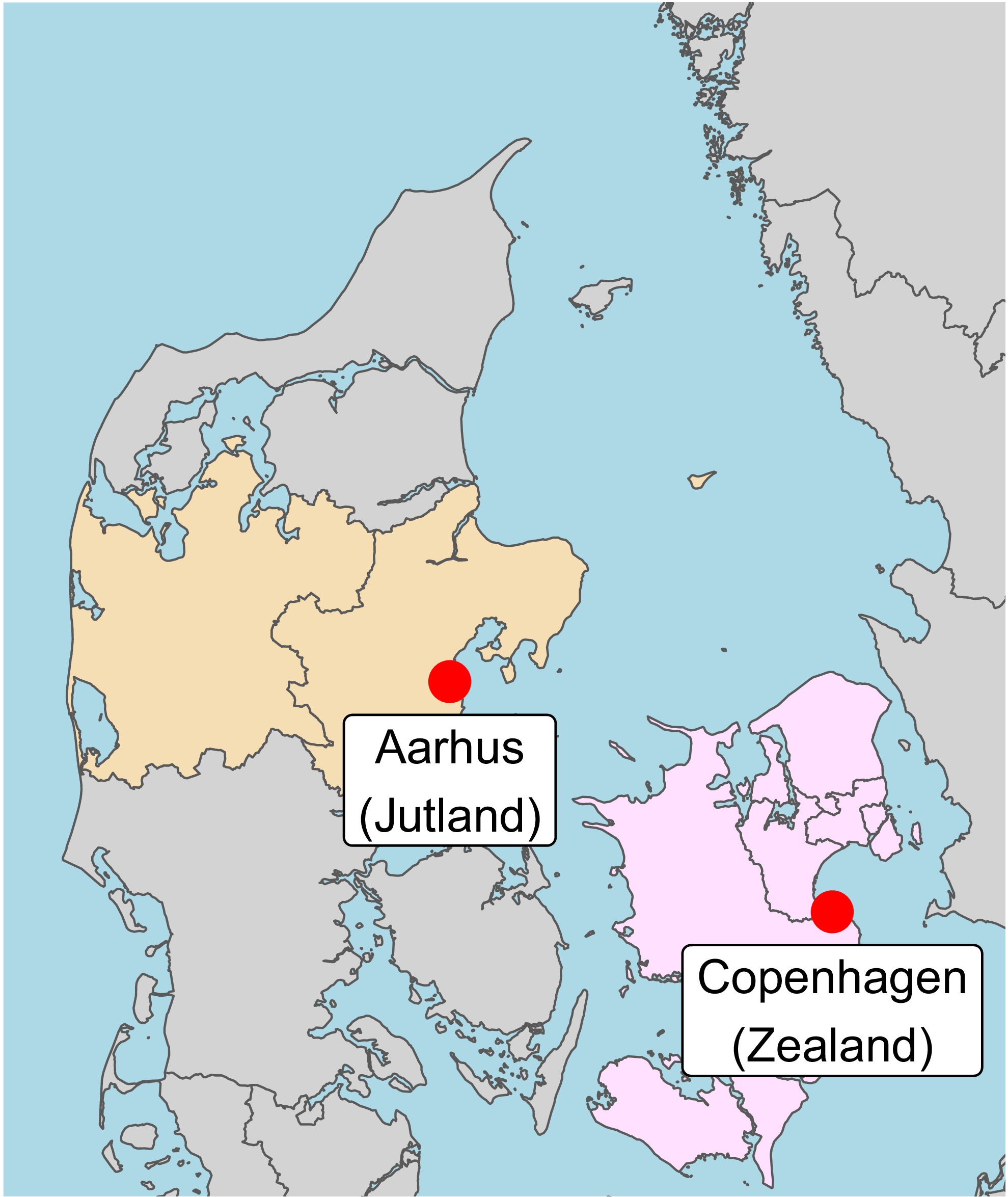
Denmark can be seen in Figure 1, where the two main dialect areas under consideration in this study are colored in. Jutland is the peninsula in Western Denmark; note that Northern Jutland is not colored and is kept out of this study, because we have reason to believe that the laryngeal contrast in stops may be implemented differently here (see e.g. Puggaard-Rode Reference Puggaard-Rode2024a). The colored-in island in Eastern Denmark is Zealand.Footnote 5 Since a few of the speakers recorded for the study are from outside the greater Copenhagen area but distinctly have the stress–pitch peak alignment associated with Standard Copenhagen Danish, we conceptualize this variety instead as Zealand Danish here; see Section 2.2.
Map of Denmark showing roughly the two dialect areas considered in this study (the Jutland peninsula to the west, and the island of Zealand to the east) and highlighting the two cities where recordings took place.

This particular pattern of variation should give rise to a unique opportunity to tease apart the influences of focus and pitch on Cf0. If the previous findings of more extensive Cf0 under focus are actually due to synergistic effects of multiple sources of pitch raising (rather than due to focus), we should find stronger Cf0 effects in Jutland Danish compared to Zealand Danish, at least in syllables without stød, since the focused syllable should co-occur with a pitch peak in Jutland Danish but not in Zealand Danish. However, for reasons which are not entirely clear to us, our speaker sample from Jutland did not display the stress–pitch alignment pattern previously reported in the literature. Speakers from Jutland and Zealand differ in that the pitch peak of Zealand speakers is later, higher, and follows a steeper rise, but the pitch peak of Jutland speakers is rather later than expected, meaning that Cf0 effects do not co-occur exactly with the pitch peak in either group. We discuss this further in Section 3.1. This necessarily means that our discussion of regional differences in Cf0 is somewhat more exploratory than originally planned.
1.3. Research questions
rq1: What will Cf0 look like in a language which contrasts two series of actively devoiced stops? While this has already been tested by Jeel (Reference Jeel1975) and Petersen (Reference Petersen1983) in highly controlled laboratory speech (see Section 1.2.1), it is unclear whether their results will replicate in a larger, more naturalistic study, especially given that the Danish findings conflict with some of the theoretical predictions in the broader Cf0 literature (see Section 1.1.1).
-
• h1a: f0 is raised after both stop series, since both stop series are actively devoiced. The f0 levels following consonants would then be ranked either ⁄p ∼ b⁄ > ⁄m⁄ or ⁄p⁄ > ⁄b⁄ > ⁄m⁄, depending on whether the magnitude of devoicing gestures is expected to have an observable influence on Cf0. The latter option would be in line with the results of Petersen (Reference Petersen1983).
-
• h1b: ⁄b d g⁄ are underlyingly represented as [+voice], which acts as an f0 depressor even if the stops are phonetically voiceless, and the f0 levels following consonants is ranked ⁄p ∼ m⁄ > ⁄b⁄.Footnote 6
-
• h1c: f0 is raised after ⁄p t k⁄, since this is often found after the ‘less voiced’ series of stops in languages with two-way contrasts, regardless of how the contrast is otherwise realized, and the f0 levels following consonants are ranked ⁄p⁄ > ⁄b ∼ m⁄.
rq2: How do focus, global pitch level, and local pitch peak location respectively affect Cf0?Footnote 7 (cp. Section 1.1.2 and Section 1.2.3). The hypotheses below are not necessarily mutually exclusive.
-
• h2a: Cf0 is enhanced in words with high pitch targets in speakers from both Jutland and Zealand, suggesting that the global pitch target affects Cf0 but the differences in implementation of the high pitch target in the two varieties are insufficient to affect Cf0.
-
• h2b: Cf0 is generally enhanced in speakers from Jutland relative to speakers from Zealand in a high pitch environment. This would suggest that Cf0 effects are modulated by their proximity to a local high pitch target, which is closer to the vowel onset in the speakers from Jutland.
rq3: Do lexical demands on pitch level (specifically the stød contrast) affect Cf0? (cf. Section 1.1.2 and Section 1.2.2).
-
• h3a: The magnitude of Cf0 is greater in syllables with stød relative to syllables without stød, i.e. Cf0 strengthens when pitch is high, regardless of the source of high pitch.
-
• h3b: There is attrition of Cf0 in syllables with stød, since the competing demands on the vocal folds allows for less modulation of f0.
-
• h3c: Cf0 is not affected by the stød contrast either way.
2. Methods and materials
2.1. Speech materials
We constructed 132 alternative question sentences of the form Er det dine eller er det mine? ‘Are they yours or are they mine?’. Following Kirby & Ladd (Reference Kirby and Ladd2016), this sentence structure was intended to prompt a high pitch reading of the first alternative (in this case dine ‘yours’) and a low pitch reading of the second alternative (in this case mine ‘mine’). All items of interest occur in both high and low position. The items of interest were crossed to contain all possible combinations of the following variable levels in the stressed syllable:
-
• onset category: nasal, unaspirated, aspirated
-
• place of articulation: bilabial, alveolar
-
• vowel height: high, low
-
• stød: present, absent
The test items all have phonologically long vowels in the stressed syllable.Footnote 8 Most items were disyllabic with stress on the first syllable; a few were trisyllabic, with stress either on the second or the first syllable. For processing purposes, trisyllabic items with stress on the first syllable were analyzed in full, whereas the first syllable (typically a prefix) was ignored in trisyllabic items with stress on the second syllable.
Alternative question sentences were constructed around the test words. Most items contained only one item of interest, in order to ensure that the sentence sounded relatively pragmatically natural, but when feasible, sentences contained two items of interest. The full list of sentences is in the supplementary materials published through the Open Science Framework (DOI: 10.17605/OSF.IO/67SHC).
2.2. Participants
31 speakers of Danish were recorded for the study. Participants were either undergraduate students in linguistics at the University of Copenhagen, or recruited in Aarhus from the extended network of the first author. Several participants had some phonetic training. Participants self-reported their variety of Danish, year of birth, and gender. We explicitly looked for speakers from either Zealand or Jutland, excluding speakers from Northern Jutland (Section 1.2.3). Speakers were subsequently categorized as speakers of either Jutland Danish (n = 17) or Zealand Danish (n = 12); two speakers were excluded from the analysis, as they were late bilinguals with a different first language. The Jutland Danish speakers were predominantly from Eastern Jutland near Aarhus (see Figure 1), but a few came from Central Jutland and Southern Jutland. The Zealand Danish speakers were predominantly from the greater Copenhagen area, although a few came from other places in Zealand. Two participants reported having a bidialectal upbringing; since variation in stress–pitch peak alignment was our reason for this categorization, and both speakers could straightforwardly be assigned to one of these two categories, we include these speakers in the final results. Participants were between 19–34 years old at the time of recording. 19 participants were female, 9 were male, and one was non-binary.
2.3. Recording procedure
Recordings were made in sound-attenuated booths at the University of Copenhagen or Aarhus University. Participants provided demographic information as outlined in the previous section, and signed informed consent forms. The recordings made in Copenhagen were self-supervised after instructions by the third author as part of a course in acoustic phonetics; the recordings made in Aarhus were supervised by the first author. Speakers were seated in front of an omnidirectional microphone (AKG P420 through a Zoom H5 in Aarhus; Sennheiser MKH40 in Copenhagen). Sentence prompts appeared on a computer screen, and speakers were instructed to read as colloquially as possible, and at a natural pace. The first 5 sentences were trial items not used in the analysis, in order to allow speakers to accommodate to the recording device. Sentences were pseudo-randomized, and there was a break in the middle of the recording session. Recordings were made direct to disk at a 44.1 kHz sampling rate using SpeechRecorder, version 6.8.5 (Draxler & Jänsch Reference Draxler, Jänsch, Lino, Xavier, Ferreira, Costa and Silva2004).
2.4. Pre-processing and annotation
Pre-processing, acoustic analysis, and statistical analysis were predominantly done in R (R Core Team 2023). For each speaker, all recordings were concatenated to a single sound file using the tuneR library (Ligges Reference Ligges2023), and sentence-level orthographic annotations were automatically generated in the Praat TextGrid format (Boersma Reference Boersma2001) using the rPraat library (Bořil & Skarnitzl Reference Bořil, Skarnitzl, Sojka, Horák, Kopeček and Pala2016). Recordings were then force-aligned using the DanFA module of the Autophon tool (Young Reference Young2023; Young & McGarrah Reference Young and McGarrah2023; Young & Anikwe Reference Young and Anikwe2024), which implements the Montreal Forced Aligner (McAuliffe et al. Reference McAuliffe, Socolof, Mihuc, Wagner and Sonderegger2017) with a series of pre- and post-processing steps. The force-aligned annotations were split to match the original audio files, and the resulting pairs of audio and annotation files were then converted to an EMU-SDMS database. Subsequent work with the files was done using the emuR interface (Winkelmann, Harrington & Jänsch Reference Winkelmann, Harrington and Jänsch2017).
In order to more precisely delimit the locations of stops, we used the getVOT library (Puggaard-Rode Reference Puggaard-Rode2023) to annotate landmarks associated with pVOT. Prior to this, a bandpass filter was applied with cut-off frequencies of 50 Hz (abrupt) and 10,000 Hz (with a 100 Hz smooth Gaussian filter) using the soundgen library to eliminate an occasional low-frequency rumble and speed up the process. getVOT is a simple utility that automatically searches for those landmarks in the speech signal that are typically manually annotated from inspecting the waveform: a sudden amplitude peak after a period of silence corresponding to the beginning of the release, and the onset of periodicity (operationalized here as increased autocorrelation of the signal) corresponding to the onset of voicing. There are multiple parameters that can be toggled to improve results, but getVOT has a function for automatically estimating optimal parameters from a few (typically less than 10) representative hand-annotated tokens. getVOT may not be as precise as more sophisticated tools such as AutoVOT (Sonderegger & Keshet Reference Sonderegger and Keshet2012) or Dr.VOT (Shrem, Goldrick & Keshet Reference Shrem, Goldrick and Keshet2019), but it has the advantage of being very easy to set up and run, and of interacting directly with EMU-SDMS.
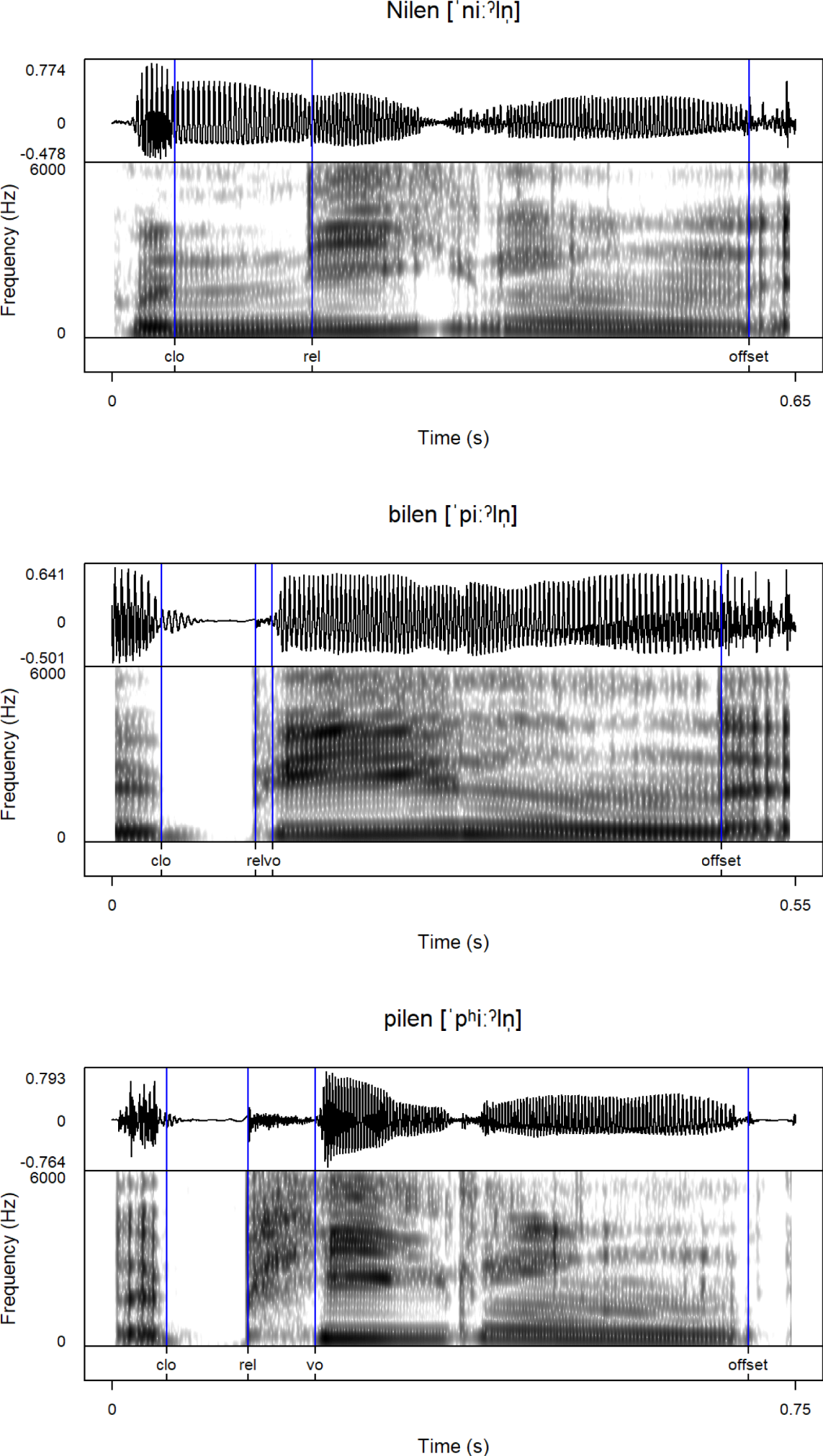
Finally, all relevant boundaries – i.e., the beginning of the closure, the end of the closure, the end of the word, and onset of voicing after ⁄b d p t⁄ – were manually checked and adjusted when necessary, based primarily on visual inspection of the waveform. Examples of the resulting annotations for each segment category can be seen in Figure 2, where clo indicates the beginning of the closure, rel indicates the release, vo indicates the voicing onset, and offset indicates the end of the word.
Examples of annotation landmarks for each segment category. Note that the symbol [ˀ] in the transcriptions indicate stød. Plotted in R using the praatpicture library (Puggaard-Rode Reference Puggaard-Rode, Fougeron and Perrier2024b).

2.5. Acoustic analysis
Durational measures, such as closure duration and pVOT,Footnote 9 are straightforwardly extracted from the annotations described above.
In order to only include pitch measures that we were reasonably certain about, we calculated pitch using a cross-validation method with two distinct pitch tracking algorithms, viz. Praat and REAPER. Pitch was calculated using Boersma’s (Reference Boersma1993) autocorrelation algorithm in Praat, using the emuhelpeR library (Puggaard-Rode Reference Puggaard-Rode2024c) to access the PraatSauce scripts (Kirby Reference Kirby2020) and import the results into EMU-SDMS. Additionally, pitch was calculated using Talkin’s (Reference Talkin2015) REAPER (robust epoch and pitch estimator) algorithm, which first estimates the candidates for the locations of glottal closure instances, and then defines pitch as the distance between ‘winning candidates’ (determined through a dynamic programming procedure). REAPER has been shown to perform particularly well for pathological and creaky speech (Vaysse, Astésano & Farinas Reference Vaysse, Astésano and Farinas2022; White et al. Reference White, Penney, Gibson, Szakay and Cox2022), which is highly relevant here since we measure syllables with stød. A set of custom functions in R were used to call the REAPER utility and import the results into EMU-SDMS.
With both Praat and REAPER, we used the two-pass pitch estimation procedure proposed by Hirst (Reference Hirst, Trouvain and Barry2007) to dynamically estimate suitable pitch floor and ceiling values. This involves first running the algorithms with very liberal pitch floor and ceiling values of 60 Hz and 700 Hz respectively (following recommendations by Hirst & De Looze Reference Hirst, De Looze, Knight and Setter2022). For each speaker, quartiles Q n are calculated from all resulting pitch values, and the algorithms are rerun where the pitch floor is set to ¾ Q 1 and the pitch ceiling is set to ½ Q 3. This method reduces pitch tracking errors close to the edges of a speaker’s register (De Looze Reference De Looze2010). Any f0 measures that fall outside of three standard deviations of a speaker’s mean are treated as a missing value.
To cross-validate the resulting pitch measures, we analyze only measurements from frames where both trackers successfully estimated pitch, and where the estimates are no further than 20% apart. For the remaining frames, we analyze the arithmetic mean of the two pitch estimates. Prior to analysis, the Hz values of trajectories to be analyzed are converted to by-speaker z-scores, and in order to filter out octave jumps, trajectories were removed if they included changes of ±1.5 z between any adjacent measures. While octave jumps may well reflect sudden shifts in the rate of vocal fold vibration (Talkin Reference Talkin, Bastiaan Kleijn and Paliwal1995; Watkins, Boersma & Hamann Reference Watkins, Boersma, Hamann, Lapidot and Gannot2024), we opt to filter them out here since such sudden shifts cannot be adequately modelled using the statistical methodology presented below.
In total, 4,168 pitch trajectories were analyzed, yielding a total of 280,767 pitch frames, of which 44,879 contain missing values. Missing values are typically found in words with stød, or in the phrase-final low pitch condition where we often find some degree of phrase-final creak (especially in items that also have stød). A few items also have obstruent onsets in the post-tonic syllable, which are typically voiceless.
2.6. Determining the domain of analysis
Recall from Section 1.1.1 that Xu & Xu (Reference Xu and Xu2021) have proposed that pitch trajectories are always synchronized to full syllables, and as a result, studies of Cf0 should compare trajectories starting at the syllable onset and not at the onset of voicing to avoid overestimating Cf0 effects.Footnote 10 In order to evaluate whether the syllable onset or the onset of voicing is the optimal starting point for comparing pitch trajectories in the present study, we carried out some exploratory analyses.
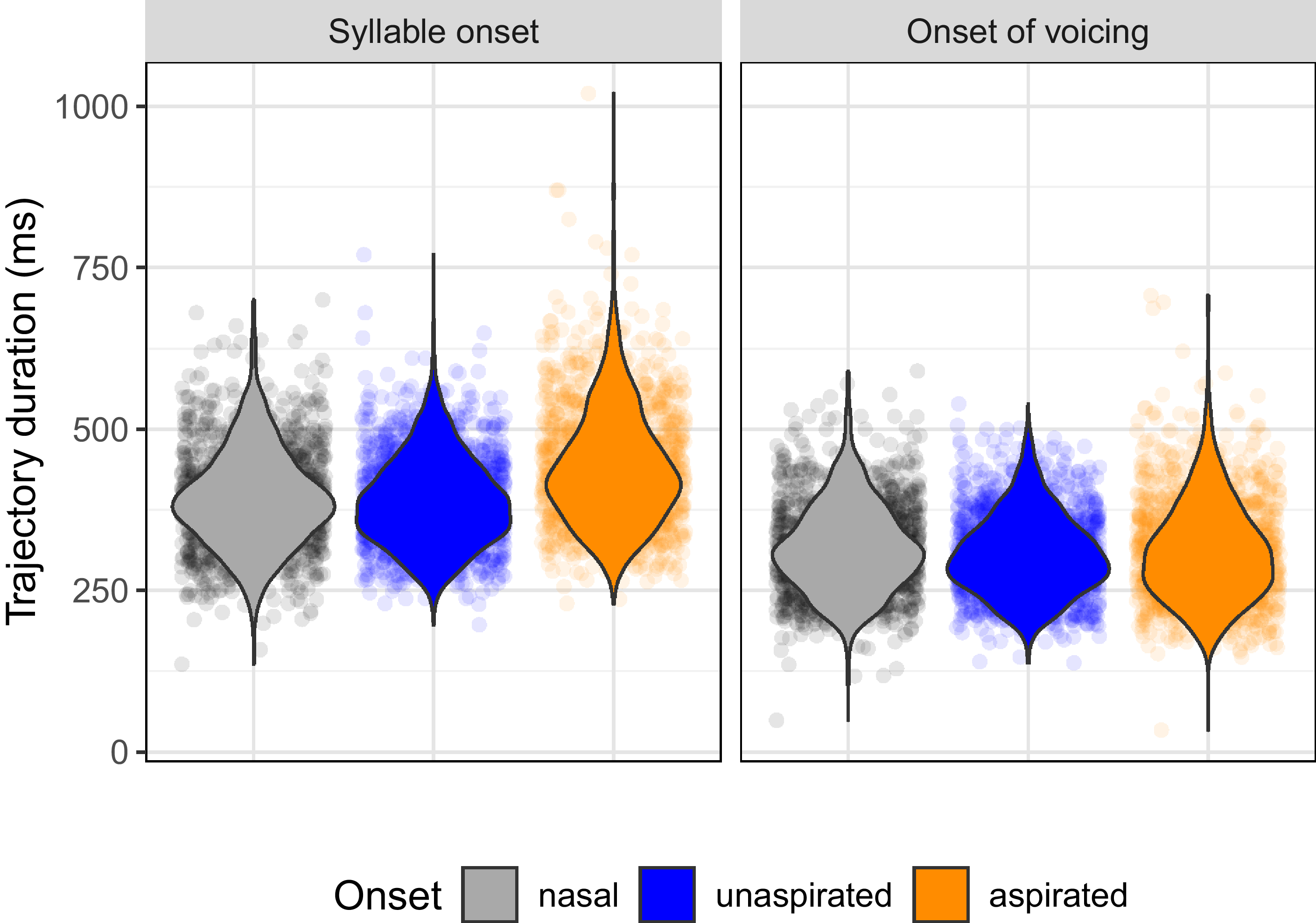
First, we checked whether the total durations of our words – i.e., the duration of trajectories beginning at the syllable onsets – are roughly comparable across our onset categories. The word durations with nasal and unaspirated onsets are very similar (means = 391 ms and 388 ms, respectively), but words with aspirated onsets have systematically much longer durations (mean = 440 ms). The mean vowel durations, on the other hand – i.e., the duration of trajectories beginning at the onset of voicing – are roughly comparable across onset categories (nasals = 314 ms, unaspirated = 304 ms, aspirated = 310 ms). The distributions of trajectory durations using different landmarks are shown in Figure 3. This intuitively makes it seem likelier that pitch peaks are also timed to the onset of voicing.
Violin plots showing the distributions of trajectory durations depending on which landmark is chosen to represent the beginning of the trajectory. Points show individual trajectory durations.

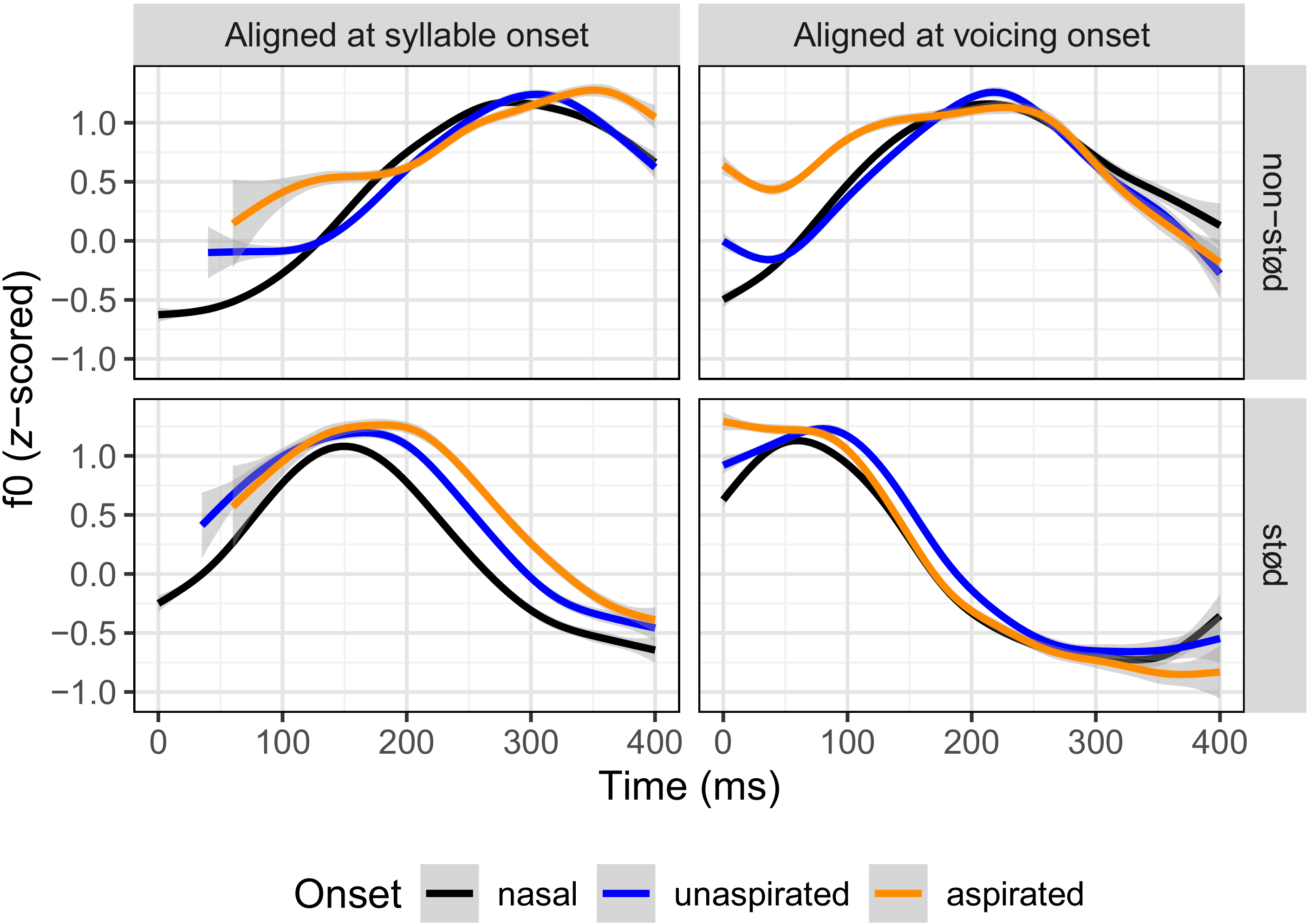
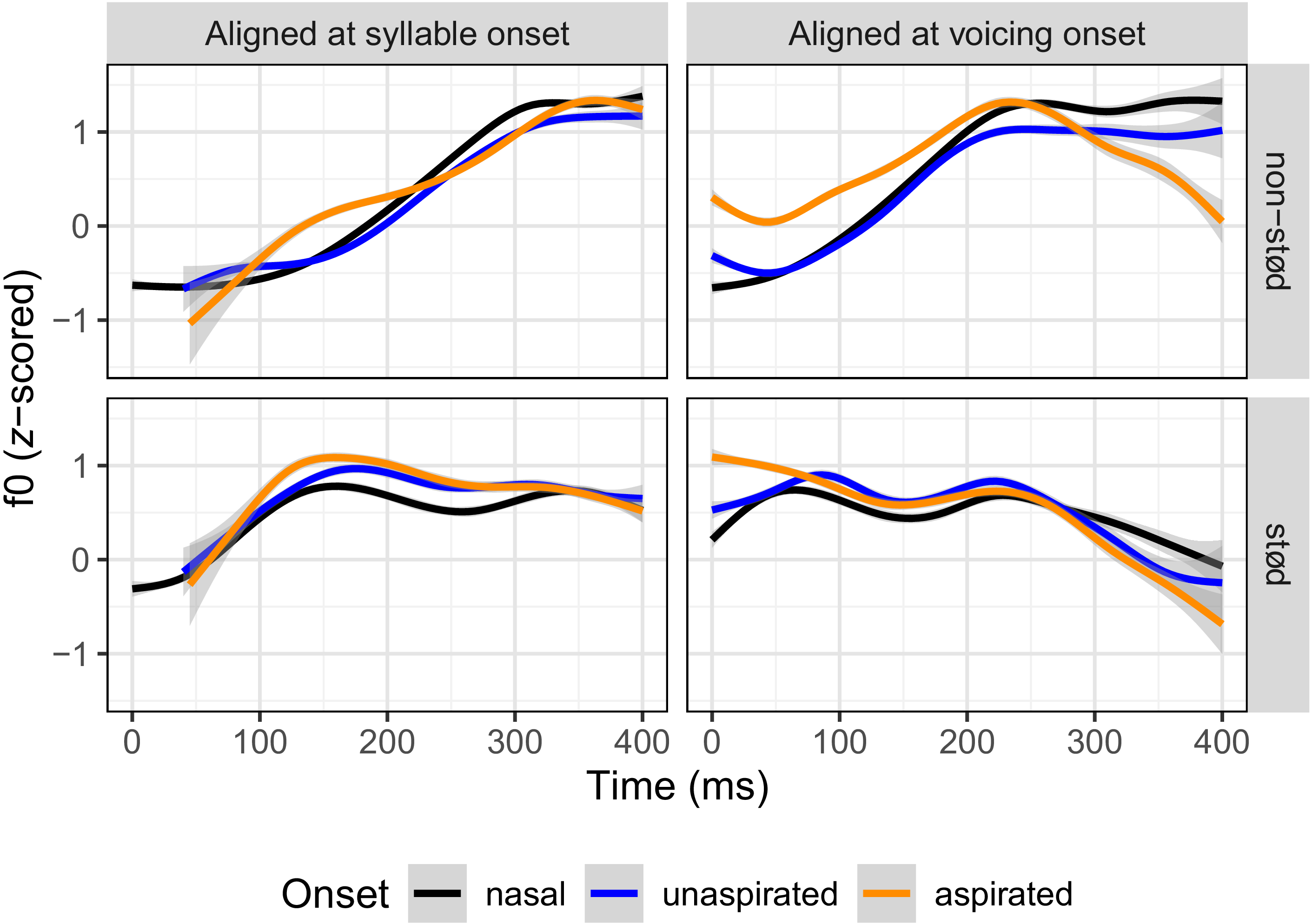
To check whether this is indeed the case, we plot some representative smoothed average f0 trajectories on a raw time scale. Figure 4 shows trajectories of the words in the high pitch condition in the subgroup of speakers from Jutland, and Figure 5 shows corresponding trajectories in the subgroup of speakers from Zealand. The figures show that, on a raw time scale, prominent peaks and valleys are systematically misaligned across onset categories if trajectories begin at the syllable onset, but they align better after an initial perturbation if trajectories begin at voicing onset. The figures also show across the board that any initial Cf0 effects in ⁄p t k⁄ would be obscured if trajectories begin at the syllable onset due to variation in pVOT – this is what causes the initially very large confidence intervals in the left columns of the figures. Note that final confidence intervals are large because a number of trajectories are shorter than 400 ms.
Smoothed f0 trajectories over raw time in different conditions with different landmarks conditioning the beginning of the trajectory. Trajectories are smoothed using separate generalized additive models. Based on Jutland speakers and words in the high-pitch condition.

Smoothed f0 trajectories over raw time in different conditions with different landmarks conditioning the beginning of the trajectory. Trajectories are smoothed using separate generalized additive models. Based on Zealand speakers and words in the high-pitch condition.

2.7. Statistical analysis
The research questions posed in Section 1.3 are all statistically tested using a generalized additive mixed model (GAMM). GAMMs are highly suitable for modelling data that change over time (Wieling Reference Wieling2018), and they have been widely used in the past few years for modelling pitch data, including in studies of Cf0 (e.g. Kirby, Pittayaporn & Brunelle Reference Kirby, Pittayaporn and Brunelle2022; Ting et al. Reference Ting, Clayards, Sonderegger and McAuliffe2025). The advantage of using GAMMs over traditional linear mixed-effects regression models in the analysis of time series is that GAMMs do not restrict the relationship between predictor and response variables to be linear; GAMMs can model data that vary dynamically in time, i.e. complex contour shapes. In this approach, non-linear (or smooth) effects are predicted by fitting the data to a series of basis functions (or splines). We fit GAMMs using the mgcv library in R (Wood Reference Wood2017), which provides a very flexible framework for selecting and combining basis functions, and for penalizing overfitting.
The model is fitted using fast restricted maximum likelihood estimation with discretized values for covariates to decrease computing load (Wood et al. Reference Wood, Li, Shaddick and Augustin2017), and using the scaled-t error distribution to account for heavy-tailed residuals. The residuals of the final model are approximately normal, although somewhat platykurtic. The temporal dynamics of f0 is modeled with thin plate regression spline smooths (Wood Reference Wood2003; Wieling Reference Wieling2018) using 10 basis functions, where time is normalized to a 0–1 scale; separate f0 contours are modeled for all levels of the four-way interaction between the variables onset, pitch condition, stød and regional variety. The model further includes this same four-way interaction as well as vowel height as parametric, i.e. time-invariant, predictors.Footnote 11 The model is fitted with a maximal random effects structure, including by-speaker and by-item factor smooths (the non-linear equivalent to random slopes) for each logically meaningful combination of the variables. To decrease computing load, factor smooths are fitted with first-order penalty differences and are smoothed using only five basis functions.
Skipping over most implementation details, the model can be summarized as

where α denotes the intercept, E denotes the residual error, i indexes each observation, j indexes each speaker, and k indexes each item. A typical problem with time series analysis is residual autocorrelation stemming from the high degree of similarity between adjacent measures in time series. We manage this problem by modulating the error of each observation e i by the error of the preceding observation e i-1 by a factor of ρ; this is referred to as an AR(1) error model (Baayen et al. Reference Baayen, Rij, Cat, Wood, Speelman, Heylen and Geeraerts2018; Wieling Reference Wieling2018). Following e.g. Wieling et al. (Reference Wieling, Tomaschek, Arnold, Tiede, Bröker, Thiele, Wood and Harald Baayen2016), ρ is a fixed value equivalent to the average residual autocorrelation of adjacent measures in a nested model with no correction. Residual autocorrelation in the corrected model is negligible. A more ideal solution would be to fit the model with by-trajectory factor smooths, which preserves the identity of trajectories in the model and dispenses with the assumption that the degree of autocorrelation is constant (Sóskuthy Reference Sóskuthy2021); however, fitting such a model proved to be computationally infeasible.
It is not straightforward to test hypotheses from the non-parametric components of GAMMs. The F-test provided by the mgcv library essentially tests the significance of the spline fitting procedure (Wood Reference Wood2013), which is typically not something phoneticians have hypotheses about. In this study, hypothesis testing is done through pointwise comparisons of relevant model-predicted trajectories with random effects removed (so-called ‘difference smooths’), using the itsadug library (van Rij et al. Reference van Rij, Martijn Wieling, Baayen and Rijn2022). For each level of the stød : condition : variety interaction, both series of stops are compared to the nasal baseline in this manner. Comparisons are considered significant at time points where the predicted 95% confidence intervals of difference smooths do not overlap, which provides a direct estimate of the temporal extent of perturbation from the nasal baseline. This further provides a direct estimate of the magnitude of perturbation relative to the nasal baseline, for either series of stops for each level of the interaction. When we discuss the ‘magnitude’ of Cf0 effects in different conditions below, it refers to the temporal extent and/or magnitude of perturbation from the nasal baseline as estimated by the GAMM.
3. Results
3.1. Exploratory analysis
Before proceeding to the statistical analysis of Cf0 in Section 3.2, in this section we first present some brief data exploration.
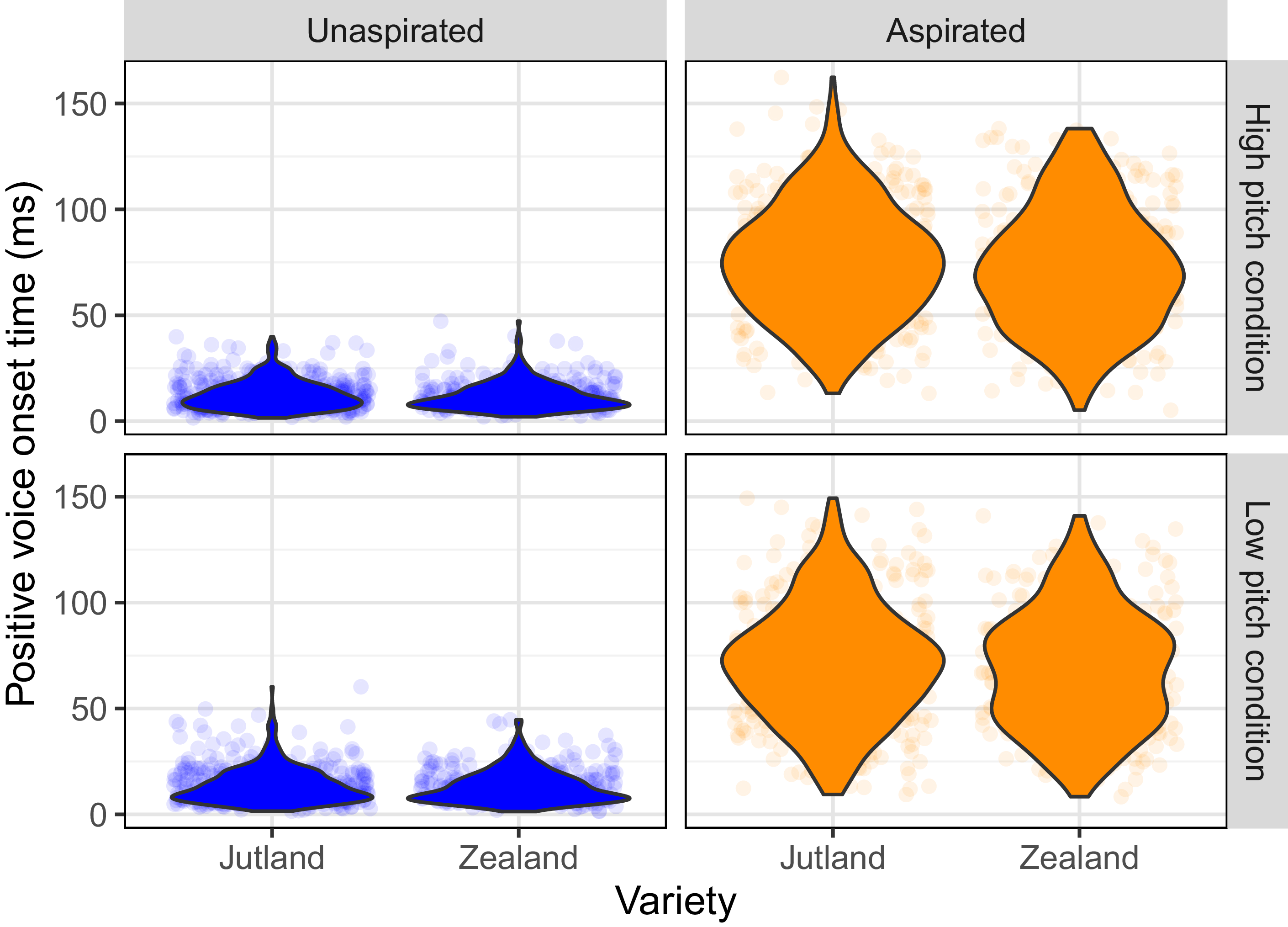
A core assumption of rq2 is that the aspiration contrast is comparable in speakers from Jutland and Zealand; if this contrast differs in these two varieties, it would potentially be a major confound. As proxies for this, we plot the distributions of pVOT in Figure 6. The plots show that pVOT is quite similar across varieties; aspirated stops are slightly longer in Jutland varieties, but the difference is below 5 ms on average. We also facet this by sentence position, to check whether there are major pVOT differences between words in the high and low pitch condition, for example due to phrase final lengthening. It appears that pVOT is very similar across conditions.
Violin plots showing the distributions of positive voice onset time values by onset category, sentence position, and variety.

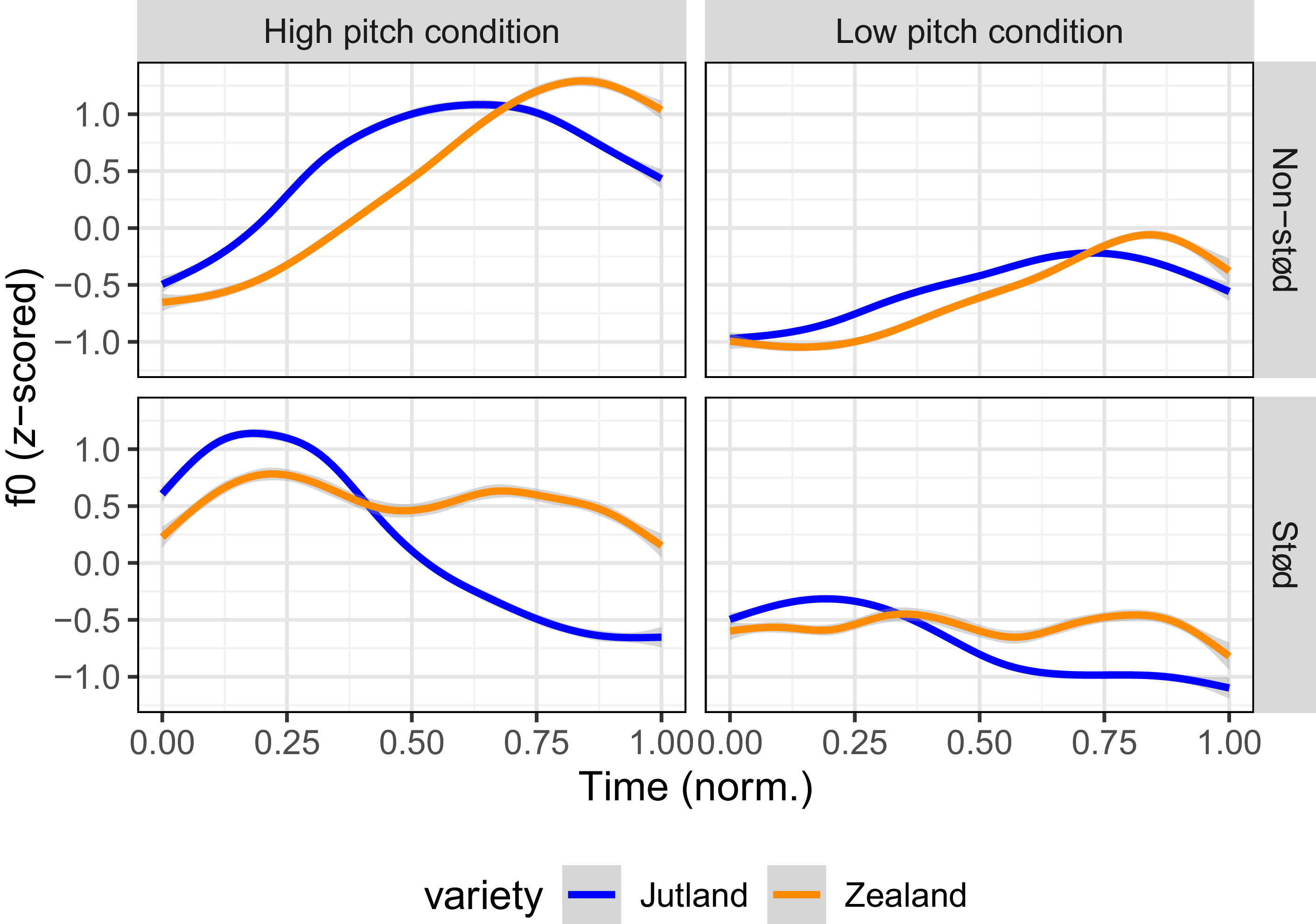
Both rq2 and rq3 rely on specific assumptions about the baseline pitch contour when combining sentence position, the voice quality contrast, and regional varieties. To this end, we plot the f0 trajectories of items with nasal onsets in all those combinations in Figure 7. As already mentioned in Section 1.2.3 above, the pitch peak in Jutland Danish does indeed fall earlier than in Zealand Danish, but the two trajectories are more similar than expected from previous descriptions. There is, however, an earlier and more prominent rise in the tonic syllable among the Jutland speakers. We cannot straightforwardly make judgments about syllable boundaries from Figure 7, so it is not clear whether the pitch peak in both varieties generally falls in the post-tonic syllable.
Smoothed f0 trajectories of words with nasal onsets showing combinations of the sentence position, voice quality contrast, and regional variety. Trajectories are smoothed using separate generalized additive models.

The bottom row of Figure 7 shows that the pitch onset is higher in syllables with stød, and that pitch rises slightly and then drops. This is the case in both varieties, but pitch both rises and drops much more dramatically in Jutland Danish. This is in line with the findings of Kyst (Reference Kyst2008) and Siem (Reference Siem2023a) that stød in Jutland Danish is predominantly tonal, while in Zealand Danish there is a voice quality component which may not be captured in Figure 7. In any case, it is clearly the case – in both varieties, but more so in Jutland Danish – that syllables with stød place constraints on the vocal folds that may either strengthen or weaken Cf0 effects, following rq3. It is the case across the board that trajectories in the low pitch condition have similar shapes to the high pitch condition, but with a clear difference in pitch level and the scope of the excursions.
3.2. Co-intrinsic f0
The research questions posed in Section 1.3 are tested with the GAMM that was presented in Section 2.7. The model has a high effect size of R 2 = 0.64. We do not explore the parametric coefficients of the model in any detail, as they are all control variables, and generally taken into account in the plots below. It is worth mentioning here that all dynamic model terms are highly significant, that most levels of the parametric four-way interaction also differ significantly from the model intercept (i.e., they exert a constant influence on pitch level), and that high vowels are predicted to raise pitch by 0.29 standard deviations or approximately 16 Hz (SE = 0.02, t = 12.02, p < .001).Footnote 12 The influence of vowel height is somewhat smaller than that reported in a previous study by Petersen (Reference Petersen1978b), likely because that study focused particularly on corner vowels whereas the present study includes also mid-high and mid-low vowels; the results are closely aligned with a cross-linguistic meta-analysis which found a difference of 15.3 Hz on average between f0 in high and low vowels (Whalen & Levitt Reference Whalen and Levitt1995).
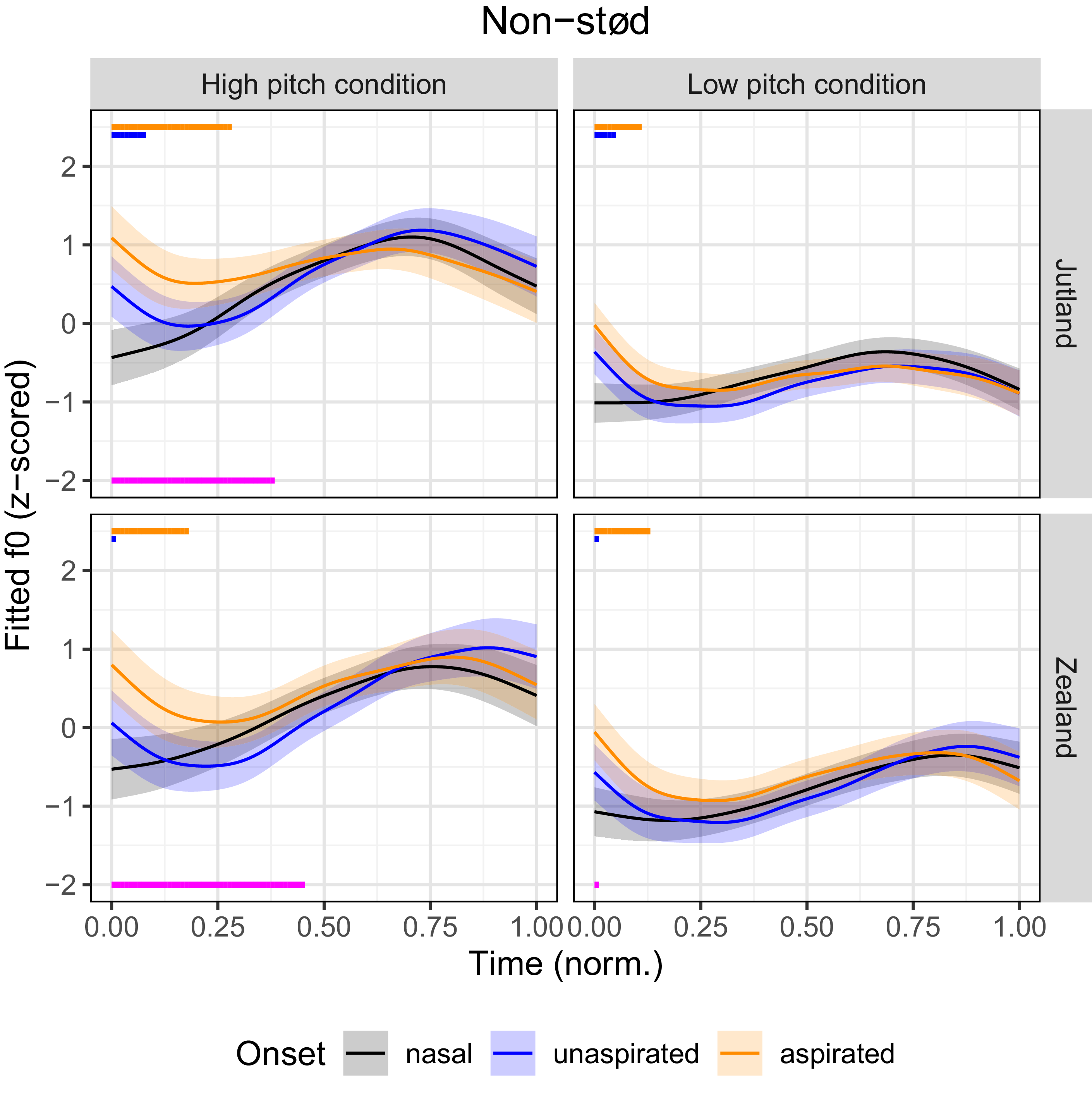
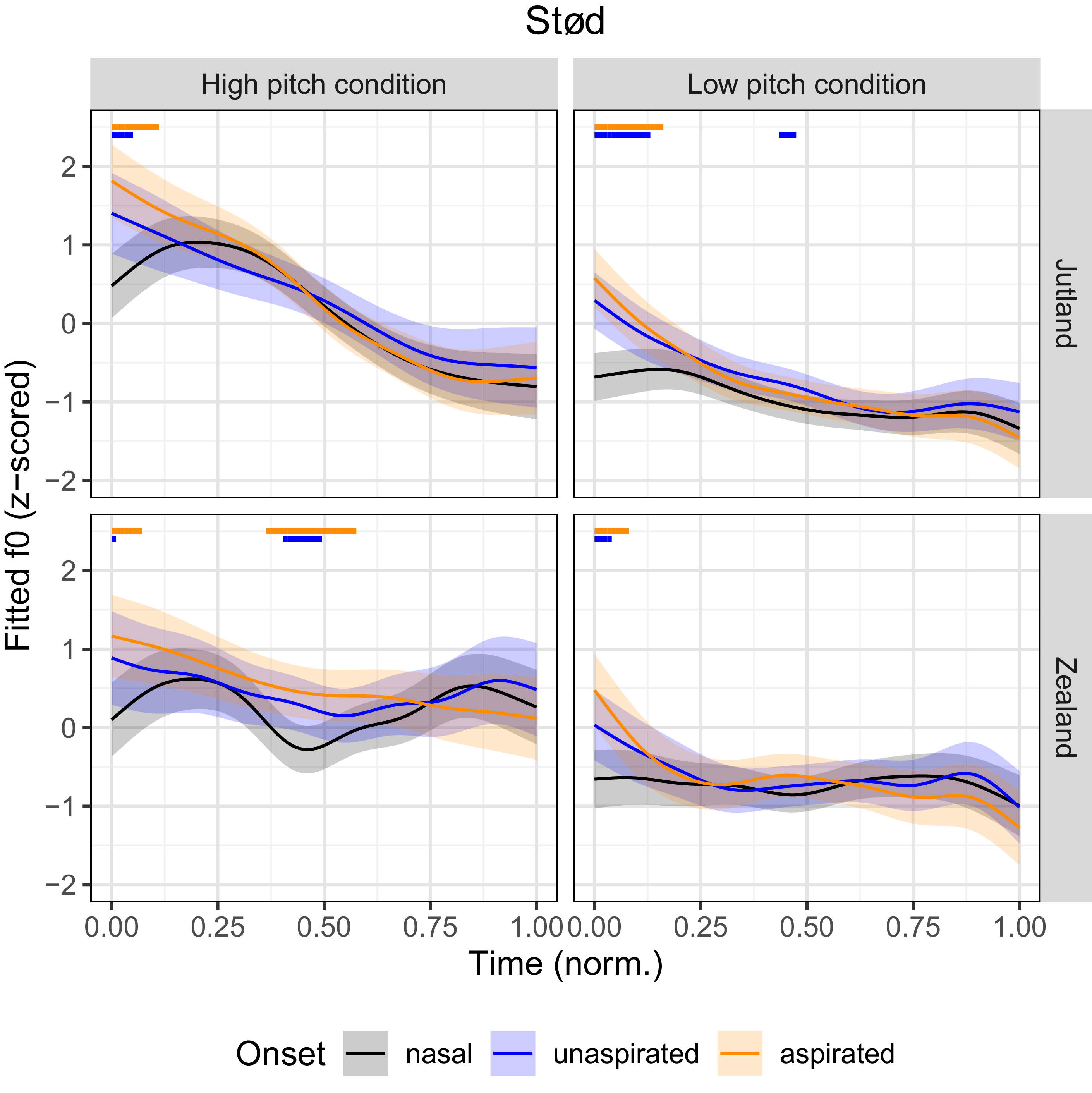
All model-predicted trajectories are shown in Figures 8–9. Both plots are faceted by sentence position and variety, such that the high pitch condition is shown in the left column and the low pitch condition in the right column, and speakers from Jutland are shown in the top row and speakers from Zealand in the second row. Lines are colored by onset category, and in addition to the predicted values, the plots also show pointwise 95% confidence intervals. The straight lines at the top of each plot indicate parts of trajectories that are significantly higher than the nasal baseline, whereas the lines at the bottom of each plot indicate parts of trajectories where the f0 after aspirated stops are significantly higher than their unaspirated counterparts.Footnote 13 Figure 8 shows words without stød, and Figure 9 shows words with stød.
Model predicted f0 trajectories with 95% confidence intervals of words without stød, faceted by focus condition and variety and colored by onset category. Straight lines at the top of each facet indicate parts of trajectories that are significantly above the nasal baseline, and straight lines at the bottom of each facet indicate parts of aspirated trajectories that are significantly higher than unaspirated trajectories.

Model predicted f0 trajectories with 95% confidence intervals of words with stød, faceted by focus condition and variety and colored by onset category. Straight lines at the top of each facet indicate parts of trajectories that are significantly above the nasal baseline.

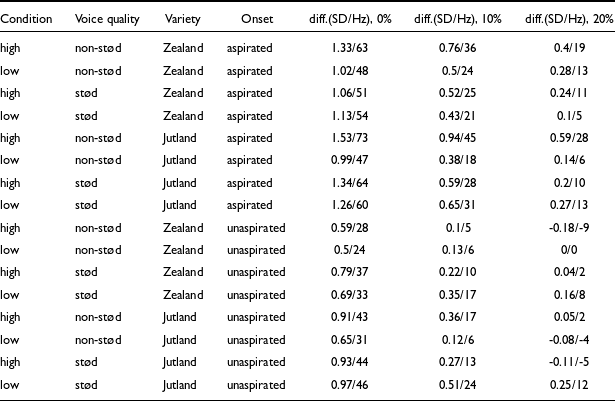
Table 1 gives the predicted f0 differences between stops and nasals in different conditions and at different points in time; note that the trajectories are approximately 312 ms long on average, so the reported differences 20% into the trajectory correspond to differences just above 60 ms after the onset of voicing on average. The f0 differences are given both in terms of standard deviations and in terms of approximate Hz values, estimated by converting the z-scores back to raw frequency using the global mean in the data.
Model-predicted f0 differences between stops and nasals in different conditions at different points in normalized time.

Table 1. Long description
The table presents model-predicted f0 differences between stops and nasals in different conditions at different points in normalized time. It has 20 rows and 6 columns. The columns are labeled Condition, Voice quality, Variety, Onset, diff.(SD/Hz), 0%, diff.(SD/Hz), 10%, and diff.(SD/Hz), 20%. The rows list different combinations of conditions, voice qualities, and varieties, along with their corresponding onset and f0 differences at 0%, 10%, and 20% points in normalized time. The table includes data for both aspirated and unaspirated stops in Zealand and Jutland varieties, under high and low conditions, and with standard and non-standard voice qualities.
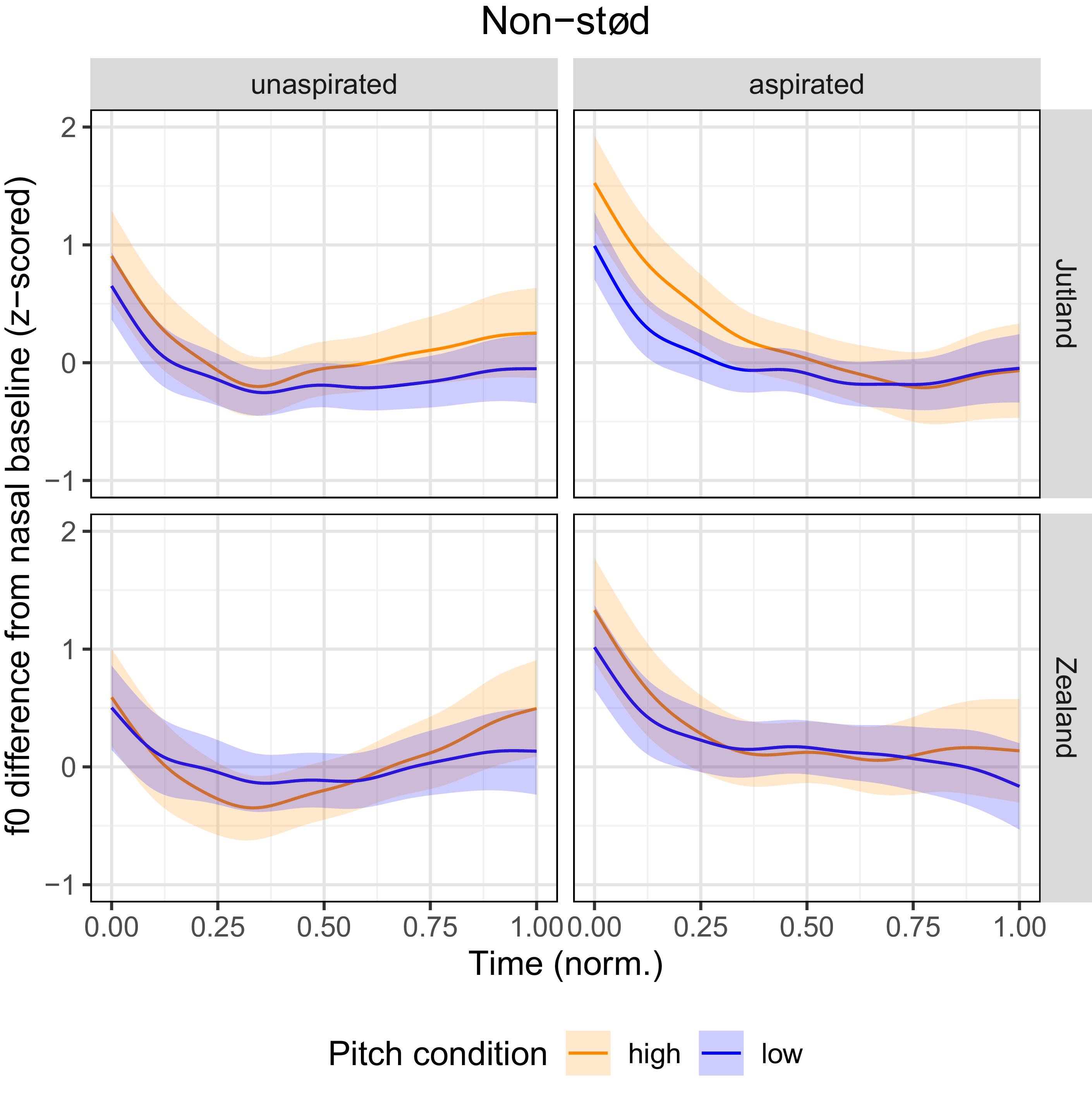
Model predicted Cf0 differences (i.e., within condition differences between stops and nasal baseline) with 95% confidence intervals of words without stød, faceted by stop category and variety and colored by pitch condition.

The results show that both unaspirated and aspirated stops cause Cf0 effects in all conditions, although of differing magnitude and temporal extent. Immediately following unaspirated stops, f0 is closer to the equivalent position following aspirated stops than following nasals in all conditions. Unaspirated stops display Cf0 effects of smaller magnitude and shorter temporal extent; this is empirically the case across all conditions, but for some conditions, the difference between the two stop series is negligible and not significant at any point in the trajectories. Among Zealand speakers, the Cf0 effects of unaspirated stops are very short-lasting in all conditions.
If we consider words without stød, the predicted Cf0 effects have a greater magnitude and longer temporal extent in the high pitch condition. Differences in temporal extent can be seen in Figure 8, while differences in magnitude of the Cf0 effect are shown in Figure 10, which shows the within-condition differences between the two stop classes and nasals within the same condition as estimated by the GAMM. Interestingly, in the non-stød condition, the significant differences between the two stop series actually last longer than the difference between either stop series and nasals, presumably because f0 dips below the nasal baseline after the initial Cf0 effects. This is the case for both Jutland and Zealand speakers, although in aspirated stops, the temporal attrition of Cf0 effects in the low pitch condition is clearly more extensive for Jutland speakers. The magnitude of Cf0 effects is empirically different in the high and low pitch condition except in the case of Zealand speakers’ unaspirated stops, although the differences are most extensive by far in Jutland speakers’ aspirated stops.
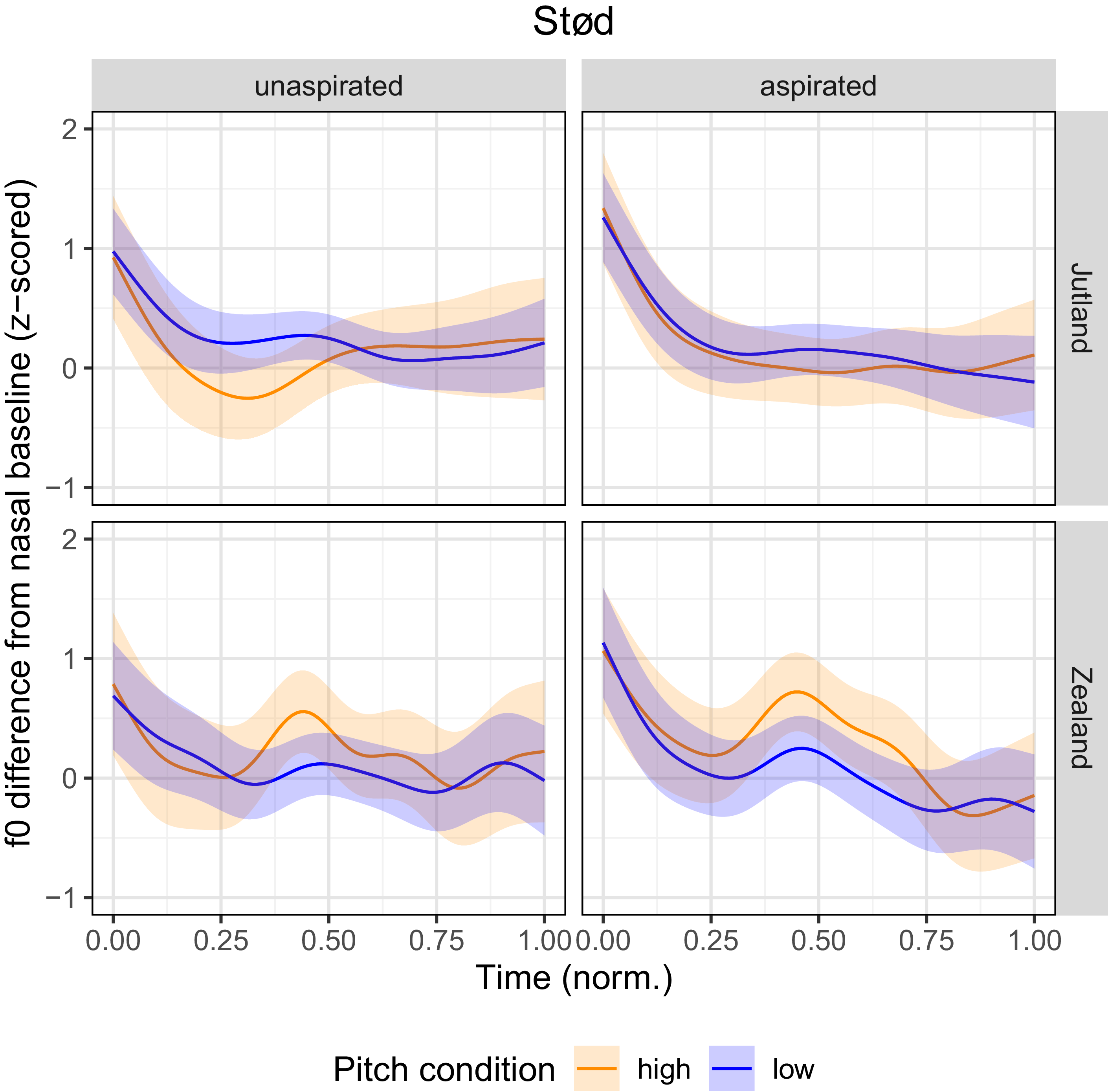
The situation is different in words with stød (see Figure 11). Here, there is no obvious across-the-board attrition of Cf0 effects in the low pitch condition. In fact, if anything, Cf0 effects tend to last somewhat longer in the low pitch condition, although the magnitude of the effects is not greater in the low pitch condition (as shown in Figure 11). When comparing focused words with and without stød, Cf0 effects of aspirated stops in particular last much shorter in words with stød, and the magnitude of effects in aspirated stops is also somewhat smaller, again particularly for the Jutland speakers. While Cf0 effects still last longer in aspirated stops than unaspirated stops, the two trajectories never differ significantly from each other in syllables with stød.
Model predicted Cf0 differences (i.e., within condition differences between stops and nasal baseline) with 95% confidence intervals of words with stød, faceted by stop category and variety and colored by pitch condition.

Note that in the stød words of Zealand speakers in the high pitch condition, words with nasal onsets appear to have an f0 dip about halfway through the trajectory that words with obstruent onsets do not share. The global pitch shape in general appears simpler in words with obstruent onsets. We have no hypotheses about why this is, nor explanations of it, and will not discuss it any further; it may be due to pitch tracking issues during the stød phase proper, which is after all expected to be much less modal among speakers from Zealand than speakers from Jutland.
In the following section, we will discuss the theoretical implications of these findings in light of the research questions and hypotheses posed in Section 1.3.
4. Discussion
In this section, we discuss our findings in light of our three research questions in turn: in Section 4.1, we consider Cf0 in a language with two series of voiceless stops, and whether this can tell us anything about general mechanisms of Cf0 in light of existing studies of how the Danish laryngeal contrast is implemented; in Section 4.2, we attempt to tease apart the influence of high pitch and focus on Cf0; and in Section 4.3, we discuss how competing demands on the larynx influence Cf0.
4.1. Multiple series of voiceless stops and Cf0
Across all contexts and varieties tested in this study, we find raised f0 after stop releases relative to a neutral baseline, and we find more raising after aspirated stops, i.e. ⁄p⁄ > ⁄b⁄ > ⁄m⁄, where the difference between two stop series and the nasal is generally greater than the difference between the two stop series. These findings reproduce the results of Petersen (Reference Petersen1983) in a greater range of contexts and with more naturalistic data. The findings are in line with h1a (devoicing generally raises f0) and provide clear evidence against h1b (a phonological [+voice] specification in ⁄b d g⁄ lowers f0).
As such, the results support accounts of Cf0 as a predominantly physiological effect of gestures that inhibit voicing; this is captured in the phonological proposal by Goldstein & Browman (Reference Goldstein and Browman1986), where the laryngeal contrast is underlyingly represented with continuous gestural scores. This proposal is also consistent with the intervocalic voicing patterns for Danish discussed by Puggaard-Rode et al. (Reference Puggaard-Rode, Horslund and Jørgensen2022). The ranking and internal relationships among segment categories in terms of Cf0 are similar to recent results from Mandarin Chinese (Luo Reference Luo2018; Lo Reference Lo2022), another language which contrasts two series of voiceless stops and where intervocalic voicing is comparatively infrequent (Shih, Möbius & Narasimhan Reference Shih, Möbius, Narasimhan, Ohala, Hasegawa, Ohala, Granville and Bailey1999; Deterding & Nolan Reference Deterding, Nolan, Trouvain and Barry2007).Footnote 14
Goldstein & Browman (Reference Goldstein and Browman1986) do not offer many specific details about how this mechanism would work in practice. Löfqvist et al. (Reference Löfqvist, Baer, McGarr and Seider Story1989) propose that Cf0 in English and Dutch follows explicitly from tensing of the cricothyroid muscle, which is implicated in both f0 control and enforcing voicelessness. Hutters (Reference Hutters1985) measured the cricothyroid activity in Danish stops using EMG, and her results hint that the cricothyroid is essentially in rest position during the production of ⁄b d g⁄, while activity is slightly increased in ⁄p t k⁄. While she only has stable measurements from a single speaker, this certainly suggests that cricothyroid tensing is not the main driver of devoicing in Danish stops, and that if Cf0 is primarily caused by cricothyroid tensing, we would expect to see relatively limited effects after Danish ⁄p t k⁄ and no effects at all after ⁄b d g⁄.
A clear main driver of devoicing in the production of Danish stops is glottal spreading, accomplished by tensing the posterior cricoarytenoids and suppressing activity in the interarytenoids (Hutters Reference Hutters1985). Another potential driver, according to Hutters (Reference Hutters1985) and following e.g. Hirose, Lee & Ushijima (Reference Hirose, Lee and Ushijima1974), is suppressed activity in the vocalis muscle, which may reduce slackness in the vocal folds and hence impede voicing. Danish stops show an abrupt increase in vocalis activity approaching the vowel onset; as mentioned in Section 1.1.1, Hoole (Reference Hoole2006) discusses this as a possible mechanism behind Cf0 (see also Chen Reference Chen2011). While Hutters (Reference Hutters1985) finds evidence of this pattern of vocalis activity in both series of stops, it is especially clear in ⁄p t k⁄, which is in line with differences in magnitude and temporal extent of the reported Cf0 effects. Several studies have found a correlation between vocalis tension and f0 (e.g. Hirano, Ohala & Vennard Reference Hirano, Ohala and Vennard1969; Atkinson Reference Atkinson1978; Kempster, Larson & Kistler Reference Kempster, Larson and Kistler1988), although the correlation is generally weaker than that between the cricothyroid and f0. According to Titze’s body–cover model of pitch control (e.g. Titze, Jiang & Drucker Reference Titze, Jiang and Drucker1988; Titze Reference Titze1994), the cricothyroid and vocalis jointly control f0, and in the regular pitch range for speech, increased tension of the vocalis uniformly serves to increase f0. This suggests that abrupt increase in vocalis activity drives Cf0 in Danish, but of course does not negate that the cricothyroid is a driver of Cf0 in languages where that muscle is also the main driver of devoicing; the cricothyroid and the vocalis can both contribute to devoicing (although in different ways), so it is very much in line with the prediction of Goldstein & Browman (Reference Goldstein and Browman1986) that they can both contribute to Cf0 effects.
After aspirated stops, f0 is raised relative to sonorants in languages like English, German, and Swedish, as well as Danish, but as mentioned in Section 1.1.1 above, the situation is often different in languages with more complex laryngeal contrasts in stops. For example, f0 is lowered after aspirated stops in languages with four-way contrasts like Nepali and Bengali, and in Kurtöp, which has a three-way contrast, f0 appears to be raised after aspirated stops but less so than after plain voiceless stops (Hyslop & Plane Reference Hyslop and Plane2024). On a similar note, syllable final ⁄h⁄ has been shown to correlate with f0 lowering in the preceding vowel in some languages, like Arabic and Itunyuso Trique (Hombert et al. Reference Hombert, Ohala and Ewan1979; DiCanio Reference DiCanio2012), whereas in other languages, e.g. Eastern Khmu, it correlates with f0 raising (Kirby et al. Reference Kirby, Puggaard-Rode, Burroni, Maspong, Chen, Chen and Arvaniti2024). The fact that the influence of aspiration on f0 varies so much depending on the phonological role of aspiration in the language arguably makes it unlikely that aspiration – either in terms of physiology or aerodynamic side effects – is a main driver of Cf0, in Danish or elsewhere. Rather, the various Cf0 effects of aspirated stops are likely the result of other concomitant laryngeal gestures tied to the suppression of voicing (such as cricothyroid tensing, or suppression followed by rapid activation of the vocalis).
It should be noted that a short f0 rise after voiceless unaspirated stops has also sometimes been noted in languages where there is no indication of an active devoicing gesture, predominantly English (Ohde Reference Ohde1984; Hanson Reference Hanson2009; Xu & Xu Reference Xu and Xu2021), but also at least empirically in some varieties of German (Pöhnlein & Kleber Reference Pöhnlein and Kleber2023). Xu & Xu (Reference Xu and Xu2021) suggest that such an initial peak is found because the very first glottal cycles involve only the outer layer of the vocal folds, which vibrate at a higher natural frequency than the main vocal folds due to smaller mass, triggering f0 generated at the falsetto register. This is arguably unlikely to be the explanation for the Danish findings presented here, as it is unlikely that our cross-validation method for pitch tracking will have picked this up; Praat’s autocorrelation method (using standard settings which penalize rapid changes in the predicted pitch contour) is probably not well-suited for capturing one or very few initial glottal cycles that are very different from subsequent cycles.
Notably, the situation in Swiss German is quite similar to Danish, since this language also contrasts (at least) two series of voiceless stops: voiceless short (or lenis) unaspirated, voiceless long (or fortis) unaspirated, and in subsets of the lexicon, voiceless aspirated (see Ladd & Schmid Reference Ladd and Schmid2018). Zebe-Sheng et al. (Reference Zebe-Sheng, Watter, Schmid and Robert Ladd2025) show that long unaspirated and aspirated stops have a similar influence on f0, while the raising effect of short unaspirated stops has a smaller magnitude and shorter duration. It is unclear whether these effects are caused by the same mechanisms as in Danish, since less is known about mechanisms of devoicing in Swiss German, but in any case, these results are also in line with our h1a, i.e. that devoicing generally raises f0.
4.2. Cf0, focus, and pitch targets
The design of the current study was motivated by studies, predominantly from the 1980s, showing that the pitch peak placement in a stress group falls much earlier in Jutland Danish than Copenhagen Danish. While we do find an earlier pitch peak in Jutland Danish, both speaker groups appear to have some degree of peak delay in the current study. This may be due to incipient change that causes Jutland Danish to approach Standard Copenhagen Danish, but we cannot say this with any degree of certainty.
Target f0 appears to be relatively low in the beginning of stressed syllables in both varieties. Even so, Cf0 effects are enhanced (i.e., greater in magnitude and temporal extent) when there is a global intonational high pitch target – at least in words with modal voice, i.e. words without stød. We cannot straightforwardly interpret this as a synergy effect between a high pitch target and the direction of Cf0 (as discussed by Chen Reference Chen2011), as we would presumably not expect Cf0 synergy unless it co-occurs with a pitch target that is actually high, which is not the case in either variety. Another reason to doubt a straightforward f0 synergy account of Cf0 enhancement is that we do not see Cf0 enhancement in words with stød relative to words without, even though stød words do have a high initial pitch target.
We do, however, find some evidence in favor of both h2a and h2b: when the voice quality is modal, Cf0 effects are generally stronger in global high pitch environments (h2a), and they are generally stronger in speakers from Jutland (h2b). In spite of the unexpected peak delay in Jutland speakers, pitch contours remain different across speaker groups, with Zealand speakers displaying both a later peak and a steeper rise (cf. Figure 7), and this difference is presumably perceptually salient, given that relatively recent studies have shown that pitch differences play a large role in Danish dialect discrimination (Kristiansen et al. Reference Kristiansen, Pharao, Maegaard, Kristiansen and Grondelaers2013; Tøndering & Pharao Reference Tøndering and Pharao2020). The results cannot support a straightforward f0 synergy account, but they do suggest that proximity to a pitch peak target can enhance Cf0. If the late and steep pitch rise in Zealand Danish is particularly salient, this would limit the possible temporal extent Cf0 could have without affecting the intonational pitch cue. Given the previous reports of Jutland Danish stress–pitch alignment (see Section 1.2.3), it is reasonable to assume that this cue does not carry the same weight in this variety, allowing Cf0 effects to last longer.
Meanwhile, effects are enhanced in a global high pitch environment (h2a), although only very marginally so for ⁄b d g⁄. We discussed in Section 4.1 why this is likely not due to f0 synergy per se, since the local pitch target is not high in modal syllables, and any such enhancement disappears in stød syllables where there is a local high pitch target. A more likely explanation is that some sources of high f0, but not all, serve to enhance Cf0, and this depends not on f0 itself but rather synergy at the level of laryngeal implementation.
4.3. Cf0 and other demands on the vocal folds
The relationship between Cf0 and stød can arguably be explained if we assume that Cf0 effects can be constrained if there are pre-existing demands on the vocal folds. As discussed in Section 1.1.1, there is ample support for this from tone languages, where Cf0 effects often vary in scope, magnitude, and even direction based on the tonal context (for an overview, see Kirby Reference Kirby2018).
We do not find direct evidence of a synergistic effect where Cf0 is enhanced in high pitch contexts, as discussed by e.g. Chen (Reference Chen2011). There is certainly no evidence for this in words with stød, where there is attrition of Cf0 effects even though they consistently have higher f0 onset than words without it. In Fischer-Jørgensen’s (Reference Fischer-Jørgensen and Hirose1974b, Reference Fischer-Jørgensen1987, Reference Fischer-Jørgensen1989) physiological study of stød, the pitch contour in syllables with stød can straightforwardly be explained with reference to activation level of the cricothyroid muscle. Since the cricothyroid does not appear to play a major role in regulating the laryngeal contrast (see Section 4.1), it stands to reason that there is no strong synergistic effect of cricothyroid activation. If we assume that the vocalis is a driver of Cf0 effects in Danish, it further stands to reason why effects would be attenuated in the stød context: following Titze’s body–cover model (see Section 4.1), there is a complex interaction between the influence of cricothyroid and vocalis tension in pitch control, such that the effect of increased vocalis activity on pitch is reduced if it co-occurs with strong cricothyroid activity (Titze, Luschei & Hirano Reference Titze, Luschei and Hirano1989).
In addition to strong initial cricothyroid activity, Fischer-Jørgensen (Reference Fischer-Jørgensen1987, Reference Fischer-Jørgensen1989) also finds that the second phase of stød is accomplished with strong coactivation of the vocalis and lateral cricoarytenoids. Comparing the results of Hutters (Reference Hutters1985) and Fischer-Jørgensen (Reference Fischer-Jørgensen1987, Reference Fischer-Jørgensen1989), the activation of the vocalis required for the second stød phase appears to be much stronger than the peak found immediately after a voiceless stop. This corresponds well to the finding that the vocalis tension, especially at high levels, can either raise or lower f0 depending on the overall state of the glottis (Titze et al. Reference Titze, Luschei and Hirano1989). Very simply put, stød places a range of complicated demands on the larynx, and our results suggest that this reduces the capability of Cf0 to be temporally extensive. Such a mechanism can also help explain why Cf0 effects are often somewhat more temporally extensive when stød is found in the low pitch condition; the pitch range is generally reduced here, so it is likely that the laryngeal adjustments required for stød are also weaker, allowing greater range for the Cf0 effects. These results support h3b (attrition of Cf0 in syllables with stød).
5. Conclusion
In this paper, we have revisited co-intrinsic pitch effects in Danish, a language with two series of contrastive voiceless stops. We found that both series of stops increase the pitch of the following vowel relative to a neutral baseline, although the aspirated and unaspirated series differ in terms of magnitude and temporal extent. In other words, the observed Cf0 effects suggest a scalar effect of devoicing gestures on f0. Drawing on the existing literature about how the laryngeal contrast in Danish stops is implemented, this suggests that the cause of Cf0 in Danish is not cricothyroid tensing; one possible alternative mechanism is a sudden rise in vocalis activity.
In order to test how co-intrinsic pitch is affected by the phonological context in various ways, we varied the intonational pitch context and phonological voice quality of items, and recruited speakers of different varieties of Danish which do not appear to differ in the implementation of laryngeal contrast, but differ in terms of prosodic phonology (although less so than previously described). The upshot is that global high pitch generally enhances Cf0, i.e. we do find evidence of a synergistic effect of pitch on Cf0 that cannot be explained by focus alone. This is not a ‘one-size-fits-all’ explanation though – such synergistic effects are reduced or even reversed in cases where high f0 is ‘required’ to cue other local phonological contrasts, such as the voice quality contrast. In other words, we do not find consistent evidence of co-intrinsic pitch being enhanced in high pitch environments, but rather that co-intrinsic pitch is inhibited or enhanced based on the phonological source of high pitch.
Availability of data and code
Annotated analysis code, analysis data and raw data are available from the Open Science Framework under DOI 10.17605/OSF.IO/67SHC. A version of this paper with embedded R code demonstrating all analytical steps is available from https://rpuggaardrode.github.io/cf0dan.
Acknowledgements
This project was partially funded by the European Research Council (ERC StG 758605). We are grateful to thank Francesco Burroni, Phil Hoole, Michele Gubian, and Bob Ladd for helpful comments and discussion of previous versions of the manuscript, as well as attendees of the 6th Phonetics and Phonology in Europe conference. Finally, we wish to thank the associate editor Oliver Niebuhr and two anonymous reviewers, whose input have greatly improved the paper.

 Open access

