1 Introduction
Chong is an Austroasiatic language (Mon-Khmer: Pearic) spoken in Chanthaburi province, Thailand, and in northwestern Cambodia (Choosri Reference Choosri2002). This study investigates the phonetics of register in the dialect of Chong spoken in the Takhian Thong community. The term register is used in the Southeast Asian linguistic literature with reference to a collection of contrastive suprasegmental properties like phonation type, pitch, vowel quality, intensity, and vowel duration (Henderson Reference Henderson1952, Reference Henderson, Ratanakul, Thomas and Premsrirat1985). A register language is distinct from a tone language because contrastive phonation type typifies the former, while contrastive pitch typifies the latter. Phonation type is to a register language what tones are to a tone language.
Most register languages contrast only two phonation types, e.g. Middle-Khmer (Jacob Reference Jacob1968) and Wa (Watkins Reference Watkins2002). Those which contrast three are quite rare, but do exist, e.g. Jalapa Mazatec (Kirk, Ladefoged & Ladefoged Reference Kirk, Ladefoged, Ladefoged, Mattina and Montler1993) and Bai (Edmondson & Esling Reference Edmondson and Esling2006), and, of course, languages with a four-way phonation-type contrast are extremely rare. Only a few languages in the world have been found to use this number of contrasts: Chong (Thongkum Reference Thongkum and Davidson1991), !Xóõ (Traill Reference Traill1985), Bai, and Bor Dinka (Edmondson & Esling Reference Edmondson and Esling2006). Chong contains both dynamic (contour) and level registers. There is a modal register, a tense register, a breathy register, and a breathy-tense register. While the temporal dynamics of pitch is considered significant in the production and perception of tone (Bao Reference Bao1999, Gordon Reference Gordon2001, Avelino Reference Avelino2003, Liu & Samuel Reference Liu and Samuel2004, Khouw & Ciocca Reference Khouw and Ciocca2007), there are very few studies that have focused on the temporal dynamics of phonation type with respect to register.Footnote 1 This is understandable as both tone and tonal contours are much more common in languages of the world than register and register contours are. However, the existence of such patterns necessitates a phonetic analysis of how they are produced for both research in phonetic typology and research investigating the acoustic and articulatory manifestation of distinct glottal states. The notion of a tonal contour is well-known to most phonologists, where a single prosodic unit may have two or more suprasegmental specifications given an autosegmental representation (Goldsmith Reference Goldsmith1976). However, the presence of phonation-type contours implies that multiple laryngeal specifications may be present on a single prosodic unit. Phonation may behave prosodically like tone in its representation in the phonology of a language.
Apart from describing the phonetics of a typologically rare contrast, this study investigates changes in phonation type along the duration of Chong vowels contrasting the different registers. Both electroglottographic (EGG) and acoustic recordings were used to analyze the differences among the registers. A number of spectral tilt measures and F0 were compared using linear discriminant analysis (LDA). These measures are compared to the articulatory data from the EGG signal. The results suggest that changes in H1-H2 are correlated more closely with changes in open quotient (OQ) derived from the EGG signal than mid-band spectral slope measures like H1-A3 are. While a number of parameters are predicted to significantly contrast the four registers, H1-A3 significantly distinguishes the breathy registers from the non-breathy ones while H1-H2 significantly distinguishes registers with increased glottal tension from those lacking it.
2 Phonological background
2.1 Chong segmental phonology
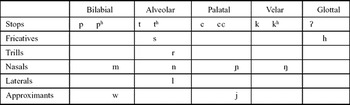
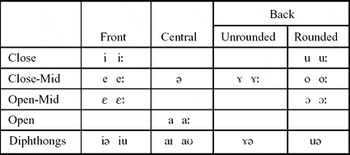
There are three major dialects of Chong: Northern Khao Khitchakut, Pong Nam Ron, and Southern Khao Khitchakut (Choosri Reference Choosri2002). Takhian Thong Chong, the focus of this paper, belongs to the Northern Khao Khitchakut dialect region. Like the other Chong dialects, Takhian Thong Chong phonology is noteworthy for having a four-way contrast among place of articulation in stops, a complex vowel inventory, and a four-way contrast in register. The consonant inventory is given in table 1 and the vowel inventory in table 2.
Takhian Thong Chong consonant inventory.

Takhian Thong Chong vowel inventory.

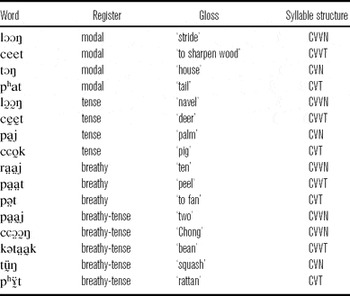
All consonant phonemes given in table 1 may occur as the onset of a syllable with any of the vowels. Most of these same consonants can occur as codas, with the exception of the aspirated stops, /s/, and /r/. Glottal consonants /h/ and /ʔ/ may also occur as coda consonants, but only on modal and breathy registers. All registers may occur on closed syllables containing both long and short vowels, with sonorant or stop codas. I show this in table 3, but I was unable to elicit CVN (short vowel + sonorant coda) forms for the breathy register during fieldwork. Only the modal and breathy register may occur on open syllables. For instance, the word /tṳː/ ‘to escape’ is breathy while the word /hɔː/ ‘dinner, food’ is modal.
Takhian Thong Chong registers.

Aspirated stops have a restricted distribution in Takhian Thong Chong. They occur only as the onsets of modal vowels, e.g. /tʰoh/ ‘breast’ and /pʰat/ ‘tail’. This is different from the nearby dialect of Khlong Phlu Chong, which maintains the aspiration distinction on all registers, but similar to the Wang Kraphrae dialect, which has lost many of the aspirated stops in these environments (Ungsitipoonporn Reference Ungsitipoonporn2001).Footnote 2 It is possible that the lost aspirated stops have conditioned or merged with the register on the following vowel. The pattern whereby aspiration conditions register is called registrogenesis and has been described for many languages in the Mon-Khmer family (Haudricourt Reference Haudricourt1954, Ferlus Reference Ferlus1979, Wayland & Jongman Reference Wayland and Jongman2003). However, it is an open question as to whether this has also occurred in Chong.
There is an effect of register on vowel quality in Chong. This is most noticeable on the non-close vowels. In general, vowels occurring on the breathy or breathy-tense register are higher than those occurring on the modal or tense register. The open-mid vowels (/ɛ/, /ɛː/, /ɔ/, or /ɔː/) never occur on each of these registers. Furthermore, the vowel /a/ is realized with a slightly higher variant when it occurs on the breathy or breathy-tense register. Thongkum (Reference Thongkum and Davidson1991) found a similar effect measuring vowels on different registers. This effect is most noticeable on words with a long vowel in the breathy-tense register because the vowel quality as well as the voice changes throughout the course of the vowel. Thus, a word like /pa j/ ‘two’ is realized as [p
 j], where the initial portion of the long vowel is more close.
The correlation between breathiness and vowel height has been mentioned in the previous literature on Chong (Ungsitipoonporn Reference Ungsitipoonporn2001) and is a well-established phenomena within Mon-Khmer as a source of sound change (Ferlus Reference Ferlus1979). Both Esling (Reference Esling2005) and Edmondson & Esling (Reference Edmondson and Esling2006) offer a clear and compelling account for how voice quality influences vowel quality (and vice versa). These authors argue that many of the relationships between apparent tongue root advancement and voice quality are easily explained if one considers an articulatory model of the vowel space which includes an active laryngeal articulator. This differs from traditional models which define vowel quality solely in terms of lingual movement. While register-induced changes in vocalic formant values were not explicitly investigated in this study, the observations here conform well with the Laryngeal Articulator Model put forth in both Esling (Reference Esling2005) and Edmondson & Esling (Reference Edmondson and Esling2006).
2.2 Chong register
The register contrast in Takhian Thong Chong includes a modal register, a tense register, a breathy register, and a breathy-tense register. The hyphen here indicates that there is a movement from one phonation type to another over the vowel's duration. Thus, the breathy-tense register consists of breathy voice following the release of the onset consonant, with a change in voice quality towards more tense or pressed phonation. This description of the Chong register system follows that of Thongkum (Reference Thongkum and Fujimura1988), though I think that tense is a better term to use than creaky as it more accurately describes the phonation type found in Takhian Thong Chong. Examples of each register are given in table 3.
3 Cross-linguistic phonetics of phonation type
3.1 Production aspects
Edmondson & Esling (Reference Edmondson and Esling2006) divide the articulators involved in the production of voice quality into a set of six valves: glottal vocal-fold adduction, ventricular incursion, upward and forward sphincteric compression of the arytenoids via the thyroarytenoid muscles, epiglotto-pharyngeal constriction, laryngeal raising, and the narrowing valve of the pharynx. The set of articulators used to produce a distinct voice quality varies according to both the language and the speaker. The authors state that characteristic ‘tense’ or ‘pressed’ phonation is produced by bracing the vocal folds against the ventricular folds (ventricular incursion) with a sphincteric compression of the arytenoids. In languages like Bor Dinka, speakers also use pharyngeal narrowing during their production of this voice quality.Footnote 3 However, this articulation is not found in all languages described as having tense phonation. In this way, distinct phonation types are similar to other phonological contrasts which differ in articulatory detail. For instance, the target low F2 in the vowel /u/ may require a large degree of lingual retraction and less lip-rounding in one language and more lip-rounding with less lingual retraction in another. Yet, both articulations produce a similar acoustic consequence.
This particular perspective on phonation type differs in many ways from models which assume that phonation type falls along a continuum defined solely by the aperture between the arytenoid cartilages. Such models do not adequately capture the activity of the other valves utilized in the production of particular phonation types. The necessity to revise them has been prompted mainly through advances in technology that have permitted detailed laryngoscopic investigations of the human larynx in various languages (Esling et al. Reference Esling, Clayards, Edmondson, Fuyuan and Harris1998; Esling Reference Esling1999; Edmondson et al. Reference Edmondson, Ziwo, Esling, Harris and Shaoni2001, Reference Edmondson, Esling, Harris and Wei2004: Carlson & Esling Reference Carlson and Esling2004; Esling Reference Esling2005; Edmondson & Esling Reference Edmondson and Esling2006). Such studies have demonstrated the importance of both the supraglottal cavity and larynx as a whole in the production of phonation type.
While there are a number of possible laryngeal configurations, linguistically-constrastive phonation types fall within fewer categories: modal voice, creaky voice, tense (harsh) voice, breathy voice, lax voice, epiglottalized voice, and faucal voice. I will define the relevant phonation types investigated in this study in terms of their articulatory configuration. Modal phonation is characterized by neither broadband spectral energy in the upper harmonics nor irregular vocal fold vibration where the arytenoid cartilages are neither pulled apart nor pushed together (Ladefoged & Maddieson Reference Ladefoged and Maddieson1996, Ní Chasaide & Gobl Reference Ní Chasaide, Gobl, Hardcastle and Laver1997). During the production of modal phonation, there is moderate adductive tension and medial compression of the vocal folds (Laver Reference Laver and Laver1991). There is adequate subglottal pressure present to overcome vocal fold impedance. As a result, sustained voicing with regular periodicity characterizes this phonation type.
Both lax and breathy phonation involve an increase in the aperture between the vocal folds, such that the posterior portion to the midline of one vocal fold never comes in contact with the other fold (Laver Reference Laver and Laver1991, Pennington Reference Pennington2005). The vocal folds have minimal adductive tension, weak medial compression, and little longitudinal tension (ibid). In both Bor Dinka (Nilo-Saharan) and Bai (Sino-Tibetan), breathy phonation occurs with laryngeal lowering (Edmondson & Esling Reference Edmondson and Esling2006). In Bai, this lowering is accompanied by tongue advancement. What distinguishes lax from breathy phonation though is the degree of vocal fold tension and the amount of aperiodic noise that dominates the upper spectrum. Breathy phonation contains substantial broadband spectral energy that arises due to greater vocal fold aperture. Lax phonation does not contain substantial high amplitude noise components (Pennington Reference Pennington2005).
Creaky and tense phonation types are similar in that both involve decreased aperture between the vocal folds. The vocal folds are mostly closed for this phonation type, vibrating mainly at the ligamental portion between the arytenoids. Both phonation types are characterized with increased adductive tension and medial compression (Ní Chasaide & Gobl Reference Ní Chasaide, Gobl, Hardcastle and Laver1997). While tense phonation is characterized with mostly periodic vocal fold vibration, creaky phonation contains substantial frequency modulation (jitter) and amplitude modulation (shimmer) (Childers & Lee Reference Childers and Lee1991, Blomgren et al. Reference Blomgren, Chen, Ng and Gilbert1998, Pennington Reference Pennington2005).
A key articulatory difference between these two phonation types is larynx height and ventricular incursion. Tense voice is produced with a raised larynx position while creaky voice is produced with the larynx in a lower position. Greater vocal fold stiffness is observed with laryngeal raising (Hirose. Yoshioka & Niimi Reference Hirose, Yoshioka and Niimi1978, Löfqvist et al. Reference Löfqvist, Baer, McGarr and Seider-Story1989, Hirose 1997, Stevens Reference Stevens2000). In Bai, Bor Dinka, Chong, and Somali, the tense vocal register is produced with laryngeal raising (Edmondson et al. Reference Edmondson, Ziwo, Esling, Harris and Shaoni2001, Tumtavitikul Reference Tumtavitikul2004, Esling Reference Esling2005, Edmondson & Esling Reference Edmondson and Esling2006). Tense voice is also produced with a lowering of the ventricular vocal folds. Ventricular incursion produces contact between their inferior surfaces and the superior surfaces of the true vocal folds. Normally, such an articulation would result in a compressed and thick structure that would inhibit voicing (Laver Reference Laver and Laver1991). However, the increased stiffness of the vocal folds during tense voice allows voicing to be maintained.Footnote 4
The evidence supporting laryngeal lowering during creaky phonation is more indirect. Creaky phonation induces pitch-lowering effects (Laver Reference Laver1980, Reference Laver and Laver1991; Hirose 1997; Gordon & Ladefoged Reference Gordon and Ladefoged2001; Kingston Reference Kingston, Hargus and Rice2005). Pitch-lowering is often accompanied by laryngeal lowering (Hirose 1997), which elongates the laryngopharynx (Laver Reference Laver1980). This results in greater vocal fold cover slackness which will, in turn, lower pitch specifically when F0 is relatively high (Titze Reference Titze1994). While this explanation jibes well with observed phonetic patterns in languages of the world, more direct evidence is needed.
3.1.1 Articulatory measures
The articulatory descriptions of phonation type above bear directly on the utility of measures like open quotient (OQ) or closed quotient (CQ) in distinguishing register in Chong. The open quotient is the proportion of the glottal period where the vocal folds are not in contact. This comprises the portion of the glottal wave between the abduction of the vocal folds at their upper margin until adduction occurs along their lower or central margins (Rothenberg 1981, Titze & Talkin Reference Titze and Talkin1981, Childers & Krishnamurthy Reference Childers and Krishnamurthy1985, Childers & Lee Reference Childers and Lee1991, Michaud Reference Michaud2004). The CQ measure is derived from the OQ measure (1 − OQ = CQ).
Since electroglottography determines the CQ from electrical conductance (see section 4.1 below), any articulation that permits longer contact between the vocal folds will create larger CQ values. The use of EGG has largely assumed a model of phonation type based upon the aperture between the arytenoid cartilages. Yet, other valvular constrictions may result in greater electrical conductance across the larynx, e.g. sphincteric compression of the arytenoids, ventricular incursion. Larger CQ values may reflect these additional articulations and not increased glottal tension. While research suggests that observed CQ differences mainly reflect differences in glottal aperture, one can not rule out the possibility that CQ differences reflect these additional articulations.
The impedance of the vocal folds is directly related to the closed quotient, where an increase due to strong adductive tension and medial compression of the vocal folds leads to longer closed periods in the glottal cycle. Subglottal pressure must build up over a longer duration in these cases. Conversely, low impedance on glottal airflow due to weak adductive tension between the vocal folds will lead to shorter closed periods in the glottal cycle. In such cases, it is possible that low impedance may also prevent full closure from being reached during a glottal period. Accordingly, it is possible to use CQ or OQ as a measure of phonation type since it may correlate with glottal tension.
3.2 Acoustic measures
3.2.1 Power spectra
Apart from examining the glottal source directly, a number of acoustic measures are correlates of phonation type (Ladefoged, Maddieson & Jackson Reference Ladefoged, Maddieson, Jackson and Fujimura1988, Ní Chasaide & Gobl Reference Ní Chasaide, Gobl, Hardcastle and Laver1997, Pennington Reference Pennington2005, Kreiman, Gerratt & Barroso Reference Kreiman, Gerratt and Barroso2007). An examination of power spectra often reveals differences between phonation types. The theory behind this method is that the increased closing velocity of the vocal folds that occurs with greater adductive tension (as found in tense or creaky phonation) causes an excitation of higher harmonics. Slower vocal fold closure which occurs with less adductive vocal fold tension (as found in breathy phonation) does not excite the upper harmonics and causes a lowering of the harmonics’ amplitude (Ladefoged et al. Reference Ladefoged, Maddieson, Jackson and Fujimura1988, Ní Chasaide & Gobl Reference Ní Chasaide, Gobl, Hardcastle and Laver1997, Pennington Reference Pennington2005). Thus, one measures the amplitude of higher harmonics to see, albeit indirectly, how tense the vocal folds are during their vibration.
Spectral tilt measures can be divided into those which compare low-range, mid-range, and high-range regions of the spectrum. Low-range measures like H1-H2 have a close correlation to OQ values and are therefore good measures of the degree of glottal tension present in different phonation types (Holmberg et al. Reference Holmberg, Hillman, Perkell, Guiod and Goldman1995, Stevens & Hanson Reference Stevens, Hanson, Fujimura and Hirano1995, Sundberg, Andersson & Haltqvist Reference Sundberg, Andersson and Hultqvist1999). H1-H2 successfully distinguishes modal from breathy (and creaky) phonation in a variety of languages, e.g. !Xóõ (Traill & Jackson Reference Traill and Jackson1987), Gujarati (Fischer-Jørgensen Reference Fischer-Jørgensen1967, Pennington Reference Pennington2005), Tsonga (Ladefoged & Antoñanzas Barroso Reference Ladefoged and Barroso1985), Wa (Watkins Reference Watkins2002), Jalapa Mazatec (Blankenship Reference Blankenship2002, Pennington Reference Pennington2005), Chanthaburi Khmer (Wayland & Jongman Reference Wayland and Jongman2003), and Fuzhou, Green Hmong, White Hmong, Santa Ana del Valle Zapotec, San Lucas Quiaviní Zapotec, and Tlacolula Zapotec (Esposito Reference Esposito2006). Ladefoged & Maddieson (Reference Ladefoged and Maddieson1985) mention that H1-H2 values were greater for lax syllables than for tense syllables in Jingpho, Hani, Yi, and Wa.Footnote 5
Kreiman et al. (Reference Kreiman, Gerratt and Barroso2007) examined 78 different spectral measures of voice quality within a principal components analysis where the first factor accounting for the most variance between different glottal wave shapes corresponded to H1-H2. While substantial evidence supports the use of this measure in distinguishing certain phonation types, both Blankenship (Reference Blankenship2002) and Esposito (Reference Esposito2006) report that it does not distinguish the breathy from modal register in Chong, Mon, and Tamang (incidentally all Mon-Khmer languages). Blankenship (Reference Blankenship2002) examined the modal and breathy registers in Chong with power spectra at 25 ms intervals throughout the vowels. She found that H1-A2 is a more reliable indicator of the difference between these two registers than H1-H2. Blankenship also found, contra Edmondson (Reference Edmondson1997), that the breathy register has gradually increasing breathiness (and therefore should have increasing glottal airflow). These specific findings will be re-evaluated in light of the data in this paper.
Mid-range measures of spectral tilt include H1-A1, H1-A2, H1-A3, and A1-A3. Each of these measures involves a calculation of the amplitude of the different formants, i.e. A1 = amplitude of F1, A2 = amplitude of F2, etc. Accordingly, changes in vowel quality will alter formant frequency. Since radiation impedance is approximately proportional to frequency, the wide-band spectral slope is approximately −6 dB/octave for modal phonation (Klatt Reference Klatt1980, Pennington Reference Pennington2005). Shifts in the center formant frequency due to vowel quality changes will affect these measures. Thus, given a vowel [i] with a high F2 frequency value and a vowel [u] with a low F2 frequency value, the H1-A2 calculation for these vowels will be substantially different even if phonation-type parameters remain constant. This has caused some researchers to question the validity of using mid-range measures of spectral tilt. However, such measures have been used to reliably distinguish phonation type in a variety of languages. Esposito (Reference Esposito2006) shows that H1-A1, H1-A2, and H1-A3 distinguish breathy from modal phonation in a variety of languages including Chong, concluding that the most successful measure of spectral tilt is H1-A3. Blankenship (Reference Blankenship2002) found that H1-A2 and H1-A3 distinguished creaky and modal phonation type in Jalapa Mazatec, but these same measures did poorly in distinguishing breathy from modal voice. Yet, Traill & Jackson (Reference Traill and Jackson1987) found that H1-A2 is a strong correlate that distinguishes those same phonation types in Tsonga. The acoustic importance of mid-range spectral tilt measures seems to be dependent on both particular languages and particular phonation types.
3.2.2 Phonation type and pitch
Research on phonation type has also found that there is an interaction between the degree of glottal aperture and pitch (Hombert Reference Hombert and Fromkin1979, Ladefoged & Maddieson Reference Ladefoged and Maddieson1985, Thongkum Reference Thongkum and Fujimura1988, Gordon & Ladefoged Reference Gordon and Ladefoged2001). The claim of these authors is that increased glottal tension causes pitch raising while decreased glottal tension causes pitch lowering. Kingston (Reference Kingston, Hargus and Rice2005) argues that glottal tension may cause pitch-raising only when the cricothyroid muscle is contracted along with the thryoarytenoid. The cricothyroid is responsible for the stiffness of the vocal fold covers, which remain slack when it is not contracted. Laryngeal raising during the production of tense voice (see section 3.1) may also trigger pitch raising as well. If this is true, then pitch-raising in tense phonation is best explained articulatorily. For breathy voice, the pitch effect is both aerodynamic and articulatory: increased glottal airflow lowers subglottal pressure which then lowers pitch (Hombert Reference Hombert and Fromkin1979) and increased vocal fold cover slackness also lowers pitch (Titze Reference Titze1994). These connections between pitch and phonation type hold for previous studies of Chong. Thongkum (Reference Thongkum and Fujimura1988, Reference Thongkum and Davidson1991) found that the tense register has the highest F0 value, appearing with a rise-fall F0 contour in most cases, while the breathy register is realized with the lowest F0.
3.2.3 Previous work
Thongkum (Reference Thongkum and Davidson1991) used H1-A1 as a measure of spectral tilt on the different registers in Chong. However, her measurements did not distinguish the registers, because both the inconsistency in the position of F1 and the dynamic nature of the registers caused problems for the measure. Unfortunately, Thongkum only measured H1-A1 from one position in each vowel. Since Chong has register contours, spectral tilt measures at a single location on the vowel are not suitable for distinguishing the acoustic differences between the phonation types for each register.
Edmondson investigated glottal airflow throughout the duration of selected tokens of the different registers in Chong. He found that the breathy and breathy-tense registers have high amplitude glottal airflow at the onset of the vowel, while the tense and breathy-tense registers have marked low-amplitude glottal airflow pulses during the second half of their duration, with some concomitant irregularity in the pulse amplitude. This suggests that the registers with breathiness have more airflow mainly during the beginning of the vowel, while the tense registers have increased tension and lower airflow over the latter portion of the vowel. This finding agrees with the observation in Thongkum (Reference Thongkum and Davidson1991) that glottal tension is timed toward the end of the vowel.
4 Laryngographic data
4.1 Method
Electroglottographic (EGG) data were acquired using a Laryngograph® model portable electroglottograph which was connected to one channel of an M-Audio® USB audio interface. A microphone was connected to another channel's input. The audio interface was connected to an Apple® iBook G3 computer where both channels were synchronously acquired using Praat (Boersma & Weenink Reference Boersma and Weenink2008). Subjects were given all instructions in Thai with the help of an interpreter (S.N.). Either the interpreter or I gave the Thai word, which was translated into Chong by the speakers.
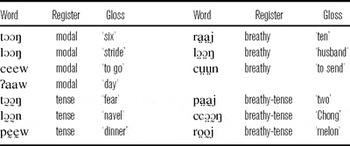
EGG data from seven speakers (four female, three male), age 30–76 years, were elicited. Due to the loss of neck-electrode contact for many of their tokens, two speakers’ data (one female, one male) were not included in this investigation. In total, 39 words each repeated five times were elicited from each speaker. The word-list was designed to be balanced so that each register would appear in multiple syllable types on short and long vowels. Upon later investigation, some of the words that I elicited turned out to contain long vowels rather than short ones. As a result, there is a balanced list for all registers with long vowels followed by a sonorant coda (N). Three words containing a long vowel and sonorant coda are analyzed for each register, with the modal register containing four such words. In sum, there were 13 words × 5 repetitions × 5 subjects = 325 tokens included in the analysis, shown in table 4.
Words used in electroglottographic (EGG) analysis.

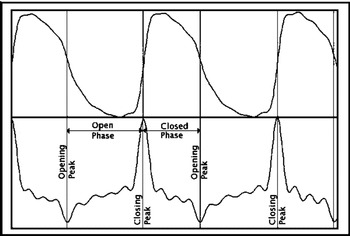
Electroglottography (EGG) involves the use of electrical current to determine the degree of abduction or adduction between the vocal folds. EGG peak maxima correspond to the moment of maximum contact between the vocal folds while peak minima correspond to the moment of minimum contact between the vocal folds (Childers & Krishnamurthy Reference Childers and Krishnamurthy1985, Childers & Lee Reference Childers and Lee1991, Heinrich et al. Reference Heinrich, D'Alessandro, Doval and Castellengo2004). Both the OQ and the CQ were extracted from the derivative of the EGG signal (DEGG). These measures require an accurate estimation of the moment of vocal fold separation. Since the EGG peaks do not correspond to the closing or opening instants of the vocal folds, the DEGG signal is used (Childers & Krishnamurthy Reference Childers and Krishnamurthy1985, Childers & Lee Reference Childers and Lee1991, Heinrich et al. Reference Heinrich, D'Alessandro, Doval and Castellengo2004, Michaud Reference Michaud2004). An EGG and its corresponding DEGG signal are shown in figure 1.
Example of Filtered EGG (top) and DEGG (bottom) signal.

The vowel portions within each EGG data file were segmented and labeled using Praat (Boersma & Weenink Reference Boersma and Weenink2008). The data was then analyzed using a peak detection script in Matlab (version 7.5). Within the script, the original 44.1 kHz EGG signal was band-pass filtered from 5 Hz to 1200 Hz to eliminate low-frequency DC components and any high-frequency peaks unrelated to the opening or closing phases of vocal fold vibration. The signal was then smoothed with a third order Butterworth filter (−18 dB/octave) with a 0.054 normalized cutoff-frequency. Peak maxima or minima that were less than 10% of the amplitude of the highest amplitude maxima or minima, respectively, were considered erroneous. Wherever the script detected two consecutive minima or maxima, the one with greater amplitude was chosen. The output file of the script provided the EGG signal maxima and minima, the DEGG maxima and minima, period durations, and CQ & OQ values calculated from the DEGG signal. The output files were then visually inspected for remaining erroneous peaks. If more than three OQ values showed a greater than 10% rise or fall from an adjacent value, the token was omitted. If there were three or fewer erroneous OQ values, these data points were replaced with NA values. The output OQ data were then time-normalized using R (2007) to allow for a proportional comparison between the different speakers and tokens. OQ was averaged over 12 even intervals of the token's vowel.
4.2 Results
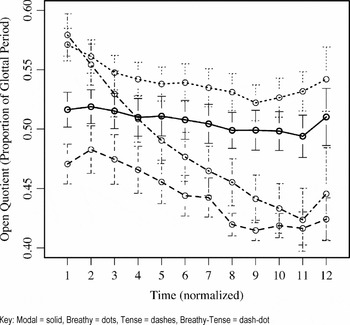
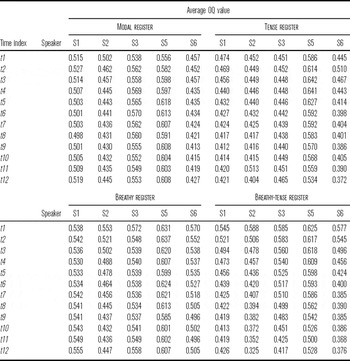
The results of the OQ measures are shown in figure 2 along with 95% confidence intervals. Individual speakers’ OQ data is given in figure 3. Confidence intervals are wider at time index 12 because the script was unable to calculate OQ accurately for some tokens, resulting in a smaller sample size. For all registers, there is a declination in OQ throughout the duration of the vowel, with the breathy-tense register showing the sharpest decline in OQ. The breathy register shows the highest OQ value which gradually declines toward the endpoint of the vowel while the tense register shows the lowest OQ value which similarly declines. The modal register does not show substantial declination in OQ, lying between the values for the breathy register and the tense register. At time index 1, the breathy-tense register shows overlap in OQ value with the breathy register, but from time indices 10–12, it shows overlap with the tense register.
Open quotient curves for each register.

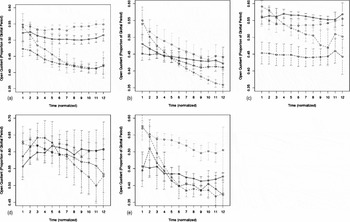
Individual speaker OQ values. (a) Speaker 1 (b) Speaker 2 (c) Speaker 3 (d) Speaker 5 (e) Speaker 6.

Individual speakers’ OQ data are shown in figures 3a–e. There was some variability between speakers in the OQ value for each of the registers as well as some similarities. All speakers produced the breathy register with higher OQ values than found in the other registers. All speakers also produced the breathy-tense register with a declination in OQ value throughout the vowel duration. The variability that occurred between speakers was attributed to differences in the realization of the tense and modal registers. For speakers 1, 2, 3, and 6, the tense register was produced with low OQ values, as might be expected if this register is realized with greater adductive vocal fold tension and/or ventricular incursion. However, for speaker 5, the OQ values of this register substantially overlap with the other registers. For speakers 3 and 5, the modal register is produced with high OQ values, similar to the breathy register. For speakers 1 and 2, the modal register is produced with OQ values between those of the breathy and tense registers. For speaker 6, modal register is similarly produced, but with lower OQ values.
The general tendency among the individual speakers’ data is to produce the tense register with lower OQ values, the breathy register with higher OQ values, and the breathy-tense register with OQ values which shift from high to low. Modal register is less defined, being produced with either higher or lower OQ values.
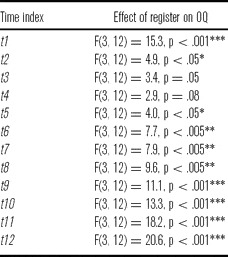
The pooled OQ data were examined using a repeated-measures ANOVA with register as a factor and speaker as an error term, shown in table 5. The main effect was significant but not equally so across the vowel duration. As seen in time index 2, OQ values for each register cluster together almost halfway into the vowel's duration (to time index 5). Throughout the latter half of the vowels, OQ values diverge. This pattern is attributable to the falling of OQ values observed in both the tense and breathy-tense registers. Adductive tension of the vocal folds (or ventricular incursion) increases throughout the duration of the vowel, causing longer duration closed cycles.
Open quotient (OQ) statistics.

*p < .05, **p < .01, ***p < .001
Examining the individual speaker data in table A1, we notice that the modal and tense register have different OQ values for speakers S1, S3, S5, and S6, but not for S2. There is also some variability in where certain OQ values differ between the modal and breathy registers. For all speakers, there is a decrease in OQ value for the breathy-tense register, but its magnitude varies by speaker as well. While register has a strong effect on OQ value for all speakers, there are individual differences in the timing and magnitude of changes in OQ. Individual speakers’ OQ values are given in the appendix (table A1).
Given that OQ values correlate with the degree of constriction in the laryngeal cavity (via the vocal folds or other valves), we can conclude that the registers in Takhian Thong Chong are at least partly distinguished by differences in laryngeal cavity aperture. The tense register occurs with a smaller opening than the modal register, which occurs with a smaller glottal opening than the breathy register. The breathy-tense register occurs with a quick change in laryngeal aperture size across the duration of the vowel.
5 Acoustic data
5.1 Method
Acoustic data were acquired using the setup described in section 4.1 with the same speakers. However, all seven speakers’ acoustic data were usable. Acoustic recordings were originally sampled at 44.1 kHz but downsampled to 16 kHz before analysis. A script was written to extract F0, H1-H2, and H1-A3 measures at 12 even time indices along the duration of each vowel along with its total duration. Spectral tilt was acquired by first calculating the position of F3 with an LPC analysis. Maximum amplitude peaks were then extracted from ranges in a power spectrum within 10% of the frequency of a particular formant, i.e. if F3 = 2500 Hz, peak maxima were extracted from the 2250–2750 Hz range. The amplitude value of the highest amplitude harmonic within these ranges corresponds to A3. Two sets of formant reference values were used depending on the speaker's gender. For males, these reference values were F1 500 Hz, F2 1485 Hz, and F3 2475 Hz. For females the values were F1 550 Hz, F2 1650 Hz, and F3 2750 Hz. H1 and H2 were determined by taking the highest amplitude peak to within 10% of the fundamental and twice the fundamental, respectively. All pitch data were converted to semitones for analysis and statistics, following the method used in Abramson, Nye & Luangthongkum (Reference Abramson, Nye and Luangthongkum2007).Footnote 6 Data from all subjects were grouped together and statistically analyzed using R (2007).
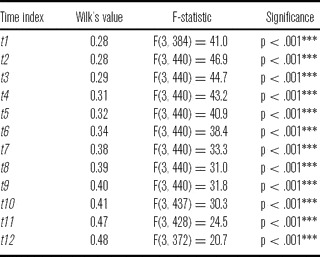
Linear discriminant analysis (LDA) was performed on linear models containing three predictor variables for register at each time index: Pitch, H1-H2, and H1-A3. A two-way ANOVA determined that each of these measures was significant at each time index prior to their inclusion in the discriminant model. Wilk's Lambda and canonical correlations were calculated to determine the goodness of the discriminant model at each time index.
5.2 Spectral tilt results
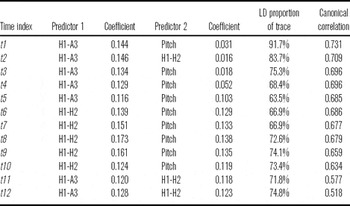
The results of the LDA are shown in table 6. The first two predictors correspond to the measures in the first linear discriminant model that account for the most variance. The LD Proportion of Trace is the proportion of between-group variance that the first linear discriminant explains with respect to the total between-group variance. Canonical Correlation is the percentage of variance in the data that is explained by the predictor variables. Wilk's Lambda tests at each time index are given in the appendix (see table A2). All discriminant models were significant for each time index.
Results of linear discriminant (LD) analysis on spectral measures of register.

Table 6 shows that the H1-A3 spectral tilt measure is the best discriminator of register in Takhian Thong Chong within the first half of the vowel duration. However, the H1-H2 measure better discriminates among the registers in the latter half of the vowel. In terms of discriminability, pitch is a stronger correlate of the register contrast within the second half of the vowel duration. There was little correlation between H1-A3 and H1-H2 at any point, reflected by a maximum adjusted R2 value of .09. The first linear discriminant accounts for a large proportion of the variance in register throughout the vowel duration. At each time index, the canonical correlation lies between .52 and .73, so the first discriminant model can explain between 52% and 73% of the variance between the registers. The discriminant model more poorly discriminates register differences over the final 1/4 duration of the vowel, however.
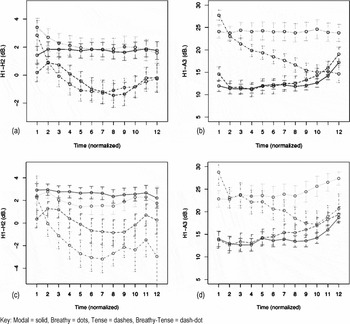
Plots of the H1-A3 and H1-H2 measures are shown in figures 4a–d with 95% confidence intervals. As a comparison, the same measures are given for a single vowel (/ɔɔ/) in each register. We observe here that the breathy register has a steeper spectral slope throughout its duration than any of the other registers. The modal and tense registers have very similar values for the H1-A3 measure throughout the vowel on which they are realized. The breathy-tense register begins with steep spectral slope but rapidly becomes less steep throughout its duration. This spectral tilt measure on the vowel /ɔɔ/ appears very similar to the pooled results. However, the breathy-tense register is realized with an even steeper slope a quarter of the way into the vowel than it was in the pooled results. The similarity between these measures on an individual vowel and on all vowels suggests that there is little effect of vowel quality on this measure in Chong. For the H1-H2 spectral slope measure, values given for the modal register are lower (flatter) than those of the breathy register at time index 1–4, but overlap with those of the breathy register from time index 5–12. The tense and breathy-tense registers overlap in H1-H2 value for a majority of their duration, but not at time index 1. Unlike the H1-A3 measure, the H1-H2 plot shows a distinction between the tense and modal register.
Measures of spectral tilt on vowels. (a) H1-H2 (b) H1-A3 (c) H1-H2 for vowel /ɔɔ/ (d) H1-A3 for vowel /ɔɔ/.

There are some differences between the pooled-data H1-H2 values and the spectral tilt values for the vowel /ɔɔ/. The breathy-tense register has more distinct H1-H2 values from the tense register in the vowel /ɔɔ/ context than in the general case. This register is produced with a more negative spectral tilt here. Indeed, all four registers are better distinguished in this specific vowel context using the H1-H2 measure. Such differences suggest that some spectral tilt measures may better distinguish register contrasts for certain vowels than they do for others. Even though H1-H2 does not generally distinguish breathy from non-breathy registers, it may be used to distinguish such contrasts on the vowel [ɔɔ].
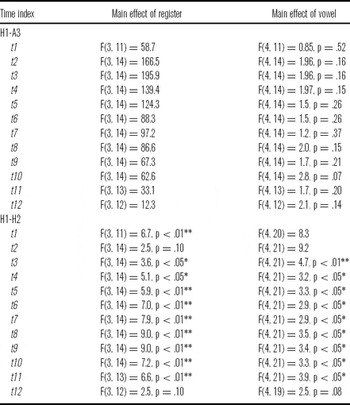
Two two-way repeated-measures ANOVAs were performed on H1-A3 and H1-H2 with register and vowel as factors and speaker as an error term, shown in table 7. For the H1-A3 measure, the main effect of register was significant at all time indices, but the main effect of vowel was not significant. It is possible that since some vowel qualities differed between individual registers, individual vowel quality effects could not be evenly compared. However, there is also less of a substantial effect of vowel quality differences on A3 than on other formants in the spectrum.
Results of two-way repeated measures ANOVA on H1-A3 and H1-H2. (All results are significant at a p < .001 level unless otherwise noted.)

*p < .05, **p < .01, ***p < .001
For the H1-H2 measure, the main effect of register was significant at all but the second and last time indices. The main effect of vowel quality was significant at every time index except the last. For the H1-H2 measure, the main effects of register and vowel were both significant at every time index. At most time indices, there was a marginally significant interaction between register and vowel quality (p < .05).
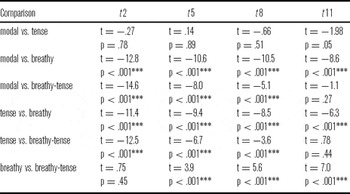
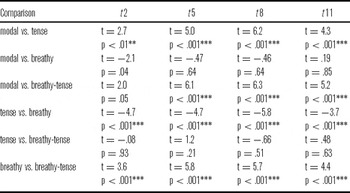
I evaluated individual speaker differences between the different registers’ H1-A3 values and H1-H2 values via Welch two-sample t-tests, shown in the appendix (tables A3 and A4). For the H1-A3 data, results from these tests show that each of the registers are distinct from one another except for the tense and the modal register (see table A3). The breathy-tense register does not significantly differ from the breathy register at time index 2 while it does not significantly differ from the tense or modal register at time index 11. For the H1-H2 data, these tests show that the H1-H2 measure significantly distinguishes between tense and modal register, the tense and breathy register, the breathy-tense and modal register, and the breathy-tense and breathy register. The breathy/modal and tense/breathy-tense contrasts do not significantly vary with respect to the H1-H2 measure (see table A4).
Even though H1-A3 is a significant measure distinguishing register in Takhian Thong Chong, it does not distinguish between the modal and the tense register. Rather, it seems that this spectral tilt measure best distinguishes the phonation types which contrast in terms of breathiness. H1-H2 distinguishes between the modal and tense registers.
5.3 Pitch and duration results
5.3.1 Pitch
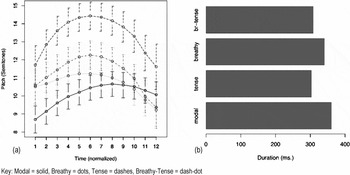
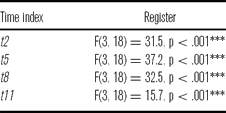
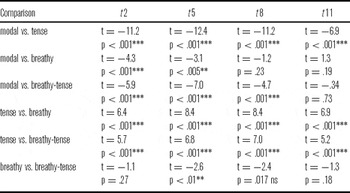
Pitch data from Takhian Thong Chong are given in figure 5.Footnote 7 The tense register is realized with a high rising-falling pitch contour that is approximately two semitones higher than the other registers’ pitch values throughout its duration. The other registers are all within about 1–1.5 semitones of each other. The breathy-tense register has higher overall pitch than the breathy and modal registers. The modal register has the lowest overall pitch. These results are similar to the findings in Thongkum (Reference Thongkum and Fujimura1988) for the Thung Kabin dialect where the tense and breathy-tense register have higher pitch while the breathy and modal registers have a lower pitch. The results of a one-way repeated-measures ANOVA at four time intervals (2, 5, 8, 11) reveal a significant effect of register on pitch at all time points with p < .001, shown in table 8. The main effect of register was significant. Each register is significantly different from the tense register in pitch throughout the vowel. The modal register is significantly different from the breathy-tense register throughout the vowel duration, but only significantly different from the breathy register at time indices 2 and 5 (the first half of the vowel). The breathy and breathy-tense registers are not significantly different in terms of pitch. Individual differences between the different registers’ pitch values were determined via Welch two-sample t-tests, shown in the appendix (table A5).
Pitch and duration measurements of the register contrasts. (a) Pitch (b) Duration.

Results of repeated measures ANOVA of register effect on pitch.

***p < .001
5.3.2 Duration
From the duration data in figure 5, we observe that both breathy-tense and tense vowels have shorter duration than breathy and modal vowels. However, vowel duration can be influenced by other factors, such as coda type and vowel quality (Keating Reference Keating and Fromkin1985). To isolate the relative role of register, a two-way repeated-measures ANOVA with register and vowel quality as factors was performed. There was a strong main effect of register on vowel duration, F(3, 11) = 21.5, p < .001***. The main effect of vowel quality was marginally significant, F(4, 19) = 3.4, p < .05*. There was a marginally significant interaction between vowel quality and register on vowel duration, F(5, 26) = 2.9, p < .05* as well. Interestingly, the effect of vowel quality on vowel duration was not very strong. This is probably due to the fact that most vowels in the data set are mid or low vowels. We might expect a vowel quality effect on duration to be more noticeable if the data set had contained more words with high vowels, as they tend to have the greatest influence on duration (Lehiste Reference Lehiste1970, Keating Reference Keating and Fromkin1985).
5.4 Summary of pitch and duration data
While the best predictors of register in the LDA were those relating to spectral tilt, pitch also significantly varied with respect to register. In general, the tense register is realized with substantially higher pitch than the other registers throughout its duration, while the modal register is realized with the lowest pitch. The breathy-tense and breathy registers have intermediate pitch values that are significantly different from both the modal and tense registers, but not significantly different from each other. The duration data show that the registers containing glottal tension occur with shorter vowels than those registers lacking it.
6 Analysis and discussion
6.1 Spectral tilt and open quotient correlation
To examine the relationship between the OQ data given in section 4.2 and the spectral tilt measures in section 5.2, I calculated the degree of correlation between them. The spectral tilt data was truncated so that the data frames had matched observations, as the OQ data contained two fewer speakers than the spectral tilt data. A correlation matrix with adjusted R2 values is given in table 9.
Correlation comparison between spectral tilt measures, pitch, and open quotient (OQ). (Values given as adjusted R2.)

Open quotient is more closely correlated with the H1-H2 measure than H1-A3. Two conclusions can be drawn from this. First, since H1-H2 distinguishes the phonation types containing glottal tension from those without it, OQ is by extension also a good predictor of the degree of overall tissue contact in the laryngeal cavity, caused by either greater adductive tension between the folds, greater ventricular incursion, or greater aryepiglottic fold compression. Second, the lack of correlation between the mid-band spectral tilt measures and the OQ data suggest that changes in spectral tilt within broader ranges of the spectrum are not the direct result of changes in the degree of tissue contact in the laryngeal cavity.
Rather, such changes are perhaps related to the slackness of the vocal folds, where the vocal fold body has reduced tension and permits greater airflow during its open phase. A consequence of this is that air pressure is lost (to glottal frication) during the production of breathy phonation and will not drive vocal fold vibration. This loss of energy will create lower amplitude closure of the vocal folds and subsequent loss of energy in the upper spectrum (Ladefoged et al. Reference Ladefoged, Maddieson, Jackson and Fujimura1988). The vocal folds may have the same degree of adduction in modal and breathy register, but be relatively slack in the latter. While this lax vocal fold configuration may often co-occur with reduced adductive tension (Ladefoged & Maddieson Reference Ladefoged and Maddieson1985), the number of phonological register contrasts in Chong may require that slackness and adductive tension be independently controlled.
6.2 Data comparison
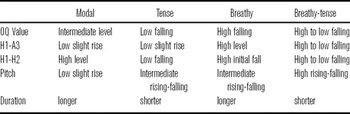
Table 10 shows the acoustic and laryngographic characteristics of each of the registers in Takhian Thong Chong. The OQ measure relates to different spectral tilt measures in a complementary way. Registers with low OQ values correspond with those with flatter spectral tilt (low) within the lower region of the spectrum. As a result, the measure H1-H2 uniquely captures the differences between registers lacking glottal tension and those containing it. The other registers are not as strongly distinguished using these measures though. The relationship between low OQ value and low H1-H2 value is reflected in the correlation between these two measures given in table 9.
Significant articulatory and acoustic correlates of register.

The tense, breathy, and breathy-tense registers have declining OQ values throughout the vowel duration. This seems also to correspond to a fall in H1-H2 value. Interestingly, this is not well-reflected in the H1-A3 measure where the breathy and breathy-tense registers are relatively level throughout their duration.
Registers with higher OQ values also correspond to those with a steeper (high) spectral tilt within a broader spectral range. The measure H1-A3 captures the differences between registers lacking breathiness and those containing it. These measures may be used to distinguish between all registers except the modal and tense registers. While this relationship is not directly observed in the correlation matrix in table 9, increasing OQ may have the indirect result of changing aerodynamic conditions which causes a decrease in amplitude of formants within the spectrum.
Certain spectral tilt measures seem to vary significantly with respect to pitch. At selected time indices (2, 5, 8, 11) across the vowel duration, two-way ANOVAs were performed with spectral tilt measures as factors. Results found that each spectral tilt measure varies somewhat with pitch, but no particular measure seems to correlate closely with pitch at all time points. For instance, the tense register is produced with decreasing OQ values and spectral tilt at the end of the vowel, yet these values are uncorrelated with the higher overall pitch and pitch contour present with this register. We may conclude that pitch can be influenced slightly by changes in phonation type but that the pitch contours present with different registers are not simply byproducts of changes in glottal aperture.
6.3 Discussion
6.3.1 Phonation type
The results from the comparison between OQ and spectral tilt suggest that there is a one-to-many interaction between the proportion of the glottal cycle that is open and its acoustic consequences on the speech signal in Chong. The acoustic correlates of Chong register include mid-band and narrow-band spectral slope, changes in spectral slope, pitch, and to a lesser degree, duration. Registers with low OQ values and greater glottal tension, are best distinguished from the other registers with narrow-band spectral slope (H1-H2), pitch, and duration. Registers with breathiness, or high OQ, are best distinguished from the others with mid-band spectral slope measures. These findings are in agreement with Blankenship (Reference Blankenship2002) and Esposito (Reference Esposito2006) who found that H1-H2 was a poor discriminator of the modal and breathy registers in Chong. Whereas the previous studies did not address the utility of different measures in distinguishing all four registers in the language, this study has attempted to do so while also comparing spectral tilt measures to changes in the vibratory cycle of the vocal folds.
The breathy-tense and the breathy registers are realized with increased OQ values after the onset consonant release in Chong, while the breathy-tense and tense registers are realized with decreased OQ values at the end of the vowel. These findings agree with Edmondson (Reference Edmondson1997) who found greater glottal airflow at the beginning of the breathy registers which gradually diminished and low amplitude glottal airflow at the end of tense register vowels. Thongkum (Reference Thongkum and Davidson1991) makes a similar prediction regarding increasing glottal tension on these registers. Contra Blankenship (Reference Blankenship2002), breathiness does not increase throughout the duration of breathy vowels.
The increased correlation between OQ and H1-H2, and the lack of correlation between OQ and other spectral tilt measures suggests that EGG methods may only be useful for distinguishing between glottal states with greater laryngeal constriction and those lacking it. As many register languages contain only two phonation types, EGG analysis is probably useful for them. However, in a language like Chong, with four phonation types, differences among all registers may not be directly observable from the EGG signal. H1-A3 is a strong discriminator of register in Chong. However, if amplitude differences calculated from this measure are not correlated with OQ, some other mechanism must be responsible for the decreases in harmonic amplitude present in breathy and breathy-tense phonation.
Phonological descriptions of voice quality often assume that there is a static representation of phonation type within a prosodic unit. This perspective is made explicit in Golston & Kehrein (Reference Golston and Kehrein2004), who argue that no conflicting laryngeal contrasts may occur within the nucleus of a syllable. Building upon previous typological work by Kehrein (Reference Kehrein2002), the authors argue that no language has multiple laryngeal feature specification within a prosodic unit. While the data here examine register contrasts in long vowels, they also occur in short vowels. The change in phonation type across the vowel in Chong is a counterexample to Golston & Kehrein's claim, since two laryngeal features would need to be specified on one vowel.
The absence of detailed phonetic investigations in the description of phonological voice quality results in inaccurate simplifications of its representation. Thus, researchers attempting to glean phonetic details from phonological descriptions of a language are capable of making faulty conclusions as to the nature of laryngeal contrasts. Insofar as the featural representation of phonological contrasts seeks to capture necessary details of phonetic implementation (Halle & Stevens Reference Halle and Stevens1971, Jakobson, Fant & Halle Reference Jakobson, Gunnar, Fant and Halle1976, Stevens & Blumstein Reference Stevens, Blumstein, Eimas and Miller1981, Stevens & Keyser Reference Stevens and Keyser1989, Hall Reference Hall2001), phonetic detail informs such phonological descriptions.
6.3.2 Pitch and duration
The pitch data here suggest a weak association between phonation type and pitch. We might expect a close correlation between increased glottal tension and pitch as both may involve laryngeal raising. The tense register is, in fact, realized with the highest pitch of all the registers, similar to findings by Thongkum (Reference Thongkum and Fujimura1988) for Thung Kabin Chong. However, on this register and others, changes in pitch do not correspond to changes in glottal aperture. While the tense register occurs with a rising-falling pitch contour, OQ values decrease throughout its duration. The same is true for the other registers. The H1-H2 values are most closely correlated with pitch changes. This is in agreement with Esposito (Reference Esposito2006) who mentions that pitch tends to most closely correlate with H1-H2. However, there are substantial differences between the pitch and the H1-H2 contours. While the breathy-tense and tense registers virtually overlap in H1-H2 value, the tense register is realized with substantially higher pitch than the breathy-tense register. The contour of each register's pitch resembles its H1-H2 trajectory, however the relative pitch level seems unrelated to H1-H2 values.
Phonation type influences pitch in many languages (Silverman Reference Silverman1997b), so we would expect changes in voice quality to correlate with changes in pitch. However, the presence of pitch that is uncorrelated with phonation type in Chong suggests that pitch changes are not simply phonetic by-products of phonation type. While these pitch contours may be phonologically associated with particular registers, they are distinct phonetic correlates of the register contrast.
While the phonological vowel length contrast must be a strong predictor of observed phonetic vowel duration, register is also significant. Thongkum (Reference Thongkum and Fujimura1988) does not find vowel duration to be a correlate of the register contrast in Thung Kabin Chong, but it distinguishes the registers with glottal tension in Takhian Thong Chong from those lacking it. Both tense and breathy-tense vowels have a similar shorter duration than the modal or breathy vowels. Fischer-Jørgensen (Reference Fischer-Jørgensen1967) and Kirk, Ladefoged & Ladefoged (Reference Kirk, Ladefoged and Ladefoged1984) mention that breathy vowels in Gujarati and Jalapa Mazatec have longer duration than modal or creaky phonation. Gordon & Ladefoged (Reference Gordon and Ladefoged2001) mention that the overall duration of vowels with non-modal phonation is longer than those with modal phonation. An explanation for this pattern is given in Silverman (Reference Silverman1997a), which states that breathy vowels in languages are longer so that speakers have additional time to perceive the voice quality on the vowel.
However, there is perhaps a historical reason for the development of longer phonetic duration on breathy vowels and shorter phonetic duration on tense vowels. Breathy vowels often derive from historically aspirated initial stops. In these cases, the loss of the duration of aspiration following the stop may cause the vowel to undergo compensatory lengthening. As a result, a longer vowel occurs with breathy phonation. On the other hand, glottal tension often derives from a historical glottal stop at the end of the vowel. Final glottal stops may cause vowel shortening if the vowel is shorter before voiceless stops as a general phonetic trend. This is true in a variety of languages (Chen Reference Chen1970). The breathy onset hypothesis of duration differences cannot explain why modal and breathy vowels would be of similar duration. The glottalization-induced shortening hypothesis would better explain the durational differences among registers in Chong.
7 Conclusion
The fact that Chong has a four-way contrast in register makes it exceptional from a typological viewpoint. The results of both an EGG and an acoustic phonetic analysis of the register distinction in this language add support to the view that the specific timing relationship of laryngeal configurations across the syllable is relevant in marking phonological distinctions in languages of the world. The findings show that H1-H2 best correlates with changes in open quotient, while mid-band spectral tilt measures do not. In a complex-register language like Chong, a number of acoustic parameters distinguish the different registers. H1-H2 was found to distinguish between the presence and absence of increased glottal tension while H1-A3 distinguished between the presence and absence of breathiness.
Acknowledgements
Data in this paper come from the author's fieldwork. I would like to acknowledge Suwilai Premsrirat and Sompop Ngammas at Mahidol University for their generous help in making research with Chong speakers possible. I would also like to acknowledge Keith Johnson, Reiko Kataoka, and three anonymous reviewers for comments on this paper. A special thanks is given to Sam Tilsen for providing a Matlab script for EGG data extraction. This work was supported by a block grant from the Social Sciences Division at University of California, Berkeley.
Appendix
Individual speaker open quotient (OQ) values.

Wilk's Lambda.

***p < .001
T-tests of H1-A3 differences at selected time indices.

***p < .001
T-tests of H1-H2 differences at selected time indices.

**p < .01, ***p < .001
T-tests of pitch differences at selected time indices.

**p < .01, ***p < .001