





Tai Nuea (ISO 639-3 code: tdd; Glottocode: tain1252) belongs to the Tai-Kadai languages within the Sino-Tibetan language family. It is also known as ‘Tai Nüa’, or ‘Tai Le’, as it is a transliteration of the indigenous name (Luo Reference Luo1998). Tai Nuea is one of the languages spoken by the Dai people in China, particularly in the Dehong Dai and Jingpo Autonomous Prefecture, located in southwestern Yunnan Province, China (Yu & Luo Reference Yu and Luo1980; Wang Reference Wang1983). According to the data from China’s 2021 population census, the population of the Dai ethnicity in China is 1,329,985 (National Bureau of Statistics of China 2021). Almost all speakers of Tai Nuea use Mandarin Chinese as a second language. In particular, the younger generation has received Mandarin education since early childhood and exhibits high proficiency in Mandarin.
Existing studies have divided Tai Nuea into two dialects: the Dehong (德宏) dialect and the Menggeng (孟耿) dialect, collectively spoken by 541,000 speakers. The Dehong dialect has a larger number of speakers (approximately 332,000) and is mainly distributed in Mangshi (芒市), Yingjiang (盈江), Lianghe (梁河), Longchuan (陇川), and Ruili (瑞丽) of Dehong Dai and Jingpo Autonomous Prefecture, as well as Tengchong (腾冲), Longling (龙陵), and Shidian (施甸) of Baoshan (保山) City. The Menggeng dialect has about 209,000 speakers and is mainly distributed in Menglian (孟连), Jinggu (景谷), Lancang (澜沧), Zhenyuan (镇沅), Ximeng (西盟), Jingdong (景东), Simao (思茅), and Mojiang (墨江) of Pu’er (普洱) City; Gengma (耿马), Shuangjiang (双江), Cangyuan (沧源), Yongde (永德), Zhenkang (镇康), Yunxian (云县), and Fengqing (风庆) of Lincang (临沧) City; and Changning (昌宁) of Baoshan (保山) City. People of the Dehong dialect call themselves Tai Le [tai˥.lɤ˧]), which means ‘Northern Tai’. However, it is pronounced Tai Ne [tai˥˧.nɤ˥]) in Menglian dialect (Luo Reference Luo1984, Reference Luo2008; Liang & Zhang Reference Liang and Zhang1996; Zhou & Luo Reference Zhou and Luo2001).
Scholars such as Goetz (Reference Goetz2001), Cai (Reference Cai2007), Wang & Kong (Reference Wang and Kong2019, Reference Wang and Kong2021), and Yu & Chen (Reference Yu and Chen2023) have conducted research on issues related to the phonetic and grammatical characteristics of Tai Nuea. The Dehong dialect, chosen for this study, is widely regarded as the representative dialect of Tai Nuea (Luo Reference Luo1998). It is primarily spoken in Mangshi, the administrative center of Dehong Dai and Jingpo Autonomous Prefecture, with its geographic distribution illustrated in Figure 1.
This study was based on the recorded data provided by a 30-year-old female native speaker of Tai Nuea. Born and raised in Mangshi, the speaker is a graduate from Dehong Normal University. She communicates primarily in Tai Nuea in daily contexts and has not resided outside the region for any extended duration. The recording devices included a laptop computer, an external sound card, a mixing console, and a unidirectional collar clip microphone.Footnote 1 Recordings were made in a soundproof room using Adobe Audition 2023 software with a sampling rate of 44.1 kHz and 16-bit resolution. Basic phonetic parameters were extracted using Praat software (Boersma & Weenink Reference Boersma and Weenink2020).
Consonants

Tai Nuea has 17 consonant phonemes, including six plosives, one affricate, four fricatives, three nasals, one lateral approximant, and two approximants. All consonants are permitted in onset position except /n/, whereas coda position is restricted to the nasals /m/, /n/, /ŋ/ and the plosives /p/, /t/, /k/. The following minimal and near-minimal pairs illustrate the consonants of Tai Nuea.


Location of Mangshi, Dehong Dai and Jingpo Autonomous Prefecture on the map of Yunnan Province, China

Plosives
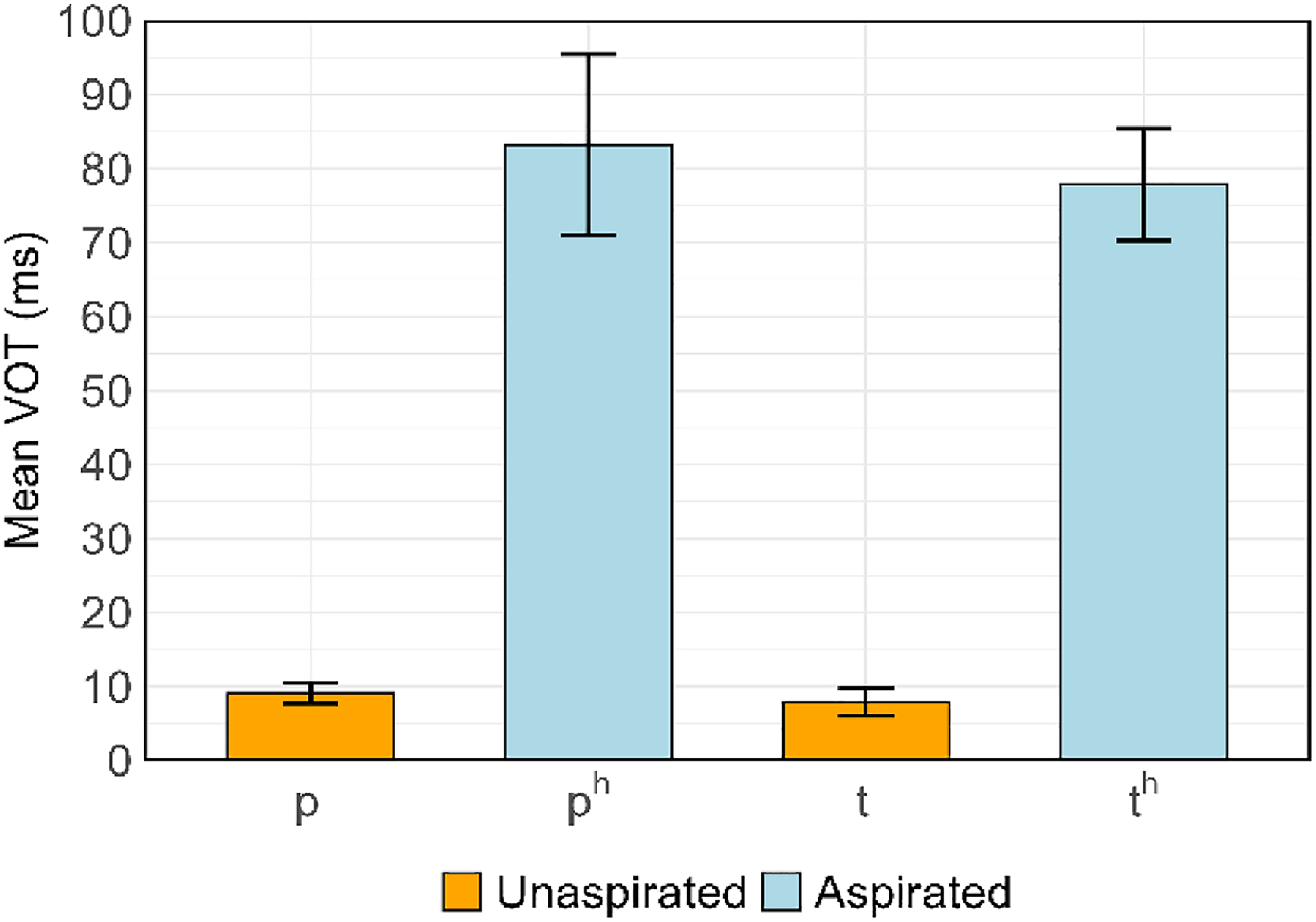
There are six plosives in Tai Nuea, all voiceless, at bilabial, alveolar, velar, and glottal places of articulation. Among places of articulation, the first two distinguish between aspirated and unaspirated plosives, whereas the latter two do not. Figure 2 presents the spectrograms of /ta51/ (‘to build’) and /tʰa51/ (‘to wait’), showing the significant difference in Voice Onset Time (VOT) between the two syllables. As shown in Figure 3, overall, aspirated plosives consistently exhibit larger VOT values, averaging approximately 80 ms. In contrast, unaspirated plosives demonstrate significantly smaller VOT values, averaging approximately 8 ms. In addition to functioning as onsets, the unaspirated plosives /p/, /t/, and /k/ may also occur in the coda position following vowels. The glottal plosive /ʔ/ typically precedes vowel-initial syllables, serving as the onset.
Waveforms and spectrograms for the minimal pairs of /ta51/ ‘to build’ and /tʰa51/ ‘to wait’.

VOT of two pairs of plosives in Tai Nuea. (The unaspirated and aspirated plosives are indicated by distinct colors. The mean and standard deviation were calculated using ten tokens of each plosive from the single speaker.)

Affricate
Only one affricate is present in Tai Nuea. As illustrated in the spectrogram presented in Figure 4, this affricate exhibits a release burst and frication intervals.
Waveform and spectrogram for /tsa31/ ‘to blast’.

FFT (blue line) and LPC (red line) spectra of the frication /f/ in /fa51/ ‘to award’, /s/ in /sa51/ ‘Chinese sauerkraut’, /x/ in /xa51/ ‘slave’, and /h/ in /ha51/ ‘five’.

Fricatives
Tai Nuea has four fricatives produced at four places of articulation: labiodental, alveolar, velar, and glottal. As shown in Figure 5, the spectrograms of Tai Nuea fricatives (made with a 5 ms window centered on the peak of noise intensity) exhibit distinct energy distributions among different fricatives. The energy distribution of /f/ is relatively dispersed, with a prominent frequency band concentrated between 6,000 and 10,000 Hz. The spectral peak for /s/ lies between 8,000 and 12,000 Hz. Both /h/ and /x/ exhibit an overall energy attenuation as the frequency increases, with /h/ demonstrating weaker energy.
Nasals
There are three places of articulation for nasals in Tai Nuea: bilabial /m/, velar /ŋ/, and alveolar /n/. Among these, bilabial /m/ (as in /ma31/ ‘shoulder’, /kam31/ ‘purple’) and velar /ŋ/ (as in /ŋa31/ ‘stupid’ and /kaŋ33/ ‘daze’) can occur in both onset and coda positions, whereas the alveolar /n/ (as in /kan51/ ‘to endure’) is restricted to the coda position.
Approximants
Tai Nuea features a lateral approximant /l/ and two approximants /j/ and /ʋ/. Notably, when preceding vowels including /a/, /u/, /o/, /ɤ/, and /ɯ/, /j/ exhibits a free variant [ʎ]. For instance, Figure 6 presents the waveforms and spectrograms for /ja51/ ‘grass’, demonstrating this variation: (a) illustrates the pronunciation [ʎa51], and (b) shows [ja51].Footnote 2
Waveforms and spectrograms for /ja51/ ‘grass’.

Vowels

Monophthongs

Tai Nuea has eight vowel phonemes: /i, e, ɤ, a, aː, ɯ, u, o/, among which /i/, /e/, /ɤ/, /aː/, /ɯ/, /u/ and /o/ can be found in open syllables and /a/ does not occur as a monophthong in open syllables. All vowel phonemes may combine with nasal codas /˗m, ˗n, ˗ŋ/ and plosive codas /˗p, ˗t, ˗k/. Notably, while the symbol /a/ typically represents a front vowel within the International Phonetic Alphabet, it is used in this study to represent a central vowel as Tai Nuea lacks an open-front vowel. The long vowel /aː/ and the short vowel /a/ are both open central vowels. Specifically, /i/ is a close front vowel, /e/ is a close-mid front vowel, /ɤ/ is a close-mid back vowel, /ɯ/ is a close back vowel that is acoustically positioned close to the center, /u/ is a close back rounded vowel and /o/ is a close-mid back rounded vowel. In addition, the phoneme /ɯ/ is realized as a noisier vowel after /s/ and /ts/, as in /sɯ33/ ‘straight’, /tsɯm35/ ‘spread’. Figure 7 shows the waveforms and spectrograms of these tokens, together with /kɯ33/ ‘rein’ for comparison.
Waveforms and spectrograms for (a) /kɯ33/ ‘rein’, (b) /sɯ33/ ‘straight’ and (c) /tsɯm35/ ‘spread’.

To quantify the acoustic characteristics of /ɯ/, we measured the harmonics-to-noise ratio (HNR) and formant frequencies in 10 tokens of the vowel in /s, ts/-initial contexts and 10 tokens in other consonant-initial contexts, respectively.
HNR analysis revealed a clear distinction between the two conditions: /ɯ/ in /s, ts/-initial contexts had a mean HNR of 19.7 (SD = 1.49), compared to a higher mean HNR of 24.9 (SD = 1.31) in other consonant-initial contexts. The lower HNR value in the /s, ts/-initial context indicates a larger proportion of aperiodic noise energy, corroborating the auditory perception of a noisier vowel realization (Kong, Wu & Li Reference Kong, Wu and Li2023).
In contrast, formant analysis showed negligible differences between the two contexts. For /ɯ/ in /s, ts/-initial contexts, the mean F1 was 473.6 Hz (SD = 60.37) and the mean F2 was 1591.1 Hz (SD = 149.36); for /ɯ/ in other consonant-initial contexts, the mean F1 was 488.2 Hz (SD = 35.01) and the mean F2 was 1577.0 Hz (SD = 87.24). Overall, the acoustic results confirm that /ɯ/ has a noisier realization following /s/ and /ts/, whereas its formant structure stays relatively stable across different consonantal environments.
Based on the F1 and F2 values of Tai Nuea monophthongs, the formant plot presented in Figure 8 was generated using R software. Formant data for each vowel were derived from 15 syllables. Steady-state vowel formant frequencies within these syllables were extracted using Praat software with default settings.
Formant plot for the monophthongs of Tai Nuea. The F1 and F2 of each vowel were based on mean formant values of 15 syllables. The ellipses show the F1 and F2 values to 2 standard deviations.

Diphthongs


Tai Nuea diphthongs are relatively complex, totaling 12 in number. The front vowel /i/ can combine with /˗u, ˗a/ to form two diphthongs: /iu, ia/. The central vowels /a, aː/ can combine with /˗i, ˗u/ and /a/ can also pair with /˗ɯ/, forming five diphthongs: /ai, aːi, au, aːu, aɯ/. The back vowels /u, ɤ, o/ combine with other vowels to form five diphthongs: /u/ with /˗i, ˗a/ yields /ui, ua/; /ɤ/ with /˗i, ˗u/ yields /ɤi, ɤu/; and /o/ with /˗i/ yields /oi/.
Long and short vowels
As previously noted, Tai Nuea preserves the long-short vowel contrast when /a/ and /aː/ occur within a diphthong or precede a coda. This distinction manifests in three categories, encompassing eight specific pairings: (1) /a, aː/+V (diphthongs): /ai/ and /aːi/, /au/ and /aːu/; (2) /a, aː/+N (nasal codas): /am/ and /aːm/, /an/ and /aːn/, /aŋ/ and /aːŋ/; (3) /a, aː/+S (plosive codas): /ap/ and /aːp/, /at/ and /aːt/, /ak/ and /aːk/. Subsequently, we examined the durational and formant characteristics that distinguish these long and short vowels.
We measured the duration of the aforementioned three categories of syllables with distinct long and short vowels, taking 10 samples for each category. The durations of /aː/ and /a/ specifically, as well as their proportional durations within the total syllable duration, were calculated. The results are presented in Figure 9.
Duration of long and short vowels. Symbols V, N, S denote diphthongs, nasal codas and plosive codas, respectively.

Across all three syllable structures, consistent duration patterns were observed: the long vowel /aː/ demonstrated notably longer absolute durations and higher proportions compared to the short vowel /a/, thereby establishing a robust vowel length contrast. We can observe that in syllables with diphthongs or nasal codas, the long vowel /aː/ is followed by a shorter V or N, while the short vowel /a/ co-occurs with a longer V or N. Crucially, the so-called ‘duration’ distinction between long and short vowels does not derive from the overall syllable duration but specifically resides in the nucleus’ duration. For instance, as shown in Figure 10, the syllables /kam31/ (‘purple’) and /kaːm31/ (‘fate’) exhibit nearly identical total durations. The duration of /aː/ is longer than that of /a/ whereas the coda /m/ in the /am/ structure endures longer than the /m/ does in the /aːm/ structure. This closely mirrors the same characteristic found in Kam, another language within the Tai-Kadai languages (Yang, Wu & Kong Reference Yang, Wu and Kong2024).
Waveforms and spectrograms for the minimal pairs /kam31/ ‘purple’ vs. /kaːm31/ ‘fate’.

Formant analysis
To examine the acoustic distinctions between long and short vowels, the mean values of the F1 and F2 were extracted from the steady-state portion of the vowel /a/ and /aː/ within each of the three aforementioned syllable types. As shown in Figure 11, these results represent the averages derived from 10 tokens per category.
Formant plots for the long and short vowels of Tai Nuea. The F1 and F2 of each vowel were based on the mean formant values of 10 syllables. The ellipses show the F1 and F2 values to 2 standard deviations. Symbols V, N, S denote diphthongs, nasal codas and plosive codas, respectively.

In all three groups, the long vowel /aː/ exhibited higher F1 values than the short vowel /a/ did, indicating a lower tongue position during articulation. For F2, the short vowel /a/ showed much higher values in the first group, reflecting a more anterior tongue position. These findings reveal that the contrast between /aː/ and /a/ involves differences in both tongue height and backness. Notably, such formant differences were most prominent in the /a, aː/ + V group, demonstrating that the acoustic and articulatory distinction between short and long vowels varied across the three groups.
Triphthongs


Tai Nuea possesses two triphthongs: /iau/ and /uai/. Both triphthongs consist of the same phonemes /i/, /a/, and /u/. However, /a/ in /uai/ has a lower tongue position than in /iau/, indicating a subtle difference between the two vowels.
Tones

f0 contours of Tai Nuea tones.

The Tai Nuea tone system is rather complex. The fundamental frequency (f0) values for each tone were extracted using Praat software with its default settings. To facilitate comparative observation, each pitch trajectory for the unchecked and checked tones is presented in Figure 12, to clearly illustrate the distinct characteristics of each tone category. Each contour represents an average of 10 tokens. Tone values were subsequently annotated using Chao’s (1980) five-point pitch scale, a widely adopted method for quantifying pitch height, where 5 denotes the highest pitch and 1 denotes the lowest.
Tai Nuea has nine tones: six unchecked and three checked. Among the unchecked tones, there are two level tones: a mid-level tone (T33) and a high-level tone (T55). The f0 curve of T33 maintains a level tone in the mid-tone register throughout, whereas the f0 curve of T55 starts with a slightly rising phase and then maintains a high-level tone. Additionally, there are two falling tones: a mid-falling tone (T31) and a high-falling tone (T51). The f0 contour of T31 moves up from middle to low, whereas the f0 curve of T51 initiates with a slight rise before falling from high to low. There are also two rising tones, T24 and T35. T24 begins with a slightly falling contour, followed by a rise from the middle to the high register. T35 starts with a short period of a mid-range level tone before rising to the high register. Though the f0 variation ranges of the two are very close, the f0 value of T35 remains higher.
There are three checked tones in Tai Nuea. T23 is a rising tone, with the f0 contour moving from low to mid, sharing the same tonal pattern as the unchecked tone T24 and having largely corresponding tonal values. However, the f0 range of the checked tone T23 is smaller than that of the unchecked tone T24. T31 is a falling tone, with the f0 contour moving from mid to low, matching both the tonal pattern and values of the unchecked tone T31. T55 is a high-level tone, aligned with the tonal pattern of the unchecked tone T55.
As shown in Figure 12, the duration range of the unchecked tones in Tai Nuea is 270–375 ms, whereas that of the checked tones is approximately 150–200 ms. The unchecked tones are significantly longer than the checked tones.
Existing research generally agrees that Tai Nuea has nine tones; however, views on the specific pitch values of these tones differ. The main points of contention are twofold. First, regarding the pitch value of T35, earlier work described it as a high-level tone (Yu & Luo Reference Yu and Luo1980), while studies from approximately two decades ago documented a rising-falling contour (Luo Reference Luo2006; Cai Reference Cai2007). Yang (Reference Yang2005) also reported ongoing sound change in this tone, with older speakers favoring a level contour and younger speakers a rising-falling contour. Our f0 analysis shows that T35 is currently realized as a rising tone. Such a directional change from a rising-falling contour to a rising tone may result from the weakening or loss of the final falling component. Taken together, these observations could be consistent with a possible evolutionary pathway: T35 might have shifted from an earlier high-level tone to a rising-falling tone, and eventually developed into the rising tone attested in the present study.
Second, it is commonly believed that the checked tones T23, T31, and T55 correspond to the unchecked tones T23, T31, and T55, respectively. Some prior studies (i.e., Yu & Luo Reference Yu and Luo1980; Gong Reference Gong2003) asserted a complete correspondence in pitch values between the checked and unchecked tones, while others (i.e., Zhou & Fang Reference Zhou and Fang1983; Luo Reference Luo1998; Lu, Liang & Kong Reference Lu, Liang and Kong2025a; Lu et al. Reference Lu, Wang, Li and Kong2025b) argued that this correspondence was not absolute. The f0 data in this study show that the pitch values of the checked and unchecked tones largely correspond, although the pitch range of the checked tone T23 is slightly narrower than that of its corresponding unchecked tone T24, possibly because of the shorter duration of checked tones.
Syllable structure
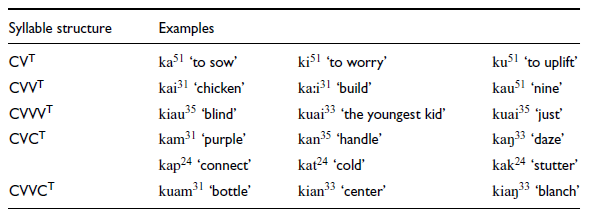
Tai Nuea has five types of syllable structure: CV, CVV, CVVV, CVC, and CVVC. As shown in Table 1, V, VV, and VVV represent all the monophthongs, diphthongs, and triphthongs mentioned above, respectively. The onset consonants include all consonants except /n/, while the codas consist of the nasals /m/, /n/, and /ŋ/ and the plosives /p/, /t/, and /k/.
Syllable structure and examples of Tai Nuea

Table 1 Long description
A table with five rows and three columns. The columns are labeled ‘Syllable structure’, ‘Examples’, and ‘Examples’. The rows list different syllable structures and their corresponding examples in Tai Nuea. Row 1: Syllable structure, CVT; Examples, ka51 ‘to sow’, ki51 ‘to worry’, ku51 ‘to uplift’. Row 2: Syllable structure, CVVT; Examples, kai31 ‘chicken’, kai31 ‘build’, kau51 ‘nine’. Row 3: Syllable structure, CVVVT; Examples, kiau35 ‘blind’, kuai33 ‘the youngest kid’, kuai35 ‘just’. Row 4: Syllable structure, CVCT; Examples, kam31 ‘purple’, kan55 ‘handle’, kap33 ‘daze’. Row 5: Syllable structure, CVVCT; Examples, kap24 ‘connect’, kat24 ‘cold’, kak24 ‘stutter’. Row 6: Syllable structure, CVVCT; Examples, kuam31 ‘bottle’, kian33 ‘center’, kian33 ‘blanch’.
Transcription of the recorded passage
This passage is transcribed using the consonants, vowels, and tones of Tai Nuea described above. The transcription below is broad phonemic. The symbols ‘|’ and ‘||’ mark minor and major phrase boundaries, respectively. The transcription of each sentence is presented in three versions: the first line is an IPA transcription; the second, in italics, is a Tai Nuea writing system transcription; and the third is the interlinear morphemic glossing. The abbreviations used in the interlinear glossing follow the Leipzig Glossing Rules (LGR, http://www.eva.mpg.de/lingua/resources/glossing-rules.php).

Trans: Finally, the wind admitted that the sun was stronger than him.
Acknowledgements
This work was supported by the National Social Science Fund of China (No. 22&ZD213) and China Ministry of Education Project of Humanities and Social Sciences (No. 25YJC740049). We extend our sincere thanks to Hanyin Sha, the speaker who provided pronunciation samples for this paper.
Supplementary material
To view supplementary material for this article, please visit https://doi.org/10.1017/S0025100326101108






 Open access

