





Wenchang (文昌市) is situated in the northeast part of Hainan province (海南省), China. The city has a total population of about 570,000 local people.Footnote 1 The dialect (文昌话) spoken here is representative of Hainan Min dialect group of Chinese (ISO 639-3; code:nan).
Map of Hainan Province, China and location of Wenchang in Hainan Province (d-maps.com n.d.).

The stop system in Wenchang Chinese is relatively unusual in Chinese dialects. In addition to commonly found voiceless and voiced plosive series, there exist implosives which form minimal pairs with voiceless plosives or voiced plosives in this dialect (Chao Reference Chao1936; Hashimoto Reference Hashimoto1960; Liang Reference Liang1986; Woon Reference Woon1987; Liu Reference Liu2006; Cun Reference Cun2009; Xin Reference Xin2013).
Two native speakers, one male and one female, were recorded. They were born and grew up in Wenchang until they pursued higher education in another city. At the time of recording, both of them are university students. The wordlist was compiled based on the descriptions in Liang (Reference Liang1986) and Woon (Reference Woon1987). The informants were then asked to read the wordlist for acoustic analysis. The recordings were made in a quiet room and a Tascam US-322 audio interface connected with a unidirectional Shure microphone and a laptop computer were used for recording. The acoustic analysis is based on the recordings of the male speaker, if not otherwise mentioned. Acoustic analyses are carried out using Praat (Boersma & Weenink Reference Boersma and Weenink2021).
Consonants
There are 18 consonants in this dialect, the inventory of which is listed below and example words are given thereafter. Underlined tone marks, as in the first item, indicate checked tones.


Plosives and Implosives
There are eight stops /p b ɓ t d ɗ k ɡ/ in this dialect, among which /b ɓ t d ɗ k ɡ/ can occur in syllable-initial position and only /p t k/ can occur in syllable-final position and /p/ never appears in syllable-initial position. In terms of place of articulation, there are three places, namely bilabial, denti-alveolar and velar. Therefore, voiced bilabial plosive /b/ contrasts with bilabial implosive /ɓ/ whereas voiceless bilabial plosive /p/ does not exist in the initial position, voiceless denti-alveolar plosive /t/, voiced plosive /d/ and implosive /ɗ/ form a minimal set, voiceless velar plosive /k/ and voiced plosive /ɡ/ contrast with each other with no corresponding velar implosive.
Figures 2 to 4 are histograms of the distribution of VOT values across three laryngeal categories occurring in syllable-initial position. Measurement of VOT values is made referring to both waveforms and wide-band spectrograms. VOT of the voiceless unaspirated plosives is measured as the interval between burst release to the voice onset of the following vowel. VOT of the voiced unaspirated plosives and voiced implosives is measured as the interval between the voicing onset to the release burst (Lisker & Abramson Reference Lisker and Abramson1964; Abramson & Whalen Reference Abramson and Whalen2017).
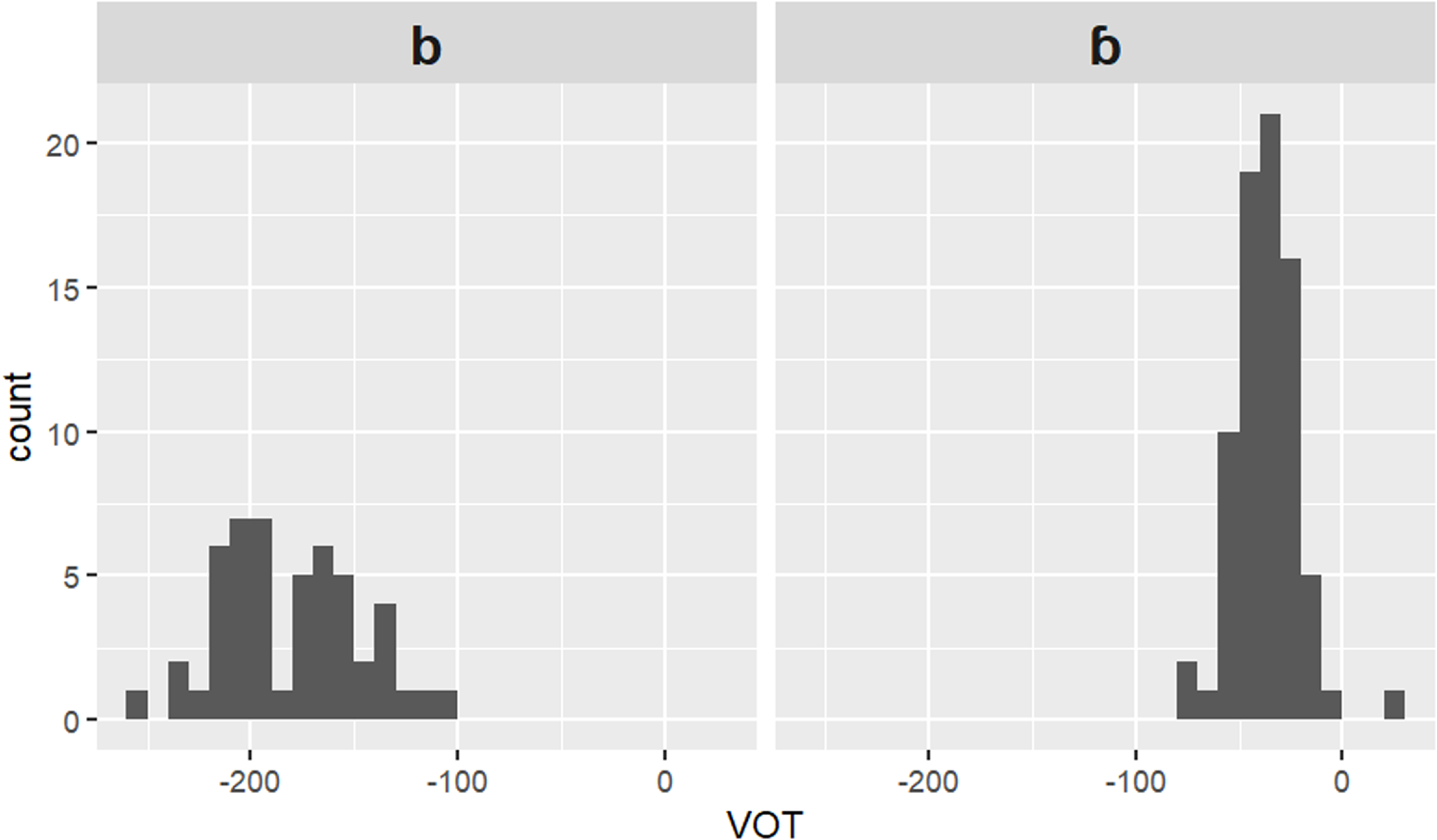
Histograms of distribution of VOT values (in ms.) of voiced bilabial plosive /b/ and bilabial implosive /ɓ/.

Histograms of distribution of VOT values (in ms.) of voiced alveolar plosive /d/, alveolar implosive /ɗ/ and voiceless unaspirated alveolar plosive /t/.

Histograms of distribution of VOT values (in ms.) of voiced velar plosive /ɡ/ and voiceless velar plosive /k/.

Both the voiced bilabial plosive /b/ and the implosive /ɓ/ (with few exceptions) have negative values with clear distinction between them and visual examination shows clearly that the voiced plosive /b/ tends to have a longer negative VOT. The average VOT value of the voiced bilabial plosive /b/ is −180 ms (SD=33.3, n=50) and that of the bilabial implosive /ɓ/ −37 ms (SD=15.6, n=76).
VOT values for the voiced alveolar plosive /d/ are negative, VOT values for the alveolar implosive /ɗ/ are characterized by dominant negative values and VOT values for the voiceless alveolar plosive /t/ are positive. With the exception of two tokens which have overlapped positive VOT between the alveolar implosive /ɗ/ and the voiceless alveolar plosive /t/, a distinctively pre-voiced onset for the alveolar implosive /ɗ/ and positive VOT for the voiceless alveolar plosive /t/ are evident. In this study, the average VOT of the voiced alveolar plosive /d/ is 192ms (SD=39.7, n=4),Footnote 2 that of the alveolar implosive /ɗ/ is −37ms (SD=19, n=89) whereas that of the voiceless alveolar plosive /t/ is 15 ms (SD=5, n=118).
It is clear that voiced and voiceless velar plosives show obvious distinction in VOT values, with the voiced velar plosive /ɡ/ having negative VOT values and the voiceless velar plosive /k/ positive VOT values. The average VOT value of the voiced velar plosive /ɡ/ is −150 ms (SD=25.2, n=22) and that of voiceless velar plosive /k/ 36 ms (SD=13.6, n=128).
To sum up, voiceless unaspirated plosives show short lag VOT and both the voiced plosives and implosives (with four exceptions in total) have negative VOT. Generally speaking, implosives are characterized by shorter voicing lead VOTs than voiced plosives. The current finding of a VOT difference between voiced plosives and implosives is consistent with earlier research (Nihalani Reference Nihalani1986, Reference Nihalani2006; Naidoo Reference Naidoo, Ndinga-Koumba-Binza and Bosch2012; Mori Reference Mori2023).
In addition to a primary correlate of the voicing contrast, VOT values are also reported to correlate with place of articulation. For voiceless plosives, voiceless unaspirated plosives /t/ and /k/ have average VOT values of 15 ms and 36 ms respectively. This is in agreement with the general tendency observed in other languages and has been documented in many other languages: positive VOT values are longer as the place of articulation is further back (Lisker & Abramson Reference Lisker and Abramson1964; Klatt Reference Klatt1975; Nearey & Rochet Reference Nearey and Rochet1994; Cho & Ladefoged Reference Cho and Ladefoged1999; Öğüt et al. Reference Öğüt, Kiliç, Engin and Midilli2006; Bijankhan & Nourbakhsh Reference Bijankhan and Nourbakhsh2009; Cho, Whalen & Docherty Reference Cho, Whalen and Docherty2019; Genee & Li Reference Genee and Li2023). The correlation between the voicing contrast and VOT values does not hold true with respect to voiced plosives and implosives. For voiced plosives, /b d ɡ/ have average VOT values of −180, −192, and −150 ms, respectively, where the ranges of VOT values overlap extensively. For implosives, the difference in VOT values between /ɓ ɗ/ is also negligible.
The realization of implosives can vary considerably across tokens, which is in accord with those reported in previous studies (Ladefoged Reference Ladefoged and Bouhuys1968; Ladefoged & Maddieson Reference Ladefoged and Maddieson1996; Lindau Reference Lindau1984; Piñeros Reference Piñeros2003; Nihalani Reference Nihalani2006; Cun Reference Cun2009). Figure 5 shows examples exhibiting the way an implosive may be realized in Wenchang dialect.
(a) [ɓan33] ‘bottle’, (b) [ɗo31] ‘to pour’, (c) [ɓo52] ‘disapprove’, (d) [ɗo33] ‘long’ – various realization forms of implosives in Wenchang dialect.

Figure 5. Long description
Panel A: The waveform graph shows the amplitude over time for the implosive [an33] bottle. The spectrogram below it displays the frequency spectrum over time, with darker regions indicating higher energy concentrations. The time axis ranges from 0 to 0.7 seconds, and the frequency axis ranges from 0 to 5000 hertz. Panel B: The waveform graph shows the amplitude over time for the implosive [o31] to pour. The spectrogram below it displays the frequency spectrum over time, with darker regions indicating higher energy concentrations. The time axis ranges from 0 to 0.6 seconds, and the frequency axis ranges from 0 to 5000 hertz. Panel C: The waveform graph shows the amplitude over time for the implosive [o52] disapprove. The spectrogram below it displays the frequency spectrum over time, with darker regions indicating higher energy concentrations. The time axis ranges from 0.25 to 0.55 seconds, and the frequency axis ranges from 0 to 5000 hertz. Panel D: The waveform graph shows the amplitude over time for the implosive [o33] long. The spectrogram below it displays the frequency spectrum over time, with darker regions indicating higher energy concentrations. The time axis ranges from 0 to 0.7 seconds, and the frequency axis ranges from 0 to 5000 hertz.
The token (5a) [ɓan33] ‘bottle’ is characterized by increasing amplitude of vocal fold vibration during the closure, which is an acoustic feature typical of implosives (Catford Reference Catford2010, originally published in 1939; Laver Reference Laver1994; Chen Reference Chen2000; Cun Reference Cun2009; Ladefoged & Johnson Reference Ladefoged and Johnson2014). Out of 165 implosive tokens, the number of tokens with characteristics similar to (5a) includes 143 monosyllabic words, accounting for 87% of the total.
Compared to the token (5a), the token (5b) [ɗo31] ‘to pour’ has a much shorter voicing before the release of the closure, with about one or two glottal pulses in length before the release of implosive. There are only 18 tokens similar to (5b) with VOT values between −20ms and 0ms, significantly fewer than the first category. Implosives with short pre-voicing are documented in previous studies (Ladefoged et al. Reference Ladefoged, Williamson, Elugbe and Uwalaka1976; Lojenga Reference Lojenga1991; Demolin Reference Demolin, Comrie and Arvanti1995; Mc Laughlin Reference Mc Laughlin2005; Cun Reference Cun2009).
The token (5c) [ɓo52] ‘disapprove’ shows a voiceless stop realization of an implosive where the voicing onset and oral release are almost synchronous. Among the current 165 implosive tokens, (5c) is the only token with a VOT of zero.
The production of token (5d) [ɗo33] ‘long’ exhibits no pre-voicing before closure release, resulting in a voiceless production. A similar example where creakiness can also be observed after the release is reported in Cun (Reference Cun2009), and it can take up to 63ms for the vocal folds to get started. The voiceless variants of the implosives (similar to 5d) are also limited in quantity and amount to 3 tokens in total.
Plosives /p t k/ can occur in syllable-final position. In monosyllabic environments, these three voiceless consonants are not released in the coda position, but their effect on the preceding vowels is evident. Figure 6 shows /p t k/ at the end of the monosyllables [kiap 3 ] ‘to clip’, [tuat 3 ] ‘extinct’ and [liak 3 ] ‘green’. These three words have the identical vowel—the low vowel /a/—preceding the syllable-final obstruents. Their formant trajectories show different transitional patterns. In the word [kiap 3 ] ‘to clip’, the second formant of the vowel falls slightly during the transition into the following bilabial consonant and ends around 1100 Hz. In the word [tuat 3 ] ‘extinct’, the F2 value of the low vowel ends around 1300 Hz. In the word [liak 3 ] ‘green’, F3 falls towards F2 and a velar pinch can be noticed. The formant frequencies at the coda position change, implying the articulatory gestures in the supralaryngeal cavity for the production of the post-vocalic plosives. Therefore, although syllable-final obstruents are not released, they differ in terms of their formant transitions.
Formant transition patterns of /p t k/ at the syllable-final position in the example words: (a) [kiap 3 ] ‘to clip’, (b) [tuat 3 ] ‘extinct’, (c) [liak 3 ] ‘green’.

Figure 7 compares the monosyllabic word [ɓak 5 ] ‘north’ read in isolation and in the intervocalic position of the bisyllabic compound word [ɓak 5 uaŋ34] ‘the north wind’ (extracted from two different positions of the passage ‘the North Wind and the Sun’). As is shown in the figure, when it is read in isolation, the voiceless velar plosive is not released whereas in the intervocalic position of the connected speech, it might or might not be audible. In (7b), the syllable-final /k/ is audible and appears as a voiced approximant whereas in (7c), it is inaudible.
Syllable-final /k/ (a) in the monosyllabic word [ɓak 5 ] ‘north’, and (b) and (c) in the intervocalic position of the bisyllabic word [ɓak 5 uaŋ34] ‘the North Wind’ (extracted from the passage ‘the North Wind and the Sun’).

Affricates
Affricates exhibit a two-way distinction in manner—voiceless /ts/ vs. voiced /dz/. The denti-alveolar affricates become palatalized [tɕ dʑ] when the following rhymes are unrounded high front vowel /i/ or rhymes beginning with /i/ such as /iu io ia iom ien ioŋ iaŋ iet iop iok iak/. Figure 8 shows sample FFT spectra of the affricates [ts dz tɕ dʑ] measured within the 500 to 10, 000 Hz frequency range in a 25-ms window centered around the midpoint of the affricate release phase (Forrest et al. Reference Forrest, Weismer, Milenkovic and Dougall1988; Zsiga Reference Zsiga1993; Jongman, Wayland & Wong Reference Jongman, Wayland and Wong2000; Cho, Jun & Ladefoged Reference Cho, Jun and Ladefoged2002; Gordon, Barthmaier & Sands Reference Gordon, Barthmaier and Sands2002). Figure 8 shows the spectra of denti-alveolar affricates and allophonic alveolar-palatal counterparts.
FFT spectra within the 500 to 10, 000 Hz frequency range in a 25-ms window centered around the midpoint of the affricate release phase of four sample words: (a) [tse42] ‘to sit’, (b) [dze31] ‘arrogant’, (c) [tɕiam34] ‘pointed’ and (d) [dʑiok 5 ] ‘to nurture’.

Figure 8. Long description
Panel A: A line graph shows the sound pressure level in decibels per hertz (dB/Hz) against frequency in hertz (Hz) for the word to sit. The x-axis ranges from 500 to 10,000 Hz, and the y-axis ranges from -40 to 20 dB/Hz. The graph exhibits fluctuations in sound pressure level across the frequency range. Panel B: A line graph displays the sound pressure level in dB/Hz against frequency in Hz for the word arrogant. The x-axis ranges from 500 to 10,000 Hz, and the y-axis ranges from -40 to 20 dB/Hz. The graph shows variations in sound pressure level across the frequency range. Panel C: A line graph presents the sound pressure level in dB/Hz against frequency in Hz for the word pointed. The x-axis ranges from 500 to 10,000 Hz, and the y-axis ranges from -40 to 20 dB/Hz. The graph indicates changes in sound pressure level across the frequency range. Panel D: A line graph illustrates the sound pressure level in dB/Hz against frequency in Hz for the word to nurture. The x-axis ranges from 500 to 10,000 Hz, and the y-axis ranges from -40 to 20 dB/Hz. The graph demonstrates fluctuations in sound pressure level across the frequency range.
The voiced affricate shows more variation compared with its voiceless counterpart. Words (a) /dze31/ ‘grandpa’, (b) /dʑiu34/ ‘again’, (c) /dze21/ ‘liquid’, (d) /dzuai31/ ‘sharp’ and (e) /dzua42/ ‘hot’ are examples of different realizations of the voiced affricate, as shown in Figure 9. The first type, which is illustrated in Figure 9a, is the typical pronunciation of a voiced affricate; that is, voicing starts before the release, which is followed by a period of fricative noise. In Figure 9b, no clear burst can be seen and Figure 9c is characterized by nasalization before the burst. Figures 9d and 9e illustrate a process of lenition where the realization form is a fricative instead of an affricate. In the token 9d it is realized as [z]; in the token 9e, voicing only appears one third of the way through the frication. The fricative realization of /dz/ is limited, amounting to 5 tokens (8.3% of 60 voiced affricate tokens) and in all other cases the realization of a plosive and a fricative is preserved in the present dataset.
Waveforms and spectrograms of variability in the realization of the underlying affricate /dz/: (a) [dze31] ‘grandpa’, (b) [dʑiu34] ‘again’, (c) [dze21] ‘liquid’, (d) [zuai31] ‘sharp’ and (e) [zua42] ‘hot’, ranging from an affricate to a devoiced fricative.

Nasals
Nasals with three different places of articulation exist in this dialect and all are voiced. They are bilabial nasal /m/, alveolar nasal /n/ and velar nasal /ŋ/. All can occur in both syllable-initial and syllable-final position, with certain phonotactic restrictions. In syllable-final position, /m/ occurs after vowels /a o ia io/ and never co-occurs with syllable-initial homorganic bilabial consonants /ɓ b ɸ m/; /n/ occurs only after vowels /a u ie ua/; and /ŋ/ occurs after vowels /a e o ia io ua/ and does not co-occur with syllable-initial voiced velar plosive /ɡ/.
Fricatives
There are three voiceless fricatives and one voiced fricative in this dialect: a bilabial fricative /ɸ/, a denti-alveolar fricative /s/, a voiceless glottal fricative /h/ and a voiced glottal fricative /ɦ/.
With respect to bilabial fricative /ɸ/, most, if not all, of the tokens in present study turn out to be voiceless aspirated bilabial plosive [pʰ] instead of a bilabial fricative [ɸ], which may reflect a synchronic sound change in this dialect. The reason why bilabial fricative has disappeared or is disappearing from this dialect might be because it is a marked sound and rarely found in the world’s languages (Ladefoged & Maddieson Reference Ladefoged and Maddieson1996). Controversy exists in the description of this sound. It has long been documented in the majority of previous impressionistic transcriptions as bilabial fricative /ɸ/ (Liang Reference Liang1986; Woon Reference Woon1987; Huang & Feng Reference Huang and Feng1993; Zhang Reference Zhang2006). Xin (Reference Xin2013), however, points out that both [pʰ] and [ɸ] exist in this dialect and they are in free variation. He further mentions that [ɸ] tends to appear before syllables that are not high-front ‘Hongyin’ (洪音) whereas [pʰ] occurs before front ‘Xiyin’ (细音)Footnote 3 syllables. The source of this variation is yet to be determined. One reviewer also mentions the example word /ɸui34/ ‘very’ is indeed pronounced with a bilabial fricative. Further research based on a larger scale is needed.
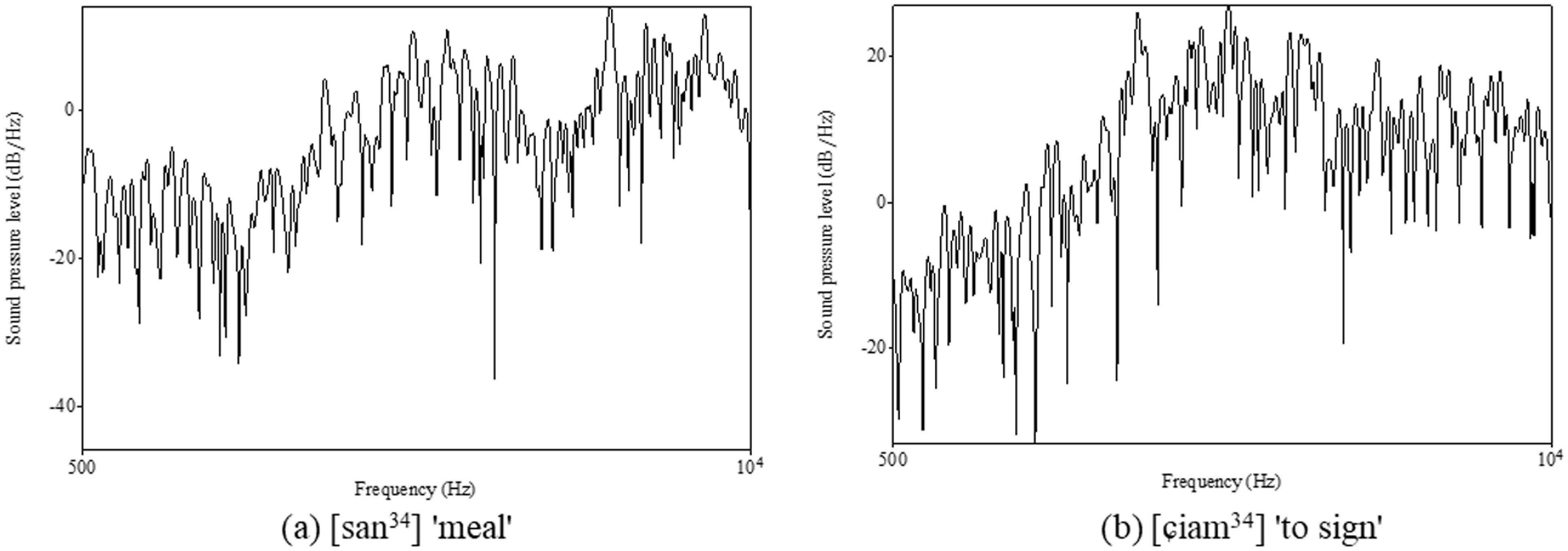
Fricative /s/ is realized as a palatalized variant [ɕ] when it occurs before a high front vowel /i/ or other rhymes /ia io iu iam iaŋ ien iom iat iop/ with the high front vowel as the first segment such as in /ɕiam34/ ‘to sign’. Figure 10 shows the spectra of denti-alveolar fricative and allophonic palatalized counterparts.
FFT spectra centered around the midpoint of the frication part of two sample words: (a) [san34] ‘meal’ and (b) [ɕiam34] ‘to sign’.

With respect to the glottal fricative /h/, previous studies differ in the symbols used to describe it. Liang (Reference Liang1986) and Xin (Reference Xin2013) describe it as a velar fricative /x/, whereas Hashimoto (Reference Hashimoto1960) and Woon (Reference Woon1987) describe it as a glottal fricative /h/. Its phonetic realization may vary and exhibit coarticulatory variation as a result of different vowel environment. Figure 11 shows the spectra of /h/ followed by a back vowel and a front vowel.
The status of the voiced glottal fricative /ɦ/ is controversial and the controversy can be summarized as two points.
On one hand, earlier research (Hashimoto Reference Hashimoto1960; Liang Reference Liang1986; Woon Reference Woon1987) uses different symbols to transcribe it. It is transcribed as voiceless glottal fricative /h/ in Liang (Reference Liang1986), but voiced glottal fricative /ɦ/ in Hashimoto (Reference Hashimoto1960) and Woon (Reference Woon1987). On the other hand, more recent research (e.g. Liu & Wang Reference Liu and Wang2008) proposes treating it as allophonic variant of the null onset. Therefore, in this section whether or not the voiced glottal fricative exists in this dialect is discussed together with the zero onset as well as its variants.
Figure 12 shows five pairs of words. It is obvious that typologically, the distribution of /ɦ/ in this dialect is different from Wu dialects such as Shanghai Chinese (Chen & Gussenhoven Reference Chen and Gussenhoven2015) or Lili Wu Chinese (Shi & Chen Reference Shi and Chen2022) where the appearance of /ɦ/ is tone-dependent or vowel-dependent. In this dialect, /ɦ/ can freely co-occur with vowels of different heights (e.g., high vowel /i/ in (1b) and /un/ in (4b), mid vowel /o/ in (2b) and /eŋ/ in (5b), and low vowel /au/ in (3b)) and across all tonal categories (e.g., falling in (1b) and (2b), level in (3b), and rising in (4b) and (5b)).
FFT spectra centered around the midpoint of the aspiration part of two sample words: (a) [hou33] ‘to throw’ and (b) [hi31] ‘utensil’.

Comparison between /V/-initial syllables (left) and /ɦ/-initial syllables (right).

Figure 12. Long description
Panel 1a: A spectrogram shows the syllable chair. The x-axis represents time in seconds, ranging from 0 to 0.7. The y-axis represents frequency in Hertz, ranging from 0 to 5000. The spectrogram displays a waveform at the top, a frequency plot in the middle, and a fundamental frequency (F0) contour at the bottom. Panel 1b: A spectrogram shows the syllable like. The x-axis represents time in seconds, ranging from 0 to 0.93. The y-axis represents frequency in Hertz, ranging from 0 to 5000. The spectrogram displays a waveform at the top, a frequency plot in the middle, and a fundamental frequency (F0) contour at the bottom. Panel 2a: A spectrogram shows the syllable shadow. The x-axis represents time in seconds, ranging from 0 to 0.83. The y-axis represents frequency in Hertz, ranging from 0 to 5000. The spectrogram displays a waveform at the top, a frequency plot in the middle, and a fundamental frequency (F0) contour at the bottom. Panel 2b: A spectrogram shows the syllable good. The x-axis represents time in seconds, ranging from 0 to 0.99. The y-axis represents frequency in Hertz, ranging from 0 to 5000. The spectrogram displays a waveform at the top, a frequency plot in the middle, and a fundamental frequency (F0) contour at the bottom. Panel 3a: A spectrogram shows the syllable throat. The x-axis represents time in seconds, ranging from 0 to 0.86. The y-axis represents frequency in Hertz, ranging from 0 to 5000. The spectrogram displays a waveform at the top, a frequency plot in the middle, and a fundamental frequency (F0) contour at the bottom. Panel 3b: A spectrogram shows the syllable proud. The x-axis represents time in seconds, ranging from 0 to 0.89. The y-axis represents frequency in Hertz, ranging from 0 to 5000. The spectrogram displays a waveform at the top, a frequency plot in the middle, and a fundamental frequency (F0) contour at the bottom. Panel 4a: A spectrogram shows the syllable warm temperature. The x-axis represents time in seconds, ranging from 0 to 0.82. The y-axis represents frequency in Hertz, ranging from 0 to 5000. The spectrogram displays a waveform at the top, a frequency plot in the middle, and a fundamental frequency (F0) contour at the bottom. Panel 4b: A spectrogram shows the syllable to fair. The x-axis represents time in seconds, ranging from 0 to 0.96. The y-axis represents frequency in Hertz, ranging from 0 to 5000. The spectrogram displays a waveform at the top, a frequency plot in the middle, and a fundamental frequency (F0) contour at the bottom. Panel 5a: A spectrogram shows the syllable outstanding. The x-axis represents time in seconds, ranging from 0 to 0.8. The y-axis represents frequency in Hertz, ranging from 0 to 5000. The spectrogram displays a waveform at the top, a frequency plot in the middle, and a fundamental frequency (F0) contour at the bottom. Panel 5b: A spectrogram shows the syllable to initiate. The x-axis represents time in seconds, ranging from 0 to 0.94. The y-axis represents frequency in Hertz, ranging from 0 to 5000. The spectrogram displays a waveform at the top, a frequency plot in the middle, and a fundamental frequency (F0) contour at the bottom.
Words on the left side are transcribed as a zero onset by Liang (Reference Liang1986) and Woon (Reference Woon1987), but Woon (Reference Woon1987) further mentions that “words starting with a zero initial are always pronounced with a glottal stop”. The present data, however, contradict Woon’s statement, showing that the zero onset is not invariably realized as a glottal stop. The present findings show that it is realized as either a real null onset (e.g. 1a and 2a) or preglottalized onset [ʔ] (e.g. 3a, 4a and 5a). Another observation is that the allophonic realization of the zero onset is not conditioned by tones nor by the subsequent vowel context given that vowels in the example words vary in their vowel height (e.g. [i] vs. [au]) or backness (e.g. [i] vs. [un]) or tone category (e.g. falling vs. level). From the above analysis, we can draw the tentative conclusion that the zero onset can be realized either as a real null onset or with initial glottalization.
The examples appearing on the right in Figure 12 are transcribed with voiceless glottal fricative /h/ in Liang (Reference Liang1986), voiced glottal fricative /ɦ/ in Woon (Reference Woon1987) or an allophonic variant of the null onset in Liu & Wang (Reference Liu and Wang2008). Liu & Wang (Reference Liu and Wang2008) comment that because of weak energy, and short and almost imperceptible duration, all of these features suggest that voiced glottal fricative /ɦ/ is disappearing and merging with zero onset and may be treated as an allophonic variant of the null onset. Here, various acoustic evidence tends to support Woon’s description. Aspiration can be noticed before the vowels, or the initial portion of the vowel witnesses lower intensity or longer duration than words with a zero initial, which all suggest the existence of the voiced glottal fricative. In addition, breathy phonation in /ɦ/ lowers the fundamental frequency (f0) of following vowels. As a result of a breathy voice effect, the right-hand words starting with /ɦ/ all start with a lower f0 than the left-hand words with the zero onset, and the original tonal contour does not surface until halfway into the syllable. A similar f0 lowering effect as a result of neighboring breathy sounds is well documented and is empirically supported from multiple languages (e.g. DiCanio Reference DiCanio2012; Garellek et al. Reference Garellek, Chai, Huang and Van Doren2023; Gordon & Ladefoged Reference Gordon and Ladefoged2001; Hombert, Ohala & Ewan Reference Hombert, Ohala and Ewan1979).
Vowels
Monophthongs
The distribution of Wenchang monophthongs in open syllables in a traditional quadrilateral chart is shown below.

Monophthongs in (C)V structure

Monophthongs in (C)VN structure

Monophthongs in (C)VT structure

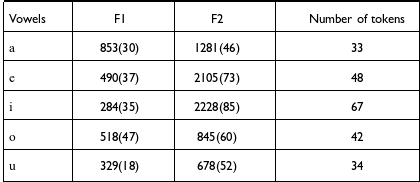
Wenchang Chinese has 5 monophthongs /i e a o u/ in open syllable. Table 1 lists the mean frequency values of the first two formants as well as the number of tokens used for each monophthong. Figure 13 shows the mean frequency values for the monophthongs as well as vowel ellipses.
Mean frequency values of the first two formants (in Hz), standard deviation in parenthesis, and the number of tokens of five monophthongs in open syllables.

Table 1. Long description
A table comparing mean frequency values of the first two formants and the number of tokens for five monophthongs in open syllables. The table has five rows and four columns. The columns are labeled Vowels, F1, F2, and Number of tokens. The row labels are a, c, i, o, and u. The values in the table are as follows: Row 1: a, 853(30), 1281(46), 33. Row 2: c, 490(37), 2105(73), 48. Row 3: i, 284(35), 2228(85), 67. Row 4: o, 518(47), 845(60), 42. Row 5: u, 329(18), 678(52), 34.
Vowel ellipses (left) and mean values (right) of F1 and F2 (in Hz) of monophthongs in open syllables. Ellipses represent 2 standard deviations (2 SD) from the mean.

Two monophthongs /a o/ can occur in syllables ending with bilabial nasal /m/ or bilabial plosive /p/, two monophthongs /a u/ occur in syllables ending with denti-alveolar nasal /n/ or plosive /t/ and three monophthongs /a e o/ can occur in syllables ending with velar nasal /ŋ/ or velar plosive /k/.
Diphthongs
Diphthongs in (C)V syllables

Diphthongs in (C)VN syllables

Diphthongs in (C)VT syllables

Ten diphthongs /ai au oi ou ia io ua ue ui iu/ can occur in open syllables. Figure 14 shows the formant distribution of each diphthong in open syllables represented by the start and end points of the arrow, the values of which are based on the mean values of F1 and F2 of the first and second element of the diphthongs. The starting and ending point of the diphthongs may fail to reach the target positions of the corresponding monophthongs, which conforms to previous findings of characteristics of diphthongs across different languages of the world (Gay Reference Gay1968, Reference Gay1970; Bladon Reference Bladon1985).
Mean F1 and F2 (in Hz) of the start and end points of diphthongs in open syllables.

Four diphthongs /ie ia io ua/ can occur in syllables ending with a nasal or a plosive. Among them, /ia io/ can occur in syllables ending with bilabial nasal /m/ or bilabial plosive /p/, /ie ua/ occur in syllables ending with denti-alveolar nasal /n/ or plosive /t/, /ia io ua/ can occur in syllables ending with velar nasal /ŋ/ or velar plosive /k/. With respect to the transcriptions of diphthongs occurring in (C)VN and (C)VT syllables, no substantial difference from previous work is observed. For the diphthong /ie/, Woon (Reference Woon1987) transcribes it as /ian/ and /iat/, but further notes that the actual phonetic values approximate /ien/ and /iet/. The present study shows that average F1 and F2 values of the second element of /ien/ are 564Hz and 1835Hz in (C)VN structure and 560Hz and 1704Hz in (C)VT structure, which supports annotating them as /ien/ and /iet/.
Triphthongs
Triphthongs in (C)V syllables

There are two triphthongs /iau uai/ in Wenchang Chinese. As shown in Figure 15, their formant values do not necessarily reach the target values found for monophthongs.
Mean F1 and F2 (in Hz) of the start, mid and end points of triphthongs in open syllables.

Syllable structure
Syllables may take the form of (C)V(C), in which the syllable-initial consonant may be any consonant listed in the consonant chart except for /p/ and syllable-final consonants are restricted to /m n ŋ p t k/. Examples are given below:
V /i34/ 医 ‘doctor’ CV /be31/ 马 ‘horse’ VC /aŋ33/ 红 ‘red’ CVC /ɗek5/ 德 ‘virtue’
No co-occurrence restriction is found between onsets and lexical tones. That is, onsets, no matter whether they are voiced, voiceless or implosives, can co-occur with any citation tones.
Syllable-initial bilabial consonants /ɓ b ɸ m/ never co-occur with syllable-final homorganic bilabial consonants /m p/. Syllable-initial voiced velar consonant /ɡ/ occurs before a restricted set of vowels /u o e ou ua ue/ (Liang Reference Liang1986).
Rhymes exhibit co-occurrence patterns with tones: short and checked tones T7(5) and T8(3) only occur with syllables ending with an obstruent and cannot co-occur with other rhyme types such as open syllables or syllables ending with a nasal.
Tone

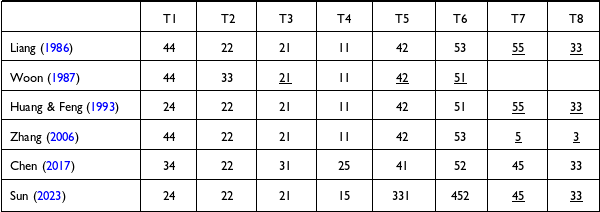
Previous studies of Wenchang dialect disagree with respect to the number of tone categories and the pitch level and pitch contour of each category, which can be seen in Table 2. Woon (Reference Woon1987) differs from all the other studies in that he shows that there are six tones, among which there are three short tones, T3(21), T5(42) and T6(51). The remaining studies agree with respect to the number of tones, but differ in the transcription of certain tones. T1 in Liang (Reference Liang1986) and Zhang (Reference Zhang2006) is transcribed as a level tone 44, whereas in Huang & Feng (Reference Huang and Feng1993), Chen (Reference Chen2017) and Sun (Reference Sun2023), it is transcribed as a rising tone, 24 or 34. Another controversy lies in the tone value of T4, some transcribing it as 11 (Liang Reference Liang1986; Woon Reference Woon1987; Huang & Feng Reference Huang and Feng1993; Zhang Reference Zhang2006) and Chen (Reference Chen2017) and Sun (Reference Sun2023) transcribing it as 25 or 15.
Previous descriptions of citation tones in Wenchang Chinese.

Table 2. Long description
The table presents a comparison of citation tones in Wenchang Chinese across various studies. It has eight columns labeled T1, T2, T3, T4, T5, T6, T7, and T8, and six rows labeled with the names of the studies and their publication years. Each cell contains numerical values representing the tone categories and their pitch levels or contours. Row 1: Liang (1986), 44, 22, 21, 11, 42, 53, 55, 33. Row 2: Woon (1987), 44, 33, 21, 11, 42, 51. Row 3: Huang (1993), 24, 22, 21, 11, 42, 51, 55, 33. Row 4: Zhang (2006), 44, 22, 21, 11, 42, 53, 5, 3. Row 5: Chen (2017), 34, 22, 31, 25, 41, 52, 45, 33. Row 6: Sun (2023), 24, 22, 21, 15, 331, 452, 45, 33. The table highlights discrepancies in the number of tone categories and their pitch levels or contours as described by different studies.
Raw f0 contours of citation tones of Wenchang dialect based on 12 tokens for each tone.

Figure 16. Long description
A line graph showing the fundamental frequency (F0) in Hertz over time in milliseconds for different tones in the Wenchang dialect. The horizontal axis represents duration in milliseconds, ranging from 0 to 500 milliseconds. The vertical axis represents F0 in Hertz, ranging from 120 to 220 Hertz. The graph includes eight data lines, each representing a different tone (T1 to T8). T1 is represented by a light blue line, T2 by an orange line, T3 by a gray line, T4 by a yellow line, T5 by a dark blue line, T6 by a green line, T7 by a dark blue line, and T8 by a brown line. Each line shows the trend of F0 over time for the respective tone. T1 shows a slight increase, T2 remains relatively flat, T3 shows a slight decrease, T4 shows a significant decrease, T5 shows a slight increase, T6 shows a peak and then a decrease, T7 shows a decrease, and T8 remains relatively flat.
Normalized f0 contours of citation tones of Wenchang dialect using Log z-score normalization method based on 12 tokens for each tone.

Raw data and normalized data of the f0 contours in this dialect are shown in Figure 16 and Figure 17. And normalized data are obtained following log z-score method proposed by Zhu (Reference Zhu1994).
In sum, there are eight tones in this dialect and all citation tones are well differentiated from each other. The tone values are assigned based on a combination of perception and the f0 contours of each tone. T1 is a mid-to-high rising tone and transcribed as 34. T2 is a mid-level tone and transcribed here as 33. T3 and T4 are transcribed as 31 and 21, respectively, in that the onset of T3 is higher than T4 and different levels are used to differentiate them. T4 needs further study on a larger scale since there exist native speakers who pronounce this tone as a rising tone. T5 and T6 are two other falling tones with higher onset values, which we transcribe as 42 and 52. Instead of falling continuously from the very beginning to the end, T6 falls from 40% point of the syllable. Four falling tones, T3, T4, T5 and T6, can have creaky voice when they are read in isolation (see Figure 20 and accompanying text). T7 and T8 are much shorter than the other tones. T7 is a short high tone and is labelled as 5 and T8 a short mid tone which is assigned 3. T7 and T8 co-occur with syllables ending with a plosive whereas all the other tones co-occur with all the other syllable types.
Tone sandhi of reduplicated words
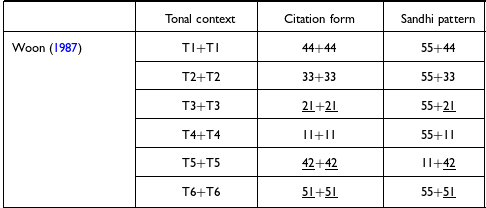
Research on tone sandhi of reduplicated words in Wenchang dialect remains limited, with only a single descriptive study by Woon (Reference Woon1987). Table 3 presents his descriptions of tone sandhi patterns on reduplicated syllables.
Woon’s descriptions of tone sandhi patterns of reduplicated syllables in Wenchang Chinese.

Table 3. Long description
The table has four columns: Tonal context, Citation form, and Sandhi pattern. It includes six rows of data. Row 1: Tonal context, T1+T1; Citation form, 44+44; Sandhi pattern, 55+44. Row 2: Tonal context, T2+T2; Citation form, 33+33; Sandhi pattern, 55+33. Row 3: Tonal context, T3+T3; Citation form, 21+21; Sandhi pattern, 55+21. Row 4: Tonal context, T4+T4; Citation form, 11+11; Sandhi pattern, 55+11. Row 5: Tonal context, T5+T5; Citation form, 42+42; Sandhi pattern, 11+42. Row 6: Tonal context, T6+T6; Citation form, 51+51; Sandhi pattern, 55+51.
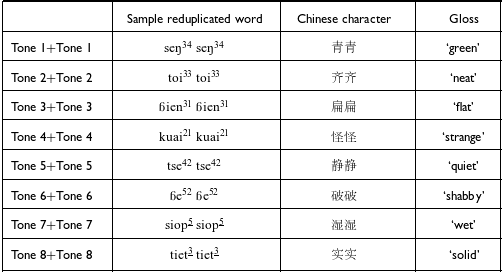
The present study re-examines the phenomenon using the test words shown in Table 4. Figures 18 and 19 show the corresponding f0 contours.
Reduplicated bisyllabic test words

Table 4. Long description
A table with four columns and eight rows. The columns are labeled ’Sample reduplicated word’, ’Chinese character’, ’Gloss’, and ’Tone’. Row 1: Tone 1+Tone 1, se34 se34, 青青, green. Row 2: Tone 2+Tone 2, toi33 toi33, 干净, neat. Row 3: Tone 3+Tone 3, ien31 ien31, 平扁, flat. Row 4: Tone 4+Tone 4, kuai21 kuai21, 奇怪, strange. Row 5: Tone 5+Tone 5, tse42 tse42, 静静, quiet. Row 6: Tone 6+Tone 6, e52 e52, 破破, shabby. Row 7: Tone 7+Tone 7, siop5 siop5, 湿湿, wet. Row 8: Tone 8+Tone 8, tiet3 tiet3, 实实, solid.
Raw f0 contours of reduplicated bisyllabic words.

Figure 18. Long description
Panel A: A line graph titled T1+T1(34+34) shows the fundamental frequency (F0) in Hertz on the vertical axis and duration in milliseconds on the horizontal axis. The graph displays a U-shaped trend, starting around 190 Hz, dropping to about 130 Hz, and then rising back to around 190 Hz. Panel B: A line graph titled T2+T2(33+33) shows the fundamental frequency (F0) in Hertz on the vertical axis and duration in milliseconds on the horizontal axis. The graph shows a slight decline from around 190 Hz to about 150 Hz, then stabilizes. Panel C: A line graph titled T3+T3(31+31) shows the fundamental frequency (F0) in Hertz on the vertical axis and duration in milliseconds on the horizontal axis. The graph displays a steady decline from around 200 Hz to about 130 Hz. Panel D: A line graph titled T4+T4(21+21) shows the fundamental frequency (F0) in Hertz on the vertical axis and duration in milliseconds on the horizontal axis. The graph shows a peak around 210 Hz, then declines to about 130 Hz. Panel E: A line graph titled T5+T5(42+42) shows the fundamental frequency (F0) in Hertz on the vertical axis and duration in milliseconds on the horizontal axis. The graph displays a slight decline from around 190 Hz to about 140 Hz, then stabilizes. Panel F: A line graph titled T6+T6(52+52) shows the fundamental frequency (F0) in Hertz on the vertical axis and duration in milliseconds on the horizontal axis. The graph shows a U-shaped trend, starting around 190 Hz, dropping to about 140 Hz, and then rising back to around 190 Hz. Panel G: A line graph titled T7+T7(5+5) shows the fundamental frequency (F0) in Hertz on the vertical axis and duration in milliseconds on the horizontal axis. The graph displays a slight decline from around 190 Hz to about 150 Hz, then stabilizes. Panel H: A line graph titled T8+T8(3+3) shows the fundamental frequency (F0) in Hertz on the vertical axis and duration in milliseconds on the horizontal axis. The graph shows a slight decline from around 190 Hz to about 150 Hz, then stabilizes.
Normalized f0 contours of reduplicated bisyllabic words.

Based on the f0 contours, we can see that the original tones on the second syllable are stable and those on the first syllable change. Tone sandhi patterns of reduplicated bisyllabic words in this dialect, therefore, belong to right-dominant patterns, similar to other Southern Min dialects such as Xiamen, Zhangzhou, Quanzhou, etc. as documented in Chen (Reference Chen2010).
The results of the present study differ to certain extent from Woon’s descriptions. According to Woon (Reference Woon1987), T5 (tone value: 42) changes to a low-level sandhi tone 11 whereas all other tones occurring on the first syllable of a bisyllabic word may change to a high-level sandhi tone 55. In the preset study, T3 (tone value: 31) and T4 (tone value: 21) change to a high-level tone whereas all other tones change to a falling contour although the f0 onsets of the falling contour may differ.
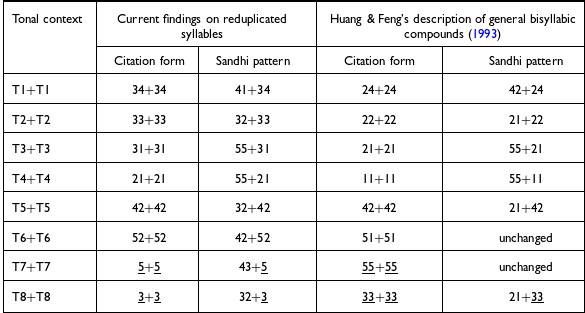
Table 5 compares tone sandhi patterns of reduplicated forms based on the present study with those of general bisyllabic compounds described by Huang & Feng (Reference Huang and Feng1993). To ensure a parallel comparison, only those items in the general compounds where both syllables share an identical citation tone are chosen.
A comparison of tone sandhi patterns: current findings on reduplicated syllables vs. Huang & Feng’s description of general bisyllabic compounds (Reference Huang and Feng1993)

Table 5. Long description
A table with three columns and eight rows comparing tone sandhi patterns. Column headers are Tonal context, Current findings on reduplicated syllables, and Huang & Fengs description of general bisyllabic compounds (1993). Current findings on reduplicated syllables is further divided into Citation form and Sandhi pattern. Huang & Fengs description of general bisyllabic compounds (1993) is further divided into Citation form and Sandhi pattern. Row 1: Tonal context, T1+T1; Current findings on reduplicated syllables, Citation form, 34+34, Sandhi pattern, 41+34; Huang & Fengs description of general bisyllabic compounds (1993), Citation form, 24+24, Sandhi pattern, 42+24. Row 2: Tonal context, T2+T2; Current findings on reduplicated syllables, Citation form, 33+33, Sandhi pattern, 32+33; Huang & Fengs description of general bisyllabic compounds (1993), Citation form, 22+22, Sandhi pattern, 21+22. Row 3: Tonal context, T3+T3; Current findings on reduplicated syllables, Citation form, 31+31, Sandhi pattern, 55+31; Huang & Fengs description of general bisyllabic compounds (1993), Citation form, 21+21, Sandhi pattern, 55+21. Row 4: Tonal context, T4+T4; Current findings on reduplicated syllables, Citation form, 21+21, Sandhi pattern, 55+21; Huang & Fengs description of general bisyllabic compounds (1993), Citation form, 11+11, Sandhi pattern, 55+11. Row 5: Tonal context, T5+T5; Current findings on reduplicated syllables, Citation form, 42+42, Sandhi pattern, 32+42; Huang & Fengs description of general bisyllabic compounds (1993), Citation form, 42+42, Sandhi pattern, 21+42. Row 6: Tonal context, T6+T6; Current findings on reduplicated syllables, Citation form, 52+52, Sandhi pattern, 42+52; Huang & Fengs description of general bisyllabic compounds (1993), Citation form, 51+51, Sandhi pattern, unchanged. Row 7: Tonal context, T7+T7; Current findings on reduplicated syllables, Citation form, 5+5, Sandhi pattern, 43+5; Huang & Fengs description of general bisyllabic compounds (1993), Citation form, 55+55, Sandhi pattern, unchanged. Row 8: Tonal context, T8+T8; Current findings on reduplicated syllables, Citation form, 3+3, Sandhi pattern, 32+3; Huang & Fengs description of general bisyllabic compounds (1993), Citation form, 33+33, Sandhi pattern, 21+33.
Examples of falling tones ending in creakiness: (a) /ti31/ ‘to die’, (b) /ti42/ ‘yes’, (c) /kuai21kuai21/ ‘strange’ and (d) /ɓe52 ɓe52/ ‘shabby’.

Both similarities and differences can be found. The patterns are identical for two tones: T3 and T4 change to 55 and 55, respectively. For T1, T2, T5 and T8, the sandhi forms in both studies show falling tones; the slight difference lies in the starting or ending point. A more notable difference can be observed in the sandhi forms of tones T6 and T7, where the sandhi form of reduplicated words changes to a falling tone, while that of general compounds will retain the original tone.
Future research is needed to explore whether these differences come from morphological conditioning (potentially creating special reduplication sandhi patterns similar to Mandarin reduplication), higher-level prosody factors or other factors.
Another phenomenon to note is the presence of creakiness at the end of different tones and falling tones in particular.
Figure 20 shows that in both monosyllabic context and bisyllabic contexts, falling tones may end in creakiness, regardless of their specific tonal categories. This observation is in accordance with Kuang (Reference Kuang2017)’s finding in the study of Mandarin Chinese that creaky voice is not solely restricted to Tone 3 in Mandarin, but may instead correlate with any low f0 production, suggesting its emergence is likely governed by physiologically-driven mechanism with automatic and inherent nature.
Transcription of recorded passage ‘the North Wind and the Sun’
The passage ‘the North Wind and the Sun’ is transcribed in four tiers: 1) Broad phonemic transcription; 2) Morpheme glosses; 3) English version; 4) Orthographic Characters.
Abbreviations used for the morpheme glosses: BA = light causative, CL = classifier, COP = copular, DEM = demonstrative pronoun, FOC = focus marker, GEN = genitive, MOD = modal verb, NEG = negative, PERF = perfective, RES = resultative complement marker, SG = singular.

Acknowledgements
I would like to thank my informants for making this research possible. I am deeply grateful to the editors, Prof. Marija Tabain and Prof. Marc Garellek, for their guidance and insightful comments, and to the two anonymous reviewers for their constructive suggestions. Their feedback has been invaluable in improving this work throughout the review process. And thanks also go to André Radtke for his work on audio checking, to Adele Gregory for her help with editorial matters at various stages of this work, and to David Deterding for his copyediting and language polishing. This research was funded by the Youth Foundation of Humanities and Social Sciences of Ministry of Education of China (No.15YJC740059).













 Open access

