One of the most controversial images in accounts of Brahms’s early life became embedded in the composer’s biography with the publication of the first volume of Max Kalbeck’s influential biographical study in 1904.Footnote 1 Kalbeck famously suggested that Brahms had survived an impoverished childhood during which, to aid his family’s finances, the young musician had been forced to play the piano in insalubrious drinking houses in his native city of Hamburg. The essential details of this biographical vignette had actually appeared in print seven years previously in a feuilleton Kalbeck had penned for the Neues Wiener Tagblatt:
He indeed used to tell friends how, exhorted by his poor father, he would have to play for dancing in disreputable Hamburg taverns and how while there, without paying attention to the indecent activities going on round about, he read his Eichendorff and Jean Paul while his fingers mechanically did their dreaded duty. The Romanticism of these writers and of other favourites such as Novalis, Tieck and Hoffmann was the mysterious sympathetic bond that drew him to Schumann and his music. Though he later turned decisively away from the poetic musical direction, his first compositions nevertheless stand under the spell of the moonlit magical night of Romanticism and he felt such an affinity with the essence of Schumann’s beginnings that he dubbed and signed himself Johannes Kreisler II.Footnote 2
In the decades since the publication of Kalbeck’s biography a great deal of attention has been lavished on the establishments in which Brahms was thought to have performed, with some later writers embellishing these into full-scale brothels – scenes of sordid activity that caused the composer lasting psychological trauma. Criticism was levelled at this aspect of Kalbeck’s biography from very early on, and following the research of scholars such as Kurt Stephenson and Styra Avins, the veracity of the story now appears highly questionable.Footnote 3 All this interest in the revelling and lusty dancing apparently taking place around Brahms’s piano has, however, had the effect of sidelining his rapt engagement with literature that (in Kalbeck’s original version of the tale) was supposed to serve as its antipode. In his biography, Kalbeck reflected that the books perched on the music stand allowed Brahms to lose himself ‘in the vivid dreams of Romantic poetry’.Footnote 4
Brahms’s youthful passion for reading in general and German Romantic literature in particular is well documented in letters, memoirs and the surviving materials from the composer’s estate. Hedwig von Salomon recalled meeting Brahms in Leipzig in December 1853, when the young musician (apparently otherwise introspective) chattered enthusiastically about his favourite writers Jean Paul (Johann Paul Friedrich Richter), Joseph von Eichendorff, E. T. A. Hoffmann and Friedrich Schiller, and implored her to read Schiller’s play Kabale und Liebe, Hoffmann’s Die Serapionsbrüder stories, and especially this last author’s novellas on musical subjects.Footnote 5 Brahms’s access to books during his time in Hamburg is likely to have come in large part through borrowing from other people’s libraries, including that of his teacher Eduard Marxsen. With income from music publishing and concert tours, though, he soon began to amass a collection of his own. Clara Schumann contributed generously to Brahms’s bookshelf, and in August 1854 he wrote to her expressing delight over recent acquisitions:
I bought Aeschylus’s 7 tragedies and a volume of Plutarch’s Lives. Soon I won’t know what else there is to buy. I have Shakespeare’s and Schumann’s complete works, Goethe’s poems, Hoffmann’s Fantasiestücke and still more! When I [receive] my next 10 louis d’or, I will again have a hard struggle to stay away from book shops.Footnote 6
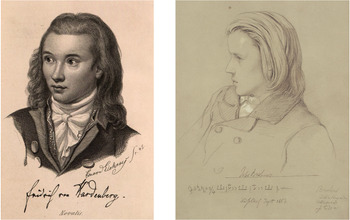
Literary references occur with considerable frequency in the letters and memoirs relating to these years. Eduard Hanslick first encountered Brahms at the Lower Rhine music festival in 1855, and later recalled the young musician’s distinctive physiognomy: with his long blond hair, forget-me-not eyes and rosy complexion, Brahms seemed to Hanslick to resemble a youth from a Jean Paul novel.Footnote 7 After Brahms’s death Joseph Joachim recalled that Novalis (Friedrich von Hardenberg), Hoffmann and Des Knaben Wunderhorn had been the composer’s most constant companions at this time.Footnote 8 Back in 1853, the violinist had sent his Christmas greetings, enclosing an image of the first of these writers: ‘The picture of Novalis will give your parents pleasure; it’s almost your spitting image!’Footnote 9 On comparing Novalis’s likeness with one of the drawings of Brahms by Jean-Joseph Bonaventure Laurens (see Figure 1), one is inclined to agree.Footnote 10 As Kalbeck suggested, during these early years of his career Brahms cultivated the identity of a fictional musician, signing himself as ‘Johannes Kreisler’ after the kapellmeister who appears in Hoffmann’s Kreisleriana stories and the novel Kater Murr. Footnote 11 The evidence of Brahms’s manuscripts suggests that this practice had actually begun before his momentous meeting with the Schumanns in Düsseldorf in the autumn of 1853.Footnote 12
Left: engraving of the writer Novalis by Eduard Eichens (frontispiece to Novalis, Schriften, 3 vols. (Berlin: Reimer, 1837– 46), iii); right: drawing of the young Brahms by Jean-Joseph Bonaventure Laurens (Carpentras, Bibliothèque-Musée Inguimbertine, DES00006, reproduced by permission).

While it is important to maintain a critical stance towards memoirs and reminiscences about Brahms, such a pile-up of literary references and allusions raises the question of how the young composer read, and invites us to think afresh about the ways in which his absorption in literature related to his musical creativity. In response to these questions, this investigation interrogates a fascinating but understudied source as a means of thinking about Brahms’s reading habits: the collection of quotations, aphorisms and poems commonly known as Des jungen Kreislers Schatzkästlein. Comprising four notebooks, the Schatzkästlein (Little Treasure Chest) was begun by Brahms in his native city of Hamburg, with many of the subsequent entries added in the mid-1850s, when he was a frequent guest at the Schumann house in Düsseldorf. Titled in homage to Johannes Kreisler, these notebooks attest to the young Brahms’s enthusiastic engagement with literature, including entries from writers ranging from Cicero and Diogenes, Dante and Tasso, to the nineteenth-century revolutionaries Robert Blum and Ferdinand Freiligrath; the greatest concentration in the collection by far, though, is on German authors from the late eighteenth and early nineteenth centuries, particularly Jean Paul, Novalis, Goethe and Schiller. For Kalbeck, the entries seemed to provide the key to Brahms’s ‘innermost being’.Footnote 13 The Deutsche Brahms-Gesellschaft published the notebooks in 1909, but despite this (and the more recent presence of an English translation), the Schatzkästlein has received little scholarly scrutiny.Footnote 14
Brahms’s early literary entanglements have typically been afforded little attention in considerations of the composer’s aesthetics. Most investigations of Brahms’s youthful reading thus cast his attraction to German Romantic literature as an early passion that the composer outgrew in the later 1850s – a period during which, in the wake of the death of Robert Schumann and beset by doubts over his own creative abilities, Brahms seemed to recalibrate his own aesthetic priorities. Roger Moseley has provided an exemplary comparative study of the two versions of the op. 8 Piano Trio (1854, revised 1889), noting how the Romantic flights of fancy of the young Brahms tended to be reined in by his older self, the later work being marked by a more reflective engagement with his music-historical inheritance.Footnote 15 Shifting focus away from Brahms as a composer of instrumental music, though, recent studies of Brahms’s lieder and large-scale choral works by Natasha Loges and Nicole Grimes have demonstrated the ongoing importance of different aspects of literary culture for Brahms’s later musical projects, with Grimes arguing persuasively for the ‘philosophical weight’ of Brahms’s major Schiller, Goethe and Hölderlin settings.Footnote 16 Such studies help to challenge the critical commonplace that Brahms derived his creative inspiration from a cultural canon that was purely musical.
Drawing on archival materials housed in Vienna and my own transcription of the surviving Schatzkästlein sources, this article provides a critical account of Brahms’s collection in the context of the composer’s youthful passion for reading, and considers the complex role played by literature in the development of Brahms’s distinctive musical sensibility. The first section of the investigation examines sources for the Schatzkästlein, offering a brief evaluation of the 1909 Deutsche Brahms-Gesellschaft publication and retracing some of Brahms’s paths in gathering his quotations. While scholars have conventionally assumed that Brahms acquired his entries from first-hand encounters with the individual authors, I note here that around a quarter of the surviving Schatzkästlein quotations derive from extant literary collections and publications of Robert Schumann. The later sections of the investigation turn away from documentary aspects of Brahms’s notebooks to reflect on the different approaches to reading evidenced by the Schatzkästlein and the artistic world view that the assembled entries articulate. Although our knowledge about this fascinating collection must in some respects remain provisional, I suggest that the Schatzkästlein offers a valuable window onto Brahms’s use of literature as a means of exploring competing conceptions of artistry. As such it bears witness to one individual’s enraptured reading and to the ongoing, creatively productive relationship between music and German Romantic literature in the mid-nineteenth century.
Sources for the Schatzkästlein
Brahms’s Schatzkästlein notebooks were among the handwritten items found in the composer’s apartment after his death that he had stipulated should be destroyed.Footnote 17 The original publication of the notebooks, edited by the Berlin-based musicologist Carl Krebs (see above, note 14), was a handsomely produced pocket-sized volume with marbled boards. Like the volumes of letters and Kalbeck’s biography which also appeared under the aegis of the Deutsche Brahms-Gesellschaft, this edition was intended not just for scholars, but also for a wider circle of readers interested in Brahms’s life and works. In September 1907 Krebs had corresponded with Kalbeck over the edition and expressed his opinion over the merits of and justification for publication:
As you perhaps know, Herr Simrock had asked me if I thought it appropriate to publish this quotation collection, and after looking through the material I have come to the conclusion that a printed copy would certainly interest all Brahms admirers, particularly because the selection made by the young artist from his reading is very characteristic of him as a person and of his artistic worldview.Footnote 18
Kalbeck had three of the four notebooks in his personal possession and advised Krebs over certain textual and biographical details.Footnote 19 Krebs’s edition presented Brahms’s admirers with the entries from the four notebooks as a continuous flow of 645 quotations and – so as to aid the comprehensibility of the collection – also included a short introduction, a thematic index and some brief biographical comments on the featured authors. Krebs’s somewhat casual editorial approach falls short of modern scholarly standards, but there are many useful details that can be inferred from his publication, particularly when it is taken together with an account of the materials provided by Kalbeck in his Brahms biography.Footnote 20 Such inferences are necessary, as the first three notebooks (those formerly in Kalbeck’s possession) are now in private ownership or lost and the last of the four notebooks survives only as a photocopy (see Table 1).Footnote 21
OVERVIEW OF SCHATZKÄSTLEIN SOURCES
| Full title (from Kalbeck) | Dates and places (from Kalbeck) | Present location |
|---|---|---|
| ‘Schatzkästlein des jungen Kreisler’ | Begun in Hamburg (no date); completed March 1854, in Düsseldorf | Unknown; formerly in the possession of Max Kalbeck |
| ‘II. Des jungen Kreislers Schatzkästlein’ | Begun March 1854 | Unknown; formerly in the possession of Max Kalbeck |
| ‘Schöne Gedanken über Musik’ | Begun in Düsseldorf, September 1853; completed July 1854 | Unknown; formerly in the possession of Max Kalbeck; sold by Sotheby’s in London, 2 August 1935, as ‘The Property of Herr Paul Kalbeck’; purchased by ‘Beck’ for £27 |
| ‘Schöne Gedanken über Musik, Heft II: Schatzkästlein des jungen Kreisler’ | Begun Düsseldorf, July 1854; final entries added later, possibly in last years of Brahms’s life | Original notebook lost; photocopy survives (Wienbibliothek im Rathaus, Ia 79562, H.I.N.55729); for colour photographs of selected pages, see below, n. 21 |
| ‘Deutsche Sprichworte’ | Dated March 1855 | Wienbibliothek im Rathaus, Ia 79561, H.I.N.55728 |
When Brahms began his Schatzkästlein cannot be determined precisely, but both Kalbeck and Krebs record that the place given in the first notebook was ‘Hamburg’, suggesting that the collection was begun before Brahms left his native city for a lengthy concert tour in the month of April 1853.Footnote 22 This first notebook, which carried the title ‘Schatzkästlein des jungen Kreisler’, contained a total of 371 numbered quotations, and its place and date of completion are recorded as ‘Düsseldorf’ and ‘March 1854’. Kalbeck suggested that Brahms added entries while giving concerts in the cities of Weimar and Hanover, a detail supported by the presence of 18 quotations from Brahms’s friend Joseph Joachim.Footnote 23 The Joachim entries, which were apparently made in the violinist’s own hand, were identified by his motto frei aber einsam (‘free but lonely’), either in the form of the initials F.A.E. or through music notation. Brahms’s second Schatzkästlein notebook appears to have been started promptly on completion of the first. It was entitled ‘II. Des jungen Kreislers Schatzkästlein’, and the date and place are recorded as ‘March 1854’ and ‘Düsseldorf’. Kalbeck believed that this second volume of the Schatzkästlein contained the first fruits of Brahms’s studies in the Schumann library.
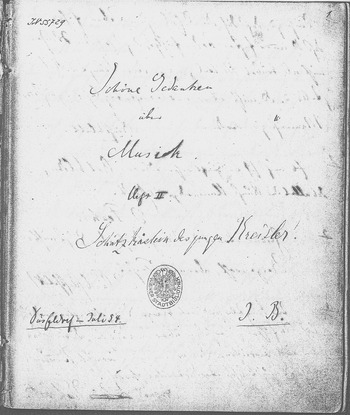
Already in September 1853 Brahms had begun the process of ordering some of his accumulated quotations, selecting those specifically about music and recopying them together with new entries into another book. This volume was titled ‘Schöne Gedanken über Musik’ (‘Fair Thoughts about Music’). Kalbeck speculated that Brahms’s motivation in putting together his entries on musical subjects came from a contemporaneous project of Robert Schumann’s entitled Ein Dichtergarten für Musik (A Poets’ Garden for Music) – an anthology that was to include quotations about music from a wide range of writers. At the end of his third notebook Brahms had started an index ordering the entries by number under different headings: ‘Schöne Bilder’, ‘Über Studium, Form und Technik’, ‘Über Kritik’ and ‘Publikum’. This notebook spilled over into a further volume, begun in Düsseldorf in July 1854, and was graced with the lengthier title ‘Schöne Gedanken über Musik. Heft II. Schatzkästlein des jungen Kreisler’ (see Figure 2). There are 134 numbered quotations in this fourth Schatzkästlein notebook, the last of which comes from Goethe’s conversations with Johann Peter Eckermann (Gespräche mit Goethe, 1836). The final seven pages of entries in the notebook are unnumbered and occur in a noticeably different, messier style of handwriting. These later quotations, which include extracts from the speeches of the German chancellor Otto von Bismarck, clearly postdate the 1850s. In his introduction Krebs suggested that Brahms made the final entries in this fourth notebook ‘shortly before his death, when, sick and exhausted, he could no longer spend evenings in the accustomed merry company of the tavern’.Footnote 24 Though widely accepted by biographers, this point now seems hard to substantiate; the extracts from Jean Paul in these final pages are, however, consistent with Brahms’s ongoing enthusiasm for this writer in the 1890s.Footnote 25
Title page of Brahms’s fourth Schatzkästlein notebook (Vienna, Wienbibliothek im Rathaus, Handschriftensammlung, Ia 79562, H.I.N.55729, reproduced by permission).

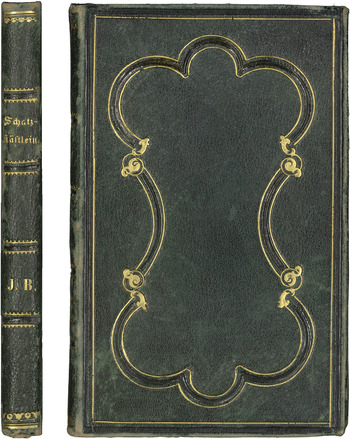
Kalbeck’s account of the Schatzkästlein in his biography made mention of an additional, incomplete notebook that was not included in the 1909 publication. This book contained German proverbs and was of a different format from the others. Whereas the first four Schatzkästlein notebooks were ‘small paper volumes in octavo of the type that school students use’, Kalbeck suggested that the additional volume, bound in green leather, was likely to have been a present.Footnote 26 The notebook was dated ‘March 1855’, and thus postdated the bulk of Brahms’s work on the Schatzkästlein. Perhaps because of the later date and different format, Kalbeck seems to have felt that the collection of proverbs was not directly related to the other Schatzkästlein materials, and he provided little commentary on its contents. This notebook survives in Vienna (see Figure 3).Footnote 27 The spine of the attractively bound volume is stamped with both Brahms’s initials ‘J. B.’ and the one-word title ‘Schatzkästlein’. Given the fine binding of this notebook, it is possible that Brahms originally planned to use it as a repository for his earlier Schatzkästlein entries; the majority of pages in the book were, however, left unused.
Binding of Brahms’s collection of ‘Deutsche Sprichworte’ (Vienna, Wienbibliothek im Rathaus, Handschriftensammlung, Ia 79561, H.I.N.55728, reproduced by permission).

For musicologists today, the inaccessibility of the original Schatzkästlein source materials is frustrating; however, in other respects, in the early twenty-first century we are well placed to make sense of this collection. Kalbeck and Krebs, like most subsequent writers who have discussed the Schatzkästlein, took the range of entries as evidence of the breadth of Brahms’s reading, and it was assumed that the young musician extracted passages having encountered them directly in longer texts by the quoted authors. The digitization of German-language books and music periodicals and the recent publication of important Schumann source materials allows for a significant reassessment of the ways in which Brahms put together his collection. Some of the most frequently cited entries from the Schatzkästlein are on the subject of form in art, and it becomes clear that Brahms did not acquire these entries directly from Goethe and Eckermann, but rather through an article on musical form that had appeared in an issue of the Allgemeine musikalische Zeitung in October 1846.Footnote 28 Similarly, a sizeable group of poetic epigrams in Brahms’s notebook appears to derive from an anthology of German poetry – Poetischer Hausschatz des deutschen Volkes (Poetic Household Treasures of the German People), first published in 1839. Edited by O. L. B. Wolff and issued by the publisher Wigand in Leipzig, this popular collection had by 1850 already run to some 14 editions, and it is possible that Brahms would have had access to it while a schoolboy in Hamburg.Footnote 29 In addition to the epigrams by writers such as Schiller, Goethe and Friedrich Gottlieb Klopstock, the volume contains the text for Postillons Morgenlied by Wilhelm Müller, a poem that the young Brahms used in the composition of a partsong in the late 1840s.
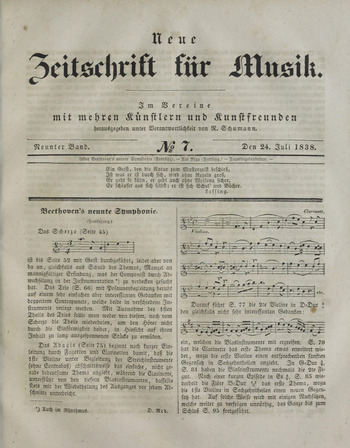
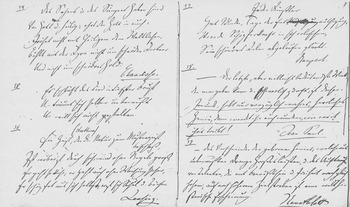
The most significant groups of quotations in the Schatzkästlein that are readily traceable to earlier collections and publications relate to Schumann sources. These entries were probably amassed by Brahms in 1854 when, following Robert’s attempted suicide at the end of February, he took up lodgings in Düsseldorf near the Schumann home in Bilkerstraße. As is well known, during the ensuing months Brahms assisted Clara Schumann with the running of the household.Footnote 30 He probably consulted many of the abundant volumes of music and literature in the Schumann library at this time, and it is clear that one of his main interests in 1854 was Robert’s own music and writings. Some 120 entries spread across the third and fourth Schatzkästlein notebooks were harvested from the Neue Zeitschrift für Musik, the influential music periodical that Robert Schumann founded back in 1834 and edited for the following decade.Footnote 31 Most of these items comprise the short poetic mottos that appeared on the title page of the newspaper. In many cases the mottos in the Neue Zeitschrift were chosen for their relation to the subject of a leading article. In July of 1838, for example, the paper carried an essay on Beethoven’s Ninth Symphony, above which was printed a quotation from Gotthold Ephraim Lessing (see Figure 4):
A person who is ordained by nature as a model of intellect and spirit
Is what he is through himself – without rules he becomes great, He treads boldly, has surety without instruction, He creates out of himself, serves as his own school and books.Footnote 32
Title page of the Neue Zeitschrift für Musik, 24 July 1838. Austrian Newspapers Online, Österreichische Nationalbibliothek, <https://anno.onb.ac.at>.

When Brahms wrote out these words as entry 36 in his fourth Schatzkästlein notebook he also jotted down Beethoven’s name. The other entries on the double-page spread in his notebook come from issues of the newspaper that appeared in July and August 1838 (see Figure 5).
Poetic mottos from the Neue Zeitschrift für Musik in Brahms’s fourth Schatzkästlein notebook, entries 34 –9 (Vienna, Wienbibliothek im Rathaus, Handschriftensammlung, Ia 79562, H.I.N.55729, reproduced by permission).

Brahms’s copying of these poetic mottos suggests his interest in Robert Schumann’s major musical-literary project of the 1830s and early 1840s, but it is equally apparent that the young Brahms had knowledge of some of Schumann’s more recent and planned publications. In June 1854 Clara Schumann presented Brahms with a copy of Robert’s collected writings which had very recently been issued by the Leipzig-based publisher Georg Wigand.Footnote 33 The majority of the material that appeared in the four volumes of Gesammelte Schriften comprised the essays that Robert had originally penned for the Neue Zeitschrift. In the fourth volume of the writings, though, were a few pages of aphorisms of his own devising:
To send light into the depths of the human heart – the artist’s calling!
Nobody can do more than he knows. Nobody knows more than he can do.
In literary spheres whoever doesn’t know the most significant recent publications counts as uneducated. In musical spheres we should also have reached this stage.Footnote 34
These sentences, together with two other aphorisms printed on the same page, were copied out by Brahms into his fourth Schatzkästlein notebook.Footnote 35
Another of Robert Schumann’s literary projects during his Düsseldorf years was a large compendium of quotations about music drawn from world literature – the Dichtergarten für Musik that was mentioned by Kalbeck in conjunction with Brahms’s Schatzkästlein back in 1904. Schumann did not live to complete the ambitious undertaking, but he continued to work on it right up until his suicide attempt. Thoughts about the Dichtergarten also occupied him until at least May 1855, when, from the asylum at Endenich, he wrote about the project to Bettina von Arnim.Footnote 36 Given the period of Brahms’s acquaintance with the Schumanns, it is likely that he would have been privy to conversations about the Dichtergarten, though whether or not he sought to assist Robert with the project (as was suggested by Kalbeck) is hard to assess. The Dichtergarten materials were finally published in 2007 in an edition by Gerd Nauhaus and Ingrid Bodsch.Footnote 37 Brahms seems to have copied out quotations from the manuscript for his own collection: a group of lengthy excerpts from Jean Paul, Novalis and Shakespeare are among the entries belonging to the third of the four Schatzkästlein notebooks on which Brahms worked between September 1853 and July 1854. Other entries in the Schatzkästlein that Brahms seems to have harvested from the Dichtergarten were by Joseph Christian von Zedlitz and Elisabeth Kulmann.Footnote 38
To some extent, the identification of Brahms’s repurposing of Schumann sources highlights the provisionality of our knowledge about the Schatzkästlein. It is likely that some of the other entries in Brahms’s notebooks might also come from pre-existing collections, though the identification of such borrowings is reliant on a combination of luck, the digitization of the original printed materials and the accessibility of handwritten sources. Robert Eshbach has noted that Joachim also maintained a short collection of aphorisms. Information about Joachim’s collection, entitled ‘Kleine Sätze für mich’, derives solely from a 1929 auction catalogue, but as Eshbach makes clear, Joachim’s aphorisms align with several of those marked with the violinist’s motto ‘F.A.E.’ in Brahms’s notebooks.Footnote 39 The inaccessibility of original Schatzkästlein source materials is a particular hindrance here, as it is quite possible that Krebs’s transcriptions will have omitted details that would facilitate our identification of Brahms’s borrowings. When the third Schatzkästlein notebook was sold in London in 1935, the auction catalogue made mention of Brahms’s frequent quotation of Shakespeare.Footnote 40 Given the relatively small number of Shakespeare entries in Brahms’s collection, it seems likely that some of these were omitted by Krebs when he prepared the 1909 publication.
While such unknowns are frustrating, these fresh discoveries about Brahms’s notebooks are valuable in the light of our pre-existing knowledge of his broader interests and self-directed education in the mid-1850s. Brahms’s artistic response to Schumann’s musical and poetic legacy during this period has been understood in terms of his contemporaneous piano compositions and study of counterpoint. As has frequently been observed, in his op. 9 Variations on a Theme by Robert Schumann, Brahms did not just take up a Schumann theme, but also modelled a number of Robert’s own piano compositions and followed the older composer’s pattern of attributing alternate numbers to contrasting compositional personae. David Brodbeck has suggested that, through the counterpoint studies conducted in correspondence with Joachim, Brahms sought in earlier decades to emulate the activities of Robert and Clara, and Virginia Hancock has observed that during his time in Düsseldorf Brahms copied out vocal compositions, thought to have been by Palestrina, that he found in the Schumann library.Footnote 41 The large number of entries from Schumann sources in Brahms’s Schatzkästlein demonstrates the crucial role of literature in Brahms’s attempts to understand and assimilate aspects of the older composer’s artistic world.
Modes of reading
Whenever you read a book and come across any wonderful phrases which you feel stir or delight your soul, don’t merely trust the power of your own intelligence, but force yourself to learn them by heart and make them familiar by meditating on them, so that whenever an urgent case of affliction arises, you’ll have the remedy ready as if it were written in your mind. When you come to any passages that seem to you useful, make a firm mark against them, which may serve as lime in your memory, lest otherwise they might fly away.
(Augustine, as imagined by Petrarch in his Secretum meum)Footnote 42Beyond the environment of the Schumann house in Düsseldorf and the culturally sophisticated world it represented, Brahms’s passionate commitment to reading and his playful identification with Hoffmann’s Kreisler figure might helpfully be understood in the context of ‘bookish’ activities that flourished in the German-speaking world in the first half of the nineteenth century. Of course, the notion that one might copy out or memorize important passages from books was not new (see the Petrarch quotation above and the commonplace books of Erasmus and John Locke).Footnote 43 But the rapid increase in literacy in German lands in the late eighteenth century brought with it a veritable mania for reading that led in turn to a newly elevated importance of novels, plays and poetry. In 1828 Wolfgang Menzel would comment that, ‘If a citizen of the next century were to look back at the current moment in German history, he would say that we had slept and dreamt in books.’Footnote 44 For those who sought to belong to the educated middle class a familiarity with canonic writers was integral to one’s Bildung, and Brahms’s reading must be viewed partly in relation to such aspirations – as an attempt to gain admittance to a social world removed from his own more modest background and potentially also as a means of compensating for his lack of a university education. Perhaps more interestingly, though, the practice of gathering quotations and Brahms’s strong desire to dwell in the fictional spaces of literature suggest the extent to which for him – as for many other young German readers – literature had come to represent what the critic Rüdiger Safranski has described as ‘a medium of existential guidance’.Footnote 45
If Brahms’s Schatzkästlein implies a belief in the potentially transformative powers of the written word it pays to think more closely about the distinctive modes of reading that this commonplace book might imply. In an insightful study of reading culture in the early nineteenth century Andrew Piper has drawn attention to the way that an engagement with books was itself often a subject in works of Romantic fiction; bibliographic fantasies, he notes, could be ‘a product of the very narratives and symbolic operations’ contained within books themselves.Footnote 46 We can observe something of this in Jean Paul’s Leben des vergnügten Schulmeisterlein Maria Wutz (1793). The impoverished schoolmaster Wutz, being too poor to purchase printed reading matter, writes books for himself according to the titles he finds in the Leipzig book catalogue (these include Johann Kaspar Lavater’s Physiognomische Fragmente, Immanuel Kant’s Kritik der reinen Vernunft and Schiller’s Die Räuber). As a Jean Paul enthusiast, Brahms is likely to have known this novella; the powers of the book and the activity of reading more generally figure as the subject of several of Brahms’s Schatzkästlein entries and appear in writings by many of his quoted authors.
The notion that an engagement with books might help to fashion the consciousness of a reader was a fairly common theme in the German literature that was devoured by Brahms as a young man. Significantly, the young protagonist of Eichendorff’s Aus dem Leben eines Taugenichts (1826) decides to venture out into the wider world to seek his fortune after gorging himself on adventure stories and chivalric romances. Some 50 years earlier, at the start of another novella known to Brahms, Goethe’s Die Leiden des jungen Werthers (1774), the narrator had commended Werther’s story to readers as a source of consolation: ‘And you, worthy soul, you who also feel the same urge as him, draw comfort from his suffering and let this little book be your friend, when owing to circumstances or faults of your own you can find no better one.’Footnote 47 Goethe was later alarmed by the number of German youths who turned to suicide in emulation of his protagonist. But two decades after the publication of the hit novella he was still capable of demanding receptivity in his readers. ‘What type of reader do I desire?’ Goethe asks. ‘The most uninhibited, the one who forgets me, himself and the world and lives only in the book.’Footnote 48
Brahms included these words by Goethe in his notebook, but probably the most striking commentary on the power of literature to be found in the Schatzkästlein comes from Eichendorff’s novel Ahnung und Gegenwart (1815), a Romantic Bildungsroman that thematizes, among other things, the activity of reading. In a lengthy autobiographical confession, the novel’s protagonist, Friedrich, looks back on his discovery of books as a decisive moment of childhood: ‘It was’, he notes, ‘as if these books had given me the golden keys to the wondrous treasures and the hidden splendour of nature.’Footnote 49 Friedrich goes on to describe his youthful enthusiasm for popular folk tales, such as the story of the beautiful Magelone; at the end of the novel, his decision to enter a monastery is made in response to his reading of scripture.
The ideas about reading articulated throughout Eichendorff’s richly evocative and rambling novel derive from two obvious sources. In the final portion of the narrative it becomes clear that the mystical high regard that his characters have for the printed page relates partly to the centrality of reading within the Christian tradition: the Bible together with the natural world serve as the means through which Eichendorff’s characters consider the mysteries of the Creation. The novel’s other ideas about reading can be understood in relation to Eichendorff’s earlier allusion to one of literature’s most famous readers. In chapter 10, the assembled characters encounter a half-crazed knight riding around on horseback, whom they humorously liken to Don Quixote, the star of Cervantes’s early seventeenth-century novel.Footnote 50 In Cervantes’s telling, Don Quixote had been a figure of fun who addled his mind through overexposure to novels, coming to believe in the fantastical happenings about which he had read; for Eichendorff, though, this kind of enchanted reading was to be admired rather than mocked. Friedrich thus proclaims that the attitude of the ideal reader is not cynicism, but a childlike openness:
These are the true readers, those who poeticize with and about the book. For no poet gives a finished heaven; he merely erects a Jacob’s Ladder from the beautiful earth. Whoever is too lazy and listless and doesn’t feel the courage to climb the golden rungs, to him the mysterious letters remain eternally dead, and he would do better to burrow or to plough than to continue pointlessly with unprofitable reading.Footnote 51
What is to be celebrated is the ability of readers such as Don Quixote to lose themselves in a fictional creation and to come to believe (be it just temporarily) in the mentally constructed literary world. Brahms entered Friedrich’s words into his Schatzkästlein, and with his devotion to the stories of Eichendorff and Hoffmann he could deservedly count himself as among the best readers of Romantic literature.
For Brahms, the appeal of a novel such as Ahnung und Gegenwart probably lay in the invitation it offered to project himself into the narrative. Also included in the Schatzkästlein were passages from Eichendorff’s Dichter und ihre Gesellen (1833) and two earlier Romantic Bildungsromane: Ludwig Tieck’s Franz Sternbalds Wanderungen (1798) and Novalis’s Heinrich von Ofterdingen (1802). All of these stories feature artistically inclined male protagonists who leave home in search of experience and enlightenment, and by tracing the existence of these young artists, be they painters, poets or musicians, Eichendorff, Tieck and Novalis meditate on the relationship between art and life. Most obviously, these authors set out to aestheticize a recognizable reality, enclosing the life narratives of their protagonists in the cultural form of the novel. But the movement between art and reality also runs in the opposite direction, and the radical message of these stories reaches out from pages of fiction. The injunction felt by the archetypal Romantic male protagonist – that he strives to give ethical coherence and aesthetic form to his earthly existence – also forces itself on the novels’ readers. While one could reduce this to metaphor (the novel standing in for human life), underlying these ideas is a powerful view of human subjectivity. As Friedrich Schlegel observed in one of his Kristische Fragmente, ‘Every person who is educated and continues to develop and educate himself contains within him a novel. That he reveals it and writes it down is not necessary.’Footnote 52
This faith in a ‘novelistic’ understanding of the human subject can help to make sense of life’s confusions and uncertainties. Like the details of a novel’s plot that conforms to a coherent plan but in any given moment may seem haphazard and disorderly, the purpose and meaning of individual human lives is most easily understood in retrospect. For writers such as Novalis, the coherence underlying life’s surface confusions could be related to an omniscient creator – a divine authorial presence. Novalis takes up this idea in one revelatory moment in his unfinished novel Heinrich von Ofterdingen. In the course of a journey to Augsburg, the novel’s title character ventures into the abode of a hermit and discovers a mysterious tome in a strange library of books. The images Heinrich encounters in its pages recapitulate the previously narrated events of the novel:
Eventually a book fell into his hands that was written in a foreign language that seemed to him to have a certain similarity with Latin and Italian. He desired most eagerly to know the language because the book pleased him enormously, without his being able to understand a single syllable. It had no title, but on searching he found several pictures. To him they seemed strangely familiar and, as he looked closer, he discovered his own person discernible among the figures. He was startled and thought he was dreaming, but on repeated examination he could no longer doubt the perfect similarity. He barely trusted his senses when he soon discovered in one picture the lair, the hermit and the old man beside him. Gradually, in other pictures, he found the oriental woman, his parents, the Landgrave and Landgravine of Thuringia, his friend the court chaplain, and many other of his acquaintances; but their clothes were altered and seemed to come from another age […] He saw his likeness in different locations. Towards the end he seemed taller and nobler […] He saw himself at the imperial court, aboard a boat, and in a warm embrace with a slender and charming girl, in a battle with savage-looking men, and in friendly conversations with Saracens and Moors […] The last pictures were dark and unintelligible; but, with the most heartfelt delight, he beheld some figures from his dreams; the ending of the book seemed to be missing.Footnote 53
In writing this striking passage Novalis provided a counterpart to an episode that had occurred at the end of Goethe’s Wilhelm Meisters Lehrjahre (1795–6). Whereas for Goethe’s protagonist, Wilhelm, the equivalent passage has the character of a dénouement, resolving the previous mysteries of the plot, significant in Novalis’s writing are the devices of distance and uncertainty built into Heinrich’s encounter with the book: the unknown language, the unfamiliarity of the depicted acquaintances, the missing ending to the story and the likening of the encounter to a dream. Heinrich’s life is represented as having a coherence in a book of life, but this divine plan can be only vaguely intuited in the earthly and temporal realm that he inhabits.Footnote 54 The book of life, never fully knowable, remains an object of mystery and wonderment.
Literary treasure chests
Heinrich’s enraptured encounter with the book that tells a story of his life, together with the comments by Eichendorff and Goethe, provide us with one way of thinking about Brahms’s reading – as a continuation of the Romantic project of mixing up art and reality, that is to say, of romanticizing the world around him. For Brahms, the appeal of these German Romantic texts perhaps lay in the escapism they afforded and the alternative they offered to the practicalities of the musical profession he was then confronting. But literature and the practice of storytelling could also be used as a means of stimulating reflection on social and cultural issues. We can trace this phenomenon in story collections with framing narratives such as Goethe’s Unterhaltungen deutscher Ausgewanderten (1795) and Tieck’s Phantasus (1812–16), where interpolated stories are shared and then discussed by an assembled group of characters. These collections suggest the sociability that was bound up with reading and also helpfully make clear that for all the prevalence of swashbuckling male protagonists in German Romantic novels, literature was enjoyed, discussed and criticized by both male and female readers.
The process of copying out and ordering quotations, as documented by Brahms’s Schatzkästlein notebooks, offers another example of a reflective engagement with literature, but one that could be practised more readily by a solitary reader. For the entries in a commonplace book, what is of greatest importance is not the specific text from which they come (the literary world in which the reader might temporarily reside), but the nuggets of wisdom that the quoted words contain. Theoretically, these quotations could thus be recycled – harvested from secondary sources, or from other peoples’ equivalent collections (as, it transpires, many of Brahms’s were). What was crucial was the insight or idea provided by the individual entry. This type of engagement with the printed page relates to a process Arthur Schopenhauer described in an essay on reading published in 1851:
When we read, someone else thinks for us: we merely repeat his mental process. It is like the pupil who, when learning to write, goes over with a pen the strokes made in pencil by the teacher.Footnote 55
Brahms’s act of copying out quotations could be understood as an extension of this process: as an attempt first to trace the thoughts of earlier writers, and then to take hold of them for himself.
In conjunction with this reflective type of reading, it seems worthwhile to dig deeper into Brahms’s designation of his commonplace books as a Schatzkästlein. As Schatz means ‘treasure’ in German, and as Kästlein is a diminutive form of Kasten, meaning box or chest, a Schatzkästlein is most literally translated as a ‘little treasure chest’. In this simple act of naming, Brahms likened his literary pearls of wisdom to valuable material commodities. Like a jewel, the aphorism, quotation or poem is a miniature form with an attraction and a power incommensurate with the smallness of its scale; these items glimmer from a distance, but they also demand care and loving contemplation. Like a real treasure chest, Brahms’s trove of quotations might imply a particular mode of engagement: rummaging, rather than ordinary reading – the sifting of its contents in search of some half-remembered object of delight.
In nineteenth-century German, though, the noun ‘Schatz’ was understood not just to mean treasure, but also (akin to the English term ‘treasury’) as a designation for literary anthologies. It is possible that Brahms found inspiration for his Schatzkästlein title from Wolff’s Poetischer Hausschatz des deutschen Volkes, the collection that, as noted above, furnished him with a number of epigrams. As a title for a literary collection, the specific term Schatzkästlein was not new: in the early nineteenth century, the writer Johann Peter Hebel (1760–1826) gathered together his earlier stories and anecdotes, the resulting volume appearing in 1811 as Schatzkästlein des rheinischen Hausfreundes (The Little Treasure Chest of the Rhenish Family Friend).Footnote 56 And according to the Grimm brothers’ Deutsches Wörterbuch, the metaphorical use of ‘Schatzkästlein’ as a term to describe a collection of valuable quotations that might serve dual purposes of entertainment and edification can be traced back to Goethe.Footnote 57
Probably the most significant meaning of the term Schatzkästlein, though, and one that certainly featured in Brahms’s own reading matter, takes the word as a metaphor for an individual’s heart or soul. In Hoffmann’s novel Kater Murr the character of Meister Abraham thus refers to an ‘inner little treasure chest’ when berating kapellmeister Kreisler for his playful evasiveness. Abraham encourages the musician to provide an honest account of an episode from his past:
‘I would have thought’, Master Abraham commented […], ‘that in your present good mood you could do nothing better than to open up your heart or your mind, or whatever else you might name your inner little treasure chest [inneres Schatzkästlein], and take this and that from it.’Footnote 58
Kreisler, Meister Abraham here implies, customarily keeps his Schatzkästlein locked, hiding his true self from public view. To open up the Schatzkästlein would be to let down his guard, to lower his customary defence of sarcastic humour. A very similar usage of the same word occurs in Das merkwürdige musikalische Leben des Tonkünstlers Joseph Berglinger (1797), a short story by Wilhelm Heinrich Wackenroder from which Brahms quoted in his fourth notebook.Footnote 59 Early on in Wackenroder’s narrative we learn that the aspiring musician Berglinger feels he has an artistic calling that outweighs even his affection for his family:
He loved his father and siblings sincerely; but he treasured his inner life above everything and kept it secret and hidden from others. In this manner one keeps a little treasure chest secret, to which one surrenders the key to nobody.Footnote 60
The remainder of Wackenroder’s story traces Berglinger’s trials and tribulations as he attempts to live out his artistic calling as a musician.
This type of connection between Brahms’s quotation collection and his inner life finds support in other entries in the Schatzkästlein. The general practice of gathering together sayings and wise words, and of storing them in a notebook for future contemplation, was familiar to Brahms from at least one literary source: the novella Contraste und Paradoxen (1845) by the now little-known German writer Friedrich von Sallet (1812–43). In this story, the central figure is a young boy called Junius who is caught between the opposing forces of his bourgeois materialistic father, Herr Habichs, and the dreamy, subversive artistry of his uncle Holofernes. Interpolated within the story are entries from both Holofernes’s own diary and an instructional volume made by the uncle for his nephew – the ‘ABC-Buch des Onkels Holofernes’. Common to both types of interpolated entry is the simple tone of the language through which moral and artistic precepts are delivered. Interrupting the temporal flow of Sallet’s narrative, these quotations are presented as worthy of the reader’s quiet contemplation. Brahms copied several of Holofernes’s precepts into his notebook, including the following lengthy passage:
Most commonly one finds that which is called openness in the highest degree only in the most frivolous and unreflective of people; that which is called reticence in the deepest, truest and most bountiful of minds. And truly: I participate gladly and love a full, free flow of conversation to accompany the clanging of glasses; everything noble that I have thought is not for me – it has, where possible, been won for the entire world. But there is a sanctuary in our minds. That which is on display in this private inner space I should not pull out and allow to glisten vainly and childishly in the ordinary light of day. It remains there in the holy night! Not even to my kindred spirit, be he the most noble of men, not even to my beloved (if I have one), should I make this known in plain words […] To provide a report, directly explaining that which is holy within us, is a wanton desecration.Footnote 61
The earnest tone of these words stands in contrast to the comical satire present elsewhere in Sallet’s story. The concern for a type of ‘inner life’ that should be protected from the outside world is germane to Holofernes’s precepts more generally and relates also to equivalent collections of thoughts and wise words maintained by other German literary characters. Relevant here are the short passages of poetic prose known as polymeters that are penned by the character Walt and occur as interpolations in Jean Paul’s novel Die Flegeljahre (1804–5). Perhaps the most famous example of this type of literary device are the brief diary entries of the young Ottilie found in Goethe’s Die Wahlverwandtschaften (1809). These entries, which are generally much shorter than the Sallet quotation given above, are notable in affording an inner life to a female protagonist; like the Sallet quotation, though, they marry acuity with simple verbal expression and delight in a type of unvarnished honesty.
If these quotations suggest that Brahms used the term Schatzkästlein with an awareness of its many significations, they also link the practice of maintaining this literary collection firmly to the project of his private self-fashioning. In January 1854, Clara Schumann, observing Brahms’s introversion, noted in her diary that he certainly has his ‘secret inner world’, that ‘he takes up everything beautiful into himself and feeds on it inwardly’.Footnote 62 In relation to this, it is noteworthy that Brahms shared his notebook with his friend Joachim, at least to the extent of allowing the latter to copy in certain aphorisms of his own devising. While the opening up of the Schatzkästlein to a friend may have contravened Sallet’s precept about guarding one’s inner life, the gesture seems to find support in words of Schiller that were also quoted by Brahms:
Aesthetic values
While Brahms had begun the process of providing an index for his third Schatzkästlein notebook, for the most part the entries across his collection appear to have been left unsorted: the order in which quotations occur probably relates to the order in which they were encountered. The lack of system is especially apparent in the third and fourth notebooks, which from their title (‘Schöne Gedanken über Musik’) would seem to be concerned with music but in fact contain quotations on other subjects as well. Despite the relative messiness of the collection, though, and the presence of a wide range of quoted writers, many of the entries in the Schatzkästlein engage with themes that one would expect to be of importance to a devoted reader of Hoffmann. While Hoffmann himself appears only twice, a substantial number of the quotations directly support the ideas he articulates in his prose fiction through the figure of kapellmeister Kreisler.Footnote 64 This goes particularly for entries on musical subjects, such as these words by Jean Paul which give voice to the idea of music as an unmediated expression of the soul:
O Music! Echo of a remote, harmonious world! Sighs of the angels within us! When the word is speechless, and the embrace and the eye full of sorrow, and when our mute hearts lie imprisoned in our breasts: O then, it is only through you, music, that they call out to one another from their dungeons, and unite their distanced sighs in the wilderness!Footnote 65
Equally in tune with Hoffmann’s sensibility are the quotations which suggest that art should be practised by artists in a manner akin to a religious calling. One of Joachim’s aphorisms proclaims that, ‘Artists should not be servants, rather priests of the public.’Footnote 66 The violinist was also keen to stress that art must not be treated as though it were merely ornamental:
The complete artist is only the man for whom life and art mingle with one another exultantly – the man for whom art is not something incidental, that he puts on and takes off at whim like a piece of jewellery.Footnote 67
The seashell resounds with the roar of the waves even when far from the sea; likewise, far from the ebb and flow of tones, music rings out within the true musician.Footnote 68
Here Joachim implies that music exercises its rights as a kind of divine sovereign: like faith, it claims its musicians, irrespective of where they are or what else they might be doing. Such pronouncements would have met with the approval of Kreisler senior: in his essay ‘Gedanken über den hohen Wert der Musik’, the kapellmeister adopts a heavily ironical tone, using sarcasm to poke fun at philistines who view music’s role as being merely to provide ‘pleasant entertainment’ (‘angenehme Unterhaltung’).Footnote 69
Probably the most fascinating sections in Brahms’s Schatzkästlein, though, are the points at which one is most keenly aware of the lack of a tidy and unified aesthetic world view. The presence of contradictory entries is in many ways germane to such a collection and is in some ways unsurprising given that Brahms gathered up his literary treasures from different sources, at both first and second hand, and did not necessarily set out to formulate a coherent aesthetic treatise. Particularly when it comes to ideas about genius, originality, technique and the creative process, the divergences among Schatzkästlein entries seem to provide evidence of the young Brahms drawing on literature as a means of exploring and evaluating competing conceptions of artistry. While a substantial group of entries accord with sentiments expressed in Hoffmann’s writings, at other times Brahms copied quotations into his notebooks that serve to challenge and modify the German Romantic writer’s heady view of artistry.
Genius and originality
In the German intellectual tradition, a veneration of originality was a key feature of the Sturm und Drang movement of the later eighteenth century. As Safranski notes in his biography of Goethe, a strong desire of Sturm und Drang writers was to break with ‘prescribed, eternally valid patterns and conventions’; for them, ‘It was a point of pride to be an original genius or at least to be regarded as one.’Footnote 70 Brahms was certainly aware of key literary works from the 1770s and 80s which were informed by such ideas (notably, Goethe’s Werther and Schiller’s plays Die Räuber and Kabale und Liebe), though in his Schatzkästlein collection the hymns of praise to groundbreaking geniuses derive largely from the later German Romantics. These quotations coexist with the more cool-headed maxims offered by the older Goethe and the young Joachim – entries that suggest the need for both diligence and humility in relation to one’s artistic forebears.
Given Brahms’s identification with the figure of Kreisler, it is unsurprising to find a cluster of quotations that accord with the understanding of artistic greatness that is advocated by Hoffmann:
The more confused a person is […] the more can be made of him through diligent self-study. On the other hand, ordered minds have to aspire to become true scholars and thorough encyclopaedists […] Confusion indicates a surplus of energy and capacity but a lack of balance; resoluteness indicates balance but reduced capacity and energy. Therefore, the confused one is progressive and perfectible; on the other hand, the orderly individual soon ends up as a philistine.Footnote 71
These words by Novalis could be understood as a tribute to Kreisler’s own personality. In the novel Kater Murr, the kapellmeister’s unpredictable antics and emotional volatility contrast with the orderly aristocratic society that surrounds him. Kreisler’s artistry even emerges as a kind of illness, and it seems that this also might have met with Novalis’s approval. In another quotation copied by Brahms, Novalis opines that the ‘ideal of complete health is only interesting from a scientific perspective. Illness pertains to individualization.’Footnote 72 In spite of such sentiments, diligent study remained important for Novalis in the development of an artist, and he describes the true sustenance of the soul (‘Seelenkost’) as deriving from the co-mingling of cool reason (‘klarer Verstand’) and warm fantasy (‘warme Phantasie’).Footnote 73
More extreme representations of the individualized artist which Brahms included in his collection advocate the jettisoning of study and reason altogether in favour of one’s immediate creative instincts. Significant in this regard is a series of extracts seemingly from Tieck’s 1818 edition of Wackenroder’s Phantasien über die Kunst which occurs in the fourth Schatzkästlein notebook (see above, note 59). The subjects of the essays are for the most part Italian Renaissance artists, and the short and entertaining narrative accounts of their lives draw heavily on the writings of Giorgio Vasari. Brahms’s quotations from this text typically omit the references to the artists being described. Entry 76, for example, was lifted from an account of the genius of Leonardo da Vinci:
(In a short time he overtook his teachers.) A proof that art truly cannot be learnt and taught, but rather that its tide, when led and directed for but a small stretch, flows unrestrained from the individual soul.Footnote 74
Entry 83, offering an even more radical celebration of artistic originality, was taken from Wackenroder’s comments about Michelangelo:
In the world of artists there is nothing worthier of veneration than true originality! To work with diligence, faithful emulation and clever judgment – that is human; but to see the entire substance of art with fresh eyes, as though to make it anew – that is divine. Footnote 75
Noteworthy in these words is the representation of artistry as a God-given gift. For Wackenroder and Tieck these ideas about genius did not apply merely to the visual arts: later in the Phantasien there are chapters dealing with musical themes, including the life narrative of the fictional musician Berglinger cited above. This high regard for artistic originality underlay other Romantic writings on culture, and the extravagant language employed by Wackenroder resonates with much of what Hoffmann has to say about Beethoven. In his famous essay on Beethoven’s instrumental music Hoffmann characterized Beethoven as a Romantic rule-breaker, an inspired artistic creator akin to Shakespeare, whose music opens up to us the ‘realm of the infinite and the immeasurable’.Footnote 76
Important though Romantic conceptions of genius and originality are within the Schatzkästlein, these sentiments are at times directly contradicted by other authors quoted by Brahms. The heady and excitable tone of Wackenroder’s language is thus condemned by the words of the Enlightenment philosopher Moses Mendelssohn, who notes how much easier ‘reverent effusion’ is than good, straightforward action.Footnote 77 Even more startling is the way that the disdain for imitation and the feverish praise of Leonardo find a terse dismissal in a precept from Joachim: ‘Don’t praise and admire,’ the violinist admonishes; ‘love, imitate!’Footnote 78 When it comes to conceptions of originality, though, the most important opponent of Romantic excess among Brahms’s quoted authors was Johann Wolfgang von Goethe.
As suggested by two entries in the fourth Schatzkästlein notebook (both lifted from Schumann’s Neue Zeitschrift), Goethe’s conception of talent might have been different for musical and non-musical artistry. In one of the entries, Goethe thus opines:
Musical talent can probably show itself the earliest, as music is something inborn and innate that requires no great nourishment from the outside and no experience drawn from life.Footnote 79
Dominant in Brahms’s notebooks, though, are Goethe’s more general maxims on the themes of talent and originality, and these tend to qualify the role of the innate artistic gifts by calling for diligent study and respect for tradition. In sharp distinction to Wackenroder, the mature Goethe therefore claims that a regard for rules is a crucial component of genius:
What justifies our strict demands and firm rules more than anything else is that precisely the genius, the inborn talent grasps them first, and acquiesces to them most compliantly. Only the half-capable individual would wish to set his restricted peculiarity in place of the absolute whole – to ennoble his errant fumbling under the guise of untameable originality and independence.Footnote 80
Such comments could be used to criticize the Romantic protagonists and real-life creators celebrated by Hoffmann, Jean Paul and Wackenroder. Goethe’s backward glance towards earlier artistic achievements also served as a means of providing an assessment of his own creations, as in these words copied by Brahms that inculcate an attitude of humility:
Technique, form and the creative process
For several German Romantic writers, technique and reflective study were regarded as having little to do with art and were therefore quickly dismissed as arid and soulless. Hoffmann characterizes technical accomplishment (in relation both to musical composition and to performance) as oppositional to the spiritual aspects of music-making. In Hoffmann’s story Der Sandmann (1817), the perfect singing and piano-playing of the automaton Olympia are thus depicted as mere mechanical music-making;Footnote 82 similarly, in Die Fermate (1816) the central character Theodor views the local organist as a stale old arithmetician who writes ‘unpleasant-sounding toccatas and fugues’.Footnote 83 After his musical awakening, achieved through a rapturous encounter with operatic singers, Theodor throws all of these compositions into the fire and laughs gleefully as the double counterpoint smoulders and crackles.Footnote 84 Here the sunny and sensuous delights of Italian opera contrast starkly with the musty mind-music of a provincial organist.
Brahms’s Schatzkästlein, however, contains a number of entries that, in opposition to Hoffmann, stress the absorption of basic principles and technique early on in one’s artistic education. Thus, Friedrich Schlegel dismisses those who would dismiss learning:
All those who believed themselves to be done with what they once learnt have remained insignificant; all who continually returned to basic principles and developed skills and proficiency through observing, learning and practising have become accomplished.Footnote 85
Hoffmann’s characters typically have no truck with ‘observing, learning and practising’, and would probably be disconcerted to find their favoured opposition between technique and spirit (Geist) being challenged by writers and musicians who feature in the Schatzkästlein. Goethe’s friend Carl Friedrich Zelter argues that technical accomplishment must be viewed as an essential part of one’s early training as an artist and is, in fact, a prerequisite of true creative freedom:
The technical aspects of an art must be mastered in the earlier years in an orderly manner. For the spirit to emerge from within, the concern for outward presentation must be removed, and whoever is acquainted with good craftsmanship will admit that it helps poetic expression; for it stirs the passions and frees the instinct.Footnote 86
For Kreisler, by contrast, what seems to free the instinct most effectively is not technique but the excessive intake of alcohol. In the first story of Kreisleriana, the kapellmeister drifts into an enraptured state as he plays Bach’s Goldberg Variations at a tea party. Growing steadily less aware of his surroundings and of the gradually depleting audience (they expected to hear variations on a popular operatic tune), Kreisler is sucked into the world of Bach’s music to such a degree that when he reaches the end of the work he continues to play out of his own imagination, fantasizing at the piano:
I would gladly have ended, but this No. 30, the theme, swept me inexorably onward. The quarto pages suddenly stretched themselves out into a gigantic folio on which were written thousands of imitations and realizations of the theme which I had to play. The notes became alive and flickered and hopped around me – electrical sparks surged through my fingertips into the keys – the spirit from which they emanated outstripped the ideas – the entire room was full of a heavy fragrance, the candles burned more and more murkily – occasionally a nose appeared, at other times a pair of eyes; but they disappeared again straightaway. Thus it happened that I remained seated alone with my Sebastian Bach, served by Gottlieb as though by a spiritu familiari! – I drink!Footnote 87
Here, as with other examples in Hoffmann’s writings, transcendent experience is abetted by alcohol, with this glimpse of the spirit realm likened to intoxication.
Against Hoffmann’s excitable and breathless prose, some of the comments about creativity that Brahms included in the Schatzkästlein sound like the complaints of an irritable schoolteacher. As noted above, Brahms copied a succession of quotations on the subject of form into his collection from an article that appeared in back issues of the Allgemeine musikalische Zeitung. This article included Goethe’s previously cited comment about the importance of obedience for the true genius, together with quotations from the novelist Heinrich Laube (1806–84) and Goethe’s associate Eckermann. One of the passages from Eckermann’s Beiträge zur Poesie (1824) verges on outright dogmatism:
Form is something that has been refined through the efforts of the most excellent masters over millennia, something that every succeeding generation cannot assimilate quickly enough. It would be a most foolish delusion of misunderstood originality if everyone were to set out on their own path, blundering around in order to find that which is already to hand in great perfection.Footnote 88
Towards the end of the second part of the same article in the Allgemeine musikalische Zeitung, a brief editorial conclusion considered the implications of the assembled quotations (which had literature as their original subject matter) from the perspective of contemporary musical culture. Somewhat predictably, the article ended with a dismissal of the urge towards originality: ‘One only becomes incomprehensible, and incomprehensibility can nevermore be a desirable attribute of the artwork.’Footnote 89 Hoffmann’s fictional Kreisler figure, along with Romantic writers such as Novalis and Tieck, would almost certainly have disagreed.
Significantly, underlying the tension between Kreisler’s improvisations and the words about form from Goethe and Eckermann are contrasting models of the creative process: artistic creation as a spontaneous outpouring on the one hand and as a hard-won battle over unyielding materials on the other. As a lover of folk song and an avid reader of Eichendorff, Brahms would have encountered the notion that art (in the form of song) might serve as an unchecked expression of one’s feelings. In Eichendorff’s novels, in moments of despair, rapture and joy, his protagonists abandon speech for song. And as Adalbert von Chamisso puts it in one of the Schatzkästlein entries:
While Hoffmann does not appear to have been especially interested in folk song, he certainly privileged spontaneity in music-making. Probably Hoffmann’s most remarkable account of the process of musical composition occurs towards the end of the novel Kater Murr. Here Kreisler recounts a dream in which he conducts a polyphonic Mass setting sung by the monks at the monastery of Kanzheim; in this episode Julia, the central female character in the novel, appears transfigured as an angel:
It was indeed wonderful the manner in which Kreisler had brought forth this composition, in which the abbot and brothers discerned the expression of the most ardent reverence – of heavenly love itself. Completely taken up with the High Mass, which he had begun to set but was a long way from completing, one night he dreamed that the saint’s day for which the composition was determined had arrived – the bell has sounded for the start of the Mass, he is at the conductor’s stand, the completed score in front of him, the abbot intones and his Kyrie begins. –
Movement after movement now follows, the performance, dignified and powerful, surprises him, carries him along up until the Agnus dei. Then, to his horror, he becomes aware of empty pages in the score with no notes written on them, the brothers look at him as he suddenly lets the baton drop, expecting that he will eventually begin, that the interruption will eventually cease. But embarrassment and fear weigh on him heavily, and despite the fact that he holds the entire Agnus complete within his breast, he cannot bring it forth into the score. Then a beautiful angelic figure seems to appear suddenly, to step up to the music stand, and to sing the Agnus with heavenly tones, and this angelic figure is Julia! In the rapture of the highest exultation Kreisler awoke and wrote down the Agnus that had been revealed to him in the blessed dream.Footnote 91
Noteworthy in this passage – itself a high point among Hoffmann’s rapturous imaginings – is the description of how the music of the Mass is created by Kreisler: it is heard by him in a dream and then copied out in a moment of artistic exultation. Tellingly, musical creativity is depicted here as beyond the capacities of the rational human subject; it arises not through work and diligence, but from involuntary flashes of inspiration.
Goethe was no stranger to flashes of inspiration, but his mature conception of creativity (in contrast to that of Hoffmann) stressed the importance of moderation and balance, and for a mode of artistic expression within established cultural forms. Despite the complaints of Romantic writers and later critics (Heine likened Goethe’s poetic works to the cold and unfeeling stone statues displayed in the Louvre),Footnote 92 Goethe sought not so much to do away with feeling and emotion as to bring them into a harmonious relationship with reason and the intellect. Simon Richter elegantly characterizes the determining values of Weimar Classicism as an aesthetic of containment.Footnote 93 One of the Goethe entries included by Brahms in his collection suggests the importance of being able to move beyond one’s immediate emotions through reflection:
Similarly, the following utterance by Goethe makes sense of feeling and thought hierarchically within human development:
The uncivilized human is content merely to see something happen; the educated wants to feel, and reflection is enjoyable only to the completely refined.Footnote 95
As precepts that might guide human action, the values underlying these words are exemplified by the title character of Goethe’s play Iphigenie auf Tauris. Iphigenie is depicted as an individual who both feels and suffers owing to her fate, but crucially also demonstrates a capacity to master and control her emotions.Footnote 96 With regard to the process of artistic creation, the ideas underlying Goethe’s quotations were probably most famously realized not by Goethe himself, but by his close friend Schiller, a supreme proponent of the triumph of reason over instinct and raw emotion. The locus classicus for Schiller’s fraught and troubled approach to creativity is the Wallenstein trilogy, which he eventually brought to completion in 1799. Schiller gave a sense of his struggle with this particular dramatic work in a letter to Goethe:
The more I rectify my ideas for the form of the play, the more gargantuan the material that is to be mastered appears, and truly, without a certain bold faith in myself, I would find it hard to continue.Footnote 97
Here successful artistic creation emerges not as the result of imagination and inspiration, but from conviction, from an unshakeable belief in one’s own ability to win the battle. The goal of such hard work was an artistic creation that will not vanish in a puff of smoke but rather, like the bell whose casting is narrated in Schiller’s famous poem Das Lied von der Glocke (1799), might withstand the ravages of time and human history.
Epilogue
In his later life, Brahms was fairly reticent when talking about his personal artistic values and compositional processes, but the few surviving comments tend to privilege work over inspiration, and thus accord more with the sentiments of the mature Goethe and Schiller than with the alcohol-induced imaginings of Hoffmann. While teaching Gustav Jenner in the 1880s and 90s Brahms famously advocated for a ‘dauerhafte Musik’ (an ‘enduring music’, or a ‘music built to last’), a concept that Reinhold Brinkmann has described as the ‘avowed moral and aesthetic goal of Brahms’s compositional work’.Footnote 98 In 1876, in an oft-cited conversation with the singer George Henschel, Brahms would comment that:
There is no real creating without hard work. That which you would call invention, that is to say, a thought, an idea, is simply an inspiration from above, for which I am not responsible, which is no merit of mine. Yea, it is a present, a gift, which I ought even to despise until I have made it my own by right of hard work.Footnote 99
In a similar vein, Eusebius Mandyczewski, who knew the composer in the last decades of his life, suggested that Brahms’s motto was: ‘Composition means not phantasizing.’Footnote 100 A disdain for immediate inspiration is also captured in the bon mot offered by Brahms to his close friend Theodor Billroth: ‘The more an artwork chews things over, the tastier it becomes.’Footnote 101
In the cultural context of late nineteenth-century Vienna there are other frames of reference for these comments beyond the opposition between Classical and Romantic literary aesthetics. As Martin Ennis has recently suggested, Brahms’s commitment to work over inspiration could reasonably be viewed in terms of religious affiliation, with Brahms playing on the stereotype of the industrious north German Protestant in Catholic Vienna.Footnote 102 Most influential of late, though, has been the politicized reading of Brahms’s aesthetics, with the composer’s music being understood to avoid immediate emotional gratification in favour of the working out of rational motivic processes, and thus according with the reason-based politics of Viennese Liberalism.Footnote 103 None of these interpretative perspectives need be mutually exclusive, but it seems significant that a commitment to composerly craft and inherited cultural traditions can be traced to the Schatzkästlein entries of the mid-1850s, given that this preceded a period in which, through diligent study, Brahms transformed and consolidated his musical language.
To see the Schatzkästlein simply as charting the emergence of ‘Brahms the classicist’ would, however, be to impose an overly reductive teleological interpretation on these fascinatingly messy notebooks. The arrangement of the entries does not necessarily dramatize such a progression (Wackenroder and Jean Paul appear both before and after Goethe). Also, the conception of Brahms merely as a ‘classicist’ tends to carry with it an emphasis on the intellectual qualities of his oeuvre, sidelining other important aspects of his creativity – notably his piano playing and (in the literary sphere) his enthusiasm for Romantic literature, which continued well beyond the 1850s, as is evidenced by his Tieck settings in the Magelone-Lieder, op. 33, and the Trio op. 40 for piano, violin and Waldhorn (both works written to some degree ‘under the spell of the moonlit magical night of Romanticism’).
Perhaps the most striking detail about Brahms’s Schatzkästlein is the fact that the composer kept these notebooks for the remaining four decades of his life. However many youthful works he destroyed, and however much he tried to write his younger self out of early compositions (as with revisions to his op. 8 Piano Trio), it seems that even into the 1890s there was something about this collection that still spoke to him. For the elderly Brahms to leaf through these pages might have been to recall his younger self and that crucial period of artistic development in the Schumann house in 1854. Brahms’s youthful love of Romantic literature certainly figures in the surviving correspondence and memoirs of his later years: in 1895 he wrote nostalgically to Heinrich von Herzogenberg, noting that Eichendorff had probably been ‘the adolescent infatuation of us all’.Footnote 104 Richard Heuberger noted details of a conversation he had with Brahms in the last decade of the composer’s life when Brahms enthused about Jean Paul – a writer he suggested that the young of today knew too little.Footnote 105 Despite the very different cultural worlds Brahms inhabited in the 1850s and the 1890s, he himself suggested that there were overarching values supporting his creativity. Writing to Philipp Spitta in 1894, he commented: ‘I believe in my life I have changed my spots only rarely and but slightly.’Footnote 106 Perhaps these notebooks of quotations, with their ardently expressed idealism and the devotion they inculcate towards music as an art, might have allowed Brahms to feel a sense of continuity in his personal subjective identity; for the elderly Brahms this trace of his youthful desire to live in books and to be nourished by his reading was a remnant of his now largely completed Bildung.