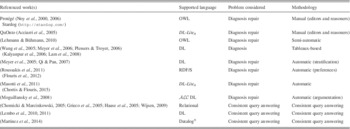
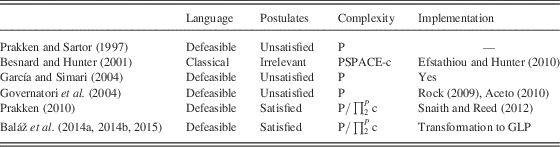
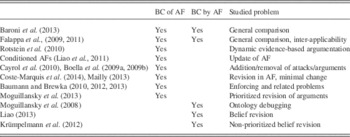
1 Introduction
1.1 Background and focus
The knowledge representation and reasoning (KR) research community contributed over the years a multitude of well-defined theoretical results, as well as practical solutions for engineering information systems tailored to the needs of diverse application domains that deal with knowledge. Recently, the domain of ambient intelligence (AmI) emerged as an important objective merging research trends from different disciplines; many of the problems relevant with respect to the handling of knowledge within AmI were studied in KR for a number of years. Although some solutions from this field already found their way to AmI systems, as intelligent environments move from the lab to the real world their behaviour becomes more sophisticated and the development of viable holistic approaches requires a thorough reconsideration of the applicable tools and methodologies that need to be seamlessly combined within them.
The field of AmI (Zelkha, Reference Zelkha1998; Information Society Technologies Advisory Group, 2003) studies information systems embedded within the environment, sensitive to the human presence, that are able to facilitate distributed and networked computing machinery with the aim to accommodate and support human users with their everyday activities and tasks. Application domains of AmI range from ambient-assisted living and health-care monitoring, to smart home and office automation, transportation services, classroom and education environments, smart shopping, and others (Rubel et al., Reference Rubel, Fayn, Simon-Chautemps, Atoui, Ohlsson, Telisson, Adami, Arod, Forlini, Malossi, Placide, Ziliani, Assanelli and Chevalier2004; Chan et al., Reference Chan, Estève, Escriba and Campo2008; Cook et al., Reference Cook, Augusto and Jakkula2009; Sadri, Reference Sadri2011).
The envisioned AmI applications materialize a long anticipated application objective for artificial intelligence (AI), and many of the subproblems studied within AmI can be addressed by AI methods, including how to recognize activities, how to detect, anticipate, and respond to users’ needs and intentions, how to develop autonomous entities that can exhibit commonsense behaviour, how to conduct distributed reasoning, etc. AmI systems need to be able to process knowledge about the environment in which they are embedded, but also about the users’ activities, goals, and tasks. As the knowledge of the environment may be imperfect and ambiguous and the goals of diverse users may be contradictory, one particular issue that has been long studied within KR becomes relevant also in this domain: the problem of conflict resolution. The autonomous entities involved in an AmI application need to be able to handle conflicting knowledge, and to find (a form of) mutual consensus in their actions, in order to serve their users well, in a consistent, and unobtrusive fashion. This issue was already recognized by the researchers within the AmI domain (Resendes et al., Reference Resendes, Carreira and Santos2014).
In this survey, we focus on selected KR approaches and formalisms that address conflict resolution. Each of the surveyed approaches addresses the problem with a specific motivation, following certain use cases. We do believe that the research in KR has now advanced to a state where it is useful to consider also more broadly defined problems, rooted in challenging real-world applications. For this sake, we look towards AmI as a model domain that integrates a set of important features that need to be considered together, and not only in isolation: (a) distributed and decentralized nature of the system, with multiple autonomous reasoning entities (agents) and the need to resolve the conflicts reaching a certain consensus between the entities; (b) the need to recognize the context: the environment where the agent is placed, users within the environment, their preferences, and needs; (c) being able to react appropriately to a possible change in the situation; (d) computational effectivity of reasoning and conflict resolution; (e) unobtrusiveness: the system should be able to work autonomously without calling for interference of the users.
While we could have selected other model domains, this combination of requirements together with some other AmI specifics, that we discuss later on, introduce complex interdependencies between agents and their interactions that are much more intensively emphasized within the AmI setting, and forbid many simplifying assumptions one may take in other domains.
1.2 Goals and audience
The goal of this survey is to review and evaluate the relevant approaches from KR that can be applied on the conflict resolution problem. In particular, we investigate the extent to which they can be applied to a complex setting, as framed by the requirements (a)–(e) above. That is, our goal is to identify to which extent the KR approaches may possibly be applied, and to pinpoint important issues that still need to be resolved in the respective subfields, in order to become applicable in such challenging domains as AmI.
Having this goal in mind, we believe that the survey can be especially useful to the researchers in KR, who will get an overview of research directions relevant to the problem of conflict resolution, they will be able to compare the various approaches within the field, contrasting their applicability and open issues. Researchers will be able to compare how analogous issues were addressed in different subfields, and also where and how different approaches need to be combined in order to meet the given goals.
The survey can also be useful to researchers who are looking for a suitable conflict resolution methodology for their application in AmI or a similar area. They will learn about the approaches coming from the KR area and about their current status and potential applicability.
Other similar areas which share some specifics with AmI and have strong needs for conflict resolution may include, for example, open multi-agent systems (MAS), systems of agents interacting with Web services and processing information from the Web, etc.
1.3 Survey scope and overview
In Section 2, we first introduce the necessary background from AmI and discuss how KR is relevant to AmI, where in the architecture of AmI systems KR methods can be best applied. In Section 2.3, we take a closer look at the problem of conflict resolution, and we analyze the different kinds of conflicts that appear in AmI applications, especially from the point of view of the diversity of knowledge types that necessarily need to be processed by AmI systems.
Then, in Section 3, we survey a number of selected KR areas in which the problem of conflict resolution was pursued. In each area, we focus on the representational issues (i.e. what problems the approach allows to deal with), but also on computational issues (i.e. if the solutions can be computed, and how hard is it to compute them, if there are any known implementations, etc.), and as well on the relevance of the area to AmI and the known applications in this domain. The surveyed areas are as follows.
Context modelling (Section 3.1) was considered for a long period of time an important issue in KR, and it is a central problem for AmI as well, where context recognition is equally important to context modelling. Apart from answering the question which information is needed to capture the current situation of an agent, and how this contextual model should be organized, reasoning agents are challenged with uncertainty and ambiguity of the data on which they need to build their contextual models, and they need to resolve conflicts that may thus arise (e.g. in sensory data, or between the sensory data and background knowledge). We will discuss both more traditional KR-based approaches where the uncertainty and ambiguity are captured symbolically, and data-driven approaches where they are captured numerically. Hybrid approaches try to combine the results of the former two.
Multi-context systems (MCS) (Section 3.2) and similar approaches in the area of distributed KR focus on the problem of combining multiple knowledge sources for reasoning. The combination is achieved with so called bridge rules, which allow to transfer conclusions from local reasoning in one knowledge source into another one as facts. Particularly relevant to AmI is the assumption that the knowledge sources may be distributed and heterogeneous, for example, each coming from a different agent that may possibly be placed in a different context, and may even use a different representation language. The knowledge derived from different sources may be conflicting, and MCS provide methods to resolve such conflicts. The focus on distribution of knowledge is also relevant, as this is often required in real-world applications.
Belief change (Section 3.3): often referred to as belief revision is the problem of determining how to modify an agent’s knowledge base (KB) in the face of new, possibly contradictory information. The focus is on identifying and resolving problems before they actually creep into the KB. Belief change approaches could be used to prevent conflicts arising from conflicting sensor readings or from information provided by other agents that is conflicting with the context that the local agent understands. The conflicts considered by belief change approaches are logical inconsistencies, and many of the works in this area deal with the theoretical and philosophical aspects of the problem of updating a KB. Thus, the field is quite relevant for understanding the process of updating KBs, and, consequently, the semantics that a rational agent should apply in order to prevent conflicts from creeping into its KB.
Ontology evolution (Section 3.4.1) refers to the process of modifying an ontology in response to a certain change in the domain or its conceptualization. Ontologies and ontology languages are being increasingly applied also by AmI applications, therefore this area is relevant. It is similar to belief change, in the sense that ontology evolution also tries to prevent conflicts from appearing in the KB. Ontology evolution has a more practical nature compared with belief change, in the sense that most approaches are dealing with the practical aspects of the problem of evolution, rather than understanding the evolution process per se. It deals with both the schema and the data of the ontology. It can thus serve to resolve conflict of various types, depending especially on the role the ontology is playing in the agent’s knowledge.
Ontology debugging (Section 3.4.2), just like ontology evolution, deals with ontological languages at a practical level. The main difference is that ontology debugging is applicable after the conflicts have appeared in the KB, which can happen either because they were somehow allowed to appear, or because of reckless updating, or because the rules associated with the data had to be changed. Ontology debugging may take two different forms: direct approaches (repairing) actively try to restore the conflicts by removing conflicting elements, whereas indirect approaches (based on consistent query answering methods) do not directly address the conflicts but provide appropriate inconsistency-tolerant semantics that allow consistent answers over a conflicting data set, essentially ‘hiding’ the conflict from the user.
Argumentation (Section 3.5) aims to understand the process of exchanging rational arguments. More specifically, argumentation studies how arguments relate to each other, and how one can take decisions in the presence of possibly conflicting arguments. Argumentation was successfully applied to conflict resolution, because the resolution of a conflict can be modelled as the process of deciding which part of the evidence (arguments) is acceptable, given a complex evidence set parts of which support (or attack) conflicting arguments.
In Section 3.6, we have a look at the existing body of work on the relation between argumentation and belief change, which we suggest as particularly interesting development w.r.t. AmI, as combining and revising argumentation systems will make them more applicable in complex and dynamic environments.
Preferential reasoning (Section 3.7): KR formalisms are employed to encode a problem in a formal language, and use reasoning capabilities of the formalism to compute the solutions to the problem. Often multiple solutions exist, for example, due to the nature of a problem, or due to the use of general rules that are used to model the problem. Preferences are then used to select preferred solutions. Or preferences can be used to select from multiple conflicting rules that are applicable in certain situations.
Paraconsistent reasoning (Section 3.8): while most of the approaches above aim at resolving conflicts, for example, by performing a repair, or revision of the KB, or by deciding which arguments should be upheld and which should be rejected, paraconsistent reasoning studies logics which are able to derive meaningful conclusions also from inconsistent theories and data sets, for example, by ignoring the inconsistent premises and drawing conclusions only from the consistent part of the knowledge.
2 Ambient intelligence, knowledge, and conflicts
2.1 Ambient intelligence
The advent and penetration of interconnected mobile devices into our everyday life has triggered a shift in computing towards sensor-rich environments with pervasive technologies, often referred to as smart spaces. Stemming from the vision of new generation computer systems known as ubiquitous computing (Weiser, Reference Weiser1991), the new research area of AmI has emerged. AmI places the human user at the centre of attention aiming at creating intelligent environments with the ability to adapt to human preferences, serve their needs and goals, and communicate with their inhabitants utilizing novel means. This paradigm implies a seamless medium of interaction, advanced networking technology, and efficient knowledge management, in order to deploy an environment that is aware of the characteristics of human presence and the diversities of personalities, and is also capable of responding intelligently and proactively to the users’ needs.
AmI systems are intended to be (Zelkha, Reference Zelkha1998; Aarts et al., Reference Aarts, Harwig and Schuurmans2001):
1. embedded within the environment: users do not need to be concerned with their operation;
2. context-aware: they are able to recognize the user and the situation;
3. personalized: they can serve different users according to their own needs;
4. adaptive: they can change in response to the environment and users’ actions;
5. anticipatory: they can understand users’ needs and act upon them proactively, as opposed to only responding user-generated requests.
Agent-based paradigms, most commonly MAS, are often used to design and develop AmI environments. These contain embedded software entities, called agents, able to perceive and reason upon the current context, exploit the functionality of devices installed within the environment, and pursue specific goals while exhibiting autonomous behaviour.
However, there are a few features that distinguish AmI applications from MAS in general. The agents are assumed to be physically placed within a real-world environment, also inhabited by human users—that is, the smart space. As a variety of elements and devices serving diverse purposes are typically installed in smart spaces, it is unreasonable to assume that all agents will share a unique agent architecture—in fact, the agents may be rather heterogeneous in their implementation. Particularly, their cognitive skills may range from simple reactive agents whose behaviour is based on the most recent sensor readings, to complex knowledge-based and deliberative agents that perform elaborate reasoning in order to infer relevant context, make estimates over the users’ intentions, and communicate and negotiate with the other agents in collaborative manner.
Given the complex tasks that AmI applications are to carry out as a whole, we typically assume that a smart space hosts at least a small number of the latter type of agents. While often such rational agents are modelled using the belief–desire–intention (BDI) architecture (Bratman, Reference Bratman1987; Cohen & Levesque, Reference Cohen and Levesque1990; Rao & Georgeff, Reference Rao and Georgeff1991, Reference Rao and Georgeff1995) comprising beliefs (i.e. some knowledge), desires (i.e. certain set of goals), and intentions (i.e. commitment to execute actions in order to meet a chosen set of the goals). Aiming to provide a suitable abstraction of agents for the need of this survey, we simplify the agent architecture and assume that the agents comprise especially the following components:
∙ A KB of certain sort, comprising as a distinguished part the context model of the current situation respective to the agent, and possibly some additional background and domain knowledge used by the agent. There may be different kinds of beliefs that we may need to distinguish. Each agent may keep track of different aspects of the world and represent them differently than the other agents.
∙ A set of goals the agent is able to follow in all possible situations to serve its purpose, from which the agent selects some, depending on the current perceived context.
∙ Either some predefined plans of actions to execute to achieve each goal, or the ability to plan the actions accordingly when needed.
∙ Some way to communicate with other agents with the aim to exchange knowledge and cooperate the next actions (e.g. messages, queries, bridge rules, etc.).
It should be remarked that in AmI systems the general aim of an agent is to perceive and accommodate the goals of the users and to help them in carrying out actions to achieve these goals. For this reasons, agents may likewise model users simply as agents having goals and executing actions. This abstraction is indeed useful when studying AmI environments as a whole, however, we must keep in mind that there is a distinction between the goals of an agent and that of a user, which are not always easily specifiable.
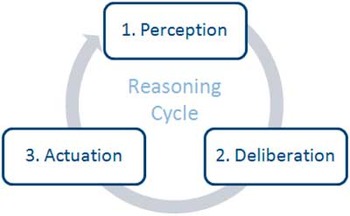
An abstract loop that can characterize the basic internal reasoning phases carried out by an agent is shown in Figure 1 and involves the phases of perception, deliberation, and actuation. This cycle is triggered by specific sensory inputs that the agent is monitoring (or the lack of them) and captures the ability to both deliberate about how best to interpret changes that occur in their dynamically changing world, as well as to make decisions about the most appropriate course of actions that needs to be taken to support the human users’ activities. While many approaches have been proposed to study each phase alone, recent studies (e.g. Chen & Khalil, Reference Chen and Khalil2011; Pecora et al., Reference Pecora, Cirillo, Dell’Osa, Ullberg and Saffiotti2012) argue about the need for a seamless integration of the tasks of perception, recognition, and acting in a coherent loop, in order to synthesize support services in smart environments with proper and verifiable behaviour.
The reasoning cycle of autonomous devices in smart spaces

In addition to its dynamic nature, the aspect of heterogeneity is an equally challenging factor for developing AmI services. Agents operating in smart spaces may possess different reasoning skills, obtain access to distinct knowledge repositories, local or shared, and evaluate incoming information based on different trust criteria. A real-world smart system needs to respect the fact that the way high-level context is inferred by each involved agent is not an objective process. Being highly distributed, these environments produce information that can be interpreted in a totally different manner by the various intelligent agents; as such, it is not uncommon for the latter to end up having incoherent and conflicting views of the current context. Devising intelligent-automated mechanisms for identifying, preventing, or resolving conflicts is of utmost importance, in order to appropriately balance between the two main design principles that have been set for the success of smart spaces: being as less intrusive as possible minimizes the need for user input, while still letting humans feel confident that they have control over their space.
2.2 Relevance of knowledge representation and reasoning in ambient intelligence
A typical AmI application, as described in the previous section, needs to deal with a certain amount of knowledge, in order to evaluate the situation and to carry out the required tasks to serve its users. This knowledge must be represented, and processed within the system. In this section, we take a closer look into the types of knowledge that need to be represented and the kind of processing (i.e. reasoning) that is needed. Many of the problems involved have been thoroughly studied for years in the area of KR.
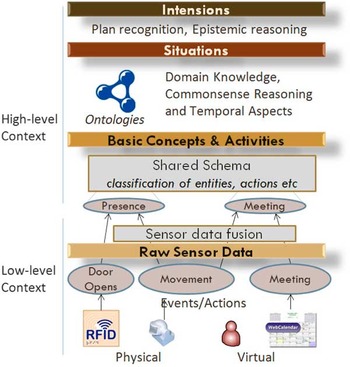
In Figure 2, we observe the different conceptual layers of knowledge within an AmI system. As a first type of knowledge, the bottom layers are concerned with identifying the current context in which the AmI system is placed. There are typically two layers of contextual knowledge—the lower level containing raw sensor readings, and the higher level in which these readings are interpreted on a more abstract level, using a set of concepts based on a commonly agreed schema.
Conceptual layers of contextual knowledge

Climbing up the levels of abstraction, the need to represent rich knowledge structures by means of expressive models becomes more apparent. User activities, such as the process of making coffee, are highly goal driven, typically follow specific patterns, and pre-assume a significant extent of background and domain knowledge with respect to their causal effects and ramifications. In addition, their compositions, often referred to as situations, such as the preparation of breakfast, have rich structural and temporal aspects, as for instance location, duration, frequency, causality, and action. In order for AmI systems to fulfil complex tasks, they may need to consider also specific domain knowledge, and data from external data sources. Expressive symbolic modelling not only allows to combine all necessary reasoning tasks, but in addition significantly enhances the reasoning capacity of smart applications by enabling developers to hide the complexities and noise of sensor readings (Bikakis et al., Reference Bikakis, Patkos, Antoniou and Plexousakis2008; Bikakis & Antoniou, Reference Bikakis and Antoniou2010b), while exploiting the implicit structure of the activities being observed and data that needs to be processed (Loke, Reference Loke2004; Ye et al., Reference Ye, Dobson and McKeever2012). Languages with expressive and formal semantics, relying on ontologies (Sowa, Reference Sowa2000; Staab & Studer, Reference Staab and Studer2004) or dealing with commonsense reasoning (Kuipers, Reference Kuipers1984; Mueller, Reference Mueller2014), spatio-temporal issues (Cohn & Hazarika, Reference Cohn and Hazarika2001; Gabbay et al., Reference Gabbay, Kurucz, Wolter and Zakharyaschev2003), action and planning (Ginsberg & Smith, Reference Ginsberg and Smith1988; Lifschitz, Reference Lifschitz1999; Eiter et al., Reference Eiter, Faber, Leone, Pfeifer and Polleres2003b) have long been studied in knowledge representation.
AmI systems comprise autonomous entities, which need to act in synchronized fashion and collaborate, in order to meet the users’ goals. This inherently imposes the need of distributed processing of the knowledge involved in the overall application. Different agents may hold different viewpoints on the context, and they may have access to different knowledge resources. Therefore, ambiguity and conflicts frequently arise and must be resolved at execution time, in order to assure smooth operation of the system (Henricksen & Indulska, Reference Henricksen and Indulska2004). While current AmI implementations often take a simplistic and centralized approach to conflict resolution (Resendes et al., Reference Resendes, Carreira and Santos2014), within KR a multitude of approaches have been devised with the aim to deal with distributed knowledge sources modelled from the perspective of distinct viewpoints (Giunchiglia, Reference Giunchiglia1993), possibly inconsistent knowledge (Bertossi et al., Reference Bertossi, Hunter and Schaub2005), and reaching agreement (Ossowski, Reference Ossowski2013).
While many of the KR techniques presented above may not have achieved yet the requirement of scalability in an extent suitable for immediate application to AmI systems, they certainly focus on a number of issues that are central to AmI. Their further development will give significant potential for improving the capabilities of AmI systems. In this survey, we concentrate our focus to the problem of resolving conflicts once they arise, and specifically consider the relevant KR approaches that address this problem in different settings and with different goals. Before presenting the surveyed areas in Section 3, we first take a look at the different types of conflicts that are met in AmI systems.
2.3 Conflicting knowledge
One of the problems that has long been studied in KR is how to deal with conflicting knowledge. This problem is particularly relevant in scenarios where multiple distributed knowledge sources that have to be combined for reasoning come into play. As we argued above, AmI systems and architectures often fall into this case, especially if they incorporate multiple autonomous agents that need to cooperate, in order to achieve common goals. Indeed, this has been noted by other researchers working in the field (Henricksen & Indulska, Reference Henricksen and Indulska2004; Muñoz Ortega et al., Reference Muñoz Ortega, Blaya, Clemente, Pérez and Skarmeta2010; Resendes et al., Reference Resendes, Carreira and Santos2014).
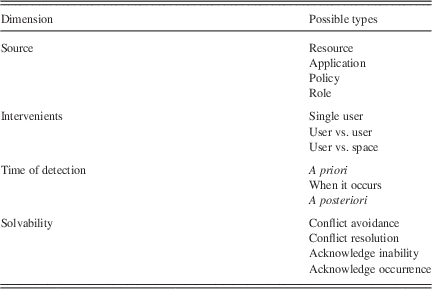
Resendes et al. (Reference Resendes, Carreira and Santos2014) analyze different types of conflicts that may arise in AmI systems and organize them into a taxonomy, as listed in Table 1. They identify four basic broad categories of conflicts, which are dubbed dimensions in order to stress their orthogonality, that is, the fact that one conflict can be independently classified with respect to each of them.
Taxonomy of conflicts (Resendes et al., Reference Resendes, Carreira and Santos2014)
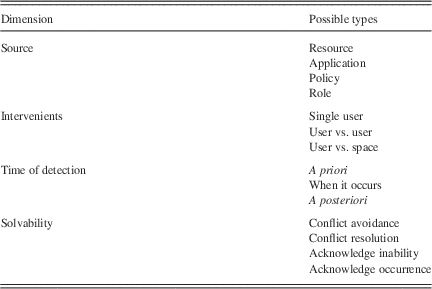
The source dimension indicates where/how each conflict originates—it may be the case that users (or applications) are conflicting over some resource allocation, or it is not possible to execute some action due to policy, or there are conflicting user profiles. The intervenients dimension considers the different parties between which the conflict arises: there might be conflicting intentions within a single user, between multiple users, or between user and the space. The time of detection dimension sorts conflicts into those that are (can be) detected a priori, at the time they occur, or only a posteriori. Finally, the solvability dimension indicates at which level can conflicts be resolved—before they happen (i.e. to avoid them), or immediately when they happen, or, possibly, some conflicts cannot be resolved in sensible time, and these are further split into those which cannot be resolved at all, and those which cannot be resolved due to being detected too late.
For an example, let us consider that there are two conflicting instructions for the temperature to be set in the living room, say one 20°C and the other one 23°C. Using the taxonomy of Resendes et al., we classify such a conflict as resource conflict w.r.t. the source dimension. In the intervenients dimension there are two likely cases: either this is a conflict between the space and a user, one instruction coming from each, or this might be a conflict between two distinct users. The case of a single user providing both instructions is not ruled out, but indeed less likely. Moving to the time of detection dimension, such conflicts are typically detected when they occur, if the instructions are immediate. They can also be detected a priori, if they concern a setting relevant for some future period. According to the solvability dimension, the conflict is likely solvable by conflict resolution (e.g. based on some policy, preference between the user and the space, between the two users, or alike). Alternatively, conflict avoidance may be achieved if the users are warned and they can agree on a common setting. This may, however, decrease unobtrusiveness, praised in AmI systems, if not executed with caution—for example, a warning at the time when the user is providing the setting may be considered sufficiently unobtrusive.
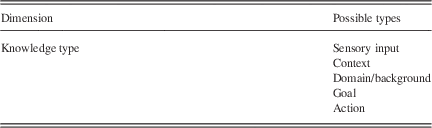
Homola and Patkos (Reference Homola and Patkos2015) propose an additional dimension to be added to the taxonomy of Resendes et al., namely that of the knowledge type. As each type of knowledge is processed differently, and in a different point of the agents reasoning cycle (cf. Figure 1), conflicts in distinct types of knowledge may need to be processed differently in AmI systems.
The possible values of the knowledge-type dimension are listed in Table 2 and in more detail they are described as follows:
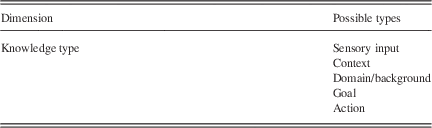
Sensory input conflict: if a conflicting reading of some sensors appears. Either multiple readings of the same sensor, or similar sensors may be conflicting. Or the reading may be of different sensors, however, the outputs are mutually exclusive (the agents know that these outputs cannot occur at the same time). The conflict may arise within a single agent, but it may also be distributed between more than one agent (each containing part of the conflicting readings). The latter option may subsequently possibly cause a contextual conflict.
Contextual conflict: if two (or more) agents are part of the same situation, their models of the world are conflicting, implying, for example, a different location, or perceived activity of the user, etc. This type of conflict may likely be caused by a previous unnoticed sensory input conflict. But it may also be caused by different evaluation of the situation.
Domain and background knowledge conflict: domain and background knowledge refer to the information the agent possesses and uses in order to fulfil its purpose. For instance, a calendar scheduling agent associated with a user records information about months in a year, days in a week, working days, holidays, etc. This is the knowledge respective to the domain of the agent’s tasks. To contrast this with contextual knowledge, the fact that Monday follows Sunday is part of unchanging domain knowledge, respective to the calendar domain, while the current date and time, 1st day of week are in reality contextual knowledge, which changes from situation to situation. It is apparent that conflict in domain and background knowledge should occur less frequently in AmI systems, in comparison to the remaining four kinds of conflicts discussed here. Also, if they occur, they may require a different kind of solution, due to domain and background knowledge being most typically considered unchanging and fully specified (to the extent required by the application). Hence, redesign of the agent’s KB by its creator may be required, in contrast to automatic dealing with the conflict.
Goal conflict: if two (or more) agents are part of the same situation, their models of the world are compatible, but they have mutually conflicting goals. Note that we do not consider it a goal conflict if agents have conflicting goals in different models of the world, because it is natural to have different goals in different situations.
Action conflict: if two (or more) agents share a compatible model of the world, and a compatible set of goals, yet decide to follow a contradictory course of actions to carry out their goals.
According to the knowledge-type dimension, the conflict between two desired temperature settings, as discussed above, is a goal conflict rather than an action conflict, as there are really two conflicting goals for setting the temperature to a different value. This is different than the case when there is a common goal and the conflict is merely between the actions chosen to be executed by distinct parties.
As a case of an action conflict, consider an ambient-assisted living scenario in which the agents monitoring a user detect that the user has left the stove on while she went to take a shower. With the common goal to secure the stove an action, conflict arises when one agent decides to alert the user, while another decides to call external assistance. The actions are not directly contradictory, however, one of them is redundant if executed at the same time. It is more preferred if the agents avoid such a conflict by reaching an agreement on the best action to execute immediately.
As further observed by Homola and Patkos (Reference Homola and Patkos2015), these five knowledge types can be sorted on the scale from lower to higher level of knowledge: (a) sensory input, (b) contextual, domain, and background knowledge, (c) goals, and (d) actions, in the respective order. Distinguishing between these five types is important also due to the following conjecture: solving conflicts in a lower-level knowledge may possibly prevent occurrence of further conflicts in the higher levels of knowledge. Consider an example in which two agents have a conflict in the contextual knowledge, that is, their interpretation of the situation in which they both participate is not compatible (e.g. they may have conflicting information about location). If the conflict is resolved at this level, it is less likely that the agents will come up with conflicting goals and consequently action plans.
In the remainder of this survey, we overview and compare different KR formalisms and tools that are suitable to resolve conflicts. Each formalism can be suitable for different type of conflicts, and the knowledge-type dimension is often important to consider. As noted above, conflicts in domain and background knowledge most likely require a manual solution, and hence they are not in our main focus. There are, however, a few formalisms capable of addressing these conflicts, as we note below in the survey.
3 Conflict resolution approaches
In the previous section we have learned of the different types of conflicts that may arise in AmI scenarios. In this section, we will present different ways in which agents could resolve such conflicts. In particular, we will focus on the research areas of context modelling, MCS, belief change, ontology evolution, ontology debugging, argumentation, and preferential reasoning. Each of these areas is relevant to the problem of resolving conflicts, however, each of them uses a different approach to resolve the conflict. Even though these fields were developed and motivated in different contexts, we feel that the ideas and approaches used there can be easily applied for AmI-related problems, which we also highlight in this section.
3.1 Context modelling and recognition
There is a plethora of methodologies that investigate issues related to the recognition of context. These methodologies are distinct in the way in which they model, represent, or reason over the involved information (relevant surveys include Yang (Reference Yang2009), Chen & Khalil (Reference Chen and Khalil2011), Sadri (Reference Sadri2011), and Ye et al. (Reference Ye, Dobson and McKeever2012)). Among the different classifications that can be made, a commonly adopted one is related to how the information is being processed, which leads to the very broad distinction between data-driven and knowledge-based approaches. The former rely on a numerical characterization of the uncertainty in inferring context, while the latter apply symbolic reasoning techniques from the field of KR. In the sequel, we investigate the main advantages and weaknesses of methodologies in both categories, as well as recent approaches that attempt to combine prominent features in hybrid models. The main objective of these approaches is to process information from the lower levels of context and produce inferences on the higher levels, with the big majority of approaches focussing on activity recognition (Figure 2). Although the topic of automatic conflict detection and recognition is inherent in the construction of smart spaces, addressing it as part of the context recognition research has only produced partial solutions, as we will see later on.
3.1.1 Data-driven approaches
Data-driven approaches adopt primarily a probabilistic and statistical view of information and widely rely on the enormous impact of machine-learning techniques in real-world applications. Although further classification can be made, for example, based on whether supervised or unsupervised methods are being used, one distinctive characteristic of data-driven activity recognition algorithms is their capacity to model uncertainty. They apply quantitative measures to evaluate plausibility of observed data, which renders them a popular solution for deciding how best to resolve contradictory sensor inputs. For instance, the problem of domestic activity recognition for a single user was approached by training multiple naive Bayesian models enhanced with ranking features and reliability factors to detect interleaved activities and unexpected sensor malfunction (Lu & Fu, Reference Lu and Fu2009). The same topic for multiple users was investigated with the application of Hidden Markov Models that can benefit the process of recognition taking into consideration temporal patterns of data (Singla et al., Reference Singla, Cook and Schmitter-Edgecombe2010).
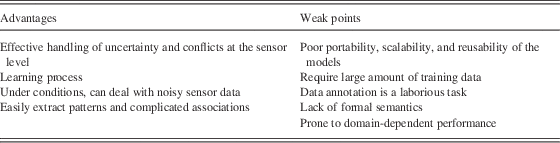
The ability to learn from data sets is a big leverage for data-driven models for tackling conflicts at the sensor level, but often becomes their main point of weakness when attempting to address problems related to the recognition of high-level context. The performance of data-driven approaches is largely dependent on the availability of big amounts of—labelled or unlabelled—training data, thus compromising their capacity to offer scalable, reusable, and portable solutions. Due to the pragmatic difficulty to monitor the behaviour of different humans for a long period of time while they perform everyday activities, the models produced exclusively from data-driven techniques are often prone to domain-dependent performance, limiting their reusability and portability (Ye et al., Reference Ye, Dobson and McKeever2012).
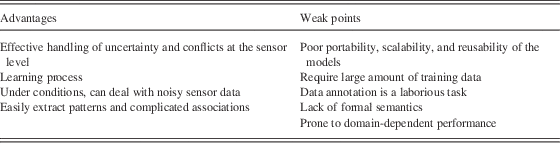
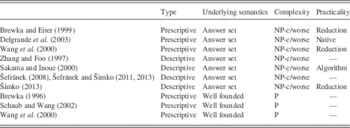
Moreover, for abnormal or exceptional behaviours, such as for recognizing a heart attack, specialized equipment is needed (e.g. heartbeat/pulse sensors), which is often considered too intrusive for the daily activities of ordinary users. Without such equipment though it is difficult to train a typical AmI system properly, which is why, for instance, the applicability of certain approaches, like the one proposed by Jakkula et al. (Reference Jakkula, Crandall and Cook2009), is limited to frequent and predictable behaviours only. For less common situations, there is also the problem of overfitting, that is, when the training of a system is based on a small set of annotated data, which cannot be disregarded, as understood in the work of Lester et al. (Reference Lester, Choudhury, Kern, Borriello and Hannaford2005). Table 3 summarizes the main points of these approaches.
Characteristic features of data-driven context recognition fields
3.1.2 Knowledge-based approaches
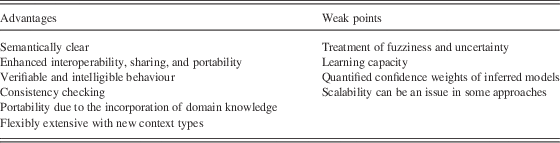
With knowledge-based approaches the rules of inference are modelled from first principles, rather than learned from raw data, and typically rely on formal specifications of their syntax and semantics, exploiting symbolic modelling and logic-based reasoning techniques. The expressive power, along with the capacity to verify the properties of their axiomatizations, are key advantages of these methodologies. Among knowledge-based approaches for context recognition, ontology-based models are arguably the most popular ones.
Ontology languages have rich and formal semantics that enables them to express complex knowledge using a wide set of primitives. These languages are utilized in modelling high-level contextual information, due to their ability to incorporate rich domain knowledge and heuristics in a machine processable way, thus offering a number of advantages in terms of expressiveness and quality of representation, automation and interoperability, composition and level of formality (Strang & Linnhoff-Popien, Reference Strang and Linnhoff-Popien2004; Bettini et al., Reference Bettini, Brdiczka, Henricksen, Indulska, Nicklas, Ranganathan and Riboni2010). The most elaborate recent studies in the field of ontology-based context recognition are probably Riboni and Bettini (Reference Riboni and Bettini2011b) and Springer and Turhan (Reference Springer and Turhan2009). Based on expressive languages (i.e. OWL 2 description logic (DL) and OWL DL, respectively) and decidable reasoners, they enable a context-aware system to detect inconsistencies, infer out activities occurring in the environment, and reproduce knowledge to model activities that share similar characteristics.
Although a multitude of pervasive computing systems have applied ontologies in modelling and reasoning on context knowledge (Preuveneers et al., Reference Preuveneers, den Bergh, Wagelaar, Georges, Rigole, Clerckx, Berbers, Coninx, Jonckers and De Bosschere2004; Ye et al., Reference Ye, Coyle, Dobson and Nixon2007; Patkos et al., Reference Patkos, Chrysakis, Bikakis, Plexousakis and Antoniou2010), most of them try to avoid the generation of conflicts relying on centralized solutions, whereas only few try to explicitly incorporate a solution for resolving conflicts about context within a distributed environment. An early example is Semantic Space (Wang et al., Reference Wang, Dong, Chin, Hettiarachchi and Zhang2004; Tan et al., Reference Tan, Zhang, Wang and Cheng2005), a context infrastructure for building smart spaces that investigates a variety of issues, such as context modelling, storage, inference, querying, and dynamic discovery of available context providers (wrappers). Context wrappers that obtain raw context information from various software and hardware sources transform them into semantic knowledge (markups) based on the system’s context model and store this knowledge in the KB. As an attempt to avoid potential conflicts generated by application-specific inferences, the higher-level context inferred from markups using general purpose reasoners is not explicitly stored in the KB; instead, when needed, specific rulesets are applied to obtain the required knowledge on-the-fly. While this approach may be sufficient for restricted domains, it can be problematic for the general AmI setting, where the different entities often need to obtain a ubiquitous and commonly agreed view of the current situation, in order to decide the best actions to perform and support humans accordingly.
Similar approaches that perform rule-based reasoning are also proposed by Fuchs et al. (Reference Fuchs, Hochstatter, Krause and Berger2005), as well as in the SOCAM system (Gu et al., Reference Gu, Pung and Zhang2005), where first-order logic (FOL) rules are applied to reason about the context data and resolve possible conflicts between data coming from different sources. Sets of rules are defined for the classification and evaluation of the quality of the observed context data.
One serious limitation and a key reason for the superiority of data-driven approaches over ontology-based ones is the limited support for temporal reasoning by ontology-based languages, according to Riboni et al. (Reference Riboni, Pareschi, Radaelli and Bettini2011). Nevertheless, temporal extensions of Semantic Web languages start to become popular (Gutierrez et al., Reference Gutierrez, Hurtado and Vaisman2007; Batsakis et al., Reference Batsakis, Stravoskoufos and Petrakis2011). More importantly, the inherent uncertainty of the information that exists in ubiquitous domains is difficult to handle at the pure symbolic level. While context recognition with respect to coherent incoming information is where most of the aforementioned studies are focussing on, the resolution of information that is conflicting has not been extensively considered so far. Indeed, Semantic Web-based approaches mostly deal with the problem of context disambiguation up to the point of acknowledging that certain parameters can be regarded as unknown.
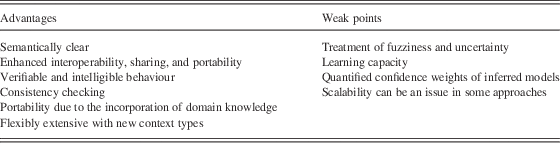
The problem becomes more pronounced when the recognition task involves high-level complex situations, which ultimately leads in having to resolve the two other types of conflicts defined in Section 2.3, namely goal and action conflicts. For instance, Sadri (Reference Sadri2010) proposes an approach to recognize the intentions of a user by means of identifying plans using action graphs. Human intentions are often unclear, cannot be directly measured with physical devices, and may be the result of controversial desires. Committing to specific potential human intentions typically means for an agent to decide which of the conflicting knowledge to keep and which to drop. Considering the fact that often multiple and heterogeneous entities are employed in a smart space to perform such reasoning tasks, it becomes evident that dealing with the resolution of the conflicting viewpoints adopted will be inevitable in the next generation of smart systems. This aspect is starting to become an important research topic by considering the integration of techniques from other fields, such as argumentation, as it often requires extra logical information, as we will see in the following sections. Table 4 gives an overview of the main features of the approaches belonging to this category.
Characteristic features of knowledge-based context recognition fields
3.1.3 Hybrid and other approaches
Although data-driven methods are currently the mainstream choice to activity recognition, with most effective being the supervised learning methods, numerous recent studies justify the attention that knowledge-based approaches have attracted over the last years. Yet, experience showed that both lines of investigation suffer from limitations that restrict the former to the lower levels of data abstraction and the latter to high-level knowledge. A seamless integration of methodologies for all levels is essential for the materialization of AmI objectives. Much of current research is working towards this end. The COSAR system (Riboni & Bettini, Reference Riboni and Bettini2011a), for example, loosely couples ontological OWL DL reasoning with statistical inferencing, where the latter predicts the set of possible activities without considering context parameters, in order to make the task manageable, while the former is applied to refine the results. In a similar style, the approach by Roy et al. (Reference Roy, Giroux, Bouchard, Bouzouane, Phua, Tolstikov and Biswas2011) applies possibility theory to model qualitatively incomplete knowledge, coupled with a DL representation of context to characterize the subsumption relation of actions, whereas the one by Helaoui et al. (Reference Helaoui, Riboni, Niepert, Bettini and Stuckenschmidt2012) presents a first attempt to use probabilistic DL for activity recognition. Still, these frameworks provide only limited or no support for temporal reasoning, inheriting some of the deficiencies of ontological reasoning in expressiveness, as discussed before.
A coupling of uncertainty with rich temporal relations is presented by Helaoui et al. (Reference Helaoui, Niepert and Stuckenschmidt2011) that uses Markov logic networks (MLNs), a statistical relational framework, to introduce uncertainty measures in logical statements to recognize simultaneous and nested activities. Skarlatidis et al. (Reference Skarlatidis, Paliouras, Vouros and Artikis2011) go even further to combine MLNs with the event calculus, a theory for reasoning about action and change, in order to exploit certain properties of the latter, such as the persistence of activities, and soften them as appropriate. Closely related to MLNs is the approach presented by Augusto et al. (Reference Augusto, Liu, McCullagh, Wang and Jian-Bo2008) that integrates confidence values to event-condition-action rules. The authors define a new syntax for expressing temporal relations among events, with Dempster–Shafer theory being used to assign confidence values to both antecedents and conclusions of rules. The belief rules they define can be used both to monitor a user’s interactions and to recognize exceptional situations.
3.1.4 Summarizing
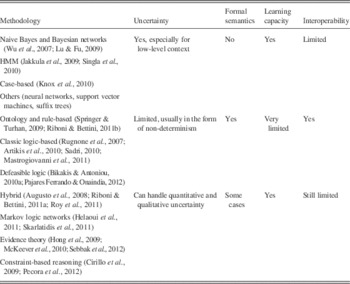
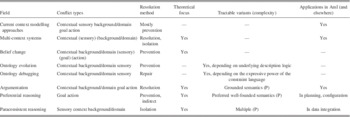
Although the domain of AmI environments demands the generation of collective context-aware applications for group of users, where individual agents with personal goals seek collaborative execution of tasks (see, for instance, Muñoz Ortega et al., Reference Muñoz Ortega, Blaya, Clemente, Pérez and Skarmeta2010; Braga Silva et al., Reference Braga Silva, Ruiz and Loureiro2011; Muñoz et al., Reference Muñoz, Augusto, Villa and Botía2011), relevant literature on collective context conflict resolution is rather scarce. A large portion of contemporary approaches, summarized in Table 5, rely largely on centralized architectures, where a single reasoning entity handles conflict resolution. Those that deploy distributed settings, on the other hand, either try to avoid conflict occurrences (Muñoz Ortega et al., Reference Muñoz Ortega, Blaya, Clemente, Pérez and Skarmeta2010) or focus primarily on policy conflict detection, that is, establishing behaviour schemes that guarantee acceptable system states (Resendes et al., Reference Resendes, Carreira and Santos2014).
Context modelling approaches

HMM=Hidden Markov Models.
The heterogeneity of the reasoning entities inhabiting smart spaces, as well as the processing load required to reason about context renders unreasonable the assumption that full perception is owed by all agents in a smart environment for describing the world state and the situation the users are involved in. Similarly, the need to combine context inference with actuation cannot be overlooked. As evidenced by Pecora et al. (Reference Pecora, Cirillo, Dell’Osa, Ullberg and Saffiotti2012), inference, sensing, and actuation must operate in close cooperation, in order to manage an effective integration of the cognitive capabilities of an intelligent system to be both context-aware and proactive. As the various smart entities need to interact and negotiate with one another, individually or collectively, in order to make decisions and synchronize their actions, conflicts inevitably emerge at the actuation level as well, a topic that only recently started to attract attention by current research in smart spaces, as we see in later sections and especially in Section 3.5.
3.2 Multi-context systems and distributed knowledge representation
AmI systems are particularly peculiar in that they are inherently distributed and decentralized, and their components are supposed to act autonomously. The agents should be able to carry out their tasks in cooperation with other agents, but also independently, for example, if communication, or perhaps other parts of the system are broken. Such assumptions pose increased requirements on knowledge processing, particularly reasoning, which was traditionally investigated especially for the single KB/single-agent case. Although reasoning agents (e.g. based on BDI architecture (Rao & Georgeff, Reference Rao and Georgeff1991, Reference Rao and Georgeff1995)) were investigated in the context of distributed MAS (Wooldridge & Jennings, Reference Wooldridge and Jennings1995; Jennings et al., Reference Jennings, Sycara and Wooldridge1998), the concern was usually about how should the agents process the newly acquired knowledge (e.g. possibly by revising their KB, see Section 3.3) and what should the resulting knowledge state of the agent be, upon which they would then act. However, it was not traditionally investigated what should the resulting knowledge state of the whole system be, and how the knowledge of one agent can influence the others, etc.
3.2.1 Multi-context systems
This interesting problem was pursued by Giunchiglia (Reference Giunchiglia1993) and Giunchiglia and Serafini (Reference Giunchiglia and Serafini1994), who proposed MCS. In MCS, we deal with a collection of KBs  ${\cal K}_{1} ,\:\,\ldots\,\:,\,{\cal K}_{n} $
. Each of the KBs
 ${\cal K}_{i} $
is a collection of formulae in its own language
 $${\cal L}_{i} $$
. The KBs of an MCS, commonly called contexts, represent different pieces of knowledge that are to be combined in a unified reasoning system. The contexts may represent different knowledge sources, KBs of communicating and cooperating agents, etc. The issue of multi-contextuality is captured by MCS in various ways. Not only with different languages that the contexts may possibly use, but also with the fact that each context may be respective to a different situation and, therefore, may contain diverse facts. Each context may even represent similar information differently. The combination of these assumptions renders MCS very flexible in modelling scenarios of diverse levels of knowledge heterogeneity, from completely homogeneous, up to ones involving largely heterogeneous knowledge sources/agents.
Logical semantics of the contexts is assumed, in the sense that we have either entailment or a proof system by which we can derive when a formula  $$\phi \in {\cal L}_{i} $$
is true in
 ${\cal K}_{i} $
. The knowledge from different contexts is combined with bridge rules of the form
 $i:\phi \leftarrow j:\psi $
, meaning that if the formula
 $$\psi \in {\cal L}_{j} $$
is true in
 ${\cal K}_{j} $
then also the formula
 $$\phi \in {\cal L}_{i} $$
must be true in
 ${\cal K}_{i} $
. That is, bridge rules allow to derive consequences in one context (target context) based on premises previously proven in some other context (source context). Hence, bridge rules allow to characterize knowledge transfer between contexts, but also to translate from the language used in one context to that of another, which may be necessary given their possible heterogeneity. That is, given the bridge rule
 $i:\phi \leftarrow j:\psi $
, the recipient agent
 ${\cal K}_{i} $
upon receipt of information ψ from the sender agent
 ${\cal K}_{j} $
concludes ϕ, where ϕ represents the recipient’s own representation and interpretation of the senders statement ψ. A more general form of bridge rules allows more assumptions coming from different contexts on the right hand side (e.g. i:ϕ←j 1:ψ 1, … , j n:ψ n). Such rules fire if ψ k is derived in
 ${\cal K}_{{j_{k} }} $
for all j k.
Inference in MCS was first characterized by a proof theory, where bridge rules are used as calculus rules, that are combined with the local calculus of each context (Giunchiglia, Reference Giunchiglia1993; Giunchiglia & Serafini, Reference Giunchiglia and Serafini1994). A model theoretical semantics for MCS, called local mod el semantics, was introduced by Giunchiglia and Ghidini (Reference Giunchiglia and Ghidini1998) and Ghidini and Giunchiglia (Reference Ghidini and Giunchiglia2001). In this semantics, the model of a whole MCS is a collection of local models over which additional semantic constraints are asserted that are derived from the bridge rules. Local model semantics was particularly influential and formed the base for further research. We will now survey the main areas of research associated with MCS.
3.2.2 Distributed logics and distributed ontologies
Due to their capacity to combine logical reasoning over multiple knowledge sources, MCS have been used to formalize distributed FOL (Ghidini & Serafini, Reference Ghidini and Serafini1998), and later Distributed Description Logic (DDL) (Borgida & Serafini, Reference Borgida and Serafini2003). The latter approach, in particular, proved to be influential and sparked considerable interest in distributed ontologies, where the power of MCS is used either to make alignments between heterogeneous and possibly ambiguous ontologies that are to be combined in reasoning (Ghidini & Serafini, Reference Ghidini and Serafini2008; Ghidini et al., Reference Ghidini, Serafini and Tessaris2008), or to facilitate truly distributed inference (Serafini & Tamilin, Reference Serafini and Tamilin2004; Serafini et al., Reference Serafini, Borgida and Tamilin2005; Homola & Serafini, Reference Homola and Serafini2010). Both directions may be useful in AmI systems, in cases when more than one ontology is employed within a system, possibly governed by independent agents. Other related approaches to distributed ontologies include  ${\cal E} $
-connections (Kutz et al., Reference Kutz, Wolter and Zakharyaschev2002, Reference Kutz, Lutz, Wolter and Zakharyaschev2003; Cuenca Grau et al., Reference Cuenca Grau, Parsia and Sirin2004), context OWL (Bouquet et al., Reference Bouquet, Giunchiglia, van Harmelen, Serafini and Stuckenschmidt2004), integrated DDLs, and package-based DLs (Bao et al., Reference Bao, Voutsadakis, Slutzki and Honavar2009). For a comparison of their expressive power, we refer the interested reader to Homola (Reference Homola2010: Ch. 6).
3.2.3 Non-monotonic multi-context systems
Logic-based MAS often rely on non-monotonic logics, in which the agents are able to reason with assumption, and derive new consequences from assumptions as long as they are not disproven. In order to plug non-monotonic contexts into MCS, it was desirable to enable also non-monotonic bridge rules. Such rules are of the from  $i:\phi \leftarrow j_{1} :\psi _{1} ,\:\,\ldots\,\,j_{k} :\psi _{k} ,\,{\rm not}\ k{\rm {\plus}1:}\,\psi _{{k{\plus}1}} ,\:\,\ldots\,\,{\rm not}\,l\,{\rm :}\,\psi _{l} $
, and they allow to assert consequences in some context also based on the fact that some evidence is not proven in a source context of the bridge rule. For example, consider a situation in which the control agent is instructed to switch lights on during the night if a person is present and switch them off if a person is not present, using knowledge from the calendar and detector agents. While the former case is easily captured by a monotonic bridge rule (1), the latter is not; we need a non-monotonic bridge rule (2) for that:
 $$ctrl:lights\_on\leftarrow cal:night,\,det:preson\_\,present$$
 $$ctrl:lights\_off\leftarrow cal:night,\,{\rm not}\ det:preson\_\,present$$
Local model semantics was not sufficient to handle non-monotonic bridge rules. First steps towards such extensions were taken by Roelofsen and Serafini (Reference Roelofsen and Serafini2005) and Brewka et al. (Reference Brewka, Roelofsen and Serafini2007), but the semantics which later became generally accepted as a de facto standard for non-monotonic MCSs is the equilibrium semantics given by Brewka and Eiter (Reference Brewka and Eiter2007).
The expressive power of MCS is further increased in Managed Multi-Context Systems (mMCS) (Brewka et al., Reference Brewka, Eiter, Fink and Weinzierl2011). While so far we dealt with bridge rules, which always result in addition of a formula into the target context, mMCS introduce new operations, such as deletion of a formula, revision by a formula (in the sense of belief revision, cf. Section 3.3).
3.2.4 Contextual knowledge representation
While bridge rules allow to change and accommodate information transferred between contexts in arbitrary way, they do not suggest how this should be done. The reason is that MCS enable to connect KBs pertaining to different contexts, but do not provide any apparent means to capture the characteristics of these differing contexts. Already in his early work on contextual reasoning, McCarthy (Reference McCarthy1993) described transfer of information between contexts as knowledge lifting. This operation, which in MCS is implemented with bridge rules, was also studied under other names, such as knowledge push and pop (Benerecetti et al., Reference Benerecetti, Bouquet and Ghidini2000). It is understood that the knowledge is changed or adjusted during the transfer, in order to fit into the target context. What is more, these changes are influenced by the characteristics of the source and the target context, sometimes also called contextual meta knowledge. This meta knowledge may refer, for example, to a particular location, period of time, topic, etc., associated with a context. Once such meta information is assigned to contexts, contextual relations between them are studied, for example, one context preceding another in time, or, is associated with a broader topic, and so on. Thanks to these relations, contexts can be organized into a contextual space (Lenat, Reference Lenat1998; Benerecetti et al., Reference Benerecetti, Bouquet and Ghidini2001). Thus, for instance, the statement President(Bill_Clinton) associated with the context of United States in year 2000 may be changed to ExPresident(Bill_Clinton) when lifted into another context associated with some future period of time.
Contextualized Knowledge Repositories (CKR) (Serafini & Homola, Reference Serafini and Homola2012) can be seen as extension of MCS that addresses this issue. In CKR, users may initialize a number of contextual dimensions, with respective values and their relations. Such dimensional values are then assigned to contexts as a form of meta knowledge. Thus, we can have a context associated with, for example, US politics 2000, similarly as illustrated above. CKR relies on the mechanism of knowledge importing, which enables to reuse the knowledge of a context in another one. For example, in any context we can access the predicate President US,politics,2000(), which will import relevant instances respective to President() from the context of US politics in 2000. Or to give a very simple example from the AmI domain, consider that we divide a smart home into separate rooms and we use a single dimension location, which takes values, such as kitchen, living room, etc. In the context of the living room, we can access the relevant users present in the kitchen as instances of UserPresent kitchen. This way we transfer the knowledge from one context to another. This way, the user does not deal directly with bridge rules. Further versions of CKR extend the framework with more expressive meta theories than just simple dimensional properties (Bozzato & Serafini, Reference Bozzato and Serafini2013) and also with non-monotonic defeasible reasoning capabilities (Bozzato et al., Reference Bozzato, Eiter and Serafini2014). Similarly, DLs of context (Klarman & Gutiérrez-Reference Klarman and Gutiérrez-BasultoBasulto, to appear) allow to model a set of contexts and a meta theory that describes their relations, and information between contexts is then accessed using dedicated modal operators.
CKR and similar formalisms may particularly be useful to AmI applications to develop agents, which need to combine numerous amounts of knowledge imported from various sources. This can be information from sensors and other agents, or external knowledge available in the form of linked data data sets from the Web. Each piece of information can be associated with respective contextual metadata and then seamlessly combined in reasoning.
3.2.5 Conflict resolution and argumentation in multi-context systems
Apart from resolving sensory input conflicts, MCS can potentially be applied to resolve any types of conflicts that may arise between the agents in AmI environments. However, their main efficacy lies with resolving or avoiding contextual conflicts between the agents, as documented by the studies of Serafini and Homola (Reference Serafini and Homola2012), Bikakis and Antoniou (Reference Bikakis and Antoniou2010a), Benerecetti et al. (Reference Benerecetti, Bouquet and Ghidini2000), Ghidini et al. (Reference Ghidini, Serafini and Tessaris2008). It is also apparent from the foundational works that MCS were built upon Lenat (Reference Lenat1998).
MCS immediately allow for localized conflict resolution, that is, if a context  ${\cal K}_{i} $
imports mutually conflicting information from some other contexts
 ${\cal K}_{j} $
,
 ${\cal K}_{l} $
, this can be resolved within
 ${\cal K}_{i} $
. For instance, we may choose to prefer the information from
 ${\cal K}_{j} $
and neglect the one from
 ${\cal K}_{l} $
, or vice versa, or we may decide to ignore it entirely, or to react in some other appropriate way.
A global view on inconsistency handling in MCS was studied by Eiter et al. (Reference Eiter, Fink, Schüller and Weinzierl2010b) who looked at MCS systems, which have no equilibrium and propose possible explanations why this happens. Confining local inconsistencies and preventing them from polluting the entire system was also one of the design goals of DDL (Serafini et al., Reference Serafini, Borgida and Tamilin2005) and CKR (Serafini & Homola, Reference Serafini and Homola2012).
The problem with localized conflict resolution is that two separate, autonomous agents may face the same conflict differently, choosing two different resolutions and act upon them. This may possibly disturb the overall coordination of agents in the system. Negotiating about conflicting knowledge between autonomous entities has been studied in the argumentation theory (see Section 3.5). Combining MCS with argumentation therefore seems to be a particularly promising direction in this respect. Already Parsons et al. (Reference Parsons, Sierra and Jennings1998) propose to use argumentation within an MCS-based agent architecture in order to resolve conflicts that arise between agents. More recently, Bikakis and Antoniou (Reference Bikakis and Antoniou2010a) study an application of MCS and argumentation in the context of AmI systems. They proposed so called contextual defeasible logic, built as an MCS with defeasible logic used inside contexts that uses argumentation to resolve conflicts in each context. Such an approach, however, is still localized: each context resolves the conflicts locally, based on its local preferences. Brewka and Eiter (Reference Brewka and Eiter2009) introduce argumentation context systems. This approach takes further steps towards reaching a certain level of agreement between the agents, in order to resolve mutual conflicts: MCS are enriched with so called mediators, which import relevant information from other contexts using bridge rules that resolve any conflicts relying on an argumentation semantics.
3.2.6 Towards applicability of multi-context systems in ambient intelligence
Some of the systems described above were also developed into working prototypes. Support for  ${\cal E} $
-connections is implemented in the Pellet reasoner (Sirin et al., Reference Sirin, Parsia, Cuenca Grau, Kalyanpur and Katz2007). A distributed reasoner prototype for DDL was released under the name DRAGO (Serafini & Tamilin, Reference Serafini and Tamilin2005). It enables to combine and reason with OWL ontologies with expressive power up to
 ${\cal S}{\cal H}{\cal I}{\cal Q}$
DL (Horrocks et al., Reference Horrocks, Sattler and Tobies2000). It was developed as an extension of the Pellet reasoner (Sirin et al., Reference Sirin, Parsia, Cuenca Grau, Kalyanpur and Katz2007). The DDL framework and the DRAGO system were consecutively employed in tasks such as debugging of automatically generated ontology mappings (Meilicke et al., Reference Meilicke, Stuckenschmidt and Tamilin2007) and also providing reasoning support for manual ontology mapping revisions (Meilicke et al., Reference Meilicke, Stuckenschmidt and Tamilin2009).
An implementation of an Resource Description Framework (RDF)-based CKR was showed by Joseph and Serafini (Reference Joseph and Serafini2011). It is an extension of the OWLIM semantic data store (Bishop et al., Reference Bishop, Kiryakov, Ognyanoff, Peikov, Tashev and Velkov2011). A use case-based exploration of practical applicability of contextualized modelling with CKR was published by Bozzato et al. (Reference Bozzato, Ghidini and Serafini2013).
A working prototype of an MCS system was developed by Bögl et al. (Reference Bögl, Eiter, Fink and Schüller2010), in order to demonstrate the method for finding explanations for inconsistency in MCS by Eiter et al. (Reference Eiter, Fink, Schüller and Weinzierl2010b). This implementation is based on the tool named dlvhex (Eiter et al., Reference Eiter, Ianni, Schindlauer and Tompits2006).
Regarding the question of what role should MCS actually play in AmI applications, they were proposed as basis of agent architectures. Parsons et al. (Reference Parsons, Sierra and Jennings1998), Casali et al. (Reference Casali, Godo and Sierra2005), and Sabater et al. (Reference Sabater, Sierra, Parsons and Jennings2002) use MCS to develop the internal architecture of an agent. While Parsons et al. and Casali et al. essentially design an MCS implementation of the BDI architecture, Sabater et al. propose a more elaborate, modular architecture, which extends BDI. Other works (Cimatti & Serafini, Reference Cimatti and Serafini1995; Bikakis & Antoniou, Reference Bikakis and Antoniou2010a) use the notion of context to encapsulate an agent and exploit bridge rules to implement inter-agent exchange of knowledge. This enables to reason about the knowledge distributed in the whole MAS. While such an approach can be used within each agent to model its perception of the other agents’ knowledge, Parsons et al. (Reference Parsons, Sierra and Jennings1998) envisaged that bridge rules could potentially be exploited also for capturing the actual inter-agent communication and thus the MCS would take the role of a fully fledged multi-agent architecture.
Above, we highlighted the application of MCS in resolving conflicts, especially when referring to contextual conflicts. Recently, work has been done towards integrating also normative reasoning into MCS (Knorr et al., Reference Knorr, Slota, Leite and Homola2014), which can further enhance the capabilities of AmI systems relying upon the MCS architecture.
As mentioned above, Bikakis and Antoniou (Reference Bikakis and Antoniou2010a) studied contextual defeasible logic, which is capable of conflict resolution using argumentation. Basing the approach on MCS, they yield a fully distributed contextual platform suitable for AmI applications. The authors compared their solution with a centralized one (Bikakis & Antoniou, Reference Bikakis and Antoniou2010b). This approach was also experimentally evaluated by an implementation (Bikakis et al., Reference Bikakis, Antoniou and Hassapis2011), in which various conflict resolution strategies were studied. The communication complexity of these strategies was evaluated, shown to be ranging from polynomial to exponential, depending on their expressiveness. Further implementation details were given by Moawad et al. (Reference Moawad, Bikakis, Caire, Nain and Le Traon2013).
Yet another extension to MCS that may be potentially useful in AmI applications as it allows to deal with uncertainty is the possibilistic extension of MCS (dubbed poss-MCS, Jin et al., Reference Jin, Wang and Wen2012). This work is still preliminary, offering a basic framework with an equilibria-based semantics and an initial decision algorithm. The authors envisage work on more efficient algorithms in the future.
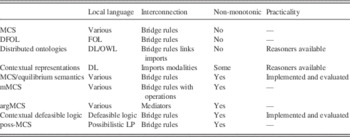
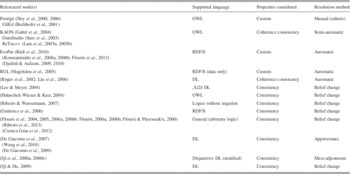
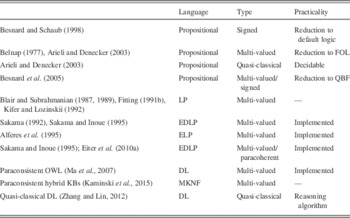
The works from the area of MCS and distributed knowledge representation are summarized in Table 6, where we compare them with respect to the local language of the contexts, type of interconnection between contexts, whether they are non-monotonic or not, and whether a practical implementation is known.
MCS: comparison of approaches

MCS=multi-context systems; DFOL=distributed first-order logic; FOL=first-order logic; DL=description logic; mMCS=managed multi-context systems.
3.3 Belief change
3.3.1 Classical belief change
Belief change is important in the context of conflict resolution, because it prevents inconsistencies (and therefore conflicts) from arising, by taking appropriate actions during changes, that is, during the process of adding into the KB the new knowledge that came from sensors or other agents. Thus, following the classification of Resendes et al. (Reference Resendes, Carreira and Santos2014), belief change falls under the ‘conflict avoidance’ type. A recent survey of the field (Fermé & Hansson, Reference Fermé and Hansson2011) shows that the problem is very challenging, both from the theoretical and the practical perspective.
In terms of the classification of conflict types appearing in Section 2.3, one could say that belief change can, in principle, deal with all types. However, belief change approaches are most suitable for contextual conflicts, as they were designed to deal with conflicts in agents’ models and beliefs. Some types of conflicts, namely goal and action conflicts, would require special variations or applications of belief change theories into languages that they were not in their original focus, for example, BDI models or action languages, whereas others (e.g. sensory input and domain and background knowledge conflicts) may require assumptions that are usually considered in subfields of belief change (rather than the mainstream), such as the assumptions considered in non-prioritized belief change. Further issues that restrict the applicability of belief change theories in AmI environments are provided in the analysis below.
As far as the theoretical perspective is concerned, the main challenges arise from the fact that it is often difficult, even in toy examples, to identify the appropriate result of a change operation, and several philosophical considerations need to be taken into account (such as the debate related to the adoption of coherence or the foundational viewpoint (Gärdenfors, Reference Gärdenfors1990), the use of belief sets or belief bases (Hansson, Reference Hansson1991), the differences between static-world and dynamic-world changes (Katsuno & Mendelzon, Reference Katsuno and Mendelzon1991), the semantics of minimal change (Makinson, Reference Makinson1987; Fuhrmann, Reference Fuhrmann1991; Hansson, Reference Hansson1996, and others). As already mentioned, most of the belief change field is focussing on understanding and resolving those challenges, that is, identifying the optimal way to resolve conflicts (logical inconsistencies) arising due to the introduction of new, conflicting information.
From the practical perspective, the main challenges are related to the fact that belief change algorithms are usually intractable. This is partly attributed to the types of languages considered (propositional and FOL) whose reasoning problems are intractable (at best). However, intractability should also be attributed to the inherent difficulty of the problem itself and the difficult challenges that it poses. Unfortunately, most of the works in belief change are not dealing with the practical aspects of the problem.
All the works related to belief change can be broadly classified in three different categories: postulation approaches, construction approaches, and explicit definition of concrete operators. These are defined in detail below:
∙ Postulation amounts to defining a set of formal requirements (postulates) that determine whether any given operator behaves in a ‘rational’ manner. Depending on the application at hand, the engineer can choose the exact semantics of the operator to use; as long as the postulates are satisfied, the operator is guaranteed to produce rational results and have certain desirable properties. Not surprisingly, there is no single set of postulates that works well for all cases (Flouris et al., Reference Flouris, Plexousakis and Antoniou2004; Ribeiro et al., Reference Ribeiro, Wassermann, Flouris and Antoniou2013), even though there are some proposals that are more widely accepted than others (Alchourrón et al., Reference Alchourrón, Gärdenfors and Makinson1985; Hansson, Reference Hansson1991).
∙ A set of postulates tells us the desired properties of a rational change operator, but gives us no clue as to how to construct one. The latter is the role of construction approaches, which essentially define a construction methodology for change operators satisfying a particular set of postulates. At the heart of such approaches is usually a representation theorem that proves that the constructed family coincides with the family of operators that satisfy the intended postulates.
∙ The explicit definition of concrete operators is a more direct approach to belief change, where a specific change operator is provided, often for use in a certain application or context. Such operators usually employ some kind of application-specific hard-coded or parameterized methodology to define the result, as this usually involves extra logical considerations. In addition, such operators are often shown to satisfy certain postulates or are based on some construction method.
The most seminal work on belief change is that of Alchourrón et al. (Reference Alchourrón, Gärdenfors and Makinson1985), a postulation attempt for the operators of contraction and revision. These postulates are often referred to as the AGM postulates by the initials of the authors. The AGM postulates formed the cornerstone of later approaches on belief change. Alchourrón et al. considered three operators: expansion, which is the trivial addition of information without regards to possible inconsistencies that could arise; revision, which deals with adding information consistently; and contraction, which deals with removing information.
These operators deal with the assumption of a static world, that is, in cases where a new observation, experiment, or other information forces us to change our conceptualization of the world; the world itself does not change, but our modelling of the world does. On the other hand, under the dynamic world assumption a belief change operation is caused by a change in the world itself; in this case, there is nothing wrong with our original conceptualization, but the world itself is evolving and we need to keep our conceptualization up-to-date. These two settings have different semantics, so another pair of operations (update and erasure), along with a set of postulates, were defined by Katsuno and Mendelzon (Reference Katsuno and Mendelzon1991). These are the dynamic counterparts of revision and contraction, respectively. Note that the dynamic setting is more relevant for the AmI domain.
The presence of postulates allowed to formally show a number of interesting results for these operators. In particular, the operations of contraction and revision were shown to be interdefinable in the presence of the postulates (Alchourrón et al., Reference Alchourrón, Gärdenfors and Makinson1985). Further results showed that update and erasure are also interdefinable, and revealed connections between the static-world operations and their dynamic-world counterparts (Katsuno & Mendelzon, Reference Katsuno and Mendelzon1991). In most contexts, including the AmI context, revision and update are the most relevant operators; however, due to contraction/erasure being simpler, and in the light of the above results, most works in the literature deal with contraction.
Obviously, the intuition behind the AGM postulates is not valid for all settings. The most controversial postulate in the AGM set was the postulate of recovery, which captures the informal principle of minimal change for contraction; this principle states that change operators should have the minimal possible effect (or ‘impact’) on the original KB. The recovery postulate was criticized as non-intuitive by several authors (Fuhrmann, Reference Fuhrmann1991; Hansson, Reference Hansson1996), and its status was the subject of several debates (e.g. Makinson, Reference Makinson1987). Alternative postulates were proposed, the most prominent one being the postulate of relevance (Hansson, Reference Hansson1991), which captured the intuition of minimality in a different way. Surprisingly, relevance, despite being proposed as a more intuitive alternative to recovery, was formally shown to be equivalent to recovery in the presence of the other postulates under the assumptions considered by the AGM work (Hansson, Reference Hansson1991).
All the above works (and most of the works related to belief change in general) are dealing with prioritized belief change, that is, they assume that the new information is unconditionally accepted (an assumption known as the principle of primacy of new information (Dalal, Reference Dalal1988) or the principle of success (Alchourrón et al., Reference Alchourrón, Gärdenfors and Makinson1985)), and this is also captured in one of the AGM postulates. The effects of dropping this assumption were studied in the subfield of non-prioritized belief change (Hansson, Reference Hansson1997; Hansson et al., Reference Hansson, Fermé, Cantwell and Falappa2001; Shakarian et al., Reference Shakarian, Simari and Falappa2014). Non-prioritized belief change is important for the AmI setting, where the cause of a conflict may be found in the input, for example, a faulty sensor reading (sensory input conflict), and not in the agent’s KB.
Most construction approaches are based on the AGM postulates, in the sense that they show that the resulting family of operators coincides with the family of operators satisfying the AGM postulates. One such construction was provided by Alchourrón et al. themselves in their original paper (Alchourrón et al., Reference Alchourrón, Gärdenfors and Makinson1985), but others were proposed as well (Alchourrón & Makinson, Reference Alchourrón and Makinson1985; Gärdenfors & Makinson, Reference Gärdenfors and Makinson1988; Grove, Reference Grove1988; Rott, Reference Rott1992; Hansson, Reference Hansson1994).
Works that explicitly propose a concrete belief change operator are rather scarce in the belief change literature. Unfortunately, this makes the application of belief revision methods to practical domains (like AmI) more difficult. Works that propose an explicit belief change operator are based on the idea of ‘closeness’ between (sets of) models: they view a KB as a set of models (i.e. those that the KB satisfies), and the result of a change application (e.g. contraction or revision) is the KB (i.e. set of models) that satisfies the required postulates, while being the ‘closest’ to the set of models satisfied by the original KB. The difference in these works stems from the different definition of ‘closeness’ between models. Two of the most important concrete operators that have been proposed are those of Dalal (Reference Dalal1988) and Chou and Winslett (Reference Chou and Winslett1994).
Another family of works, known as truth maintenance systems, provide explicit operators via a step-wise, formula-based approach, where a set of rules determines the facts to be added/removed from the KB in each step, towards reaching a KB satisfying a set of conditions (i.e. requirements that correspond to the considered postulates). Eventually, a state is reached where no more facts need to be added/removed to achieve the required properties, at which point the result is returned (Doyle, Reference Doyle1979).
Note that most of the above works are not touching practical issues such as efficient implementation of the related algorithms. This is an inherent problem of belief change methods, as they are dealing with logics which are intractable at best. However, most of the employed techniques are also problematic when used in less expressive logics, as they involve identifying minimal sets of formulae that cause conflicts and selecting one of them in an optimal manner, a process that is also (usually) intractable.
An additional drawback of belief change techniques, as related to their applicability in the AmI setting, is the fact that they do not deal with distributed, multi-agent settings, but consider scenarios where a single agent autonomously collects information from its environment and incorporates some information in its own KB, without regards to the existence (or not) of other cooperating (or competing) agents.
For these reasons, belief change techniques were only rarely considered in AmI settings so far, for example, by Bosse and Sharpanskykh (Reference Bosse and Sharpanskykh2010). Nevertheless, we argue that belief change techniques should be viewed (and used) for what they offer, namely a robust understanding of the process of change and evolution (which includes conflict resolution as an integral process) and a rich set of theoretical results that describe this process. Under this light, belief change literature could be re-used to understand and describe the intricacies of the conflict resolution process in AmI settings, but this would require revisiting existing belief change approaches under this prism.
3.3.2 Belief change in Semantic Web and other non-classical logics
The AGM approach, as well as most belief change approaches, are based on some relatively strong assumptions regarding the underlying language; this essentially limits their applicability to KBs represented using the so-called classical logics, which basically amount to propositional and FOL. For a complete list of these assumptions, as well as their effects on the supported languages, see the works of Alchourrón et al. (Reference Alchourrón, Gärdenfors and Makinson1985), Ribeiro et al. (Reference Ribeiro, Wassermann, Flouris and Antoniou2013), Creignou et al. (Reference Creignou, Papini, Pichler and Woltran2014), and Cuenca Grau et al. (Reference Cuenca Grau, Kharlamov and Zheleznyakov2012).
However, changes also happen in different settings, where other knowledge representation languages are used. For example, we could mention handling of changes in logic programming (Lloyd, Reference Lloyd1984), MCS (Giunchiglia, Reference Giunchiglia1993), Horn logic (Horn, Reference Horn1951), or data sets based on Semantic Web languages (such as DLs (Baader et al., Reference Baader, Calvanese, McGuinness, Nardi and Patel-Schneider2003) or OWL (OWL Working Group, 2009)).
For addressing dynamicity in logic programming, different approaches have been considered, some of which consider a non-standard set of postulates that is more suitable for the characteristics of logic programming and its different variants (Leite & Pereira, Reference Leite and Pereira1998; Alferes et al., Reference Alferes, Leite, Pereira, Przymusinska and Przymusinski2000; Leite, Reference Leite2002; Shakarian et al., Reference Shakarian, Simari and Falappa2014). In MCS, different variants have been proposed addressing changes in the knowledge itself (Gonçalves et al., Reference Gonçalves, Knorr and Leite2014b), or in the corresponding bridge rules (Gonçalves et al., Reference Gonçalves, Knorr and Leite2014a). The field of belief change for Horn KBs has been addressed in various papers (Delgrande, Reference Delgrande2008; Langlois et al., Reference Langlois, Sloan, Szörényi and Turán2008; Booth et al., Reference Booth, Meyer and Varzinczak2009, Reference Booth, Meyer, Varzinczak and Wassermann2011; Delgrande & Wassermann, Reference Delgrande and Wassermann2010; Zhuang & Pagnucco, Reference Zhuang and Pagnucco2010, Reference Zhuang and Pagnucco2012; Adaricheva et al., Reference Adaricheva, Sloan, Szörényi and Turán2011), where most approaches are again trying to adapt belief change ideas to apply for the reduced expressiveness of Horn KBs. A more general approach appears in Creignou et al. (Reference Creignou, Papini, Pichler and Woltran2014); in that work, the authors assume any given fragment of propositional logic where the models of the formulas are closed under a Boolean function (such as Horn logic), and propose a general approach for adapting standard operators (e.g. the revision operators presented in Dalal (Reference Dalal1988), Chou & Winslett (Reference Chou and Winslett1994)) in a way that the result of the revision remains in the fragment under consideration.
The case of changes in Semantic Web data sets and ontologies is much more relevant for this survey, as there is an increasing volume of works that employ Semantic Web languages to address AmI-related problems and/or exploit data in the linked data cloud for AmI applications (Celino et al., Reference Celino, Contessa, Corubolo, Dell’Aglio, Valle, Fumeo and Krüger2012; Emaldi et al., Reference Emaldi, Lazaro, Laiseca and Lopez-de Ipina2012; Lécué et al., Reference Lécué, Schumann and Sbodio2012; Daly et al., Reference Daly, Lécué and Bicer2013). For this reason, this subsection is mostly focussing on the dynamics of Semantic Web data sets. In that context, the problem has been addressed in the field of ontology evolution, where it has been argued that the adaptation of belief change methods and ideas in ontology evolution would provide several benefits (Flouris & Plexousakis, Reference Flouris and Plexousakis2006).
The idea of applying belief change theories in the ontological setting was introduced in a series of works that studied the feasibility and consequences of applying the AGM postulates in the ontological setting (Flouris et al., Reference Flouris, Plexousakis and Antoniou2004, Reference Flouris, Plexousakis and Antoniou2005, Reference Flouris, Huang, Pan, Plexousakis and Wache2006a; Flouris, Reference Flouris, Huang, Pan, Plexousakis and Wache2006a, Reference Flouris2006b; Flouris & Plexousakis, Reference Flouris and Plexousakis2006). Even though the AGM postulates can be easily reformulated to apply for ontological languages, it so happens that most DLs are not closed with respect to updates, in the sense that one can find examples where none of the ‘expected results’ (per the postulates) is expressible in the underlying DL.
Subsequent work by the same authors proposed new postulates, like optimal recovery (Flouris et al., Reference Flouris, Plexousakis and Antoniou2006b) or a generalized form of relevance (Ribeiro et al., Reference Ribeiro, Wassermann, Flouris and Antoniou2013), which share most of the good properties of the standard AGM postulates, while being more widely applicable. The latter (generalized relevance) was shown to be applicable for a large class of logics, which includes all compact logics (Ribeiro et al., Reference Ribeiro, Wassermann, Flouris and Antoniou2013). Given that most Semantic Web languages are compact, this work is very relevant for the AmI domain (and non-classical logics in general). Other works provided further insights on why certain Semantic Web languages cannot comply with belief change methods (that were developed for classical logics), resulting in the so-called inexpressibility results (Cuenca Grau et al., Reference Cuenca Grau, Kharlamov and Zheleznyakov2012). Other similar negative results appear in De Giacomo et al. (Reference De Giacomo, Lenzerini, Poggi and Rosati2007), Liu et al. (Reference Liu, Lutz, Miličić and Wolter2006), and Calvanese et al. (Reference Calvanese, Kharlamov, Nutt and Zheleznyakov2010).
These results motivated the search for ways to circumvent this problem. One approach used approximation techniques, that is, evolution approaches resulting to an ontology whose set of models is as close as possible to the desired one (De Giacomo et al., Reference De Giacomo, Lenzerini, Poggi and Rosati2007; Wang et al., Reference Wang, Wang and Topor2010; Qi et al., Reference Qi, Wang, Wang, Fu and Zhuang2015). Others chose to develop new DLs, which provably avoid such problems (Liu et al., Reference Liu, Lutz, Miličić and Wolter2006; De Giacomo et al., Reference De Giacomo, Lenzerini, Poggi and Rosati2009).
Some works adopt a more direct approach by proposing specific operators (inspired by belief change ideas), which are applicable for certain DLs. For example, Lee and Meyer (Reference Lee and Meyer2004) deal with ontologies represented in the  ${\cal A}{\cal L}{\cal U}$
DL fragment; OWL ontologies are handled by Halaschek-Wiener and Katz (Reference Halaschek-Wiener and Katz2006); Qi and Du (Reference Qi and Du2009) propose three different revision operators for DLs; and Ribeiro and Wassermann (Reference Ribeiro and Wassermann2007) deal in general with knowledge representation formalisms that do not support negation (making it applicable to Resource Description Framework Schema (RDF/S) ontologies, as well as ontologies represented using certain DL fragments).
The maxi-adjustment algorithm (Benferhat et al., Reference Benferhat, Kaci, Le Berre and Williams2004) is an approach for repairing inconsistencies in stratified propositional KBs in a minimal manner; the works by Qi et al. (Reference Qi, Liu and Bell2006a, Reference Qi, Liu and Bell2006b), based on this approach, develop evolution algorithms that guarantee the validity of the result in the context of stratified ontologies. Note, however, that this line of work assumes that ontologies are expressed using disjunctive DLs (Meyer et al., Reference Meyer, Lee and Booth2005), an extension of standard DLs that supports disjunction of axioms.
Gutierrez et al. (Reference Gutierrez, Hurtado and Vaisman2006) consider the operator of erasure for RDF/S ontologies. Due to the simplicity of the underlying language, the main problem considered by Gutierrez et al. (Reference Gutierrez, Hurtado and Vaisman2006) is how to prevent the removed triple from reappearing in the ontology as the result of RDF/S entailment. The approach of Gutierrez et al. (Reference Gutierrez, Hurtado and Vaisman2006) addresses this problem using a technique inspired by belief revision.
The resolution of conflicts in the Semantic Web languages is a critical task for the AmI setting, as more and more works are employing such languages to address AmI-related problems. In addition, the wealth of information existing in the Semantic Web (as linked open data) is increasingly being exploited in various AmI applications, especially in the context of smart cities (Celino et al., Reference Celino, Contessa, Corubolo, Dell’Aglio, Valle, Fumeo and Krüger2012; Emaldi et al., Reference Emaldi, Lazaro, Laiseca and Lopez-de Ipina2012; Lécué et al., Reference Lécué, Schumann and Sbodio2012; Daly et al., Reference Daly, Lécué and Bicer2013). As a result, resolving the conflicts that appear in the underlying data, represented using Semantic Web languages, will become increasingly important, and one possible approach in this direction is the application of belief change technologies in such languages (as advocated by the works presented in this subsection).
The works related to the generalization of belief change approaches to Semantic Web (or other) languages are mainly focussing on the feasibility of such an application, and are thus not concerned with the tractability properties of the corresponding approach. More work is needed in this respect to verify that these approaches can scale when applied to practical situations. Therefore, as with classical belief change approaches, one should view the works presented here as a means to understand the process of change and conflict resolution in representation languages that are useful in AmI settings.
3.4 Ontologies and belief change
3.4.1 Ontology evolution
Ontology evolution deals with the process of modifying an ontology in response to a certain change in the domain or its conceptualization (Flouris et al., Reference Flouris, Manakanatas, Kondylakis, Plexousakis and Antoniou2008), and its main objective is to prevent conflicts from appearing in the ontology during the evolution process (where the term ‘ontology’ refers to both the data and the schema). Thereby, ontology evolution falls under conflict avoidance with respect to the classification of conflicts given by Resendes et al. (Reference Resendes, Carreira and Santos2014). Given the popularity of ontology-based methods in the AmI field, ontology evolution is highly relevant for this survey, as it could be directly adapted for conflict resolution in smart spaces. Recent surveys on ontology evolution were done by Flouris et al. (Reference Flouris, Manakanatas, Kondylakis, Plexousakis and Antoniou2008) and Zablith et al. (Reference Zablith, Antoniou, d’Aquin, Flouris, Kondylakis, Motta, Plexousakis and Sabou2015).
As with belief change, all the conflict types appearing in Section 2.3 are relevant for ontology evolution. However, since many of the approaches are dealing with the data part of the ontology, they are only applicable to sensory input and contextual conflicts, but some of the more recent works are also dealing with the schema part, making them applicable for the other types of knowledge conflicts as well.
In ontology evolution, two different types of conflicts are considered, namely incoherency and inconsistency. Incoherency appears when a class is unsatisfiable (Flouris et al., Reference Flouris, Huang, Pan, Plexousakis and Wache2006a). Inconsistency is closer to the notion of logical inconsistency and appears when an ontology has no models (Flouris et al., Reference Flouris, Huang, Pan, Plexousakis and Wache2006a).
In early approaches to ontology evolution, the application of changes upon ontologies was performed manually by the editor/curator using ontology editors (e.g. Protégé (Noy et al., Reference Noy, Fergerson and Musen2000, Reference Noy, Chugh, Liu and Musen2006), OilEd (Bechhofer et al., Reference Bechhofer, Horrocks, Goble and Stevens2001)) and reasoners used to pinpoint conflicts. Later on, more specialized tools appeared, which can identify the changes to be performed to guarantee validity, possibly with some user interaction. User interaction may be direct, through an intuitive interface (Lam et al., Reference Lam, Sleeman and Vasconcelos2005b), or indirect through parameters, like evolution strategies (e.g. Stojanovic et al., Reference Stojanovic, Maedche, Motik and Stojanovic2002). Examples of such tools are KAON (Gabel et al., Reference Gabel, Sure and Voelker2004), OntoStudio (formerly OntoEdit, Sure et al., Reference Sure, Angele and Staab2003), and ReTax++ (Lam et al., Reference Lam, Sleeman and Vasconselos2005a, Reference Lam, Sleeman and Vasconcelos2005b). It is obvious that such approaches cannot be applied in the AmI setting, because it is assumed that agents should resolve conflicts (and inconsistencies/incoherencies) in an automated manner.
RUL (Magiridou et al., Reference Magiridou, Sahtouris, Christophides and Koubarakis2005) is a declarative language for data updating in RDF/S ontologies, which takes into account RDF/S semantics, as well as a fixed set of constraints on the resulting RDF/S ontology. For every change requested by the user, the language automatically checks whether the application of said change would cause any problems related to the above constraints (taking into account RDF/S semantics), and, if so, it automatically adds further changes (side-effects) to guarantee that the end result will have no conflicts.
In EvoPat (Rieß et al., Reference Rieß, Heino, Tramp and Auer2010), the identification of conflicts is performed using SPARQL queries; each conflict is associated with one or more SPARQL Update statements that resolve it. The same idea of identifying conflicting patterns (in various ways) and resolving them (in a user-defined way, or using some hard-coded, predetermined process) was employed in various works (e.g. Roger et al., Reference Roger, Simonet and Simonet2002; Liu et al., Reference Liu, Lutz, Miličić and Wolter2006; Djedidi & Aufaure, Reference Djedidi and Aufaure2009, Reference Djedidi and Aufaure2010).
A formal method for applying changes in the presence of custom validity rules was proposed by Konstantinidis et al. (Reference Konstantinidis, Flouris, Antoniou and Christophides2008a, Reference Konstantinidis, Flouris, Antoniou and Christophides2008b) and Flouris et al. (Reference Flouris, Konstantinidis, Antoniou and Christophides2013), where the incorporation of changes is performed automatically, taking care that the validity rules are not violated at the end of the process (see also the discussion on invalidity in Section 3.4.2).
Ontology evolution approaches are, by conception, meant to be applied in real settings where ontologies are used, and often the intended application area is the Semantic Web. As a result, scalability and tractability is generally an objective for these approaches, and sometimes applicability and formal rigour are sacrificed to achieve good tractability properties. The main drawback for many evolution approaches is the fact that they rely on manual or semi-automatic processes, which makes them unsuitable for the AmI setting. Therefore, further research efforts towards a fully automated ontology evolution process would be highly relevant for AmI.
Table 7 shows the works related to the evolution of ontologies and includes works presented in this section, as well as related works presented in Section 3.3.2. The referenced works have been grouped according to their properties. The second column in the table mentions the language(s) that the corresponding works consider (OWL, RDF/S, various types of DLs, or arbitrary logics). The third column specifies the properties that the corresponding method respects during evolution: some works support the definition of custom (provided by the user) constraints to be respected during evolution, whereas others focus on preserving coherence and/or consistency. Finally, the fourth column determines the resolution method, which can be manual, semi-automatic, or automatic; approximate; or inspired by/reusing other methodologies/fields, such as belief change approaches or the maxi-adjustment algorithm.
Summary of ontology evolution approaches

RDF/S=Resource Description Framework Schema; DL=description logic.
3.4.2 Ontology debugging
The field of ontology debugging addresses conflicts after they have already appeared in the KB (cf. Section 2.3). In contrast to ontology evolution, the reason that caused the conflict is unknown (or irrelevant) in this field, that is, it is not considered during the resolution of the conflict. Works in ontology debugging are not only dealing with inconsistencies and incoherencies, but also with invalidities, which are violations of one or more custom validity rules that express application- or domain-specific requirements on the underlying ontology (Roussakis et al., Reference Roussakis, Flouris and Christophides2011). For a related survey see the one by Flouris et al. (Reference Flouris, Manakanatas, Kondylakis, Plexousakis and Antoniou2008).
Several recent works have acknowledged the need for imposing custom, application-specific or user-defined requirements (in the form of validity rules) upon ontologies (Serfiotis et al., Reference Serfiotis, Koffina, Christophides and Tannen2005; Lausen et al., Reference Lausen, Meier and Schmidt2008; Motik et al., Reference Motik, Horrocks and Sattler2009; Tao et al., Reference Tao, Sirin, Bao and McGuinness2010). Thus, identifying and resolving cases where an ontology violates the imposed requirements, either after a reckless change or for other reasons, is paramount for the seamless functionality of the associated applications. Such validity rules are also important for smart spaces, where agents can employ commonsense background knowledge (in the form of rules) to improve their performance in supporting the user in the smart space, for context recognition, or to overrule unreasonable data (e.g. sensor readings); such rules should be respected by the agents’ KB at all times.
Validity rules are often encoded as part of the ontological schema (e.g. as OWL rules (Horrocks et al., Reference Horrocks, Patel-Schneider, Bechhofer and Tsarkov2005)); however, in some cases the ontological language is not rich enough to encode the necessary rules, so another ‘rule layer’ is considered on top of the ontology, encoded in some more expressive logical language. In both cases, an important invariant in ontology debugging is that the rules are considered fixed and do not change. Thus, in the former case (rules in the schema) ontology debugging only applies changes in the data part (instance level) of the ontology to resolve a conflict, whereas in the latter (rules in an external layer) it may affect both the schema and the data. Due to this invariant, ontology debugging is not suitable for resolving conflicts related to the rule level, which typically encodes (parts of) the domain and background knowledge.
Regardless of the type of conflicts considered (coherency, consistency, or custom validity rules), ontology debugging comprises of two different stages. The first, called diagnosis, refers to the identification of the conflicts, as well as the possible causes behind such conflicts; the second, called repair, refers to the determination of the best way to resolve the identified conflicts. Essentially, diagnosis provides the necessary information for repair to resolve the conflicts.
Standard reasoners are of little help for the task of diagnosis, because, even though they can identify the existence of a contradiction, they provide little support for resolving and eliminating it (cf. Section 2.3, the solvability dimension (Resendes et al., Reference Resendes, Carreira and Santos2014)). On the other hand, manual identification of the sources of a conflict (contradiction) is not feasible, especially in a smart space setting. Therefore, a more powerful approach is required in order to identify the part(s) of the ontology that led to the contradiction (Flouris et al., Reference Flouris, Manakanatas, Kondylakis, Plexousakis and Antoniou2008).
Repairing is even more difficult, because, in addition to identifying the causes of a conflict (diagnosis), one must determine the ‘optimal’ (under some measure of optimality) way to resolve such a conflict. This process is very similar to the process of identifying the ‘minimal change’ in the belief change/ontology evolution context, and often requires some kind of user feedback, as the choice involves non-logical considerations. Due to this fact, most of the works related to the field of ontology debugging actually deal with the problem of diagnosis only, leaving the problem of repairing to human experts. However, this is not enough for most AmI applications.
Many approaches use some tableau-based algorithm for diagnosis. One of the most influential approaches was given by Schlobach and Cornet (Reference Schlobach and Cornet2003), where a tableau-based algorithm for identifying the causes of an incoherency for a specific DL was presented. Similar tableaux-based algorithms for diagnosis were also proposed (Wang et al., Reference Wang, Horridge, Rector, Drummond and Seidenberg2005; Meyer et al., Reference Meyer, Lee, Booth and Pan2006; Plessers & Troyer, Reference Plessers and De Troyer2006). In all these techniques, diagnosis reports the axioms responsible for a conflict; a more fine-grained approach would be to identify the parts of the axioms that are responsible for the conflict (see the works of Kalyanpur et al. (Reference Kalyanpur, Parsia, Sirin and Cuenca Grau2006) and Lam et al. (Reference Lam, Sleeman, Pan and Vasconcelos2008) for such approaches).
As already mentioned, the process of repairing usually employs some kind of user interaction. In some cases (e.g. in ontology editors such as Protégé (Noy et al., Reference Noy, Fergerson and Musen2000, Reference Noy, Chugh, Liu and Musen2006), or in the case of reasoners, such as Stardog (http://stardog.com/), or QuOnto (Acciarri et al., Reference Acciarri, Calvanese, De Giacomo, Lembo, Lenzerini, Palmieri and Rosati2005)), this interaction is direct, that is, the user is presented with the conflicts (possibly with some support regarding the results of the diagnosis) and asked to manually resolve them. In the ORE tool (Lehmann & Bühmann, Reference Lehmann and Bühmann2010) a similar interactive approach is used, where the system presents the user with a set of suggestions for resolving the conflict. Such approaches are not useful in the AmI context, where agents need to decide how to resolve conflicts in an automated manner.
Automated approaches for repairing either employ ad hoc solutions for resolving conflicts (e.g. Masotti et al., Reference Masotti, Rosati and Ruzzi2011; Chortis & Flouris, Reference Chortis and Flouris2015), or take advantage of some kind of implicit user feedback (e.g. Meyer et al., Reference Meyer, Lee and Booth2005; Qi & Pan, Reference Qi and Pan2007; Roussakis et al., Reference Roussakis, Flouris and Christophides2011). For example, Qi and Pan (Reference Qi and Pan2007) and Meyer et al. (Reference Meyer, Lee and Booth2005) take into account external information related to the stratification of knowledge to identify the optimal resolution option, whereas Roussakis et al. (Reference Roussakis, Flouris and Christophides2011) relies on user feedback that is provided at input time via a set of user-defined ‘preferences’. These preferences act as high-level declarative specifications for the ‘ideal’ repair, based on which the system is able to automatically determine the optimal resolution of conflicts in order to produce a repair that is as close as possible to the ‘ideal’ one, as specified by the preferences. The same technique, using preferences based on metadata (such as trust or provenance) was applied in a real setting by Flouris et al. (Reference Flouris, Roussakis, Poveda-Villalon, Mendes and Fundulaki2012).
In an effort to achieve scalability, some works consider ontological languages with a limited expressiveness, such as  $DL{\minus}Lite_{{\cal A}} $
(a tractable DL). Examples include the works of Masotti et al. (Reference Masotti, Rosati and Ruzzi2011) and Chortis and Flouris (Reference Chortis and Flouris2015), both of which provide algorithms for automated repairing of
 $DL{\minus}Lite_{{\cal A}} $
KBs.
A rather original approach for repairing, proposed by Moguillansky et al. (Reference Moguillansky, Rotstein and Falappa2008), employs ideas from argumentation frameworks to identify and resolve conflicts. In particular, a conflict is defined as an ‘attack’ between arguments (which can be easily identified using logical reasoning), whereas repairing consists in determining accepted/rejected ontological axioms based on the standard acceptability semantics of argumentation frameworks. This approach can be used both for ontology evolution and for ontology debugging.
An alternative approach to repairing, originally proposed for relational databases, but also applied in the ontological setting, is consistent query answering (Arenas et al., Reference Arenas, Bertossi and Chomicki1999). Consistent query answering advocates the use of query rewriting techniques that allow ‘hiding’ the conflict from the user by providing consistent answers over a conflicting data set. This is an indirect approach to repairing, as the conflicts are allowed to persist in the data set, rather than being resolved.
In the context of relational databases, consistent query answering approaches have been proposed in various works dealing with different classes of constraints, mainly key constraints (e.g. Chomicki & Marcinkowski, Reference Chomicki and Marcinkowski2005; Grieco et al., Reference Grieco, Lembo, Rosati and Ruzzi2005; Haase et al., Reference Haase, van Harmelen, Huang, Stuckenschmidt and Sure2005; Wijsen, Reference Wijsen2009). Recently, there has also been some relevant research for KBs expressed in DLs, such as the works of Lembo et al. (Reference Lembo, Lenzerini, Rosati, Ruzzi and Savo2010, Reference Lembo, Lenzerini, Rosati, Ruzzi and Savo2011), which deal with different variants of inconsistency-tolerant semantics to reach a good compromise between expressive power of the semantics and computational complexity of inconsistency-tolerant query answering. In Martinez et al. (Reference Martinez, Ariel, Deagustini, Falappa and Simari2014) the Datalog± language (Cali et al., Reference Cali, Gottlob and Lukasiewicz2009) is extended with defeasible semantics. This essentially allows the incorporation of inconsistency-tolerant semantics for Datalog± ontologies.
Ontology debugging approaches are also concerned with the scalability properties of the proposed algorithms. In most of the works presented (both for repairing and for consistent query answering), one can find experimental results, as well as theoretical analyses of their computational complexity. Of course, the scalability of approaches for ontology debugging is greatly depending on the expressiveness of the considered underlying language and integrity constraints; when considering expressive DLs or expressive integrity constraints, the problem of diagnosis/repair is inherently intractable.
Ontology debugging is very relevant to the AmI setting where agents should make sure that their KBs satisfy the imposed validity rules at all times; this is especially relevant for recognizing the context and for reacting appropriately to its changes. For the same reason, ontology debugging is mostly useful for contextual conflicts, but also for the other types of conflicts which are identifiable through a set of rationality constraints (validity rules) based on the background knowledge about the domain.
Table 8 shows the works related to the problem of ontology debugging, grouped according to their properties. The table shows the supported language for the input KB per case, the type of problem considered (diagnosis, diagnosis, and repair, or consistent query answering), as well as some details on the methodology used (manual, semi-automatic, automatic, etc.).
Summary of ontology debugging approaches

RDF/S=Resource Description Framework Schema; DL=description logic.
3.5 Argumentation
Argumentation is nowadays a very popular conflict resolution approach. Its semantics can be adapted to both centralized and decentralized distributed settings and some solvers have already been implemented, making it relevant also for the AmI domain.
The research on argumentation covers a wide range of disciplines: from psychology, philosophy, and social sciences in general, to cognitive science and AI (Prakken & Vreeswijk, Reference Prakken and Vreeswijk2002; Besnard & Hunter, Reference Besnard and Hunter2008; Rahwan & Simari, Reference Rahwan and Simari2009). In the latter in particular, the focus of relevant research is devoted to formal models of argumentation. One of the main challenges is to design a formal system that enjoys desirable semantic properties and tractable computational complexity, while being theoretically easy to understand.
In this section, we overview existing approaches and discuss how argumentation can be suitable for dealing with conflicting information in AmI environment.
Formal models of argumentation can be divided according to whether they focus on a specific logical language and the structure of arguments, or not. Thus, we usually distinguish between abstract and structured argumentation (Prakken & Vreeswijk, Reference Prakken and Vreeswijk2002).
3.5.1 Abstract argumentation
The most influential work on abstract argumentation is by Dung (Reference Dung1995), where abstract argumentation frameworks (AFs) have been introduced. Abstract argumentation does not consider any structure of arguments or conditions defining the conflict (attack) between arguments.
An argument in abstract argumentation is an atomic term that is understood as anything that a rational agent can argue with/about and the attack between arguments is an arbitrary binary relation representing any inconsistency between these arguments. The advantages of this abstract approach are simple elegant semantics and generality. The main issue in abstract argumentation is to determine which arguments are accepted, which are rejected, and which are left undecided. Generally, if an argument a attacks an argument b then arguments a and b cannot be accepted together, and b is rejected whenever a is accepted.
Intuitively, an argumentation semantics prescribes a set of sets of arguments, called extensions, to each argumentation framework. Different semantics have been proposed by Dung (Reference Dung1995), based on the notion of admissibility, and several of them have been defined with different motivations in mind. An argument a is defended by a set of arguments S if S attacks all arguments attacking a. An extension is said to be admissible if it is conflict free (i.e. it does not contain any pair of attacking arguments) and defends all its members. For example, given the AF shown in Figure 3, the admissible extensions are  $\emptyset$
, {a}, {c}, {d}, {a, c}, and {a, d}.
Nodes denote arguments and arrows denote the attack relation (e.g. a attacks b)

In our example, not all admissible sets are relevant as an intended meaning of the argumentation framework. Various semantics based on admissibility have been proposed by Dung (Reference Dung1995), and others, with the aim to capture the notion of relevant extensions. For example, admissible extensions {c}, {d} do not provide intuitive meaning, since they do not contain all the arguments they defend (argument a namely). The semantics requiring such property is called complete. There are three complete extensions {a}, {a, c}, {a, d} for the given AF. As it can be seen, complete extensions can be included in one another resulting in two different semantics: skeptical and credulous. The skeptical semantics is the most careful one, where arguments cannot be defended by themselves. The extension corresponding to the skeptical semantics is called grounded and we can see that {a} is the grounded extension. On the other hand, there are two credulously accepted extensions {a, c}, {a, d} called preferred. The last semantics proposed by Dung (Reference Dung1995), is called stable and requires all arguments outside of an extension to be attacked by an argument in the extension. The only stable extension of our AF is {a, d}. Note, however, that stable semantics is not always defined—there are AFs with no stable extensions, such as the AF consisting of only one self-attacking argument. As sometimes this is unsatisfactory, a weaker semantics called semi-stable have been defined (Caminada et al., Reference Caminada, Carnielli and Dunne2012), which is universally defined and coincides with the stable semantics if stable extensions exist.
Given an arbitrary complete extension E, a justification status in, out, undec can be assigned to arguments (Caminada & Gabbay, Reference Caminada and Gabbay2009). Intuitively, an argument is:
∙ in if it is defended by E;
∙ out if it is attacked by E;
∙ undec otherwise.
Arguments that are in are included in the extension and are always accepted. Rejected arguments (status out) are attacked by the extension and, consequently, are never accepted. Finally, the acceptance of undecided arguments (status undec) is not determined, since they are attacked by undecided arguments only.
Argumentation can be described as a discussion between two players: a proponent trying to justify his claim and an opponent who counter-argues. The inclusion of an argument in some of the semantics described above can be decided procedurally by creating and evaluating such discussions, called argument games. Intuitively, a player wins a discussion if she has the last word.
Dung (Reference Dung1995) also studied the relationship of argumentation with other non-monotonic formalisms, such as default logic (Reiter, Reference Reiter1980), inductive defeasible system (Pollock, Reference Pollock1995), stable (Gelfond & Lifschitz, Reference Gelfond and Lifschitz1988), and well-founded (Van Gelder et al., Reference Van Gelder, Ross and Schlipf1988) semantics for logic programming. Furthermore, significant research has been conducted on studying proof theories (Modgil & Caminada, Reference Modgil and Caminada2009), and complexity analysis (Dunne & Wooldridge, Reference Dunne and Wooldridge2009) for the varying semantics. In Table 9 we summarize the complexity results of Dunne and Wooldridge (Reference Dunne and Wooldridge2009), for different abstract argumentation semantics and for both the credulous and the skeptical case (the trailing ‘-c’ means that the given problem is complete for the given class).
Complexity of abstract argumentation

Dunne and Wooldridge (Reference Dunne and Wooldridge2009).
Various extensions of abstract AFs have been studied. For instance, Dung’s AF only features the single relation attack between arguments—the attack relation. But when a 1 attacks a 2, and a 2 attacks a 3, then in a sense a 1 indirectly and implicitly supports a 3. However, as argued by Cayrol and Lagasquie-Schiex (Reference Cayrol and Lagasquie-Schiex2009), in certain application domains also explicit support relations between arguments may be present. To capture this, they present Bipolar AFs featuring both attack and support.
Abstract dialectical frameworks (ADF), a generalization of abstract AFs, were introduced by Brewka and Woltran (Reference Brewka and Woltran2010). Acceptance conditions are added to arguments in ADF. They allow to specify different types of interactions between arguments. Both attack and support are expressible in ADF. ADFs are characterized by Brewka and Woltran (Reference Brewka and Woltran2010) in terms of dependency graphs together with acceptance conditions.
Assumption-based frameworks (ABF) were introduced in Bondarenko et al. (Reference Bondarenko, Dung, Kowalski and Toni1997). ABFs understand non-monotonic reasoning as a deduction from assumptions. The structure of ABF is an abstraction of well-known non-monotonic formalisms and it was shown that many of them are instances of ABF. Argumentation semantics were applied to (sub)sets of assumptions. It was shown that traditional semantic characterizations of non-monotonic theories, for example, stable models of logic programs or extensions of default theories, correspond to argumentation semantic characterizations. Assumption-based argumentation (Dung et al., Reference Dung, Kowalski and Toni2009) has been later developed over the basis of ABF.
Other extensions of AFs include the addition of preferences (Amgoud & Vesic, Reference Amgoud and Vesic2011), or weighted attacks (Dunne et al., Reference Dunne, Hunter, McBurney, Parsons and Wooldridge2011; Coste-Marquis et al., Reference Coste-Marquis, Konieczny, Marquis and Ouali2012) into the context of abstract argumentation. This is often required by various application domains, and therefore it considerably extends the flexibility and applicability of abstract argumentation.
3.5.2 Structured argumentation
For certain application areas Dung’s approach may be too abstract to be directly used in practice. Take, for example, the legal domain, where problems can be naturally formalized in a logical language comprising facts, implications, or rules, etc. In abstract argumentation, the arguments are just atomic ‘letters’ but here the formulae are more complex and the notion of attack will depend on their structure and the semantics of the language.
The usual methodology in order to employ argumentation in such cases is to instantiate an AF (e.g. Dung’s AF). This is often done by defining the following four notions: a logical language, the structure of an argument, the attack relation, and the status of an argument (Prakken & Vreeswijk, Reference Prakken and Vreeswijk2002). Each one of these notions can be expressed by means of the previous. The status of an argument depends on the notion of arguments and the attack relation. The attack relation depends on the notion of arguments and the underlying logical language. The structure of arguments is defined with respect to the underlying logical language.
Once the instantiation is done, extensions may be computed treating the result as abstract AF (e.g. using one of Dung’s semantics). The semantics of the structured argumentation framework is then derived from the arguments present in the extensions.
As for the logical language, classical propositional language may be used (Besnard & Hunter, Reference Besnard and Hunter2001). More often the language of Defeasible Logic Programming (DeLP) (García & Simari, Reference García and Simari2004) or other logic programming or defeasible logic languages (Prakken & Sartor, Reference Prakken and Sartor1997; Governatori et al., Reference Governatori, Maher, Antoniou and Billington2004; Prakken, Reference Prakken2010) are considered. If the system uses a language of classical logic (Besnard & Hunter, Reference Besnard and Hunter2001) then we speak of deductive argumentation. On the other hand, the languages that feature both strict and defeasible rules are also called defeasible theories (Caminada & Amgoud, Reference Caminada and Amgoud2007).
The language of DeLP is particularly interesting, as its semantics is usually derived from argumentation frameworks. Two kinds of rules are distinguished in the language of DeLP: strict (→) and defeasible (⇒). While strict rules are used to represent some kind of deductive reasoning (i.e. whenever the preconditions hold, we accept the conclusion), defeasible rules formalize tentative, uncertain knowledge, where the validity of the precondition of a rule usually (but not necessary) implies the validity of the head of the rule. Thus, defeasible rules can be defeated, in light of some conflicting evidence.
Let us demonstrate this on a very simple example from the intelligent household domain. We want to encode the following rules: the heating is generally turned on before the user usually arrives (for simplicity, assume that arrival_time becomes true at the right moment). However, if based on the events scheduled in the user’s calendar we know that the user is having a meeting in a remote location (for simplicity, in_meeting is true in such case) then the first rule should be overridden and the heating is not turned on). We may encode such rules in a DeLP program, specifically the first two rules below:
 $$arrival\_time\Rightarrow heating\_on$$
 $$\,\quad in\_meeting\to\neg heating\_on$$
 $$\quad \ \,\, \qquad \qquad \to arrival \_time$$
 $$\qquad\ \ \,\, \qquad \to in\_meeting$$
Rule (3) is defeasible, it represents knowledge that is usually valid. Rule (4) is strict, it represents knowledge that is always valid. There are also two (strict) facts (5–6) representing that both arrival_time and in_meeting are true in the current instance. In DeLP, arguments are actually constructed through the chaining of the rules. For example, in the program above, we may construct the following arguments: A 1=[→arrival_time], A 2=[→in_meeting], A 3=[A 1⇒heaing_on], and A 4=[A 1, A 2→¬heating_on]. We can see that arguments have an inherently recursive structure. Based on conflicting conclusions of the arguments we can construct the attack relation: there will be a single attack, A 4 attacking A 3, intuitively due their conflicting conclusions and due to the fact that the strict rule overrides the defeasible one. Thus we have constructed an abstract AF and we can use any of the Dung’s semantics to compute the extensions and consequently also the meaning of the given DeLP. Taking, for example, the grounded semantics, there is a single extension E={A 1, A 2, A 4} (in fact, in this simple case the complete, preferred, and stable semantics give also the very same result). Finally, we derive the semantics of the DeLP program as the conclusions of the arguments present in the extension, that is, the set of literals {arrival_time, in_meeting, ¬heating_on}.
García and Simari (Reference García and Simari2004) deal with the language of defeasible logic. The semantics is determined by the set of literals, which is computed procedurally via an argument game. However, the argument game is not admissibility based and therefore it departs from Dung’s semantics. It is interesting to note though that an online solver has been implementedFootnote 1.
On the other hand, Prakken and Sartor (Reference Prakken and Sartor1997) directly instantiate Dung’s AF. They define an argument as a sequence of derivations and apply argumentation games to compute the grounded semantics. According to the authors, several non-standard design decisions were motivated by the legal domain.
A more recent work by Prakken (Reference Prakken2010) introduces an argumentation framework with structured arguments, called ASPIC+. It is basically a framework for structured argumentation rather than a particular system, where a particular language and argument ordering (preferences on arguments used in conflict resolutions) is left to be determined by the user. The online Java system TOAST that implements ASPIC+ has been developed by Snaith and Reed (Reference Snaith and Reed2012).
A different methodology was applied by Baláž et al. (Reference Baláž, Frtús and Homola2014a), where the status of an argument does not depend on attacks between arguments, but instead on attacks between conflict resolutions. Intuitively, a conflict resolution is a recipe describing how a conflict is resolved. Within the language containing defeasible rules and default literals a conflict may be resolved by either attacking a default literal or a defeasible rule.
Some approaches working with defeasible theories (Prakken & Sartor, Reference Prakken and Sartor1997; García & Simari, Reference García and Simari2004; Governatori et al., Reference Governatori, Maher, Antoniou and Billington2004) fail to meet the so called rationality postulates, as Caminada and Amgoud (Reference Caminada and Amgoud2007) pointed out. Specifically, properties known as indirect consistency (i.e. conclusions of extensions and conclusions of the intersection of all extensions must be consistent) and closure under strict rules (i.e. conclusions of extensions are closed under strict rules) are violated. Violation of these postulates can result into justification of absurdities or incomplete results, where some conclusions are missing.
While ASPIC+ (Prakken, Reference Prakken2010) satisfies the aforementioned postulates, it relies on transposition of rules. As pointed out by Baláž et al. (Reference Baláž, Frtús and Homola2014a), this is not in line with the intuitions of some non-monotonic rule-based formalisms, like logic programming, where the rules are treated as unidirectional. Hence, using such a framework with the aim to derive a semantics for DeLP may lead to some undesirable consequences. Baláž et al. (Reference Baláž, Frtús and Homola2014a, Reference Baláž, Frtús, Flouris, Homola and Sefránek2015) propose alternate approaches which avoid transposition and the associated problems while still satisfying the desired postulates. Both works extend ABF. Baláž et al. (Reference Baláž, Frtús, Flouris, Homola and Sefránek2015) extend ABF with a formal notion of conflict resolution strategy (CRS), with the idea that this component should not be fixed or limited to a small number of strategies, but rather an input parameter that can change from one application to another. It is showed that the postulates are satisfied for any given input CRS.
In a related work, Baláž et al. (Reference Baláž, Frtús, Homola, Sefránek and Flouris2014b) study the relationship between the argumentation semantics of DeLP (i.e. defeasible reasoning) and more traditional Generalized Logic Programs (GLP) (i.e. default reasoning). They show a transformation by which it is possible to compute a number of the argumentation semantics of DeLP in terms of a transformed GLP, relying on existing GLP semantics and solvers.
Table 10 summarizes several approaches and their properties with the focus on the underlying language (classical theory or some defeasible theory), the satisfaction of all relevant postulates, theoretical complexity, and whether there is a practical implementation of the given approach. If the reader is interested in further details regarding structured argumentation, we suggest to refer to the special issue of Argument & Computation dedicated to this topic (A&C, 2014).
Structured argumentation-based formalisms
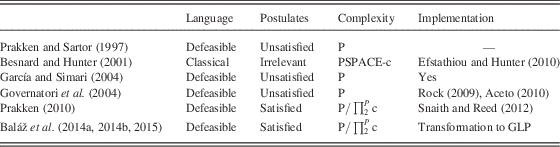
GLP=Generalized Logic Programs.
3.5.3 Applications in ambient intelligence
Argumentation has already been applied in AmI as a KR paradigm for dealing with both incomplete (partial) and inconsistent (contradictory) knowledge (Moraitis & Spanoudakis, Reference Moraitis and Spanoudakis2007; Bikakis & Antoniou, Reference Bikakis and Antoniou2010a; Muñoz et al., Reference Muñoz, Botía and Augusto2010, Reference Muñoz, Augusto, Villa and Botía2011; Muñoz Ortega et al., Reference Muñoz Ortega, Blaya, Clemente, Pérez and Skarmeta2010; Pajares Ferrando & Onaindia, Reference Pajares Ferrando and Onaindia2012). The approach presented by Muñoz et al. (Reference Muñoz, Botía and Augusto2010), for instance, uses argumentation techniques, in order to tailor services to the preferences of multiple users that share the same resources (i.e. a TV set). An internal dialogue is structured whenever conflicting preferences arise.
Notable are also the studies of Pajares Ferrando and Onaindia (Reference Pajares Ferrando and Onaindia2012), Bikakis and Antoniou (Reference Bikakis and Antoniou2010a), and Moraitis and Spanoudakis (Reference Moraitis and Spanoudakis2007) that respect the distributed nature of contextual information, where different entities possess locally a partial and tentative view of the actual world state. In these studies, defeasible rules are defined to represent uncertainty during context recognition, while techniques from the argumentation theory are applied in an attempt to resolve conflicts and reach a consensus about the actual context. Argumentation techniques are well tailored to resolving such types of contextual conflicts. In particular, Pajares Ferrando and Onaindia (Reference Pajares Ferrando and Onaindia2012) implemented and experimentally evaluated a DeLP multi-agent partial order planning framework. Their objective is to choose a plan respecting both the desire to minimize the computational overhead and to maximize the quality of the solution plan. Bikakis and Antoniou (Reference Bikakis and Antoniou2010a) aimed primarily at representation and reasoning issues. They defined a contextual defeasible logic (MCS instantiated with defeasible logic in each of the contexts), providing a decentralized platform and a set of distributed algorithms for query evaluation. To resolve all possible conflicts, a total preference ordering on the system contexts is assumed. Further, Bikakis and Antoniou (Reference Bikakis and Antoniou2011) study also partial preferences as well as different conflict resolution techniques (ambiguity blocking, ambiguity propagation, team defeat).
Although not directly applied in an AmI setting, an interesting application of argumentation techniques was proposed by Leite and Martins (Reference Leite and Martins2011) in the social Web area where the social voting determine arguments strength and consequently also the semantics of the system (valuation of all arguments).
As we may observe, applications in AmI will often require to consider certain levels of uncertainty, preference, or weights on arguments and attacks. Therefore, the studies extending argumentation frameworks with these capabilities (as discussed above) are quite relevant to this domain. But also other relevant directions, for example, investigating applications of argumentation for decision making (Amgoud & Prade, Reference Amgoud and Prade2009; Amgoud & Vesic, Reference Amgoud and Vesic2012) may be relevant.
To conclude, argumentation is a well-investigated field and one of its advantages over the other KR formalisms is its user-friendliness; argumentation-based semantics can be intuitively explained for both researchers in the KR domain and people not familiar with formal logic.
3.6 Belief change and argumentation
In the previous sections we noted that the area of belief change may amplify AmI systems with the ability to deal with newly acquired information and to accommodate changes in the current situation. Moreover, the field of argumentation has contributed works that enable agents with contrary beliefs or goals, to achieve agreement.
In this section, we survey some works proposed recently that investigate the interrelations between these two fields. This issue is gaining an increasing research attention: three recent events, Madeira Workshop on Belief Revision and Argumentation (Fermé et al., Reference Daly, Lécué and Bicer2013), Luxembourg Workshop on the Dynamics of Argumentation, Rules and Conditionals (DARC, 2012), and Dagstuhl Seminar on Belief Change and Argumentation in Multi-Agent Scenarios (Dix et al., Reference Dix, Hansson, Kern-Isberner and Simari2013) focussed on the relations of these fields.
Being a relatively novel research direction, it has mainly developed theoretical models so far. Even so, it can be considered relevant to the current survey as it may extend the state of the art in both fields of belief change and argumentation. In realistic multi-agent settings as is AmI, these two important capabilities of agents need to be combined to ensure that the changes in beliefs and goals are executed in a mutually compatible way.
3.6.1 General considerations on interrelation of argumentation and belief change
Standard argumentation theory deals with a set of arguments and an attack relation. However, when argumentation becomes dynamic by adding or removing new arguments/attacks, interesting problems arise. Belief change methods are helpful in such situations. On the other hand, a variety of argumentation semantics exists, representing different views on compatible sets of arguments, which set the basis for a more flexible approach to belief change.
In works by Baroni et al. (Reference Baroni, Giacomin and Simari2013) and Fermé et al. (Reference Fermé, Gabbay and Simari2013), argumentation and belief change are considered as reasoning process and are thoroughly compared for commonalities and differences. They conclude that both fields capture partially distinct but overlapping research problems, and identify a number of interesting open research questions, posed by their comparison (e.g. they note the rising importance of postulates in argumentation which were long considered central in belief change, and call for proposals of ‘reasoning benchmarks’ which could be used to evaluate different approaches in both fields).
According to Falappa et al. (Reference Falappa, Garca, Kern-Isberner and Simari2011), some argumentation formalisms can be used to define belief change operators, and belief change techniques have been used for modelling the dynamics of beliefs in such argumentation formalisms. Complementary roles of belief change and argumentation in understanding and modelling complex reasoning processes are stressed. The analysis of connections between argumentation and belief change within a complex reasoning process is based mainly on the ideas of Falappa et al. (Reference Falappa, Kern-Isberner and Simari2009). A complex reasoning process consists usually of the following basic reasoning steps: (1) reception of new information, (2) evaluation of it, (3) change of beliefs, and (4) inference. Basically, argumentation can be used mainly in step 2 and belief change can be used in step 3. However, a more detailed analysis shows that there are complex interrelations between argumentation and belief change within the different reasoning steps.
Rotstein et al. (Reference Rotstein, Moguillansky, Garca and Simari2010) propose dynamic argumentation framework, in which a new feature, evidence, is introduced. Evidence enables to distinguish valid arguments. Change is represented at different levels: change on evidence, on arguments, on conflicts, or on a preference relation.
The works surveyed so far study the general connections between belief change and argumentation. Next, more technical approaches follow, categorized in two directions: those, applying methods of belief change to argumentation and those, that use the argumentation viewpoint to introduce some new features about belief change.
3.6.2 Belief change applied to argumentation
Computational aspects of argumentation frameworks updating are studied by Liao et al. (Reference Liao, Jin and Koons2011). A modular approach to updates is implemented as follows: if an update operation is specified for a given argumentation framework, the updated argumentation framework is divided into three parts: arguments affected by the update, arguments unaffected, and conditioning arguments. The latter are unaffected arguments, which attack affected arguments.
The role of conditioning arguments is essential from the computational point of view. Computation of the status of arguments can be divided in two parts. The status of unaffected arguments is the same as in the original argumentation framework; it is not changed by the update. The status of affected arguments is computed in a conditioned argumentation framework, where attacks of conditioning arguments against affected arguments influence the status of the second. An algorithm implementing this method is described.
The next works focus on elementary change operations in AFs. They provide a view on the change of basic components of argumentation frameworks. Different basic change operations are considered.
Cayrol et al. (Reference Cayrol, de Saint-Cyr and Lagasquie-Schiex2010) defined four basic change operations on argumentation frameworks: adding an attack between arguments, removing an attack, adding an argument together with attacks involving it, and removing an argument together with the involved attacks. The case of adding one argument is studied in details. The main focus is on the impact that the changes cause on the structure of extensions and on the status of some particular arguments.
Boella et al. (Reference Boella, Kaci and van der Torre2009b) are focussed on impact from adding attack relations to the semantics of an AF. The work is continued in Boella et al. (Reference Boella, Kaci and van der Torre2009a), where the removal of attacks and arguments is studied. Only the case of a semantics with precisely one extension is considered. The main focus is on principles for the argumentation dynamics.
Coste-Marquis et al. (Reference Coste-Marquis, Konieczny, Mailly and Marquis2014) and Mailly (Reference Mailly2013) study revision of attack relations in argumentation as minimal change of the arguments status. The principle of minimal change plays an important role in the belief change research: it states that it is appropriate to preserve as much from the given knowledge set as possible. It is further shown how AGM belief revision postulates (Alchourrón et al., Reference Alchourrón, Gärdenfors and Makinson1985) can be translated to the case of argumentation systems.
A different approach was undertaken by Baumann and Brewka (Reference Baumann and Brewka2010, 2012, Reference Baumann and Brewka2013). So called enforcing problem was described and solved by Baumann and Brewka (Reference Baumann and Brewka2010). It poses the question whether it is possible, given a specific set of allowed operations, to modify a given argumentation framework  ${\cal A}$
into
 ${\cal A}'$
such that a desired set of arguments E is contained in some extension of the modified AF. Some conditions, under which enforcements are possible, were identified.
An important special case of the enforcing problem—how to reach that goal by a minimal change—was studied by Baumann (Reference Baumann2012). Given an argumentation framework A and a set of arguments E, the minimal number of additions or removals of attacks needed to reach an enforcement of E is called the characteristic of E. This number depends on the underlying semantics and the type of allowed modifications. It was shown that in certain cases there are local criteria, allowing to determine the characteristic. Local in the sense that the criteria are based on properties of the underlying argumentation framework and they enable to determine the characteristic in a finite number of steps.
The spectrum problem is studied by Baumann and Brewka (Reference Baumann and Brewka2013). Given a set of semantics and a modification type, the task is to determine for the pairs (σ, Φ), where σ is a semantics and Φ is a modification type, the set of all natural numbers which are characteristics of arbitrarily argumentation framework A and a set of arguments E. Surprisingly, this rather abstract problem yields interesting insights into relations of stable, semi-stable, and preferred semantics: it may be arbitrarily more difficult to enforce arguments using stable rather than semi-stable semantics, and also using semi-stable rather than preferred semantics.
Some researchers addressed problems connected to belief change in instantiated argumentation systems (structured argumentation frameworks with a subargument relation). Moguillansky et al. (Reference Moguillansky, Rotstein, Falappa, Garca and Simari2013) studied argumentation within DeLP. They defined prioritized argument revision operators for a given DeLP. The newly inserted argument becomes undefeated after the revision, hence its conclusion becomes warranted. In order to ensure this warrant, the program has to be changed in accordance with a minimal change principle.
3.6.3 Argumentation applied to belief change
A relatively smaller part of research is devoted to this aspect of interrelations between belief change and argumentation. As already mentioned, Moguillansky et al. (Reference Moguillansky, Rotstein and Falappa2008) employed argumentation to belief change in ontologies (particularly, ontology debugging). They build an argumentation framework, in which mutually inconsistent ontological axioms attack each other, and argumentation semantics thus determines possible repairs.
Liao (Reference Liao2013) constructed a layered (abstract) argumentation framework with subargument relation (AFwS). The semantics of AFwS provide a basis for the study of updating a layered AFwS and its properties. Among motivations for this research is a scenario as follows. An argumentation component is put before a belief revision component. Suppose that a new piece of (updating) information is given. The argumentation component serves as a filter: a set of accepted arguments (and therefore, their conclusions) is obtained by means of argumentation. As a consequence, only new information justified by the argumentation process inputs into the process of belief change. This can serve as a contribution to standard implementations of belief change.
Krümpelmann et al. (Reference Krümpelmann, Thimm, Falappa, Garca, Kern-Isberner and Simari2012) proposed a way how to distinguish whether new information should be accepted. Deductive argumentation (Besnard & Hunter, Reference Besnard and Hunter2001) is used to assess the value of new information. Hereby is obtained a revision operator which accepts new information only if the new information is justifiable.
3.6.4 Summary
Understanding the mutual interrelations between belief change and argumentation presents a contribution to both these fields, which we previously found relevant for AmI applications. In particular, it may contribute to develop more flexible argumentation frameworks, capable of updating, and thus reflecting the necessary changes that may be required by a change of a situation faced by a particular AmI application. On the other hand, it may contribute to the development of more flexible and more effective belief change operators implemented with argumentation procedures.
Given that this research direction is fairly new, most of the proposals are yet at the theoretical level, lacking reasoning support and implementations. We see this as a notable research challenge, especially for the KR community. Out of these theoretical works we would like to particularly highlight the notion of complex reasoning processes (Falappa et al., Reference Falappa, Kern-Isberner and Simari2009), which highlights interactions between related reasoning tasks of a rational agent and which is fairly in line with the reasoning cycle of agents in AmI systems (cf. Figure 1). The only work with more practical implications in this area is that of Liao et al. (Reference Liao, Jin and Koons2011). In Table 11 the overviewed approaches are classified with respect to whether they are an application of belief change in argumentation, or an application of argumentation to belief change (columns ‘BC of AF’ and ‘BC by AF’, respectively). Some of the approaches fall into both categories. The main focus of each work is also summarized.
Belief change and argumentation: comparison of works

3.7 Preferential reasoning
The notion of preferences is part of the everyday human reasoning. For example, in case of two laws giving conflicting instructions, the instructions given by the law with more ‘power’ precede. Another example is that doctors usually prefer non-invasive procedures over invasive ones.
Almost every KR formalism was extended to support preferences. However, the term ‘preferences’ is too abstract, and means slightly different things in different approaches. A common underlying intuition is that preferences select between multiple options. In this section, we focus our attention to logic programming, a widely used non-monotonic formalism. Logic programming uses if–then rules to express the knowledge about a domain. In contrast, for example, with production systems, which also use if–then rules, logic programming is purely declarative. Logic programming is very relevant for AmI, as it is a generic knowledge representation formalism, which was applied in many areas, for example, agent programming (Köster et al., Reference Köster, Novák, Mainzer and Fuhrmann2009), assisted living (Mileo et al., Reference Mileo, Merico and Bisiani2008a, Reference Mileo, Merico and Bisiani2008b), decision support (Nogueira et al., Reference Nogueira, Balduccini, Gelfond, Watson and Barry2001), diagnosis (Balduccini & Gelfond, Reference Balduccini and Gelfond2003), multi-agent planning (Son et al., Reference Son, Pontelli and Sakama2009), planning (Dimopoulos et al., Reference Dimopoulos, Nebel and Koehler1997), policies (Son & Lobo, Reference Son and Lobo2001). For additional references to applications we refer the reader to Schaub (Reference Schaub2011). For the survey of preference handling approaches in other non-monotonic formalisms we refer the reader to Delgrande et al. (Reference Delgrande, Schaub, Tompits and Wang2004b). In the context of logic programming, preferences are used in the following ways:
∙ Preferences on rules are used to control the applicability of rules. Having two conflicting rules that are both applicable, we use the preferred one.
∙ Preferences on literals are used to prefer answer sets containing some literals over answer sets containing others.
3.7.1 Preferences on rules
Consider we have a rule encoding that an agent should execute an action A, and a second rule encoding that the agent should not execute the action A. If the ‘if’ parts of both rules are satisfied, we have a conflict. This conflict can be resolved using preferences and preferential reasoning. Assuming that we prefer the second rule, for example, because it is based on more specific information, preferential reasoning makes the first rule inapplicable whenever the second one is applicable.
One of the standard semantics for logic programming is the answer set semantics (Gelfond & Lifschitz, Reference Gelfond and Lifschitz1991). It assigns to a logic program a collection of answer sets, each corresponding to an alternative set of beliefs an agent can accept. The so-called selective preference handling approaches studied, for example, by Brewka and Eiter (Reference Brewka and Eiter1999), Wang et al. (Reference Wang, Zhou and Lin2000), Delgrande et al. (Reference Delgrande, Schaub and Tompits2003), Zhang and Foo (Reference Zhang and Foo1997), Sakama and Inoue (Reference Sakama and Inoue2000), Šefránek (Reference Šefránek2008), and Šimko (Reference Šimko2013) select a subset of standard answer sets as preferred. They do so in order to stay compatible with the answer set semantics, instead of inventing a completely new semantics.
The approaches studied by Delgrande et al. (Reference Delgrande, Schaub and Tompits2003), Wang et al. (Reference Wang, Zhou and Lin2000), and Brewka and Eiter (Reference Brewka and Eiter1999)can be characterized as prescriptive (Delgrande et al., Reference Delgrande, Schaub, Tompits and Wang2004b). Preferences on rules are interpreted as the order, in which rules are applied. As a consequence, a less preferred rule cannot defeat a preferred rule. Each of the approaches puts slightly different conditions on the order in which rules have to be applied. Schaub and Wang (Reference Schaub and Wang2003) showed that the approaches form a hierarchy. The biggest difference between the approaches is that the one by Brewka and Eiter (Reference Brewka and Eiter1999) handles only direct conflicts, while those by Delgrande et al. (Reference Delgrande, Schaub and Tompits2003) and Wang et al. (Reference Wang, Zhou and Lin2000) handle indirect conflicts. Delgrande et al. (Reference Delgrande, Schaub and Tompits2003), Eiter et al. (Reference Eiter, Faber, Leone and Pfeifer2003a), Grell et al. (Reference Grell, Konczak and Schaub2005), and Asuncion and Zhang (Reference Asuncion and Zhang2009) deal with the issue of computing the semantics.
On the opposite side of prescriptive approaches lie descriptive (Delgrande et al., Reference Delgrande, Schaub, Tompits and Wang2004b) approaches. They do not see preferences as the order of application of rules, instead preferences are handled in a more declarative fashion. Zhang and Foo (Reference Zhang and Foo1997) view preference handling as a removal of less preferred rules. Sakama and Inoue (Reference Sakama and Inoue2000) define preference handling as a comparison of the rules that generate answer sets. Sefránek (Reference Šefránek2008) and Šefránek and Šimko (Reference Šefránek and Šimko2011, Reference Šefránek and Šimko2013) look at preference handling as a form of argumentation. Šimko (Reference Šimko2013) uses preferences to transform conflicting rules into rules defining exceptions: a preferred rule defines exception to a less preferred rule, but not the other way around.
The computational complexity of various decision problems for the aforementioned semantics has been studied. While for some semantics the decision problems are polynomially decidable, the decision problems for the remaining approaches are NP-complete, or lie on a higher level of the polynomial hierarchy. This is expressed by the values ‘P’ and ‘NP-c/worse’ in Table 12.
Preferential reasoning: preferences on rules

Besides the answer set semantics, the well-founded semantics is the second standard semantics for logic programs. It can be computed in polynomial time. Brewka (Reference Brewka1996), Schaub and Wang (Reference Schaub and Wang2002), and Wang et al. (Reference Wang, Zhou and Lin2000) defined preferred well-founded semantics for logic programs with preferences, which can also be computed in polynomial time.
Delgrande et al. (Reference Delgrande, Schaub and Tompits2003) and Zhang and Foo (Reference Zhang and Foo1997) consider dynamic preferences. Preferences not only change the semantics of logic programs, they are also subject of reasoning.
The main shortcoming of the literature in the field is that it provides little or no insight into which semantics to use in a domain at hand. The study of principles for preferential reasoning can help to fill this gap. Some development was done by Brewka and Eiter (Reference Brewka and Eiter1999), Šefránek (Reference Šefránek2008), and Šefránek and Šimko (Reference Šefránek and Šimko2013). Ideally, given an application domain, a suitable semantics is selected based on a subset of relevant principles. However, work in this direction is still needed. So far, existing principles do not sufficiently differentiate between the approaches and are unable to guide in selecting a right semantics for a task at hand.
Table 12 summarizes the approaches for reasoning with preferences on rules. The values in the column ‘practicality’ have the following meaning: (i) native—a solver with an algorithm specifically tailored for the approach is implemented, algorithm—there is an algorithm specifically tailored for the approach, but no implementation is available, reduction—reduction of an approach to logic programming without preferences exist.
3.7.2 Preferences on literals
If the answer set programming methodology is used, a problem is encoded into a program in a way that the answer sets of the program correspond to the solutions of the problem, for example, using answer set programming for planning, each answer set of the program corresponds to a valid plan. In some situations, having multiple solutions means a conflict, for example, as we can execute only one plan of actions, we need to select one of the valid plans. While there is always an option of selecting a random plan, we usually have additional preferences that need to be taken into account. For example, if it is possible we want to select a plan containing non-destructive actions. Preferences on literals and preferential reasoning allow us to express and reason with exactly this kind of preferences. Usually, an order on answer sets is computed based on the preferences, and maximal answer sets with respect to the order are selected.
Sakama and Inoue (Reference Sakama and Inoue2000) extend logic programs with a preference relation on literals. The relation is then transferred to a relation on answer sets and maximal answer sets are selected as preferred. In this way, preferred answer sets contain preferred literal. Sakama and Inoue also showed how preferences on literals can be applied to various forms of commonsense reasoning: minimal abduction, prioritized abduction, default reasoning, prioritized default reasoning, circumscription, and prioritized circumscription.
Brewka (Reference Brewka2002) introduces logic programs with ordered disjunction, in which preference of a literal is given by its position in a disjunction. The intuition behind the rule with ordered disjunction A×B←C is as follows. If C is contained in an answer set S, then A is in S if possible. But if it is not possible, then (at least) B is in S (Brewka, Reference Brewka2002). Brewka also shows how programs with ordered disjunction can be used in the configuration domain.
Brewka et al. (Reference Brewka, Niemelä and Truszczynski2003) consider answer set optimization programs consisting of two parts. The generating program produces answer sets representing solutions of a problem. The preference program expresses user preferences using the rules of the form A 1> ··· >A n←B 1, … , B m. A preference relation on the answer sets of the generating program is based on the degree in which the rules of the preference program are satisfied.
Complexity of various decision problems for the aforementioned semantics have been studied. The decision problems for all the reviewed approaches are NP-complete, or lie on a higher level of the polynomial hierarchy. This is expressed by the value ‘NP-c/worse’ in Table 13.
Preferential reasoning: preferences on literals

Table 13 summarizes the approaches for reasoning with preferences on rules. The column ‘practicality’ contains a unique value ‘algorithm’—there is an algorithm specifically tailored for the approach.
Related to the aforementioned approaches are CP-nets (Boutilier et al., Reference Boutilier, Brafman, Hoos and Poole1999, Reference Boutilier, Brafman, Domshlak, Hoos and Poole2004). They deal with the problem of inferring preferences on vectors of feature values given conditional preferences on feature values. This problem can be very naturally expressed by all the reviewed approaches for preferences on literals. The benefits of these logic programming-based approaches are (i) the availability of default negation allows to represent defeasible information, and (ii) while CP-nets are concerned only with one fixed space of vectors, the answer set optimization programs have a substantial flexibility in defining the space (Brewka et al., Reference Brewka, Niemelä and Truszczynski2003). The same holds also for the Sakama and Inoue’s preferences on literals, and logic programs with ordered disjunction. Brewka et al. (Reference Brewka, Niemelä and Truszczynski2003) also show that (i) the semantics of the CP-nets and the answer set optimization programs are different, mainly due to the different interpretations of the phrase ‘other things being equal’, which lies at the heart of both semantics, and preferences inferred by CP-nets can be approximated by preferences inferred by answer set optimization programs.
Closely related to logic programming are relational databases, which are also relevant for AmI. It has been explored how to extend relational databases with preferences on database rows, which are preferences on literals in logic programming terminology. For the survey of the approaches adding preferences to relational databases we refer the reader to Stefanidis et al. (Reference Stefanidis, Koutrika and Pitoura2011). Another interesting approach is Lukasiewicz et al. (Reference Lukasiewicz, Martinez and Simari2013). It extends Datalog+/−, a family of ontology languages, with preferences. Syntactically the preferences are on literals, similar to that of Brewka et al.’s answer set optimization programs, but the semantics follows the database approaches.
3.7.3 Summary
We have given an overview of the approaches for preference handling in logic programming. In this section we give some pointers how the approaches can be used in AmI.
In Section 2.3, five types of conflicts with respect to the knowledge-type dimension were introduced. With a suitable encoding, all conflicts seem to be solvable using preference handling. However, some might feel little unnatural, and probably other approach would be more appropriate.
Preferences on literals are especially suitable for handling conflicting goals and plans. If answer sets correspond to different goals/plans, we can select preferred ones. Preferences on literals can, for example, prefer literals representing non-destructive actions over destructive ones, or actions using less expensive resources. For the issue of incorporating domain-specific preferences in planning systems we refer the reader to Delgrande et al. (Reference Delgrande, Schaub and Tompits2004a).
Preferences on rules are usable for handling both conflicts inside an agent and conflicts between agents. One way at looking at preferences on rules is as a handy way of encoding exceptions between rules. When writing logic programs, we usually use general rules with exceptions. Preferences on rules allow us to express exceptions in a more easily and change tolerant way. Preferences on rules were already used in AmI. Bikakis and Antoniou (Reference Bikakis and Antoniou2010a) use trust level of agents to determine preferences on conflicting rules, although they use a different formalism than we discuss in this section.
Regarding the applicability of the approaches in real environments, algorithms and prototypical solvers exists. However, additional work needs to be done as no production ready solver for preferences exists.
3.8 Paraconsistent reasoning
One of the key features of AmI systems is the ability of agents operating within them to handle knowledge that originates from multiple sources, that may be incomplete, ambiguous, or even inconsistent. AmI systems are not supposed to halt or report errors when they face such problematic situations, instead they should be able to react to such situations appropriately, reconstructing, and reusing the consistent and reliable parts of the knowledge at hand. In this section, we give an overview of paraconsistent reasoning, the area of KR that comprehensively addresses the problem of reasoning with inconsistent knowledge.
Inconsistency is a challenge for classical logic-based systems, as in classical logic meaningful reasoning is not possible once inconsistency arises. Once an inconsistency occurs, the ex falso quodlibet principle is applied, and then all formulae are derived as consequences. Therefore, studies in the area of paraconsistent reasoning focus on identifying the sources of inconsistency in the knowledge and on developing methods to constrain and isolate inconsistent knowledge, as well as consequences that are only supported by inconsistent knowledge and there is no way to derive them from consistent premises. Consequently, also the goal of proposing repairs and removing the inconsistencies from the affected knowledge sources is often considered (Bertossi et al., Reference Bertossi, Hunter and Schaub2005).
Related goals are indeed addressed by a number of approaches that we already reviewed: belief revision, ontology repair, and argumentation. All these approaches aim at conflict resolution, or at least avoidance. In this section, we will focus on paraconsistent logics, which, instead, focus on derivation of sound conclusions from knowledge that may possibly contain inconsistencies, without necessarily attempting to repair the KB. Such approaches may be beneficial if an agent is acting upon the currently available knowledge, without the need to store it for later reuse.
3.8.1 Propositional case
Paraconsistent logic can be split into several types (Bertossi et al., Reference Bertossi, Hunter and Schaub2005): signed systems, which involve the renaming of literals and then restoring the non-conflicting part of the original theory by adding equivalences with their renamings; weakly negative logics and quasi-classical logic, which use a restricted subset of classical proof theory, or rely on natural deduction to apply the proof rules more carefully, in order not to avoid the explosive derivation of all conclusions; and multi-valued logics, which employ a dedicated semantics, in which the truth and the falsity of each statement are considered independently.
Besnard and Schaub (Reference Besnard and Schaub1998) define a paraconsistent semantics for propositional theories by a signed system, in which they represent each positive literal a as a + and each negative literal ¬a as a −. They employ default logic (Reiter, Reference Reiter1980), which allows to interpret a + as a and a − as ¬a, but only as long as the equivalence between a + and ¬a − can be assumed, that is as long as it does not cause the conflict between a + and a − to occur. Thus, a consistent part of the original theory is effectively reconstructed. Unlike some other paraconsistent logics, in the consistent case the entailment within such a system coincides with classical entailment. Decision procedures for default logics (e.g. Junker & Konolige, Reference Junker and Konolige1990; Ben-Eliyahu & Dechter, Reference Ben-Eliyahu and Dechter1991; Niemelä, Reference Niemelä1995) can be used, although even in propositional case default entailment is known to be complete with respect to the second level of the polynomial hierarchy (Gottlob, Reference Gottlob1992). This stream of development has largely gave way to (answer set) logic programming, with relevant paraconsistent extensions being discussed in Section 3.8.2.
Besnard and Hunter (Reference Besnard and Hunter1995) and Hunter (Reference Hunter2000b) proposed and developed quasi-classical logic, which they show to possess useful properties to reason with inconsistent knowledge. A number of interesting applications have been studied (e.g. Hunter, Reference Hunter2000a; Byrne and Hunter, Reference Byrne and Hunter2004), and the logic is known to be decidable (Hunter, Reference Hunter2000b); however, no implementations are known.
The four-valued propositional logic was developed by Belnap (Reference Belnap1977). This logic works independently with truth and falsity, yielding two new truth values of a statement (apart from the classical true and false), namely unknown and inconsistent. This approach was later generalized for more than four truth values (Ginsberg, Reference Ginsberg1988; Fitting, Reference Fitting1991a). Translations of this logic into FOL are known (Rodrigues & Russo, Reference Rodrigues and Russo1998), which enable the use of classical first-order provers, for example, VAMPIRE (Riazanov & Voronkov, Reference Riazanov and Voronkov2002), for reasoning.
Arieli and Denecker (Reference Arieli and Denecker2003) also investigate on paraconsistent propositional logic with multi-valued semantics and its translation to classical logic. In addition, they employ preferential reasoning (cf. Section 3.7), with the help of which they accept only models in which the inconsistent part of the KB is minimized. They provide a polynomial translation, yielding a first-order theory with an addition of circumscriptive second-order formulae (McCarthy, Reference McCarthy1980) representing the preferential criteria. This allows to use known translations of circumscriptive (Gustafsson, Reference Gustafsson1996; Ohlbach, Reference Ohlbach1996; Doherty et al., Reference Doherty, Lukaszewicz and Szalas1997), finally yielding a first-order theory and again enabling to resort to classical first-order provers.
Besnard et al. (Reference Besnard, Schaub, Tompits and Woltran2005) encode various paraconsistent systems (maximal-consistent subsets, signed systems, and multi-valued approaches) into quantified propositional logic (QBF). This enables their comparison, but also the use of QBF (e.g. Feldmann et al., Reference Feldmann, Monien and Schamberger2000; Giunchiglia et al., Reference Giunchiglia, Narizzano and Tacchella2001; Letz, Reference Letz2002) for reasoning. This paves the way towards more practical applications, given the recent increased interest and developments in the area of QBF solvers.
3.8.2 Paraconsistent logic programs
The logic programming paradigm has been successfully applied in agent-based applications. Development of paraconsistent semantics for logic programs has been driven by the ability of agents (and other systems) to deal with situations, in which inconsistent information simply cannot be ruled out. Real-time applications, and distributed systems with autonomous entities and decentralized information sources fall under this category.
Paraconsistent semantics for logic programming was largely built on top of multi-valued logics (Belnap, Reference Belnap1977; Ginsberg, Reference Ginsberg1988; Fitting, Reference Fitting1991a). First, such semantics for logic programs was developed by Blair and Subrahmanian (Reference Blair and Subrahmanian1987, Reference Blair and Subrahmanian1989); other early studies in this area include those of Fitting (Reference Fitting1991b) and Kifer and Lozinskii (Reference Kifer and Lozinskii1992). All use four-valued semantics and only work with classical negation.
Sakama (Reference Sakama1992) concentrates on extended logic programs (ELP, Gelfond & Lifschitz, Reference Gelfond and Lifschitz1991), which feature both classical and default negation, and possibly negation in the head. Sakama proposes a paraconsistent version of the well-founded semantics (Van Gelder et al., Reference Van Gelder, Ross and Schlipf1991) for this class of logic programs, where in order to distinguish between the classical and the default negation he resorts to the seven-valued semantics of Ginsberg (Reference Ginsberg1988).
This work is further extended by Sakama and Inoue (Reference Sakama and Inoue1995) who developed a paraconsistent stable-model semantics for extended disjunctive logic programs. This semantics was also implemented on top of the MGTP reasoner (Inoue et al., Reference Inoue, Koshimura and Hasegawa1992). Further evaluation of this semantics was done by Alcântara et al. (Reference Alcântara, Damásio and Pereira2004) and Odintsov and Pearce (Reference Odintsov and Pearce2005).
An alternative paraconsistent version of the well-founded semantics for ELP, dubbed WFSX p, was proposed by Alferes et al. (Reference Alferes, Damásio and Pereira1995). This semantics is based on the principles of coherence and introspection (Damásio & Pereira, Reference Damásio and Pereira1995), ensuring, for example, that the default negation of an atom (i.e. the weaker one) is always entailed from the classical negation of the same atom. A dedicated decision procedure called SLX, which uses a procedure similar to the standard PROLOG SLDNF procedure (Lloyd, Reference Lloyd1984) was described and implemented (Alferes et al., Reference Alferes, Damásio and Pereira1995). Further extensions of WFSX p towards other common logic programming semantics are proposed by Damásio and Pereira (Reference Damásio and Pereira1995).
In the same paper discussed above, Sakama and Inoue (Reference Sakama and Inoue1995) proposed also the so called semi-stable semantics, which has the feature that it is able to derive consequences in cases when the classical stable-model semantics has no model, but coincides with it in cases when it has models. Such an approach, dubbed paracoherent is not intended to draw conclusions from truly inconsistent KBs, but merely to overcome non-existence of models in some cases due to some rather technical reasons (e.g. cyclic dependencies). This line of work was further extended by Eiter et al. (Reference Eiter, Fink and Moura2010a) who provided a model-theoretic characterization, and proposed several improvements. They show the complexity of reasoning, which is one level up in the polynomial hierarchy when compared with the classical stable-model semantics. Finally, they briefly describe a prototype implementation.
3.8.3 Other paraconsistent logics
Given the popularity of Semantic Web ontology languages such as RDF and OWL 2 in AmI applications, their paraconsistent variants may contribute to the ability of AmI systems to deal with inconsistent information sources. Four-valued paraconsistent extensions of DLs (i.e. the family of logics which provides the formal semantics for OWL 2) were already investigated by Patel-Schneider (Reference Patel-Schneider1989) and Straccia (Reference Straccia1997). The approach of Ma et al. (Reference Ma, Hitzler and Lin2007) who propose  ${\cal A}{\cal L}{\cal C}4$
, a four-valued extension of
 ${\cal A}{\cal L}{\cal C}$
(cf. Baader et al., Reference Baader, Calvanese, McGuinness, Nardi and Patel-Schneider2003), is particularly interesting to us as paraconsistent reasoning is obtained with no additional computational cost by reduction to classical DL. In the follow-up work, Ma and Hitzler (Reference Ma and Hitzler2009)extended this approach towards the
 ${\cal S}{\cal R}{\cal O}{\cal I}{\cal Q}$
DL (Horrocks et al., Reference Horrocks, Kutz and Sattler2006), reaching the full expressivity of OWL 2. They also investigate the tractable fragments of OWL 2. Their approach has been implemented into the RaDON plug-in (Ji et al., Reference Ji, Haase, Qi, Hitzler and Stadtmüller2009) of the NeOn ontology engineering toolkit (Erdmann & Waterfeld, Reference Erdmann and Waterfeld2012).
A quasi-classical variant of DL was developed by Zhang and Lin (Reference Zhang and Lin2012). A tableau algorithm was also described by Zhang et al. (Reference Zhang, Xiao and Lin2009). These studies carry over the quasi-classical approach into the area of ontologies.
Hybrid KBs feature both ontologies and rules, a combination which is often required by practical applications, as ontologies carry the terminological knowledge, while rules are a more powerful tool for implementing reasoning. Paraconsistent reasoning has been investigated for each component separately, but recently also for hybrid KBs by Kaminski et al. (Reference Kaminski, Knorr and Leite2015) who have investigated two multi-valued semantics in this context.
Another approach to inconsistency is based on estimating the amount of contradicting knowledge within a given information source or between different information sources with suitable inconsistency measures (Hunter & Konieczny, Reference Hunter and Konieczny2005). Such an approach may provide agents with more fine-grained assessment of diverse information sources with respect to their degree of inconsistency in comparison with the current agent’s belief and/or their degree of self-contradiction. Some sources may be rejected straight ahead, while some, more valuable sources, may be integrated with the agent’s beliefs directly or by suitable conflict resolution methods. See the work of Hunter and Konieczny (Reference Hunter and Konieczny2005) for an overview of this area.
3.8.4 Applicability of paraconsistent reasoning
Paraconsistent reasoning has found applications in databases (Arieli et al., Reference Arieli, Denecker, Van Nuffelen and Bruynooghe2004), including medical KBs (da Costa & Subrahmanian, Reference da Costa and Subrahmanian1989), and its applications in spatial databases were also conceived (Rodríguez, Reference Rodríguez2005).
Paraconsistent reasoning has been further applied for inconsistency management in areas, such as software engineering, and on problems, such as combining inconsistent specifications (Hunter & Nuseibeh, Reference Hunter and Nuseibeh1998) and requirements (Ernst et al., Reference Ernst, Borgida, Mylopoulos and Jureta2012).
Quasi-classical logic has been applied in dealing with inconsistency in structured text excerpts (Hunter, Reference Hunter2000a), for example, structured news reports (Byrne & Hunter, Reference Byrne and Hunter2004). A similar approach may be valuable in AmI applications with the need to process textual inputs from multiple users. An interesting observation in these works is that the presence of inconsistency need not necessarily be an indicator of error; for instance, if multiple news reports are found inconsistent with the background knowledge, then this may be an indicator of interesting new developments in the domain, that have to be accommodated and processed (Byrne & Hunter, Reference Byrne and Hunter2004).
We are not aware of any direct application or case study of paraconsistent reasoning in AmI. Nevertheless, these approaches can be applied to any type of conflict resolution, most notably sensory input conflicts, and also for resolving conflicts between new observations and background knowledge (Byrne & Hunter, Reference Byrne and Hunter2004; Ernst et al., Reference Ernst, Borgida, Mylopoulos and Jureta2012).
As already noted above, current AmI applications already make use of ontologies. If inconsistency handling of ontological data becomes needed, paraconsistent OWL (Ma et al., Reference Ma, Hitzler and Lin2007; Ma and Hitzler, Reference Ma and Hitzler2009) may become handy (or alternatively some of the ontology debugging approaches surveyed in Section 3.4.2 may be applied).
While all the approaches surveyed in previous sections mostly aim at removing conflicts and repairing the KB, paraconsistent reasoning shifts the point of view into simply being able to reason also with inconsistent knowledge, without necessarily requiring some kind of repair. This point of view may be useful in certain AmI scenarios, where agents need to react based on their inputs while maintaining the KB is of secondary interest. Many of the logics which we surveyed have favourable (polynomial) reasoning complexity (Coste-Marquis & Marquis, Reference Coste-Marquis and Marquis2005). Many of the paraconsistent logic programming extensions have developed into experimental implementations, and some of them are also known to be tractable (e.g. WFSX p, Alferes et al., Reference Alferes, Damásio and Pereira2003). Further research may be however needed in order to make them effective enough for real-time AmI applications.
3.8.5 Summary
In this section we have discussed approaches that allow to reason also with inconsistent KBs, evaluate them and draw conclusions from sound parts of the knowledge. Most of them are summarized and compared in Table 14 where we distinguish them based on the underlying representation language and different type of paraconsistent reasoning. We also point out practical results achieved in this area. Measures of inconsistency (cf. Hunter & Konieczny, Reference Hunter and Konieczny2005) are not included as the main focus in this area is different from the rest of the surveyed works, as explained above.
Paraconsistent reasoning: comparison of approaches

FOL=first-order logic; QBF=quantified propositional logic; EDLP=extended disjunctive logic programs; ELP=extended logic programs; DL=description logic; KB=knowledge base.
4 Summary
In this work, we surveyed a number of research areas in KR that we believe to be relevant to the problem of conflict resolution, that, as we noted, is crucial in AmI, and in many other knowledge-intensive application scenarios.
The body of research concentrating on modelling context within AmI, also addresses conflict resolution to a certain extent. The main attention is given to resolving conflicts within context, originating, for instance, from faulty or incompatible sensor readings, or as a result of situation change. This part is well elaborated in the literature, and it is also efficiently handled, for example, by resorting to hybrid techniques integrating KR and machine-learning methods. The field, however, relies mostly on centralized context models, which may not be sufficient in real-world AmI environments, as we discussed above. Therefore, this branch may largely benefit from cross-fertilization with the other KR branches discussed in the paper.
MCS and related approaches allow to represent heterogeneous and interconnected systems composed of KBs, each of which may be modelled in different language and from a different contextual perspective (therefore they are called contexts). As such, MCS allow to resolve conflicts that may arise between the contexts, although mostly in a localized fashion, that is, each context is capable to resolve the conflicts locally and independently from the other contexts. Some recent efforts may help to make conflict resolution more shared (Brewka & Eiter, Reference Brewka and Eiter2009) and its understanding global (Eiter et al., Reference Eiter, Fink, Schüller and Weinzierl2010b). In this respect, cross-fertilization between MCS and argumentation seems to be a promising approach (Brewka & Eiter, Reference Brewka and Eiter2009; Bikakis & Antoniou, Reference Bikakis and Antoniou2010a). Some studies related to MCS also considered resolving, or, at least isolating conflicts inside contexts; this can be seen as some limited way how to handle background or domain knowledge conflicts. The research in MCS has been advanced to the point, where multiple implementations and evaluations are known and even for experimental applications in AmI settings (Bikakis & Antoniou, Reference Bikakis and Antoniou2010a).
Conflict resolution has long been studied in the area of belief revision, where KBs are combined with newer, or more important knowledge, end conflicts need to be resolved in order to yield a consistent result. As such, belief change methodologies mostly fall under conflict avoidance, as they prevent the conflict from creeping into the KB. The main body of research in this filed focusses mostly on foundational research, trying to characterize suitable conflict resolution strategies with postulates and devising revision operators, that behave accordingly. The area may contribute to AmI as a foundation for suitable conflict resolution strategies to be applied in AmI systems. More practical approach is undertaken in ontology evolution and ontology debugging fields, where real algorithmic support, feasibility, and effectiveness are considered relevant. Nevertheless, further research will be needed before the results can be applicable in real time, as most of the current methodologies, especially in ontology evolution, are semi-automatic and require human intervention. In ontology debugging several approaches are known, which go in the fully automated direction (Meyer et al., Reference Meyer, Lee and Booth2005; Qi & Pan, Reference Qi and Pan2007; Roussakis et al., Reference Roussakis, Flouris and Christophides2011).
Argumentation is a representation technique that formalizes notions of argument, attack, and support, and enables to resolve conflicts by identifying sets of arguments that are consistent, and defending the set from external attacks. The notion of argument is rather abstract, which enables to resolve conflict between beliefs, goals, actions, etc. The increasing popularity of argumentation is given by its rich and flexible formalism with a family of semantics with well-established theoretical properties, some of which also enjoy feasible complexity results. It was applied on a number of practical problems, and notably, also in AmI (Moraitis & Spanoudakis, Reference Moraitis and Spanoudakis2007; Bikakis & Antoniou, Reference Bikakis and Antoniou2010a; Pajares Ferrando & Onaindia, Reference Pajares Ferrando and Onaindia2012), especially as a decision-making technique for autonomous agents in the presence of conflicting information.
The position of argumentation as essential and effective conflict resolution technique is further assured by the fact that researchers from the other fields try to integrate argumentation into their approaches when conflicts need to be resolved. We noted such attempts in MCS (Brewka & Eiter, Reference Brewka and Eiter2009) and ontology debugging (Moguillansky et al., Reference Moguillansky, Rotstein and Falappa2008), but the interchange between argumentation and belief change seems to be especially fruitful, as we documented in Section 3.6. This line of research is only very recent, and mostly theoretical results were yet achieved, though we believe its possible future impact on practical applications, including AmI, is quite likely.
Preferences are sometimes combined with different reasoning formalisms, in order to select a rule to be applied in a given situation from a set of possibly conflicting rules, or in order to distinguish between multiple possible derivations. The former case can be seen as conflict avoiding, while the latter case is a more delicate indirect conflict resolution method, as it allows to choose from the set of all possible solutions, some of them possibly conflicting, based on predefined preferences. As we have argued, such a strategy may be useful in resolving conflicts in goals and actions, if preferences are paired with a formalism that can capture planning such as, for instance, logic programming. Algorithms for reasoning with preferences were devised, and prototypical reasoners were implemented. Preferential reasoning was also already applied in AmI (Bikakis & Antoniou, Reference Bikakis and Antoniou2010a).
While most of the above approaches work by removing or avoiding conflicts, paraconsistent reasoning takes a slightly different direction and concentrates on identifying and isolating the inconsistent parts of the KB and carefully drawing conclusions only from the consistent knowledge. In this area, different approaches were theoretically studied, however, especially paraconsistent logic programming and paraconsistent ontologies were developed also in practice and prototypical reasoners have been implemented. We believe that they can be potentially useful in AmI, especially when the AmI environments are to react to the current situation (which may feature inconsistencies) without the need to necessarily store all the current information for future processing.
A summary of our observations is presented in Table 15, where we compare the surveyed areas with respect to the different types of conflicts they are typically suited to resolve depending on which type of knowledge they occur, and how the conflicts are most typically resolved in each given area. Then, in the next two columns we highlight whether the area has a strong theoretical focus, but also whether the development has led into computationally feasible algorithms or implementations. In the final column, we indicate whether some applications in AmI (or at least some other relevant areas) are known. The details can be found in each respective subsection of Section 3.
Summary of conflict resolution fields

AmI=ambient intelligence.
We conclude that indeed KR has been fruitful in addressing the problem of conflict resolution from many different points of view and with diverse applications in different use cases. The different approaches to conflict resolution are theoretically very well developed, in the sense that the semantics is established and its properties are investigated. But, as we saw, effective (in the sense of polynomial) algorithms for number of approaches were also developed, and some of them were implemented and experimentally evaluated. Finally, we have also pointed out a number of works that are already trying to apply KR methods in AmI (Moraitis & Spanoudakis, Reference Moraitis and Spanoudakis2007; Mileo et al., Reference Mileo, Merico and Bisiani2008b; Bikakis & Antoniou, Reference Bikakis and Antoniou2010a; Muñoz et al., Reference Muñoz, Botía and Augusto2010; Muñoz Ortega et al., Reference Muñoz Ortega, Blaya, Clemente, Pérez and Skarmeta2010; Pajares Ferrando & Onaindia, Reference Pajares Ferrando and Onaindia2012).
Acknowledgements
The authors would like to thank Antonis Bikakis, Luciano Serafini, and Stefan Woltran who provided some very useful feedback on the preliminary version of this survey. The authors would also like to thank Júlia Pukancová and Daniel Skalický for help with proofreading. This work resulted from the Slovak–Greek bilateral project ‘Multi-context Reasoning in Heterogeneous Environments’, registered on the Slovak side under no. SK-GR-0070-11 with the APVV agency and co-financed by the Greek General Secretariat of Science and Technology and the European Union. It was further partially supported from the Slovak national VEGA project no. 1/1333/12 and also from the EU FP7 project DIACHRON (ICT-2011.4.3, #601043).