





1. Introduction
A central question with respect to the relationship between sadness, fear and anger concerns the structure of conceptual space. Opposing the position that emotions are separate, discrete entities, we alternatively support the viewpoint that the conceptual structure of emotions comprises clusters of emotions that have a closer or more distant proximity within conceptual space. For example, we have shown that the British English concept hurt is characterised more by anger cluster emotion concepts, while sadness cluster emotion concepts are relatively more salient in the Polish equivalent of hurt, poczucie krzywdy (Lewandowska-Tomaszczyk & Wilson, Reference Lewandowska-Tomaszczyk, Wilson, Wolf, Latić and Finzel2021). With respect to this cluster perspective, we support the proposal advanced by Berenbaum et al. (Reference Berenbaum, Fujita and Pfennig1995) regarding the need to determine both differences and similarities in associations between negative emotions. In findings directly relevant to the focus of the present study, they showed covariation as well as differences between fear, sadness and anger.
Anger, sadness and fear are three distinct but fundamental emotions, each characterised by specific triggers, responses and psychological features. Anger is typically evoked when an individual’s goal is blocked by an obstacle that must be overcome (Karnaze & Levine, Reference Karnaze and Levine2018), with its intensity increasing when the obstruction is perceived as intentional, unjustified, preventable or violating one’s values, expectations, promises or rights (Levine, Reference Levine1995). Berkowitz (Reference Berkowitz1990) observes that anger often emerges from an undifferentiated state of negative affect, while Harmon-Jones et al. (Reference Harmon-Jones, Sigelman, Bohlig and Harmon-Jones2003) emphasise its prosocial potential, particularly when it arises to defend moral principles. Furthermore, anger is commonly associated with feelings of hot-headedness, frustration and irritation (Özkarar-Gradwohl et al., Reference Özkarar-Gradwohl, Narita, Montag, Panksepp, Davis, Yama and Scherler2020).
In contrast, sadness arises primarily from the inability to achieve or maintain a valued aim or state, often triggered by loss, separation, social rejection or failure (Carnelley et al., Reference Carnelley, Wortman, Bolger and Burke2006; Sbarra, Reference Sbarra2006). Its intensity is linked to perceptions of low power and helplessness following unsuccessful attempts to obtain a desired reward (Siemer et al., Reference Siemer, Mauss and Gross2007), and it is often accompanied by crying, longing for absent loved ones and reflections on previous relationships (Özkarar-Gradwohl et al., Reference Özkarar-Gradwohl, Narita, Montag, Panksepp, Davis, Yama and Scherler2020).
Fear, unlike anger and sadness, functions primarily as a survival mechanism when facing physical threats (Beck et al., Reference Beck, Emery and Greenberg2005; Öhman, Reference Öhman, Lewis, Haviland-Jones and Barrett2008), and is often marked by worry, tension, insomnia, indecision and rumination (Özkarar-Gradwohl et al., Reference Özkarar-Gradwohl, Narita, Montag, Panksepp, Davis, Yama and Scherler2020). Fear responses fall into three categories: fight, flight and fright. The fight response, first coined by Cannon (Reference Cannon1929), involves active confrontation of a threat, allowing individuals to feel powerful and in control (Eilam, Reference Eilam2005; LeDoux & Gorman, Reference LeDoux and Gorman2001). In contrast, the fright response is an involuntary reaction characterised by motor inhibition, immobility and heightened environmental awareness, serving to reduce the likelihood of further attack (Fiszman et al., Reference Fiszman, Mendlowicz, Marques-Portella, Volchan, Coutinho, Souza, Rocha, Lima, Salomão, Mari and Figueira2008; Monassi et al., Reference Monassi, Leite-Panissi and Menescal-de-Oliveira1999) and often results in withdrawal, avoidance and feelings of helplessness (LeDoux & Gorman, Reference LeDoux and Gorman2001). The flight response, by comparison, involves escaping from danger, as frequently seen in responses to natural disasters such as earthquakes (Misslin, Reference Misslin2003).
Given the focus on the conceptual proximity between sadness, fear and anger, it is essential to explore their possible interrelationships. Research suggests that the frequency of anger experiences may influence the experience of both fear and sadness (Berenbaum et al., Reference Berenbaum, Fujita and Pfennig1995). Anger and sadness appear linked through shared attributes such as stable and global attributions (Abramson et al., Reference Abramson, Metalsky and Alloy1989), and their association is further supported by evidence linking anger with depression (Berenbaum, Reference Berenbaum1992) and findings that suppressed anger is related to sadness (Vansteelandt & Van Mechelen, Reference Vansteelandt and Van Mechelen2006). Moreover, anger and depression can mutually reinforce each other (Dutton & Karakanta, Reference Dutton and Karakanta2013), although neurological evidence indicates that sadness may suppress anger (Zhan et al., Reference Zhan, Ren, Sun, Fan, Liu and Luo2018). Sadness and fear are connected through heightened threat perception and lack of control (Lerner & Keltner, Reference Lerner and Keltner2001) and fear of sadness itself may arise from concerns over its effects (Taylor & Rachman, Reference Taylor and Rachman1991). Fear and anger also overlap, particularly in risk-avoidant contexts (Javela et al., Reference Javela, Mercadillo and Ramírez2008), and anger has been shown to intensify following fear induction (Zhan et al., Reference Zhan, Ren, Fan and Luo2015). Overall, these studies point to the complex and dynamic interconnections between sadness, fear and anger. Empirical findings that are relevant to our aims, hypotheses and contrastive analyses of the British English cluster concepts of sadness, fear and anger versus the equivalent, respective Polish cluster concepts of smutek, strach, złość ‘anger 1’ and gniew ‘anger 2’ are discussed in Section 1.3.
1.1. Culture
Culture is a central feature of our study as the overarching aim is to compare conceptualisations of the relationships between sadness, fear and anger in British English and Polish. Hofstede (Reference Hofstede1980) proposed that cultural differences can be understood on the basis of a number of cultural dimensions. The two that are relevant to our study are individualism-collectivism (IDV) and the power distance index (PDI), with the former offering a strong theoretical framework for a plethora of cross-cultural emotions studies including emotional arousal level (Lim, Reference Lim2016), concerns, appraisals and social sharing (Mesquita, Reference Mesquita2001) and pride and luck appraisals (Imada & Ellsworth, Reference Imada and Ellsworth2011). PDI also provides a sound theoretical basis for many studies in this field that focus on, for example, shame and guilt (Velayutham & Perera, Reference Velayutham and Perera2004), empathic emotions (Sadri et al., Reference Sadri, Weber and Gentry2011) and fear of authority (Dai et al., Reference Dai, Li, Xie and Deng2022).
PDI corresponds to the extent of acceptance of unequal power distribution in a society by the less powerful members. A higher PDI value indicates acceptance of inequality in society, while a lower one indicates degrees of unacceptance by society members. PDI has a direct relevance to our study as Poland, with a score of 68, is more of a hierarchical society than Britain, which has a score of 35 (The Culture Factor Group, n.d.).
The large difference between Britain and Poland on the IDV scale also means that this cultural dimension is directly relevant to our study. In individualistic cultures one perceives oneself as an individual, autonomous entity with individualised goal construal designed to gain personal optimal achievement, self-fulfilment and accomplishments that differ from those of the in-group. In contrast, the fundamental feature of collectivism comprises closer interpersonal relationships that are present within groups, which result in these groups being more cohesive with emphasis being placed on the maintenance of harmony. In the light of the comparison between sadness, fear and anger in British English and Polish in the present study, it is important to narrow our focus to these two cultures. In cross-cultural research, Poland is often described as a collectivistic culture (e.g., Szarota et al., Reference Szarota, Cantarero and Matsumoto2015). However, despite a score of 60 on the IDV scale, which shows that Poland is clearly more collectivistic in relative terms than individualistic Britain with a score of 89, it can be questioned whether Poland should be deemed to have a collectivistic status that is on a par with countries typically considered in such terms, such as China with an IDV score of 20 (The Culture Factor Group, n.d.). However, the point to note here is that the individualism-collectivism scale allows the relative comparison of countries on this dimension and Poland is clearly more collectivistic in comparison to Britain on this scale.
1.2. Cross-linguistic asymmetries in emotion expression
While the methodology applied in the first part of our study relies on a questionnaire (GRID), the corpus data are samples of naturally occurring language in various contexts. The GRID questionnaire exploited reactions to noun-expressed emotion concepts in both languages, which can, apart from naming things, generally convey a more abstract type of sense expression than, for example, verbs or adjectives. Verbs are considered forms of event-builders, and adjectives add various types of descriptive and specific properties to nominal concepts. In naturally occurring language the frequencies of occurrence of the parts of speech can vary, partly depending on the typological properties of language. Nouns or adjectives, as carriers of emotions, are more frequently used in English than in Polish (e.g., Wierzbicka, Reference Wierzbicka1999), particularly in spontaneous language. In Polish, a preference for more verb-based, emotion event-type expression was observed by Dziwirek and Lewandowska-Tomaszczyk (Reference Dziwirek and Lewandowska-Tomaszczyk2010, part 2), in which the authors discussed the emotion-event contexts in which Polish uses verbs, nouns and adverbs, while the corresponding English constructions employ primarily adjectives. Therefore, a comparison of raw frequency data of nominal emotion terms can be partly misleading. However, the relative frequency of use as presented in the Dice statistics, showing a relationship between the frequency of co-occurring emotion sequences of words as opposed to sums of the frequencies of the individual words used in the search questions, provides a more objective comparison method.
In the last part of our study we present examples of corpus verbal strings using forms of the concept of fear in English and strach in Polish. Their co-occurring preferences are also analysed with regard to the use of the forms anger and sadness in English and złość and gniew as lexicographic equivalents of anger, on the one hand, and smutek – an equivalent of sadness, on the other. Consideration of other related forms from the same emotion cluster, for example hate in the English anger cluster or sorrow in the sadness one, and their corresponding similar Polish concepts nienawiść ‘hate’ and rozpacz ‘despair’ or depresja ‘depression’, will also be considered when needed.
The corresponding concept asymmetry between the English anger and its two main Polish equivalents, złość ‘anger 1’ and gniew ‘anger 2’, plays a role in such a comparison. The Polish meanings, which correspond to a single one in English, represent two, albeit equally polysemous, distinct concepts, in which one of the key functions of anger is to remove obstacles (Rozin et al., Reference Rozin, Lowery, Imada and Haidt1999), and therefore its co-occurrence with fear indicates an active – fight rather than fright – attitude to fear (Lewandowska-Tomaszczyk & Wilson, Reference Lewandowska-Tomaszczyk, Wilson, Krawczak, Lewandowska-Tomaszczyk and Grygiel2022). This active approach to fear was observed in our first analysis on fear (Lewandowska-Tomaszczyk et al., Reference Lewandowska-Tomaszczyk, Wilson, Niiya, Fontaine, Scherer and Soriano2013), where we presented a higher frequency of fight-related metaphors in selected samples of English corpora, with prevailing numbers of fright-linked metaphorical expressions in the comparable Polish data. The Polish texts did not foreground an active attitude to fear, but often a resignation, inactivity cognate that corresponds with the sadness cluster. When the two Polish equivalents of British English anger, that is, złość and gniew are compared, it is also rather in the latter ‘anger 2’ that one can identify a less expressive manifestation of the emotion marker of anger than in the case of fully externalised złość ‘anger 1’. While they both share properties with the English concept of anger, they differ significantly in intensity and outward expression (Lewandowska-Tomaszczyk & Wilson, Reference Lewandowska-Tomaszczyk, Wilson, Krawczak, Lewandowska-Tomaszczyk and Grygiel2022):
-
• Złość: Characterised by higher arousal and greater behavioural and verbal expressivity. It is the more active or explosive form of the emotion.
-
• Gniew: More likely to contain an element of sadness or moral indignation. It is often less about immediate arousal and more about a deep-seated feeling. It is also less active and related to disillusionment, sorrow and sadness.
Consequently, while English anger can take many forms, it is generally more intense and likely to align conceptually more closely with the Polish złość than with gniew.
1.3. British English versus Polish emotion concepts: Aims and hypotheses
The GRID, online emotions sorting and the corpus methodologies were employed to provide contrastive analyses of the emotion concepts sadness, fear and anger in British English and Polish. Whereas some of the hypotheses pertain to novel aspects of the investigation that are grounded in analyses that attempt to uncover the relevance of the relationships between these emotion concepts to our previous studies, other hypotheses relate to new avenues of academic pursuit.
1.3.1. Fear, sadness and anger
The dearth of studies comparing conceptualisations of English fear and Polish strach brings our study comparing these two emotion concepts into sharper focus, in which we showed the relative salience of high power in the concept of fear compared with the lower power that characterises that of strach (Lewandowska-Tomaszczyk et al., Reference Lewandowska-Tomaszczyk, Wilson, Niiya, Fontaine, Scherer and Soriano2013). The novelty that is inherent in our present endeavour is largely based on analyses focusing on the relationship between the fear and sadness concepts (see Section 1.3.2.) that allow the exploration of possible reasons for the effects of power in these two variants of fear concepts that have hitherto eluded us. Contrastive analyses on these two fear concepts are extended in the present study to additionally include the valence, arousal and novelty dimensions.
Additional novelty value emerges in the present study by identifying the influences (see Section 1.3.2.) arising from our previous study (Lewandowska-Tomaszczyk & Wilson, Reference Lewandowska-Tomaszczyk, Wilson and Korangy2024) that demonstrated that the concept smutek is characterised as a relatively more negative, weaker, deeper, more profound and more long-lasting emotion than that of sadness and is therefore consistent with a range of empirical evidence (e.g., Doherty & Kelly, Reference Doherty and Kelly2010; Helliwell et al., Reference Helliwell, Huang, Wang, Helliwell, Layard and Sachs2015; Inglehart, Reference Inglehart1990; Mikolajczyk et al., Reference Mikolajczyk, Maxwell, Naydenova, Meier and El Ansari2008; Sebena et al., Reference Sebena, El Ansari, Stock, Orosova and Mikolajczyk2012; Steptoe & Wardle, Reference Steptoe and Wardle2001; Wardle et al., Reference Wardle, Steptoe, Guliš, Sartory, Sȇk, Todorova, Vögele and Ziarko2004).
The difference in the emphasis placed on the maintenance of social harmony in individualistic versus collectivistic cultures is a key element in differences in the conceptual representation of anger between British English and Polish. Whereas the expression of anger is viewed more negatively by collectivistic individuals as it is seen as a threat to the quality of interpersonal relations (Cheung & Park, Reference Cheung and Park2010), in more individualistic societies, which place relatively more importance on the self as opposed to social relationships, outward manifestations of anger are more accepted. Results consistent with this were demonstrated by Ogarkova et al. (Reference Ogarkova, Soriano, Lehr and Wilson2012) in a study in which participants from two relatively more collectivistic cultures, Russia and Spain, were compared with those from three more individualistic cultures, Britain, Germany and France, in their labelling of different emotional experiences pertaining to four emotion categories (anger, shame, guilt and pride). The specific results for anger showed that the most frequent label used by the Russian sample to label the anger situations was the lower-intensity emotion, rozdrażninie ‘irritation’, and that similarly there was a high usage of the label impotencia ‘impotence’ / ‘powerlessness’ by the Spanish sample for the anger situations. A possible conclusion arising from this is that low intensity and power are salient features of anger in more collectivistic cultures. This restriction of anger has also been observed in more collectivistic Asian cultures by Cole et al. (Reference Cole, Bruschi and Tamang2002) who note the threat it poses to relationship harmony. The intermediate position of Poland between Asian and Western cultures in terms of aggression has been shown by Forbes et al. (Reference Forbes, Zhang, Doroszewicz and Haas2009). Consistent with its intermediate position in terms of IDV, the Polish sample had lower aggression than the US sample, but higher aggression than the Chinese sample. Crucially, the important point to be noted with regard to the present study is that the Polish participants had lower aggression than the more individualistic US participants and as aggression is characterised by power and arousal, it is directly relevant to these dimensions in our study. These results have a similar pattern to those of a study by Soriano (Reference Soriano, Fontaine, Scherer and Soriano2013), which showed that the Spanish equivalent of anger, ira, was associated more with powerlessness than anger by the relatively more collectivistic Spanish participants versus the more individualistic American participants, respectively. On the basis of the lower aggression that has been observed for Polish participants (Forbes et al., Reference Forbes, Zhang, Doroszewicz and Haas2009) and lower power for collectivistic participants (e.g., Ogarkova et al., Reference Ogarkova, Soriano, Lehr and Wilson2012; Soriano, Reference Soriano, Fontaine, Scherer and Soriano2013), we hypothesised that the Polish conceptual variants of anger – złość ‘anger 1’ and gniew ‘anger 2’ – would be rated lower than the British English concept anger on the power and arousal dimensions (hypothesis one).
1.3.2. Relationships between fear, sadness and anger
Our aim is to determine the possible specific reasons for the differences in the conceptual proximity between the concepts sadness, fear and anger in British English and Polish and therefore what they can tell us about how these emotion concepts differ in these two cultures.
One possible reason for the effect of power we observed in our previous study comparing the fear concept in British English versus Polish (Lewandowska-Tomaszczyk et al., Reference Lewandowska-Tomaszczyk, Wilson, Niiya, Fontaine, Scherer and Soriano2013) is that the relatively lower power that we have identified as being salient in the concept of smutek (Lewandowska-Tomaszczyk & Wilson, Reference Lewandowska-Tomaszczyk, Wilson and Korangy2024) might be a possible cause for the relatively lower power that we have also identified in strach (Lewandowska-Tomaszczyk et al., Reference Lewandowska-Tomaszczyk, Wilson, Niiya, Fontaine, Scherer and Soriano2013). This would be consistent with the salience of sadness that has been reported in Polish culture. Based on this possibility, we hypothesised that there would be a closer conceptual proximity between the smutek and strach clusters than between the sadness and fear clusters (hypothesis two).
The relatively lower aggression in the Polish participants in the study by Forbes et al. (Reference Forbes, Zhang, Doroszewicz and Haas2009) and the powerlessness with respect to anger that has been observed for other, similar collectivistic participants (Ogarkova et al., Reference Ogarkova, Soriano, Lehr and Wilson2012; Soriano, Reference Soriano, Fontaine, Scherer and Soriano2013) suggest that the Polish variants of anger, that is, złość and gniew, are conceptualised as having relatively lower power than the more individualistic British English anger. Following this, it is possible that the relatively higher power in the fear concept is due to the influence of the higher power in the anger concept. Similarly, the relatively lower power in the strach ‘fear’ concept might be a consequence of the lower power in the złość ‘anger 1’ and gniew ‘anger 2’ concepts. However, it is difficult to predict how such a bilateral effect might translate into differences in the relationship between the conceptual clusters of fear and anger in the two languages.
Evidence suggests a possible greater association between sadness cluster emotions and anger in individualistic cultures. Specifically, Berenbaum et al. (Reference Berenbaum, Fujita and Pfennig1995) showed that there is a greater likelihood of autonomous depressives eliciting anger. This is directly relevant to British culture as autonomy is a feature of individualism. Furthermore, it has been shown that the link between the suppression of anger and depression is weaker for more interdependent individuals (Cheung & Park, Reference Cheung and Park2010). On the basis of this, we hypothesised that there would be a closer conceptual proximity between British English anger and sadness cluster concepts than the corresponding variants in Polish (hypothesis three).
2. GRID
2.1. Methodology
The GRID instrument comprises a web-based questionnaire in which 24 prototypical emotion terms are evaluated on 144 emotion features (Fontaine et al., Reference Fontaine, Scherer and Soriano2013). These features represent activity in all six of the major components of emotion. Thirty-one features relate to appraisals of events, 18 to psychophysiological changes, 26 to facial, vocal or gestural expressions, 40 to action tendencies, 22 to subjective experiences and four to emotion regulation. An additional three features refer to other qualities, such as frequency and social acceptability of the emotion.
The four dimensions of valence, power, arousal and novelty are a central element of the GRID analyses. Fontaine et al. (Reference Fontaine, Scherer and Soriano2013) propose that the valence dimension is characterised by appraisals of intrinsic pleasure and goal conduciveness. Power includes appraisals of control, with the feelings of power and weakness being particularly salient. The arousal dimension is mainly characterised by sympathetic arousal (e.g., rapid heartbeat and readiness for action). The fourth dimension is represented by novelty. On this dimension, appraisals of novelty and unpredictability are compared with expectedness or familiarity.
2.1.1. Procedure
British English and Polish participants completed the GRID instrument in a controlled web study (Reips, Reference Reips2002) in which each participant was randomly presented with four emotion terms, which were randomly chosen from the complete set of 24 emotion terms, in their respective language and asked to rate them on the 144 emotion features. This procedure meant that all 24 emotion terms were rated on the 144 emotion features. The specific emotions analysed in the present study are fear, sadness and anger. Each of the 144 emotion features was presented separately. Participants rated the likelihood that each of the 144 emotion features can be inferred when a person from their cultural group uses one of the emotion terms to describe an emotional experience. A 9-point scale was employed that ranged from extremely unlikely (1) to extremely likely (9) – the numbers 2 to 8 were placed at equidistant intervals between the two ends of the scale, with 5 ‘neither unlikely, nor likely’ in the middle, and participants typed their ratings on the keyboard. It was clearly stated that the participants needed to rate the likelihood of occurrence of each of the features when somebody who speaks their language describes an emotional experience associated with that particular emotion term.
2.1.2. Participants
The mean ages and gender ratios of the participants for each of the emotion terms were as follows: sadness (32 British English-speaking participants; mean age 21.5 years; 18 females); smutek (21 Polish-speaking participants; mean age 23.8 years; 13 females); fear (34 British English-speaking participants; mean age 21.5 years; 19 females); strach (21 Polish-speaking participants; mean age 23 years; 19 females); anger (32 British English-speaking participants; mean age 20.8 years; 20 females); złość (16 Polish-speaking participants; mean age 22.4 years; 10 females); gniew (30 Polish-speaking participants; mean age 27.4 years; 17 females).
2.2. Results
The means of the low-value GRID features were subtracted from the means of the high-value GRID features for each participant for each of the valence, power, arousal and novelty GRID dimensions. This created four dependent variables, the higher the value of which denoted more positive valence and greater power, arousal and novelty. Two sets of four separate 2 x 3 ANOVAs were performed, one on each of these sets of means. Both sets of analyses had two between-subjects variables (language group: British English versus Polish; and emotion: sadness versus fear versus anger). In one set of analyses the Polish term for anger was złość ‘anger 1’ and in the other set of analyses the Polish term for anger was gniew ‘anger 2’.
The analyses performed on the valence and novelty dimensions did not produce statistically significant results.
2.2.1. Power
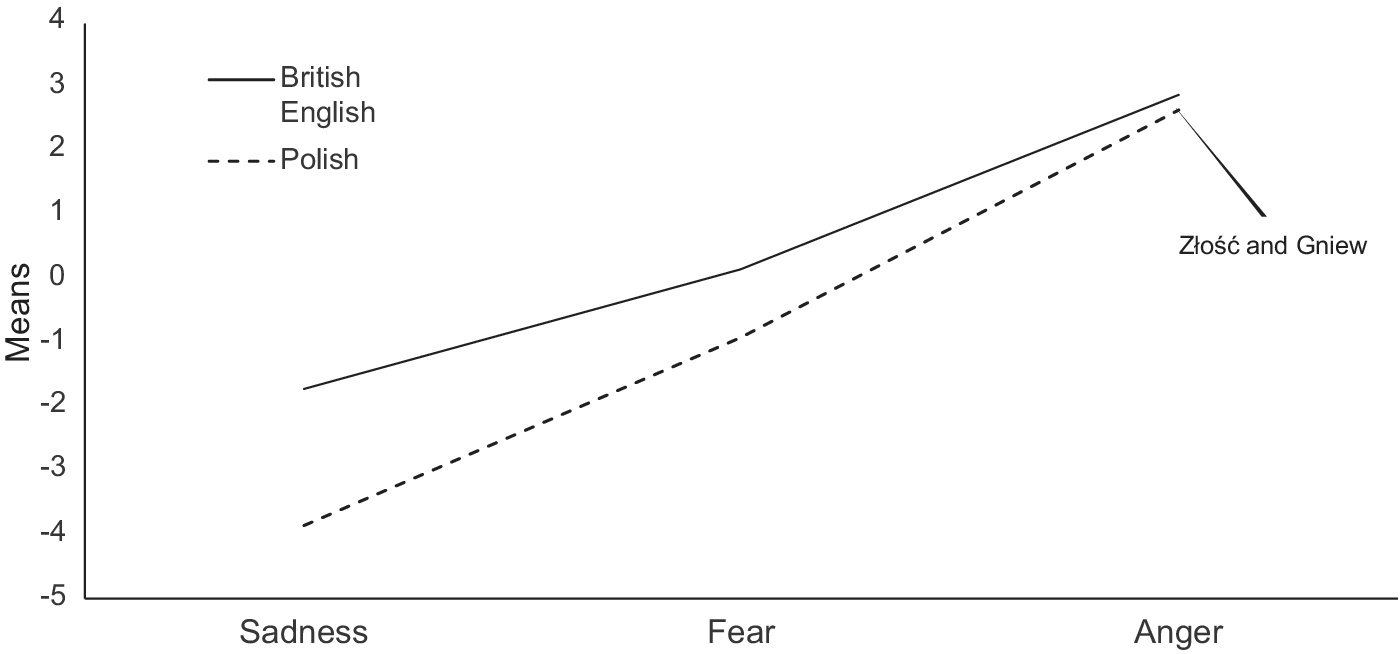
The analysis including złość ‘anger 1’ that was performed on the power dimension produced a significant interaction between language group and emotion (F (2, 150) = 4.05, P < 0.05). Contrasts were performed to break down this interaction. Figure 1 shows that anger (M = 2.87) was rated higher than fear (M = 0.14) and sadness (M = −1.71), and that fear was rated higher than sadness (P < 0.001 for all comparisons). It can also be seen that złość ‘anger 1’ (M = 2.63) was rated higher than strach ‘fear’ (M = −0.93) and smutek ‘sadness’ (M = −3.86), and that strach was rated higher than smutek ‘sadness’ (P < 0.001 for all comparisons). Additionally, sadness was rated higher than smutek ‘sadness’ (P < 0.001) and fear was rated higher than strach (P < 0.05), but there was no significant difference between anger and złość ‘anger 1’ (P > 0.05). The interaction between language group and emotion was also significant in the analysis including gniew ‘anger 2’ (F (2, 164) = 5.01, P < 0.01). Contrasts were performed to break down this interaction. It can be seen in Figure 1 that gniew ‘anger 2’ (M = 2.66) was rated higher than strach ‘fear’ (M = −0.93) and smutek ‘sadness’ (M = −3.86), and that strach was rated higher than smutek ‘sadness’ (P < 0.001 for all comparisons). Additionally, sadness was rated higher than smutek ‘sadness’ (P < 0.001) and fear was rated higher than strach (P < 0.05), but there was no significant difference between anger and gniew ‘anger 2’ (P > 0.05).
Means of British English versus Polish sadness, fear and anger concepts on the power dimension.

Figure 1. Long description
Anger was rated higher than fear, which was rated higher than sadness for British English. There was a similar pattern in the Polish data, with both variants of anger, that is złość ‘anger 1’ and gniew ‘anger 2’, rated higher strach ‘fear’, which was rated higher than smutek ‘sadness’. The graph further shows that although fear has a higher rating than strach and that sadness has a higher rating than smutek, there was no significant difference between British English anger and the two Polish variants, złość ‘anger 1’ and gniew ‘anger 2’.
2.2.2. Arousal
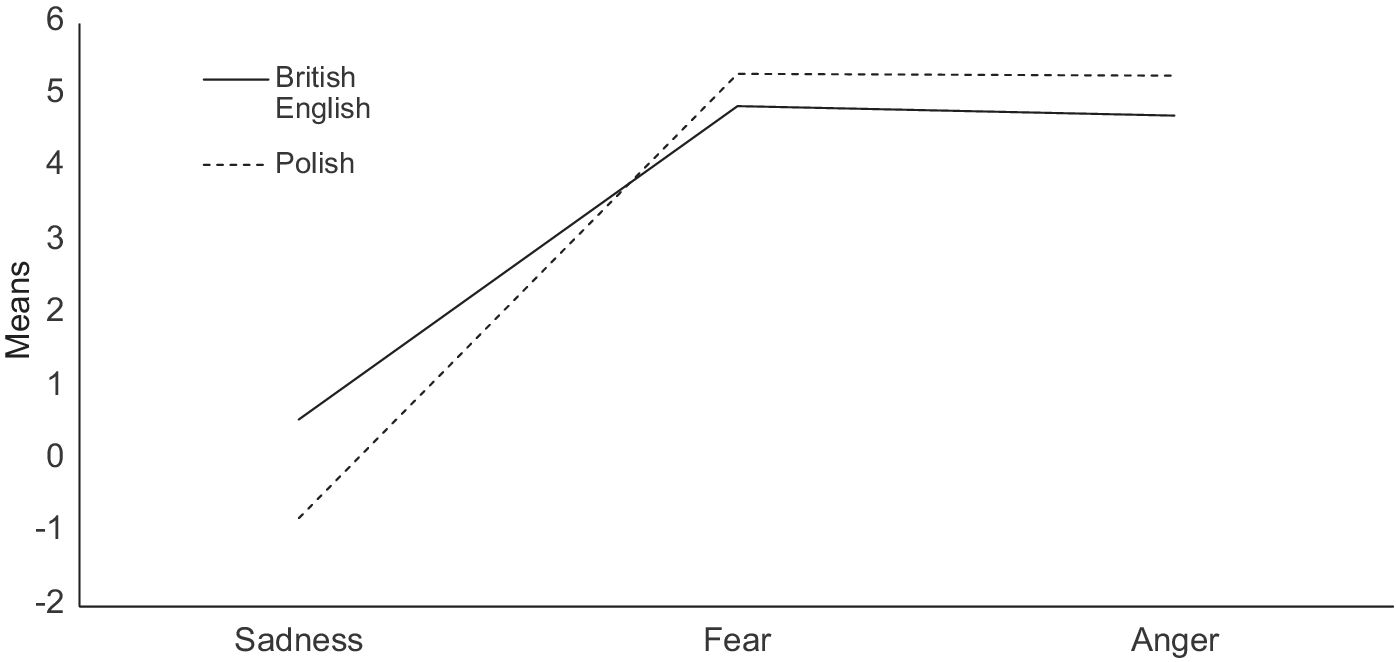
The analysis including złość ‘anger 1’ that was performed on the arousal dimension produced a significant interaction between language group and emotion (F (2, 150) = 4.03, P < 0.05). Contrasts were performed to break down this interaction. Figure 2 shows that anger (M = 4.74) was rated higher than sadness (M = 0.56), and that fear (M = 4.86) was rated higher than sadness (P < 0.001 for both comparisons). However, there was no significant difference between anger and fear (P > 0.05). It can also be seen that złość ‘anger 1’ (M = 5.29) was rated higher than smutek ‘sadness’ (M = −0.77), and that strach ‘fear’ (M = 5.32) was rated higher than smutek ‘sadness’ (P < 0.001 for both comparisons). However, there was no significant difference between złość ‘anger 1’ and strach ‘fear’ (P > 0.05). Additionally, sadness was rated higher than smutek ‘sadness’ (P < 0.05), but there was no significant difference between fear and strach ‘fear’ (P > 0.05), and between anger and złość ‘anger1’ (P > 0.05). The interaction between language group and emotion was not statistically significant in the analysis including gniew ‘anger 2’ (F (2, 164) = 2.59, P > 0.05).
Means of British English versus Polish sadness, fear and anger concepts on the Arousal dimension (with złość as the Polish anger concept).

Figure 2. Long description
The y-axis is labeled Means and ranges from negative 2 to 6. The x-axis lists three emotions: Sadness, Fear, and Anger. A legend in the top-left identifies a solid line for British English and a dashed line for Polish.
* For Sadness: British English starts at approximately 0.5, while Polish starts lower at approximately negative 0.8.
* Between Sadness and Fear: Both lines show a steep linear increase. They intersect at a mean of approximately 3.8.
* For Fear: Polish reaches a higher peak at approximately 5.2, while British English is slightly lower at approximately 4.8.
* Between Fear and Anger: Both groups show a plateau with a very slight downward trend.
* For Anger: Polish remains higher at approximately 5.2, while British English ends at approximately 4.6.
2.2.3. Correlations between fear, sadness and anger
Pearson correlations were performed between sadness and fear (Table 1), fear and anger (Table 2) and sadness and anger GRID terms (Table 3) on the mean values of the GRID emotion features in British English versus Polish that loaded on the valence, power, arousal and novelty dimensions.
Correlations between Polish versus British English sadness and fear concepts

Table 1. Long description
There are similar, positive, strong correlations between sadness and fear in both languages on the valence dimension. There are weak, non-significant correlations between sadness and fear in both languages on the arousal and novelty dimensions. The significant correlation between smutek and strach on the power dimension does not exist between sadness and fear.
Note: *Correlation is significant at the 0.05 level (two-tailed). **Correlation is significant at the 0.01 level (two-tailed).
Correlations between Polish versus British English fear and anger concepts

Table 2. Long description
There are similar, positive, strong correlations between fear and anger, strach and złość, and strach and gniew on the valence and arousal dimensions. There are similar, weak non-significant correlations between fear and anger, strach and złość, and strach and gniew on the power dimension. Compared with the significant, strong correlations between fear and anger, and strach and gniew on the novelty dimension, there is a weak, non-significant correlation between strach and złość.
Note: *Correlation is significant at the 0.05 level (two-tailed). **Correlation is significant at the 0.01 level (two-tailed).
Correlations between Polish versus British English sadness and anger concepts

Table 3. Long description
There are significant positive, strong correlations between sadness and anger, smutek and złość, and smutek and gniew on the valence dimension. There are significant negative, strong correlations between sadness and anger, smutek and złość, and smutek and gniew on the power dimension. The corresponding correlations on the arousal and novelty dimensions are non-significant.
Note: **Correlation is significant at the 0.01 level (two-tailed).
2.2.4. Conclusions
The results of the analyses examining between-language effects of the emotion concepts showed that sadness was rated higher than smutek on the power and arousal dimensions and fear was rated higher than strach on the power dimension. There were no significant differences between fear and strach on the arousal dimension, between anger and złość/gniew on the power dimension, and between anger and złość on the arousal dimension.
The non-significant interaction between language group and emotion on the valence dimension and the similar British English versus Polish correlation values on this dimension are expected on the basis of the negativity of sadness, fear and anger in these two languages. The non-significant interaction between language group and emotion on the novelty dimension and the pattern of correlation values on this dimension suggest that novelty is not a major distinguishing feature between the British versus Polish emotion concepts of sadness, fear and anger. The higher ratings of fear and anger than sadness for both British English and Polish in analyses involving złość on the arousal dimension is what is expected on the basis of the relatively low arousal of sadness. This is further shown by the non-significant correlations in both languages on this dimension involving sadness (see Tables 1 and 3) compared with the strong, significant correlations between fear and anger (see Table 2). The lack of statistical significance for the analyses that included gniew is likely a consequence of the relatively lower intensity and arousal of this emotion concept that, as outlined above, means that it is more related to sadness. Finally, the higher power ratings for British English anger, followed by fear and then sadness was similar in the Polish analyses involving both złość and gniew. The strong, significant negative correlations between sadness and anger on the power dimension in both languages show the discrepancy in power between these two emotion concepts (see Table 3). Also, the lack of a relationship between the fear and anger concepts in both languages in terms of power is underscored by the weak, non-significant correlations on this dimension (see Table 2). However, a notable difference between British English and Polish in the correlations conducted on the power dimension is the significant correlation between smutek and strach (0.46) compared with the zero correlation between sadness and fear (see Table 1).
3. Online emotions sorting task
3.1. Methodology
In the emotions sorting methodology, emotion terms are typically presented simultaneously on a desk in front of participants who are free to categorise them into as many or as few groups as they wish. In the online version, the sorting takes place in an experimental GUI on a computer. We adapted the NodeXL (Smith et al., Reference Smith, Ceni, Milic-Frayling, Shneiderman, Mendes Rodrigues, Leskovec and Dunne2010) tool to provide information pertaining to the relationships between the British English versus Polish conceptual clusters fear, sadness and anger. Although the most common use of NodeXL is to analyse relationships between individuals using online social media networks, we employ NodeXL to create graphical representations of the Polish and British English co-occurrence emotion matrices. The graphs created are like those produced by the synonyms rating methodology employed by Heider (Reference Heider1991) to compare and contrast emotion terms across three Indonesian languages. Whereas for Heider connection strength refers to the between-subjects frequency with which an emotion term is given as the synonym for another, the connection strength in our NodeXL graphs represents the co-occurring frequency of the emotion terms in the online emotions sorting data and are hence sometimes referred to as co-occurrence values or interconnections.
3.1.1. Procedure
Participants volunteered to take part in the study either through direct contact by one of the authors or in response to adverts placed on internet forums. The participants were given the following instructions:
You will be presented with 135 emotions on the computer screen. We’d like you to sort these emotions into categories representing your best judgement about which emotions are similar to each other and which are different from each other. There is no one correct way to sort the emotions – make as few or as many categories as you wish and put as few or as many emotions in each group as you see fit. This study requires careful thought and you therefore need to carefully think about which category each emotion belongs rather than just quickly putting emotions in categories without much thought.
3.1.2. Participants
There were 58 British English participants (27 females, mean age = 42.7 years) and 58 Polish participants (27 females, mean age = 35.8 years).
3.2. Results
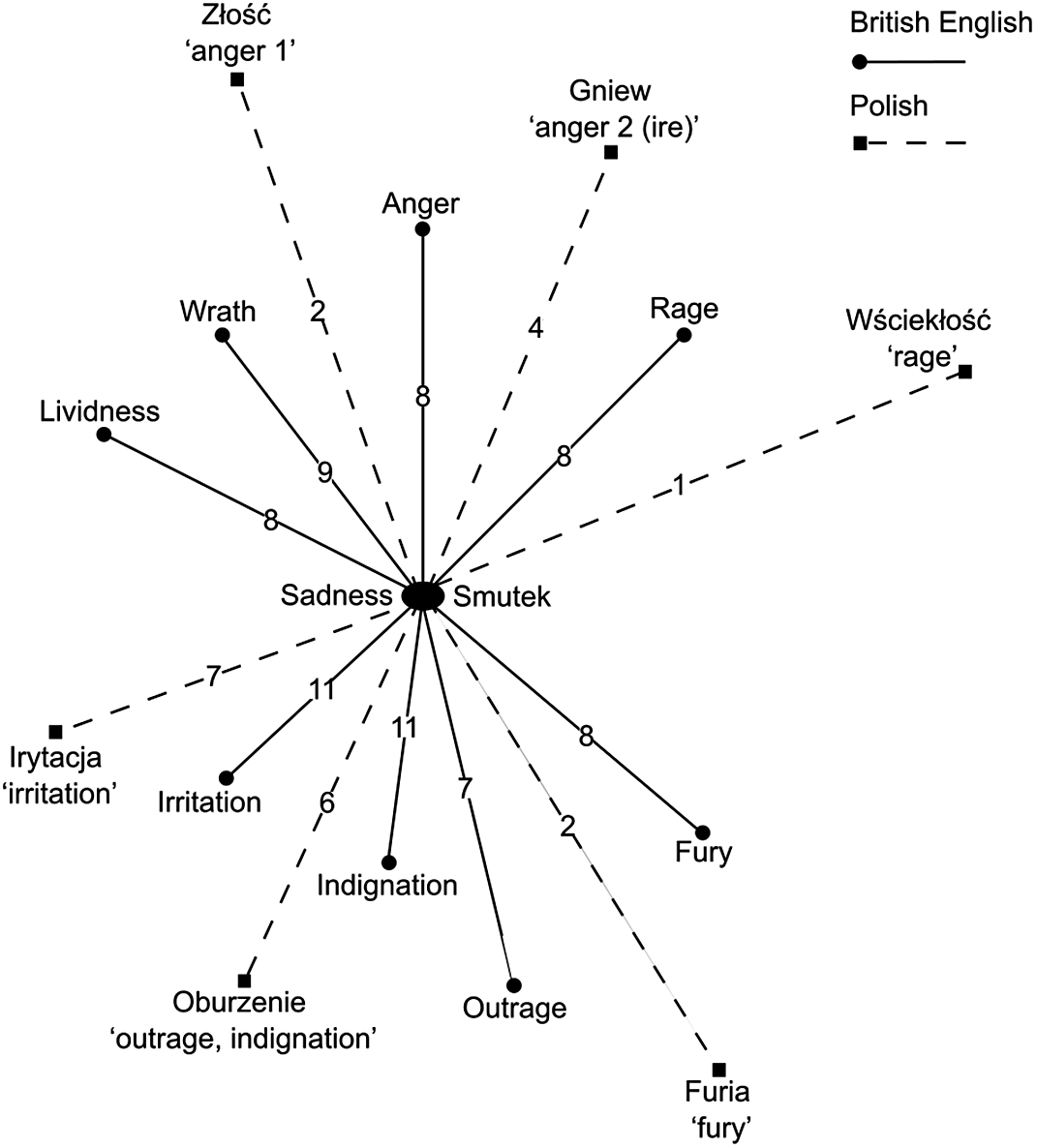
It can be seen in Figure 3 that the co-occurrences between sadness and British English anger cluster emotions (e.g., sadness–anger (8), sadness–rage (8), sadness–fury (8)) are higher than those between smutek ‘sadness’ and Polish anger cluster emotions (e.g., smutek–złość ‘anger 1’ (4), smutek–gniew ‘anger 2 (ire)’ (2), smutek–wściekłość ‘rage’ (1), smutek–furia ‘fury’ (2)).
Co-occurrences between sadness / smutek concepts and anger cluster concepts.

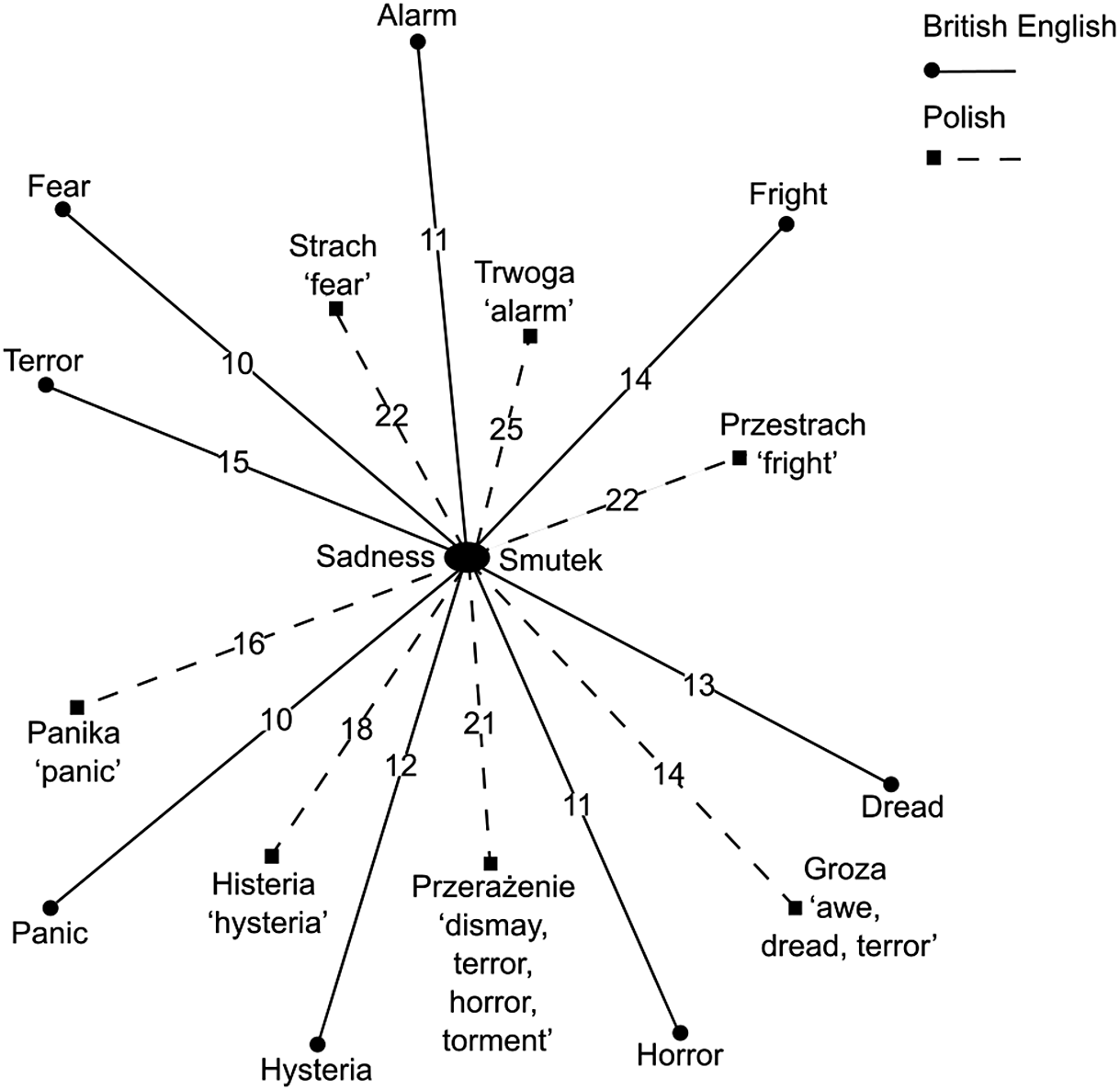
Figure 4 also shows that the interconnections between smutek ‘sadness’ and Polish fear cluster emotions (e.g., smutek–strach ‘fear’ (22), smutek–trwoga ‘alarm’ (25), smutek–przestrach ‘fright’ (22)) are higher than those between sadness and British English fear cluster emotions (e.g., sadness–fear (10), sadness–alarm (11), sadness–fright (14)).
Co-occurrences between sadness / smutek concepts and fear cluster concepts.

The co-occurrences between fear and British English anger cluster emotions (e.g., fear–anger (11), fear–rage (8), fear–fury (9)) are similar to those between strach ‘fear’ and Polish anger cluster emotions (e.g., strach–złość ‘anger 1’ (10), strach–wściekłość ‘rage’ (9), strach–furia ‘fury’ (10)).
4. Corpus data
The corpora selected for scrutiny in the present study are primarily monitor corpora, precisely MONCO media corpora of English and Polish, publicly available for English and for Polish. Reference to the British National Corpus and the National Corpus of Polish will also be made in the sections that follow.Footnote 1
The data we want to identify here are not only collocations in the strict sense of the term, referring to two-word combinations co-occurring above chance, but also such co-occurring strings of emotion terms which span from 0 to 3, thereby releasing the condition towards three intervening words. We believe (following Lemaire & Denhiere, Reference Lemaire and Denhiere2006) that “operationalizing similarity as a frequency of co-occurrence probably introduces a bias: first, there are cases in which there is similarity without co-occurrence and, second, the frequency of co-occurrence overestimates similarity” (p. 1). This can be particularly true when it comes to synonyms, that is, words typically of the same part of speech, which would not form collocational strings in English; for example, road and street, which would almost never co-occur (Lund & Burgess, Reference Lund and Burgess1996). In this part of our study, we will present the co-occurrence corpus data to analyse the extent to which the emotion terms fear, anger and sorrow in English and strach, złość, gniew and smutek in Polish appear in the co-occurrence of up to three spans in the corpus materials.
4.1. MONCO emotion terms
The MONCO project, which was launched in 2015 by Pęzik (Reference Pęzik, Gruszczyńska and Leńko-Szymańska2016) and the Łódź University team, is regularly growing by a few million words every day. The list of monitored sources has been extended, which makes its index unbalanced; however, it functions in a truly referential manner. Direct links to the original web pages are indicated with each of the listed occurrences and mechanisms excluding duplicated uses are provided.
Sources of the corpus data indexed in MONCO are RSS4 channels shared by over 1,500 news, industry and blog platforms, and, as reported in Pęzik (Reference Pęzik2012, Reference Pęzik, Gruszczyńska and Leńko-Szymańska2016), of which around 600 were active in July 2019 with the largest corpus sources identified in the Tools → Statistics view → Index. As the data contain both anonymous media comments, media articles and TV interviews, their analysis is likely to provide adequate verification materials to compare with the results obtained from our GRID-based results and online emotions sorting task.
In the Collocation positionsFootnote 2 field, we defined the maximum positional distance of potential collocations from the collocation centre as three. These kinds of restrictions increase the probability of occurrence of syntactic relations between the collocation centre and the words associated with it. Paths present all identified syntactic combinations in which the given form appears in the corpora. The Dice metrics visible in the columns represent a relationship between the frequency of occurrence of the searched combination against the joint frequencies of individual combination forms in the corpora. A Dice result ‘1’ means that the number of occurrences of the combined form searched is equal to the joint frequencies of these forms when used as individual linguistic forms in the MONITOR corpus. The Lemma column indicates the linguistic form intervening between the parts of the combined form as, for example, in (1) in List (2) the item and is a form between fear and anger in the English MONITOR corpus and can be treated as an indication of the co-occurring emotions. Paths information gives detailed information with regard to particular instances of each of the combinations. Paths typically contain forms listed in the table above them – therefore, no additional translation from Polish to English is provided for them. For the sake of manuscript limitations regarding paper length, we provide only the first instances of such combinations. All other relevant, detailed combinations can be generated from the Polish and English MONITOR corpora.
4.1.1. Co-occurrence MONITOR corpus materials of English fear
List (1) presents anger as the main collocate of fear in the MONCO British English data. The relatively closer co-occurrence between fear and anger than between fear and sadness in List (2) suggests a higher perceived similarity between fear and anger in British English. In discussing the significance of such results, we might recall the familiar Form-Meaning Iconicity, most precisely the Proximity Principle. The principle proposes that conceptual distance tends to match linguistic distance; in other words, stimuli presented closer together are judged to be more similar than stimuli presented farther apart. This is consistent with Lakoff and Johnson’s Conceptual Metaphor Theory (Casasanto, Reference Casasanto2008; Lakoff & Johnson, Reference Lakoff and Johnson1980, Reference Lakoff and Johnson1999). We might therefore conjecture that fear in British English, co-occurring with anger more closely than with sadness, is considered more similar to anger than to other emotions in co-occurring segments.
Fear-anger collocations (English MONCO).

LIST 1. Long description
A table displaying English collocations for the concept fear filtered for anger. It shows anger as a primary collocate with a frequency of 144, occurring in multiple positions relative to the center word (mostly immediately following it), with a score of 0.0346 and a part-of-speech tag of “nn” (noun).
Fear-anger co-occurrences (English MONCO)

LIST 2. Long description
A data summary of 1,000 non-duplicated spans for fear-anger co-occurrences. It highlights that the concept fear co-occurring with anger more closely than sadness suggests a higher perceived similarity between fear and anger in British English.
4.1.2. Fear-sadness
List (3) shows that the lemma sadness appears with a low frequency of 9 and a score of 0.0019, indicating a much weaker direct collocational link than fear-anger in English, while List (4) notes that the fear-sadness co-occurrences are less frequent and often involve more distant slopes or intervening words compared to the fear-anger pairing.
Fear-sadness collocations (English MONCO)

LIST 3. Long description
A table for fear-sadness collocations in English. The lemma sadness appears with a low frequency of 9 and a score of 0.0019, indicating a much weaker direct collocational link than fear-anger.
Fear-sadness co-occurrences (English MONCO)

LIST 4. Long description
A report on 649 non-duplicated spans for fear-sadness. The text notes that these co-occurrences are less frequent and often involve more distant slopes or intervening words compared to the fear-anger pairing.
4.1.3. Fear-anger/sadness – summing up
The concepts fear and anger present a strong and particularly frequent co-occurrence combination, both in the collocational and co-occurrence profiles as shown above. They indicate especially strong conceptual and affective links between fear and anger in English.
4.2. MONITOR Corpus co-occurrence materials of Polish strach
General MONITOR data collocations for strach**
List (5) shows collocations for the Polish word strach ‘fear’ across 7,932 contexts. Top collocates include pomyśleć (‘think’, frequency 195), Lach (part of an idiom, 130), lęk (‘anxiety’, 113) and niepewność (‘uncertainty’, 109).
Collocations of Polish strach ‘fear’ across 7,932 contexts

LIST 5. Long description
A table showing collocations for the Polish word strach (fear) across 7,932 contexts. Top collocates include pomyśleć (‘think’, frequency 195), Lach (part of an idiom, 130), lęk (‘anxiety’, 113), and niepewność (‘uncertainty’, 109).
4.2.1. Strach–złość
List (6) shows Polish strach ‘fear’ co-occurring with złość ‘anger 1’ with a frequency of 26, while its Path indicates complex emotional strings which include adjacent emotion concepts smutek, wstręt, strach, zaskoczenie i złość ‘sadness, disgust, fear, astonishment and anger 1’.
Strach-złość (fear-‘anger 1’) co-occurrences (Polish MONCO)

LIST 6. Long description
A table showing strach (fear) co-occurring with złość (anger 1) with a frequency of 26. The score is relatively low at 0.005.
Conclusions. There are 185 unique Polish strach-złość ‘fear-anger 1’ combinations generated from the corpus. However, the next characteristic emotive combinatorial elements include obrzydzenie ‘disgust (revulsion)’, smutek ‘sadness’, bezradność ‘helplessness’, bezsilność ‘powerlessness’ and lęk ‘anxiety’. All five show a decreased power element in the strach ‘fear’ concept when it co-occurs with złość ‘anger 1’.
4.2.2. Strach–gniew
List (7) shows Polish strach ‘fear’ co-occurring with gniew ‘anger 2’ with a frequency of 23 in varying positions in a five-word span. Its Paths often include disgust ‘wstręt’ and other related terms, such as strach, gniew and odraza ‘fear, anger 2, loathing’.
Strach-gniew (fear-‘anger 2’) co-occurrences (Polish MONCO)

LIST 7. Long description
A table showing strach co-occurring with gniew (anger 2) with a frequency of 23. Positions vary across the five-word span.
4.2.3. Strach–smutek ‘fear–sadness’
List (8) for strach ‘fear’ and smutek ‘sadness’ co-occurrences, shows a frequency of 23 and a score of 0.005, while their Paths show these terms appearing in lists of basic emotions, such as złość ‘anger 1’ and smutek ‘sadness’ often alongside radość ‘joy’ or odraza/wstręt ‘disgust’.
Strach-smutek (fear-sadness) co-occurrences (Polish MONCO)

LIST 8. Long description
A table for strach and smutek (sadness) co-occurrences, showing a frequency of 23 and a score of 0.005.
4.3. Conclusions: MONITOR corpus data
A complex pattern emerges from the co-occurrences between strach and the Polish equivalents of anger and sadness. As discussed earlier, Polish has two basic equivalents of anger – złość ‘anger 1’ and gniew ‘anger 2’. These represent two separate basic emotion concepts that overlap in some semantic properties to a certain extent. Mikołajczuk (Reference Mikołajczuk2000, 143) aptly summarised the differences in her detailed analysis of English ‘anger 1’ and ‘anger 2’ (wrath) and the Polish equivalents złość and gniew, respectively. She proposes that gniew ‘anger 2’ is typically elicited by the behaviour of a person who breaks rules accepted by another, while złość ‘anger 1’ arises most often when an obstacle is placed in the path of the experiencer’s activity or plans. An experiencer’s evaluation of such reasons does not require any reflection or conscious decision; it may be fully spontaneous. Moreover, the obstacle does not have to have any human involvement. In the light of this, both anger and wrath seem to be more similar to gniew than to złość; however, obstacles also occur in situations characterised by anger , but they are extremely unusual in situations typically associated with wrath. Mikołajczuk also makes reference to Anna Wierzbicka’s Russian concept of gnev (compare Polish gniew), which necessarily involves basic ethical principles, unlike English anger (Wierzbicka, Reference Wierzbicka, Athanasiadou and Tabakowska1998, 19–20).
In the light of such differences, it is interesting to note that although Polish fear does quite often co-occur with the Polish equivalent of anger, it is in fact the emotion of gniew and not złość, which is present in such cases, as seen in the Paths and statistics above.
Gniew in Polish is often felt as a reaction to another person’s mistreatment, experienced as an unjust opinion or action. It is more often associated with depression, a sense of hurt or humiliation, which are not primarily clustered with złość ‘anger 1’. Therefore, even if in certain contexts the co-occurrences of Polish equivalents of English fear and anger are observed, such cases often involve gniew ‘anger 2’ rather than złość ‘anger 1’, the former of which possesses elements of melancholy, depression and humiliation that are members of the sadness cluster and are less likely in złość.
In comparison to the case of English, it might also be observed that there are more frequent co-occurrences between Polish strach ‘fear’ and numerous Polish emotion equivalents of disgust cluster members, such as wstręt ‘repulsion’, obrzydzenie ‘disgust’, odraza ‘loathing’ and niesmak ‘distaste’.
4.4. Fear, sadness and anger in English and Polish national corpora
In this section, relevant examples in English and Polish will be presented from two comparable sources – the British National Corpus and the National Corpus of Polish (Narodowy Korpus Języka Polskiego www.nkjp.pl ), released in 2012 (Przepiórkowski et al., Reference Przepiórkowski, Bańko, Górski and Lewandowska-Tomaszczyk2012). The search data slope was three, similar to the MONCO data search.
4.4.1. BNC http://pelcra.clarin-pl.eu/SlopeqBNC/ fear-anger
List (9) notes a statistically high number of co-occurrences between fear and anger in British English compared to other pairings.
Fear-anger co-occurrences (British National Corpus)

LIST 9. Long description
A summary of co-occurrences in the BNC. It notes a statistically high number of co-occurrences between fear and anger in British English compared to other pairings.
4.4.2. BNC fear-sadness
The rare co-occurrences of anger and sadness in the English BNC, as in List (10) or example (15) in List (9), can be considered an argument against a strong cognitive co-occurrence link between anger and sadness, as in both the cases fear is used as one of a number of emotions listed, including anger and sadness, compared to a statistically high number of co-occurrences between fear and anger, as in List (9).
Fear-sadness co-occurrences (British National Corpus)

LIST 10. Long description
A summary showing that sadness rarely co-occurs with anger in the BNC. When it does, fear is usually part of a larger list of emotions.
4.4.3. NKJP ‘National corpus of Polish’
NKJP strach-złość ‘fear-‘anger 1’’
List (11) shows 14 segments from a 240-million-word corpus where strach and złość co-occur. Many instances involve negation or listing multiple negative passive emotions such as upokorzenie ‘humiliation’ or wina ‘guilt’.
Strach-złość co-occurrences (Polish National Corpus – NKJP)

LIST 11. Long description
A list of 14 segments from a 240-million-word corpus where strach and złość co-occur. Many instances involve negation or listing multiple heavy emotions.
4.4.4. NKJP strach-gniew ‘fear-‘anger 2’’
Strach-gniew co-occurrences (Polish National Corpus - NKJP)

LIST 12. Long description
Corpus data for strach and gniew. The text notes these often appear in contexts of mistreatment or perceived injustice.
4.4.5. NKJP strach-smutek ‘fear-sadness’
Strach-smutek co-occurrences (Polish National Corpus - NKJP)

LIST 13. Long description
Data showing the relationship between fear and sadness in the NKJP. It supports the hypothesis of closer conceptual proximity in Polish than in English.
4.5. Conclusions from corpus findings
Both in the English MONCO data and BNC findings, there is a fairly frequent co-occurrence relation between the forms fear and anger. The lexical item sadness appears mostly integrated with fear rather via indirect paths.
The frequency of the Polish form strach ‘fear’, followed by gniew ‘anger 2’ or złość ‘anger 1’ in the Polish MONCO corpus is higher than in the context of smutek ‘sadness’. However, the qualitative context of the three (distant) collocates (slope 3, positions from −5 to +5), shows that the intervening concepts (e.g., List 12, examples 6 and 7) or niepewność, smutek i żal ‘uncertainty, sadness and regret/grief’ (List 13, example 4) as identified in the respective paths lists are associated with the concepts of sadness rather than anger emotion clusters (see Lists 12–13). Some additional indication of the same occurrence can be observed in the Polish National Corpus data as, for example, in the sample below:
strach, nie złość
‘fear, not anger 1’
, lecz właśnie rozpacz. Jakby coś tak po kawałku
‘but despair’ As if one bit after another…’
Złość in this text only nominally co-occurs with strach. It is negated and a corrected co-occurring emotion is labelled, that is, by the author, and a different accompanying emotion rozpacz ‘despair’ – a member of the sadness emotion cluster - is substituted for złość in: strach nie złość, lecz właśnie rozpacz ‘fear, not anger 2, but just despair’, as in an act of self-correction.
Similarly, in both złość and gniew emotion scenarios, the co-occurring contexts contain emotion concepts that indicate emotion words referring to feelings of weaker arousal or indicating a lower willingness to act by experiencers than in the case of both Polish main lexicographic equivalents of anger – złość or gniew. Additionally, such forms as znika nadzieja, znika motywacja ‘hope and motivation are vanishing’, or the Polish culture-bound polysemous emotive term żal ‘regret’, a cluster member of smutek ‘sadness’, indicating low arousal and hopelessness, tend to co-occur with the Polish equivalents of anger.
5. Parallela data
To provide a more in-depth verification of the thesis concerning the semantic differences between the English polysemous senses of anger (złość or gniew in Polish) and their differing equivalence patterns between English and Polish translation, we also analysed the co-occurrence equivalence results in Polish–English and English–Polish Paralela corpus data. The Paralela corpus is available at https://paralela.clarin-pl.eu/#. It was developed by the CLARIN-PL project research group for a large collection of annotated Polish–English parallel texts (Pęzik, Reference Pęzik, Gruszczyńska and Leńko-Szymańska2016) and contains over 250 million words presented in terms of parallel segments of translated texts (Paralela Web (clarin-pl.eu)).
The Dice column in the equivalence tables below is sorted from the highest to the lowest values, irrespective of the frequency of segment occurrences in the parallel texts (column A).
5.1. English anger translation data
English fear and the manifestation of the anger emotion cluster collocating with fear are recognised in the Polish translations (List 14). Both Polish direct equivalents of anger, in the forms of złość and gniew, as well as the co-occurring cluster members agresja ‘aggression’, wściekłość ‘rage’ and nienawiść ‘hate’ are present in Polish. Smutek ‘sadness, sorrow’ occupies a significantly lower position (Dice 0.014 versus 0.439 for gniew ‘anger 2’). Compare also smutek ‘sadness, sorrow’ and its cluster member przygnębienie ‘depression’ (see below).
English ‘anger’ translation equivalents (Paralela)

LIST 14. Long description
A translation table for the English lemma anger into Polish. Gniew is the top equivalent (Freq: 1570, Dice: 0.439), followed by złość (Freq: 532, Dice: 0.182), aggression, and rage.
5.2. Polish sadness translation data
List (15) presents English translations for the Polish złość ‘anger 1’. The top result is anger (Freq: 294, Dice: 0.123), followed by angry, malice and spite. Path texts include rage, mad and temper.
English ‘sadness’ translation equivalents (Paralela)

LIST 15. Long description
List (15) presents Polish translational equivalents of English sadness to be primarily ‘smutek’, with the frequency 590 and Dice – 0,323, followed by przygnębienie ‘depression’ (frequency 27, Dice -0,015).
5.3. Polish złość ‘anger 1’ and gniew ‘anger 2’ co-occurrence equivalents in English
List (16) for the Polish lemma złość ‘anger 1’ shows anger as its primary equivalent, followed by ‘malice’, ‘spite’, ‘mad’, while List (17) presents English translational equivalents of Polish gniew ‘anger 2’, as ‘angry’, ‘grief’ and also ‘fury’, ‘hatred’ or ‘indignation’.
Polish ‘złość’ translation equivalents (Paralela)

LIST 16. Long description
A list showing English translations for the Polish złość. The top result is anger (Freq: 294, Dice: 0.123), followed by angry, malice, and spite.
Polish ‘gniew’ translation equivalents (Paralela)

LIST 17. Long description
A list for the Polish lemma gniew. Anger is the primary equivalent (Freq: 784, Dice: 0.305), followed by wrath, rage, and angry.
5.4. Polish smutek ‘sadness’ co-occurrence equivalents in English
e.g.,
Najpierw rodzi się smutek, potem gniew.
[Out of the ashes of Buenos Aires] comes first sorrow, then anger 1
The example above presents prototypical lexicographic Polish to English translational equivalents: Pol. smutek > Eng. sadness, and Pol. gniew - Eng. anger 2. The last List (18) shows more variety in the translational equivalents of Polish smutek in English, presenting the top ten English translation equivalents in the parallel corpus. The list is topped by ‘sadness’ with 280 occurrences and a Dice coefficient of 0.262, followed closely by ‘sorrow’ (233 occurrences, 0.158 Dice) and ‘grief’ (138 occurrences, 0.092 Dice). It also includes a high frequency of descriptive or situational terms like ‘profound’ and ‘despair’ from the sadness cluster, but also anger, which, in that context and relevant to our analysis, might have been considered rather semantically close to Polish gniew ‘anger 2’.
Polish ‘smutek’ translation equivalents (Paralela)

LIST 18. Long description
List (18) Polish smutek equivalents in English shows the top 10 English translation equivalents based on corpus data. Sadness is a primary equivalent with 280 occurrences and a Dice coefficient of 0.262, followed by sorrow and grief The table also includes sad, melancholy and joy, along with descriptive or situational terms like profound, despair, anger, and parting.
6. General conclusions
The GRID, online emotions sorting, and corpus methodologies were employed to perform analyses on the concepts sadness, fear and anger to test three hypotheses. Although there was no clear support for hypothesis one that the British English concept anger would be rated higher than the corresponding Polish concepts of anger – złość ‘anger 1’ and gniew ‘anger 2’ – on the power and arousal dimensions, the results supported hypothesis two in showing a closer relationship between the smutek and strach cluster concepts than between the sadness and fear clusters, as well as hypothesis three in the demonstration of a closer relationship between the British English anger and sadness cluster concepts than the corresponding conceptual variants in Polish.
The results supporting hypothesis two are novel in the sense that they not only replicate but extend the results of our previous studies (Lewandowska-Tomaszczyk et al., Reference Lewandowska-Tomaszczyk, Wilson, Niiya, Fontaine, Scherer and Soriano2013; Lewandowska-Tomaszczyk & Wilson, Reference Lewandowska-Tomaszczyk, Wilson and Korangy2024) that showed a higher rating of the concept sadness than that of smutek on the power and arousal dimensions, and a higher rating of the concept fear than that of strach on the power dimension, suggesting the salience of fight in the conceptualisation of the former and fright in the latter. Specifically, the evidence from the three methodologies supports the prediction of a relatively closer conceptual proximity between the smutek and strach cluster concepts than between the sadness and fear cluster concepts. This is shown by higher co-occurrences between the concepts smutek and strach than between those of sadness and fear in the online emotions sorting results, and corroborates the GRID results demonstrating a significant correlation between the concepts smutek and strach (0.46) on the power dimension (see Table 1). The corpus results are generally consistent with this, suggesting that there is some preference to introduce elements of weakness and/or inactivity in senses of strach ‘fear’, which make it closer to the expression of sadness rather than to the overtly visible anger. In addition, the English co-occurrence patterns of fear and sadness are much less numerous in all types of corpus data. The weight of evidence showing the salience of sadness in Polish culture (e.g., Doherty & Kelly, Reference Doherty and Kelly2010; Helliwell et al., Reference Helliwell, Huang, Wang, Helliwell, Layard and Sachs2015; Inglehart, Reference Inglehart1990; Sebena et al., Reference Sebena, El Ansari, Stock, Orosova and Mikolajczyk2012) offers a compelling case in favour of the low power in the smutek concept exerting an influence on the salience of power in the concept of strach in contrast to the lack of a theoretical basis for the opposite influence of the concept strach on that of smutek. We can therefore conclude the results provide evidence that suggests a reason for the relatively lower power in the concept strach that has hitherto alluded us. The major finding that emerged from the corpus data showing a relatively strong link between British English fear and anger has obvious relevance to the power effects we have observed for fear, namely that the power in the British English concept anger might be a reason for the salience of high power in the concept fear.
The higher interconnections in the online emotions task between the concepts of sadness and British English anger cluster emotions than between those of smutek and Polish anger cluster emotions offer support for hypothesis three. As autonomy is a feature of individualism, this finding is consistent with the association that Berenbaum et al. (Reference Berenbaum, Fujita and Pfennig1995) showed between autonomous depressives and anger. It also corroborates the weaker link between anger suppression and depression for more interdependent individuals (Cheung & Park, Reference Cheung and Park2010).
The results should be viewed in the light of the complexity of the relationships between the concepts of fear, sadness and anger. The differing degrees of consistency in the results from our three methodologies reflect the intricate conceptual structure of these three emotions. Our findings show that there is a clear need to employ a wide range of other methodologies to explore the underlying influences on the interrelationships between these emotion concepts in British English and Polish as well as other languages.














 Open access

