





1. Introduction
In canonical passives, the subject aligns with the patient role assigned by the verb. This principle generally holds for Mandarin, as in (1); however, Mandarin also exhibits a non-canonical construction where the patient is retained in the post-verbal object position, a pattern exemplified by (2):
(1)
他
的
左臂
被
子弹
打
伤
了。
tā
de
zuǒbì
bèi
zǐdàn
dǎ
shāng
le
3SG
POSS
left.arm
PASS
bullet
hit
injure
PERF
‘His left arm was injured by a bullet.’
(People’s Daily, Jun. 1965)
(2)
[周春阔]NP₁
被
[弹片]NP₂
[打]V₁
[伤]V₂
了
[手臂]NP₃。
Zhōu Chūnkuò
bèi
dànpiàn
dǎ
shāng
le
shǒubì
name
PASS
shrapnel
hit
injure
PERF
arm
‘Zhou Chunkuò had his arm injured by shrapnel.’
(Lit. Zhou Chunkuò was hit-injured [his] arm.)
(People’s Daily, Dec. 1966)
In (1), zuǒbì ‘the left arm’ acts as the patient of the verb dǎ ‘hit’ and is positioned as the subject, standing in a possessive relationship with tā ‘he’. In (2), however, the patient shǒubì ‘arm’ appears in the post-verbal position, while the subject position, typically designated for the patient (the arm), is occupied by its possessor. Although both convey similar propositional content, they differ in construal (Langacker, Reference Langacker2008): (1) profiles the state change of the possessed, while (2) profiles that of the possessor.
This distributive pattern, often referred to as the Retained Object Passive (henceforth ROP; e.g., Lü, Reference Lü1984), can be schematically represented as: NP₁ + bèi + (NP₂) + P + le + NP₃, where P represents the predicate core.Footnote 1 The ROP is characterized by distinct properties: (i) the passive marker bèi introduces the agent (NP₂), which is syntactically optional; (ii) NP₁ and NP₃ are in a possessive relationship; (iii) the predicate (P) exhibits a morphological continuum between resultative verb compounds (henceforth RVCs; V₁V₂) and simplex verbs (V₁/V₂); and (iv) the perfective marker le indicates the completion of an action or a change of state. While these properties have been examined from various cognitive perspectives (e.g., Deng & Zeng, Reference Deng and Zeng2011; Jiang & Wen, Reference Jiang and Wen2023), existing research often lacks corpus-based quantitative evidence. More importantly, a crucial question persists regarding the established assumptions about verb argument structure: How can a passive construction retain an object?
To address this, the present study adopts the framework of Cognitive Grammar (CG) and suggests that the predicate core (P) is immanent in a causative schema that includes two relational components: ACTION and RESULT. These components constitute dual profile determinance, wherein the RESULT functions as a causative profile determinant that licenses the retained object. It is proposed that the ROP is not merely a structural anomaly but rather a motivated composite structure that effectively integrates thematicity and agentivity.
The remainder of this paper is organized as follows: Section 2 reviews the literature and introduces the CG framework; Section 3 analyzes the component structures of the ROP; Section 4 develops a dual profile determinance model to address the apparent structural anomaly of the ROP; Section 5 discusses theoretical implications and Section 6 concludes the paper.
2. Background
2.1. Previous research
The ROP presents a significant challenge to established assumptions regarding the valence relations of passive constructions, as it retains the patient in the object position while promoting its possessor to the subject position. Generative accounts have drawn considerable attention to the case-assigning properties of retained objects, yet they face a theoretical dilemma regarding their classification. Proposals range from partitive (e.g., Xu, Reference Xu1999) and nominative (e.g., Pan & Han, Reference Pan and Han2008) to accusative case (Quan & Han, Reference Quan and Han2021). This persistent lack of consensus indicates that the unique valence relations of the ROP cannot be adequately explained by rigid rule-based paradigms. To provide a more motivated account, cognitive linguistic research has shifted toward two interrelated dimensions: constituent properties and functional motivations.
Debates on constituent properties focus on the semantic relationship between the subject (NP₁) and the retained object (NP₃), as well as on the predicate core (P). While it is widely recognized that a broad possessive relationship exists between NP₁ and NP₃, including ownership, kinship and part-whole relations (Xu, Reference Xu1999), cognitive linguistic analyses argue for a hierarchy of alienability that prioritizes part-whole relations in licensing the ROP (Wu, Reference Wu2019; Yue & Wu, Reference Yue and Wu2019). Ma (Reference Ma2013a, Reference Ma2013b), however, argues against the inclusion of kinship. The nature of P also remains contentious. Both Ma (Reference Ma2013a) and Wu (Reference Wu2019) reject the notion of a simple verb (V₁) (Pan & Han, Reference Pan and Han2008; Tang, Reference Tang2004; Xu, Reference Xu2004), arguing instead that P must be realized as RVCs (V₁V₂).
Existing research generally agrees that the functional motivations for the grammatical realization of the ROP are rooted in affectedness semantics, with passives without a retained object as the prototype. The proposed mechanisms can be categorized into: (i) prototypicality, viewing the ROP as a decategorialized deviation from the prototype (Liu & Bai, Reference Liu and Bai2011; Liu, Reference Liu2012); (ii) conceptual integration, emphasizing metaphorical extension and cross-metonymic mapping within an ‘affecting-affected’ Gestalt (Deng, Reference Deng2011; Deng & Zeng, Reference Deng and Zeng2011); and (iii) functional-relational approach, focusing on bridging semantic gaps through argument augmentation (Wu, Reference Wu2019), autonomy/dependence analysis (Xu, Reference Xu2022), and analogical leveling (Zhang, Reference Zhang2010).
However, the research landscape uncovers two significant gaps. First, discussions on the predicate core (P) often focus on a one-to-one correspondence between semantic and morphological structures, while overlooking the potential for a one-to-many relationship. Debates on the semantic relationship between NP₁ and NP₃ further indicate that current research inadequately addresses the semantic nature of the ROP. Second, current studies primarily emphasize functional motivations while neglecting structural ones. Although the ROP may emerge from affectedness through cognitive mechanisms like conceptual integration, its structural motivations for object retention remain underexplored. This gap complicates the understanding of the absence of the ROP in languages like English. Drawing on Cognitive Grammar, this study addresses these gaps by characterizing the ROP as a highly motivated composite structure, thus providing a unified account of its functional and structural coherence.
2.2. Theoretical framework
The present study is situated within the framework of CG (Langacker, Reference Langacker1987, Reference Langacker1993, Reference Langacker2008), which posits three basic types of structures: semantic, phonological and symbolic. Symbolic structures reside in the symbolization of semantic structures by phonological structures: [[SEM]/[PHON]]. Morphology and syntax are also symbolic in nature, suggesting that only symbolic structures are essential for the characterization of grammatical structure.
Symbolic organization comprises different dimensions. Each component structure engages in integration relationships with one another and compositional relationships with the composite structure. Effecting the integration is a correspondence that defines the conceptual overlap between component structures. This involves elaboration, where one component structure contains a schematic substructure that the other structure elaborates in finer detail. At the core is profile determinance, where the composite semantic structure profiles the same entity as one component structure, referred to as the profile determinant. Grammatical composition is defined by schematic assemblies, or constructional schemas, which are abstracted from specific instances. There is a categorizing relationship between schemas and instantiations, with schemas as categorizing structures and instantiations as targets. Schemas are not separate from their instantiations; rather, they are immanent within them.
Meaning is conceptualization shaped by construal, the capacity to view the same situation from alternative perspectives. Construal manifests in trajector/landmark alignment, where trajector and landmark are defined by primary and secondary focal prominence. They are not confined to specific conceptual levels; a trajector or landmark can profile not only entities but also a relationship. The alignment is facilitated by reference point relationships that establish mental connections between two entities, forming the basis for metonymy.
Finally, CG delineates force-dynamic events by distinguishing between maximally distinct thematic and agentive processes in terms of their profiling. A thematic process involves a single participant and is independent of any agentive causation. In contrast, an agentive process consists in bringing about a thematic process and is therefore conceptually dependent with respect to it.
In summary, CG offers a coherent framework for analyzing symbolically complex structures. This study seeks to clarify how thematic and agentive processes are integrated into a single finite ROP clause.
3. Component structures of the ROP
This section focuses on three component structures of the ROP: the predicate core (P), the subject (NP₁) and the retained object (NP₃). Using a dataset from the People’s Daily sub-corpus of the BCC, the analysis begins by examining how P is characterized by a causative constructional schema immanent in its various instantiations.Footnote 2 Following this, the semantic categories of NP₁ and NP₃ are analyzed to identify the prototypical possessive relations that characterize this construction.
3.1. Predicate core (P)
3.1.1. Causative constructional schema: Full and partial instantiations
To investigate how P is morphologically realized, this analysis examines instances where P is represented as either an RVC (V₁V₂) or a simple verb (V₁/V₂). It posits that P has multiple phonological manifestations, with its realization governed by a causative schema (ACTION + RESULT). This schema is defined as a trajector exerting force on the landmark to effect a desired change. Based on its phonological realizations and alignment with the specifications of the causative schema, P fully instantiates the causative schema when it appears as an RVC, while it partially instantiates the schema when it appears as a simple verb.
The full instantiation of the causative schema directly reflects the semiological function of language: both the ACTION and RESULT components at the semantic pole are individually symbolized by phonological elements. As demonstrated in Example (3), the ACTION is symbolized by kǎn ‘cut’ (V₁) and the RESULT by xià ‘down’ (V₂).
(3)
有
[一个人]NP₁
被
[人]NP₂
[砍]V₁
[下]V₂
了
[脑袋]NP₃。
yǒu
yī gè rén
bèi
rén
kǎn
xià
le
nǎodai.
exist
one.cl.person
pass
person
cut
down
perf
head.
‘A person’s head was chopped off by someone.’
(Dec. 1951)
The notion of causation (ACTION + RESULT) emerges as an aspect of constructional meaning that is not always symbolized individually. However, the causative schema remains immanent in their instantiations, even when partially symbolized. The partial instantiation results from an asymmetric phonological realization of the causative schema, with only one component explicitly manifested while the other remains unsymbolized. For instance, in example (4), action-only instantiation occurs as the ACTION component is symbolized by kǎn ‘cut’ (V₁), while the RESULT component is ‘zero’ (symbolized Ø).
(4)
有
个
[战友]NP₁
被
[鬼子]NP₂
[砍]V₁
[Ø]
了
[头]NP₃
yǒu
gè
zhànyǒu
bèi
guǐzi
kǎn
Ø
le
tóu
exist
cl
comrade
pass
enemy
cut
Ø
perf
head
‘A comrade had his head chopped off by the enemy.’
(Apr. 2016)
Action-only instantiation calls into question the assumption that the RESULT component must be overtly symbolized for the ROP to be grammatical (e.g., Ma, Reference Ma2013a; Wu, Reference Wu2019). This study, however, argues the opposite, proposing that the RESULT component may remain phonologically unsymbolized due to functional redundancy. As illustrated in (3), kǎn ‘cut’ typically leads to xià ‘down’. However, when grammaticalized, xià ‘down’ conveys the completion of the action more than the downward direction, leading to a semantic overlap with the aspectual marker le (Shen & Wei, Reference Shen, Wei, Clemens and Liu2010). Consequently, it becomes functionally redundant and thus phonologically unsymbolized.
The second type of partial instantiation, often neglected, is result-only instantiation, in which only the RESULT component is overtly specified:
(5)
[一个老年人]NP₁
被
[弹片]NP₂
[Ø]V₁
[伤]V₂
了
[膝盖]NP₃。
yī-gè
lǎoniánrén
bèi
dànpiàn
Ø
shāng
le
xīgài
one-cl
elderly.person
pass
shrapnel
Ø
injure
perf
knee
‘An elderly person had his knee injured by shrapnel.’
(May 1946)
In (5), the RESULT component is phonologically symbolized by shāng ‘injured’ (V₂), while the ACTION is manifested by zero (symbolized Ø). The RESULT is conceptually dependent: the conception of a state change from uninjured to injured presupposes the conception of the ACTION that brings about this change. Although the ACTION is left unexpressed, it can be pragmatically inferred from the Warfare ICM (Idealized Cognitive Model; Lakoff, Reference Lakoff1987).
While P conveys causation at the semantic pole, its phonological structure varies depending on whether ACTION, RESULT or both are symbolized:
-
(6) Full instantiation (e.g., kǎn xià ‘cut down’ in Ex. 3):
[[ACTION]/[V₁]] + [[RESULT]/[V₂]] = [[ACTION RESULT]/[V₁V₂]]
-
(7) Partial instantiation
-
(a) Action-only (e.g., kǎn ‘cut’ in Ex. 4):
[[ACTION]/[V₁]] + [[RESULT]/[Ø]] = [[ACTION RESULT]/[V₁Ø]]
-
(b) Result-only (e.g., shāng ‘injure’ in Ex. 5):
[[ACTION]/[Ø]] + [[RESULT]/[V₂]] = [[ACTION RESULT]/[ØV₂]]
-
To assess the empirical validity of the diverse phonological manifestations of P, a detailed quantitative analysis of the collected data will follow.
3.1.2. Quantitative analysis: From attraction to redundancy
Data were sourced from the People’s Daily sub-corpus (BCC), an authoritative reference for Standard Mandarin. This corpus shows that the varied phonological realizations of P are systematic variants rather than idiosyncratic errors, particularly for partial instantiations often overlooked or denied in previous studies. The search targeted two composite structures: bèi + NP₂ + V₁V₂ + le + NP₃ and bèi + NP₂ + V + le + NP₃.
The data were filtered according to three criteria. First, since null subjects are rather common in Mandarin, the search was conducted regardless of whether the subject (NP₁) was overtly manifested. Second, the selection focuses on instances where both ACTION and RESULT are symbolized by monosyllabic elements. Consequently, multi-syllabic instances such as shùfù-zhù, where the ACTION is specified by two syllables, are excluded to avoid interference from prosodic constraints (Ma & Lu, Reference Ma and Lu1997). Third, only ROPs with an overt NP₂ were selected to ensure agentive causation, thereby providing a prototype for analyzing agentivity (Section 4).
This process yielded a total of 439 valid tokens. After removing duplicates, 366 unique tokens and 135 distinct types were identified. The results indicate a clear frequency hierarchy: full instantiation constitutes the prototypical core at 83.37%, followed by action-only instantiation as a notable secondary variant at 15.72%, while result-only instantiation remains largely marginal at 0.91%.
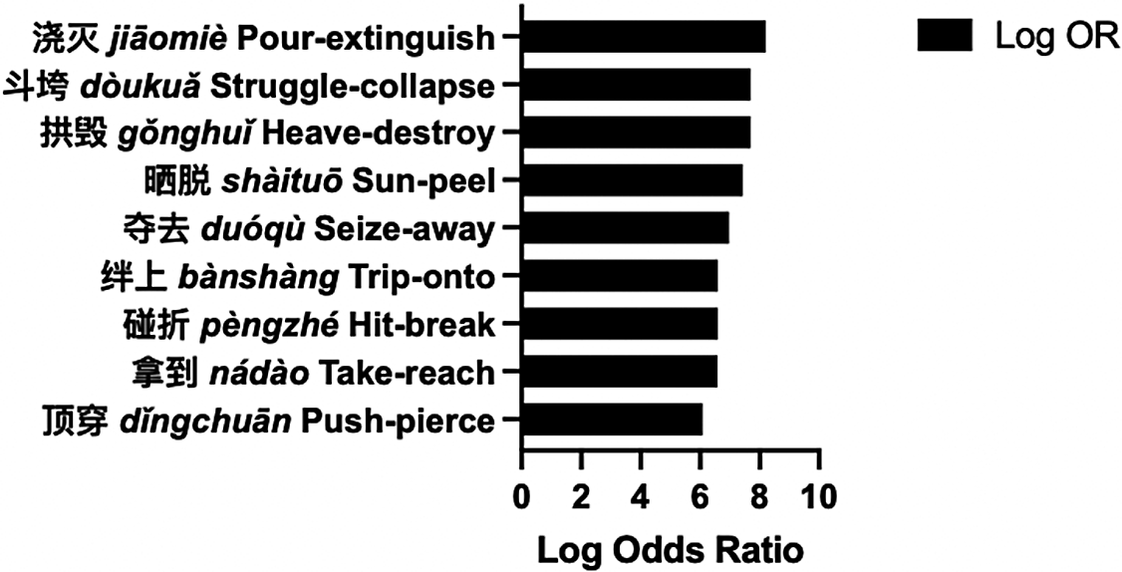
The analysis begins with full instantiation (V₁V₂), which prototypically symbolizes the causative schema of P. To move beyond intuitive judgments, this study employs covarying collexeme analysis (Stefanowitsch & Gries, Reference Stefanowitsch and Gries2003) to investigate the associative attraction between V₁ and V₂. The log-transformed odds ratio (Log OR) is used as the primary measure, as it is particularly effective for capturing the statistical contingency between these two variables.Footnote 3 Furthermore, by integrating the complete 2 × 2 contingency table (including cells a, b, c and d) to account for paradigmatic competition (Schmid & Küchenho, Reference Schmid and Küchenho2013), this analysis shifts the focus from simple frequency to internal cohesion. As a result, the Log OR serves as a probabilistic proxy for cognitive entrenchment (Schmid, Reference Schmid2020; Schmid & Küchenho, Reference Schmid and Küchenho2013), reflecting the degree to which V₁V₂ are routinized in the mental lexicon. When applied to the 135 types (366 tokens), this approach reveals a broad spectrum of association strengths. While all types conform to the causative schema by symbolizing both ACTION and RESULT, the differences in Log OR values indicate a continuum of cognitive entrenchment, ranging from novel structures to conventional chunks (Bybee, Reference Bybee2010). Among these, 73 types exhibit significant association (Log OR > 3), among which nine types demonstrate strong attraction (Log OR > 6), as illustrated in Figure 1.
V₁V₂ with strong associative attraction (Log OR > 6).

Figure 1. Long description
The horizontal bar chart features a vertical axis on the left and a horizontal axis at the bottom. The horizontal axis is labeled Log Odds Ratio with a scale from 0 to 10 in increments of 2. A legend in the top right corner indicates that the black bars represent Log O R.
From top to bottom, the bars represent the following verb pairs and their approximate Log OR values:
* Pour-extinguish (jiāomiè): 8.201
* Struggle-collapse (dòukuǎ): 7.693
* Heave-destroy (gǒnghuǐ): 7.693
* Sun-peel (shàituō): 7.433
* Seize-away (duóqù): 6.971
* Trip-onto (bànshàng): 6.592
* Hit-break (pèngzhé): 6.592
* Take-reach (nádào): 6.586
* Push-pierce (dǐngchuān): 6.078
The strong associations seen in Figure 1 can be attributed to two main factors: semantic underspecification and lexical conventionalization. First, actions that can lead to multiple outcomes need a clear endpoint to define the result. For instance, jiāo miè ‘pour extinguish’ (Log OR = 8.201) specifies the result as miè to distinguish it from alternatives like shī ‘wet’ or tòu ‘through’. This highlights how the action and its outcomes work together to achieve semantic disambiguation. Second, lexical conventionalization arises from the close relationship between events based on experiential salience. In instances like duó qù ‘seize away’ (Log OR = 6.971), the resulting event is so closely intertwined with the action that they function as conventional units. The same applies to kǎn xià ‘cut down’ (Log OR = 4.966) in Example 3. However, since directional particles like qù ‘away’ and xià ‘down’ are grammaticalized into schematic units that convey a sense of completion within RVCs, they create functional redundancy that facilitates action-only partial instantiation.
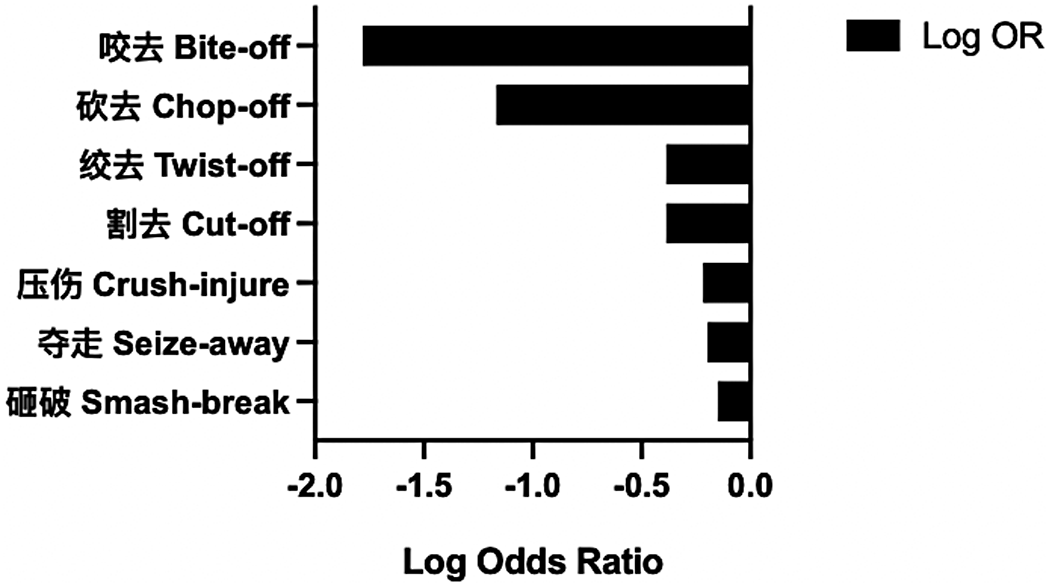
Empirical evidence for action-only instantiation appears at the opposing end of the statistical spectrum. The collexemic analysis reveals a subset of data characterized by negative associative attraction (Log OR < 0), as shown in Figure 2. The most common are RVCs with qù ‘away’ as V₂, indicating that qù and its causative actions are loosely associated in actual usage events.
V₁V₂ with negative associative attraction (Log OR < 0).

The statistical repulsion results from functional redundancy in the phonological manifestations of the causative schema of P. Qù is grammaticalized to assign an abstract endpoint to the bounded event (Lü, Reference Lü1984), rather than indicating a movement of the trajector. Thus, it conveys a sense of completion that overlaps semantically with the obligatorily used perfective marker le, making its phonological realization redundant. This results in an economy-driven preference for action-only instantiation, where the RESULT remains conceptually active even when unsymbolized. Viewed this way, kǎn ‘cut’ in Example 4 provides a more efficient alternative to kǎn xià ‘cut down’ in Example 3. Besides qù and xià, Mandarin also features several grammaticalized elements that express completive meanings. Table 1 summarizes the distribution of action-only instantiation, categorized by types of completion such as Fixation (immobilization), Detachment (removal) or Targeting (hitting a goal).
Frequency and types of completion of action-only instantiation (Tokens ≥ 3)

Table 1. Long description
The table consists of four columns: Predicate core (P), Frequency, Percentage (%), and Type of completion (symbolized by).
* Row 1: mí (fascinate), Frequency 11, 15.94 percent, Type: Fixation (z hù).
* Row 2: qiăng (rob), Frequency 5, 7.25 percent, Type: Detachment (z ŏu / qù).
* Row 3: yăo (bite), Frequency 4, 5.80 percent, Type: Targeting (z hò ng / zháo).
* Row 4: jiē (uncover), Frequency 4, 5.80 percent, Type: Detachment (z ŏu / qù).
* Row 5: zá (smash), Frequency 4, 5.80 percent, Type: Targeting (z hòng / zháo).
* Row 6: kăn (cut), Frequency 3, 4.35 percent, Type: Detachment (d iào / xià).
* Row 7: zhā (stab), Frequency 3, 4.35 percent, Type: Targeting (z hòng / zháo).
* Row 8: piàn (cheat), Frequency 3, 4.35 percent, Type: Detachment (z ŏu / qù).
* Row 9: duó (seize), Frequency 3, 4.35 percent, Type: Detachment (z ŏu / qù).
* Row 10: Others, Frequency 29, 42.01 percent, Type: Not specified.
* Final Row: Total, Frequency 69, 100 percent.
Upon closer examination, yǎo ‘bite’, kǎn ‘cut’, duó ‘seize’ and zá ‘smash’ in Table 1 serve as the first component of the composite structure V₁V₂, which exhibits negative associative attraction (Figure 2). The low type frequency of completion meanings, symbolized by a closed set of grammaticalized elements (Xuan, Reference Xuan2018), further contributes to their redundancy. However, among these, duó ‘seize’ exhibits a more intricate interaction: while it often independently symbolizes the causative schema, duó qù ‘seize away’ retains a positive associative attraction (Log OR = 6.971; Figure 1). This reveals a tension between lexicalized entrenchment and functional economy, as duó qù is so entrenched that it resists the pressure to leave qù unsymbolized. Crucially, while these grammaticalized elements overlap with -le in indicating completion, they do not fully grammaticalize as perfective markers; they provide semantic content (e.g., fixation) to license retained objects, even when unsymbolized (Section 4).
The statistical repulsion in Figure 2 suggests a potential reversal in functional redundancy, leading to a difference in partial instantiation strategy: result-only instantiation. In action-only instantiation, ACTION symbolizes the causative schema, while RESULT remains unexpressed due to its semantic overlap with le. Conversely, result-only instantiation symbolizes RESULT, leaving ACTION unexpressed. The common elements that symbolize the RESULT in result-only instantiation are shāng ‘injure’ and pò ‘break’, as they are loosely associated with their antecedent actions, supported by the negative associative attraction for zá pò ‘smash break’ (Log OR = −0.151) and yā shāng ‘press injure’ (Log OR = −0.218). This is attributed to their intermediate (or semantically neutral) status: shāng and pò have more semantic content than grammaticalized resultatives like qù ‘away’, yet are more schematic than lexical resultatives like suì ‘shatter’, which represents a specific instance of pò ‘break’. Conceptually dependent, shāng and pò presuppose an ACTION that brings about these state changes; however, this ACTION is not a specific act but an ICM-based action cluster. Despite being infrequent (Table 2; N = 4), these instances indicate that the RESULT can independently evoke the causative schema.
Result-only instantiation of the causative schema

Table 2. Long description
The table is organized into three columns: Predicate core (P), IC M, and Action cluster (e.g.,).
* Row 1: Predicate core is ‘shāng’ (injure). The ICM is ‘Warfare’. The Action cluster includes ‘guā’ (scrape) and ‘cā’ (graze).
* Row 2: Predicate core remains ‘shāng’. The ICM is ‘Animal husbandry’. The Action cluster includes ‘yā’ (press) and ‘zhuàng’ (strike).
* Row 3: Predicate core remains ‘shāng’. The ICM is ‘Plant-human encounter’. The Action cluster includes ‘cì’ (stab) and ‘huá’ (scratch).
* Row 4: Predicate core is ‘pò’ (break). The ICM is ‘Go match’. The Action cluster includes ‘dǎ’ (hit) and ‘gōng’ (attack).
As shown in Table 2, unsymbolized ACTION can be pragmatically inferred as action clusters based on ICMs. This arises from the principle of economy: specifying ACTION that is both ICM-dependent and inferable becomes redundant when RESULT carries greater communicative weight. In result-only instantiation, ACTION remains schematic and underspecified, whereas in action-only instantiation, RESULT is definite. This may explain the infrequency of result-only instantiation: although both types are guided by economy, result-only instantiation involves greater linguistic indeterminacy.
Overall, P is defined by a causative constructional schema immanent in its full or partial instantiations, resulting from the interplay between associative attraction and functional redundancy. The following analysis will explore the other two component structures: the subject (NP₁) and the retained object (NP₃).
3.2. Subject (NP₁) and retained object (NP₃)
This section examines two focused participants of the ROP, identifying NP₁ as the possessor and NP₃ as the possessed. In a possessive structure (NP₁ de NP₃), NP₁ typically acts as a landmark that provides mental access to the trajector (NP₃) (Langacker, Reference Langacker, Taylor and MacLaury1995, Reference Langacker2016). However, NP₁ and NP₃ are positioned at opposite ends of the ROP, which reflects a conceptual realignment: the ROP elevates NP₁ from a landmark within the possessive structure to the status of clausal trajector.
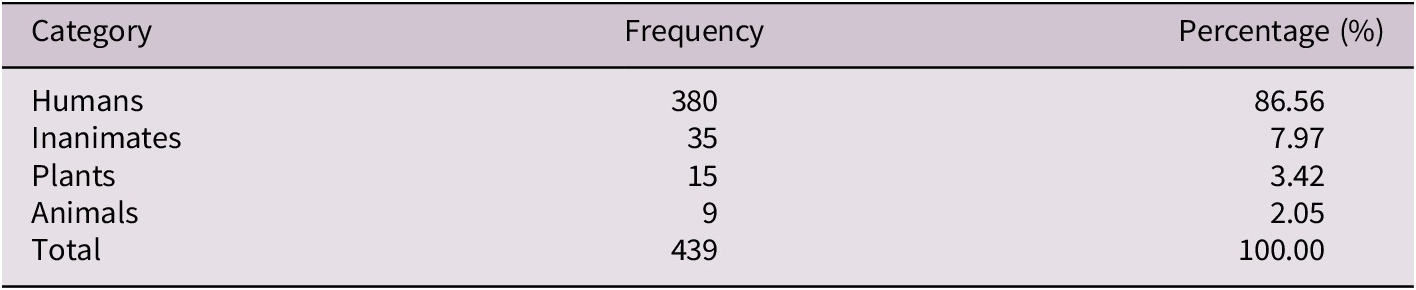
Participants in the subject position (NP₁) are analyzed first. As shown in Table 3, the semantic categories of NP₁ can be classified into four types: humans, inanimates, plants and animals, with humans (86.56%) significantly surpassing the other categories. This pattern of distribution reveals a clear prototypicality hierarchy that is consistent with cognitive semantic principles (Langacker, Reference Langacker1991) or the proto-patient entailment of sentience (Dowty, Reference Dowty1991), wherein humans form the prototypical core while nonhuman entities occupy increasingly peripheral positions. This is not surprising, as bèi passives in Mandarin are associated with adversative meaning, typically identifying subjects as sentient and normally human. However, nonhuman entities can also appear in the subject position, albeit less prototypically (Li & Thompson, Reference Li and Thompson1981: 492, 494–497).
Distribution of subjects in the ROP across semantic categories

Table 3. Long description
The table consists of three columns: Category, Frequency, and Percentage.
* Humans: Frequency of 380, representing 86.56 percent.
* Inanimates: Frequency of 35, representing 7.97 percent.
* Plants: Frequency of 15, representing 3.42 percent.
* Animals: Frequency of 9, representing 2.05 percent.
* Total: Frequency of 439, representing 100.00 percent.
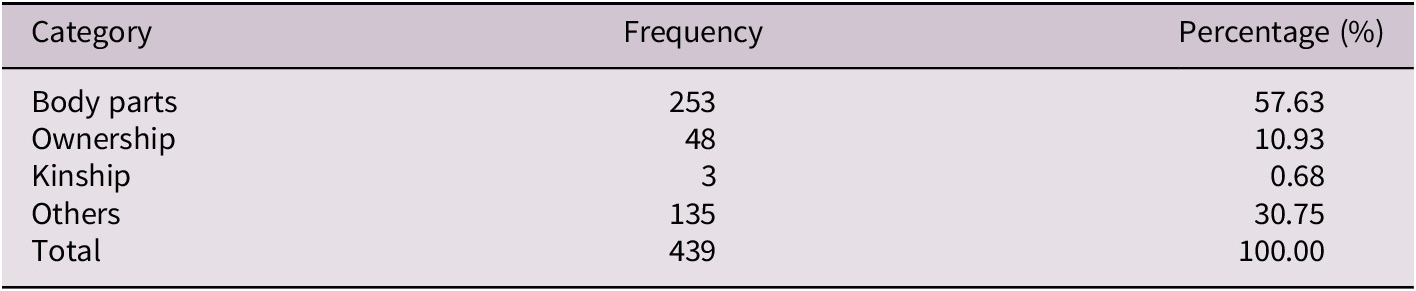
The retained objects (NP₃) are likewise examined in terms of prototypicality. Following Langacker (Reference Langacker, Taylor and MacLaury1995: 56–60), body parts, ownership and kinship constitute the prototypical core of possession, while abstract entities are situated in the periphery. Accordingly, the semantic categories of NP₃ are classified into four types: body parts, ownership, kinship and others (Table 4). As shown, body parts make up the dominant category at 57.63%, followed by ownership at 10.93% and kinship at 0.68%. The ‘Others’ category, comprising 30.75%, includes abstract entities that serve as metaphorical extensions of the prototypical core. While this category includes items such as quánlì ‘power’ and hún ‘soul’, it is dominated by shēngmìng ‘life’, which accounts for 113 instances (25.74% of the total sample and 83.70% within the category). Through the metaphor LIFE IS A POSSESSED OBJECT, life is perceived as an object that can be possessed, despite its abstract nature.
Distribution of retained objects in the ROP across semantic categories

Table 4. Long description
The table consists of three columns: Category, Frequency, and Percentage.
* Body parts: 253 frequency, 57.63 percent.
* Ownership: 48 frequency, 10.93 percent.
* Kinship: 3 frequency, 0.68 percent.
* Others: 135 frequency, 30.75 percent.
* Total: 439 frequency, 100.00 percent.
To sum up, the predicate core (P) displays varied phonological manifestations that either fully or partially instantiate the causative schema, with full instantiation as the prototype. The subject (NP₁) and retained object (NP₃) stand in possessive relations, typically with NP₁ as humans and NP₃ as body parts. While passives with a focused theme offer an alternative to the agent orientation of canonical transitives, the question arises: how can an object be retained? This will be addressed in the next section.
4. From motivation to integration: Metonymic realignment and dual profile determinance
Having examined the component structures of the ROP, the analysis will now turn to how the components are integrated to form a composite structure. The discussion will first address the structural and cognitive motivations, followed by its underlying integration mechanism.
4.1. Structural and cognitive motivations for the ROP
4.1.1. Structural motivation: RESULT (V₂) as profile determinant
The ROP exhibits a structural mismatch: the passive marker bèi de-transitivizes its predicate, leaving the retained object (NP₃) without a licensing source. This apparent discrepancy often leads to its dismissal as a marginal deviation. This mismatch stems from structural hybridity. Emerging during the Northern and Southern Dynasties (Dong, Reference Dong1989), the ROP serves as a transitional hybrid between the coordinate verb construction (CVC, V₂ as the profile determinant) and the RVC (V₁ as the profile determinant). It integrates the semantic and morphological features of the RVC while preserving V₂ as the profile determinant characteristic of the CVC (Li, Reference Li1984, Reference Li1992; Ren, Reference Ren2001). Thus, V₂ can exert a causative force and function transitively, a capacity rooted in the causative use of intransitives in Classical Chinese, exemplified by the evolution of the intransitive verb yuǎn ‘distance’ (Chen, Reference Chen2007; Pan, Reference Pan1980; Wang, Reference Wang1980).
-
(8) 远之 (yuǎn zhī) [V₂(caus) + O]: ‘distance it’
-
(9) 推而远之 (tuī ér yuǎn zhī) [V₁ + Conj + V₂(caus) + O]: ‘push and distance it’
-
(10) 推远之 (tuī yuǎn zhī) [V₁ + V₂(caus) + O]: ‘push-distance it’
Across this continuum, V₂ maintains functional autonomy in object licensing that would otherwise be suppressed: it independently profiles a causative event in (8) and (9), and its causative force persists as a structural legacy in (10).
Applied to the ROP, the RESULT offers an alternative licensing source for NP₃, when the ACTION (V₁) is de-transitivized by the passive marker bèi. This constitutes a hybrid structure: while the clausal orientation is marked thematically by bèi, the RESULT (V₂) provides nested agentivity within the global thematicity. Since P has multiple phonological realizations (see Section 3.1), it licenses NP₃ in alternate ways:
-
(11) Full instantiation (V₁V₂): Analogous to the CVC, the RESULT (V₂) explicitly licenses NP₃.
-
(12) Partial instantiation (V₁Ø): Aligned with the RVC, the RESULT (Ø) latently licenses NP₃ despite being unsymbolized (Langacker, Reference Langacker2008: 194).
-
(13) Partial instantiation (ØV₂): With V₁ unsymbolized, the RESULT (V₂) explicitly and independently licenses NP₃.
The ability of the RESULT to license an object is not restricted to the ROP; it serves as a primary means of expressing transitivity in Mandarin, as illustrated by the oft-cited Pseudo-RVC:
(14)
他
哭
哑
了
嗓子。
tā
kū
yǎ
le
sǎngzi
3sg cry hoarse perf throat
‘He cried his throat hoarse.’ (Lit. ‘He cried hoarse the throat.’)
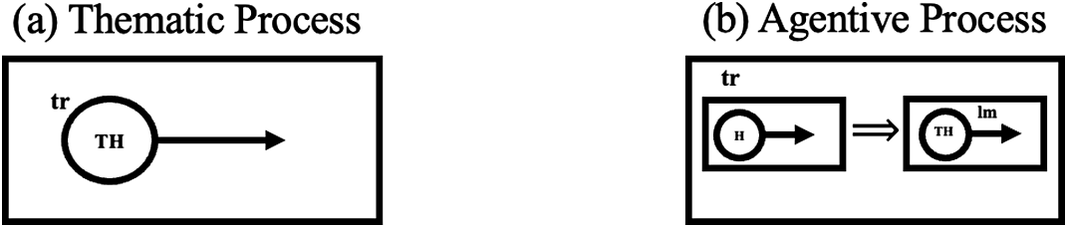
While kū ‘cry’ (V₁) is intransitive, yǎ ‘hoarse’ (V₂) functions as a transitive verb. Transitivity does not operate at the verb level (lexically determined) but at the clause level (grammatically determined) through the V₂-NP sequence, leading to an inchoative-causative alternation. The shift in word order between V₂ and NP indicates a change in processual profiling (Langacker, Reference Langacker2008: 370–373):
-
(15) Inchoative (NP-V₂): sǎngzi yǎ le ‘The throat became hoarse’ profiles a thematic process, where sǎngzi ‘throat’ (NP) functions as trajector undergoing the state change specified by yǎ ‘hoarse’ (V₂).
-
(16) Causative (V₂-NP): yǎ le sǎngzi ‘X causes the throat to become hoarse’ profiles an agentive process, where trajector X exerts force to induce the state yǎ ‘hoarse’ (V₂) in landmark sǎngzi ‘throat’ (NP).
Since a trajector represents both an entity and a relationship, trajector X is relational in nature and is elaborated by the thematic process tā kū ‘he cries’. The alternation shown in (15–16) is sketched in Figure 3.
Thematic process versus agentive process.

Figure 3(a) illustrates a thematic process, where sǎngzi ‘throat’ (abbreviated as TH) functions as trajector (tr) of the state change specified by yǎ ‘hoarse’ (single arrow), independent of any inducing force or agent. In Figure 3(b), yǎ ‘hoarse’ serves as a causative profile determinant. The thematic process tā kū ‘he cries’ (single arrow) elaborates its relational trajector, where tā ‘he’ (abbreviated as H) acts as local trajector. The process of his crying exerts force (double arrow), causing sǎngzi ‘throat’ (lm) to become yǎ ‘hoarse’ (single arrow). Therefore, the Pseudo-RVC in (14) integrates thematicity and agentivity. Their integration is sketched in Figure 4.
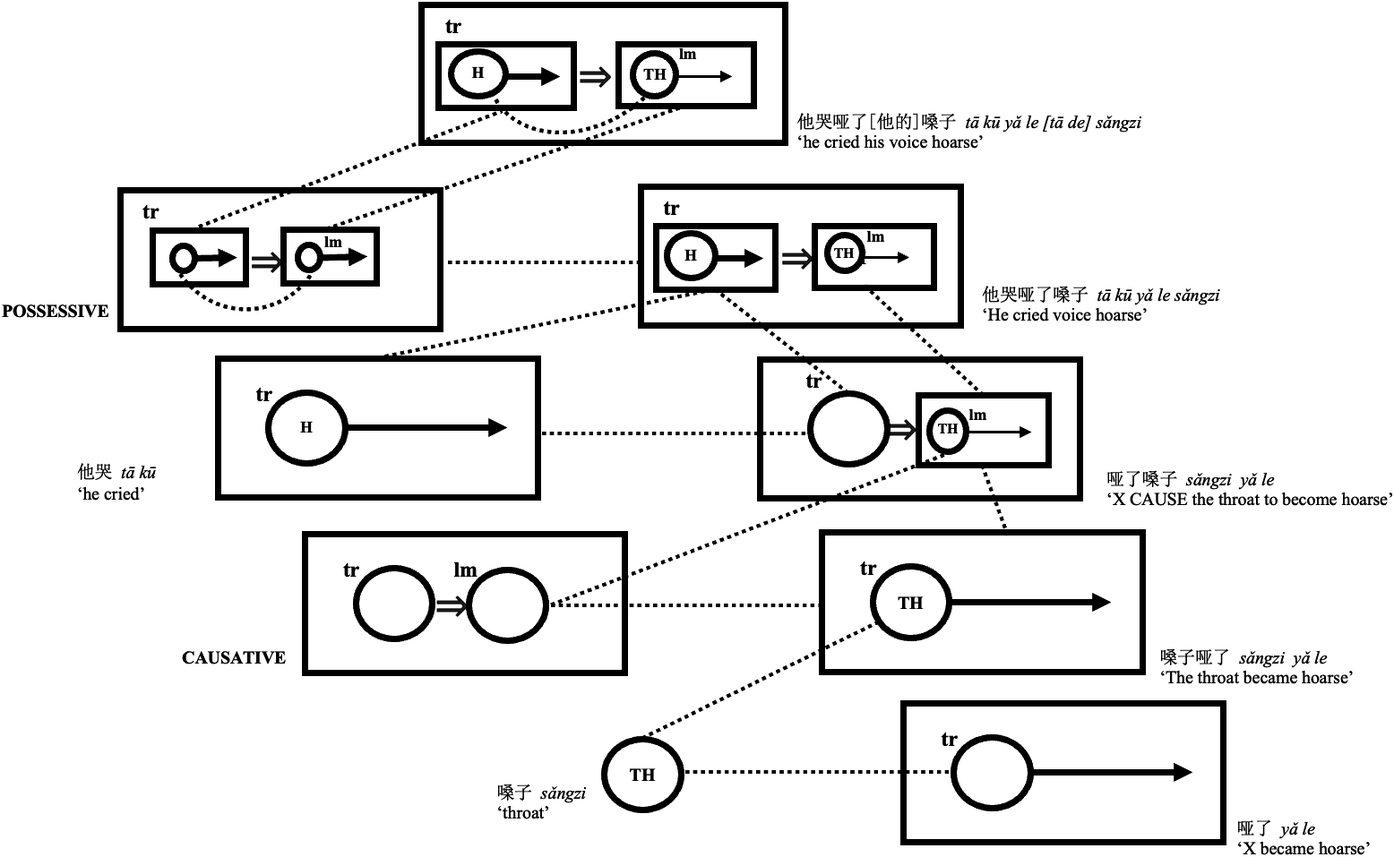
Integration of the component structures of tā kū yǎ le sǎngzi ‘He cried his throat hoarse.’

Figure 4. Long description
The diagram uses boxes, circles, and arrows to map the integration of the sentence ‘He cried his throat hoarse.’
At the top level, a large box contains two sub-boxes. The left sub-box shows a circle labeled H with a rightward arrow. The right sub-box shows a circle labeled TH with a rightward arrow. A double arrow connects the sub-boxes. Dotted lines connect the circles to a lower level. Text to the right reads: tā kū yǎ le [tā de] sǎngzi ‘he cried his voice hoarse’.
The second level splits into two branches. The left branch is labeled POSSESSIVE and shows a similar structure of two sub-boxes. The right branch shows the integration without the possessive marker, with text: tā kū yǎ le sǎngzi ‘He cried voice hoarse’.
The third level breaks the sentence into two main components. On the left is a box with circle H and a long arrow, labeled tā kū ‘he cried’. On the right is a nested box structure where a circle points to a sub-box containing circle T H, labeled sǎngzi yǎ le ‘X CAUSE the throat to become hoarse’.
The fourth level further decomposes these. On the left, a box labeled CAUSATIVE shows two empty circles connected by a double arrow. On the right, a box shows circle TH with a long arrow, labeled sǎngzi yǎ le ‘The throat became hoarse’.
The fifth and bottom level shows the base units. A single circle labeled TH is labeled sǎngzi ‘throat’. To its right, a box with an empty circle and a long arrow is labeled yǎ le ‘X became hoarse’.
In Figure 4, dotted correspondence lines serve as a graphic indication of conceptual overlap. At the first (‘lower’) level, the trajector is elaborated by sǎngzi ‘throat’ (TH), yielding the thematic process sǎngzi yǎ le (single arrow). It further integrates a CAUSATIVE element to produce the agentive process yǎ le sǎngzi (double arrow), where sǎngzi ‘throat’ (TH) is landmark but the clausal trajector remains schematic. The trajector is elaborated by the thematic process tā kū ‘he cries’, with tā ‘he’ (H) as local trajector, yielding the composite structure tā kū yǎ le sǎngzi. Finally, due to the absence of a possessive marker between tā ‘he’ and sǎngzi ‘throat’, a possessive link is required (dashed arc) at the highest level of organization.
The Pseudo-RVC provides the structural frame for the ROP, with the causative RESULT as the licensing source for NP₃. However, with NP₃ (the possessed) retained in the object position, why is it possible for the possessor (NP₁) to be promoted to the subject position? This question will be explored next.
4.1.2. Cognitive motivation: Metonymic realignment of prominence
The ROP reveals a mismatch between semantic relations and syntactic realization: the verb targets the possessed (NP₃) as the direct patient, while the possessor (NP₁) is realized as the syntactic subject instead. This study argues that this realignment is motivated by the POSSESSOR FOR POSSESSED metonymy, which is grounded in the transmission of energy along an action chain. According to the billiard-ball model (Langacker, Reference Langacker2008), an action chain involves forceful interactions where energy is transmitted between participants. In the context of possession, the energy from an action targeting the possessed (NP₃) ultimately transfers to the possessor (NP₁). This justifies the status of the possessor as a passive theme, the clausal trajector, and, consequently, the syntactic subject. By way of illustration, consider the contrast between (17–19):
(17)
父亲
的
膝盖
被
农奴主
挖
掉
了。
fùqin
de
xīgài
bèi
nóngnúzhǔ
wā
diào
le
father
gen
knee
pass
serf-owner
dig
out
perf
‘Father’s knees were dug out by the serf-owner.’
(18)
*父亲
被
农奴主
挖
掉
了。
fùqin
bèi
nóngnúzhǔ
wā
diào
le
father
pass
serf-owner
dig
out
perf
‘Father was dug out by the serf-owner.’
(Intended: ‘Father had his knee dug out by the serf-owner.’)
(19)
[父亲]NP₁
被
[农奴主]NP₂
[挖]V₁
[掉]V₂
了
[膝盖]NP₃。
fùqin
bèi
nóngnúzhǔ
wā
diào
le
xīgài.
father
pass
serf-owner
dig
out
perf
knee
‘Father had his knees dug out by the serf-owner.’
(Aug. 1965)
Example (17) represents the default case, where the direct patient is realized as the syntactic subject. Examples (18) and (19) illustrate metonymic realignment, with the father (NP₁) as the reference point for the knee (NP₃). In (18), the shift is absolute: the father serves as the sole focal participant, while the knee is backgrounded despite its role as the active zone (Langacker, Reference Langacker1987). In (19), the ROP elevates the father to trajector status, while the knee stays foregrounded as the active zone.
The contrast between (18) and (19) illustrates the interplay between cognitive and structural motivations. In (18), the absence of a retained object renders the construction ungrammatical, as the RESULT diào ‘out’ is related to the subject (father). This is particularly confusing because the predicate wā diào ‘dig out’ typically refers to actions performed on objects rather than on people. Example (19) addresses this by aligning diào ‘out’ with the retained object xīgài ‘knee’.
In summary, the ROP is a highly motivated structure, both structurally and cognitively. It promotes the possessor to the subject position for primary focal prominence through metonymy. Additionally, the RESULT serves as a causative profile determinant, allowing the possessed to be retained as an object.
4.2. From component to composite: Integrating thematicity and agentivity
Moving from motivation to integration, this section models how the components of the ROP are integrated to form a coherent composite structure. The central proposal is that the ROP is characterized by dual profile determinance: the passive marker bèi profiles clausal thematicity, while the RESULT acts as a causative profile determinant that licenses NP₃. Given that a fully instantiated predicate core (V₁V₂), a human subject (NP₁) and a body-part retained object (NP₃) serve as prototypes, the analysis will focus on the structure NP₁ + bèi + NP₂ + V₁V₂ + le + NP₃, with findings applicable to all ROP variants.
A comparison between a canonical passive and its ROP counterpart reveals the re-construal of a thematic process as a thematic-agentive hybrid:
(20)
她
的
右臂
被
狗
咬
伤
了。
tā
de
yòubì
bèi
gǒu
yǎo
shāng
le
3sg
poss
right.arm
pass
dog
bite
injure
perf
‘Her right arm was injured by a dog bite.’
(21)
[她]NP₁
被
[狗]NP₂
[咬]V₁
[伤]V₂
了
[右臂]NP₃。
(Sept. 2006)
tā
bèi
gǒu
yǎo
shāng
le
yòubì
3sg
pass
dog
bite
injure
perf
right.arm
‘She had her right arm injured by a dog bite.’
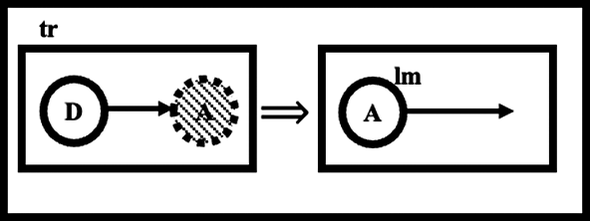
Example (20) profiles a thematic process wherein yòubì ‘right arm’ undergoes the state change specified by shāng ‘injured’. In (21), shāng ‘injure’ (V₂) serves as a causative profile determinant, adding an agentive layer to the clausal thematic process [tā bèi …]. The agentivity is realized in [gǒu yǎo shāng le yòubì]. While yǎo ‘bite’ (V₁) is lexically transitive, as seen when gǒu ‘dog’ (abbreviated as D) bites yòubì ‘right arm’ (abbreviated as A), the passive marker bèi blocks the transitivity (the dashed, shaded circle in Figure 5). Consequently, gǒu yǎo ‘dog bite’ profiles a single-participant thematic process and functions as clausal trajector (tr). The transitivity is re-established by shāng (V₂): the dog-biting process (tr) exerts force (double arrow), causing yòubì ‘right arm’ (lm) to become shāng ‘injured’ (single arrow).
The re-profiling of gǒu yǎo shāng le yòubì ‘The dog bit injured her right arm’ in the bèi-construction.

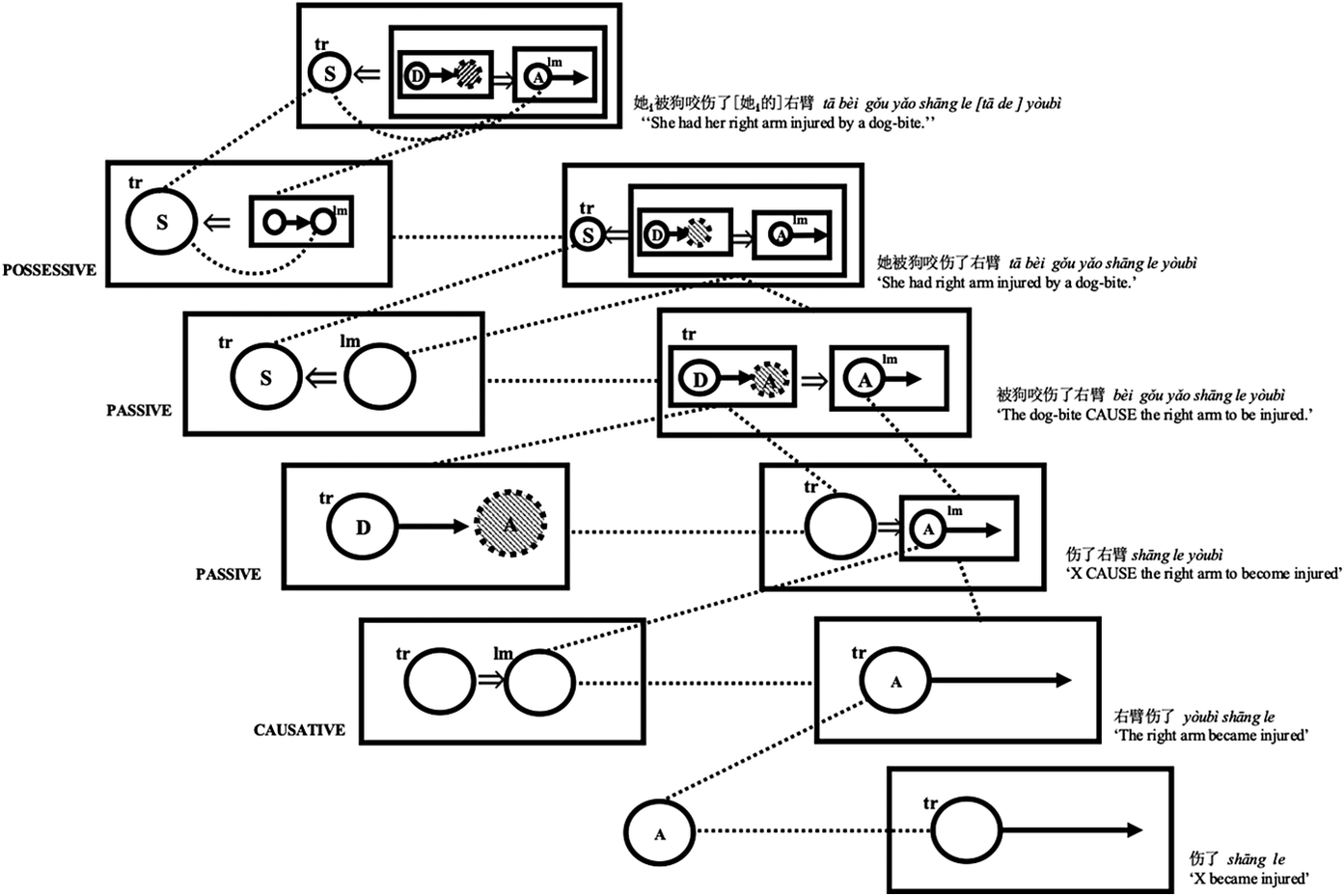
Figure 5 illustrates the emergence of agentivity, but understanding the conceptual integration of (21) requires a broader perspective. Figure 6 illustrates how shāng ‘injure’ (V₂) serves as a causative profile determinant that licenses yòubì ‘right arm’ (NP₃) to appear in a passive construction.
Integration of the component structures of tā bèi gǒu yǎo shāng le yòubì ‘She had her right arm injured by a dog bite.’

Figure 6. Long description
A complex linguistic flowchart illustrates the decomposition of the sentence ‘She had her right arm injured by a dog-bite’ into its constituent cognitive and grammatical parts.
* At the top level, labeled POSSESSIVE, a large box contains two sub-diagrams. The left sub-diagram shows a circle labeled S with a tr superscript, connected by a double-lined arrow to a complex right-hand box. This right box contains a circle D pointing to a shaded circle, which in turn points to a circle A with an lm superscript. This represents the full sentence: tā bèi gǒu yǎo shāng le yòubì.
* Moving down, the diagram splits into PASSIVE and CAUSATIVE layers. Dotted lines connect the top-level components to simpler diagrams below.
* The middle section shows the PASSIVE construction, where the relationship between the subject S and the action is isolated. One diagram shows S and an empty circle connected by a double arrow, while another shows the agent D causing an effect on A. The text reads: bèi gǒu yǎo shāng le yòubì, translated as ‘The dog-bite CAUSE the right arm to be injured.’
* The lower section focuses on the CAUSATIVE and resultative aspects. It shows the transition of the arm A into an injured state. The diagrams simplify to a single circle A with a bold arrow pointing right, representing the change of state. The text here includes: yòubì shāng le, translated as ‘The right arm became injured.’
* At the very bottom, the most basic unit is shown as a single circle with a tr superscript and a rightward arrow, corresponding to the word shāng le, translated as ‘X became injured.’
At the lowest level, yòubì ‘right arm’ (A) elaborates the trajector of the thematic process yòubì shāng le (single arrow). A CAUSATIVE element is then integrated, yielding the agentive process shāng le yòubì (right-oriented double arrow). The transitivity is restored by shāng ‘injure’ (causative V₂-NP; see (16)) when yǎo ‘bite’ is de-transitivized by the passive marker bèi (dashed, shaded circle). In the agentive process, yòubì ‘right arm’ (A) elaborates its landmark and the thematic process gǒu yǎo ‘dog bite’ elaborates the trajector, leading to gǒu yǎo shāng le yòubì. The passive marker bèi also imposes a thematic construal, with the clausal trajector elaborated by tā ‘she’ (abbreviated as S), yielding tā bèi gǒu yǎo shāng le yòubì (left-oriented double arrow). Finally, due to the absence of a possessive marker between tā ‘she’ and yòubì ‘right arm’, a POSSESSIVE link is required (dashed arc) at the highest level of organization.
In summary, the ROP is a motivated structure that integrates thematicity and agentivity, resulting from dual profile determinance: thematicity is profiled by the passive marker bèi, while agentivity is a function of the RESULT component.
5. The interaction of thematicity and agentivity and its implications
5.1. The interaction of thematicity and agentivity
The integration of thematicity and agentivity defines the ROP as a hybrid composite structure. As a passive construction, it designates the passive marker bèi as the primary determinant that profiles thematicity, while the RESULT component serves as the secondary determinant for agentivity. Thematicity, as the primary orientation, aligns with Mandarin’s status as a topic-prominent language, where the subject identifies the entity discussed in the sentence (Li & Thompson, Reference Li and Thompson1981: 15). However, the relationship between thematicity and agentivity is more complex than it appears in actual language use, as the predicate core (P) features three distinct phonological manifestations that highlight their dynamic interaction.
Given that phonological structures symbolize semantic structures (Langacker, Reference Langacker2008: 15), the thematicity-first and agentivity-second pattern is most evident in the full instantiation of P (V₁V₂), where thematicity (bèi + V₁) and agentivity (V₂) are directly and individually symbolized. Consequently, the phonological values of P function as a major factor in determining conceptual arrangement, with the phonological prominence of the ACTION and RESULT reflecting their conceptual significance.
-
(22) Full instantiation (V₁ V₂, 83.37%) (thematicity > agentivity). Thematicity is symbolized by bèi + V₁ and agentivity by V₂. The ROP achieves an optimal balance between thematicity and agentivity, justifying its status as the prototype.
-
(23) Partial instantiation (action-only) (V₁ Ø, 15.72%) (thematicity ≫ agentivity). Thematicity is symbolized by bèi + V₁ and agentivity by Ø. The ROP maximizes thematicity and serves as a significant variant.
-
(24) Partial instantiation (result-only) (Ø V₂, 0.91%) (thematicity ≈ agentivity). Thematicity is symbolized by bèi + Ø and agentivity by V₂. The ROP allows thematicity to be overridden by agentivity, accounting for its marginal status.
As illustrated above, (23) and (24) represent extensions of the prototype in (22). While (24) is often neglected due to its marginal status, (23) remains contentious. Consequently, the legitimacy of structures like (25) is questioned in previous studies (e.g., Ma, Reference Ma2013a, Reference Ma2016; Xu, Reference Xu2022):
(25)
[张三]NP₁
被
[杀]V₁
[Ø]V₂
了
[父亲]NP₃。
name
bèi
shā
Ø
le
fùqīn
Zhang San
pass
kill
Ø
perf
father
‘Zhang San’s father was killed.’
However, the 15.72% frequency supports action-only instantiation as a productive structure rather than a grammatical violation. In (25), shā ‘kill’ lexically entails sǐ ‘dead’. While sǐ ‘dead’ is zero (symbolized Ø), it latently licenses fùqīn ‘father’ (NP₃). The zero role of sǐ ‘dead’ is allowed since it is an ergative verb that overlaps functionally with the perfective marker le denoting completion. Thus, what is often regarded as ungrammaticality is actually a defocusing of agentivity in favor of thematicity.Footnote 4
5.2. Theoretical implications
First, the dual profile determinance model helps explain the absence of the ROP in English. In English, a finite clause allows only one component to serve as a profile determinant. Thus, English passives, also finite clauses, profile thematicity while excluding a retained object (agentivity). In contrast, Mandarin passives feature the RESULT component as a causative profile determinant for agentivity, alongside the clausal thematicity profiled by passive marker bèi. Therefore, while the POSSESSOR FOR POSSESSED metonymy may be conceptually possible in English, it lacks the necessary structural basis for grammatical realization.
Furthermore, the dual profile determinance model contributes to CG by providing insights into how thematicity and agentivity interact within finite clauses. Langacker’s (Reference Langacker2008: 366–373) model introduces three coding strategies for agent and theme roles: agent orientation (where the agent acts as the trajector), theme orientation (where the theme serves as the trajector) and balanced orientation (which treats both roles equally). Languages that exhibit balanced orientation may be seen as subjectless, as agents and themes show similar grammatical behaviors in both one-participant and two-participant clauses. Langacker also notes that agent and theme orientations function as competing strategies. This study refines Langacker’s model by introducing mixed orientation, where thematicity and agentivity coexist within a finite clause without competition, with one being primary and the other secondary.
Finally, the dual profile determinance model plays a crucial role in online processing. While the ROP integrates thematicity and agentivity to convey more information, it complicates real-time comprehension. In Mandarin, the subject of a passive construction typically corresponds to the theme, specifically the patient. However, the ROP identifies the subject as an experiencer and places the patient at the end of the clause. This structural arrangement can create a ‘garden-path’ effect, leading the reader or listener to initially misinterpret the subject as the patient until the true patient is revealed, thus increasing cognitive load. For example, in (25), readers or listeners might initially assume Zhang San is the victim, only to later realize it is actually his father who has been killed.
6. Conclusion
This study examines the ROP in Mandarin to elucidate the mechanisms by which it retains an object. By integrating CG with quantitative analysis, we investigate the component structures and how they are integrated to form the composite structure: NP₁ + bèi + (NP₂) + P + le + NP₃.
Empirical evidence indicates that the predicate core (P) has multiple phonological manifestations based on a common causative schema, establishing a prototypicality hierarchy: full instantiation as the core, action-only as secondary extensions and marginal result-only cases. This hierarchy corresponds to a prototypicality hierarchy of participant selection, where a preference for human subjects (NP₁) and body-part objects (NP₃) is evident. The integration of these components into the composite ROP is driven by structural and metonymic motivations. Structurally, the ROP follows a dual profile determinance model, with the passive marker bèi serving as the primary determinant for thematicity and the RESULT component as the secondary determinant for agentivity. Cognitively, the ROP is motivated by the POSSESSOR FOR POSSESSED metonymy.
Given these findings, this study provides insights into how the ROP retains an object and clarifies its absence in English. It also advances CG by introducing mixed orientation to elucidate the interaction between thematicity and agentivity within finite clauses. However, this study offers a limited analysis of NP₂, which is part of the trajector in the agentive process profiled by the ROP. Analyzing its explicitness, implicitness and animacy may offer insights into the conditions and motivations underlying ROP usage. Furthermore, experimental studies and validation across diverse registers are essential for a comprehensive evaluation of the dual profile determinance model in future research.
Abbreviations
- CL
-
classifier
- GEN
-
genitive (de)
- PASS
-
passive marker (bèi)
- PERF
-
perfective aspect marker (le)
- POSS
-
possessive marker (de)
- 3SG
-
third person singular
Data availability statement
The dataset is available at https://osf.io/umha7.
Acknowledgments
The authors would like to express their sincere gratitude to the editors and the anonymous reviewers for their valuable insights and constructive feedback. Any remaining errors remain our own. AI tools were used for proofreading. No original content was generated by AI.
Competing interests
The authors declare none.



 Open access

