1. Introduction
Physical experiences have been shown to implicitly affect judgments, through associations between a physical domain and a more abstract domain (e.g., Casasanto & Boroditsky, Reference Casasanto and Boroditsky2008). According to conceptual metaphor theory (CMT), people think about abstract concepts partially in terms of more concrete vehicles (Lakoff & Johnson, Reference Lakoff and Johnson1980); e.g., in the metaphor kindness as warmth, warm temperature is associated with kindness and cold temperature is associated with affective distance (e.g., she’s a warm person; he’s cold). While these mappings are primarily evident in language, they affect our non-linguistic behavior as well. For example, previous research has shown that holding a hot cup of coffee leads participants to evaluate a hypothetical person as warmer than when holding a cup of iced coffee (Williams & Bargh, Reference Williams and Bargh2008). Similarly, physical warmth makes people feel greater social proximity to a third person (IJzerman & Semin, Reference IJzerman and Semin2009) and elicits feelings of trust towards investors (Kang, Williams, Clark, Gray, & Bargh, Reference Kang, Williams, Clark, Gray and Bargh2011). Furthermore, priming abstract concepts can also automatically activate associated concrete domains: for example, induced feelings of social exclusion made participants perceive lower room temperature and prefer warm food and drinks compared to a control group (Zhong & Leonardelli, Reference Zhong and Leonardelli2008).
The effects of conceptual metaphors on judgments are non-normative. That is, it is clearly not rational to view someone as kinder just because one has recently held a hot cup of coffee. We therefore aimed to investigate whether context can modulate the activation of a conceptual metaphor and to what extent. In particular, building on Williams and Bargh’s (Reference Williams and Bargh2008) study, we investigated whether being perceived as an ally (in-group member) as opposed to an adversary (out-group member) might mitigate the effect of the kindness as warmth metaphor, since people are less likely to form hasty or extreme judgments about in-group members (Linville & Jones, Reference Linville and Jones1980). That is, affectively relevant information leads to greater polarization in the evaluation of out-group members compared to in-group members, regardless of whether the information is positive or negative. Linville and Jones (Reference Linville and Jones1980) proposed that this is because people have more complex mental schemas of their own group and therefore tend to make more moderate judgments of in-group members; knowledge about out-groups may be based on fewer dimensions, leading to less weighted and more extreme evaluations.
The present studies aimed to replicate Williams and Bargh’s (Reference Williams and Bargh2008) study in a German-speaking population, while adding the contextual manipulation. In Experiment 1, after contact with a hot vs. cold beverage and before reading a neutral description of a hypothetical person, participants were told they were going to play a computer game on the same team or against the hypothetical person.
In the evaluation questionnaire, participants rated the degree to which the hypothetical person was agreeable, sociable, etc. (kindness) along with filler questions that tapped into various other attributes including impulsivity, honesty, talkativeness, etc. We expected physical warmth to implicitly activate the metaphor kindnessaswarmth in both groups, which would replicate Williams and Bargh (Reference Williams and Bargh2008). At the same time, we expected participants assigned to the ‘adversary’ condition to implicitly activate this metaphor more strongly, i.e., giving more extreme evaluations, than participants in the ‘ally’ condition. Finally, we expected no difference in ratings of the filler items, since they were unprimed by our warmth manipulation.
2. Experiment 1
2.1. material and methods
2.1.1. Participants
Thirty-six native German speakers took part in the experiment in Berlin (M = 32 years, range = 20–65; 21 women). Participants received 5€ or course credit.
2.1.2. Material and procedure
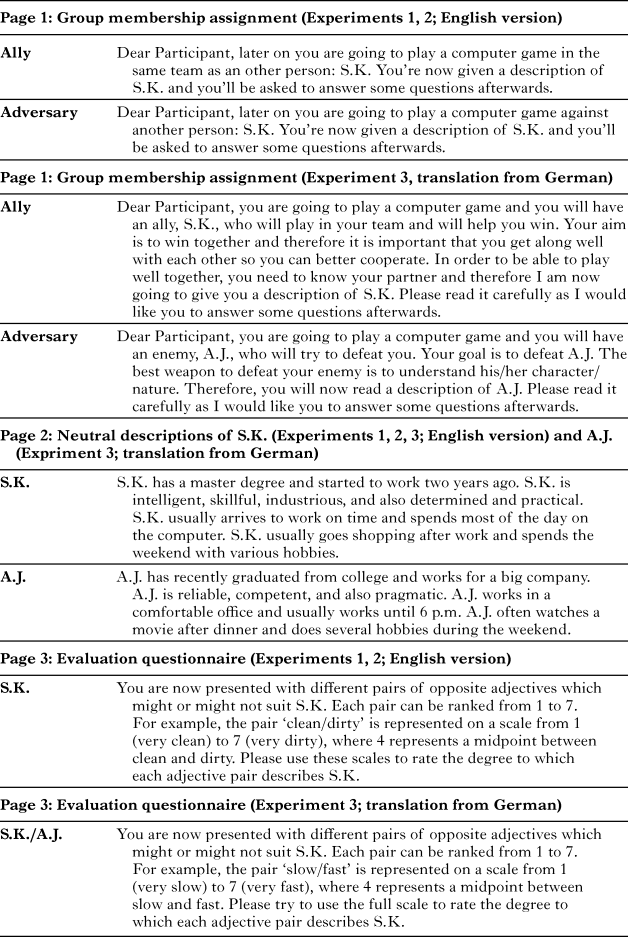
The experimenter met each participant at an entrance to Freie Universität Berlin. Participants were asked to carry a beverage for the experimenter as they walked to the experimental room (about 300 meters away). The beverage was hot or iced water, contained in a thin disposable paper cup. Once in the room, participants returned the cup without drinking from it and received an instruction booklet. The first page informed them that they would later play a computer game on the same team or against a hypothetical person referred to as ‘S.K.’
The second page contained a neutral description of S.K. (see instructions on Table 1). The third page contained the evaluation questionnaire, with instructions on how to rate S.K. on 7-point Likert scales. Five kindness-related scales (i.e., caring–selfish, generous–ungenerous, sociable–unsociable, agreeable–disagreeable, warm–cold*) and ten filler items (i.e., agitated–self-controlled, aggressive–unaggressive, impulsive–cautious, irritable–good-natured, hot-headed–cool-under-pressure,Footnote 1 happy–sad, honest–dishonest, talkative–quiet, serious–carefree, strong–weak) were included, with the extreme ends representing opposite traits. A unique header above all scales had the label ‘very much’ on points 1 and 7 and ‘in between’ on point 4. Two different randomized orders were used, whereby kindness-related and filler items were alternated, as well as the direction of the single scales. Further, the direction of each item (e.g., caring–selfish vs. selfish–caring) was reversed in a second version of each of the two randomizations. The metaphorical item (flagged with * above) always appeared last within the kindness category to make sure the metaphorical association would not be explicitly activated during the questionnaire completion.
Instructions

Awareness of the experimental manipulations was assessed after the experiment and then participants were debriefed. Experiment and debriefing lasted approximately 20 minutes.
2.1.3. Design and data analysis
Participants were randomly assigned to the hot vs. cold cup condition as well as to the ally vs. adversary condition in a between-subjects design. Two-by-two independent-measures ANOVAs with factors temperature (hot, cold) and group membership (ally, adversary) were conducted on the kindness ratings and filler ratings separately. We kept note of the temperature of the days in which testing took place. The experimenter was the same person throughout.
2.2. results
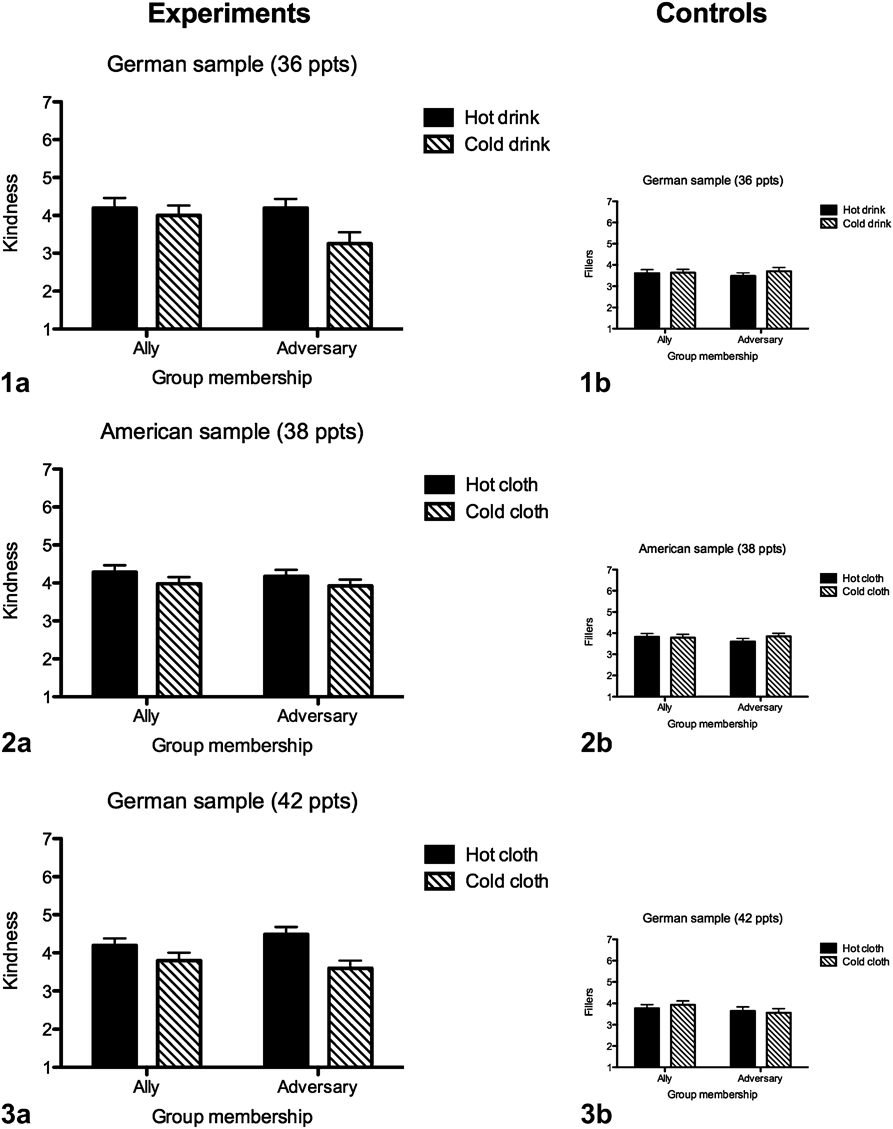
No participant reported being aware of any connection between the beverage temperature and the evaluation of S.K. A main effect of temperature on the kindness ratings was found (F(1,32) = 4.68, p = .038): participants primed with warm temperature rated S.K. as more kind (see Figure 1 for descriptive statistics). No effect of group membership and no interaction between the two factors was found (Fs(1,32) < 1.98, n.s.). Nevertheless, the descriptive statistics show a numerically large difference between warm and cold beverage in the adversary condition and almost no difference in the ally condition. Neither main effects nor an interaction were found on the filler ratings (Fs(1,32) < 0.52, n.s.). There was no difference in average day temperature between warm and cold cup conditions in Experiments 1, 2, or 3 (t(34) = 0.17; t(36) = 0.31; t(40) = 0.71; respectively).
Mean ratings of (a) kindness and (b) filler items, broken down by temperature and group membership conditions. Each row (1–3) represents a different experiment. Error bars represent standard errors of the mean.
2.3. discussion
Experiment 1 replicates Williams and Bargh’s (Reference Williams and Bargh2008) study in a German population. The hypothetical person was judged to be more kind after holding a hot cup than after holding a cold cup. Our second hypothesis that the effect would be stronger if the hypothetical person was perceived to be an adversary (member of an out-group) was not supported by the results, although we observed a numerical trend in the expected direction.
In order to be able to generalize our results to another type of temperature manipulation, we ran a second experiment in which participants were handed a hot or cold wet thick paper cloth to wipe their hands with. The second experiment took place in the US, and so English was used instead of German.
3. Experiment 2
3.1. material and methods
3.1.1. Participants
Thirty-eight native English speakers from Princeton University took part in the experiment (Mean age = 21 years, range = 18–56; 32 women). Participants were rewarded with either $8 or course credit.
3.1.2. Material and procedure
The experimenter met each participant at the entrance of the Psychology Department at Princeton and took them to the experimental room. Participants sat at a table and were given a hot vs. cold wet paper cloth, with which they were asked to wipe their hands because they were going to eat finger food later on. The cloth had been previously wet with tap water, gently wrung and laid on a plate; in the hot condition only, the cloth was microwaved for 2 minutes. After wiping their hands, participants were given the equivalent instruction booklet as in Experiment 1 (in English). The rest of the methods were identical to Experiment 1 except that, after the debriefing, participants were given a snack as promised.
3.2. results
All participants perceived the cloth as actually hot or cold and none of them reported being aware of any connection between cloth temperature and S.K. evaluation. A marginally significant effect of temperature on kindness ratings was found (F(1,34) = 2.78, p = .105), in the same direction as in Experiment 1. No effect of group membership and no interaction was found (Fs(1,34) < 0.24, n.s.). As in Experiment 1, no main effects and no interaction on filler ratings were found (Fs(1,34) < 0.96, n.s.).
3.3. discussion
The results only show a trend toward an effect of temperature on kindness ratings. A possible explanation for the failure to fully replicate the kindness results might be that, even though the hot cloth was properly hot, the cold cloth might not have been as cold as the iced beverage in Experiment 1. In fact, the temperature of participants’ hands could quickly transfer to the cloth and dampen the influence of the cold. Unlike in Experiment 1, inspection of the descriptive statistics (2a in Figure 1) shows no numerical difference in the temperature effect between ally and adversary conditions. We considered the possibility that our group membership assignment instructions might not be effective enough.
In order to address these issues, we ran a third experiment, again with German speakers, in which we again used the wet hot cloth, but this time we cooled the cold cloth with cold water. Further, we modified our instructions for group membership assignment to make them more effective.
4. Experiment 3
4.1. material and methods
4.1.1. Participants
Forty-two native German speakers from the Berlin area who did not previously participate in Experiment 1 performed the experiment (M = 31 years, range = 19–73; 24 women).
4.1.2. Material and procedure
The temperature condition assignment was identical to that of Experiment 2, except the cold cloth was made wet with cold water kept in the fridge. For the group membership assignment, slightly different and longer instructions were used (see Table 1). In addition, a second person description was created, A.J., to be certain results would generalize. Participants were randomly assigned to one of the two descriptions, which were counterbalanced across ally/adversary conditions. To make sure the descriptions were interchangeable, we ran a control study with twenty additional participants (M = 23 years, range = 20–31; 13 women), in which no temperature or group membership priming was given. We found no significant difference between S.K. and A.J in either kindness or filler ratings (ts(18) < 0.88, n.s.). Kindness for S.K. had (M = 4.12, SD = 0.51); for A.J. (M = 3.88, SD = 0.70). Finally, in the evaluation of the hypothetical person, the example pair ‘clean–dirty’ was replaced by ‘slow–fast’, as the former could be associated with the hand wiping.
4.2. results
All participants perceived the cloth as actually hot or cold and none of them reported being aware of any connection between cloth temperature and evaluation of the hypothetical person. A significant main effect of temperature on kindness ratings was found (F(1,38) = 7.70, p = .009), in the same direction as in Experiments 1 and 2. No main effect of group membership (‘ally’ vs. ‘adversary’) was found (Fs(1,38) = 0.44, n.s.). In addition, a marginally significant interaction appeared (F(1,38) = 2.82, p = .102); the descriptive statistics showed the same trend as in Experiment 1, i.e., a numerically larger temperature effect for the adversary compared to the ally condition. As expected, the filler ratings showed no main effects of either temperature or group membership (Fs(1,38) < 1.79, n.s.).
As an explorative, post-hoc analysis, we combined the German data from Experiments 1 and 3 in order to see whether the lack of a significant interaction in these studies might be due to low statistical power. We repeated the ANOVAs by adding the between-subjects factor experiment (1, 3) and now found that an interaction of temperature and group membership on kindness ratings was significant (F(1,74) = 4.70, p < .034). There was also a main effect of temperature (F(1,74) = 11.93, p < .001), and no effect of experiment (F(1,74) = 0.14, n.s.). No other significant interactions (Fs(1,74) < 2.41, n.s.). were found. Follow-up analyses revealed that the temperature effect was significant in the adversary condition only (F(1,34) = 16.45, p < .001), with no effect of experiment or interaction (Fs(1,34) < 1.92, n.s.). In the ally condition, no significant effects were found (Fs(1,36) < 0.80, n.s.). In the filler ratings, no main effects nor interactions were found (Fs(1,70) < 1.31, n.s.).
5. General discussion
This study builds on previous work showing that the physical experience of warmth, a concrete domain, leads to the implicit activation of kindness, a more abstract, affective domain (Williams & Bargh, Reference Williams and Bargh2008). We also aimed to determine if, by manipulating whether a hypothetical person was viewed as an ally or an adversary, we could see a modulation of the activation of the metaphor kindnessaswarmth. Since people tend to draw more extreme conclusions about people outside their own social circle or out-group members, we predicted that warmth would lead to enhanced kindness evaluations of a hypothetical adversary compared to a hypothetical ally (cf. Linville & Jones, Reference Linville and Jones1980).
Overall, our experiments showed reliable activation of the kindnessaswarmth metaphor, as revealed by significant effects of temperature on kindness ratings in Experiments 1 and 3 with German speakers (although only a marginal effect in Experiment 2 with English speakers). These results replicate Williams and Bargh’s results and generalize them to a German-speaking population. As a control, we used filler items that tapped into various other attributes including impulsivity, honesty, talkativeness, etc., and we found no effects of physical warmth on these ratings.
Numerical trends toward an interaction of temperature and group membership in the expected direction were only observed in Experiments 1 and 3. Given the consistent pattern and the marginally significant interaction found in Experiment 3, we combined the data from both studies in order to gain more statistical power. Once combined, our data supported the hypothesis of an enhanced effect of temperature on kindness in the adversary condition only, suggesting that social context may modulate the activation of the conceptual metaphor kindnessaswarmth. This finding may be explained by the fact that evaluations of out-group members are usually more extreme than those of in-group members (Linville & Jones, Reference Linville and Jones1980), and an adversary would naturally be viewed as an out-group member. That is, there seems to be a tendency to judge out-group members more strongly on the basis of meager evidence.
An alternative interpretation has to do with category-driven processes that require a degree of perceived fit between a member’s characteristics and the characteristics associated with a category. If the member does not fit the category, people will look for additional information to evaluate them (Fiske & Taylor, Reference Fiske and Taylor1991). In our studies, the neutral description of S.K./A.J. might not have fit with implicit expectations regarding an adversary, and therefore people may have relied on the additional temperature cue in order to evaluate them. The same descriptions might have been perceived as more compatible with a hypothetical ally.
A final note should be made on the fact that, as is evident in our Experiment 2 as well as others’ studies (cf. Pashler, Spellman, Kang, & Holcombe, n.d.), effects of metaphorical associations are subtle and not easy to replicate across tasks, materials, languages, and cultures. The present experiments suggest that additional investigations into contextual effects on the activation of conceptual metaphors may provide needed nuance to theories of embodied cognition.