1. Introduction
Motion is a domain that can be represented in distinct ways across languages and characterized by a set of underlying universal patterns (Talmy, Reference Talmy and Shopen1985, Reference Talmy2000a, Reference Talmy2000b, Reference Talmy, Guo, Lieven, Budwig, Ervin-Tripp, Nakamura and Özçalışkan2009). According to Talmy (Reference Talmy, Greenberg, Ferguson and Moravcsik1978), a motion event consists of six semantic components including Figure, Ground, Motion, Path, Manner, and Cause. From the perspective of lexicalization patterns of a motion event, namely how surface forms encode Manner and Path, languages in the world are categorized into two types: verb-framed languages (V-languages) and satellite-framed languages (S-languages) (Talmy, Reference Talmy2000b). To be specific, V-languages (e.g., Spanish, Japanese, and Turkish) express Path in the main verb and Manner in an adjunct, whereas S-languages (e.g., English, German, and Polish) encode Path outside the main verb leaving the verb free to lexicalize Manner. Talmy’s binary typology is particularly fruitful in the study of motion event expressions in a wide range of languages. However, it has been discovered that such a binary typology cannot be satisfactorily applied to a variety of serial-verb languages (e.g., Chinese and Thai). As Slobin (Reference Slobin, Strömqvist and Verhoeven2004) has argued, in such serial-verb languages, Manner and Path are simultaneously encoded in grammatical elements of equal status in verb compounds or co-verbs.Footnote 1 Therefore, the binary typology should be expanded to include a third type of language – equipollently framed languages (E-languages), in which both Manner and Path are expressed by elements that are equal not only in formal linguistic terms but also in force or significance.
The above discussion is mainly based on the morphosyntactic properties of languages. At the semantic or conceptual level, many scholars, particularly the team led by Slobin, have conducted empirical research and found that lexicalization patterns affect speakers’ conceptualization of motion events and the distribution of semantic components in discourse (e.g., Berman & Slobin, Reference Berman and Slobin1994; Ibarretxe-Antuñano, Reference Ibarretxe-Antuñano2004, Reference Ibarretxe-Antuñano, Guo, Lieven, Budwig, Ervin-Tripp, Nakamura and Özçalışkan2009; Slobin, Reference Slobin, Shibatani and Thompson1996, Reference Slobin, Niemeier and Dirven2000, Reference Slobin, Strömqvist and Verhoeven2004, Reference Slobin, Hickmann and Robert2006; Strömqvist & Verhoeven, Reference Strömqvist and Verhoeven2004). Plenty of these studies focus on inter-typological variation (i.e., variation between language types) and claim that S-language speakers use a larger variety of Manner verbs and express Manner more frequently than V-language speakers when describing motion (e.g., Allen et al., Reference Allen, Özyürek, Kita, Brown, Furman, Ishizuka and Fujii2007; Berman & Slobin, Reference Berman and Slobin1994; Gennari et al., Reference Gennari, Sloman, Malt and Fitch2002; Hickmann et al., Reference Hickmann, Taranne and Bonnet2009; Naigles et al., Reference Naigles, Eisenberg, Kako, Highter and McGraw1998; Strömqvist & Verhoeven, Reference Strömqvist and Verhoeven2004; Zlatev & Yangklang, Reference Zlatev, Yangklang, Strömqvist and Verhoeven2004). In addition, researchers have noticed intra-typological variation (i.e., variation within language types) and provided compelling evidence indicating that languages of the same type show significant variation in the level of Path and Manner elaboration (e.g., Fagard et al., Reference Fagard, Stosic and Cerruti2017; Filipović, Reference Filipović2007; Goschler & Stefanowitsch, Reference Goschler and Stefanowitsch2013; Lewandowski & Özçalışkan, Reference Lewandowski and Özçalışkan2021; Slobin, Reference Slobin, Strömqvist and Verhoeven2004). For instance, although both German and Polish are S-languages, German speakers convey more detailed Manner information in the main verb and use a larger variety of Manner verbs than Polish speakers (Lewandowski & Mateu, Reference Lewandowski and Mateu2016; Lewandowski & Özçalışkan, Reference Lewandowski and Özçalışkan2021). Moreover, there is a discernible increase in research on intra-linguistic variation (i.e., variation within particular languages) (e.g., Aske, Reference Aske1989; Croft et al., Reference Croft, Barðdal, Hollmann, Sotirova, Taoka and Boas2010; Feist & Duffy, Reference Feist and Duffy2020; Hendriks & Hickmann, Reference Hendriks and Hickmann2015; Lewandowski & Mateu, Reference Lewandowski and Mateu2020; Martínez-Vázquez, Reference Martínez-Vázquez2015; Özçalışkan, Reference Özçalışkan2005; Slobin & Hoiting, Reference Slobin and Hoiting1994). The debate on intra-linguistic variation dates back to Aske’s (Reference Aske1989) discussion of path phrases constraint in Spanish as a typical V-language. Specifically, locative path phrases allow the use of Manner verbs, whereas telic path phrases must appear with Path verbs. Slobin and Hoiting (Reference Slobin and Hoiting1994; see also Slobin, Reference Slobin, Shibatani and Thompson1996) then have noted the acceptability of the use of Manner verbs with telic path phrases in Spanish and provided a revision that Manner verbs are allowed when the event does not involve a crossing of a spatial boundary. Recent research (Fábregas, Reference Fábregas2007; Folli & Ramchand, Reference Folli, Ramchand, Verkuyl, de Swart and van Hout2005) has proposed that V-languages, including Spanish, Italian, and French, exhibit a split system that has a subset of satellite-framed constructions. There is also work revealing differences within particular languages based on Manner type (e.g., punctual vs. extended; e.g., Naigles et al., Reference Naigles, Eisenberg, Kako, Highter and McGraw1998; Özçalışkan, Reference Özçalışkan2015) or event type (e.g., self-motion vs. caused motion; e.g., Hendriks & Hickmann, Reference Hendriks and Hickmann2015; Lamarre, Reference Lamarre2003; Lewandowski, Reference Lewandowski2021; Lewandowski & Özçalışkan, Reference Lewandowski and Özçalışkan2018; Rohde, Reference Rohde2001).
Recurring observations about intra-linguistic variation have prompted researchers to shift the emphasis on various constructions within languages rather than distinct types of languages (Beavers et al., Reference Beavers, Levin and Tham2010; Croft et al., Reference Croft, Barðdal, Hollmann, Sotirova, Taoka and Boas2010). According to Croft et al. (Reference Croft, Barðdal, Hollmann, Sotirova, Taoka and Boas2010), “the Talmy typology is not a typology of how a language encodes complex events in general, but rather a typology of how particular complex event types are encoded by different constructions in a language” (p. 29). The choice of constructions may be influenced by factors such as event type, pragmatic rules, verb type, aspect, or transitivity (Hendriks & Hickmann, Reference Hendriks and Hickmann2015; Nikitina, Reference Nikitina, Ashbury, Dotlačil, Gehrke and Nouwen2008), resulting in scales of possible lexicalization patterns within languages.
In this article, we aim to further contribute to the ongoing debate on motion event encoding with a particular emphasis on intra-linguistic variation, by comparing actual motion and metaphorical motion. Actual motion depicts the objective movement in the physical world that concerns concrete entities (e.g., I walked into the room), whereas metaphorical motion describes the subjective movement in the human mind that involves abstract entities.Footnote 2 There are two possible configurations.Footnote 3 In the first, abstract entities are metaphorically construed as moving entities (e.g., the thought flew through his mind). In the second, they are conceived as physical locations with spatial configurations via a similar metaphor (e.g., she flew into a rage). In both cases, concrete entities in actual motion are mapped onto abstract entities in metaphorical motion.
Since metaphor involves a systematic mapping between a source domain and a target domain (Lakoff & Johnson, Reference Lakoff and Johnson1980, Reference Lakoff and Johnson1999), the typological properties in the source domain of actual motion are expected to extend to the metaphorical uses. Özçalışkan’s (Reference Özçalışkan2004, Reference Özçalışkan2005) studies of English and Turkish metaphorical motion reveal a greater variety of Manner verbs and a higher rate of encoding of Manner in English than in Turkish, echoing the patterns of actual motion. Similarly, Caballero and Ibarretxe-Antuñano (Reference Caballero, Ibarretxe-Antuñano, Pirrelli, Marzi and Ferro2015) maintain that the typological differences between English and Spanish in actual motion are sustained in the metaphorical uses of motion verbs in the domains of architecture, wine, and tennis. In contrast, Feist and Duffy (Reference Feist and Duffy2020) discover a preference for Path verbs in English temporal motion, a subdomain of metaphorical motion, which is not fully in line with the patterns observed in actual motion. These inconclusive research findings suggest that more work is needed to advance our understanding of metaphorical motion, especially the distinction between metaphorical motion and actual motion within languages. Indeed, the above studies concerning metaphorical motion have paid more attention to cross-linguistic comparison instead of intra-linguistic variation.
As for the language to be studied, we focus on Standard Mandarin Chinese for the following reason.Footnote 4 English, Turkish, and Spanish, whose metaphorical motion has been explored, are typical members of S-languages or V-languages. To wit, along the scale of the motion event typology, English lies at the S-end, whereas Turkish and Spanish are at the V-end. For each of these three languages, if there exists intra-linguistic variation, it can only happen in one direction. For English, variation can only occur toward the V-end, whereas for Turkish and Spanish, variation can merely take place toward the S-end. However, as far as Chinese is concerned, there has been much debate about its status in the motion event typology. Some scholars regard Chinese as an S-language (Li, Reference Li1993, Reference Li1997; Peyraube, Reference Peyraube, Hickmann and Robert2006; Shen, Reference Shen2003; Talmy, Reference Talmy and Shopen1985, Reference Talmy2000b), whereas others categorize it as an E-language (Chen & Guo, Reference Chen and Guo2009; Slobin, Reference Slobin, Strömqvist and Verhoeven2004). From an evolutionary perspective, Shi and Wu (Reference Shi and Wu2014) claim that Chinese is in a transitional state from the V-end toward the S-end and favors the S-end. In other words, Chinese lies between the two ends of the scale, and intra-linguistic variation could occur in both directions. Till now, it is not clear whether there exists significant variation between metaphorical motion and actual motion in Chinese, and if so, in which direction the variation will happen.
In summary, the current study intends to explore whether the typological properties of actual motion extend to metaphorical motion in Chinese with a corpus-based method. Both lexicalization patterns and semantic components distributed in discourse are examined. The reason is that, according to Shi et al. (Reference Shi, Yang and Su2018), the lexicalization pattern-based approach and the discourse-based approach do not strictly correlate with each other in every aspect and should be treated separately. Four research questions are raised:
-
I. Is the use of lexicalization patterns of metaphorical motion similar to that of actual motion in Chinese?
-
II. Is the distribution of semantic components of metaphorical motion similar to that of actual motion in Chinese?
-
III. If not, what factors account for the variation?
-
IV. What contributions can our approach (i.e., a comparison between metaphorical motion and actual motion) make to the debates on the motion event typology?
The remainder of this article is organized as follows: after outlining the methodology, we report and discuss the results. Then, some relevant conclusions are drawn in the final chapter.
2. Methodology
2.1 Data collection
The data for this study consisted of Chinese expressions of actual motion and metaphorical motion. The source for our data was the Lancaster Corpus of Mandarin Chinese (LCMC), a 1-million-word balanced corpus that consists of five-hundred 2,000-word samples of written Chinese texts excerpted from publications in Mainland China. It contains 15 text categories including press reportage, press editorials, press reviews, religion, skills/trades/hobbies, popular lore, biographical stories, reports/official documents, science/academic prose, general fiction, mystery/detective fiction, science fiction, martial arts fiction, romantic fiction, and humorous stories (McEnery & Xiao, Reference McEnery and Xiao2003).
We searched out 143 motion verbs from The Dictionary of Classification of Modern Chinese Verbs (Guo, Reference Guo1994), The Dictionary of Classification of Modern Chinese (Dong, Reference Dong2007), and previous studies on Chinese motion events (Chen & Guo, Reference Chen and Guo2009; Chu, Reference Chu2004; Han, Reference Han2007; Lin, Reference Lin2019; Shi, Reference Shi2014). Then, we used each of these verbs plus the part of speech tag, for example, ‘跑/v’ (the verb 跑 pao3 ‘run’), as the search item to get the concordances on the online website of the LCMC.Footnote 5 After downloading all the concordances, we checked each of them to identify the expressions of actual motion and metaphorical motion. It should be noted that this article merely discusses self-motion and leaves caused motion for future study because they are structurally distinct from each other. On the one hand, there is an additional semantic role in caused motion, namely the Agent. On the other hand, in caused motion, the Figure normally appears as the object, whereas in self-motion, the Figure is usually expressed as the subject.
To identify metaphorical motion expressions, we adjusted the Metaphor Identification Procedure (Pragglejaz, 2007) as follows: (i) For the motion verb in the text, establish its contextual meaning. That is, how it applies to an entity, relation, or attribute in the situation evoked by the text. Take into account what comes before and after the motion verb. (ii) For the motion verb, determine if it has a more contemporary meaning in other contexts than the one in the given context. For our purpose, basic meanings tend to be more concrete, more related to bodily action, more precise (as opposed to vague), or historically older. Basic meanings are not necessarily the most frequent meaning of the lexical unit. (iii) If the motion verb has a more basic and current-contemporary meaning in other contexts than the given context, decide whether the contextual meaning contrasts with the basic meaning and can be understood in comparison with it. (iv) If yes, mark the expression as metaphorical motion.
In the context of (1), for example, the motion verb 涨 zhang3 ‘rise’ indicates an increase in the price, whereas the basic meaning of this verb refers to an increase in the amount of water. The contextual meaning contrasts with the basic meaning. It can be understood through comparison: we can understand an abstract increase in the price in terms of a physical and concrete increase in the amount of water. Therefore, (1) is a metaphorical motion expression.

These expressions of metaphorical motion and actual motion were further divided into clauses with the criterion proposed by Berman and Slobin (Reference Berman and Slobin1994) that a clause is “a single predication expressing a unified situation (an activity, event, or state)” (p. 660). In total, we identified 636 clauses of metaphorical motion and 3,207 clauses of actual motion. To make the comparison between actual motion and metaphorical motion more convenient, we randomly selected 636 clauses from the 3,207 clauses of actual motion.Footnote 7
Since the choice of motion verbs of metaphorical motion may vary by genre (Caballero, Reference Caballero and Ibarretxe-Antuñano2017; Caballero & Ibarretxe-Antuñano, Reference Caballero, Ibarretxe-Antuñano, Pirrelli, Marzi and Ferro2015), to avoid overgeneralization, we divided the clauses of metaphorical motion and actual motion into the fiction part and the non-fiction part, respectively. The fiction part was from text categories including general fiction, mystery/detective fiction, science fiction, martial arts fiction, romantic fiction, biographical stories, popular lore, and humorous stories. The non-fiction part was from text categories including press reportage, press editorials, press reviews, religion, skills/trades/hobbies, reports/official documents, and science/academic prose. In this way, our data of metaphorical motion included 330 clauses from the fiction part and 306 clauses from the non-fiction part. The data of actual motion consisted of 325 clauses from the fiction part and 311 clauses from the non-fiction part.
2.2 Data coding and analysis
The collected clauses were coded by the authors who are native Chinese speakers according to five aspects: motion verbs, motion verb constructions, lexicalization patterns, alternative Manner expressions, and Ground expressions. The initial percentage agreement was 96%. All discrepancies were discussed until a consensus was reached.
Motion verbs were divided into four categories based on the information encoded in the verb. Manner verbs refer to those that express the way the motion is conducted. Path verbs denote those containing the course that a moving object (i.e., the Figure) follows, typically with respect to another reference landmark (i.e., the Ground). There are two subtypes of Neutral verbs. The first subtype designates verbs that express neither Manner nor Path, but solely indicate the movement of a Figure, such as ‘go/move’ in English, and 行 xing2 ‘go/move’ in Chinese. The second subtype refers to verbs that encode non-translational action, but in some constructions can express Manner of motion, such as 摸 mo1 ‘feel/touch’ in 摸到 mo1dao4 ‘feel one’s way to’. Additionally, Chinese has two Deictic verbs, which indicate the Path relative to the speaker. 来 lai2 ‘come’ means motion approaching the speaker, whereas 去 qu4 ‘go’ designates motion away from the speaker or toward a goal.
Although there is a general agreement in identifying prototypical Manner verbs like 飞 fei1 ‘fly’ and Path verbs like 进 jin4 ‘enter’, the classification of some less prototypical motion verbs is a controversial topic. For instance, 掉 diao4 ‘fall’ entails not only a downward direction of motion but also additional information that the motion is caused by gravity and that the Figure loses control of its movement. These verbs, which lexicalize both Manner and Path, are called MP verbs (Hsiao, Reference Hsiao2009; Zlatev & Yangklang, Reference Zlatev, Yangklang, Strömqvist and Verhoeven2004). Most previous studies on Chinese (e.g., Chen & Guo, Reference Chen and Guo2009; Hsiao, Reference Hsiao2009; Liu, Reference Liu2013; Shi et al., Reference Shi, Yang and Su2018) have placed MP verbs into Manner verbs, either because of the ease of the comparison or due to the fact that MP verbs like Manner verbs cannot act as directional complements or be linked with Deictic verbs. This study, for the same reasons, regards MP verbs as Manner verbs.
Motion verb constructions result from the serial-verb phenomenon in Chinese. The above four types of motion verbs occur alone or together, giving rise to various types of motion verb constructions including Manner + Path (M + P), Manner-only, Path-only, and Deictic-only. M + P constructions refer to those which encode the components of Manner and Path, such as MPD like 跑进来 pao3jin4lai2 ‘run into’ and MP like 走下 zou3xia4 ‘walk down’. NP like 摸到 mo1dao4 ‘feel one’s way to’ also belongs to this type because the Neutral verb is imposed with the meaning of Manner of motion by the construction (Goldberg, Reference Goldberg1995). Manner-only, Path-only, and Deictic-only constructions denote the constructions that merely have Manner verbs, Path verbs, and Deictic verbs, respectively. In addition, there exists a special type of motion verb construction: idioms or fixed expressions which typically include four syllables and are unanalyzable lexical items such as 直扑而来 zhi2pu1er2lai2 ‘straightly pounce and come’ and 蜂拥而下 feng1yong1er3xia4 ‘(a crowd) swarm down like bees’.
The clauses containing motion verb constructions (except idioms) were further categorized into three lexicalization patterns: verb-framed patterns (V-patterns), satellite-framed patterns (S-patterns), and equipollently framed patterns (E-patterns), based on how Manner and Path are expressed by surface forms. V-patterns are cases in which Path is lexicalized in the verb, whereas Manner is specified in an optional adjunct outside the verb, as in (2). S-patterns refer to those in which Manner is encoded in the verb, whereas Path is associated with a directional element outside the verb, as in (3).Footnote 8 E-patterns are constructions where the linguistic forms of Manner and Path have the same grammatical weight, as in (4). Since idioms or fixed expressions are unanalyzable lexical items and have a meaning that is not entirely derived from the components, they were classified into the category ‘others’ instead of these three patterns.


However, because each morpheme in the Chinese serial-verb constructions is morphologically unmarked (Ji et al., Reference Ji, Hendriks and Hickmann2011; Slobin, Reference Slobin, Strömqvist and Verhoeven2004), which pattern some M + P constructions should be categorized into is a controversial issue. For instance, the construction 走过 zou3guo4 ‘walk past/across’ in (5a) is regarded as an E-pattern by some scholars (e.g., Chen & Guo, Reference Chen and Guo2009; Slobin, Reference Slobin, Strömqvist and Verhoeven2004). They believe that the second constituent encoding Path is more akin to a verb than a satellite, since it can function as a predicate independently, as illustrated in (5b). By contrast, Talmy (Reference Talmy, Guo, Lieven, Budwig, Ervin-Tripp, Nakamura and Özçalışkan2009) takes 走过 zou3guo4 ‘walk past/across’ as an S-pattern by claiming that 过 guo4 as the V2 in (5a) has a different meaning from 过 guo4 as the sole verb in (5b). The former expresses a fairly common Path concept and the ‘experiential’ aspect – ‘to have already/ever V-ed’ – whereas the latter indicates that the Figure’s movement “was one within a succession of movements being observed from some distance by someone else” (p. 398). Only when the meaning of a morpheme in its V2 usage is the same as its meaning in its sole verb usage, can the serial-verb construction containing this morpheme as the V2 be considered as an E-pattern. As an illustration, 走进 zou3jin4 ‘walk into’ in (6a) is an E-pattern because 进 jin4 denotes ‘motion into’ both as the V2 in (6a) and as the sole verb in (6b). Talmy’s (Reference Talmy, Guo, Lieven, Budwig, Ervin-Tripp, Nakamura and Özçalışkan2009) criterion echoes with Shi’s (Reference Shi2014) investigation of the grammaticalization of Chinese Path verbs. Some Path verbs (e.g., 过 guo4 ‘pass/cross’, 去 qu4 ‘go’, and 起 qi3 ‘rise’) have gone further in the process of grammaticalization and developed new functions such as encoding tense and aspect than others (e.g., 出 chu1 ‘exit’, 到 dao4 ‘arrive’, and 进 jin4 ‘enter’). The former usually have divergent meanings in their V2 and sole verb usages, and their V2 forms are taken as a satellite subordinate to V1s. This article adopts Talmy’s (Reference Talmy, Guo, Lieven, Budwig, Ervin-Tripp, Nakamura and Özçalışkan2009) criterion in determining whether an M + P construction exhibits equipollent framing or satellite framing for a finer-grained analysis.


Alternative Manner expressions refer to those that describe the information about how a Figure moves without using Manner verbs. Three types of alternative Manner expressions were coded, including adverbials, verb complements, and descriptions of the ‘internal state or physical condition of a moving entity’ or ‘features of the physical setting that can influence Manner of motion’ (Özçalışkan & Slobin, Reference Özçalışkan, Slobin, Özsoy, Akar, Nakipoglu-Demiralp, Taylan and Aksu-Koç2003, p. 7).
Ground expressions are those providing information about a moving object’s reference landmark that constitutes the goal, the source, or the medium of the motion. Encoded outside the verb, Ground normally occurs in prepositional phrases which function as the adverbial, or appears alone as the subject or the object.
After the coding, metaphorical motion and actual motion in Chinese were compared in terms of lexicalization patterns and semantic components distributed in discourse. To check whether there exists significant variation between metaphorical motion and actual motion, the chi-square test was used through the software R (version 3.2.5). In addition, statistics of English and Turkish metaphorical motion from Özçalışkan (Reference Özçalışkan2004) were drawn upon for reference.
3. Results
3.1 Lexicalization patterns
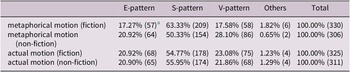
The lexicalization patterns that encode expressions of metaphorical motion and actual motion in LCMC are presented in Table 1.
Percentage of different types of lexicalization patterns in Chinese

a The numbers in parentheses indicate frequencies.
Table 1 reveals that S-patterns are the most prevalent lexicalization pattern in both metaphorical motion and actual motion. They are followed by V-patterns and E-patterns, respectively. ‘Others’ in the table refer to idioms or fixed expressions which cannot be categorized into any of the three patterns.
Although, in actual motion, there is no significant difference in the distribution of lexicalization patterns between different genres (χ 2(2) = 0.14, p = 0.93), metaphorical motion presents a distinct picture. In metaphorical motion, S-patterns in fiction (63.33%) have a significantly higher percentage than those in non-fiction (50.33%) (χ 2(1) = 10.44, p < 0.01), whereas the percentage of V-patterns in fiction (17.58%) is much lower than that in non-fiction (28.10%) (χ 2(1) = 9.46, p < 0.01).
When comparing metaphorical motion and actual motion, we find that in fiction, Chinese writers use more S-patterns (63.33% vs. 54.77%; χ 2(1) = 4.62, p < 0.05) but fewer V-patterns (17.58% vs. 23.08%; χ 2(1) = 2.73, p < 0.1) in the former than in the latter. However, in non-fiction, the situation is reversed. There are more V-patterns (28.10% vs. 21.86%; χ 2(1) = 2.88, p < 0.1) but fewer S-patterns (50.33% vs. 55.95%; χ 2(1) = 1.74, p = 0.19) in metaphorical motion than in actual motion. Since V-patterns merely concern Path-only constructions and Dectic-only constructions, the results suggest that the frequency of Path-only constructions and Dectic-only constructions is considerably increased in metaphorical motion from non-fiction.
3.2 Semantic components in discourse
3.2.1 Encoding of Manner and Path
This section presents the encoding of the Manner and Path information. We first look at motion verbs, and then alternative Manner expressions.
3.2.1.1 Motion verbs
Table 2 presents the type frequency of motion verbs in Chinese metaphorical motion and actual motion, along with a comparison with those used in English and Turkish metaphorical motion reported by Özçalışkan (Reference Özçalışkan2004).
Types of motion verbs

a The percentage in the parentheses is computed by dividing the type frequency of Manner, Path, or Neutral verbs by the total type frequency of motion verbs.
b This information is from Özçalışkan (Reference Özçalışkan2004).
c N/A means this information is not available.
As is shown in Table 2, there is no significant difference in the type frequency of motion verbs in metaphorical motion between different genres (χ 2(2) = 0.02, p = 0.99). Also, there is no pronounced difference in this aspect between metaphorical motion and actual motion in both fiction (χ 2(2) = 0.04, p = 0.98) and non-fiction (χ 2(2) = 0.02, p = 0.99). This similarity manifests that in Chinese, metaphorical motion has the same level of accessibility to the Manner and Path verb lexicon as actual motion.
In addition, the results indicate that compared with English and Turkish, Chinese falls between these two language types in the diversity of Manner verbs. Nevertheless, as to Path verb types, these three languages bear a resemblance. The most likely reason is that Path verbs, unlike Manner verbs, constitute a closed lexical category that does not offer many options for elaboration to writers of any language type (Özçalışkan, Reference Özçalışkan2004).
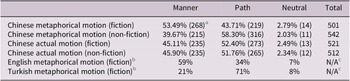
The token frequency of different motion verbs in Chinese metaphorical motion and actual motion is calculated in Table 3, along with a comparison with those in English and Turkish metaphorical motion. The statistics in English and Turkish metaphorical motion are reported in Özçalışkan’s (Reference Özçalışkan2004) study.
Percentage of different types of motion verbs

a The numbers in parentheses indicate frequencies. This information is not available for English and Turkish metaphorical motion in Özçalışkan (Reference Özçalışkan2004).
b This information is from Özçalışkan (Reference Özçalışkan2004).
c N/A means this information is not available.
Strikingly, in Chinese metaphorical motion, Manner verbs from fiction (53.49%) have a significantly higher percentage than those from non-fiction (39.67%) (χ 2(1) = 19.46, p < 0.001). By contrast, Path verbs from fiction (43.71%) have a significantly lower percentage than those from non-fiction (58.30%) (χ 2(1) = 21.60, p < 0.001). This reveals that in Chinese metaphorical motion, Manner is more salient in fiction than in non-fiction. Nevertheless, there is no discernible difference in the percentage of different types of motion verbs when comparing actual motion between different genres (χ 2(2) = 0.08, p = 0.96).
Comparing metaphorical motion and actual motion, we find that in fiction, Chinese writers use more Manner verbs and fewer Path verbs in metaphorical motion than in actual motion (Manner verbs: 53.49% for metaphorical motion, 45.11% for actual motion, χ 2(1) = 6.86, p < 0.01; Path verbs: 43.71% for metaphorical motion, 52.40% for actual motion, χ 2(1) = 7.38, p < 0.01). This suggests that in fiction, Manner is more salient in metaphorical motion than in actual motion. However, in non-fiction, the opposite comes up. Metaphorical motion has fewer Manner verbs and more Path verbs than actual motion (Manner verbs: 39.67% for metaphorical motion, 45.90% for actual motion, χ 2(1) = 3.93, p < 0.05; Path verbs: 58.30% for metaphorical motion, 51.76% for actual motion, χ 2(1) = 4.30, p < 0.05).
Whether in the token frequency of Manner verbs or that of Path verbs, Chinese still falls between English and Turkish. Compared with Chinese, English is closer to the S-end, one of whose distinctive features is using a larger and more diverse lexicon of Manner verbs (Slobin, Reference Slobin, Bybee, Haiman and Thompson1997).
3.2.1.2 Alternative Manner expressions
In addition to main verbs, there are lexical alternatives that can encode Manner in metaphorical motion, including adverbials as in (7), verb complements as in (8), and depictions of the physical setting that can influence Manner of motion (Özçalışkan & Slobin, Reference Özçalışkan, Slobin, Özsoy, Akar, Nakipoglu-Demiralp, Taylan and Aksu-Koç2003) as in (9). Specifically, example (9) describes the place that the northwest wind goes through as vast and mighty, implying the Manner of motion is direct and fierce.


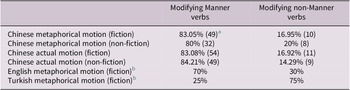
Concerning the function of the alternative Manner expressions, as presented in Table 4, in both Chinese metaphorical motion and actual motion, the majority of these lexical means are used to modify Manner verbs, thereby strengthening the Manner component. English is in a similar situation, whereas Turkish writers mainly use them with Path verbs to add the Manner information. Strikingly, Chinese writers use these alternative Manner expressions to accompany Manner verbs even more frequently than English writers do.
Percentage of alternative Manner expressions that modify Manner verbs or non-Manner verbs

a The numbers in parentheses indicate frequencies. This information is not available for English and Turkish metaphorical motion in Özçalışkan (Reference Özçalışkan2004).
b This information is from Özçalışkan (Reference Özçalışkan2004).
3.2.2 Encoding of Ground
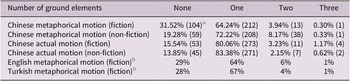
Ground is usually encoded outside the verb and can appear in different grammatical constituents. It can occur in prepositional phrases which function as the adverbial, as in (10), and appear alone as the subject or the object, as in (11) and (12). Table 5 presents the percentages of clauses that contain different numbers of Ground elements in Chinese. Statistics of English and Turkish metaphorical motion by Özçalışkan (Reference Özçalışkan2004) are also listed for comparison.


Percentage of the number of Ground elements attached to a single motion verb

a The numbers in parentheses indicate frequencies. This information is not available for English and Turkish metaphorical motion in Özçalışkan (Reference Özçalışkan2004).
b This information is from Özçalışkan (Reference Özçalışkan2004).
From Table 5, we find that Chinese actual motion applies more Ground elements than metaphorical motion in both fiction and non-fiction, which shares a similar situation with English and Turkish (Özçalışkan, Reference Özçalışkan2004). Additionally, in terms of Ground segmentation, there exist cross-genre distinctions in Chinese metaphorical motion. To wit, metaphorical motion from fiction has fewer Ground elements than that from non-fiction. One possible reason is that in non-fiction, there are a large number of cases mapping the elements in the economy or social phenomena onto moving entities with vertical motion, which often involves two or more Grounds (e.g., 国债指数从基数 100 上升到 100.6 guo2zhai4 zhi3shu4 cong2 ji1shu4 100 shang4sheng1dao4 100.6 ‘the government bond index rose from a base of 100 to 100.6’).
4. Discussion
The current corpus study has made a comparative analysis of actual motion and metaphorical motion in Chinese to explore whether the typological properties observed for actual motion extend to metaphorical motion. It examines not only lexicalization patterns but also semantic components distributed in discourse.
From the perspective of lexicalization patterns, Chinese displays the characteristics of an S-language because it takes S-patterns as its primary encoding strategy, but there exists discernible variation between actual motion and metaphorical motion. Specifically, metaphorical motion from fiction has the highest percentage of S-patterns, followed by actual motion from fiction or non-fiction and metaphorical motion from non-fiction. This result indicates that based on lexicalization patterns, along the scale of the motion event typology, Chinese favors the S-end. Moreover, within Chinese, metaphorical motion from fiction is the closest to the S-end, followed by actual motion from fiction or non-fiction, and metaphorical motion from non-fiction is the farthest.
This finding of Chinese as an S-language is inconsistent with the argument proposed by Chen and Guo (Reference Chen and Guo2009) that Chinese is an E-language. This inconformity is likely to result from the different approaches adopted. From the perspective of language use, Chen and Guo (Reference Chen and Guo2009) investigate semantic components distributed in Chinese fiction and maintain that Chinese writers do not align with writers of either S-languages such as English or V-languages such as Turkish. They then argue that the two elements in the M + P constructions have equal grammatical status, thus showing the characteristics of E-languages. However, as discussed above, based on morphosyntactic properties, only if a morpheme has the same meaning in its V2 and sole verb usages, can the V2 form of this morpheme be regarded as a main verb like the V1. Under this circumstance, the M + P construction containing this morpheme as the V2 can be taken as an E-pattern (Talmy, Reference Talmy, Guo, Lieven, Budwig, Ervin-Tripp, Nakamura and Özçalışkan2009). In our corpus, such E-patterns are not the primary encoding strategy. Additionally, our results differ from Shi et al.’s (Reference Shi, Yang and Su2018) claim that Modern Chinese is a parallel-framed language, although this article and Shi et al.’s (Reference Shi, Yang and Su2018) have adopted the same perspective – the lexicalization pattern-based approach. This difference can be attributed to the distinct methodologies employed. Shi et al. (Reference Shi, Yang and Su2018) find that S-patterns and V-patterns have an equal frequency in Modern Chinese by examining parallel texts comprised of self-motion expressions in Old Chinese (before the first century AD) and its Modern Chinese translation. However, what Shi et al. (Reference Shi, Yang and Su2018) neglect is that V-patterns are the primary encoding strategy in Old Chinese. When they are translated into Modern Chinese, translators may continue to use V-patterns to remain faithful to the original texts and avoid adding additional information. Hence, the percentage of V-patterns in Modern Chinese is increased.
From the perspective of semantic components distributed in discourse, Chinese is a Manner-salient language, but actual motion and metaphorical motion display varying degrees of Manner salience within it. The variation mainly lies in the token frequency of Manner verbs. They are most commonly used in metaphorical motion from fiction, followed by actual motion from fiction or non-fiction, and then metaphorical motion from non-fiction. As for alternative Manner expressions, there is no significant difference between metaphorical motion and actual motion. The majority of these expressions are used to qualify Manner verbs, thereby strengthening the Manner component. Chinese uses these lexical means to accompany Manner verbs even more frequently than English. One plausible explanation is that most Chinese Manner verbs are what Slobin (Reference Slobin, Bybee, Haiman and Thompson1997) names first-tier Manner verbs, which convey general Manner information, whereas English has more second-tier Manner verbs, which express specific Manner information. As a result, to elaborate on Manner, Chinese resorts to alternative Manner expressions with a higher frequency (Chen & Guo, Reference Chen and Guo2009; see also Lewandowski & Mateu, Reference Lewandowski and Mateu2016; Lewandowski & Özçalışkan, Reference Lewandowski and Özçalışkan2021, for a similar pattern in Polish).
In addition, Chinese is a Ground-insignificant language, which shows intra-linguistic variation. That is, the percentage of motion verbs carrying one or more Grounds in metaphorical motion is lower than that in actual motion. What is more, not only in Chinese but also in English and Turkish, fewer Grounds accompany metaphorical motion than actual motion (Özçalışkan, Reference Özçalışkan2004). This similarity in Ground segmentation of metaphorical motion differs from what has been observed in actual motion. Previous studies have demonstrated that in actual motion, S-languages such as English are more likely to attach multiple Grounds to a single motion verb than V-languages such as Turkish (Slobin, Reference Slobin, Shibatani and Thompson1996, Reference Slobin, Bybee, Haiman and Thompson1997). These findings may be attributable to event type. In metaphorical motion, mapping each Ground onto target concepts increases the processing load of human beings, so the number of Grounds is reduced (Özçalışkan, Reference Özçalışkan2004).
In sum, the results of this study do not support the claim that the typological effect that is evident in actual motion will unavoidably be observable in the metaphorical extensions (Özçalışkan, Reference Özçalışkan2005). In Chinese, both lexicalization patterns and the distribution of semantic components in metaphorical motion differ from those in actual motion. In addition to event type, the intra-linguistic variation also relates to genre. Furthermore, the observations in this study support the proposition that lexicalization patterns to some extent influence language use, namely semantic components distributed in discourse (e.g., Berman & Slobin, Reference Berman and Slobin1994; Slobin, Reference Slobin, Shibatani and Thompson1996, Reference Slobin, Niemeier and Dirven2000, Reference Slobin, Strömqvist and Verhoeven2004, Reference Slobin, Hickmann and Robert2006). As an illustration, metaphorical motion from fiction has the most S-patterns, leading to the highest degree of Manner salience, because S-patterns involve M + P constructions and Manner-only constructions. Slobin (Reference Slobin, Strömqvist and Verhoeven2004) has suggested that the world’s languages can be arranged along a cline of Manner salience, with some languages showing a higher degree than others do. Lewandowski (Reference Lewandowski2021, p. 18) contends that “Manner salience is a more complex and nuanced issue” by showing that caused motion elicits a greater diversity and number of Manner verbs than self-motion within a given language regardless of its typological status. Our results extend these previous findings with the evidence that the same language, that is, Chinese, can exhibit different degrees of Manner salience depending on not only event type but also genre.
Croft et al. (Reference Croft, Barðdal, Hollmann, Sotirova, Taoka and Boas2010) have made a constructional proposal of the motion event typology by claiming that there exist implicational relations between the specific situation types to be expressed and the constructions available. To be specific, along a scale of degree of morphosyntactic integration of the construction, from most to least integrated, as in (13), particular situation types tend to attract more integrated morphosyntactic constructions, whereas others are more likely to attract less integrated morphosyntactic constructions. We modify Croft et al.’s (Reference Croft, Barðdal, Hollmann, Sotirova, Taoka and Boas2010) scale to make it suitable to the specific situation of Chinese, as in (14). This customized scale also encodes the degree of morphosyntactic integration. In line with Croft et al.’s (Reference Croft, Barðdal, Hollmann, Sotirova, Taoka and Boas2010) suggestion, our results show that metaphorical motion from fiction attracts more S-patterns, whereas metaphorical motion from non-fiction appeals to more V-patterns. To put it another way, the former makes the variation along the scale in the leftward direction, whereas the latter causes the variation toward the right-hand side.


To account for why Chinese displays variation in both left- and rightward directions, multiple factors come into play, the first being the pragmatic context. According to Beavers et al. (Reference Beavers, Levin and Tham2010), options of constructions to encode motion events can be attributed to (i) the morphological, lexical, and syntactic resources available for expressing Path and Manner of motion; (ii) the properties of verbs; and (iii) extra-grammatical factors that give rise to preferences for certain options. Since metaphorical motion and actual motion in Chinese share access to the morphological, lexical, and syntactic resources in expressing Path and Manner, the variation can be attributed to the extra-grammatical factors, namely the pragmatic context.
In fiction, writers of metaphorical motion usually describe how the state of abstract entities changes rather than merely conveying the result of the change. Therefore, they use a large number of Manner verbs, giving rise to a high frequency of S-patterns and thus a leftward variation along the scale. For instance, if a writer wants to suggest that the thoughts are free to go anywhere like a bird, or that the thoughts are light and move without any goal, 飞 fei1 ‘fly’ and 飘 piao1 ‘drift’ are the most concise expressions for the writer to convey the above implications, as in (15a) and (15b). Moreover, in some cases such as (15c), merely expressing the result via V-patterns that do not contain Manner verbs is unacceptable.

By contrast, in non-fiction which is mainly comprised of news reports, official documents, and academic prose, writers of metaphorical motion simply underline the information of the result. Since the result is normally encoded in the Path verb or the Deictic verb (Rappaport Hovav & Levin, Reference Rappaport Hovav, Levin, Doron, Hovav and Sichel2010), the frequency of V-patterns significantly increases, which leads to the variation in the rightward direction. Indeed, we have identified abundant clauses describing elements in the domains of the economy or social phenomena (e.g., price, GDP, and ratio) in terms of vertical motion, which involves many V-patterns, such as 上升到 shang4sheng1dao3 ‘rise to’ and 下降 xia4jiang4 ‘decline’.
Another factor relates to the structural property of the Chinese language. S-patterns, V-patterns, and E-patterns are all commonly used, which offer writers different options depending on their pragmatic purposes. These diversified lexicalization patterns result from the diachronic evolution of Chinese. Old Chinese typically used single Path verbs, which were V-patterns. Later, the component of Motion separated from the component of Path, giving rise to serial-verb constructions. These constructions were initially E-patterns and some of them gradually shifted to S-patterns, because many V2s in the constructions became complements after grammaticalization. Since the typological shift of Chinese from a V-language to an S-language has not yet been achieved, these old and new constructions in the process of transformation remain in Modern Chinese (Shi, Reference Shi2011, Reference Shi2014). The coexistence of various lexicalization patterns also explains why Chinese presents a different picture from languages like English, Turkish, and Spanish, in which previous studies have shown that the typological properties in actual motion extend to metaphorical motion (Caballero & Ibarretxe-Antuñano, Reference Caballero, Ibarretxe-Antuñano, Pirrelli, Marzi and Ferro2015; Özçalışkan, Reference Özçalışkan2004, Reference Özçalışkan2005). English is a typical S-language, whereas Turkish and Spanish are typical V-languages. Their morphosyntactic and lexical resources limit writers to adopt distinct lexicalization patterns. For instance, in V-languages such as Turkish and Spanish, the preferred lexicalization pattern is a V-pattern, which conflates Path with Motion in the main verb. There exists no other easily codable linguistic slot to express Manner of motion. Consequently, in contexts where Manner is at issue, V-language writers normally draw on subordinated Manner verb constructions or adjunct Manner expressions to convey the Manner information, which involves heavier syntactic packaging (Özçalışkan & Slobin, Reference Özçalışkan, Slobin, Özsoy, Akar, Nakipoglu-Demiralp, Taylan and Aksu-Koç2003; Slobin, Reference Slobin, Strömqvist and Verhoeven2004). This syntactic overload becomes a blocking force for Turkish and Spanish writers to increase Manner expressions considerably in metaphorical motion from fiction.
A reviewer asked whether a similar asymmetry between actual motion and metaphorical motion could go beyond Chinese and be expected in other languages that have serial-verb constructions. Previous studies have shown that these languages like Vietnamese and Thai also have varied lexicalization patterns including S-patterns, V-patterns, and E-patterns (Han, Reference Han2011; Zlatev & Yangklang, Reference Zlatev, Yangklang, Strömqvist and Verhoeven2004). When writers have distinct pragmatic purposes, they can choose any of these resources freely and without additional syntactic load, just as Chinese writers do. In consequence, we anticipate that a similar inconformity between actual and metaphorical motion could be found in other languages that have serial-verb constructions. This needs further verification through empirical analysis, which is beyond the scope of this article.
5. Conclusion
Languages vary considerably in motion representation. The current corpus study further contributes to this field with a particular emphasis on intra-linguistic variation – a comparison between actual motion and metaphorical motion. Since metaphor involves a systematic mapping between a source domain and a target domain (Lakoff & Johnson, Reference Lakoff and Johnson1980, Reference Lakoff and Johnson1999), we would expect that the typological properties in the source domain of actual motion will extend to metaphorical motion. The aim of this article was thus to test this hypothesis with Chinese.
However, our findings reveal that there exists significant variation between metaphorical motion and actual motion within Chinese. From the perspective of lexicalization patterns, metaphorical motion from fiction is the closest to the S-end, followed by actual motion from fiction or non-fiction, and then metaphorical motion from non-fiction. Concerning the distribution of semantic components, metaphorical motion from fiction has the highest degree of Manner salience, followed by actual motion from fiction or non-fiction and metaphorical motion from non-fiction. As regards the encoding of Ground, fewer Grounds accompany metaphorical motion than actual motion in both fiction and non-fiction. In sum, both lexicalization patterns and the distribution of semantic components vary by event type and genre within Chinese.
To explain why Chinese exhibits variation in motion encoding, two factors should be noted. The first is the pragmatic context. In fiction, most metaphorical motion events intend to describe how the state of abstract entities changes instead of simply expressing the result of the change, which yields a high frequency of Manner verbs and S-patterns. By contrast, in non-fiction, the result is the writer’s emphasis. Hence, the frequency of V-patterns that encode the result increases pronouncedly. The second factor relates to the structural property of Chinese. The Chinese language has various commonly used lexicalization patterns, which provide writers with a wide range of options depending on their pragmatic purposes. This structural property is also the major reason why an asymmetry between actual and metaphorical motion is found in Chinese instead of other languages like English, Turkish, and Spanish (Caballero & Ibarretxe-Antuñano, Reference Caballero, Ibarretxe-Antuñano, Pirrelli, Marzi and Ferro2015; Özçalışkan, Reference Özçalışkan2004, Reference Özçalışkan2005). Along the scale of the motion event typology, English lies at the S-end, whereas Turkish and Spanish stay at the V-end. Their morphosyntactic and lexical resources restrain writers from choosing distinct lexicalization patterns.
The results in this article support Croft et al.’s (Reference Croft, Barðdal, Hollmann, Sotirova, Taoka and Boas2010) constructional proposal of the motion event typology. Along our modified scale of degree of morphosyntactic integration of the construction – S-pattern < E-pattern < V-pattern – metaphorical motion from fiction attracts more S-patterns, whereas metaphorical motion from non-fiction appeals to more V-patterns. This causes the variation along the scale to occur in both left- and rightward directions. The consideration of the scalar dimension allows for a clearer picture of variation within languages and contributes to more accurate explanations for these phenomena.
There are still issues that require further research. This study does not explore all possible types of Chinese metaphorical motion but concentrated on self-motion. Hence, some descriptions presented here may be particular to metaphorical self-motion. Future research could investigate metaphorical caused motion, so that the implications of this study can be fully examined. In addition, the cross-genre comparison between fiction and non-fiction is a coarse-grained contrast. In future studies, a more granular analysis could be made through comparison among metaphorical motion with different target domains (e.g., time and emotion) or with distinct specific genres (e.g., fiction, press release, and academic prose). Finally, apart from Chinese, we expect to find a similar asymmetry between actual motion and metaphorical motion in other serial-verb languages. However, this hypothesis requires to be validated further via extensive empirical research, so that the generalizability of the findings of this article can be assessed.
Acknowledgments
We would like to thank Prof. Qingshun He and Dr. Changqing Zheng for their assistance in revising this article. Thanks also go to the editors and to anonymous reviewers who contributed to improving an earlier version of this article.
Data availability statement
The motion verbs, analysis codes (R scripts), and the procedure of random selection with EXCEL are accessible in the Open Science Framework repository (https://osf.io/zfpk3/).
Funding statement
This study was supported by the National Social Sciences Foundation of China (Grant No. 22BYY070), the Humanities and Social Sciences Foundation of the Ministry of Education of China (Grant Nos. 21YJC740068 and 20YJA880040), the Philosophy and Social Sciences Planning Project of Guangdong Province (Grant No. GD22WZX02–08), and a Higher Education Teaching Reform Project of Guangdong University of Foreign Studies.
Competing interest
The authors declare no potential conflicts of interests with respect to the research, authorship, and publication of this article.
Appendix: motion verbs as the search items in LCMC
奔 ben1 ‘run’, 蹦 beng4 ‘jump’, 迸 beng4 ‘spurt’, 擦 ca1 ‘rub’, 踩 cai3 ‘step’, 蹭 ceng4 ‘inch’, 搀 chan1 ‘support with hand’, 撤 che4 ‘remove’, 沉 chen2 ‘sink’, 冲 chong1 ‘rush’, 出 chu1 ‘exit’, 触 chu4 ‘strike’, 穿 chuan1 ‘pass through’, 传 chuan2 ‘spread’, 闯 chuang3 ‘rush’, 戳 chuo1 ‘stab’, 刺 ci4 ‘stab’, 凑 cou4 ‘gather’, 蹿 cuan1 ‘leap’, 窜 cuan4 ‘flee’, 达 da2 ‘arrive’, 荡 dang4 ‘sway’, 倒 dao3 ‘fall’, 到 dao4 ‘arrive’, 登 deng1 ‘climb’, 蹬 deng1 ‘pedal’, 滴 di1 ‘drip’, 抵 di3 ‘arrive’, 掉 diao4 ‘fall’, 跌 die1 ‘fall’, 动 dong4 ‘move’, 渡 du4 ‘ferry’, 遁 dun4 ‘leave’, 踱 duo2 ‘walk’, 躲 duo3 ‘hide’, 翻 fan1 ‘overturn’, 飞 fei1 ‘fly’, 扶 fu2 ‘support with hand’, 拂 fu2 ‘whisk’, 浮 fu2 ‘float’, 赴 fu4 ‘go to’, 赶 gan3 ‘catch up with’, 跟 gen1 ‘follow’, 拐 guai3 ‘turn’, 贯 guan4 ‘pass through’, 灌 guan4 ‘pour in’, 逛 guang4 ‘stroll’, 滚 gun3 ‘roll’, 过 guo4 ‘cross’, 行 xing2 ‘move’, 划 hua2 ‘strike’, 滑 hua2 ‘slip’, 环 huan2 ‘surround’, 晃 huang4 ‘flash’, 回 hui2 ‘return’, 汇 hui4 ‘gather’, 击 ji1 ‘strike’, 集 ji2 ‘gather’, 挤 ji3 ‘shove’, 溅 jian4 ‘splash’, 降 jiang4 ‘descend’, 进 jin4 ‘enter’, 浸 jin4 ‘soak’, 聚 ju4 ‘gather’, 开 kai1 ‘away’, 跨 kua4 ‘stride’, 来 lai2 ‘come’, 离 li2 ‘leave’, 连 lian2 ‘link’, 临 lin2 ‘arrive’, 溜 liu1 ‘slide’, 流 liu2 ‘flow’, 遛 liu4 ‘stroll’, 拢 long3 ‘gather’, 掠 lve4 ‘sweep’, 落 luo4 ‘fall’, 迈 mai4 ‘stride’, 漫 man4 ‘overflow’, 冒 mao4 ‘emit’, 摸 mo1 ‘feel/touch’, 没 mo4 ‘overflow’, 挪 nuo2 ‘move’, 爬 pa2 ‘climb’, 攀 pan1 ‘climb’, 跑 pao3 ‘run’, 澎湃 peng2pai4 ‘surge’, 碰 peng4 ‘bump’, 漂 piao1 ‘float’, 飘 piao1 ‘drift’, 扑 pu1 ‘pounce’, 骑 qi2 ‘ride’, 起 qi3 ‘rise’, 迁 qian1 ‘move’, 翘 qiao4 ‘raise’, 沁 qin4 ‘ooze’, 驱 qu1 ‘drive’, 去 qu4 ‘go’, 绕 rao4 ‘surround’, 入 ru4 ‘enter’, 洒 sa3 ‘sprinkle’, 散 san4 ‘scatter’, 闪 shan3 ‘flash’, 上 shang4 ‘ascend’, 射 she4 ‘shoot’, 伸 shen1 ‘stretch’, 渗 shen4 ‘ooze’, 升 sheng1 ‘ascend’, 驶 shi3 ‘drive’, 输 shu1 ‘transport’, 摔 shuai1 ‘fall’, 甩 shuai3 ‘throw’, 踏 ta4 ‘step’, 弹 tan2 ‘spring’, 淌 tang3 ‘drip’, 逃 tao2 ‘escape’, 腾 teng2 ‘jump’, 跳 tiao4 ‘jump’, 通 tong1 ‘go to’, 透 tou4 ‘penetrate’, 退 tui4 ‘retreat’, 袭 xi2 ‘attack’, 下 xia4 ‘descend’, 陷 xian4 ‘sink’, 淹 yan1 ‘overflow’, 延 yan2 ‘extend’, 掩 yan3 ‘cover’, 扬 yang2 ‘raise’, 漾 yang4 ‘ripple’, 移 yi2 ‘move’, 溢 yi4 ‘overflow’, 引 yin3 ‘lead’, 迎 ying2 ‘move toward’, 涌 yong3 ‘gush’, 游 you2 ‘swim’, 跃 yue4 ‘jump’, 越 yue4 ‘cross’, 陨 yun3 ‘fall’, 扎 zha1 ‘stab’, 涨 zhang3 ‘rise’, 罩 zhao4 ‘cover’, 逐 zhu2 ‘chase’, 转 zhuan3/zhuan4 ‘turn’/‘revolve’, 撞 zhuang4 ‘strike’, 追 zhui1 ‘chase’, 坠 zhui4 ‘fall’, 走 zou3 ‘walk’, 钻 zuan1 ‘duck’, 坐 zuo4 ‘sit’.