

INTRODUCTION
This article explores how portrayals of Javanese and Indonesian (Bahasa Indonesia) in language policy, the media, and educational settings might lead to enregisterment, and whether and to what extent such indexical associations are appropriated by Javanese-Indonesians. In particular, I look at how Javanese and Indonesian are portrayed through government language policy, schools, rituals and the mass media. I then argue that such representations contribute to the formation of associations of context with language, which in turn are available to be appropriated in situated talk. In doing so, I draw on data gathered in an as yet under-studied Indonesian context: departmental meetings in Indonesian government offices. The data presented were gathered as part of fieldwork carried out in a government office in Semarang, the capital city of the province of Central Java, Indonesia. Planning for the collection, analysis, and presentation of these data was informed by sociological and sociolinguistic discussions about the relationship between action and social structure, as set out below.
RELATIONSHIPS BETWEEN ACTION AND SOCIAL STRUCTURE
In this section I argue for a fluid theory of the relationship between structure and interaction or talk and context. Such a position has been championed by a number of sociologists (e.g., Giddens 1984, Goffman 1983, Gubrium & Holstein 1997) and numerous sociolinguists (e.g., Agha 1998, 2003; Coupland 2001; Gumperz 1982; Heller 1988; Ochs 1988, 1990; Rampton 1998; Stroud 1998; Woolard 1985).
Goffman (1983:11), for example, has argued that social structures do not determine ways of speaking but merely provide a repertoire of information to draw on in interaction. Giddens's work is another example of how the relationship between structure and interaction can be theorized. Where Giddens 1984 differs from Goffman is in his fleshing out of how the routinization of social practices over time and across space can relate to the formation of social systems.
One way of seeing this in linguistic terms is to liken this process to that of enregisterment (cf. Agha 2003), whereby linguistic forms become associated with particular social structures and characteristics (such as class, politeness, etiquette, and so on) over time and across space (e.g., Agha 1998, 2003). As Agha 2003 argues, this process of association relies on the existence of metadiscourses about language use that might initially be found in dictionaries and prescriptive grammars, and then later in more widely accessible books on etiquette, novels, newspapers, magazines, radio, and television. Such metadiscourses often concern or develop into discourses about the type of people who habitually speak a certain variety of a language (Agha 2003:242).
This process of attaching cultural value to linguistic forms is dependent on individuals' access to or participation in speech chains. Essentially, a speech chain consists of a speech event containing the type of metadiscourse noted above, along with senders and receivers. Typically, speech chains do not involve whole populations; thus, while many people may understand a certain variety of language as well as be aware of its relationship with certain types of social structures and social characteristics, far fewer people will be competent in speaking that particular variety (Agha 2003:260). The extent to which members of a population share and pass on ideas about the cultural value of a particular language variety depends not only on their exposure to that variety, but also on their willingness to identify with and to use such a culturally valued language variety in their own interactions (Agha 2003:243–44). This process accelerates when the cultural value of a certain language variety is given authority or legitimized through public schools, as has been the case in Britain (Agha 2003:260–65).
In summary, in cases where the above factors are found and where populations align themselves with the cultural value of a certain variety, indexical relationships between language and context tend to become fixed or “enregistered.” However, this fixedness can be and is influenced by the comings and goings of role models who use enregistered varieties. For example, just as a role model's usage of an enregistered variety can play a role in the reproduction of this variety, subtle changes in the meaning of an enregistered variety can also occur when this variety is appropriated for other purposes.
This process highlights the strategic and performative nature of interaction, whereby an enregistered variety can be used as a “contextualization cue” (cf. Gumperz 1982) in order to “recontextualize” (cf. Bauman & Briggs 1990:74–76) an ongoing interaction. For example, an enregistered variety can be appropriated and recontextualized to indicate a change in “footing” (e.g., Goffman 1981), participant relationships, topic, epistemic stance, and so on. Through such appropriation and recontextualization, subtle changes or additional meanings become attached to an enregistered variety (cf. Bakhtin 1981). Acknowledging that in interaction the meanings attached to enregistered varieties are negotiated suggests that such varieties provide “constituting possibilities” for both speaker and hearer in situated interaction (e.g., Mäkitalo & Säljö 2002:63). At the same time, it also provides insight into how additional contextual information becomes indexed to enregistered varieties.
The discussion above should also highlight the theoretical and methodological difficulties in treating social structures and social action as distinct entities and/or in a cause–effect relationship, because they are “mutually constitutive” (cf. Gubrium & Holstein 1997:119). According to Gubrium and Holstein, the teasing out of the complex relationships between social structures and interaction and the production of thicker interpretations thereof requires using multiple approaches in a way that neither privileges nor presents any one approach as providing the reality. Thus, ethnographically recoverable information about social structures at national, regional, and local levels and information about attitudes or metadiscourses about certain languages and their speakers provide participants and researchers alike with resources for interpretation (Gubrium & Holstein 1997:205). By using these approaches in conjunction with interactional sociolinguistics (e.g., Gumperz 1982, Tannen 1984), analysts can see how such ethnographically recoverable information is appropriated and recontextualized and/or reproduced in face-to-face interaction.
ASSOCIATIONS BETWEEN LANGUAGE AND INDONESIAN SOCIETY
In this section I present historical information about the wider context of Javanese-Indonesian bilingualism. In particular, I will (i) explore how Javanese and Indonesian are portrayed through government language policy, schools, rituals and the mass media; (ii) explore how this relates to the process of enregisterment; and (iii) argue that this process of association of context to language over time and across space represents knowledge that Indonesians can appropriate in talk.
Javanese
Research on Javanese has shown that its usage varies quite significantly according to factors such as generation, gender, economic status, urban vs. rural background, region, purpose, class, or social group (e.g., Bax 1974; Errington 1985, 1988, 1998; Kartomihardjo 1981; Smith-Hefner 1988; Wolff & Poedjosoedarmo 1982). Even so, a common finding of many of these studies is the asymmetric exchanges of Javanese. These exchanges were usually explained in terms of power inequalities that existed among participants, such as differences in age, education, income, wealth, occupation, and royal or commoner status.
For example, Wolff & Poedjosoedarmo (1982:29) reported that there were three main Javanese codes, kromo, madyo and ngoko, which can be identified by the presence or absence of particular words and affixes. Table 1 provides some example of this. Ngoko was described as the base variety all Javanese learn and use in intimate situations (Wolff & Poedjosoedarmo 1982:17–39). With a vocabulary of around 1000 words, non-ngoko forms, such as madyo, were described as the language used among non-familiars, while kromo was the language used on formal occasions and speeches, and for conversations among, or to, nobility (e.g. Poedjosoedarmo 1968; Wolff & Poedjosoedarmo 1982:17–39).
Examples of words and affixes defining Javanese speech levels (adapted from Wolff & Poedjosoedarmo 1982:30).

Just as importantly, Wolff & Poedjosoedarmo (1982:4–5, 15, 24–27) noted that inequalities between participants in terms of age and/or status often led to asymmetric exchanges of Javanese. For example, a lower-status interlocutor might use kromo varieties to a higher-status speaker and receive ngoko varieties in return (in their study, status included considerations such as wealth, occupation, education, and to a lesser degree, noble background). In addition to the main vocabulary sets noted above, there were two others: The first, described as kromo inggil, literally ‘high Javanese’, consists of words and terms of address that honor or elevate the addressee and his or her actions (e.g. Errington 1985, 1988; Poedjosoedarmo 1968; Wolff & Poedjosoedarmo 1982). The second set, called kromo andhap, consists of words that humble the speaker and his or her actions (Figure 1 summarizes this usage).

Symmetrical and asymmetrical exchanges of Javanese.
While asymmetric exchange of Javanese is a theme common to many of the studies mentioned above, very few Javanese in fact have competence in the appropriate use of “exemplary” high Javanese (i.e., asymmetric exchanges and the use of kromo plus kromo andhap and kromo inggil). They now consist only of speakers above 70 years old, those associated with the two kratons ‘kingdoms’ located in Solo and Yogyakarta (Errington 1985), ritual specialists such as those who speak at weddings (Errington 1998:69–70), dhalang ‘puppeteers’ who perform wayang kulit ‘shadow puppet plays’ (Keeler 1987), and those performing in wayang orang ‘dance drama’ or other forms of Javanese theatre, such as Kethoprak (Siegel 1986). As Errington's (1985), Smith-Hefner's (1989), and Goebel's (2000) studies have shown, there is now a move toward the types of symmetrical exchanges of Javanese shown in (a) and (b) of Figure 1.
Even so, the Indonesian government has also been active in preserving Javanese through what Errington (1998:70) sees as the “ethnicization” of language, whereby Javanese ethnicity is presented as a custom associated with exemplary Javanese and standardized rituals. This process has its roots in the Indonesian constitution (Chapter XV, Article 36), which preserves bahasa daerah ‘regional languages’ (Anwar 1980:137). Nababan (1991:124) and Lowenberg (1992:24) have noted that this preservation is carried out initially by the government's Ministry of Education – which sets out the national curriculum for the teaching of languages – and then again, at provincial level, through the schooling system (Lowenberg 1990, Nababan 1985).1
Since the late 1990s there has been political decentralization with the devolution of powers, including those relating to the setting of curriculum at provincial and local levels.
Examples of centrally approved curriculum manifest as syllabus for the teaching of Javanese at primary school and middle school are easily found (Soeparto & Soetarno 1990, Soetarno 1989). In Soeparto & Soetarno's (1990:7–8) textbook for third graders, for instance, there are clear examples of heavily asymmetric exchanges between a mother and her child at home. In line with the earlier exemplary exchanges, the son uses kromo forms of Javanese to his mother, while his mother uses ngoko Javanese forms.
Javanese living in Central Java are also exposed to exemplary Javanese through the mass media. For example, while I was in Semarang from 1996 to 1998, I was able to record exemplary exchanges of Javanese used in comedy shows, dramas about old kingdoms, educational dramas, and other programs broadcast on government-owned television and radio stations.
In summary, while there are very few Javanese who have the competence to speak exemplary Javanese, a much wider population is exposed to this model of exchange. We could expect that this exposure would play a role in the enregisterment of Javanese. At the very least, this would mean that a large proportion of Javanese in Central Java would recognize exemplary usage and accordingly be able to appropriate aspects of it for use in their own talk.
Indonesian
Bahasa Indonesia, here called “Indonesian,” the national language of Indonesia, has its roots in a variety of Malay that was reportedly used as a lingua franca along the coasts of Indonesia's many thousands of islands for at least a millennium (Lowenberg 1990:110). From 1865 onward, Malay was developed as a language of schooling and administration by the Dutch colonial administration (Lowenberg 1990:111), and finally it was codified and adopted as the national language of Indonesia after Indonesian independence in 1945 (Abas 1987, Anwar 1980, Lowenberg 1990). As the national language, Indonesian has been used as the language of education,2
The 2003 amendments to the Indonesian constitution (Ruling number 20, Chapter 4, Article 1.1 and Chapter 7, Article 33.2) state that children must attend school from age 7, and that Indonesian is to be used as the language of education in the early years unless a lack of competence in Indonesian on the part of the child necessitates the use of a regional language. While previous research reported that Indonesian was used as the language of instruction after the third grade (e.g. Nababan 1991), I would expect that in practice there would be much variability depending on province, the area within that province, the socioeconomic background of the students, the individual school policy, the resources available, and individual teaching styles.
Recent research has shown that interethnic conversations are not always conducted in Indonesian (Goebel 2002); nevertheless, we might also expect that use of Indonesian in the above-mentioned contexts would lead to enregisterment to the extent that “indexical” (cf. Ochs 1990) associations between certain contexts and Indonesian would form over time. Indeed, Errington (1998:59) has argued that the project of modernization and development in Indonesia has resulted in indexical associations between Indonesian and third person, impersonal, evaluative, expert, or authoritative contexts.
Having briefly discussed the language setting and how this provides Javanese-Indonesians with some “constituting possibilities,” in the following sections I look at whether, and to what extent, such knowledge is actually used in talk.
DATA GATHERING
My data on talk were gathered during fieldwork carried out from September 2003 until February 2004 in a government department within Central Java's provincial public works bureau (not the real name of the bureau), located in Semarang, the capital city of Central Java. I initially visited this department each day for around half a day (alternating between mornings and afternoons) to identify who might be willing to participate and where and when I might make recordings. From this it soon became clear that this was a very busy department. Accordingly, I was concerned about the negative influence my presence would have on the ability of staff to perform their everyday duties. As a result, I reduced my visits to one to two times per week, and concentrated on arriving in the last hour of work (2:30–3:30), when the staff reported that usually most of their tasks were complete.
This, and the fact that the head of department was promoted and moved to another building in January 2004, meant that I was unable to make recordings in settings other than two staff meetings and a farewell party. Even so, these three sessions allowed me to make 5.5 hours of audio-video recordings. I was also able to record 10 hours of interviews, and to participate in and observe many face-to-face conversations in the office setting. The transcription and encoding of language varieties was done using information from a number of Indonesian research assistants, Javanese and Indonesian dictionaries (e.g., Echols & Shadily 1992; Prawiroatmojo 1989, 1993; Sudaryanto 1991), my own knowledge of Javanese and Indonesian, and later post-recording interviews with participants using transcripts of the talk as stimulus for discussions about language usage.3
While this approach may have focused participants' attention on something that they normally wouldn't notice, I could not play back these recordings to them as done in the work of Gumperz 1982 and Rampton 1995. This was not a realistic alternative because of the length of these (1.5 hours), the consequent imposition of having the participants listen/watch such long recordings, and the time constraints set by my institution.
CLASSIFYING LANGUAGE ALTERNATION
In this section I describe how I classify language alternation in my data. In doing so, I will also show that language choice differs from the earlier descriptions of Javanese usage noted previously. In particular, I point out that associations between forms and identities are context-specific.
In what follows I draw on Gafaranga & Torras's (2002:11) framework for classifying language alternation. However, I have not been able to be faithful to their framework's ethnomethodological underpinnings. This is so because their classification framework relies on the existence of metatalk about the appropriateness of particular language alternations in an ongoing interaction. Such metatalk did not occur in my data. Indeed, the only category that retains some of their original meaning is “code alternation as the medium.” I use this category to classify talk where participants make no comment about the appropriateness of alternating between two codes, either in subsequent talk or in post-recording interviews. Such alternation might resemble the following pattern (adapted from Auer 1995): AB1 AB2 AB1 AB2 (the upper case letters represent a particular language variety, and the numbers indicate participants 1 and 2).
In determining whether a particular alternation represents “alternation as medium repair,” I take a sequential look at the language choices made by all speakers involved in the particular setting. Such an approach focuses on whether language alternation seems to be deviant compared with other habitual patterns of language alternation that occur within that setting. This approach also focuses on whether a particular alternation leads to further alternation into a language that is then used for a number of turns, such as can be seen in the following pattern: A1 B2 A1 B2 A1//A2 A1 A2 A1. I use the term “code-switching” to classify language alternation that has attracted metatalk in post-recording interviews with participants. Often this metatalk suggests motivations for a speaker's alternation. Code-switching can be illustrated with the pattern A1 A2 B1 A1 A2.
The data on talk that I use in the following four extracts were all taken from a staff meeting that I audio-video recorded in the public works bureau on a Sunday morning. This meeting was called at short notice by the head of this department, whom I will call Pak Ismail, after he had been asked by his boss to check final preparations for an event that his department was coordinating the following Tuesday. Eleven of Pak Ismail's fourteen staff were present (to preserve anonymity I have changed all participants' names). The talk in ex. (1) below begins 5 minutes into the meeting. It occurs just after Pak Ismail has explained that they are there on a Sunday morning to check final preparations because of some worries his immediate boss had with their preparations and the fact that a similar event held previously had not gone well.

As we can see in (1), most of Pak Ismail's talk is in Indonesian (roman type), although he also uses ngoko Javanese (bold roman) in lines 4–6 and 17–21 (bold italics represent ambiguous forms that can be classified as either ngoko Javanese or Indonesian).4
In addition to the font conventions mentioned, the following represent the remaining transcription conventions found in all extracts:

Drawing on the classification framework set out at the start of this section, we can see that Pak Karno makes no comment about the appropriateness of Pak Ismail's use of Javanese. Moreover, Pak Karno does not reciprocate using Javanese, but rather uses Indonesian. We thus have to ask whether this alternation is relevant to the participants. It may be that what we as analysts are seeing is interpreted by participants as one medium – that is, “code alternation is the medium.”
Second, if we looked only at Pak Karno's subsequent utterance, then we might classify it as an instance of “alternation as medium repair.” That is, because his turn is conducted in Indonesian, it might possibly be taken to indicate that Pak Karno interprets Pak Ismail's choice of NJ as deviant. However, if we look at the larger conversation of which this extract is a part (ex. 2 below follows on immediately from ex. 1), then we see that most speakers (including Pak Karno) used IN. It is also worthy of note here that the pause following Pak Ismail's turn isn't overly long compared with those that occurred in his earlier interactions with staff. This also makes it unlikely that the pause signals that Pak Karno has perceived Pak Ismail's language choice as inappropriate; rather, it just signals the end of a conversational turn. Accordingly, we might classify Pak Ismail's use of Javanese as an instance of “code-switching”.
By bringing participants' commentaries into the analysis of this interaction, we can formulate some possible answers as to which of the three alternative classifications is appropriate. The first categorization – that is, “code alternation is the medium” – is unlikely given Pak Karno's post-interaction explanation of his transcribed talk, where it appears that he recognized this alternation into NJ by noting that it was indicative of Pak Ismail's wish to keep the interaction friendly and family-like. That is, he recognized this as alternation and not just one code or medium, even though at the actual time of his interaction with Pak Ismail he did not comment about the appropriateness or otherwise of his or Pak Ismail's language choice.
The second categorization – “alternation as medium repair” – has been argued to be unlikely because examination of subsequent talk indicates that the use of ngoko Javanese by Pak Karno in this meeting is uncommon. This leaves the third category, code-switching. Such an interpretation is further supported if we consider other conversation-external information – gained through observation of these participants' conversations elsewhere – which suggests that both speakers were competent in IN and NJ to the extent that they could have used the IN equivalents of any of the NJ forms had they wished, and vice versa. Thus, the usage above does not relate to competence or incompetence on the part of the speakers: They actually had a choice.
Recourse to other conversation-external data also allows us some insight into why participants might code-switch. For example, in my discussions with Pak Ismail about his language use here (and in this and other meetings more generally), he noted that he mixed NJ with IN in an unpatterned way (campur aduk) as a strategy to bring a more informal feeling to meetings. He also noted that he used NJ to change his position vis-à-vis his staff from boss to friend or equal colleague, especially in situations where a group effort was needed. In post-recording interviews, using transcripts of this talk as focus points, Pak Ismail's staff said that they also interpreted Pak Ismail's use of NJ in this and other meetings as making things more akrab ‘friendly’, though only one noted the link with non-formality, and none noted the other associations.
What the analysis thus far suggests is that ngoko Javanese (NJ) may have functioned as a contextualization cue indexing several possible contexts (e.g. familiarity, informality, and addressee selection). We have also been able to see how this relates to possible footing changes. This analysis also starts to address questions regarding whether and to what extent such alternations may be motivated or planned, insofar as we can believe the reasons Pak Ismail gave for using such forms. This “motivational” theme will be pursued further in the following extract, where it appears that Pak Ismail draws upon the contextualization potentials of certain kromo forms to change his identity relative to his staff.

As in (1), most of the talk in (2) is in Indonesian (IN), although this time in addition to one NJ form (line 62) Pak Ismail also uses kromo inggil Javanese (BOLD ITALIC CAPS) on lines 30 and 63, and kromo andhap Javanese () on lines 47 and 56. Starting with a micro-analytic view of the talk, we can see that Pak Ismail uses the same medium (Indonesian) as did Pak Karno in (1), but then, when Pak Ismail addresses Pak Karno, he again does this via alternation from Indonesian into Javanese: ngoko Javanese (NJ) and kromo inggil Javanese (KIJ) on lines 62 and 63. Following the same argument as offered in connection with (1), here we could argue that the instances of Javanese usage are instances of code-switching rather than medium repair (on the part of Pak Karno) or code alternation as the medium.
We can further support this argument from a micro-analytic standpoint if we focus on the kromo andhap Javanese (KAJ) forms being preceded by longish pauses of 0.6 to 0.7 seconds and followed by drawn-out a: ‘a:’ (perhaps a pause strategy while thinking) and sehingga ‘so that’. Taken together, we might suggest that they represent some sort of dispreferred activity (in a Conversation Analytic sense), which has been shown to be followed by code alternation (e.g., Auer 1995). We could also suggest that the code-switching here relates to addressee focus and selection. For example, in the use of Panjenengan (line 30) it relates to moving focus from Pak Karno to all present, while the later three instances of KAJ (lines 47 and 56) and KIJ (line 63) bring focus back onto Pak Karno.
The analysis thus far allows the categorization of Pak Ismail's use of Javanese as code-switching, but it leaves open questions about how the usage of these forms might have been interpreted. These questions seem especially appropriate given that this usage does not sit well with older descriptions and interpretations of Javanese usage, namely that KAJ and KIJ forms were used by inferiors to a superior (e.g., Wolff & Poedjosoedarmo 1982), nor with Pak Ismail's staff members' ideas about the contexts of usage of such forms.
For example, in interviews about language use with those involved in this meeting, four of the participants noted that the use of KIJ and KAJ forms was appropriate from inferiors to superiors rather than the reverse. When discussing the actual conversation, one of these staff members, who came from Solo, noted that Pak Ismail's use of panjenengan was strange, although he put it down to his not being as competent as they in the so-called prestigious standard of Yogyakarta and Solo. On the other hand, other staff members, such as Pak Rus, saw this usage as Pak Ismail's way of respecting his staff, and making it harder for them not to comply with his directions or requests. Interpreting this usage further, we can also look at what Pak Ismail said about this talk and his strategies for interacting with staff more generally. In particular, he noted that he used KIJ and KAJ forms here as a way of encouraging and empowering his staff by putting himself in the inferior position as a learner.
Further recourse to ethnographically recoverable data also allows other interesting insights into this talk. For example, in post-recording discussions of the transcripts of this talk, Pak Karno noted that he interpreted Pak Ismail's use of NJ as intended (i.e., the use of NJ to index friendship and familiarity), although he also noted that he would never reciprocate using ngoko Javanese because this was not luwes ‘appropriate’ with one's boss. On the other hand, my observations of Pak Karno's usage in other settings showed that he actually regularly exchanged NJ with Pak Ismail. This inconsistency between practice and attitudes also raises other questions.
For example, one wonders whether Pak Karno's non-reciprocation of Javanese might also be indicative of the relevance of the identity of Pak Ismail as boss. It could also be possible that this non-reciprocation points to the relevance of “work” in this in situ group setting, where work tasks were being discussed, vs. more private or smaller group settings where things other than work were discussed in Javanese. We might also wonder whether Pak Karno's seniority – he was 10 years older than his boss, Pak Ismail – might have had something to do with Pak Ismail's use of KAJ (lines 47 and 56), and KIJ (line 63).
Having drawn on both micro and macro data to classify and interpret language use in ex. (2), we can now also explore how this might relate to the process of enregisterment and appropriation discussed earlier. As with the code-switching found in (1) here I argue that NJ, KIJ, and KAJ were appropriated by Pak Ismail and recontextualized to try to change his footing from boss to friend (in the case of NJ usage) and from boss to learner or from boss to younger person (in the case of KIJ and KAJ). Put another way, Pak Ismail drew on his knowledge of enregistered varieties of Javanese and Indonesian (gained through previous interaction and exposure to media, schooling, rituals, and so on) and their contextualization potentials to strategically use these forms to change footing. The fact that Pak Ismail used some forms in ways that do not always fit older descriptions of usage nor prescriptions for usage offered by his staff suggests that there is no one-to-one relationship between these forms and social identities (e.g., superior or inferior). These themes will be explored in the next section.
FORM, CONTEXT, AND CONSTITUTING POSSIBILITIES
In this section I will argue that the apparent contradictions between speaker attitudes about language usage and actual practice can be accounted for if we see the enregisterment process as not providing fixed links between language and context, but rather as “constituting possibilities.” Ex. (3) starts 15 minutes into the meeting and is preceded by Pak Karno's summary of what has been done and what needs to be done (see ex. 2), and some talk between Pak Darwo and Pak Dono about the need to get an official stamp and stamp pad to bring to the function.

In line 1 of ex. (3) we see that Pak Ismail's talk is characterized by the use of self-effacing/humbling kromo andhap Javanese (KAJ). He then alternates to Indonesian in lines 2–5 before alternating again to ngoko Javanese (NJ) in lines 6–8, 23–24, and 41–44. As in (1) and (2), Pak Ismail's alternations can be classified as instances of code-switching, following the same arguments put forward for these previous extracts. Similarly, Pak Rus's and Pak Dono's alternations from IN to NJ (lines 18 and 31–33, respectively) and back to IN can also be treated as instances of code-switching. For example, both participants' alternations are not seen as deviant by Pak Ismail – that is, he makes no comments about them. Nor does Pak Ismail orient to Pak Rus's end of turn language choice (IN) in line 22.
Given some of the information discussed in analysis of (1) and (2), we can ask why this alternation occurs, given (i) that there are Indonesian alternatives for the Javanese forms used by Pak Ismail (which he also knew), (ii) that the usage of KAJ forms wasn't appropriate downward to staff, and (iii) that Pak Rus and Pak Dono use NJ in their talk with their boss, a practice that was noted by them and others as inappropriate (if anything, they should have used Indonesian or kromo Javanese equivalents to speak up to their boss).
We can begin to answer some of these questions through recourse to Pak Ismail's own explanations of his KAJ usage. For example, he explained that by using KAJ he could not only position his staff as above him in terms of expertise, but he could also reposition himself as a learner. This, as he went on to say, was part of his overall strategy to encourage a dynamic, efficient teamwork environment. If this is accepted, then the alternation to Indonesian on lines 2–4 and 39–40 might also be interpreted as accomplishing another footing change, this time from learner back to boss. It is less clear, however, to what extent he accomplished this goal by the use of Indonesian, the actual alternation, the utterance itself, or perhaps all of these.
For example, this footing change may have been accomplished because of Indonesian's historical association with power and authority. Looking at the actual talk on lines 2–4, where Pak Ismail says yang lain barang kali dengan pengalamannya masing masing ‘maybe there are others [among you], with your own respective experiences’, he appears to be widening his audience from Pak Dono and Park Darwo to include everyone present. Similarly, in line 39 he appears to be widening the audience with the use of the addressee inclusive plural pronoun kita ‘we’. The fact that he – rather than someone else – is doing this also brings with it associations of authority and power: that is, the boss has a right to facilitate or organize the flow of discussions in a meeting.
The use of NJ in lines 6–8, 23–24, and 41–44 also appears to relate to further changes in footing or attempts to keep talk within a frame of interpretation established in previous turns. For example, as in ex. (1), the first and third instances of NJ use (lines 6–8 and 42–44) tend to be associated with changing addressees (i.e., its individual-orientedness), in these instances from all of the group to Pak Rus. The use of the single NJ form kuwi ‘that’ within a phrase followed by a pause and prior to his addressing Pak Rus might also be interpreted as keeping in line with an already established frame of interpretation, namely informality.
This interpretation of NJ usage can be further fleshed out with recourse to participants' own post-conversation interpretations of their talk. For example, Pak Ismail reported that in this particular section, his use of NJ was a strategy to help him remind Pak Rus in a friendly, nonthreatening way about his previously assigned task of organizing an LCD screen, and then to maintain a friendly frame and encourage solutions from staff when further pursuing the issue (lines 23–24, 42–44). As he noted, had he done this in Indonesian it may have been interpreted as a criticism of Pak Rus in front of colleagues, which may have embarrassed Pak Rus and led to an uncooperative or inefficient relationship in further encounters. According to Pak Rus, he interpreted Pak Ismail's use of NJ as a way of being friendly. Pak Rus's colleagues also noted that Pak Ismail's use of NJ was a way of gently reminding Pak Rus about his task.
Similarly, by drawing on other ethnographic data we can begin to understand why Pak Rus and Pak Dono used ngoko Javanese to their boss and why he didn't appear to see this as a problem. For example, in a post-recording interview about this interaction in general, Pak Rus explained that his NJ usage was his way of stressing that he was trying to organize things.
The analysis of (3) has further demonstrated that there is no one-to-one relationship between Indonesian or Javanese and particular contexts. Such a position fits well with current thinking on language alternation in general (e.g., Auer 1995). This analysis also suggests that apparent contradictions between speaker attitudes and practice can be accounted for through reference to our earlier discussions about enregisterment and appropriation. That is, the indexical relationships between certain languages and certain contexts are not fixed. Rather, these relationships appear to enable speakers to appropriate and recontextualize an enregistered variety to bring about a context in situated talk. Below I present a final extract that highlights this theme. In demonstrating this I shall consider how the interaction following (3) unfolds, although to save some space I have deleted seven turns that occurred between Pak Ismail and Pak Rus (and some comments made by Pak Gatot and Pak Mugi).
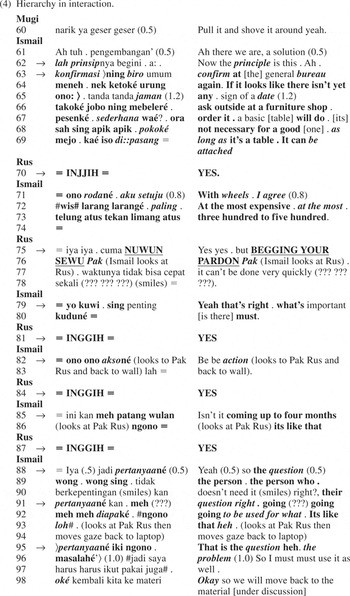
What sets the interaction in ex. (4) apart from the earlier three excerpts involving these participants is the heavy use of ngoko Javanese forms by Pak Ismail (e.g., lines 63–69, 71–73, 79–80, 82, 85–86, 88–89, 91–92, 95–96) and the use of some kromo Javanese forms by Pak Rus (e.g. lines 70, 75–76, 81, 84, 87). Even so, we can classify this alternation as code-switching.
The classification is justified by reference to earlier talk, where we saw that IN appears to be the normative medium in this setting. This classification is also confirmed inasmuch as neither participant orients to these choices as strange, either through commentary or through extended pauses relative to pauses used in earlier talk. Moreover, such a classification is further supported in that this alternation was not due to participants' incompetence in Javanese or Indonesian. That is, had they chosen to, they could have conducted this talk as a monolingual conversation in either language. Thus, we can classify Pak Ismail's use of Javanese in lines 63–69 and later as instances of code-switching. Similarly, Pak Rus's use of kromo Javanese also appears as non-normative given his previous preferences for IN, and thus his use of KAJ and KJ can also be treated as code-switching. We can therefore suggest that this code-switching was functional.
Establishing what these functions were requires recourse to our analysis of earlier talk and other conversation-external data. For example, my earlier suggestion about the indexical associations between Indonesian and authority tend to hold in Pak Ismail's utterance on line 62, lah prinsipnya begini ‘now the principle is this’ (i.e., if we assume that bosses have the right to sum up). Even so, in some ways this association appears to be weakened by Pak Ismail's subsequent use of ngoko Javanese forms when giving directions (lines 63–69). That is, he appears still to be doing things that bosses do – giving instructions – but now in ngoko Javanese. This ambiguity could be explained by taking into account earlier interpretations of the relationship of ngoko Javanese forms to familiarity, muting criticism, and so on (see discussion of ex. 3). However, Pak Rus's subsequent use of the kromo Javanese form injjih/inggih ‘yes’ on lines 70, 81, 84, and 87 also suggests an interpretation that draws on notions of hierarchical relationships and their manifestation as asymmetric exchanges of Javanese. That is, Pak Rus recognizes this talk as “instructions.”
In summary, we have seen how enregistered relationships between language and context are not fixed but present constituting possibilities for participants. Put another way, through sequential analysis of talk we can see how subtle changes in indexical relationships are realized through participants' use and interpretation of language alternation.
ENREGISTERMENT AND HIERARCHY
In this final section I want to take up the theme of hierarchical relationships by further exploring how the enregisterment process might relate to the talk discussed thus far. In particular, I will be drawing on the whole recording to focus on the question of why there are not more asymmetric exchanges than just the instances found in (4), especially given the processes of enregisterment described earlier. I will argue that an examination of the overall patterns of exchange in the whole text actually allows us to see some continuity with older descriptions of Javanese usage.
Widening our focus to all of the excerpts and the whole recording reveals regular asymmetric exchanges of language other than those found in (4). For example, Pak Ismail used ngoko Javanese and Indonesian when responding to his staff while they primarily used Indonesian. We can also see that Pak Ismail had the most turns at talk and was the person with the rights to evaluate and to direct talk (in terms of topics and recognizing next speaker). Put another way, apart from being able to tell inferiors what to do, those in power also have a choice as to how they will go about it. In this case, Pak Ismail appears to have the right to code-switch into Javanese in meetings, whereas his staff have limited, if any, right to do this.
CONCLUSION
In this article I have argued that portrayals of Javanese and Indonesian in language policy, the media, and educational settings can lead to enregisterment. I have qualified this, however, by noting that this process of attaching meanings to linguistic forms does not result in permanent relationships between language and context, but rather provides constituting possibilities for speakers who can appropriate an enregistered form or variety and recontextualize it to bring about a new context. For example, I have shown how enregisterment has fed into, but not determined, ways of speaking in an Indonesian government setting. In doing so, I have shown the fluid way in which identity can be constructed using linguistic resources. Such a perspective has also allowed us to see – contrary in some ways to earlier findings on the use of Javanese and Indonesian – that there is no one-to-one relationship between particular identities or contexts and language.
Finally, my return to a discussion of how notions of hierarchy can be reproduced in situated talk in a way that resembles earlier descriptions of hierarchy and language choice demonstrates how subtle changes in the meaning(s) of enregistered varieties can occur in situated talk. For example, on the one hand the staff's continued use of Indonesian to a boss who often addressed them in ngoko Javanese reproduced hierarchical structures through asymmetric language exchanges. On the other, the linguistic forms used in these asymmetric exchanges had little resemblance to forms used in the media and education. The extent to which these innovations in usage become enregistered will also, I would expect, be dependent on whether others within Pak Ismail's social networks wish to emulate his style of interaction.



