INTRODUCTION
Although work on migration, multiculturalism, and issues of identity dates back at least as far as the 1960s (e.g., Brettell Reference Brettell, Brettell and Hollifield2000, Vertovec Reference Vertovec2007), there is increasing interest in this area within the humanities and social sciences (e.g., Ang Reference Ang2003, Appadurai Reference Appadurai1996, Baumann Reference Baumann1996, Brettell Reference Brettell2003, Collins, Noble, Poynting & Tabar Reference Collins, Noble, Poynting and Tabar2000, Tsuda Reference Tsuda1999, Werbner Reference Werbner, Werbner and Modood1997). Sociolinguistics too has a history of sustained engagement with topics relating to migration, multiculturalism, and identity (e.g., Block Reference Block2006, Blommaert, Collins & Slembrouck Reference Blommaert, Collins and Slembrouck2005, De Fina Reference De Fina2003, De Fina, Schiffrin & Bamberg Reference De Fina, Schiffrin and Bamberg2006, Georgakopoulou Reference Georgakopoulou2007, Gumperz Reference Gumperz1982, Le Page & Tabouret-Keller Reference Le Page and Tabouret-Keller1985). Drawing on work in semiotics, talk-in-interaction, and social identification, this article adopts a temporal perspective to focus on a hitherto under-researched question within this broad area: How do systems of trust (Giddens Reference Giddens1990) or systems of expectations about behavior in public and private spaces (Goffman Reference Goffman1974) develop in a context where diversity is the norm, and where distinctions between newcomers and hosts continually change?
I do this by focusing on a transient urban milieu in Indonesia, a country that has attracted seemingly little attention from sociolinguists despite its very diverse population of close to 250 million people (Bertrand Reference Bertrand, Brown and Ganguly2003). In particular, I look at how the “social domain” (Agha Reference Agha2007:126–28) of a number of signs associated with appropriate conduct in a ward (usually one street of houses and their inhabitants) widens across a series of interactions. I do this in five steps. After fleshing out theoretical and methodological concerns, I go on to theorize long-term processes of enregisterment in Indonesia. Following this, I focus on conversational activity in a ward meeting. In particular, I examine how ward members appropriate and recontextualize signs (Bauman & Briggs Reference Bauman and Briggs1990) from perduring semiotic registers to position themselves and others. In line with Agha Reference Agha2007 and Wortham Reference Wortham2006, I show how this conversational work figures in the widening of the social domain of signs within a routine monthly ward meeting. I then examine whether and to what extent the social domain of these signs widens further as one ward member participates in subsequent monthly meetings. In particular, I examine one ward member's “trajectory of socialization” (Wortham Reference Wortham2005) to establish whether and to what extent the widening of the social domain of certain signs ultimately figures in the formation of locally emerging semiotic registers.
SIGNS, ENREGISTERMENT AND SOCIAL DOMAINS
In this section I link Agha's (Reference Agha2007) work on signs and processes of enregisterment with insights from work on social identification (Wortham Reference Wortham2006), conversational narrative (Georgakopoulou Reference Georgakopoulou2007, Ochs & Capps Reference Ochs and Capps2001), Membership Categorization Analysis (e.g., Antaki & Widdicombe Reference Antaki and Widdicombe1998, Francis & Hester Reference Francis and Hester2004, Stokoe Reference Stokoe2003) and cultural reproduction (e.g., Ochs Reference Ochs1988, Wenger Reference Wenger1998, Wortham Reference Wortham2006). I do this to provide analytic purchase on the relationships between categories of personhood writ large, the interactional achievement of such categories, and how all of this relates to the building of new systems of expectation among those who do not share similar trajectories of socialization.
Agha Reference Agha2007 has theorized how various types of social interaction figure in the creation and reproduction of relationships between signs and categories of personhood. One of his main concerns relates to how particular signs become emblems of identity or personhood across time and space. The starting point for such (re)production processes, which he terms “enregisterment,” is a “semiotic encounter.” In such encounters, communication is not a product of a face-to-face meeting, but instead depends on whether and to what extent participants orient to signs (Agha Reference Agha2007:69). In this sense, signs become signs only if those used by a sender are recognized by the receiver. Where signs are ratified and/or appropriated and recontextualized (Bauman & Briggs Reference Bauman and Briggs1990), we have the formation of what Agha Reference Agha2007 terms a “speech chain.” We also have the formation of a “semiotic register” (SR), defined as a category of signs that includes both linguistic and nonlinguistic signs, such as facial expressions, gesture, place, space, and so on. The links between these signs and the SR of which they are a part are such that the use of one sign implicates the semiotic register(s) to which it belongs (Agha Reference Agha2007:81; see also Ochs Reference Ochs, Gumperz and Levinson1996).
Like signs, semiotic registers (SRs) should be seen as emergent because the very nature of SR production means that the constellation of signs making up a SR will change in a speech chain (that is, from speech event to speech event). This is so because place, participants, and other factors will differ from one speech event to the next. In this sense, SR formation always draws upon preexisting signs from other SRs that exist within a system of SRs (Agha Reference Agha2007:81; see also Silverstein & Urban Reference Silverstein, Urban, Silverstein and Urban1996).
Although SRs need to be seen as emergent, certain signs from such registers can become more perduring and widespread (Agha Reference Agha2007:190–232). In other words, the social domain of these signs widens and stabilizes. This is especially the case where signs attract metapragmatic discourses about their usage and users. The extent to which some SRs and their associated signs perdure and can be seen as more widely circulating seems to relate to whether receivers are just a small number of people or millions (as in the case of popular mass media), whether and to what extent institutions authorize such semiotic registers (as when schools adopt a standard language), the extent to which there is continuity in authorizing institutions (Goebel Reference Goebel2008, Reference Goebel2009, Inoue Reference Inoue2006) and whether and to what extent receivers identify with and use a SR (Agha Reference Agha2007).
As work on schooling (e.g., Bourdieu & Passeron Reference Bourdieu and Passeron1977) and media reception (e.g., Ida Reference Ida2009, Spitulnik Reference Spitulnik, Ginsburg, Abu-Lughod and Larkin2002) has shown, people do have different consumption practices; that is, they have different trajectories of socialization. In this sense, they also have different competencies in terms of performing and comprehending signs (Agha Reference Agha2007, Inoue Reference Inoue2006, Johnstone & Kiesling Reference Johnstone and Kiesling2008). While this points to the fragmented nature of people's understanding of signs, these divergent trajectories also represent different processes of enregisterment, which produce competing SRs. Thus, although there will always be dominant SRs within a system of such registers – especially those that are institutionally authorized, as in the case of use of signs associated with a standard language in state-owned or state-run schools and broadcast media – there will also, necessarily, be competing SRs (Agha Reference Agha2007, Schieffelin & Doucet Reference Schieffelin, Doucet, Schieffelin, Woolard and Kroskrity1998). A person's familiarity with signs from a SR allows them to engage in discourses about difference and to socially identify others (Irvine Reference Irvine, Eckert and Rickford2001).
People can engage in discourse of difference in a number of ways, including text-based and audio-visual commentaries found in the mass media, as frequently demonstrated by those working in sociology and Critical Discourse Analysis (e.g., Collins et al. Reference Collins, Noble, Poynting and Tabar2000 and chapters in Cootle Reference Cootle2000). The concern of this article, however, is how discourses of difference emerge in everyday face-to-face interactions. As Ochs Reference Ochs1988 observed in her study of language socialization practices in Samoa, talk about difference often relates to the inappropriate actions of novices (see also the work on frames of expectation by Tannen Reference Tannen and Tannen1993). In later work on conversational narrative, Ochs & Capps Reference Ochs and Capps2001 point out that within everyday conversational storytelling, the life events that get most attention are often those that are unusual, problematic, and/or run counter to personal or community expectations. In this sense, such conversational activity raises participants' awareness about others' and/or community expectations, while at the same time providing ideas about what would have been appropriate and ways of coping with the problem (Ochs & Capps Reference Ochs and Capps2001).
This type of interactional work figures in processes of enregisterment in at least two ways. The first is through the explicit ratification of signs and expectations by “ratified participants” (Goffman Reference Goffman1981, Goodwin & Goodwin Reference Goodwin, Goodwin and Duranti2004), where the act of ratification represents a widening of the social domain of the signs and expectations. Second, in cases where there are other “ratified bystanders” (Goffman Reference Goffman1981, Goodwin & Goodwin Reference Goodwin, Goodwin and Duranti2004), this conversational work can also be seen as indirect lessons about social conduct. Put in a language-socialization sense, talk about perceived norm violations is also an activity that can be described as “socialization to use language” (Ochs Reference Ochs1988).
Talk about problematic events and people also provides insights into what the participants consider moral, and who fits such a category (Ochs & Capps Reference Ochs and Capps2001). In this sense, the talk contributes to the social identification of participants and referents. In other words, talk about others tells us about conceptions of self on the part of the teller (Georgakopoulou Reference Georgakopoulou2007:119–20). Just as importantly, as work on identity and Membership Category Analysis has shown (Antaki & Widdicombe Reference Antaki and Widdicombe1998, Francis & Hester Reference Francis and Hester2004, Stokoe Reference Stokoe2003), such talk also provides the researcher with insights into how the self and other are interactionally constructed. This can be done by looking at which participants are positioned as members, and how they can be identified through their following of what participants present as their expectations for conduct in particular settings. In this sense, we can say that social identification proceeds, while simultaneously producing insights into what is considered normative along with guidelines for future social conduct for the teller and others present (Kitzinger Reference Kitzinger2005, Ochs & Capps Reference Ochs and Capps2001, Wortham Reference Wortham2006).
Such interactions generally produce a number of categories of personhood, with one category implying the existence of another (Inoue Reference Inoue2006). During interaction, such categories are also indexed to sign(s) within a constellation of signs that make up a locally emerging SR (Wortham Reference Wortham2006). For example, a particular language variety can become associated with a particular person. These locally emerging categories, along with the signs that index them, are then available to participants for recontextualization, sometimes as “emblems” of identity in subsequent interactions (Agha Reference Agha2007:233–77).
Also of interest here is some of the work on reported speech (e.g., Berman Reference Berman1998, Errington Reference Errington1998b, Holt & Clift Reference Holt and Clift2007, Tannen Reference Tannen1989). A common observation of those working in this area is that while the way in which talk is reported in terms of language choice, prosodic features, and so on may not represent what was actually said nor how it was said, nevertheless it often tells the hearer how the teller feels about the particular talk, the event, and/or the speaker being reported. In this sense, reported speech can be talked of as “constructed dialogue” (cf. Tannen Reference Tannen1989:99) or “represented speech” (cf. Agha Reference Agha2007:32).
Thus far I have discussed ways in which distinction can be enregistered, but it is important to note that the enregisterment of sameness is the other side of this coin. Some of the earlier key work in this area has been conceptualized in terms of “crossing” (Rampton Reference Rampton1995) and “adequation” (Bucholtz & Hall Reference Bucholtz, Hall and Duranti2004a, Reference Bucholtz2004b). Drawing on Rampton (Reference Rampton1995:282), I define crossing as situation-specific, performed, nonhabitual use of linguistic and nonlinguistic signs stereotypically associated with a particular group to achieve situational sameness, comedy, irony, or other, perhaps more sinister effects associated with the negative positioning or representation of others whose linguistic signs are being borrowed. Often such crossing attracts meta-talk by other participants. In contrast, I use the term “adequation” in a more limited sense, because in its original usage “adequation” refers to both the short-term pursuit of social sameness (which seems to cover crossing), and long-term or habitual pursuit of sameness. In using the term “adequation” instead of “crossing,” what I want to highlight is the habitual sense of this term, as well as the lack of meta-talk that such practice attracts from other participants.
In pulling this section together, we can say that examining talk about others' sign usage and participants' interactional pursuit of sameness can provide insights into how people go about socially identifying others. At the same time, such talk can also be seen as functioning to explicate and construct expectations about social conduct in particular settings. To analyze this type of talk, we also need to acquire a sense of the import of signs. In this study, I do this by drawing on historical accounts of language and ethnicity in Indonesia, information on schooling and census practices, analysis of mass-mediated representations of personhood, and data from my long-term ethnographic fieldwork in an urban Indonesian ward (reported in Goebel Reference Goebel2000).
SOCIOHISTORICAL SETTING
In this section I sketch the historical (re)production of semiotic registers that contain “Indonesian” and “languages other than Indonesian” (LOTI) within their constellation of signs. I shall start with the political-scholarly discourses of the late 1920s. During this period colonial and nationalist practices of discernment and choice that explicitly mentioned Indonesian (then called Malay) and LOTI helped enregister at least two semiotic registers. The first contained within its category of signs LOTI, ethnicity, and region, while the second contained Indonesian and the potential new state (Errington Reference Errington, Schieffelin, Woolard and Kroskrity1998a, Reference Errington and Kroskrity2000, Reference Errington2001; Smith-Hefner Reference Smith-Hefner1989; Steedly Reference Steedly1996). This treatment of ethnicity as something linked with region and language continued after Indonesia gained independence from its Dutch colonial masters in the late 1940s, although ethnicity was constructed and evaluated differently by members of the central government and regional leaders from islands other than Java. For example, regional leaders saw shared language as a sign of ethnic group membership, which could be used to gather support for their efforts to gain more autonomy vis-à-vis the Jakartan political elite in the mid-1950s (Feith Reference Feith1962:522).
During the initial period of the Suharto New Order regime in the mid-1960s, perceptions about communism and Islamic fundamentalism contributed to the continued circulation of positive and negative ideologies about place-based ethnicity (Schefold Reference Schefold1998). At the same time, wary of prior regional tensions, the Suharto government also moved to look at identity, ethnic and otherwise, as multiple, so that Indonesians were Indonesian citizens first and members of ethnic and religious groups second. This was achieved in the early 1980s through the commoditization and domestication of ethnicity, whereby ethnicity was strongly linked with region, attire, housing, custom, tourism, and language (Coppel Reference Coppel1983, Errington Reference Errington1998b, Hooker Reference Hooker1993, Hoon Reference Hoon2006, Parker Reference Parker2002). Indeed, by this time the link between language and region had become part of the Indonesian constitution, which explicitly stated the need to preserve regional languages (Anwar Reference Anwar1980).
At the same time, Indonesian as the national language of Indonesia was vigorously planned based on Western models of development and nationalism, resulting in a semiotic register that included notions such as development, truth, objectivity, evaluation, education, and power (Errington Reference Errington, Schieffelin, Woolard and Kroskrity1998a, Reference Errington1998b, Reference Errington and Kroskrity2000). Just as important, however, was Indonesian's role as a language of national unity by way of its function as a mediator of social relations between geographically dispersed ethnic groups with their own languages (Abas Reference Abas1987:116; Dardjowidjojo Reference Dardjowidjojo1998; Lowenberg Reference Lowenberg1990). This act of institutionalizing Indonesian as a language of wider communication between those who are “ethno-linguistically different” also allows for the assigning of stereotypical indexical values of the “the other” or “stranger” with performances of Indonesian usage.
In implementing these institutionally authorized ideas, successive governments have attempted to realize this language ideology in centralized and decentralized curricula dealing with the teaching of regional languages in primary and secondary schools (Lowenberg Reference Lowenberg1992, Nababan Reference Nababan1991). While the success of such efforts appears to be patchy at best – as has been recently documented (Kurniasih Reference Kurniasih2007) – schooling practices have also contributed to the enregisterment of semiotic registers in other ways. For example, Parker Reference Parker2002 has observed that by the third grade of primary school, children can identify all the provinces in Indonesia along with their capital cities. This, together with the labeling processes that go with teaching, textbooks, and timetabled subjects, may contribute to children's understanding of language as a named object tied to particular geographical regions and signs from these regions, such as car number plates or architecture. These processes help children name the languages that they speak, enable them to imagine themselves as members of a particular group of people who are defined by residence and language usage (as suggested by Nababan Reference Nababan1991), and enable them to make guesses about the geographical origin of persons who use particular linguistic forms (Goebel Reference Goebel2008).
In other words, children's exposure to such discourses about regions, languages, and their users and uses will help enregister LOTI with ethnicity, forming what are essentially region-based personas who speak a specific LOTI. As such, a child's emergent semiotic register – which might initially contain signs such as linguistic tokens and utterances, intimacy, family, and local spaces – might also include “ethnicity,” “us,” and “region.”Footnote 1 This relationship between language and ethnicity will be further enhanced through the learning of Indonesian at school, especially where Indonesian is portrayed as the language of unity and communication among geographically dispersed ethnic groups with their own LOTI. Indeed, the propagation of Indonesian at schools as the language of national unity also brings into focus further criteria for defining communication with members of other ethnic groups as “a communicative practice requiring Indonesian.” That is, Indonesian is required for communication with the “ethnic other.”
Such links are also reinforced through census practices prior to 2000, which although not asking for information on ethnicity still had questions asking which regional language census takers spoke (Muhidin Reference Muhidin2002, Suryadinata, Arifin & Ananta Reference Suryadinata, Arifin and Ananta2003). Arguably, these census practices also provided an authoritative, though implicit, meta-discourse about language–ethnicity relationships, while also differentiating regional languages from Indonesian. In addition to language–identity relationships being reproduced through schooling and census practices, representations of language use on Indonesian television in the late New Order period (1990–1998) reproduced such links. For example, Sen & Hill (Reference Sen and Hill2000:119) have noted that the emergence of the first private television channels in Indonesia in 1990 was accompanied by programming and operating rules that stated that the language used by these stations should be standard Indonesian, with regional languages used only when suitable. Such rules represent state meta-discourses about the relationship between language, ethnicity, and region, while continuing to differentiate between Indonesian and LOTI.
At the same time that such authorized meta-discourses circulated, the entry of new television stations made it increasingly difficult for these stations to gain and maintain market share (Sen & Hill Reference Sen and Hill2000:123–24). One of the ways in which both private and public stations tried to do this was to feature more local content, including that which was heavily in a local language (Sen & Hill Reference Sen and Hill2000). The stereotypic representations of language use in such television serials can be seen as more implicit meta-discourses linking language usage to performable social personas and relationships. In my analysis of such representations (Goebel Reference Goebel2008, in press a), I found that while there were continuities between signs found in the preexisting semiotic registers discussed thus far (e.g., those containing Indonesian tokens and those containing LOTI tokens), there also appeared to be a new pattern of representation. This new pattern denaturalized links between language and ethnicity through characters engaging in the practice of adequation: that is, the social pursuit of linguistic sameness (Bucholtz & Hall Reference Bucholtz, Hall and Duranti2004a).
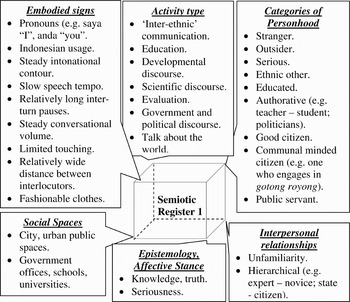
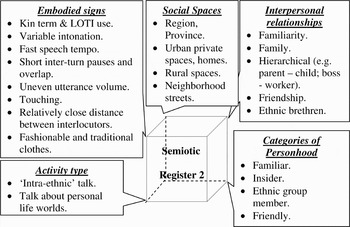
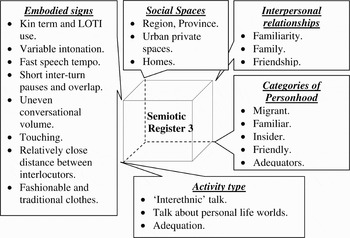
Figures 1 to 3 show the multidimensional nature of these SRs and their categories of signs. These SRs and their associated signs can be seen as offering resources to be appropriated and recontextualized in future semiotic encounters. In such encounters, the meaning of these signs will be negotiated, changed, subsequently reappropriated, and potentially reified, ad infinitum. As such, the signs within each SR represent “constituting possibilities” (cf. Mäkitalo & Säljö Reference Mäkitalo and Säljö2002:73) that Indonesians can draw upon to interpret and convey meaning in situated talk.
Semiotic register 1 (SR1).

Semiotic register 2 (SR2).

Semiotic register 3 (SR3).

FIELDWORK IN WARD 8
The talk that I analyze in the following sections was gathered during two and one-half years of fieldwork in two rukun tetangga (RT) ‘wards’ in Semarang, Central Java, Indonesia. Geographically these wards were situated in the newly urbanizing fringes of the northern part of Semarang. The ward that I focus on here, Ward 8, was part of a larger administrative unit called a rukun warga ‘neighborhood’, which was made up of twelve wards. Members of Ward 8 were diverse in terms of religious, ethnolinguistic, educational, economic, occupational, and experiential backgrounds.
As part of a government housing estate designed for low- to middle-income public servants, there was a high number of mid-level government officials who were periodically (usually every five years) transferred between districts and provinces within Indonesia. This added to the transient nature of this ward. Indeed, although established in 1988, there were few of the original inhabitants left in this ward. For example, while the original composition of the ward was primarily non-Javanese public servants (from Muslim, Christian, and Hindu backgrounds), around half had since moved and leased out their houses to an increasingly Javanese population. More specifically, during the time of this fieldwork 9 of the 23 families had one head of household coming from outside Central Java. Four families had both husband and wife coming from areas outside Java proper.
While many of the new Javanese population had moved from various shires (kabupaten) within Central Java, Central Java itself is well known – both by linguists (Conners Reference Conners2007) and by the participants themselves – for geographical variation in accent, lexicon, pronoun usage, honorific usage patterns, speed of speech and so on. Moreover, while members of this ward may have been born and raised in one area, many went on to spend several years living, studying, and working in places like Yogyakarta, Jakarta, and other larger cities within Central Java before moving to this ward. In this sense, the ward was more diverse than implied through labels such as “Javanese.”
In addition, ward layout, housing architecture, socializing patterns, and members' work routines created few opportunities for members to interact and build shared expectations about behavior in this ward. Indeed, except in official ward meetings and functions – which were regularly patronized only by a core of 15 of the 23 women heads of household – members rarely interacted. In this sense, members had no real shared expectations about linguistic sign usage, apart perhaps from those that they had become familiar with through schooling and consumption of print media and/or televised performances of Indonesian and Javanese usage.
With the informed consent of ward members, my research assistant and I observed and/or recorded the conversations that occurred in the routine monthly women's ward meeting (arisan RT). Many of the recordings were transcribed with the help of Indonesian research assistants who were also members of this ward. Part of the transcription process involved classification of linguistic forms and interpreting language alternation, both of which were quite problematic. For example, my own developing ability in the use and interpretation of linguistic signs stereotypically associated with Indonesian (the national language) and Javanese (the regional language) meant that my initial classification was based on the extent to which lexical forms approximated or deviated from standard forms found in dictionaries (Echols & Shadily Reference Echols and Shadily1992, Prawiroatmojo Reference Prawiroatmojo1989), other descriptions (Errington Reference Errington1988, Poedjosoedarmo Reference Poedjosoedarmo1968, Wolff & Poedjosoedarmo Reference Wolff and Poedjosoedarmo1982), and participants' categorizations, which differed from one person to the next.
Codeswitching too was quite common in this urban milieu, and this raised a number of other questions relating to classification, many of which came after I left the field and read more work on codeswitching and semiotics. In trying to answer these questions, I drew upon a number of insights from ethnomethodological (Auer Reference Auer, Milroy and Muysken1995, Gafaranga & Torras Reference Gafaranga and Torras2002), identity (Gumperz Reference Gumperz1982, Myers-Scotton Reference Myers-Scotton1993), and ethnographic approaches to codeswitching and language use (Alvarez-Cáccamo Reference Alvarez-Cáccamo and Auer1998, Bucholtz & Hall Reference Bucholtz2004b, Errington Reference Errington1998b, Rampton Reference Rampton1995), which I will expand upon as I look at participants' talk.
THE PUBLIC CONSTRUCTION OF SELF, OTHER, AND EXPECTATIONS
This section looks at how public talk figures in the positioning of participants, while simultaneously producing expectations about social conduct in this ward. In doing so, I point out that such acts of social identification draw upon perduring signs (both interactionally recent and those of the type found in Figures 1–3). The extracts are taken from a recording made in a routine monthly female ward meeting held in July 1996. Like most ward meetings, this took place in the front room of the host's house, with all participants sitting on the floor. This meeting was led by the female head of the ward. Part of the function of this and other such meetings was to help disseminate state development policy, often as part of the state-sponsored program Guidance for Family Prosperity (Pembinaan Kesejahteraan Keluarga or PKK). Among other things, PKK included ideas and directives on family planning, community health and development, and gotong royong “working together for the mutual benefit of the community” (see also Blackburn Reference Blackburn2004). In Ward 8 these meetings regularly included discussions about the need to plan and pay for garbage collection, dengue fever mosquito prevention, and neighborhood social activities.
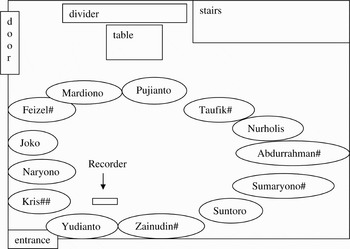
In this meeting 13 of the 23 female heads of households attended, and all present were regulars. Figure 4 shows where each person was seated. Their positions allowed their interactions to range between private and public talk. Zainudin# (my Indonesian spouse) and Abdurrahman# were both newcomers, having respectively arrived in this ward two and three months earlier. (The symbol # identifies those who self-reported or were reported/talked about by others as being non-Javanese. These were typically place-based categorizations linked with a LOTI. Two symbols ## affixed to a name means that this person has self identified or has been identified by others as being of Chinese ancestry. To save space I will not add the kin term Bu ‘Mrs.’, commonly used for second person reference – often plus a name – in these meetings.)
The July Ward 8 women's meeting.

This meeting starts with a song called Ibu PKK ‘PKK Mothers’, which among other things reminds the participants how mutual cooperation benefits them and their ward. To paraphrase some of the important meaning-making work that goes on prior to the extracts I present below, in the first ten minutes or so of this meeting (discussed in detail in Goebel in press b) there are a number of participant constellations where participants discuss topics such as payment of monthly dues, part of which involved working out exactly who gave money to whom and on whose behalf (Sumaryono#, Abdurrahman#, Nurholis, Joko, and Kris##); Independence Day celebrations (Naryono, Sumaryono#, Kris##); money required to pay for these celebrations (Naryono, Sumaryono#, and Kris##); naming those yet to pay contributions (Naryono, Joko, Nurholis, Sumaryono#, Pujianto, Kris##); talk about non-attenders and where they live in the ward (Nurholis, Sumaryono#, Naryono, Pujianto, Abdurrahman#); and talk about collecting dues from one ward member, Tobing#, and how collectors were treated by her (Joko, Naryono and Nurholis).
Within the talk, the activities of attendance and payment were evaluated as appropriate social conduct, while also implying that the opposite behaviors were inappropriate. In turn, these activities also contributed to the emergence of a number of categories of personhood. These included “non-attendees,” “non-payers,” “non-friendly ward members,” and their opposites, with one non-present person, Tobing#, being directly linked with the categories of non-payer, non-attender, and unfriendly ward member. One of the signs potentially indexed with these practices and categories of personhood included ngoko Javanese (NJ) exchange between those who reported being Javanese.
There were also instances of what I will refer to as “language alternation as the medium” (cf. Gafaranga & Torras Reference Gafaranga and Torras2002), whereby participants regularly used NJ tokens with Indonesian tokens within an intonational unit in their talk. There was also frequent use of aku ‘I’ for self-reference, which almost always co-occurred with talk that contained tokens stereotypically associated with NJ. Because of Sumaryono's self-classification as a non-Javanese whose first language was not a variety of Javanese, this practice can also be seen as a type of crossing. In terms of the relationship between conversational activity and language choice, NJ forms appear to be used when people are talking about personal life worlds, which contrast with the use of Indonesian when talking about the world. There was also some use of other-elevating krama inggil Javanese (KIJ) tokens in reference to those who attended, which served as a sequentially relevant sign figuring in the positive evaluation of the activity of “attending.” In terms of other signs, there was a type of stylized pronunciation of NJFootnote 2 and reference to facial expressions, which also figured in negative evaluations (especially in relation to Tobing#).
In reframing the above in terms of identity work, we can say that through interaction this sign usage was also indexed with certain emerging identities. For example, by being present at this meeting, paying the appropriate dues, and producing NJ utterances (or utterances peppered with NJ tokens), participants were helping to reproduce perduring associations between a LOTI, in this case Javanese, and insider talk. These linguistic tokens co-occurred with overlap, latching, and repetition. On the other hand, Indonesian and other contrasting or opposite signs are also potentially indexed to unfamiliars and outsiders as well as to particular non-payers and non-attendees. In other words, this prior interaction figures in the emergence of a number of local SRs, while also providing insights into participants' expectations about social conduct within this ward.
These expectations include the need to pay social contributions and attend meetings. By looking at extract (1) and those that follow, we can explore whether and to what extent these categories of personhood solidify. “Solidification” here refers not only to the ratification of signs, but also to their reuse by an increasing number of participants in this meeting. For example, through the evaluation of a non-present other's behavior over the course of the next six extracts, the social domain of expectations for social conduct widens from four participants (Naryono, Nurholis, Sumaryono#, and Joko) to include most of those present. In representing these signs, I use roman type for Indonesian; ngoko Javanese is in bold, and bold italic indicates those forms that can be classified as either ngoko Javanese or Indonesian. Other transcription conventions include the use of double underline to indicate temporally close instances of repetition, and wavy underline to indicate repetition separated by larger timespans. I will expand on these conventions as my analysis progresses.Footnote 3
(1) Co-constructing identities and norms for conduct.

As can be seen in lines 1–5 and 8–9, Naryono publicly associates Tobing# with the categories of non-payer, non-attendee, and a person who disregards ward responsibilities. Such public identification is done by way of Naryono raising her voice very noticeably relative to her previous talk (indicated by @ surrounding the talk). This makes the talk more accessible to the other participants, especially those who were engaged in their own conversations. In doing so, this publicly (re)produces the categories of “non-paying neighbor” and “non-attendee of meetings” discussed earlier, while adding the category of “irresponsible neighbor.” The last category is closely related to perduring categories associated with gotong-royong ‘working together for the mutual benefit of the community’, which all participants are reminded of through the Ibu PKK song at the start of each meeting. This perduring category seems to be implicitly invoked by talk about Tobing# as someone who does not belong to this category of persons. In doing so, the colluders in this talk are implying that they belong to the category of good ward members. In other words, in identifying Tobing# as deviant, they are also implying that they are not deviant.
Note also that while Naryono mentions her expectations about what is neighborly, she along with Joko and Sumaryono# evaluates this behavior either by saying that it is not acceptable (Naryono, line 10) or by citing solutions and sanctions for treating those who deviate from these expectations (lines 6–7 and 14–16). Thus, here processes of social identification are reliant on input from multiple participants. In addition, these three participants' public involvement in evaluative activities provides insight into the extent of the social domain of expectations, which at this stage is just three ward members (Soemaryono, Joko, and Naryono). Just as importantly, this co-construction simultaneously creates other identities, such as community or ward, as well as expectations for social conduct in this ward. For example, the above talk implies that having the identity of a responsible community member means attending and paying. This points to the interrelated nature of identity, practice, and community: Expectations about practice simultaneously define what social characteristics contribute to identity and community membership in this setting (cf. Wenger Reference Wenger1998).
At this stage it is important to point out that Naryono engages in language alternation in two ways. The first, in lines 1–5, appears to fit a pattern I will refer to as “alternation as the medium” (cf. Gafaranga & Torras Reference Gafaranga and Torras2002). That is, participants make no comment about the appropriateness of alternating between NJ (bold) and Indonesian (roman) in subsequent talk in this or other settings. This interpretation is further supported if we look at the use of NJ and Indonesian within intonational units (demarcated by periods in the transcript). As we can see, where pauses do occur they do not set apart linguistic signs associated with NJ or those associated with Indonesian.
In the second form of language alternation, one set of signs is used (in this case, NJ on line 9) followed by a pause, and then another set of signs (Indonesian on line 10). This alternation from NJ to Indonesian co-occurs with what appears to be an evaluation of Tobing's behavior (line 10). Thus, the alternation here seems to be functional, so I will classify it as “codeswitching.” Note also that the language choice of Naryono's interlocutor, Joko, continues to be NJ. If read in relation to perduring SRs (see Figure 2), this might also give us some insights into their situated identities. In this case we could suggest that they were familiars, intimates, and insiders. This interpretation is further supported by Joko's participation in discussions about non-normative neighbors (lines 6–7). For example, she positions herself as belonging to a category of normative persons through her talk about sanctions for persons who are deviant.
Just as importantly, the public use of NJ in a forum where there are a number of non-Javanese newcomers also points to an expectation that newcomers should understand this usage. Indeed, the response of other non-Javanese, such as Sumaryono#, shows that they can understand it, and thus this expectation. Moreover, as noted before this extract and as seen in the talk immediately following (extract (2), lines 20 and 22), Sumaryono# also uses NJ tokens and thus engages in crossing. She also offers solutions for dealing with problematic neighbors (lines 14–15); this, together with her crossing, points to her role as a ratified insider. Together with perduring SRs (see Figure 2), this reading of an insider identity become increasingly possible.
(2) Represented speech and othering

In addition to exemplifying Sumaryono's practice of crossing (lines 20 and 22), extract (2) is interesting for Naryono's alternation from NJ (bold) on lines 17–18 to Indonesian on lines 18–19. This alternation can be classified as codeswitching for two reasons. First, different mediums are used in the first and second intonational units. Second, this alternation appears to frame what is said as representing what Tobing# has said. With recourse to perduring SRs that have Indonesian and stranger within their constellation of signs (see Figure 1), here I suggest that such codeswitching helps to add Indonesian to the locally emerging SR relating to outsiders. In doing so, it also reinforces the locally emerging insider SR, which has within its category of signs Javanese usage and talk about personal life worlds associated with ward life.
This interpretation is supported by both the representation of first person reference and Sumaryono's response. For example, the use of the form saya (line 18) – stereotypically associated with Indonesian (see Figure 1) – contrasts with these participants' usage among themselves.Footnote 4 This points to a reading of the relationship between Naryono and Tobing# as different from the relationship between the conversationalists at this meeting. Sumaryono# also seems to have made such an interpretation, as illustrated by her subsequent turn, which, in contrast to her prior turns, is now in NJ. Moreover, in switching to NJ, Sumaryono# is also situationally positioning herself as a NJ-speaking insider in contrast to Tobing#, who has just been positioned as an Indonesian-speaking outsider. This interpretation also sits with what I know about both participants' competences in krama Javanese (KJ) forms and Indonesian, which suggests that they could choose which forms they used in interethnic talk and in representing others' speech.
Taken together, these social practices contribute to the solidifying of local identity categories of personhood, which simultaneously become part of emerging SRs. In the next two extracts, we see how local expectations about “appearing friendly” in interactions with one's neighbors begin to be associated with embodied behavior and linguistic sign choice. This further solidifies links between particular linguistic signs and particular identities. Extract (3) represents talk that occurred directly after that represented in (2).
(3) Indonesian, embodied behavior, and unfriendliness

From the talk in (2) and from talk that occurred prior to (1), we know that Naryono has apparently had face-to-face interactions with Tobing#, which Naryono represented as being done in Indonesian. In (3) we can see all these ways of speaking being appropriated and recontextualized to further position Tobing# as a deviant, Indonesian-speaking outsider. For example, Joko reports a time when she and Nurholis went to collect money from Tobing# (lines 25–30). Note that Joko not only appears to have been told the same thing by Tobing# as Naryono was – that Tobing# said she would be moving (line 27) – but Tobing's talk is also represented as being ‘said in Indonesian’.
This Indonesian usage co-occurs with the use of the Indonesian form of self-reference (saya) used earlier in reporting Tobing's talk. Again this contrasts with Naryono's use of aku for self-reference when talking about her feelings toward Tobing# (lines 34–35). Thus, the above talk seems to have some clear interdiscursive (cf. Bauman Reference Bauman2005) relation with Naryono's earlier report of her interaction with Tobing#. Just as importantly, the social domain of expectations for social conduct within this ward widens to involve Nurholis.
We also see that Naryono's earlier representation of Tobing# as unfriendly is now given a behavioral description: looking ‘sour-faced’ (lines 32–33). This adds to the emerging semiotic registers discussed thus far. For example, ‘looking sour-faced’ becomes attached to the SR associated with outsiders, while persons belonging to this constellation of signs are again represented as Indonesian-speaking. By implied contrast, ‘not looking sour-faced’ is attached to the locally emerging insider SR, which has Javanese linguistic forms and talk about personal experience within its category of signs.
To this we can add a tendency to engage in repetition, both in close temporal proximity (indicated by a double underline, e.g. lines 25 and 31) and that separated by longer intervals (indicated by wavy underline, lines 27 and 32–35). This type of repetition also functioned to post and ratify topics and, importantly for this study, as a collusive device used in talk that positioned others. In extract (4) we see continued collusion between participants, with Sumaryono# pointing to potential solutions for such deviant behavior (lines 36–37). These solutions include the kind of avoidance initially suggested as a solution in talk prior to extract (1). The talk in (4) occurs after three turns – involving Joko, Naryono, and Nurholis – about whether their previous interactions with Tobing# related to payment for garbage collection.
(4) Solidifying identities and embodied behavior

In further positioning Tobing# as deviant, there is continued collusion between Naryono and Sumaryono#. At this stage, Kris## also becomes publicly involved through her evaluation of Tobing's behavior (lines 42–43). In addition to the use of repetition as one collusive strategy (lines 44 and 46), the evaluation of Tobing's deviant behavior toward the ward (e.g., not attending monthly meetings or paying dues) moves to her personal interactional preferences. Her deviance as someone uninterested in ward matters (lines 40–41) is now reanalyzed as a personal trait relating to face-to-face talk in particular. Now she is represented not just as someone who doesn't like socializing with her neighbors (line 44), but as someone who won't even say hello to them (lines 46–47).
In doing so, this talk offers further insight into how the participants wish to be publicly perceived, while also giving further information about expectations for normative behavior in this ward. Moreover, (4) adds to earlier notions of what it means to be friendly. Thus, this local definition further solidifies while also undergoing some modification. For example, we see that friendliness is modified in terms of embodied behavior and interactional preferences. Furthermore, the persons who fit this category stay pretty much the same, with the addition of Kris## as someone who fits into the category “good neighbor.” This is achieved in part through her sequentially unchallenged ability to evaluate another's behavior in relation to ward expectations.
Language alternation practices also reinforce these emerging SRs. For example, again we see that Tobing's language use is represented as ‘in Indonesian’. In this case, Tobing's inner state or wishes are now represented as ‘thought about’ in Indonesian (lines 40–41). Note also that while the alternation from an utterance containing NJ fragments (line 40) may have been used as a device to indicate a change in footing (cf. Goffman Reference Goffman1981), it also provides contrasts of self-presentation in NJ and other-representation in Indonesian.
This type of language alternation is also used by Sumaryono# (the non-Javanese migrant) in her further positioning of Tobing#. This thickens Sumaryono's previously emerging identity as a “Javanese-speaking insider” or “Javanese-speaking good neighbor”. Such a reading appears especially appropriate for three reasons: Naryono's previous portrayal of Tobing# as an Indonesian-speaking deviant neighbor or outsider; Sumaryono's use of Javanese tokens in talk in the previous interactions; and Sumaryono's account of Tobing# as unsociable, which also implies that Sumaryono# herself is not a person who fits that category, and proof of that is that she can speak Javanese. In this sense, any sign by itself is quite ambiguous. However, as the interaction unfolds, the types of identities and participant positions become less ambiguous; and as social identification proceeds, so does the development of several semiotic registers. In the following extract we see how Tobing's deviant Indonesian-speaking outsider status solidifies further through the recontextualization of some earlier conversational strategies on the part of Naryono, as well as through the use of some locally relevant outsider identities. The talk in extract (5) continues directly after that in (4).
(5) Newcomers as insiders in processes of social identification

The talk in (5) adds to Tobing's position as a deviant outsider through a number of conversational moves. In the first instance, we see that Naryono slightly recontextualizes her previous codeswitching practice of representing Tobing's talk as ‘said in Indonesian’ to Naryono's own talk as ‘said in Indonesian’ (lines 51–53) when speaking to Tobing#. During Naryono's interaction with Sumaryono#, Zainudin# asks if the person being spoken about is Tobing# (line 49). This not only produces a short parallel conversation with Kris## (this parallel conversation is indicated by brackets prefixed to line numbers 49–50 and 54–58), but it also appears to provide Sumaryono# with a resource to emphasize Tobing's outsider status.
As we can see on lines 59–61 and 63–65, Sumaryono# draws on my identity (I am Zainudin's husband) as a foreigner through a comparison of my attendance at male ward meetings with the behavior of Tobing#. This comparison intensifies Tobing's deviant position by describing a foreigner, me, as a better neighbor (whether true or not) than Tobing#, an Indonesian citizen (Sumaryono# also does this in extract (7) when she refers to our son, Jery). Notably, Sumaryono's utterance contains NJ fragments. This may be further evidence to others of her own insider status and right to make claims about what characteristics make an insider and outsider. It is also interesting that Sumaryono# starts to mention the benefit of attending ward meetings, which hitherto has not entered into any of the talk about Tobing#. However, it is only in (6) – immediately following that in (5) – that we actually get some idea of what these benefits might be for attendees.
(6) Repetition, surprise, and needing one's neighbors

In beginning to analyze the above talk, we can see that Naryono's earlier pattern of codeswitching used to represent Tobing's speech as ‘said in Indonesian’ is continued on lines 66–68 and 71–74. Thus, the category of deviant Indonesian-speaking outsider continues to be associated with Tobing#. This process is helped through the contrast of Naryono's and Sumaryono's NJ usage on lines 66, 68, and 70, which positions them as the opposite. Interestingly, Sumaryono# seems to express surprise about what Tobing# has reportedly said, even though in (2) (lines 18–19) Naryono said the same thing to Sumaryono#. Here we see interdiscursive relationships where repetition of prior utterances seems to be treated as new information and as further evidence of Tobing's deviant character. Note also that evaluation of Tobing's behavior continues to be in Indonesian (lines 74–76). For her part, Sumaryono# adds local reasons why being neighborly is important, such as the need to know one's neighbors if one is sick.
Focusing on the talk in (6) also allows insight into how expectations about reciprocity are articulated by some neighbors in this transient, diverse urban community. Indeed, this type of talk fills a gap in a setting where rules for conduct cannot be taken for granted, because participants do not share the same trajectories of socialization. In particular, we see how attendance at monthly meetings, payment of monthly dues, and using linguistic tokens stereotypically associated with Javanese are linked with ensuring reciprocity in the form of assistance in times of need. If this represents the soft approach to reciprocity, then the last part of this speech event can be seen as representing a much harder approach. In this case, Naryono appears to take on a solution to Tobing's deviance that was previously offered by Sumaryono# (extract (1), lines 14–16): withholding the all-important surat pindah ‘letter of residence change’ that must be obtained from the ward head. The talk represented in (7) continues immediately on from that in (6).
(7) Begging, shame, and resolutions

The above talk not only continues the patterns of language usage analyzed so far (e.g., stylized pronunciation associated with negative affect, Javanese usage by insiders, and the use of foreigner identities to position Tobing# as an outsider), but it also explicitly invokes the category of “good neighbor” (line 123–127) while linking it to paying dues. This positioning work is preceded by a resolution not to provide Tobing# with important letters if requested. Just as importantly, a resolution that was offered earlier by Sumaryono# (extract (1), lines 14–16) appears to be ratified by Naryono, the head of the ward. This last piece of talk also offers insights into how neighbors should feel if they behave like Tobing#: They should feel ashamed (lines 97, 121, 124). Note that being ashamed or embarrassed is indexed with having to ask or beg one's neighbors for money. This extract thus provides further insight into how one should feel in a number of situations within this ward. Just as importantly, Pujianto's contribution represents a further widening of the social domain of expectations and their associated signs.
The continued focus on Zainudin# may be a result of her non-contribution to the negative evaluations of Tobing# that have hitherto come from an ever-increasing number of participants, but have yet to be added to by everyone present. This seems to contribute to the occasioning of one final piece of talk about Tobing# some 20 minutes later. I do not reproduce that talk here, but just summarize it. The time between the talk discussed thus far and this last repetition of prior talk is devoted to a number of topics, including who would be cooking what and the ward sports competitions, before a move back to ward finance as it relates to funding the coming Independence Day celebrations in August. Pujianto reiterates that there are in fact many ward members who have not paid and do not like to attend nor pay. Without mentioning any names, Naryono and Nurholis note that this type of behavior is totally unacceptable. In doing so, they jointly reproduce the categories of personhood established earlier.
Shortly thereafter, Tobing's inhospitable behavior toward visitors is again mentioned by Nurholis and Naryono, before Suntoro suggests they pretend to visit as “neighbors” rather than as “ward officials.” This is done through a report of an anticipated interaction with Tobing# where she is again represented as an “Indonesian speaker.” In doing so, the social domain of expectations for social conduct widens to include one further participant, Suntoro. Joko and Sumaryono# then reiterate that the ward need not invite Tobing# to the Independence Day celebrations. After Naryono again reminds everyone that Tobing# doesn't ask after neighbors when passing, Abdurrahman# then asks if the person being talked about is a Batak, from North Sumatra. This social identification is ratified in a way that helps her, and perhaps others, understand this deviant behavior as an ethnic trait, with recourse to local stereotypes about Batak ethnicity. Such stereotypes include a propensity to pretend to be wealthy, ignore acquaintances, and avoid those who aren't wealthy like one avoids rotten eggs. In this segment, the social domain of expectations widens further to include Abdurrahman#, who has hitherto not made any contribution to the social identification of Tobing#.
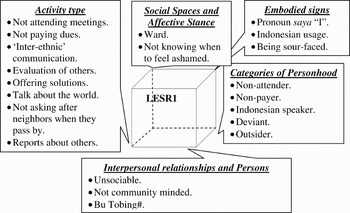
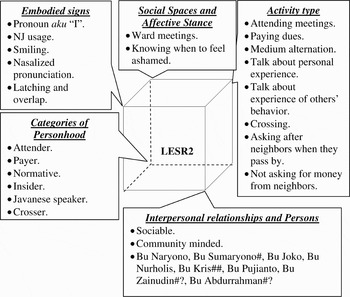
In summary, I have examined how insider and outsider identities emerge in talk about breaches of expectations among ward members from diverse backgrounds. I have done this by focusing on how such talk provides insights into what some members see as normative conduct within this ward. These expectations are jointly constructed insofar as problematic events (i.e., breaches of expectations about social conduct) are noted by one participant. On the other hand, evaluations of this event and the associated behaviors of the antagonist are often done by others, as is the posing of solutions. We have also seen how this type of conversational activity figures in widening the social domain of expectations. In addition, I have explored relationships with signs from perduring semiotic registers (SRs). For example, signs such as engaging in gotong royong ‘working together for mutual benefit’ and linguistic tokens stereotypically associated with particular identities seem to have been appropriated and recontextualized in the service of local social identification projects. In this way, I suggest that the interactional work exemplified above also produces emergent SRs (summarized in Figures 5 and 6).
Locally emerging semiotic register 1 (LESR1).

Locally emerging semiotic register 2 (LESR2).

While talk of the type examined here produces identities and expectations for social conduct in this setting, in a language socialization sense (Ochs Reference Ochs1988) it also resembles potential lessons on how newcomers might or should use certain signs to do interactional work. In this sense, through their participation as ratified bystanders, newcomers are provided with guidelines on how to become – and what it means to be – members of this ward. However, we cannot assume that newcomers will have learned such guidelines – hence the question marks after Zainudin# and Abdurrahman# in Figure 6 (bottom left box). In order to investigate whether any learning has occurred, we need to see whether and to what extent signs from the type of SRs noted in Figures 5 and 6 are appropriated, recontextualized, and then oriented to or ratified in subsequent interactions. In this sense, learning is conceptualized as the extent to which the social domain of the locally emerging SRs illustrated in Figures 5 and 6 widens through their use and ratification in subsequent semiotic encounters. Here “ratification” also suggests “appropriate” use in the sense of Hymes Reference Hymes, Pride and Holmes1972. In the next section I will take up these questions by exploring whether and to what extent these signs have been appropriated, recontextualized, and ratified across speech situations. I do this by looking at one newcomer's subsequent interactions in other meetings.
A NEWCOMER'S SIGN USAGE ACROSS SPEECH SITUATIONS
In this section I will focus primarily on one newcomer, Zainudin# (my Indonesian spouse), and her conversations in this ward during our two and one-half-year stay. I start with an account of her linguistic abilities. In tracing her trajectory of socialization outside this ward, I note that while she claimed to be a Sundanese speaker in interaction with members of this ward, she also had rather advanced ability in a number of varieties of Javanese. Despite her ability in NJ, we see evidence of use of this and other signs associated with LESR2 only in a ward meeting that occurs some five months later than the one which was the focus of the previous section. After making a quantitative comparison of her sign usage across three ward meetings, I examine some of her talk in a ward meeting held in December 1996. Taking this evidence together, I can say that Zainudin# has appropriated, recontextualized, and ratified signs from LESR2, and in doing so has contributed to widening their social domain of usage.
Starting with an ethnographic view of Zainudin's linguistic abilities, it is important to note that she had advanced ability in a number of varieties of Javanese prior to participating in the ward meeting described earlier. More specifically, by looking at her trajectory of socialization outside of ward meetings we find that Zainudin# was raised in an area near the border of Central and West Java. There her parents, siblings, and many neighbors and peers were multilingual and used signs associated with local varieties of Javanese, Sundanese, Indonesian, and Quranic Arabic. For her part, Zainudin was already a speaker of particular varieties of Javanese and Sundanese. More precisely, she was a member of several emergent communities of practice, each with its own associated SRs, which were talked about by her and her peers and parents in terms of widely circulating stereotypes about LOTI.
Just as importantly, she also had ability in a variety of Semarang Javanese (SJ). Before our move to Semarang in 1996, linguistic tokens from this variety were primarily associated with intimate age-mates in work and home settings rather than in the ward setting described thus far. This ability first developed during her three-year stay in Semarang in the early 1990s, where she lived, worked, and socialized with people born and raised in Semarang. It continued to develop during the period of fieldwork reported here, when she visited and was visited by her friends from this earlier period. I recorded one of their conversations; extract (8) is an example both of her talk with a long-term friend, Tuti, and of her ability in NJ. This recording was made one morning in early June 1996 during Tuti's first visit to our house. This particular piece of talk occurred soon after her arrival, while we were seated in the front room. The ratified participants included Zainudin#, our son Jery, Tuti, and myself (Zane). Prior to the talk in this extract Tuti had started to tell a story about a Japanese former boyfriend.
(8) Talking with a friend in ngoko Javanese

As can be seen above, Zainudin not only understands NJ usage but she also actively uses many NJ tokens here (and throughout the rest of this interaction). Even so, in the ward meetings that Zainudin attended in the early stages of her stay in this ward in 1996, she did not appear to use this ability much, although there is evidence that her usage of NJ forms and other signs associated with LESR2 did increase across time, as can be seen in the following tables. These tables represent rough quantitative counts of LESR2 features used across the three meetings, recorded in 1996. These counts need to be treated with caution because of problems of classification noted earlier, the different lengths of the meetings (the July and December meetings ran for just over an hour, and the August meeting 45 minutes), and the different participant makeup and participant constellations in each meeting.
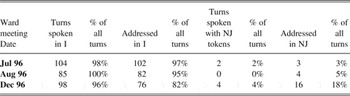
Table 1 represents a count of the number of times that Zainudin# was either addressed by others or used NJ or NJ tokens in these meetings. From this rough quantitative look, we can discern a broader pattern of increasingly frequent use of NJ to and by Zainudin#. For example, column 8 shows that from the July 1996 meeting to the December 1996 meeting there was a fivefold increase in the amount of NJ used when speaking to Zainudin#. Similarly, Zainudin's NJ token usage doubled over this time, although it appeared to be restricted to the use of the demonstrative iki ‘this’ and suffixes such as é and ké.
Increasing use of NJ with and by Zainudin.

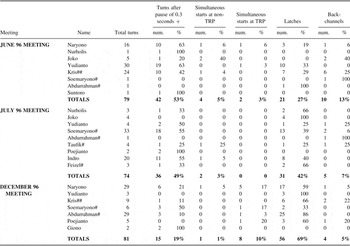
This picture of increasing use of LESR2 features is mirrored in her turn-taking patterns, shown in Table 2. This table does not include all participants at the meeting, but only those who speak to or are spoken to by Zainudin#. As can be seen in column 7 of Table 2, across a time span of six months Zainudin# seems to take less time to take a turn at turn relevance points (TRP). There is also a corresponding decrease in lengthier interturn pauses, as can be seen in column 4.
Zainudin's turn-taking patterns across three ward meetings.

She also appears to become better able to identify other participants' possible completion points, evident in the increasing occurrence of simultaneous starts at transition relevance places (TRP) in her interactions (column 6). That is, through participating in meetings she appears to have become increasingly familiar with certain members' sign usage. This appears to enable Zainudin# to project when a turn is nearly completed and to then take her turn at talk without it being seen as inappropriate (e.g., an interruption in need of repair). Column 5 also illustrates this trend. On an individual basis, there is a large increase in the number of turns and overlap with Nurholis, Naryono, Soemaryono#, and Abdurrahman#. These increases also seem to reflect these participants' trajectories of interaction within this ward in settings outside meetings where they tended to socialize on a weekly basis, with intimate friendships developing between Zainudin# and her two immediate neighbors, Abdurrahman# and Nurholis.
Extract (9) offers examples of LESR2 usage of the type documented in Tables 1 and 2. In particular, we see the existence of expectations on the part of one of her Javanese neighbors, Naryono, that Zainudin# has or should have learned some of these signs, especially Javanese, because some of Naryono's talk directed at her is in NJ. Extract (9) is taken from the December meeting, which had 13 participants. This interaction occurs about 15 minutes into the recording. It is preceded by an interaction among Pujianto, Zainudin#, Abdurrahman#, and Naryono about a new member of the ward who has opened a business that requires frequent trips by heavy trucks into the ward.
(9) Speaking and understanding ngoko Javanese

In starting the analysis, we can see that some of Naryono's talk that is directed at Zainudin in NJ suggests that Naryono either knows that Zainudin can understand talk in Javanese or expects that she should have such an ability, which is not unusual for non-Javanese, as we have seen in the case of Sumaryono# (e.g. extracts 1, 2, and 4–6). Indeed, from Zainudin's responses to Naryono's talk (lines 14–16 and 20–22), it appears that such expectations are met. Apart from the use of latching (lines 14 and 28) and overlap (lines 20 and 33), in this talk we also see that Zainudin# herself uses NJ suffixes é (soalé on line 5) and ké (bawaké on line 9). Although just a couple of suffixes, this seems to present some evidence that Zainudin# has learned that it is acceptable to use NJ tokens when interacting in ward meetings.
Along with her use of other signs associated with LESR2, this usage may be read as a claim by Zainudin# of being an insider or member of this ward. Indeed, such an interpretation also seems relevant to her interlocutor, Naryono, who replies in NJ (lines 11–13). As we follow her talk, however, we see that Zainudin# doesn't continue to use NJ forms (lines 14–16, 20–25, 28–30 and 33). We also see that Naryono moves to using Indonesian with Zainudin# (lines 26–27 and 31–32). While such usage is a type of “medium repair,”Footnote 5 it also presents evidence of Zainudin's learning signs associated with LESR2. In this sense, it is perhaps more accurate to describe this alternation as an instance of crossing or adequation, where such sign usage represents a new and emerging semiotic register that has within its category of signs Zainudin# and Naryono.
Taking these observations together with information about her trajectory of socialization, we can say that while Zainudin# had the choice of using either ngoko Javanese or Indonesian in the ward meetings held between July and December 1996, she chose to stick primarily to using Indonesian. This raises the question why. Zainudin# herself noted that this was so because she did not know these people well and indeed was rather surprised by the frequent use of NJ in these early ward meetings among those who she thought did not share any special bond of intimacy.
From my perspective, Zainudin's NJ usage in the December meeting not only represents a widening of the social domain of linguistic sign usage found in the earlier meetings, but it also is evidence of learning, where learning is conceptualized as learning to appropriately use linguistic signs (in this case NJ forms, which Zainudin already knew) and patterns of pause as two sets of signs in ward settings to signal her emerging ward member identity. In terms of other appropriate behavior, Zainudin's attendance at this and all prior meetings shows that she has learned that she should attend these meetings.Footnote 6
Put slightly differently, what we have seen is a use of some signs from LESR2 rather than all of the signs illustrated in Figure 6. The fact that she does not use all these signs – for example, her use of LESR1 term of self-reference saya on lines 2, 5, 7 and 20–21 of (9) – strengthens an interpretation of an emerging insider identity. That is, as a relative newcomer it is perhaps too risky for Zainudin# to use all these signs simultaneously. Such usage can attract comments like sok akrab ‘acting as if one is intimate’ when one does not have a long history of interaction underpinning such a claim. Zainudin's increased usage of signs associated with LESR2, especially NJ forms, is thus better conceptualized as adequation than as crossing. This adequation was facilitated by her regular engagement in these meetings and more generally through her regular sharing of social spaces as part of her daily social life within this ward (Goebel in press b).
CONCLUSIONS
This article started by reframing some enduring questions for those working in the area of migration and multiculturalism (e.g., Ang Reference Ang2003, Appadurai Reference Appadurai1996, Baumann Reference Baumann1996, Brettell Reference Brettell2003, Tsuda Reference Tsuda1999, Vertovec Reference Vertovec2007, Werbner Reference Werbner, Werbner and Modood1997). The first can be summarized as “How do people coming from diverse backgrounds and finding themselves in a setting characterized by transience go about interactionally doing togetherness in difference?” The second related question is “How do newcomers to such a setting learn expectations for social conduct?” Drawing on work on semiotics, face-to-face interaction, and cultural reproduction, I explored how attention to interdiscursive relationships between perduring semiotic registers and their appropriation and recontextualizations across speech situations can provide one way of approaching these questions, while also engaging in discussions about identity.
In particular, I examined how expectations about social conduct in a transient Indonesian urban milieu were displayed in talk that occurred in a female monthly ward meeting. In doing so, I explored how signs from three perduring semiotic registers (Figures 1–3) were recontextualized to position present and non-present participants. For example, in examining language alternation practices, I suggested that the association of Indonesian with outsiders (Figure 1) figured in the positioning of Tobing as an outsider in this ward in the July meeting. In doing so, I pointed to the relationship of this conversational work with other interactional work relating to the emergence of local categories of personhood, such as non-attender and non-payer. The result of this interactional work was that the representation of Tobing's talk could not only be read as ‘said in Indonesian’ but also as ‘said by an outsider in Indonesian’. Put slightly differently, this conversational work figured in both the social identification of ward members and the emergence of at least two semiotic registers (Figures 5 and 6), which could serve as resources for future social identification projects (cf. Wortham Reference Wortham2006).
Taking inspiration from other earlier work on language socialization and cultural reproduction (e.g., Ochs Reference Ochs1988, Wenger Reference Wenger1998), I went on to examine how one newcomer drew on her observations of sign usage and this talk as lessons for interacting in this ward. In this sense, learning is defined in terms of whether and to what extent participants are able to appropriately recontextualize signs. Learning here also means that participants can read these recontextualized signs as contextualization cues (Gumperz Reference Gumperz1982) that signify certain meanings for members who share a history of interaction. In particular, we saw how one newcomer, Zainudin, increasingly engaged in adequation. In doing so, she mirrored the language alternation practices of other non-Javanese in this ward, such as Sumaryono# and Kris##. However, Zainudin# and these other non-Javanese didn't engage in adequation with every member of the ward, but only those with whom they frequently interacted because of shared interests. The result of this chain of semiotic encounters was either a modified LESR2 or a new emerging one, which now had within its constellation of signs Zainudin#.