


INTRODUCTION

As Mexican immigrants move to areas of the United States that have not traditionally had Latino residents, both immigrants and hosts must adjust their accounts of the social world (Murillo Reference Murillo, Wortham, Murillo and Hamann2002, Zúñiga & Hernández-León Reference Zúñiga and Hernández-León2005). Longstanding residents must develop models of identity for Latino newcomers, and newcomers must make sense of other residents (Villenas Reference Villenas, Wortham, Murillo and Hamann2002, Grey & Woodrick Reference Grey, Woodrick, Zúñiga and Hernández-León2005). In our ongoing ethnographic and sociolinguistic study of one town that is experiencing rapid Mexican immigration, we have interviewed dozens of white, black, and Latino residents in order to explore the models of identity applied to and by newcomers (Wortham, Mortimer, & Allard Reference Wortham, Mortimer and Allard2009). The passage above comes from an interview conducted by an African American researcher with an African American resident of the town. The interviewee describes a commonly narrated type of event that we have called “payday muggings,” in which African American criminals mug Mexican immigrants on payday because they know that many undocumented immigrants do not have bank accounts and thus cash their paychecks (Wortham, Allard, Lee, & Mortimer in press).
Our purpose in this interview was to learn more about black residents' views of rapid Mexican immigration and to explore alleged tension between the two groups. The interviewee explicitly stated some relevant information on these topics. In the segment above, for instance, he claimed that black-on-Mexican muggings were caused by drugs and evil, not by interethnic tension. During the interview, however, interviewer and interviewee did more than communicate propositional information. The interview was done in a church, where the interviewer and interviewee had met, and the interviewee cautioned the interviewer about Satan. He may have spoken this way because he wanted her to join the church. The interviewee also expressed some frustration at the interviewer's repeated questions about interethnic tension, abruptly dismissing her claim at the end of the segment. He may have been frustrated with academic researchers, newspaper reporters, and others who seem determined to uncover tensions between blacks and Latinos. These interactional dimensions of the interview—his desire for her to join the church and his frustration at the academic emphasis on interethnic tension—might distort the information he is communicating. He might have altered what he said, in order to entice her or in order to win an argument with her, and thus his statements about payday muggings and interethnic tension might be suspect.
Many have pointed out the danger that interactional aspects of interviews pose to the collection of accurate information (e.g. Briggs Reference Briggs1986). An interview should yield some information that is communicated through propositions, and so such dangers are real. Interviewers ought to minimize the chances that interviewees edit what they say because of interactional concerns, and they should couch their requests for information in ways appropriate to the local context—so as to maximize the chance that they will collect full and accurate information. No matter how careful the interviewer is, however, interviewees always communicate other kinds of information besides the propositional. All language use communicates information about the interactional event of speaking and about broader social relations (Jakobson Reference Jakobson and Jakobson1957, Silverstein Reference Silverstein, Basso and Selby1976, Halliday Reference Halliday1978). Although interviews were not designed to collect such nonpropositional information, it can nonetheless be valuable. In this article we argue that, although interactional aspects of interviews can sometimes corrupt propositional information, these interactional aspects can also carry valuable information about habitual positioning and social evaluation done by interviewees.
INTERACTIONAL TEXT AS A RESOURCE
Jakobson (Reference Jakobson and Jakobson1957) distinguishes between the event of speaking and the narrated event. Most accounts of interview data focus on the narrated event, on propositions about the topic that are largely communicated through reference and predication. When a payday-mugging story is being told in an interview, for instance, the interviewee describes an event in which a Latino immigrant is mugged after cashing a check. But the event of speaking also plays an important role, in two respects. First, Jakobson and others have shown that narrated events can only be communicated if some information about the event of speaking is also presupposed. Personal pronouns and other deictics, for instance, depend for their referential value on temporal, spatial, social, and interactional knowledge about the event of speaking (Hanks Reference Hanks1990), and deictics are essential to denotation in almost all utterances. Second, language use always communicates about more than narrated events, as Bakhtin (Reference Bakhtin1935), Austin (Reference Austin1956), and others have shown. Speakers adopt interactional positions within emergent interactional events and with respect to larger social struggles in ways that may have little to do with the events being narrated. One might tell a payday-mugging story, for instance, in order to insult someone, in order to elicit sympathy, or in order to build an alliance with the interviewer. Interactional positioning within the event of speaking is partly accomplished through reference and predication, but it also depends centrally on indexical signaling (Silverstein Reference Silverstein, Basso and Selby1976).
Borrowing terms from Silverstein (Reference Silverstein, Basso and Selby1976), we can describe two dimensions of interview discourse. Interviewees create denotational text, producing a (hopefully) coherent propositional description of narrated events in response to interviewers' questions. Sometimes denotational text is extensively co-constructed with the interviewer, but ideally it is produced primarily by the interviewee. Interviewer and interviewee also create interactional text, a recognizable event in which they adopt interactional positions and engage in social action with respect to each other and the larger social world. Answering interview questions is a type of interactional text, but interviewer and interviewee also engage in other types of social action as well—ranging from attempts at religious conversion (Harding Reference Harding, Rosenwald and Ochberg1992) to pleas for therapeutic assistance (Wortham Reference Wortham2001) to “status bloodbaths” (Silverstein Reference Silverstein and Schiffrin1985).
The distinction between denotational text and interactional text has been applied to therapeutic discourse in a way that can illuminate interview data. Freud (Reference Freud and Strachey1900) interpreted patient speech by attending both to narrated events communicated as the denotational texts of therapy sessions—attending, for instance, to narratives about traumatic childhood events and descriptions of recent dreams—and by attending to the interactional positioning done by clients in the interactional texts of therapy sessions. He often conceptualized the latter as transference, defined as the projection of a socioemotional role onto the therapist within the therapy session. Patients enact habitual roles and project corresponding roles onto others as part of their neuroses, and Freud's attention to the interactional texts of therapy sessions allowed him to uncover these relational tendencies. We argue that interviewees engage in something like transference. The interactional texts of interview events often include positioning by the interviewee that reveals habitual social actions—sometimes actions that characterize the individual interviewee and sometimes actions typical of an interviewee's social group. Just as Freud treated transference as valuable therapeutic data that informed him about habitual socioemotional positioning done by his patients, interviewers can treat the interactional texts of interviews as valuable information about the habitual interactional and evaluative positioning done by their interview subjects. An interviewee's interactional positioning does not always reveal habitual interactional tendencies that are of use to a researcher, but it often does.
We tend not to notice the potential research value of interviewees' interactional positioning because of a prevalent (and generally plausible) language ideology about interviews: we should focus on the denotational texts of interviews because they are decontextualized events designed to elicit propositional descriptions. Briggs (Reference Briggs1986) and others have criticized this ideology, pointing out the inevitable co-occurrence of interactional texts in interviews. We argue that both the ideology and its critics are correct in important respects. Interviews are decontextualized events, and they are often well-suited to elicit accurate accounts of social life. But their decontextualization can also lead us to ignore the interactional positioning that inevitably occurs in interviews, and sometimes this interactional positioning distorts the information communicated denotationally. Furthermore, as Briggs (Reference Briggs1986) points out, some types of people and some societies are less comfortable with such decontextualized events, and interviews in these contexts may provide misleading information.
Both the ideology and its critics often make a questionable assumption, however: interviews are “artificial” and distinct from “naturally occurring” discourse. This is in some respects true, but in other respects interviews are embedded in and continuous with habitual discursive action. The interactional texts enacted in interviews are not necessarily decontextualized. They often mirror or are continuous with ongoing social action in a community. Payday-mugging stories, for instance, circulate widely in the town we have been studying. We have recorded and observed dozens of instances across settings, with narrators from several communities. Some of these narratives have been elicited, but many have been spontaneously told to us or to others both inside and outside interview settings. When an interviewee tells a payday-mugging story, the narrator may be enacting similar positioning to what he or she would do while telling the story to others in the community. In one respect the narrative is oddly decontextualized, since residents of the town do not normally interview each other. But in other respects the interactional positioning done while telling the payday-mugging story to an interviewer can resemble the interactional positioning and evaluation typically done by narrators in this town. By attending to the interactional texts of interview events, we can observe such positioning and evaluation.
Narratives are particularly rich vehicles for communicating social positions and enacting characteristic actions (Schiffrin Reference Schiffrin1996, Wortham Reference Wortham2001, De Fina, Schiffrin, & Bamberg Reference De Fina, Schiffrin and Bamberg2006). Narratives are also commonly told in interviews. So interview narratives are one promising site for studying interactional positioning that might yield evidence of interviewees' characteristic social action. In this article we adopt a Bakhtinian approach to the social characterization, evaluation, and interactional positioning that can occur through narrative discourse (Bakhtin Reference Bakhtin1935, Wortham Reference Wortham2001, Wortham & Gadsden Reference Wortham, Gadsden, De Fina, Schiffrin and Bamberg2006). Narrators always “voice” narrated characters as having some recognizable social role, and they always evaluate those characters, taking their own position with respect to narrated characters and events. Narrators also always perform social actions through their storytelling, positioning themselves with respect to interviewers and audiences in the event of speaking. In the empirical analyses below, we use this approach and the methodological heuristics described in Wortham Reference Wortham2001 to analyze payday-mugging narratives and surrounding discourse for the social evaluation and interactional positioning that is accomplished by interviewees.
PAYDAY MUGGINGS IN THE NEW LATINO DIASPORA
Payday-mugging narratives in our research site play a role in the emergent historical process through which Mexican immigrants and host communities are making sense of each other. Mexicans are the oldest and largest immigrant group to the United States (Zúñiga & Hernández-León Reference Zúñiga and Hernández-León2005). Longstanding patterns of Mexican presence in the US have changed dramatically in the past fifteen years, however. Large numbers of Mexican immigrants have settled in the Midwest, the South, and the Northeast—often in rural and suburban areas where Mexican-origin people have not lived before. Between 1990 and 2000, the number of Latino immigrants (most of whom are Mexican) to “new settlement states” grew by 130%, as opposed to 50% growth in traditional settlement states (Therrien & Ramirez Reference Therrien and Ramirez2001; Suro & Tafoya Reference Suro and Tafoya2004). According to the US Census American Community Survey, between 2000 and 2006 the number of Mexican-origin residents in the town we are studying almost tripled, and similarly rapid growth is happening in towns across the country (US Census 2006–2008).
Though spread across the US in places as geographically diverse as Nebraska, Georgia, Pennsylvania, and Maine, the small rural and suburban towns that have become new destination sites in what Villenas (Reference Villenas, Wortham, Murillo and Hamann2002) and Murillo (Reference Murillo, Wortham, Murillo and Hamann2002) have called the “New Latino Diaspora” often have much in common, both in their attractiveness to immigrants and in the way residents react to the new arrivals. Sometimes immigrants are perceived as hard-working contributors to the town, while at other times they are seen as undesirable neighbors who have brought social pathologies with them (Murillo Reference Murillo, Wortham, Murillo and Hamann2002, Rich & Miranda Reference Rich, Miranda, Zúñiga and Hernández-León2005, Zúñiga & Hernández-León Reference Zúñiga and Hernández-León2005). Host communities are generally ambivalent about the growth of the Mexican population in their midst, and internal conflicts over education, social services, local public policy, and general neighborliness appear in newspapers and other local discourse.
Our research site, “Marshall,” is a suburb of about 30,000 in an East Coast metropolitan area. Once a mostly white suburban town, Marshall is now ethnically and racially diverse. Along with the diminishing white community, a large African American community has long resided in Marshall—with some families having come at the end of the nineteenth century and many others having arrived in the 1960s and 1970s. Foreign-born immigrants also form an important part of Marshall's history—mostly Irish and Italian immigrants, but also some Puerto Rican, South Asian, and Caribbean newcomers who arrived in the 1970s and 1980s. Census data show that the distribution of racial and ethnic groups underwent radical changes between 1990 and 2006—from about 70% white, 25% African American, and 3% Latino to about 40% white, 40% African American, and 20% Latino. Many white residents have left for nearby suburbs, while the Latino population grew dramatically, going from under 0.5% in 1990 to about 20% today. Marshall is also significantly poorer than surrounding suburbs. Almost 20% of documented residents live below the poverty level, but inclusion of the many undocumented Mexican immigrants would raise this figure considerably. African Americans and Latinos live in the poorest neighborhoods and have less education than other groups. In many ways Marshall faces challenges more often associated with big cities but now increasingly confronting rural and suburban areas across the US. The analyses presented in this article are based on five years of ongoing ethnographic observations and the collection of payday-mugging narratives from white, black, and Mexican narrators in schools, social service agencies, churches, coffee shops, restaurants, libraries, government agencies, and on the streets of Marshall.
This background information is important to our analysis of payday-mugging narratives and interview data: in order to understand the interactional texts enacted in interviews, we need ethnographic information about the categories used to understand the social world and the typical practices found in this town. Only with such background information will we be able to interpret the interactional events enacted during interviews. We will also need ethnographic background information to infer when interactional positioning by an interviewee represents habitual patterns and when it does not. Our method, then, necessarily combines ethnography with interviews.
TWO INTERACTIONAL TEXTS
In this section we present excerpts from three interviews, each of which illustrates a type of interactional positioning often found among one group of Marshall residents. The first excerpt appeared at the beginning of the article, taken from an interview conducted by a young female African American researcher with a middle-aged, working class, religious African American male. The researcher was interested in reports of ethnic tension between blacks and Mexicans, and she asked whether the interviewee had observed such tension—asking the question in a way that presupposed the tension did in fact exist. Initially, the interviewee seemed to agree that there was the potential for tension and perhaps violence.

By concluding that sooner or later there might be conflict because of these crimes, he seems to align himself with the interviewer's presupposition that there is in fact interethnic tension. As the interview continues, however, he changes his stance.

The interviewee interrupts the interviewer and introduces two interactionally relevant pieces of information. First, he claims that the robbers are “crack heads” who would rob anybody—including African Americans like the interviewer and interviewee, and even the church—to get dope. This seems to argue against the interviewer's presupposition that black-Mexican tension lies behind payday muggings. Second, he warns the interviewer about the dangers of Satan. This could be the beginning of an attempt to entice the interviewer into joining the church (although there is no further evidence about this potential interactional text in this short segment).
As the interview continues, however, the interviewer reaffirms her presupposition that interethnic tension lies behind payday-mugging narratives. She implies that African Americans may be unhappy with Mexicans for moving into their neighborhoods and taking their jobs—assertions that she has heard from others and repeated earlier in the interview—and she asks whether this might explain black-on-Mexican crime.

The interviewee categorically denies the interviewer's claim about interethnic tension and reiterates his assertion that addiction motivates the criminals. In the first turn of this segment he was willing to align himself with the interviewer and her assumption about potential interethnic tension, but he quickly changes his position. He then acts impatient and frustrated with her repeated claims about interethnic tension, and at the end he is willing to confront her over this issue. In our larger ethnographic study, we have seen such frustration from other African American residents. Unlike white and Latino narrators, blacks tell payday-mugging stories in a way that distinguishes between types of black residents—crack heads and other criminals who may mug Mexicans, and working people or middle-class community members who do not. Black narrators also resist the contrast between predatory blacks and victimized Mexicans, and they express frustration with academics and journalists who assume such interethnic tension. This interviewee's interactional shift from alignment to disalignment echoes that more general stance.
The second excerpt comes from a group interview with several young Mexican men. The interview arose spontaneously during the course of a classroom observation, when the topic of crime against Mexicans in Marshall came up. The teacher noticed some students eager to talk about this, and she encouraged them to come to the front of the room and talk to a researcher who was “interesada en estos asuntos” (interested in these issues). The discussion was then moderated by the teacher, who is from Puerto Rico, and to a lesser extent by a researcher who is half Puerto Rican and half Anglo American. In the following segment from that group interview, a young man voices the characters in payday-mugging events quite differently than the first interviewee did.

Here the interviewee sets up an opposition between “they,” who complain about Mexicans taking their jobs, and “we” who in fact work hard and immigrated in order to have a better future. The last sentence implies that “they” include African Americans who mug Mexicans.
This implication becomes clearer as another interviewee adds to his classmate's account by narrating a payday-mugging event.
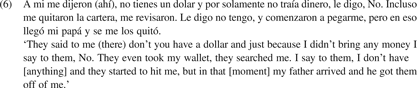
This narrative characterizes the muggers as unnecessarily violent. In addition to their inaccurate, derogatory portrayals of Mexicans, “they” beat a mugging victim just because he has no money. Interactionally, this segment positions the interviewees as reasonable people following the classic immigrant pathway of hard work and hoped-for upward mobility in the face of hardship. The narrators project an interactional position for the interviewer as being on their side, because surely both teacher and researcher will be sympathetic to a striving immigrant and opposed to “them” who make unreasonable assertions and act violently against immigrants. The Mexican youth thus invite the researcher and teacher to be part of their “we,” opposed to “they” who perpetrate payday muggings and other sorts of disorder. In our larger study we have observed many immigrants positioning themselves similarly with respect to longstanding residents: as upwardly mobile in the same way as earlier waves of immigrants, as bound to succeed through hard work, and as opposed to dangerous groups who turn to crime and threaten the larger society (Wortham et al. Reference Wortham, Mortimer and Allard2009).
As the interview goes on, however, the young men shift their interactional positioning. In the following excerpt from the end of the interview, the young men explain that, unlike older men who are more often victimized, they are generally capable of defending themselves. In doing this, they move away from the victimization narrative and into territory that may be less sympathetic to their interviewers.

This youth voices young Mexican men like himself not as passive victims, but as tough people engaged in a serious conflict who are going to defend themselves. Older men might just take the abuse, but these young men will not stand for the violence perpetrated against them. By giving themselves this more aggressive voice, these interviewees position themselves differently than they did at the beginning of the interview. The alignment that they achieved when positioning themselves as hard-working immigrants shifts when they begin to talk about violence and self-protection. It seems that appearing tough and capable in front of other young men trumps alignment with sympathetic outsiders. By interjecting, “It's not good” in English, one young man recognizes that the interviewer and the teacher will not like that they have to arm and defend themselves—but, he says, they will do what they have to do. The positioning in this case has three slots: violent perpetrators, Mexican youth, and educators who may not like it, but who will hopefully understand young Mexicans' position.
CONCLUSIONS
As they worked to position themselves interactionally, interviewees in these segments might have corrupted the data. The first interviewee might have been so frustrated with academics' focus on interethnic conflict that he neglected to mention relevant information about black resentment of Mexicans. The young men in the group interview might have been so determined to enlist the interviewer as an ally that they ignored many Mexicans' recognition of the social challenges faced by African Americans. Or the youth may have been so concerned to appear tough in front of their friends that they exaggerated the passivity of older Mexicans. Sometimes interactional aspects of interviews can lead research subjects to misrepresent reality, and interviewers should be aware of this as they encourage interviewees to give propositional accounts that accurately represent the beliefs and events they are describing.
But this is only one way in which interviews can yield useful data. In addition to communicating decontextualized representations of social reality, interviews are also part of social reality. We have argued that interviewers should follow Freud (Reference Freud and Strachey1900) in attending both to the denotational texts and to the interactional texts of their interviews. Whatever the value of the propositional descriptions they offer, interviewees also position themselves interactionally and evaluate aspects of the social world through the same discourse that they use to refer to and predicate about the topic. By attending to interactional texts, interviewers can sometimes learn about habitual positions that people take in everyday life, and this can yield useful information about research topics. Interviewees communicate two types of information, and interviewers should attend to both.


