INTRODUCTION
This article describes the emergence in Bangladesh of a repertoire of discourse forms associated with scientific psychiatry that attempt to distance it from magic and religion. These forms and their function are related to the emergence of psychiatry in Europe and the hegemony of certain centers of knowledge production vis-à-vis peripheries like Bangladesh. Beyond a brief consideration of this European background, I shall focus on the process of enregisterment, the Bangla psychiatric register,1
Bangla is the language often called Bengali.
The growth of medical and psychiatric registers can be regarded as so many skirmishes in the long border war among magic, science, and religion; they presuppose the history of European discourse influenced by Bacon and Locke, whose struggles to invent a modern scientific language were defined both by striving toward “purity” of boundaries and much “hybridity” (among nature, society, and language; among magic, science, and religion; etc. [Bauman & Briggs 2003]). The Bangladeshi psychiatrists I know react to rural patients and their families as they do in part because of such boundary/purification struggles. Issues of discourse – particularly, the production and maintenance of a scientific register – are at the heart of psychiatry's struggle, and patients become caught up in it. In Bangladesh this appears as a struggle to “modernize” the country, its culture, its people (especially rural people), its language, and its psychiatric profession, inter alia.
Psychiatry struggles with its own complex – a “magic complex” – because of its tenuous reputation (Rosoff & Leone 1991:321; Perlin 1997; Lee 1999:354),2
See Stanford law professor Lawrence Friedman's (1993:398) reference to “psychiatric mumbo jumbo,” and references in the press to such testimony as “bamboozling” (compare “mesmerizing), “psychobabble,” and (in the public's eyes) “a song and dance,” all of which associate the profession with magic and deceit (Perlin 1997:1381, 1403, 1416).
The first quote is from Goldstein (1987:382), who goes on to cite Charcot's (1892) article, from which the second quote is taken.
Agha (2004:24) defines a register as “a linguistic repertoire that is associated, culture-internally, with particular social practices and with persons who engage in such practices.” The “medical register” and its role in buttressing the credibility of expert witnesses have been explored in this journal (Matoesian 1999:519). The term “enregisterment” “refers to processes through which a linguistic repertoire becomes differentiable within a language as a socially recognized register of forms,” processes that produce cultural value, “processes through which the values of cultural forms are formulated, maintained and communicated across social populations,” as in “the emergence and spread of a prestige register” (Agha 2003:231). Agha describes the “Received Pronunciation” of British English, its demographic spread, and its function as a gold standard in an increasing array of situations in the UK. Professional registers can also confer prestige. Whereas some depict them as esoteric, members of the public occasionally borrow from the emerging Bangla psychiatric register, as has happened with psychiatric registers since the 1810s, when the newly minted psychiatric term “monomania” quickly entered French popular culture (Goldstein 1987:153).
PSYCHIATRIC PRESTIGE AND PSYCHIATRIC NOSOLOGIES
Classifying is central to culture, to what languages offer as semanticoreferential systems, and to what speech interaction does (Silverstein 2004). Moreover, the self-conscious development of a set of labels, knit together in hierarchies, uniquely characterizes the self-invention of the natural sciences in early modernity. Peculiar to modern psychiatric nosologies is a special attraction to natural kinds. Psychiatry's science envy pertains to its inability to establish with any certainty that it deals with natural kinds such as species, chemicals, and water, which are indifferent to being classified as such. Psychiatry deals instead with interactive kinds, which are conscious of, and affected by, being classified as they are. Hacking writes, “There is a constant drive in the social and psychological sciences to emulate the natural sciences, and to produce true natural kinds of people. This is evidently true for basic research on pathologies such as schizophrenia and autism.” But this is an unattainable dream; these cannot be natural kinds, because “new knowledge about [human groups] … becomes known to the people classified, changes the way these individuals behave, and loops back to force changes in the classifications and knowledge about them” (Hacking 1999:105). The frustrated drive to emulate the natural sciences becomes envy, because to be seen as more scientific is to be more highly valued (Harré 1985:182), particularly in the context of international peer relations.
In what appears to be an attempt to ward off the label “backward” for their national psychiatric professions (Lee 1999:354; Pacific Rim College of Psychiatrists 2006), Asian psychiatrists increasingly conform their labeling practices to cosmopolitan norms as embodied in the DSM (the Diagnostic and Statistical Manual, American Psychiatric Association 2000), the handbook of psychiatry and allied professions. In clinical practice (Berkenkotter & Ravotas 1997:264), psychiatric taxonomies are used as “membership categorization devices” (MCDs), Harvey Sacks's (1972) term for the category sets, and accompanying rules of application, by which people routinely describe others (Goodwin 2006:264). MCDs include the noun phrases that might be embedded in a psychiatrist's declaration, “You are suffering from [illness label].” Properly invoking membership categories that stand a chance of being recognized as rigorous is crucial to science, medicine, and psychiatry (in descending, nesting order).
THE COIN(AGE) OF THE REALM: POWER AND TAXONOMIZING IN PSYCHIATRY'S HISTORY
According to the Oxford English Dictionary, “psychiatry” appeared in English (borrowed from German; Goldstein 1987:4) only in 1846, and “psychiatrist” in 1890. Previously, these marginal figures had been called “alienists” or “mad doctors” – a profoundly ambiguous term. Throughout the 19th century, mad doctors struggled to distance themselves from the aura of magic, in part through the discursive sorts of reform instantiated in James Braid's writing:
I was led to discover the mode I now adopt with so much success for inducing this artificial condition of the nervous system, by a course of experiments instituted with the view to determine the cause of mesmeric phenomena. (1998 [1853]:61, 60; emphasis added)
Braid was the coiner of the term “hypnotism,” a technique important to early psychiatry, but whose longer history is associated with sorcery, magic, and demonology (Hayward 2004, Orne & Hammer 2006).
Discursive reform was tied to enregisterment processes that, in psychiatric French, English, German, and other languages were bound to genres like medical journal articles (an important means of establishing and circulating scientific knowledge), hospital records (typically the source of the articles), and psychiatric textbooks (an early example is Pinel's, 1801). Coining new disease labels has been central to this process at least since the 19th-century French Idéologue doctors – practitioners of “the science of ideas,” “medicine of the imagination,” or “moral treatment,” such as P-J-G. Cabanis (1757–1808) and Philippe Pinel (1745–1826) (Goldstein 1987).
In Pinel's or even Charcot's era, diagnosis was characterized by “vagueness” (Drinka 1984:40). It was not until the time of the German psychiatrist Emil Kraepelin (1856–1926) that category specification took off. The trend has only intensified since Emil, brother of the German biologist Karl Kraepelin (1848–1915), transformed psychiatry by subjecting it to the brothers' mutual interest in biological taxonomies (Weber & Engstrom 1997:383). Psychiatry's focus on classifying illnesses as natural kinds emerged with the publication of the 1899 edition of Emil's textbook on clinical psychiatry (Kraepelin 1899). That edition gave special attention to “dementia praecox,” later baptized “schizophrenia.” The Kraepelinian revolution spawned new scientizing uses of language that came to define the psychiatric register. Registral consequences are still being felt through successive iterations of the DSM, in use to a greater or lesser extent around the world.
A key marker of the psychiatric register in Bangla and English
One more piece of history outside of Bangladesh is important to mention before focusing our attention there, and that pertains to the rise in English of a certain progressive use of one verb in particular. The enregisterment of medical and psychiatric English was not completely cut off from popular usage; certain phrases, however, came increasingly to index an ever more prestigious medical profession – particularly the construction “you are suffering from … .”
The first Oxford English Dictionary entry for “suffer” is not the strictly subjective sense of the term, but rather, “to undergo, endure,” as in to undergo “(c) a blow, wound, disease.” (The denotation of the Bangla counterpart bhug- is similar; Ali, Moniruzzaman, & Tareq 1994:616). The third OED entry is “To undergo or submit to pain, punishment, or death,” e.g., “(b) from … a disease or ailment.” By the end of the 19th century, the medical associations of the progressive form “you are suffering from” were strong enough that literary instances cited in the OED are consistently medical. The phrase appears in the fiction of Conan Doyle, Kipling, and George Eliot either in the mouths of medical doctors, or (in Kipling) in an apparent parody of the medical voice. Dr. Tertius Lydgate speaks thus to Rev. Causabon in Eliot's Middlemarch: “I believe that you are suffering from what is called fatty degeneration of the heart” (1986 [1871–2]). The progressive aspect emphasizes the immediacy (and, perhaps, the short-term duration) of what the semantic patient is enduring.4
The overlap of the two senses of “patient” is no coincidence. Thanks to Doug Biber (personal communication, June 2006) for this interpretation of progressive aspect in English.
The simple present, “You suffer from… ,” tends either not to be medicalized or, when it is, to occur in interrogative or conditional sentences.
In order to contextualize the Bangla discursive forms I analyze below, I now turn to a thumbnail ethnographic sketch of Bangladesh.
ETHNOGRAPHIC CONTEXT
Bangladesh is an agrarian nation undergoing rapid change in a form of capitalist development unlike what its larger South Asian neighbor, India, experienced. Specifically, Bangladesh's development trajectory is marked by a radical dependency that sets it apart from India's mid-20th-century attempts at economic/cultural self-sufficiency. India has a thriving Ayurvedic medicine “industry”; there has been no strong movement to preserve Bangladesh's Ayurvedic medical tradition. A relatively young female psychiatrist who collaborated with me, whom I call “Dr. Pushpu,”6
This name, and those of patients, editors of the magazine, and all other Bangladeshis named, are pseudonyms. Some information about individuals has been changed to protect their privacy.
The rural Bangladeshis I've met tend to explain unusual human behavior not (or not just) as the result of psychological states but as the effect of ‘sorcery objects' (one possible sense of tabij), ‘loose wind’ (alga batas, sometimes understood as spirits), or frustrated desires (Wilce 1998). When someone goes mad, family members may subject him or her to a ritual sweeping, dusting, and blowing – jharphuk – or procure for the sufferer a protective tabij ‘amulet.’ The vast majority of Bangladeshis have nothing to do with psychiatry; they live a good day's journey from the nearest psychiatrist, and their knowledge of the world has little in common with Dhaka psychiatrists’ knowledge (Wilce 2004).
Along with other media, magazines provide a means by which modern “technologies of self” (Foucault 1990) – including psychiatry and psychology, two of what Rose calls “the psy disciplines” and their models of self – can enter popular discourse. In the West these disciplines have “disseminated themselves rapidly through their ready translatability into programs for reshaping the self-steering mechanisms of individuals, whether these be in the clinic, the classroom, the consulting room, the magazine advice column, or the confessional television show” (Rose 1996:34; emphasis added). In India one can also read magazines devoted to the psy perspective on the self, some of which began publication decades ago. General-interest magazines that have an even wider circulation in India have for many years carried psychiatric advice columns (Halliburton 2005).
Only in 1998 did a magazine appear in Bangladesh that popularized a psy approach to the self – Manabigyan ‘Psychology.’ It reflects the vision of “Dr. Minaj,” its founder and publisher – a psychiatrist who completed postgraduate training in England – and the circle of psychiatrists he has trained. Dr. Minaj is shaped by his engagement with global psychiatry (primarily through attending regional conferences) and his scouring of the Internet for articles (importantly, in English) to translate for Manabigyan. Dr. Pushpu, mentioned earlier, cofounded and helps edit the magazine.
Manabigyan’s readership is impossible to count, but surely well above the 9,000 copies of each monthly issue being printed in 2000 when I interviewed Minaj, since each copy would likely be read by several people. Readers send letters to its Paramarś;o Pata ‘Advice Page’ from all over Bangladesh, seeking help with their own or their loved ones' problems. The psychiatrist-editors responding to them reframed samasya ‘problems' as manasik rog ‘psychiatric illnesses'7
Some letter writers refer to rog or manasik rog (though never manarog, used 13 times by the editors), but the editors are responsible for 90% of the 50 tokens of the phrase manasik rog.
The magazine is a site of interest as an agent of cultural change. Dr. Minaj and his colleagues had an openly missionizing attitude about the magazine and their work in general, possibly motivated by a sense of Bangladesh's “backwardness.” To have their compatriots speak of madness as pagalami ‘craziness’ (rather than manarog ‘mental illness,’ or manasik rog) – or even to hear that some of them fall prey to spirit possession – challenged the purity of the register that they struggled to establish.
METHOD AND THEORY
During winter break, 2000–2001, I carried out three weeks of urban fieldwork in collaboration with Dr. Pushpu and other psychiatrists who are part of the Manabigyan circle. Old contacts in Bangladesh introduced me to Dr. Pushpu, who in turn introduced me to Dr. Minaj and his collaborators at Manabigyan. Later in this period the staff gave me copies of the magazine's first three volumes.
I had previously carried out doctoral fieldwork in rural Bangladesh focused on complaint, eventually working with many who were locally labeled pagal ‘mad’ (1991–1992; see Wilce 1998). This time I met patients, always accompanied by family members, in psychiatrists' chambers. I developed a joint informed consent procedure with the psychiatrists, asking patients and families whether I could arrange a home visit to videotape a dinner conversation. Once, Dr. Pushpu, a patient, and her family allowed me to videotape Pushpu's “home” visit (caveat explained below), the focus of Transcript 4. Thus this article analyzes two sorts of discourse data: videotaped interactions and advice columns.
With the assistance of a graduate student who is highly literate in Bangla, I transliterated, translated, and analyzed the first 111 exchanges appearing in Manabigyan's Advice Page (an exchange consists of reader's letter and editor's answer). I focus on the impact of the editors' responses in shaping a scientific Bangla register. Then I transcribed and analyzed eight videotaped encounters involving families and myself, using techniques combining conversation analysis and semiotic-poetic analysis, again receiving help in transcribing and translating difficult portions from the Bangladeshi student. The 111 exchanges comprised Manabigyan's first eight issues, a corpus of 15,800 words.
Why should an account of the enregisterment of a scientific variety of Bangla center on its poetics, particularly the parallelism I trace in Transcripts 1–4, below? The role that parallelism – poetic juxtapositions of paired elements (Fox 1988:3) – turned out to play is striking. “Densely laminated” or “hypertrophied” layers of parallelistic structure are associated with “full-tilt” ritual, even if “ritualization” is by degrees a feature of all speech events (Silverstein 2001, 2004). Yet, as Silverstein points out, building on a long line of argument (see Irvine 1989), all acts of naming (and, I might add, as Kripke 1972 and Putnam 1975 show, particularly scientific naming) are ritual events. Hence my focus on “baptisms” (Kripke's term) or rebaptisms of English nosological labels for use in the (hybrid-) Bangla psychiatric register.
These baptisms are embedded in parallelistic structures. The study of parallelism began with Robert Lowth (1710–1787). Scholars like Lowth associated such poetic devices with Europe's spatiotemporal Others (Bauman & Briggs 2003). It is important, therefore – to the extent that it is empirically justified – to explore parallelism's role in the enregisterment of a scientific variety.
The linguistic anthropological analysis of parallelism has shifted since Jakobson's time – though he very much prefigured the shift (1987:135) – from static to dynamic understandings of text (i.e., to “emergent entextualization”), and to an increasing focus on how emergent textual patterns achieve certain ritual ends. Silverstein uncovers the gradually building effect of Lincoln's layering of multiple forms of parallelism in the Gettysburg Address (2004:48). Elsewhere, he reinterprets one of Fox's (1989 [1974]:74–76) examples of parallelism in terms of emergent entextualization: “The dynamic figuration here – the diagram emergent over the real time in which the message is articulated – is, of course, what makes this ritual text ‘work’ as effective social action” (Silverstein 2004:627).
In his analysis of the transcript of a dyadic interaction, Silverstein demonstrates the close intertwining of what he calls the “interactional text” – the record of how participants mutually constitute each other, and themselves, in give-and-take, vis-à-vis “relational positions” – with the “denotational text” or information structure. When the latter consists to any significant extent of identity categories, the mutual involvement of the two “texts” is obvious (Silverstein 2004:622–25). The dual-text approach intimately connects the analysis of parallelism to a model of how the social order is constituted and reconstituted in interaction. Denotational texts, unfolding as they do in the binaries of “then” and “now,” “there” and “here,” provide rich resources for interlocutors to link each other with denoted identity categories contrastively laid out vis-à-vis deictics. One often finds “semantic and structural parallelism … across a series of deictic verbs, demonstratives and locative adverbs” in the worlds' languages (Sidnell 2005). Given that “most languages seem to make a basic distinction between proximal [and] distal” deictics (Sidnell 2005) that can be described as a pervasive structural duality, we have here a built-in foundation for parallelism (as poetic juxtaposition of paired elements). It is the foundation for antithetical parallelism in Transcript 4.
A final note on parallelism in the context of explicitly modernizing discourse. Contemporary social scientists critique the simplistic binaries of modernization theory: modern vs. traditional, corresponding with a whole set of antonyms including urban vs. rural and Gesellschaft vs. Gemeinschaft. Yet, as valid as the critique of modernization discourse is, we cannot ignore those instances when local actors adopt it (Ferguson 1999:83–84). In contemporary Bangladesh there are many ways of speaking about urban and rural life, or allopathic and other forms of medicine. But one way of speaking about such things that is common, at least in Dhaka, draws on the antithetical pairs of modernization theory. I wed this broad recognition with the tools of poetic-semiotic analysis in my approach to parallelism.
TEXTS AND ANALYSES
It is best in introducing the letter-exchanges to present a simple one, in translation, which moves quickly through the structural features common to all.

Italicized terms appeared in English even in the original editors' response.
Exchanges in Manabigyan move quickly along in a kind of replication of Bangladeshi psychiatric encounters. The clinical encounters I witnessed involving psychiatrists in the Manabigyan circle were under five minutes, proceeding quickly to a diagnosis. Each advice column response tends to begin with a salutation, and then move to a revelation that may (re)baptize a psychiatric illness label (“you are suffering from x”), sometimes followed by an even more dramatic revelation, viz. where this problem “comes from,” (e.g., the “unconscious mind”). Next comes professional advice (“get psychotherapy” – specifically, after a few issues, at the new Manabigyan Counseling Center), an underscoring of psychiatry's authority in these matters, and finally, prescribing psychiatric prescription drugs in this version of telemedicine.
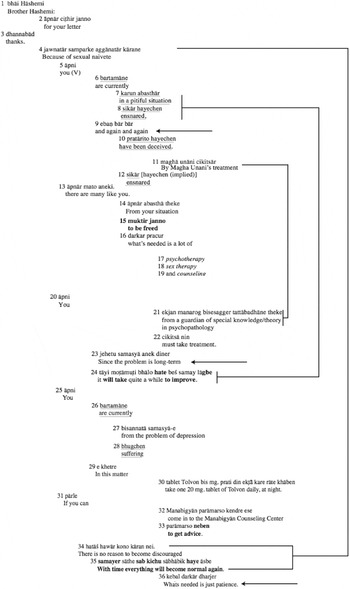
An editors' response seven months later (Figure 1) entails greater elaboration, just as in the letter that provoked it (372 Bangla words vs. 29 Bangla words in the letter translated above).

Response to Hashemi's Letter.
“Hashemi's” letter and its answer appeared in Manabigyan's seventh issue. There are several reasons to analyze it. First, writing from a major urban area, Hashemi reveals (fatefully) that he has sought treatment from an Unani (Islamic-medical; see Liebeskind 2002) clinic. This prompts the editors to attend to the boundary between science and religion. Although Hashemi indicates that Unani failed, the editors respond as though psychiatry's authority needed asserting vis-à-vis the ongoing availability of religious healing. Second, true to form, the response includes the formula “you are currently suffering from … .” Finally, it is rich in parallelistic structure, allowing us to see in its entextualized figuration the paradox of modernist psychiatrists' magical-poetic vanquishing of “backwardness.” The commitment of the Manabigyan circle to psychiatric modernism shows itself, ironically, in the unfolding poetics of this text. In particular, its three chiastic layers of antonymous parallelism (Jakobson 1987) bear the modernist message.
The outermost bracket connects the editors' accusation of naïveté, from line 4 – surely good grounds for Hashemi to feel hatas ‘discouraged’ (line 34) – to the closing exhortation not to feel discouraged (34) – a paradox at best! Thus the first antithetical pair. Moving inward – building parallelism – the next bracket connects Hashemi's condition “now” (‘ensnared’, lines 7–8) to a promised improvement in the ‘long-term’ should Hashemi pursue a full scientific psychiatric treatment (lines 21–22). We come, finally, to the literal crux. As a rhetorical tool, chiasmus (a cruciform or X-like pattern of entextualization)9
The OED defines “chiasmus” as “a grammatical figure by which the order of words in one of two parallel clauses is inverted in the other.” See also Silverstein 2004:626.
There is an intriguing paradox in the representation of the psychiatric authorities from whom Hashemi should receive therapy (line 21). The editors exhort Hashemi (and in some sense all of Bangladesh) to turn from Unani medicine/tradition/deception to psychiatry/modernity. Yet the word tattabadhane, the ‘guardianship of special knowledge’,10
Tattabadhane denotes “1) superintendence, guidance, 2) guardianship.” It derives from tatto, “(fundamental) truth; essence, reality…. the twenty four principal constituting elements according to the Sankhya [Hindu] philosophy” (Ali, Moniruzzaman, & Tareq 1994:261–62).
Present and perfective verb forms are underlined and future forms boldface. Note the non-accidental shift from one to the other as the response unfolds. This text, a microcosm of the grand narrative of modernity, dynamically figurates Hashemi's and Bangladesh's potential move from a dark past and an entrapped present to the desired future. The progressive unfolding of the editors' response maps out on the plane of discourse what they attempt to “magically” (i.e., performatively, rhetorically) accomplish on a more worldly or cosmic plane (Wilce 2006), moving Hashemi and Bangladesh from entrapment in lies to the liberation of scientific truth. This text works like other magico-ritual texts; its entextualized movement (of tenses) imitates the cosmic end being ritually enacted – magic!
Finally, note the arrows, pointing out the three passages in which the editors stress the long-term nature of the problem and its solution. These passages iconically capture the problem of Bengali tradition that the Manabigyan circle confronts, a recurrent theme of their discourse (as I show, vis-à-vis Transcript 4, below). As the editors confront poor Hashemi's naiveté, a move perhaps motivated by all psychiatrists' own awkward position in the history of science – but also related to their own awkward status as Bangladeshi and Asian psychiatrists – they index an abiding concern with temporality.
Thus this exchange operates under a powerful paradox, the profound hybridity inscribed in the psychiatric register. The editors reject a premodern determination of the boundary between science, magic, and religion – Unani's determination – while resorting to lexical tools like tattabadhane, and semiotic tools like parallelism. The irony uncovered is that the modernist message emerges, in part, in the very sort of unfolding poetics that Fox, in his argument about canonical parallelism, argued was “reserved for … the utterance of sacred words, ritual relations, curing, and the communication with spirits” (1989[1974]:84).
Note also, however, lines 25–28 of Figure 1 – a crucial textual moment in which the psychiatrists demonstrate their tattabadhane by revealing from a distance an additional manarog ‘mental illness,’ beyond the sexual problem:

‘depression’. For inventing psychiatric registers has since 1800 entailed baptizing and using new membership categories.
Rituals of terminological (re)baptism: Parallelism between exchanges
The term “baptism” has long been used to describe the launch of particular referential practices (Kripke 1972:302; Putnam 1975; Silverstein 2004). It is particularly resonant in an argument about the difficulty of maintaining strict boundaries between science, religion, and magic – a difficulty that may paradoxically provoke still more ritual behavior. That is the crux of psychiatry's magic complex.
Editorial responses in Manabigyan’s advice column are formulaic.11
Note that the Durkheimian model of ritual I adopt (Silverstein 2004, Wilce 2006) stresses not its repetitiveness, but the dynamism by which ritual semiosis transforms.
As a head-final language, Bangla VP structure is OV. By “x-lag” and x-bhug” I indicate some experienced object preceding the verb in each case (lag and bhug being the two verbs in focus). However, in the case of lag- constructions, the phrase immediately preceding the verb is often an adjective that qualifies the nature of the experience, while another NP that (optionally) precedes the adjective and occurs in the so-called dative case (a “dative subject” construction; see Klaiman 1980) encodes the experiencer. The letter writer's second line in Transcript 3 is a complex example. The experiencer NP [amar ‘my’, loosely translated ‘I’] was left implicit, which is extremely common. That sentence encodes an additional NP in locative case – kono kaj-e-i ‘no activity’ – in this case, the experienced object, the /e/ being the locative case suffix. /i/ is a stress marker.

In transcript 2 – an exchange with a writer from a peri-urban area of Bangladesh – the responding editors rebaptize the English category “social phobia”13
Here the editors use a precise DSM-TR (APA 2000) term. Its code is 300.23.
Note that the letter writer in transcript 2 discloses that lajja lage ‘shame strikes’ (with the experiencer left implicit, thus shown in brackets). Transcript 3 highlights the contrast between lag- and bhug-constructions.

Transcript 3 illustrates that the enregisterment of a psychiatric Bangla involves a lexicogrammatical struggle as well as the assertion of parallelism. In everyday Bangla, the vast majority of statements indexing feelings make use of lag- ‘[it] strikes’ constructions, although that construction can perform a number of tasks beyond expressing inner states. Many things – crowds, flying objects, clothes fitting too tight, nausea, as well as feelings translatable as psychiatric symptoms – can ‘strike’ a person. Letter writers do use lag- constructions to describe emptiness, shame, fear, and so on. But lag- is used in the letters in all of these constructions, too: man lagate ‘applying the mind’; samae lage ‘time is required’; (in an editor's reply) apnar kaje lagbe ‘it will work for you’; and finally, chariye parte lagche ‘to begin’.
The editors substitute for lage the bhugchen construction, so consistently as to set up, by means of repetition, a parallelism over time, creating a paradigm, a slot for the things to be ‘suffering from’. This feature of the psychiatric register may – by calquing the English ‘you are suffering from’ – address local psychiatrists' concern to maintain the respect of the global profession. The editors are responsible for 78% of all uses of the verb bhug- in my corpus. By contrast, letter writers use lag- constructions far more frequently than they use bhug- (34 vs. 14 tokens),14
Most letter-writers' uses of bhug- occur in later issues, an apparent diffusion of registral features.
The semantic range of bhug-15
“Suffer, experience, undergo, be troubled with” (Ali et al. 1994:616).
I am grateful to Kathryn Woolard, who drew my attention to aspectual contrasts between lage and bhugchen constructions when I presented a version of this paper at the University of California, San Diego.
To summarize: bhug- is always inflected to agree with the experiencer (not an impersonal verb), tightly linked to the experiencing subject. In the psychiatric register it typically occurs in progressive aspect, denoting immediacy and the flux of experience. It is fitted with largely English natural kind objects. (For grammatical details, see endnote 14). By repetition – diachronic parallelism – this forms a slot or paradigm for rebaptized English nosological labels, best seen in Transcript 2, line 4. The baptismal function and the careful attention to form (resulting in diachronic parallelism) index the psychiatrists' concern that the registral features distance them from magic and religion. The final transcript demonstrates this even more clearly. See Appendix for transcription conventions.

apnar, a V-form, as are all second person pronouns in the transcript.
ek batsar age.
ek bar.
takhan, distal temporal deictic. Glossed ‘back then’ here and in 189 and 190, and as ‘at that time’ in line 8.
åmnite.
cikitsa.
The doctor will later translate kabiraj ‘herbalist’, but this is misleading; kabiraj practice all sorts of curing. Fakirs (line 11) are more clearly Islamically oriented healers. Kabiraj at one time had an Ayurvedic orientation. At present the term covers a very broad range of therapeutic modalities in rural Bangladesh.
This ‘yes’, hå (see also 160, 162) is not honorifically marked, as is the ‘yes’ ji, ji, ji in line 183. The honorification contributes to the interactional text.
Bangla verbs are marked for person agreement, but not for number. Since there is no pronoun (as is typical in such a sentence), the subject – ‘I’ or ‘we’ – is ambiguous.
tabij.
jharphuk, literally ‘sweeping-blowing’.
ai samae-e. ai is a distal deictic; samae ‘time’, with the locative suffix /-e/.
This seems a remarkable thing for the doctor to state – something she later backpedals on.
ei bar. ei is the proximal deictic.
Second person plural honorific, apnara.
ai line; ai is the distal deictic.
ai line-e; /-e/ is a locative suffix on the borrowed English line.
ji ji ji.
35ei line-e (which is repeated, line 147).
karac karechen.
The use of phela ‘throw’ adds to the main verb phrase karac kara a sense of suddenness or perhaps even throwing the money away.
Verb is marked second person plural; no pronoun present.
Dr. Pushpu uses third person honorific verb agreement here, indexing the patient.
Second person plural verb + pronoun
Second person singular.
Literally, ‘after so many days’.
Second person singular.

je apnar manasik rog.

. The suffix /-i/ adds emphasis – ‘thought-EMPH’.
bujhte.
mane karen, literally ‘do with [your] mind’.
DISCUSSION
In Pushpu's interview of Manwara and her family two intertwined texts unfolded: the denotational and the interactional. The psychiatrist and family represent two poles, as in many ways they themselves constructed the situation; the positions they came to inhabit interactively form one of the two intertwined texts. What was under discussion, in all the intricacies of its grammar, deictics, and referents, constitutes the denotational text. The emergent interactional text exploited the denotational text as its resource.
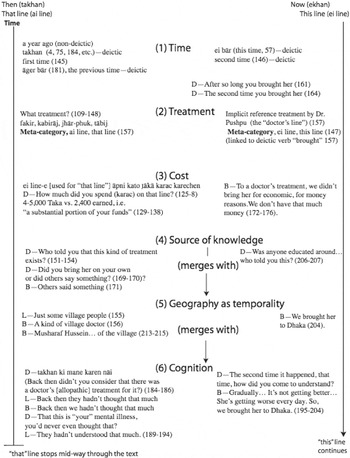
The denotational text touches several themes central to the register: time and geography-redolent-with-temporality, forms of treatment and their cost, and questions of knowledge and its source. For precision I divide these three into six categories (see Figure 2). Pushpu reads forms of treatment in relation to epochal time: One indexes tradition, the other modernity. She invokes the meta-category of ‘lines’ for these two modalities, epitomized by tabij ‘amulets’ and doctors, respectively. Lines can divide space and time, and in this encounter the noun ‘line’ is linked – first by the patient's brother, then by Pushpu (158–9) – to the Bangla deictic verb ana ‘bring,’ as in I brought her to the doctor's LINE [of treatment]. I italicize line to indicate the use of the English word in the original text.

Unfolding Parallelism in Transcript 4
The interactional text uses such oppositions, together with other lexicogrammatical resources, to build a hypertrophically dualistic – hence parallelistic – structure of contrasts. Time (category 1) is introduced with the Bangla equivalent of ‘one year ago’ (2). Later this is reduced to the Bangla deictic ai samae-e ‘at that time’ (49), both expressions referring to the patient's first episode of schizophrenia. This is contrasted with the “second” time (73), or ei bar ‘this time’ (57). These are significant because they become linked with a theme of enlightenment, as they would in a conversion narrative (Stromberg 1993).
During the first psychotic episode, the line of resort (theme #2) was to kabiraj, fakir, and jharphuk – two sorts of healers and ‘magical sweeping-blowing’ – which I refer to as a single “line” in deference to Dr. Pushpu (57), who sums them up as that line. The antonym is the

line, ‘doctors' line’ (157).
Dr. Pushpu raises the issue (theme #3) of karac ‘expense(s)’ in line 128, indirectly indicating the foolishness of the first line of resort, which eventually forced Manwara's family to go into debt for measures that, her brother says (203), resulted only in her worsening day by day. More germane to the parallelistic structure, he later raises the issue of expense, from a perspective opposed to Pushpu's. Using different terms – ‘for economic reasons’, ‘for (lack of) money’ – he invokes cost, perhaps to indicate indirectly the foolishness of preaching to him about failing to come to Dhaka to seek expensive biomedical treatment.
The fourth theme was the source of knowledge. Dr. Pushpu first raises it as an open-ended question (152–4), but eventually as a forced-choice question (169–170). She later reveals her presumption that wealthy and educated acquaintances must have been advising the patient's brother (206 and 217). This binary contrast is between the brother (apparently, to Pushpu, a man of limited mentality) and a set of people who might be physically near but socially far – founts of knowledge, able to persuade him to take his sister to Dhaka to see a proper psychiatrist.
Dhaka (theme #5) represents not only a place. The contrast between gram ‘village’, ‘rural area’ (155–6) and the capital (204) is bound up with temporality. Fabian speaks of a “translation of distribution in space into sequence in time” that characterizes common conceptualizations of Dhaka and the gram, despite ways in which many aspects of village life are brought into Dhaka and many aspects of modernity increasingly penetrate rural Bangladesh. Elites and non-elites alike use the word gram to evoke images both of backwardness and (occasionally) the idyllic, but rarely modernity, despite the recent sprouting of satellite dishes and antennas from the rural canopy.
In lines 184 and 191–2, Pushpu asks the family, in effect, “Didn't you consider that this was your [real live] mental illness?” (The ‘your’ in the question about mental illness probably functions rhetorically rather than deictically, as in English “This is not your average car”; I inserted the words ‘real live’ to lend force to that interpretation.) I call this final theme (#6) cognition (as in 184, mane kara, literally ‘didn't you do in your mind?’), or 193, cinta kara ‘to think’). The duality here is implicit, and introduced over time, interactively. In line 189 the ‘landlord’ of the building in which the family took refuge while in Dhaka – giving his guests no credit at all – says, ‘Back then they hadn't thought that much’. This sets the stage for a mini-narrative of cognitive transformation, again operating within the same dichotomous limits. In 195 Pushpu credits the family with having come to understand; but she presumes they had help. The brother's version of the story credits the family's perceptiveness for bringing his sister to Pushpu. But note also that this constitutes a kind of repair of an odd statement made earlier by Pushpu that the patient had improved under traditional treatment (out of character for her).
Neither interactional nor denotational text represents the sheer outworking of power held by one dominant actor. Several jockeyed for position; everyone contributed to both texts. The interactional text, however, emerges as both Silverstein 2004 and Reyes 2002 have argued: The denoted, represented world becomes a resource with which to affect or reconstitute the identities of the interlocutors. The patient's brother uses an honorific (ji, line 126) to address the doctor, while (via the denotational text) the doctor and the landlord interactively construct the brother as cognitively inferior – moves he does his best to resist. My analysis demonstrates that Pushpu at least tries to use the six redundant layers of binary contrast in the denotational text as resources to place herself, and psychiatry, on the right side of the “line.”
PARALLELISM, MAGIC, AND MODERNISM
Transcript 4 exemplifies what, by rights, it should not: the “dense superposition” of “hypertrophied denotational tropes” that should characterize explicit ritual texts (Silverstein 2006:906). It draws on “lexically encoded paradigms of opposed” deictics (Silverstein 2004:629). Parallelism has previously been analyzed at the level of the text, which fits Figure 1 and Transcript 4. In relation to the rebaptism of psychiatric illness labels, however, the parallelism is clearer if we think instead at the level of enregisterment. The phenomenon of parallelism always involves diachrony, if only the time it takes to produce the stretch of discourse in which the parallelism appears. The multiple repetitions of a frame over the longer time period here (two volumes of the magazine) extend well beyond the time frame in which we are accustomed to conceive of parallelism. But as Caton notes (1987:244), “intertextual relationships can be seen to involve parallelism,” as when one poem responds in form and content to another – or when a terminological baptismal in an editor's reply in Manabigyan's second year builds on a similar text from its first year.
Note other features of the register that accompany the rebaptism of diagnostic labels or membership categories. In general, what letter writers present as mere problems, the register renders “diseases.” The baptismal formula includes a robust tendency to use the progressive in direct address. The particular progressive verb overwhelmingly used in those contexts is uniquely suited for introducing to the Bangladeshi scene a new, psychologized subjectivity, and for introducing just the sort of noun phrases that need to follow – not just psychiatric disease labels, but apparent natural kinds.
The paradox I uncovered is that the science of psychiatry in Bangladesh relies on forms of emergent entextualization like those Fox 1989 describes: a series of binary contrasts organized to achieve ritual ends. This description fits particularly well. The irony of the editors' efforts to banish magic and religion from their domain is apparent. It is, however, no greater than the irony of Francis Bacon's rhetorical policing, for example. Bauman & Briggs's (2003:25) uncovering of contradiction in early modern linguistic ideologies entails demonstrating that Bacon could wage war on rhetoric and all its tools and tropes, which he considered “effeminate,” only through recourse to rhetoric – a rhetoric of newness, which is profoundly related to the Bangla psychiatric register. That register paradoxically combines a drive to police boundaries with a simultaneous, presumably unconscious, generation of hybrids such as terminological baptisms, mixing unrelated languages to create “a purer scientific register,” marshaling poetic figuration in the “exorcism of tradition” in the response to Hashemi, and the related attempt to “rationally exorcise” magic from Manwara's family, apparently regarding it as a threat to the purity of scientific modernity and rational-economic family management.
One side of psychiatry's magic complex involves its drive to achieve the respect of other sciences, and thus – by polishing its register, its symbolic capital, hence its “cash register” – to cut itself off ever more clearly from the magical/religious realms that, even today, the public, the press, and the courts in the U.S. (Perlin 1997) and other societies associate with it. One contribution this article makes to the study of psychiatry's history has been to draw attention to the enregisterment process – in this case, rationalist-modernist drives that might prompt Bangladeshi psychiatrists to prefer a particular syntactic framing of subjectivity. But why would parallelism be such an apparently unproblematic additional tool in such aggressively modernizing texts? Two factors are at work. The binary organization of the final text hinges in part on the structure of Bangla deixis, which reflects a fairly universal tendency in deictic structures. But it also reflects the tendency of Pushpu and other members of the Manabigyan circle to draw on the binaries of modernization theory. In subtle ways, despite the efforts (obvious in the denotational texts) to drive magico-religious treatment out of Bangladesh, the resort to parallelism – as well as to the rituals by which all referential practices are launched – ensures that psychiatric Bangla continues to ensnare psychiatrists in rhetorical magic. The magic complex is remarkably hard to shake.
APPENDIX
Transcription conventions for Rooftop Encounter (Transcript 4)