





Introduction
“The international landscape is changing so rapidly! Honestly, is English still worth it?” Seng, a senior data analyst at the Shanghai branch of a US tech multinational, MVM, voiced this concern during our interview in April 2025. Just months earlier, in November 2024, he had enrolled in an intensive English programme, motivated by the company’s plan to relocate ‘top Chinese professionals’ to its Seattle office. The transfer promised higher pay, international mobility, and family benefits, conditional upon what MVM called ‘cross-border adaptability’, a requirement closely aligned with English proficiency. By March 2025, however, the Seattle branch laid off all of the Chinese transferees during a global operational overhaul, prompting Seng to question whether his investment in English had been worthwhile or merely a sunk cost.
Seng’s experience exemplifies a wider dilemma confronting skilled professionals in Chinese multinational corporations (hereafter MNCs): English, once regarded as a reliable conduit for career advancement and global integration, increasingly represents a speculative and risky investment amid intensifying geopolitical upheaval. At the height of globalisation, English functioned as symbolic capital in linguistic markets (Bourdieu Reference Bourdieu1991) and the lingua franca of international business (Ehrenreich Reference Ehrenreich2010). It was imagined as a linear, accumulative pathway to employability and transnational mobility. Today, this ideological certainty is unsettled by discontinuities in the global political economy, here conceptualised as conditions of ‘post-globalisation’. The term is used not to imply the end of globalisation, but to signal a shift from ‘peak globalisation’ towards more fractured, state-driven, and uneven global processes (Latham Reference Latham2016; Flew Reference Flew2018; Talani & Roccu Reference Talani and Roccu2019). US–China trade wars, technology sanctions, protectionism, and resurgent nationalist agendas disrupt previously stabilised flows of capital, labour, and communication (Wu Reference Wu2023; McDonagh Reference McDonagh2025).
These transformations resonate with sociolinguistic concerns around mobility, inequality, and the (re)valuation of language under changing global conditions. Blommaert’s (Reference Blommaert2010) sociolinguistics of globalisation demonstrates how linguistic value is produced within stratified, multi-scalar regimes contingent on broader social arrangements. More recently, Roche & Kruk (Reference Roche and Kruk2024) call for a sociolinguistics of deglobalisation that foregrounds how re-bordering and geopolitical retrenchment reshape the circulation, valuation, and distribution of linguistic resources. Together, these perspectives underscore that linguistic markets are neither linear nor durable, while characterised by uneven mobilities, shifting normativity, and heightened volatility.
Post-globalisation dynamics also complicate assumptions within World Englishes scholarship, which has documented the pluralisation, localisation, and resultant diversification of Englishes worldwide (Kachru Reference Kachru1992; Jenkins Reference Jenkins2014; Melchers & Shaw Reference Melchers and Shaw2019), but often presumes its continued expansion. While English proficiency still facilitates global mobility, its transferability has become less predictable as global employers regionalise, restructure, or decouple from US-centred networks. In China, professionals increasingly confront the destabilisation of English’s status alongside the state-engineered rise of Mandarin as a transnational resource, most visibly through the Belt and Road Initiative (Sarieddine Reference Sarieddine2023). This study thus intervenes in World Englishes by shifting attention from diffusion and localisation to the volatility, risk, and recalibration of linguistic value amid geopolitical uncertainty.
Rather than assuming English’s decline, this article approaches post-globalisation as an analytic lens for examining how reconfigured global orders reorient linguistic ideologies and investments. While sociolinguistics has long critiqued the neoliberal underpinnings of English in the capitalist system (e.g. Duchêne Reference Duchêne2011; Holborow Reference Holborow2015; Block Reference Block2018), it has yet to fully account for how contemporary geopolitical turbulence reconditions language investment itself, especially for workers caught within global marketplaces. In this context, language acquisition extends beyond the cultivation of global competence to involve political-economic ‘anticipation’ (Beck Reference Beck1992), as linear rationales of linguistic accumulation give way to fragmented trajectories, abrupt ruptures, and uncertain returns. By situating Chinese MNC professionals’ experiences in dialogue with World Englishes and sociolinguistics, this article challenges dominant narratives of English as an inevitable or universal ‘language of global capitalism’ (O’Regan Reference O’Regan2021), highlighting that its value is situational, fluctuating, and inherently unstable.
To articulate this shift, I propose speculative bilingualism as a theoretical intervention which reconceptualises language investment from a steady accumulation of linguistic capital into an affective, volatility-sensitive stance shaped by financialised principles of risk calculation, hedging, and anticipatory repositioning. The term bilingualism underscores that such speculation unfolds across individuals’ repertoires, particularly in the relational assessment of English and Mandarin at China-based workplaces. Unlike the narrower notion of speculative English, speculative bilingualism encompasses both continued commitments to English and strategic pivots towards Mandarin-centred trajectories, as state-led linguistic priorities and domestic-sector opportunities gain prominence (An Reference An2019). This conceptualisation foregrounds the emergent, contingent logics of language valuation under post-globalisation conditions, showing how individuals manage uncertainty through anticipatory, affectively charged linguistic orientations.
Importantly, these orientations are underpinned by what I term meritocratic subjectivity: a mode of self-conduct rooted in China’s historical meritocratic ideology and rearticulated through contemporary neoliberal labour regimes. In Shanghai-located MNCs, often positioned as China’s most globalised urban hub, professionals are expected to continuously self-optimise through skill investment, notably in language, to remain competitive in transnational labour markets (Sanden Reference Sanden2015; Gong Reference Gong2024). Even as English’s value fluctuates, this imperative—mediated by market pressures and moral norms—sustains speculative bilingualism, producing tensions between hope and anxiety, investment and divestment.
This article investigates how English investment becomes a high-stakes speculative engagement intertwined with meritocratic subjectivity among skilled professionals in Shanghai-based MNCs. Drawing on a two-year mixed-methods study (2023–2025), it integrates longitudinal survey data (n = 279) on shifting attitudes towards English learning with critical sociolinguistic ethnography, including in-depth, semi-structured interviews. This approach examines how Chinese professionals strategically engage with language acquisition as a speculative endeavour shaped by—and simultaneously shaping—their meritocratic orientations, thereby offering a critical account of language investment and subject formation in increasingly uneven global workplaces.
The article proceeds as follows. Theoretical engagement with speculative bilingualism and meritocratic subjectivity is developed first, followed by a section outlining the methodology. Subsequent sections present the findings and analysis. The discussion then turns to broader implications before the article concludes.
Theorising speculative bilingualism: English between global capital and precarious promise
English has been extensively theorised as a form of global capital embedded in late capitalist political economies (Duchêne & Heller Reference Duchêne and Heller2012; Gal Reference Gal2016). Across state reforms, corporate human-resource arrangements, and individual aspirations, English circulates as a privileged avenue for international participation and personal empowerment, acquiring a symbolic and material force that exceeds communicative function and aligns with wider regimes of employability, professionalism, and mobility (Urciuoli Reference Urciuoli2008; Park & Wee Reference Park and Wee2012). In MNCs, this ideological force is further intensified: English is institutionalised as the default medium for management, coordination, and cross-border collaboration (Neeley Reference Neeley2012), and naturalised through corporate discourses of efficiency and competitiveness (Gong Reference Gong2023).
Nonetheless, recent scholarship points to growing ideological rupture, leading to ambivalence, politicisation, and contestation (Grey, Lising, & Cho Reference Grey, Lising and Cho2021). The hegemonic narratives upholding English’s socio-economic significance have come under strain amid escalating global turbulence and the inevitable ‘demise’ of the capitalist world-system, propelled by deepening structural contradictions (O’Regan Reference O’Regan2021:209). Yuan (Reference Yuan2021) illustrates how English in China is no longer perceived as a universally advantageous route to cosmopolitanism but as a saturated, politically entangled sign indexing questions of sovereignty, dependence, national security, and evolving geopolitical blocs. This discursive shift marks a significant departure from earlier framings of English as a reliable asset towards its reconfiguration as a site of precarity. Within these fractured global orders, English’s symbolic authority is increasingly destabilised, rendering its value context-dependent, geographically differentiated, and politically volatile. This speaks to emerging discussions of precarity and its sociolinguistic effects (Dovchin Reference Dovchin2024), highlighting how linguistic practices are negotiated under conditions of risk, vulnerability, and uncertainty shaped by broader political-economic forces.
These developments expose limitations in existing frameworks within World Englishes and language commodification, which continue to conceptualise English as an indispensable, relatively stable, and reliably accumulative resource linked to upward mobility and market access (e.g. Cameron Reference Cameron, Nevalainen and Traugott2012; Galloway & Rose Reference Galloway and Rose2015; Salomone Reference Salomone2022). Even critical accounts that interrogate English’s role in reproducing inequalities frequently presuppose its persistent capacity to generate access to transnational circuits of value (Tupas Reference Tupas2015; Park Reference Park2021). Such perspectives, however, necessarily underplay the extent to which post-globalisation trends—far less salient when these works were written—now unsettle the predictability of returns from learning English, reshaping linguistic ideologies and investment strategies.
To address this complexity, this article introduces the concept of speculative bilingualism, building on Norton’s (Reference Norton2013) understanding of language investment as a material, affective, subjective, and identity-related process oriented towards access to valued resources and communities of belonging, as well as on Darvin & Norton’s (Reference Darvin and Norton2015) model, which situates investment at the intersection of capital, ideology, and identity. While Norton conceptualises investment as learners’ ongoing engagement with language learning grounded in expectations of symbolic and material returns, speculative bilingualism captures a historically and political-economically specific condition in which such returns are no longer stable or assured. Extending Norton’s framework through the lens of the ‘speculative’ (Dunne & Raby Reference Dunne and Raby2013), this concept foregrounds the non-linearity of linguistic payoffs, the emotional labour of navigating uncertainty, and the anticipatory orientations informing contemporary language learning, thereby challenging dominant narratives that depict English as an uncontested global capital accumulated through sustained, worth-building commitment (Coupland Reference Coupland2011).
Drawing on Bogle’s (Reference Bogle2012) distinction between speculation and investment, ‘speculative’ here does not indicate short-term linguistic opportunism or rapidly reversible language choices. Instead, it denotes a future-oriented, affect-laden, and geopolitically shaped ideological stance through which English acquisition is pursued as a high-risk, contingent, and precarious promise—an anxious ‘trade’ in linguistic resources premised not on immediate utility but on envisioned future scenarios and shifting regimes of value, conditioned by the ‘politics of temporality and affect’ (Adams, Murphy, & Clarke Reference Adams, Murphy and Clarke2009:246). Importantly, speculative bilingualism is intended as a metaphorical, ideological, and analytical concept rather than a literal description of bilingual practice. Unlike financial assets, linguistic resources are not fully liquidable, nor does reduced investment imply the disappearance of multilingual competence. What fluctuates instead is the imagined trajectory and expected payoff of language value. Speculation therefore operates primarily at the level of ideology, affect, and future-oriented sense-making (Pérez-Milans Reference Pérez-Milans2020), shaping how MNC employees anticipate, justify, and adjust their investments in linguistic repertoires amid market transformations. Speculative bilingualism constitutes less an economic calculation than a mode of ideological reasoning through which professionals position themselves in relation to imagined futures, interpret geopolitical and institutional cues, and emotionally manage the unpredictability of language-learning outcomes.
Earlier studies have documented how learners recalibrate language investment by assessing the differentiated value of English varieties across transnational markets, as illustrated by research on Korean study-abroad trajectories (e.g. Kang Reference Kang2012; Lo, Abelmann, Kwon, & Okazaki Reference Lo, Abelmann, Kwon and Okazaki2017; Bae & Park Reference Bae and Park2020). These accounts, however, largely presume relatively stable correlations between linguistic investment and future mobility within an expanding neoliberal regime of global English. Speculative bilingualism, by contrast, theorises a sociolinguistic conjuncture marked by temporal fragility and structural volatility, where the premise of English-as-promise is destabilised by geopolitical fragmentation, nationalist shifts, and labour market restructuring. It pays attention to a distinct empirical context: Chinese MNC professionals who have long relied on English as a privileged resource (Yao & Du Babcock Reference Yao and Babcock2020) but now confront its contested futures and unstable returns. This precarity arises not from English varieties but from the erosion of English’s ideological certainties, which disrupt the affective, political, and temporal coordinates that have historically anchored investment.
The lens of speculative bilingualism extends accumulation—and utility-based models through three interrelated theoretical interventions. First, it builds on Bourdieu’s (Reference Bourdieu1991) theory of linguistic capital by situating English within processes of financialisation (Borch & Wosnitzer Reference Borch and Wosnitzer2020), reconceptualising language acquisition as a speculative investment whose value is ideologically inflated by global capitalism, yet undermined by nationalist political discourses and competing language regimes, including the strategic elevation of Mandarin under China’s ‘dual-circulation’ policy (Lin Reference Lin2021). Second, drawing on Tsing’s (Reference Tsing2015) notion of non-scalability, speculative bilingualism likens English ideologies to global supply chains—fragmented, incomplete, and vulnerable to disruption. Rather than scaling smoothly across contexts, English’s material and symbolic circulation falters under conditions shaped by protectionism drives or geopolitical antagonisms. Third, the framework incorporates Ahmed’s (Reference Ahmed2004) concept of affective economies to illuminate how language learning becomes entangled with anticipatory anxieties, hopeful imaginaries, and calculations of stakes and reward, framing investment as ‘more-than-rational’ or ‘less-than-rational’ (Anderson Reference Anderson2006). In this sense, speculative bilingualism is embedded in language ideologies, forward-looking stances, and affective entanglements.
MNCs intensify these dynamic processes, given their inherently multilingual complexity (Tietze Reference Tietze2013) and institutionally prescribed corporate language policies (Kankaanranta, Karhunen, & Louhiala-Salminen Reference Kankaanranta, Karhunen and Louhiala-Salminen2018), with English typically remaining the default choice (Lønsmann Reference Lønsmann2015). Despite insecure future returns, Chinese MNC employees constantly grapple with the political-economic imaginaries of English: institutionally obligatory yet ideologically unsettled, it requires reconciling its perceived necessity with doubts about future payoff. The tension gives rise to speculative patterns of assertive investment, cautious withdrawal, or strategic repositioning. This reflects an ambivalent navigation of dynamic, multi-scalar assemblages that link geopolitical, institutional, and familial dimensions with the lived experience of desire, pressure, and uncertainty. Following Pietikäinen (Reference Pietikäinen2024), these assemblages are processes in formation, marked by inherent instability and ongoing frictions among their interconnected elements. Consequently, the observed patterns do not entail rapid switches between languages but reveal how individuals inhabit complex ideological terrains continuously reconfigured by evolving global and local expectations.
Overall, extending models that treat linguistic accumulation as predictable, speculative bilingualism frames language investment as a precarious, future-oriented effort to anticipate and manage geopolitical risk, organisational pressures, and personal contingencies. It reconceptualises bilingualism not as a stable skillset or unitary form of capital, but as a speculative ideological formation through which individuals mediate the entanglement of linguistic, material, and affective orders (Lee & Rüdiger Reference Lee and Rüdiger2025), with English operating simultaneously as hope and vulnerability, potential reward, and possible loss.
Making meritocratic subjectivity: Skilled MNC professionals and the Shanghai Dream
This study is situated in Shanghai, China’s economic epicentre, which actively constructs itself as a ‘worlding city’ where meritocracy and cosmopolitanism converge through state discourse and corporate imaginaries (Roy & Ong Reference Roy and Ong2011). This vision crystallises in the ‘Shanghai Dream’, a regional articulation of the broader ‘Chinese Dream’ (Wang Reference Wang2014), positioning Shanghai as a meritocratic frontier that promises mobility through market-valued skills and self-improvement. Within ostensibly flexible hierarchies, social advancement hinges on individual competitiveness, producing specific forms of subjectivity characterised by the internalisation of meritocratic ideals (Markovits Reference Markovits2019). Such processes call for closer examination of how meritocracy functions not merely as an allocative principle but as a moral and affective project constituting worker subjectivity.
Originally coined by Young (Reference Young1958) as both satire and organisational logic, ‘meritocracy’ refers to systems that distribute power and resources according to demonstrable ‘merit’, typically measured through education, competence, and performance. In neoliberal context, meritocracy is associated with market rationalities that emphasise individual competitiveness and self-responsibility (Sandel Reference Sandel2020). Yet meritocracy in China cannot be understood solely through this neoliberal lens. Rather, it must be anchored in China’s distinct cultural and institutional foundations (Liu Reference Liu2016).
Historically, Chinese meritocracy emerged from Confucian statecraft and was institutionalised through the imperial civil service examination system (keju), which structured governance for over a millennium (Elman Reference Elman2013). Unlike neoliberal meritocracy, which privileges market performance and individual choice, Confucian meritocracy foregrounds moral cultivation, self-discipline, and duty to the state (Bell Reference Bell2015). Merit, in this tradition, entails not only technical competence but ethical self-fashioning—becoming a ‘proper’ person whose worth is evaluated relationally and normatively. This moral order continues to inform contemporary imaginaries of merit, where professional success is expected to coexist with gendered, familial, and national obligations (Shi Reference Shi2024).
Following the 1978 ‘Reform and Opening-up’, Deng Xiaoping reoriented meritocracy towards market competition, linking merit to labour productivity and technical expertise (Lardy Reference Lardy2014). China’s accession to the WTO in 2001 further consolidated ‘skill-based meritocracy’ (Chen Reference Chen2009), elevating cross-cultural skills, particularly English proficiency, as essential to both national strength and individual mobility (Wang, Smyth, & Cheng Reference Wang, Smyth and Cheng2017). These transformations introduced neoliberal principles of human capital optimisation into Chinese governance. Crucially, however, rather than replacing Confucian frameworks, neoliberal logics were layered onto them, resulting in a hybrid meritocratic regime that combines market competitiveness with enduring ethical expectations.
It is within this layered configuration that this article conceptualises meritocratic subjectivity in China. Adopting a Foucauldian understanding of subjectivity as historically situated and relationally shaped (Foucault Reference Foucault1988), meritocratic subjectivity here denotes a mode of selfhood forged at the intersection of neoliberal entrepreneurial rationalities and Confucian moral normativity. It is therefore not reducible to neoliberal subjectivity; instead, it constitutes a specific articulation in which the ‘entrepreneurial self’, who treats skills and dispositions as symbolic capital to maximise market advantage (Bröckling Reference Bröckling2016), is embedded within broader ethical imperatives of discipline, self-cultivation, endurance, and responsibility.
Within the MNC context, these dynamics are especially salient. Meritocracy fosters practices of linguistic entrepreneurship (De Costa, Park, & Wee Reference De Costa, Park and Wee2021), whereby employees internalise global market demands and cultivate language proficiency as human capital. English, as the dominant working language in MNCs, becomes both a technical skill and a moralised index of professionalism, diligence, and global orientation. Gershon’s (Reference Gershon2016) notion of treating the self as a ‘business’ illuminates how individuals manage linguistic resources through profit-and-loss calculations to negotiate workplace unpredictability (Fraser Reference Fraser2003). In this study, such calculations take the form of speculative bilingualism, a strategy for navigating meritocratic workplaces by anticipating future returns on linguistic labour.
The formation of meritocratic subjectivity among skilled professionals is deeply intertwined with the Shanghai Dream, the belief that migration, hard work, and skill accumulation yield permanent belonging and a ‘decent’ middle-class life (Ping Reference Ping2020). Central to this aspiration is the acquisition of Shanghai hukou, which grants privileged access to education, healthcare, and social security (Qian, Cheng, & Qian Reference Qian, Cheng and Qian2020) and serves as a powerful marker of merit-based urban inclusion. Shanghai’s Global Talent Program accelerates hukou acquisition for high-performing professionals in senior MNC roles, shortening eligibility timelines from seven years to six months (Shanghai Municipal Government 2020). This selective pathway to sociospatial belonging and entitlement is structurally mediated by English as the de facto language of global workplaces and eagerly pursued by MNC professionals (Gong Reference Gong2024).
This hukou-driven and English-mediated pursuit unfolds as a cyclical, self-reinforcing process (cf. Figure 1), comprising five interlinked stages: (i) English proficiency facilitates promotion; (ii) promotion accelerates hukou acquisition; (iii) hukou secures access to quality education for one’s children; (iv) access to quality education cultivates English proficiency; and (v) enhanced English skills, in turn, feed back into career advancement. Within this loop, English operates simultaneously as mediator, catalyst, and outcome of meritocratic striving, while MNCs constitute the institutional axis sustaining this recursive cycle of aspiration and self-improvement.
Cycle of aspiration.

However, global turbulence has increasingly unsettled English’s status as a stable and reliable indicator of merit. As language investment becomes speculative, the aspirational cycle once taken for granted is undermined, generating heightened tensions alongside ongoing strategic recalibration. Drawing on Biehl, Good, & Kleinman (Reference Biehl, Good and Kleinman2007), I approach subjectivity as an interplay of internal life processes and expressed emotional states, while following Wetherell (Reference Wetherell2012) in viewing affect, specifically anxiety, hope, and moral pressure, as a key site where subjectivity is negotiated, contested, and oriented. In this framing, meritocratic subjectivity manifests as a linguistically mediated, affectively charged, and socially situated project, produced by and responsive to the speculative conditions shaping contemporary language investment.
While recent scholarship has begun to address language, subjectivity, and affect in corporate and market settings (e.g. Park Reference Park2021; Lovrits Reference Lovrits2024), comparatively less attention has been paid to how these processes unfold when the value of language itself becomes uncertain, prompting more anticipatory orientations towards language investment. Building on this literature, this study foregrounds the speculative dimension of subjectivity, investigating how skilled professionals in Shanghai-based MNCs enact speculative bilingualism to sustain their meritocratic subjectivity amid post-globalisation dynamics, where English-driven self-making oscillates between aspiration, anxiety, and moral obligation. The next section details the methodological design employed to examine these practices.
The study
Theoretical underpinning: Critical sociolinguistic ethnography
This study adopts a critical sociolinguistic ethnographic framework (e.g. Duchêne, Moyer, & Roberts Reference Duchêne, Moyer and Roberts2013; Pérez-Milans Reference Pérez-Milans2013; Sabaté-Dalmau Reference Sabaté-Dalmau2016), complemented by a longitudinal quantitative survey, to examine how skilled employees in Shanghai-based MNCs navigate language investment and meritocratic pursuits under volatile global conditions. The quantitative component provides a temporal overview of shifting attitudes towards English and related affective states, forming a systematic foundation to identify patterns, contradictions, and emotional fluctuations. These insights inform and refine the core ethnographic inquiry, conducted through semi-structured interviews and participant observations, allowing for an in-depth exploration of how speculative bilingualism and meritocratic subjectivity are understood, enacted, and negotiated in practice.
Grounded in critical sociolinguistic traditions, this approach conceptualises language not as a neutral communicative resource, but as a socially constructed, ideologically charged, and politically entangled practice (Heller, Pietikäinen, & Pujolar Reference Heller, Pietikäinen and Pujolar2018). Within this perspective, language learning is understood as a speculative and relational terrain where individuals must continually construct ideal subjectivity, regulate mobility, and manage experiential risks in response to rising geopolitical and institutional pressures. Capturing these dynamics requires methodological tools attentive to both observable language practices and the affective, ideological, and subjective processes embedded in everyday experience.
Methods and data
This study employs a mixed-methods design, integrating quantitative surveys, semi-structured interviews, and sustained ethnographic observation conducted between 2023 and 2025. The research focuses on skilled professionals working in three Shanghai-located MNCs operating in vehicle production, international commerce, and biomedicine, which collectively constitute the research site. In these companies, English serves as the primary working language, used daily in emails, reports, presentations, and oral interactions with colleagues and clients located not only in Anglophone countries but also across Europe, Asia, and Latin America, reflecting its role as global lingua franca.
Participants typically held bachelor’s degrees and were educated within Chinese universities’ exam-oriented schooling system, in which English instruction prioritised test performance over communicative competence, leading to so-called ‘mute English’ (Wolff Reference Wolff2010). Socioeconomically, most came from lower-middle- or middle-class families outside Shanghai, viewing Shanghai hukou as a critical channel for upward mobility and long-term urban settlement. Positioned at the nexus of China’s internal migration and global corporate hierarchies, they have long experienced English proficiency as a key determinant of promotion within global workplaces and, additionally, of eligibility for accelerated hukou pathways. However, post-globalisation dynamics, including geopolitical turbulence, organisational relocations, and shrinking transnational business, have unsettled the once-stable association between English, mobility, and reward. Against this empirical backdrop, participants reassessed the value of English and recalibrated their linguistic investment, generating the experiential ambivalence that characterise the notion of speculative bilingualism analysed in this article.
The quantitative component consists of an eight-wave longitudinal survey administered via Qualtrics. Leveraging the platform’s tracking functionality, participant responses were linked across time through unique IDs and IP addresses, enabling individual-level, time-series analysis of fluctuating language attitudes and affective states. Each wave of the survey was pre-scheduled in Qualtrics, which automatically delivered the survey link to participants’ mobile devices (via SMS) on the final Friday of September 2023 and at three-month intervals thereafter. This automated scheduling ensured consistent timing and generated a rich, time-sensitive dataset documenting evolving perceptions of English amid transformative political-economic conditions.
A total of 279 participants completed each survey wave, responding to three core questions rated on a continuous 0–1 scale, with values recorded to one decimal place to measure subtle emotional fluctuations. The questions assessed participants’ perceptions of English’s importance for their work, their motivation to continue learning English, and their self-evaluated English proficiency. This design allows for the longitudinal tracking of linguistic ideologies alongside emotionally inflected variations, for instance, declining motivation following external shocks or temporary optimism after favourable market developments.
The qualitative component comprises semi-structured interviews with three focal participants (cf. Table 1). Pseudonyms are used throughout to protect participant and corporate anonymity, ensuring no foreseeable harm. Each participant exemplified one of the most prevalent language investment strategies observed in the research context and was selected for their representativeness in illustrating broader patterns among peers. Interviews explored participants’ affective narratives, risk perceptions, and the complex entanglement between language investment, career planning, and meritocratic aspirations. To maximise comfort and data richness, all interviews were conducted in Mandarin and audio-recorded rather than filmed, with non-verbal behaviours, including gestures, facial expressions, and body orientation, documented in detailed contemporaneous fieldnotes. Recordings were subsequently transcribed using a minimal transcription system (see the appendix), capturing interactional features such as pauses, silences, laughter, and sighs. These verbal and non-verbal cues, which performed expressive functions to convey participants’ stances and shifts therein, supported moment-to-moment interactional analysis (Rampton Reference Rampton2006). After translating the transcripts into English, discourse analysis examined how participants internalised structural uncertainties, often reframing macro-level instabilities (e.g. international sanctions) as personal obligations requiring strategically informed decisions.
Focal participants.

Table 1 Long description
The table lists three focal participants with their name, gender, company, division, and job position. David is a male assistant manager at MVM in the Marketing Division. Jay is a male assistant manager at GEV in the Research and Development Division. Jiale is a female specialist at CTD in the Purchasing Division. Two of the three participants are male and hold the same position of assistant manager, while the only female participant holds a specialist role. Each participant comes from a different company and a different division, so there is no repeated company or division in the entries.
This integrated methodological design enables a layered, critical understanding of how speculative bilingualism and meritocratic subjectivity are navigated—not only through situated language practices but also via market anticipation, speculative assessment, and the affective labour inherent in pursuing career development and social mobility within volatile global structures. Ethical approval was obtained prior to data collection, with all participants informed of their rights and providing explicit consent. Given the specific sensitivities of MNCs, particularly commercial confidentiality and hierarchical power relations that may influence professional prospects, the researcher continuously and reflexively considered positionality and research dynamics throughout the fieldwork to reduce power asymmetries and uphold the trustworthiness and integrity of the data.
Tracking English’s fluctuating value: Longitudinal evidence of attitudinal and affective reassessment
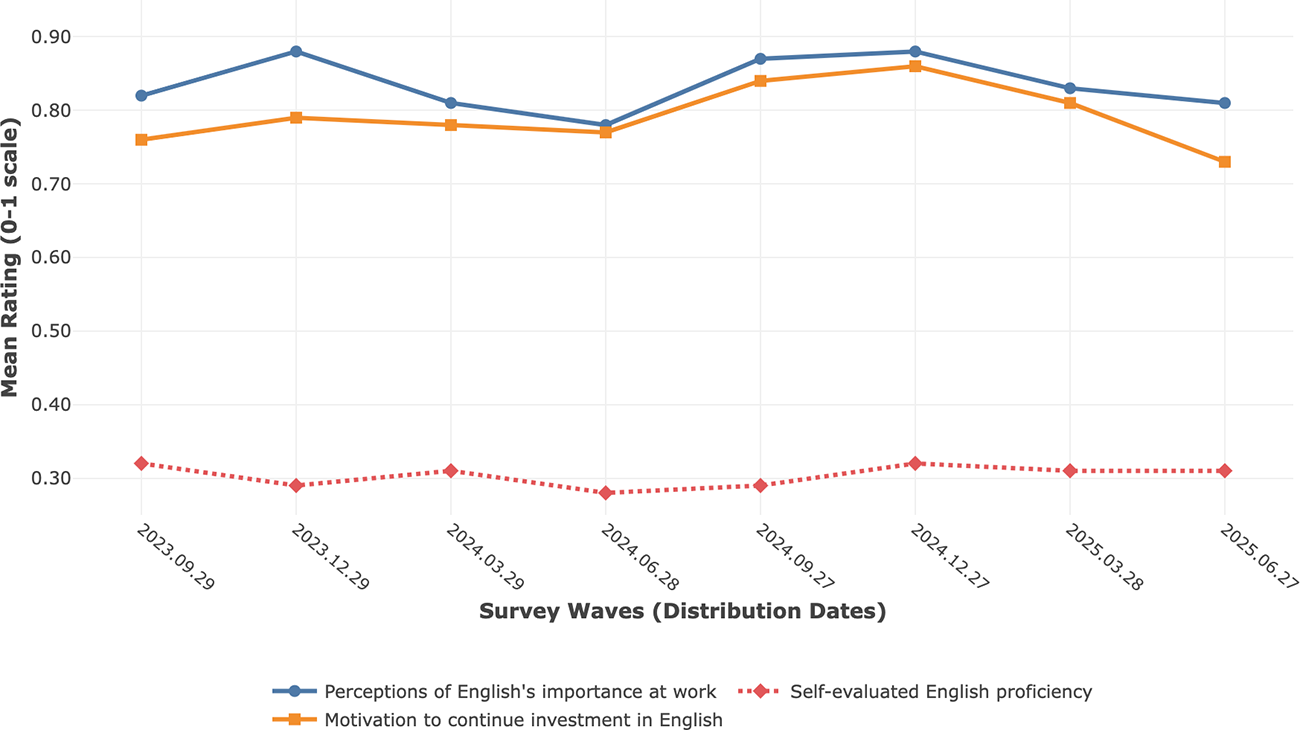
This section draws on an eight-wave longitudinal survey tracking attitudinal and affective fluctuations towards English among skilled Chinese employees across the three investigated MNCs. Participants rated their agreement (0–1 scale) with three questions: (i) Is English still important for your work? (ii) Are you still motivated to continue learning English? (iii) Do you feel you have mastered English? Mean scores were calculated for each wave, producing the trends shown in Figure 2.
Longitudinal survey trends (2023.09–2025.06).

The data reveal distinct yet interconnected patterns in participants’ perceptions of English’s importance, motivation to invest in learning it, and self-assessed proficiency. Across all eight waves, perceptions of English’s workplace relevance remained consistently high (0.78–0.88), reflecting English’s entrenched role within Shanghai-based MNCs. Ethnographic observations corroborate this: English continues to be the dominant language for official documentation, meeting records, and submissions to global headquarters, despite China’s heightened ‘internal circulation’ rhetoric aimed at bolstering its Mandarin-mediated domestic market.
In contrast, participants’ self-assessed English proficiency stayed consistently low (0.28–0.32), exposing a structural mismatch between English’s institutional significance and employees’ linguistic competence. This underscores deep-rooted linguistic inequalities within China’s educational landscape. English was only made compulsory in China’s national elementary curriculum in 2001, meaning that most participants (aged 35–50) did not benefit from this policy. Prior to university, they generally had limited access to systematic English-learning opportunities. Even today, high-quality English education is still unevenly distributed across China, conditioned by regional economic disparities that advantage residents of major cities. These structural barriers help explain participants’ low confidence in their English skills and their keen pursuit of Shanghai hukou, which secures privileged educational resources for their children and facilitates intergenerational mobility.
Perceptions of English’s importance and learning motivation followed broadly parallel trajectories over time, shaped by both global events and localised corporate dynamics. Significantly, perceived importance dropped sharply in early 2024 amid escalating geopolitical tensions, including export bans, sanctions, and technology restrictions. Nevertheless, by September 2024, motivation (0.84) and perceived importance (0.87) had unexpectedly rebounded. This apparent contradiction became clear through sustained participant observation: although all three MNCs implemented downsizing measures, MVM and GEV announced plans to transfer top-performing Chinese employees, especially English-fluent, internationally-oriented staff, to their overseas headquarters. These emergent mobility channels revitalised aspirations around English, exemplifying how investments in English respond to the interplay of macro-political pressures and evolving opportunities within transnational labour markets.
However, the rapid decline in motivation by March 2025 (0.81) reflects how quickly these aspirations collapsed when confronted with new volatility. As detailed in the introduction, mass layoffs at MVM’s Seattle headquarters, involving newly relocated Chinese staff, profoundly undermined belief in English as a stable pathway to advancement. The further decline in June 2025 (0.73) coincided with the chaotic global climate, driven by the escalating US–China spiralling tit-for-tat tariffs.
Interestingly, the slowing of the decline in June 2025 occurred alongside signs of EU–China rapprochement, notably the Geneva Agreements on Chinese electric vehicle pricing and the suspension of punitive tariffs. Follow-up interviews with GEV employees—whose company specialised in vehicle production and was directly impacted—indicate that these developments revived hopes for international cooperation and prompted a cautious resurgence in the perceived value of English. This thaw, triggered by the aggressive global tariffs levied by the US, temporarily aligned Chinese and European interests. This shift, which came just months after Europe imposed steep tariffs on Chinese electric vehicles, highlights the contingent and contradictory nature of global geopolitics—and, by extension, the indispensable yet fragile value of English within these circuits of ambition and mobility.
Field observations reveal additional complexities in corporate language hierarchies. English remains central for transnational reporting and international operations, but China’s expanding domestic market has elevated the role of local firms and Mandarin-mediated business practices. Both English and Mandarin operate as market-specific resources, destabilising older assumptions that global-facing, English-mediated positions inherently confer greater prestige. This restructuring introduces new uncertainties, compelling employees to continually recalculate their linguistic investments in light of fragmented global markets and contested ideologies of merit.
Taken together, English persists as aspirational capital across transnational labour markets, but its value becomes unstable—constantly recalibrated at the intersection of global tensions, national realignments, and corporate restructuring. Within this volatile landscape, employees’ language learning decisions are governed not only by geopolitical signals but also by affective negotiations embedded in their meritocratic subjectivity. While the longitudinal survey captures broad attitudinal trends, its fixed-question format offers only limited insight into the evolving, context-dependent rationales behind divergent strategies of English investment. These nuances emerge more vividly through employees’ own narratives, to which I now turn.
Strategising meritocratic aspirations and speculating language investment
Participants adopted distinct, at times ambivalent, approaches to pursuing meritocratic advancement, illustrating the precarity of speculative bilingualism, where language investment is influenced by fluctuating opportunities, emotional strain, and changing mobility prospects. This section examines three prevalent patterns observed: decisive full-time investment in English, sustained part-time engagement with English acquisition, and strategic reorientation towards Mandarin-dominated sectors. Drawing on interviews with focal participants David, Jay, and Jiale, I demonstrate how these divergent choices reflect the strategic navigation of language investment and meritocratic aspirations within the fractured landscape of post-globalisation.
Entrepreneurial adventure, speculative English
Only a few participants resigned to pursue full-time English learning, which is unsurprising given the heightened competition in the post-pandemic job market. Those who did were dubbed ‘brave adventurers’ by their peers. David, an assistant manager in MVM’s marketing division, exemplified this rare trajectory. He resigned in mid-2024 and explained his brave investment as shown in excerpt (1).

David’s narrative demonstrates how English investment is embedded in the discourse of entrepreneurial self-optimisation, where language learning is framed less as skill acquisition and more as a calculated market gamble. His rejection of my playful label of “brave adventurer” (line 1), “Not brave! Just investing in my future” (line 2), evidences the internalisation of neoliberal ideologies that conflate self-development with linguistic speculation. For David, the self is conceived as a project for continual enhancement, with language proficiency constructed as a speculative asset to be strategically developed for navigating volatile futures.
His decision to resign for six months of intensive English study (line 3) is explicitly characterised as a high-risk, unpredictable-return adventure. Realising his declining competitiveness in Shanghai’s globalised labour market, David positions English as both a hedge against market uncertainty and a vehicle for self-fashioning. His logic evinces the speculative temporality underpinning such investments: English is not expected to deliver immediate security but is treated as future-oriented capital, allowing him to become “more international” (line 9) and “show up as a better me” (line 11).
This notion of a ‘better me’ is tightly tied to prevailing meritocratic ideals within Shanghai’s transnational workplaces, illustrating how language learning becomes a mode of self-construction, intimately bound to the formation of a desirable, globally recognisable persona. David’s repetition of this phrase conveys his drive for self-transformation and affective attachment to English as a symbolic resource enabling professional mobility. His plan to “fix” his English permanently (line 10) reflects not only personal ambition but also the structural pressures shaping linguistic investment.
When I question his faith in English amidst worsening geopolitical tensions, David avoids answering directly. Instead, he invokes China’s national ‘going global’ strategy (line 6) and examples of colleagues who “climb the ladder faster” (line 8), attempting to reaffirm English’s value both to me and himself. His response exposes the deep entanglement of personal aspiration with national policy discourse, while emphasising how English continues to mediate access to transnational mobility even as global conditions grow more precarious.
Certainly, David accepts the possibility of failure within this speculative logic: “Then I’ll count it as a failed investment” (line 13). His calm acknowledgment reveals how language learning is reframed through an entrepreneurial lens of risk management, where setbacks are normalised and responsibility for outcomes is individualised. This mirrors broader patterns throughout China’s highly skilled labour markets, where workers must continuously renegotiate their linguistic and professional investments in light of mounting global and institutional pressures.
David’s story encapsulates the core tension of speculative bilingualism: English remains both indispensable and uncertain, an aspirational yet volatile form of capital whose value must be constantly recalibrated. His strategic gamble embodies not naïve global optimism but a pragmatic, affect-laden mediation of linguistic inequality, market precarity, and the enduring pursuit of meritocratic recognition within Shanghai’s transnational corporate structures.
Calculated compromise, meritocratic anxiety
During fieldwork, David was an exception; most participants pursued a more moderate strategy—integrating English learning into their professional routines as a gradual, long-term path to improving proficiency. Jay, an assistant manager in GEV’s R&D division, articulated how such participants managed language investment alongside career development (cf. excerpt (2)).

Jay’s account illuminates the contradictions and constraints shaping speculative language investment among working professionals embedded in globalised yet contingent labour markets. His self-description as a “full-time worker plus a part-time learner” (line 1) encapsulates the structural dilemma that many face: balancing the relentless demands of corporate work with desires to acquire English as both symbolic and professional capital. This phrase conveys more than a bifurcated role; it expresses a sense of compromise and frustration, as his “super slow progress” (line 1) emphasises how the promise of language often clashes with the cognitive and temporal exhaustion generated by high-intensity workplaces (line 2).
Jay’s anxiety about foreign client interactions (lines 3–4) underscores the affective dimension of linguistic insecurity, where language competence is tied not only to career development but also to professional legitimacy and self-worth. His discomfort exemplifies how employees in MNCs must perform linguistic competence in demanding international encounters, often without institutional support for language development.
When I shift the conversation to geopolitics, asking whether his company’s overseas business has been impacted by tariffs (line 5), Jay sidesteps the material implications, replying only: “Global politics, impossible to predict” (line 6). This generalised and non-specific formulation, preceded by a brief silence, frames geopolitics as an uncontrollable domain beyond individual agency, indexing a stance of uncertainty rather than evaluation. Against this backdrop, English acquisition is reasserted as a manageable site of action: despite geopolitical unpredictability, Jay orients to peer competition and self-responsibility (lines 7–8), punctuated by a knock on the table that signals urgency, treating language learning as a hedge against uncertainty. This dynamic illustrates the circulation of meritocratic anxiety, as employees engage in competitive language learning to maintain a fragile advantage amid political-economic precarity. English thus persists as somewhat ‘zombie linguistic capital’, intermittently destabilised by global turbulence yet fervently pursued.
Jay’s enrolment in a thirty-six-week business English course (line 9) demonstrates the calculated, incremental investment adopted by many—a strategy to enhance linguistic capital without sacrificing employment or family obligations. His refusal to resign for full-time English acquisition, contrasting himself with “crazy guys” (line 11), reveals the gendered moral economy underpinning linguistic ambition. Jay frames David’ adventure as “selfish”, specifically within male-breadwinner logics that prioritise household stability over individual risk-taking (lines 12–13). His opposition between the ‘crazy’ and the ‘rational’ constructs himself as responsible, while subtly satirising those who gamble with language investment. His stance mirrors dominant socio-economic discourses where men, as primary earners, are expected to uphold family welfare before pursuing speculative advancement.
Notably, Jay’s characterisation of his choice as “the most rational” (line 15) highlights how language investment is shaped by intersecting forces: economic precarity, peer influence, and household commitments. His pursuit of “balance” (line 16) reflects pragmatic adaptation, while also exposing structural limitations: incremental learning may support professional participation but rarely mitigates deeper insecurities regarding linguistic adequacy.
Jay’s narrative encapsulates the ambivalence of language investment: a desire for mobility tempered by the entangled realities of market volatility, economic pressure, and familial expectations, bringing to light the differentiated capacities for linguistic self-investment among China’s aspiring professionals.
Escaping the English track, reimagining Mandarin as capital
During fieldwork, several employees, predominantly women, quit their jobs and disinvest from English. Jiale, a former specialist in CTD’s purchasing division, described her resignation as an “escape” (cf. excerpt (3)). After leaving CTD, she insisted on being addressed as ‘Jiale’, despite having gone by ‘Karen’ for years.

Jiale’s account presents an alternative trajectory along the spectrum of speculative bilingualism among China’s skilled professionals in MNCs. Her emphatic declaration, “I’ve escaped!” (line 1), extends beyond resigning from her position; it symbolises her disengagement from both English acquisition and the global career paths in which English functions as essential capital. Yet instead of representing a total withdrawal from linguistic investment, Jiale’s narrative reflects a strategic recalibration within speculative bilingualism, where language choices, such as prioritising Mandarin over English, respond to emerging geopolitical, economic, and institutional uncertainties.
Jiale’s decision to divest from English stems from her critique of both corporate exploitation and global market volatility. She problematises the expectation that employees must self-fund language acquisition to “please the boss” (line 7), exposing the asymmetrical power relations embedded in workplace language demands. Her account exemplifies broader trends where language learning becomes an additional layer of unpaid, self-managed labour, particularly under precarious conditions exacerbated by global instability and the diminishing promise of upward mobility traditionally associated with English.
Crucially, Jiale’s preference for a local company focused on domestic markets and her assertion that “Mandarin’s enough” (line 4) signal not a dismissal of speculative language investment, but a shift in its orientation. Her framing of English as an unstable symbolic resource in light of global crises (lines 8–9) demonstrates how speculative bilingualism is being rearticulated within narratives of national linguistic and economic ascendancy. Rather than English serving as the sole vehicle for mobility, Mandarin is reimagined as transnational capital, aligned with China’s state-led global initiatives and expanding international presence.
She further remarks that, if she were to invest in language learning, she would prioritise refining her interpersonal communication in Mandarin (line 11), despite it being her native language, thereby orienting her development towards Mandarin-mediated futures. This choice reflects her recognition of communicative competence as a higher-order form of ‘soft merit’, extending beyond lexical range or syntactic accuracy. It also helps explain why learners such as Jay, who enroll in English courses aimed at systematic language study, remain dissatisfied with their ability to communicate in practice. In this way, Jiale challenges the assumed universality of English as aspirational capital, repositioning it as context-dependent and, in her words, economically inefficient—or even a “waste [of] money” (line 10).
This repositioning also intersects with affective and political disillusionment. Jiale describes the global market as a “mess” (line 8), invoking both tangible socio-economic insecurity and a profound questioning of globalisation’s broken promises. Her decision to “lie flat” (line 7) resonates with the tangping discourse—a Chinese grassroots social-media movement resisting overwork and hyper-competition (Zhang & Li Reference Zhang and Li2023). Her withdrawal from the transnational corporate track thus constitutes both a pragmatic adaptation and an ideological critique of extractive labour regimes.
Gendered structures of mobility are integral to her narrative. Jiale’s half-joking reference to marriage as an alternative avenue for securing Shanghai hukou (lines 13–14) underscores the illusion of choice in women’s pathways to urban belonging and social advancement—paths that appear diverse yet often involve settling for less while simultaneously relinquishing opportunities for self-investment. This illusion rests on women’s limited social and linguistic capital, reinforcing marriage as a fallback strategy when formal, market-based routes prove unattainable.
Jiale’s account illustrates how speculative bilingualism is conditioned not only by individual future-oriented striving, while also by workplace power relations, gendered labour dynamics, and shifting geopolitical calculations. Her ‘escape’ indicates neither a simplistic rejection of language-mediated aspiration nor linguistic retreat, but an adaptive realignment within volatile global and domestic circumstances, where the value of different linguistic resources, including English and Mandarin, is in constant flux.
Discussion
The preceding analysis demonstrates how skilled professionals’ language investment strategies unfold under conditions of heightened political-economic uncertainty. Synthesising these findings, this article advances speculative bilingualism as a conceptual lens for understanding the evolving relationship between language, mobility, and meritocratic subjectivity in MNC contexts. Moving beyond established critiques of linguistic imperialism that highlight domination and diffusion (Phillipson Reference Phillipson2009), speculative bilingualism foregrounds the anticipatory, contingent, and affectively mediated dimensions of language investment amid post-globalisation dynamics. English no longer functions as a stable proxy for global competence or guaranteed mobility, but is increasingly experienced, much like a financial derivative, as volatile, context-dependent, and sensitive to geopolitical recalibration. Importantly, this shift does not signal a straightforward decline of English, nor its substitution by Mandarin. Instead, it reflects a processual destabilisation and reconfiguration of global linguistic hierarchies, producing uncertainty, anxiety, and continuous renegotiation among MNC professionals.
A trinity of strategies under one speculative logic
While the three empirically identified strategies—adventuring, compromising, and escaping—are analytically distinct, they are organised by a shared speculative logic: individuals assume responsibility for anticipating, managing, and optimising future returns of language learning under conditions of uncertainty. Even Jiale, though withdrawing from further English study, does not abandon language investment altogether but redirects it. Viewing English as an increasingly risky and saturated asset under competitive MNC pressures, she repositions Mandarin as an alternative form of symbolic capital, aligned with contemporary domestic market priorities in China. For participants, the central concern is not whether English remains globally transferable, but how linguistic investment becomes an individualisation of risk and instability, continually adjusted in response to market, institutional, and geopolitical shifts.
Across all three strategies, meritocratic subjectivity emerges as inherently speculative, resembling the enhancement of one’s ‘stock value’ through calculative investment in marketable attributes (Feher Reference Feher2009). Proactive language learning becomes a future-oriented wager in which returns are unpredictable, yet non-investment carries the threat of marginalisation or exclusion. As Gershon (Reference Gershon2011:540) observes, embracing ongoing uncertainty becomes ‘a necessary component of opportunity and achievement’, forming the affective foundation of speculative bilingualism.
Crucially, speculation here extends beyond instrumental language choice. It encompasses anticipatory orientation and emotional labour: fluctuating perceptions of English’s payoff, ambivalence towards long-term commitment, sensitivity to risk, and strategic diversification or withdrawal of aspirations. The ideological volatility of English is lived through emotion as anxiety, hope, frustration, and moral pressure, shaping concrete decisions about training, relocation, and career mobility. Even those who appear to ‘escape’ English and English-mediated workplaces encounter renewed pressures to acquire other commodifiable skills (Urciuoli Reference Urciuoli2008). In a June 2025 follow-up, Jiale reported that her new employer—previously Mandarin-only—now favours employees with foreign languages beyond English, underscoring that multilingual competence persists institutionally despite market localisation.
Speculative bilingualism thus does not describe a singular linguistic trajectory but a persistent engagement with uncertainty, through which professionals continuously negotiate the recalibration of language value. Meritocratic subjectivity, which underpins this speculation, is not purely cognitive or strategic; rather, it is co-constituted through calculative orientation, emotional experience, and embodied endurance amid post-globalisation conditions.
Gendered circuits of structural constraint
Despite the individualised framing of choice, speculative language investment is neither universally accessible nor detached from intersecting gendered, familial, and institutional constraints—the ‘structural aspects that exist independently of our agency’ (Tupas Reference Tupas2015:60). The capacity to pursue risk-intensive strategies, such as full-time English retraining, is unevenly distributed. In the fieldwork, such strategies were undertaken almost exclusively by men, not because women lacked ambition or willingness to take risks, but because entrenched patriarchal work-family norms allocate reproductive labour disproportionately to women, reinforced by Confucian moral principles that prioritise male career advancement (Fan & Regulska Reference Fan, Regulska and Wu2008).
Jay’s account illustrates this dynamic clearly. Although he frames his language investment as more rational and family-oriented than that of other ‘crazy guys’, the unpaid domestic labour sustaining his professional mobility falls largely on his wife, whom he simply describes as a ‘housewife’. Such gendered sacrifices remain invisible within organisational metrics of merit, yet materially enable speculative bilingualism. For female participants, resources for speculative investment are further restricted by time scarcity, caregiving responsibilities, and socially prescribed life trajectories. Jiale, for example, faces limited means for English-mediated career advancement in MNCs and instead considers marriage as an avenue to securing Shanghai hukou, reframed through relational dependence (Chatterjee & Schluter Reference Chatterjee and Schluter2020). This echoes the classic Chinese proverb ‘marrying well substitutes for doing well’, revealing how gendered expectation structures access to meritocratic inclusion.
Other female participants articulated similar dilemmas, citing their gendered positionality as a barrier to sustained, concentrated professional training, which compels them to navigate linguistic and career investments through constrained improvisation rather than through open-ended speculation. As one participant remarked, “Women struggle to fit self-investment onto the to-do list.” Such conditions shape both the perceived feasibility and affective calculus of language investment, resulting in differentiated modes of speculation. In this sense, speculative bilingualism reproduces the moral order of meritocratic subjectivity (Markovits Reference Markovits2019), extending beyond skill acquisition to encompass negotiation with structural inequality, relational obligation, and gendered endurance.
The absent ‘fourth strategy’ for institutional alternatives
Across the dataset, a striking absence emerges: while participants articulate multiple plans corresponding to the three identified strategies, they rarely envision collective action, organisational reform, or systemic intervention. This absence is analytically significant, arising from rather than interrupting these strategies, and signals the institutional narrowing of linguistic futures under meritocratic regimes. The ‘fourth strategy’—structural awareness or institutional contestation—remains unobserved during fieldwork not due to a lack of critical insight, but because corporate and market infrastructures systematically limit the availability and imaginability of such alternatives.
Corporate language regimes remain rigid, privileging English while overlooking unequal access to educational resources and the emotional costs of intensified competition. Employees internalise meritocratic ideals of entrepreneurial optimisation and moral self-discipline, perceiving no feasible route beyond recalibrating individual investment. Specifying what institutional interventions might entail helps clarify what is structurally foreclosed in participants’ accounts. At the organisational level, these could include equitable access to progressive language training, promotion criteria decoupled from rigid linguistic gatekeeping, or recognition of diverse communicative repertoires. At the policy level, interventions could address gendered and regional disparities in language education or regulate the credentialisation of linguistic skills.
The absence of such measures renders speculative bilingualism less an expression of language preference than an adaptive response to a geopolitically mediated, structurally constrained, and affectively charged environment. Rather than reflecting straightforward economic rationality, speculation is regarded as a rarely sanctioned mode of engagement with a naturalised void of viable institutional alternatives within meritocratic workplaces. In this sense, speculative bilingualism aligns with Berlant’s (Reference Berlant2011) notion of ‘cruel optimism’: attachments to language-inflected meritocracy persist despite diminishing returns, precisely because they remain entwined with professional desire, moral obligation, and the pursuit of mobility. Language investment therefore retains symbolic appeal as an aspirational hedge against precarity, while binding individuals to speculative futures characterised by endless negotiation between possibility and constraint.
Reframing English amid post-globalisation dynamics
The analysis points to the necessity of reframing English in MNC contexts within post-globalisation dynamics. Quantitative data indicate that English continues to hold high perceived value (above 0.7), albeit with fluctuations linked to shifts in global political-economic relations. Qualitative data further suggest that scepticism towards English often arises not from deliberate rejection of the language per se, but from distress generated by hyper-competitive labour regimes and unmet promises of mobility, such as stalled promotions or curtailed transnational assignments, which prompt reassessments of linguistic commitments.
English thus circulates as a socially contingent and ideologically mediated asset, whose valuation is constantly renegotiated amid geopolitical shifts, nationalist policies, and organisational restructuring. Speculative bilingualism captures these dynamics by foregrounding the anticipatory, affective, and ideological dimensions of language work. MNC professionals interpret, act upon, and emotionally navigate the uncertain trajectories of linguistically constituted labour, speculating in response to the tensions between English’s institutionally imposed instrumental value and the volatility of its imagined promised returns.
The three strategies exemplify distinct yet interconnected approaches to linguistic investment amid conditions of flux, shaped by market turbulence, corporate hierarchies, and gendered relational obligations. The absence of a ‘fourth strategy’ further underscores the speculative nature of these engagements. English operates not as an assured path to career progression, but as a situational and morally inflected resource, whose management entails the persistent balancing of risk, desire, and opportunity within meritocratic corporate structures.
Conclusion
Building on these findings, the trinity of strategies, gendered circuits of constraint, and the absence of institutional alternative illuminate how meritocratic subjectivity is produced and enacted through speculative, experientially salient, and institutionally mediated linguistic investment. By situating language acquisition within a dynamic assemblage of market imperatives, social hierarchies, geopolitical uncertainties, and personal stakes, the concept of speculative bilingualism advances theoretical understanding beyond static measures of language importance, capturing the ideological, moral, and emotional processes through which linguistic value is performed, contested, and recalibrated.
This study demonstrates that language investment among skilled professionals in Chinese MNCs unfolds less as a linear accumulation of competencies and more as a contextually situated, affectively shaped response to shifting global market dynamics. The analysis reveals an ideological shift in language investment from a capital logic to a speculative logic, in which English—and increasingly Mandarin—is reconceptualised as a contingent, volatile resource whose worth fluctuates with transnational alliances, state agendas, and corporate priorities, rather than as a fixed form of linguistic capital. In doing so, it extends World Englishes scholarship by showing how English, even in institutionalised forms, is experienced as fragile, context-dependent, and geopolitically reconfigured amid global turbulence.
This shift in linguistic value intersects with meritocratic subjectivity, which is forged not through neutral skill acquisition but through constrained improvisations across narrowing horizons of mobility, as institutional limits, gendered barriers, familial expectations, unequal resources, and precarious aspirations become entangled in practice. Language practices that appear to reflect individual responsibility, whether investing or divesting, are better understood as the management of hope, vulnerability, and uncertainty within the speculative calculus of meritocratic subjectivity.
Although grounded in China, these findings speak to broader post-globalisation dynamics, including US–China trade tensions, unstable China–Europe economic engagements, and the anticipated reconfiguration of supply chains towards the Global South. By foregrounding affect, risk, and structural inequality in workplace language investment, this article extends sociolinguistic debates on language ideologies, organisational stratification, and international labour, offering critical insight into how linguistic value is continuously rearticulated and renegotiated amid turbulent global orders.
The figure of the ‘bilingual professional’ therefore no longer guarantees global mobility but increasingly embodies the precarity of fragmented transnational markets. Language investment emerges as a contested site of negotiation, anxiety, and calculation instead of a secure gateway to success. Speculative bilingualism invites scholars, educators, and corporate actors to move beyond simplistic human capital models and attend to the geopolitical, institutional, and affective forces reshaping language hierarchies in an era of mounting political-economic uncertainty.
Acknowledgement
I would like to thank the two anonymous reviewers for their constructive feedback, which have significantly improved this article. I am also grateful to the editors, Susan Ehrlich and Tommaso Milani, for their guidance and support throughout the submission process. My thanks further go to the organisations and participants who facilitated research access and generously shared their time and insights. Any remaining errors or omissions are my own.
Appendix: Transcription conventions



 Open access

