1. INTRODUCTION
The purpose of this paper is to examine the formation over time of a lexical honorific speech register in Tonga, a small Polynesian nation state in the South Pacific. Tongan lea faka'eiki, or ‘chiefly language’ is locally conceptualized as consisting of two levels of honorific vocabulary, a higher level for the king and a lower level for chiefs. The honorific words are substituted for everyday words that are understood to be their semantic equivalents. Tongans view their chiefly language as a part of their history that connects the pre-European contact political order with the present nation state political order. Use of historical linguistic methods to determine sources of the honorific lexicon makes it possible to consider honorific register formation within a framework of greater temporal and spatial scope than has been typical for studies of honorific register formation. This greater scope for register formation in turn enables us to identify some properties of honorific register formation that have either not been documented before or have been given little attention.
Most notably, we are able to show how different aspects of an ongoing living honorific system have been formed at different periods in time and through different linguistic processes. In the Tongan case lexical items in the higher level of honorification have honorific cognates in Samoan not found in the lower level of honorification, suggesting a regionally shared honorific vocabulary during the period before the two languages became completely separated. The lower level of honorification is in turn formed more exclusively than the higher level through processes of semantic extension of every day words, coupled with productive Tongan morphological processes of word formation.
This difference, combined with cultural and archaeological knowledge about the emergence of complex chiefdoms in Western Polynesia, indicates that the higher level of honorification is both older, going back in time, and part of a regional pattern of honorific systems. This regional pattern is associated with Tongan political influence and control over the flow of resources throughout Western Polynesia from 950 A.D. to the time of contact with Western Europeans in the late eighteenth century, sometimes referred to at the Tu'i Tonga Empire. The lower level of honorification, lacking honorific cognates in Samoan, has emerged more recently and more locally.
The clear functional separation of the lower and higher honorific sub-registers in contemporary use preserves and reproduces the evidence of this historic differentiation between the two levels. In use honorific words in the two levels are even more sharply different in their etymological sources than in the written vocabulary lists that are the basis of the historical analysis.
Our analysis, then, allows us to see not only different processes of historical formation within this Tongan honorific register, but also to see how those differences are related to different aspects of Tongan history and contemporary social life.
In the discussion to follow, we will first review ideas about how honorific speech registers have been formed in the Western Pacific, and particularly in Tongan. Attention then turns to a description of our method and a detailed discussion of the comparison of Tongan lexical honorifics with lexical equivalents in other Polynesian languages. This is followed by a discussion of the nature of the semantic extensions of everyday words involved in the formation of Tongan honorifics. We then consider how contemporary use of honorifics in speech is related to our historical findings. The paper concludes with a discussion of the general theoretical significance of our findings.
2. IDEAS ABOUT HOW HONORIFIC SPEECH REGISTERS ARE FORMED
There are several literatures that address how honorifics are formed, and to a lesser extent how honorific speech registers are formed and change over time. Etymological sources of linguistic honorifics have been well documented from a linguistic point of view, and certain processes have been found to be quite widespread. Borrowing from other languages and dialects is widespread, as are semantic extensions of everyday words, including metaphorical processes that convey cultural ideas about how to elevate and show respect (Agha Reference Agha1994; Irvine Reference Irvine, Verschueren, Ostman and Blommaert1995). Form by form characterizations of the linguistic processes involved in the formation of honorifics do not necessarily address how whole systems of honorification have been formed, or what such larger formations look like compared with each other. It is clear that some systems are much more complex than others, drawing on multiple aspects of grammar and lexicon. It is common for honorific registers to be internally diverse in their etymological sources.
In addition, more anthropological ethnographic accounts of honorific systems have given good attention to changes in such systems over time, particularly under the impact of colonialism, colonial languages, and nation state formation processes (Errington Reference Errington1988; Haviland Reference Haviland and Shopen1979; Hill and Hill Reference Hill and Hill1978). Japan, Korea, and Indonesia encompass former political entities where sacred leadership was strongly associated with the use of higher level honorifics. In each the shift to a secular system of leadership for the nation state led to considerable reconfiguration of the use of honorifics and of language ideology about honorifics (Philips Reference Philips, Makihara and Schieffelin2007).
This happened in Tonga too. At the time of European contact the higher level of honorification was used to address and refer to the Tu'i Tonga, the sacred (and formerly secular) leader of all of Tonga, while the lower level of honorification was used for the main secular leader who held the title of Tu'i Kanokupolu. As a result of nation state formation in Tonga, the higher level is now associated with the king in Tongan language ideology. The king is a hereditary monarch, who is also widely viewed as the embodiment of the Tu'i Kanokupolu title and patrilineal kinship line of descent, and by some (more controversially) as the embodiment of the Tu'i Tonga line as well. But he is conceptualized as a secular leader. Notably the kingly level is also used for God in the religious practices of the Protestant denominations established during the nineteenth century. Christian missionaries appropriated the sacred qualities of the Tu'i Tonga for their God, which ultimately led to a separation of secular and sacred power in the targets of Tongan higher level honorifics (Philips Reference Philips, Makihara and Schieffelin2007). The lower level of honorifics is today associated with a wide range of kinds of titled chiefs, but particularly with Nobles, high titled chiefs who are legally (i.e. constitutionally) the only chiefly landholders and representatives in the national legislature.
But it has been primarily historically oriented linguists who have inquired into longer term processes involved in the formation of honorific speech registers, particularly in work on such registers in the Western Pacific. The existence of systems of lexical honorification in Western Polynesia, primarily in Samoa and Tonga, has been discussed in Western European literatures since at least the early nineteenth century. In such discussions, three possible sources of honorifics have been considered: 1) Inherited forms from temporally earlier speech communities; 2) Borrowing from other Polynesian languages and dialects; and 3) What are loosely referred to as “local” processes, meaning linguistic processes that are internal and specific to the language in question.
Inherited forms
Late eighteenth century British explorations of Polynesia led scholars of language to readily see a relationship between Polynesian languages and the Austronesian languages spoken in Southeast Asia, particularly Javanese (e.g. Martin Reference Martin1979/1827). Clearly some saw a similarity between the honorific language used in Java and that of Tonga and Samoa, especially Samoa, because as early as 1895 Tregear published a paper disputing a connection between the honorific language of Java and the honorific language of Samoa. He asserted there was no evidence of cognates between the honorific vocabularies of Samoan and Javanese, and characterized the Samoan honorific language as having emerged locally (Tregear Reference Tregear1895). Milner (Reference Milner1961) felt it necessary to again assert the lack of such a genetic connection between these honorific languages, or any evidence of loan words from an invading language in Samoan of the sort that characterized Javanese honorific language development. He again asserted the locally generated nature of the Samoan honorific complex, without going into how that was the case. He recognized a small number of cognates for honorific terms for chiefs in Tongan, Futunan, and ‘Uvean, but stressed that the majority of the words had evolved since the separation of those languages, or since a joint Samoa-Tonga polity from an earlier period.
But the idea that there are historical relations among the various Austronesian languages with honorific speech registers has not been entirely abandoned. In a more recent review of named speech registers in Austronesian languages, Grimes and Maryott (Reference Grimes, Maryott, Dutton and Tryon1994) cite person oriented hierarchical speech registers as widespread throughout the Austronesian area, and suggest that “…there is something in many Austronesian societies that makes them amenable to specialized registers.” (Grimes and Maryott Reference Grimes, Maryott, Dutton and Tryon1994:310) They take the position that for Java, and other languages nearby that are known to have hierarchically oriented speech registers, it is possible the development of these registers is the result of influence from the Indian subcontinent, but it is also possible “… that the influence from India calqued on and developed something that was already present in those societies” (Grimes and Maryott Reference Grimes, Maryott, Dutton and Tryon1994:310). Arguing analogously for the chiefly honorific registers of the Pacific, Grimes and Maryott suggest that these could “…either be an independent innovation with regional cross-fertilisation or something that was an expansion of a dynamic that was already present in those societies. The data simply do not permit us to decide conclusively one way or the other.” (Grimes and Maryott Reference Grimes, Maryott, Dutton and Tryon1994:310).
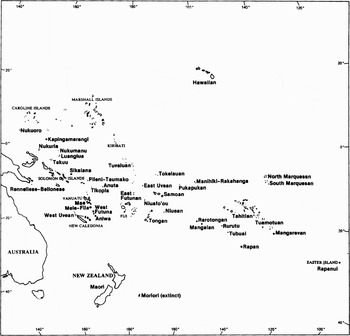
In the last half century scholars have looked closer to home in discussing possible inherited vocabulary among Tongan honorifics. It is now recognized that honorific vocabularies are widespread in island groups in the region of Western Polynesia, including Samoa, Tonga, Eastern Futuna, Eastern ‘Uvea, and the Polynesian Outlier Rotuma in Fiji. See Figure 1: Distribution of Polynesian Languages (Besnier Reference Besnier and Frawley2003). One common view is that these systems developed during the period of the Tu'i Tonga Empire of approximately 1,000 AD up to 1800 AD at the time of European contact. Tongans exerted political influence and control over this area that included control of trade and extraction of labor and resources (Geraghty Reference Geraghty, Dutton and Tryon1994; Māhina Reference Māhina1986; Schmidt Reference Schmidt and Henning2003; Taliai Reference Taliai1989). Some scholars see this period more as one of a joint Samoan-Tongan polity or as a Tongan polity deriving from Samoan influence extending into Tonga (Bott Reference Bott1982; Milner Reference Milner1961) and Samoan oral history asserts Tongan domination over Samoa ended in the fifteenth century (Meleiseā Reference Meleiseā1987). Archaeologists define this same period as one in which complex chiefdoms associated with the creation of monumental architectural structures emerged in Samoa and Tonga (Davidson Reference Davidson and Jennings1979; Poulsen Reference Poulsen and Rutherford1977).
Distribution of Polynesian Languages.

Blixen (Reference Blixen1966, Reference Blixen1967, Reference Blixen1969) is the scholar who has argued most strongly for a common prehistoric origin for lexical honorifics in Samoan, Tongan, Futuna and ‘Uvea. He offers evidence of cognate honorific forms across these four languages. As he notes, this common origin would have to have occurred since the break-up of Proto-Polynesian since such systems are not found in Eastern Polynesian languages. Linguists and archaeologists characterize the first millennium AD as the period during which Polynesians moved out from Samoa after being there and in Tonga since 1,000 BC to colonize Eastern Polynesia, and the various Polynesian languages became distinct from one another (Irwin Reference Irwin1992; Kirch Reference Kirch1984). This period pre-dates the emergence of the Tu'i Tonga Empire, or at best overlaps with it. This means scholars disagree about how early such honorific systems emerged. Only Blixen is strongly committed to the idea of a sizeable common Western Polynesian inherited honorific vocabulary, while other scholars who associate the vocabulary with the Tu'i Tongan Empire are less certain how these various island groups could have come to have honorific vocabularies associated with chiefs.
Borrowing
Tongan scholars of Tongan traditions, typically those from the chiefly class and non-chiefly scholars who work with them, stress the important role of Samoa in the shaping of the Tu'i Tonga cultural complex through all of Tonga's oral history (Bott Reference Bott1982). Taliai (Reference Taliai1989) repeatedly expresses the opinion that the higher or ‘kingly’ level of Tongan honorifics comes from the Samoan language and the larger Polynesian sub-grouping of languages closely related to Samoan. He also argues that the lower or ‘chiefly’ level of honorifics comes from “dialect borrowing” from within the Tongan language, but dialects are not systematically discussed (Taliai Reference Taliai1989:13, 39, 57, 125–126, 141). There is then the idea, in Tongan scholarship on Tonga, which we will build on, that the two levels of honorification come from different sources. However, there is very little evidence for lexical honorifics in Western Polynesian island groups having been borrowed from other languages, in spite of Churchward (Reference Churchward1959) and Taliai (Reference Taliai1989:40) raising this issue for Tongan,Footnote 1 and Tent and Geraghty (Reference Tent and Geraghty2003) and Churchward (Reference Churchward1951:143–145; 155) raising the issue for Samoan. However, Schmidt (Reference Schmidt and Henning2003) documents evidence of a chiefly respect vocabulary in Rotuma, a Polynesian Outlier, drawn from everyday words in other Polynesian languages. He suggests that Rotuman oral history describing Tongan influence is consistent with the idea of the introduction of a respect vocabulary late during the Tu'i Tonga Empire. The contrast between the Rotuman system and the others in Western Polynesia with regard to inherited vocabulary is striking.
Local development
Turning to a third possible source for such honorifics, we find that not very much attention has been given to the nature of the “local development” of Western Polynesian honorific registers argued for by Tregear (Reference Tregear1895) and Milner (Reference Milner1961). These two authors do point to Samoan semantic extensions of everyday words as a key aspect of this local coining, particularly those of a figurative or metaphorical nature, but they do not discuss them at any length. For Tongan, only Taliai (Reference Taliai1989) notes the metaphorically elevating and distancing nature of the honorific terms used for chiefs by comparing their meanings with the meanings of the everyday uses of some of the same words. He also discusses several productive derivational affixes that have combined with the semantic extensions of everyday words to produce chiefly vocabulary.
For respect vocabularies outside of Polynesia proper, but in the region of the central Pacific, Hocart (Reference Hocart1929:46–49) describes the by-then largely defunct chiefly vocabulary of the Lau Islands of Fiji, Tonga's closest neighboring area of Fiji, as also having been created through metaphorical extensions of everyday words, and Keating (Reference Keating1998:48–49) has also discussed the centrality of metaphorical extensions in Pohnpei chiefly language in Micronesia. Dixon (Reference Dixon, Steinberg and Jakobovits1971), Haviland (Reference Haviland and Shopen1979), Stasch (Reference Stasch2002) and Grimes and Maryott (Reference Grimes, Maryott, Dutton and Tryon1994) all offer models for the conceptualization of such local processes in non-honorific lexical substitution registers in Pacific societies in more detail.
There are, then, three kinds of literatures that have considered how honorifics and honorific speech registers are formed. The linguistic literature considers word formation processes in honorific systems comparatively, though not for the most part within real time frameworks. The anthropological literature has documented changes in non-Western European honorific systems over the past several hundred years of European colonization. The Pacific historical linguistic literature conceptualizes inherited vocabulary, borrowing, and local development as the key possible sources of honorifics in Western Polynesian honorific vocabularies. In these literatures, then, there is evidence that both inherited vocabulary and local development through semantic extensions of everyday words have contributed to Western Polynesian honorific speech registers, and to the Tongan honorific speech register in particular.
3. METHOD
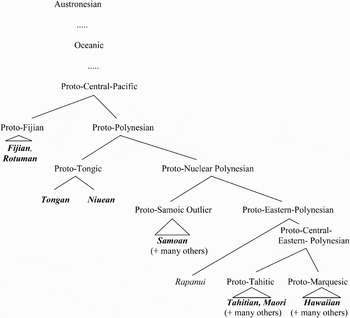
The core method used in this study was to search for cognates of Tongan (“commoner”), chiefly and kingly words in Samoan and Niuean dictionaries. The dominant Tongan language ideology captured in scholarly literature characterizes the Tongan honorific system as consisting of commoner, chiefly, and kingly levels of vocabulary (Philips 2007). This language ideology connects the honorifics to the three fundamental legal categories of citizenship in the Tongan constitution, which are commoner, noble and king. Commoner words, however, can also be thought of as ordinary or everyday words. Some Tongan consultants say that people of chiefly and royal rank use commoner words with each other in their private or home life. In public speech, relative chiefly rank reportedly ideally determines who uses honorific terms for whom in chiefly people's speech. Our purpose was to determine whether and how the contrasting historical relations between Tonga and Niuē on the one hand, and Tonga and Samoa on the other hand, would be reflected in the etymology of the Tongan honorific vocabulary. Figure 2: Proto-Central Pacific Family Tree (from Lynch Reference Lynch1998:52 and Besnier 2003: 363) shows the genetic relations among Polynesian languages.
Proto-Central-Pacific Family Tree (based on Lynch 1998: 52 and Besnier 2003: 363).

Niuean is considered to be the language most closely related to Tongan, and the two languages together comprise what has been called the Tongic sub-group branching off of Proto-Polynesian (PPN) (Besnier Reference Besnier and Frawley2003; Pawley Reference Pawley1966).Footnote 2 Samoan, in contrast, is in the other of the two branches off of PPN, Proto-Nuclear Polynesian. While both Niuean and Samoan are closely related to Tongan linguistically, the nature of the cultural-historical relationship between Tonga and the other two speech communities since the separation of the languages is considered to be quite different.
Niuē never developed the elaborate chiefly hierarchies of Tonga, Tahiti and Hawai'i (Goldman Reference Goldman1970). It is not known to have a chiefly vocabulary or a language ideology pointing to such in the culture. Niuē also does not figure prominently in Tongan or other scholarly discourses about prehistoric relations between Tonga and other island groups in the way Fiji, Samoa, and even ‘Uvea and Futuna do (e.g. Kirch Reference Kirch1984). This indicates considerably less contact over the last millennium between Tonga and Niuē.
Samoa, in contrast, shares with Tonga a cultural elaboration of chiefly hierarchy, the cultural maintenance of a stratified chiefly vocabulary, and language ideology in the culture that directs attention to both (Duranti Reference Duranti, Duranti and Goodwin1992). In addition, Tonga and Samoa are known to have maintained close ties over the last thousand years, including up to the present, and to some extent to have jointly constructed their chiefly systems through intermarriage between the high chiefly families of the two island groups (Davidson Reference Davidson and Jennings1979; Herda Reference Herda, Herda, Terrell and Gunson1990; Meleisā 1987).
If there were many cognates in our data that were also honorific in both Niuean and Samoan, that would make the case stronger for a common Proto-Polynesian origin of the honorific vocabularies. If there were many more cognates in Samoan than in Niuean, that would make the case stronger for the emergence of a joint Tongan-Samoan hierarchical polity after the split between Tongan and Niuean. If there were few honorific cognates in either language and/or evidence of honorific words that also had everyday meanings related to the meanings of the honorifics, then that would make the case stronger for the local origin of the Tongan honorific vocabulary.
A list was compiled of all recorded Tongan honorific lexical items. Honorific terms identified by Gifford (Reference Gifford1929), the Free Wesleyan Church (n.d.), Churchward (Reference Churchward1959), Shumway (Reference Shumway1971) and Taliai (Reference Taliai1989) were collated, with columns showing first the English glosses, alphabetically ordered followed by the Tongan commoner (everyday), chiefly, and kingly terms, followed by notations indicating whether these were present in each of our five sources.Footnote 3 This yielded 125 terms for which everyday, chiefly, and kingly equivalents were identified.Footnote 4
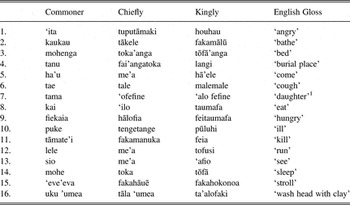
From this list we randomly selected 16 terms for analysis. For 14 of the 16, there was agreement among three to five of our sources on what the words were for the everyday, chiefly, and kingly levels of speech, and for the other two terms, at least two sources agreed on the terms for all three levels of speech. Table 1: Tongan Words with Three Speech Levels shows the 16 terms we worked with. This means that we were looking for cognates, in both Samoan and Niuean, for a total of 48 Tongan terms altogether.
Tongan Words with Three Speech Levels.

1. Churchward (Reference Churchward1959) and Tu'inukafe and Holding (Reference Tu'inukafe and Holding1992) define tama (fefine) as referring to a woman's daughter, while ‘ofefine is defined as referring to a man's daughter. Both can be used to refer to a couple's daughter. No two sources of honorific lexicon agree on the relative ranking of all three terms, but FWC and Taliai agree on the two honorific terms.
Krupa's (Reference Krupa1982:18–19) reproduction of Biggs’ (Reference Biggs, Wurm and Carrington1978) analysis of reflexes of Proto-Polynesian consonants was used to determine the cognates of Tongan words in Samoan and Niuean. Samoan and Niuean dictionaries (Milner Reference Milner1993/1966 and Sperlich Reference Sperlich1997 respectively) were used to search for cognates. Because the Sperlich dictionary also identifies which Niuean dictionary items have Proto-Polynesian reconstructed equivalents, we were also able to draw on this information, and we supplemented this information on Proto-Polynesian reconstructions by using Biggs' (1996) POLLEX (Comparative Polynesian Lexicon Project) data. The same orthographic forms are used for the same sounds across the three Polynesian languages that are our focus here, except for the use of ng in Tongan where g is used in the other two languages to represent the velar nasal. In this we follow the different orthographic traditions that have been utilized for the different languages. In some instances dictionaries for Fijian (Capell Reference Capell1968), Hawaiian (Pukui and Elbert Reference Pukui and Elbert1986), Tahitian (Davies Reference Davies1988/1851) and Maori (Tregear Reference Tregear1969/1891) were consulted as well. We paid close attention to whether the cognates in Niuean, Samoan, and in the reconstructed Proto-Polynesian vocabulary, were identified as honorific/respectful or not, and for Samoan, what degree or level of respect was involved.
A final aspect of our data collection and analysis was a search of the Tongan dictionary (Churchward Reference Churchward1959) to determine whether the 32 honorific terms also had everyday meanings, and if so, what they were, as part of the inquiry into the extent to which the honorific terms were locally created through semantic extensions of everyday words and the deployment of compounding and productive derivational processes.
4. CROSS-LINGUISTIC COMPARISON OF TONGAN HONORIFIC TERMS
We now turn to the results of our comparative study, which we will discuss in the order of: 1) Everyday/commoner terms, 2) Kingly terms, 3) Chiefly terms, 4) Proto-Polynesian, and 5) A note on borrowing. As we will see it is often important to discuss the etymology of individual lexical items in some detail in order to establish their status as cognates.
Everyday Terms
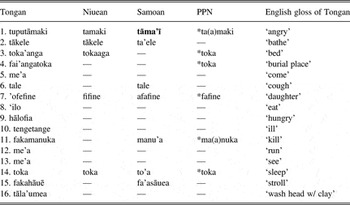
Most of the everyday or commoner terms have straightforward etymologies within Polynesian, and their cognates in Niuean and Samoan, illustrated in Table 2: Tongan Commoner Terms from Proto-Polynesian, attest to a non-honorific usage of each of the terms in PPN (The PPN reconstructions listed here are those given by Sperlich Reference Sperlich1997).
Tongan “Commoner” Terms From PPN.

1. This Samoan cognate is the polite form for ‘to bathe’ in Samoan.
2. Samoan and Niuean have a verb form as a reflex of *tanu; the expected nominal counterpart is the derived tanu-aga (‘place of burial’).
3. This verb form is not specified by Churchward as involving only a singular subject in Tongan, although it is specified as such for Samoan and Niuean.
4. Tongan tale is much more common than tae in use, and the doublet indicates that PPN is probably *ta(l,r)e. Reflexes are widespread in Polynesian languages. (Niko Besnier, personal communication)
5. The PPN root *fafine means ‘female’; cf. the Niuean cognate tama fifine, where tama refers to ‘child’. The root tama also refers to ‘child’ in Tongan and Samoan, when spoken of a woman.
6. In Samoan, as a verb this word means ‘cry’ or ‘bite or grip’. As a nominal it means ‘food’.
7. The PPN reconstruction for fia is ‘want’.
8. The root mate in Tongan, Niuean and Samoan means ‘die’. It is a “very polite” term in Samoan (i.e. the highest level in one of the few terms that make a tripartite distinction in that language). The gloss for the PPN root taa is ‘to strike’.
9. Lele means ‘fly’ in Samoan and Niuean. The PPN reconstruction is glossed as ‘allow to go free, cause to run’.
10. This commoner cognate has metaphorical uses in Tongan; it also means ‘to anchor or remain for the night’ when used in reference to a boat, or ‘to blow (from a specified direction) during the night’ when used in reference to the wind.
11. The reduplicated form in Tongan and Niuean seem to indicate a more leisurely stroll than the unreduplicated counterpart; in Samoan the reduplicative form is a frequentative which means ‘sit up late of an evening and talk’.
12. There are different meanings for each of these, all having to do with washing the head, hair, anoint with oil, etc.
As Table 2 indicates, 15 of the 16 Tongan commoner terms have cognates in Niuean and Samoan, and have PPN reconstructions. The term puke, commoner for ‘to be sick, unwell, aching’ (when used of a person or animal) seems to be a relatively rare instance of the metaphorical use of a PPN root in reference to commoners. In Samoan the cognate pu'e has meanings related to catching, clutching or grasping, or capturing; and also ‘to swell or rise’. In Niuean that term relates to ‘liquid’ or ‘juice’. Sperlich gives the PPN etymon as *puke ‘well up, flood’, which could relate to the ‘welling up’ from within of an illness when it presents itself within the individual, or also within the community, as the same verb can also refer to the rise of an epidemic in Tongan.
Note that most of the words in all three languages are relatively simple morphologically, revealing relatively little derivational morphology, with the exception of tāmate'i, in which –‘i can be identified as an optional transitivizing suffix.
Comparison of Higher Level/Kingly Honorifics
The most striking finding in our comparative analysis of the Tongan kingly or higher level of honorification is the high proportion of terms that are also honorific in Niuean and Samoan, to be discussed in more detail further on. As we will see, this sharing of honorifics is not characteristic of the lower level of honorification, what we are calling the ‘chiefly’ level.
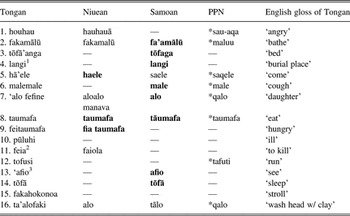
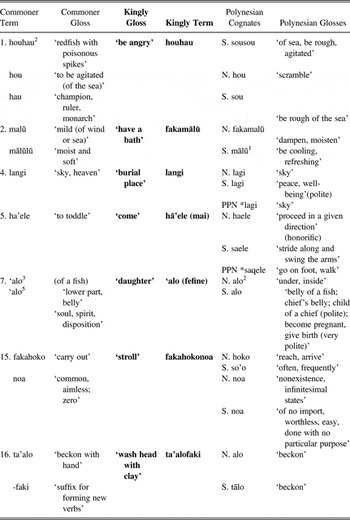
Table 3: Tongan Kingly Terms from Proto-Polynesian, shows where there are cognates for kingly terms in Niuean, Samoan, and Proto-Polynesian. As can be seen in Table 3, there are overall far fewer cognates in Niuean and Samoan for the higher level honorific terms than was true for the everyday or commoner terms, and less evidence of reconstructions of these terms for Proto-Polynesian. There is also greater evidence of the formation of new words using common derivational processes in Tongan. However, in spite of the overall smaller number of cognates, the majority of the terms in the Tongan kingly honorific vocabulary for which there are cognates in our sample are honorific in at least one of the other Polynesian languages we looked at. There are eight honorific cognates with Samoan and two with Niuean.
Tongan Kingly Terms from PPN.

Honorific terms are in bold for other Polynesian languages.
1. Langi has the everyday meaning of ‘sky, heaven’ in Tongan, Niuean, Samoan and Proto-Polynesian. Its metaphorical extension to ‘burial place’ in Tongan is well–recognized by Tongans, a point to be discussed further in the later section on semantic processes.
2. Feia also has the everyday meaning in Tongan of ‘to do’, and is characterized by Churchward as like fai, but more respectful. We consider it then as a euphemism for ‘to kill’. Fai has everyday meanings of ‘do’, ‘make’, ‘have’ across Tongan, Samoan, Niuean, and Proto-Polynesian.
3. ‘Afio has a range of only honorific meanings in Tongan, as is true in Samoan, but the range of honorific meanings in the two languages is different.
One term was shared as an honorific by all three languages: taumafa ‘eat’, which is remarkable because, as mentioned above, Niuean is not usually considered to be one of the Polynesian languages that has a developed system of honorification. Others that were honorific in both Tongan and Samoan include: fakamalu ‘bathe’, tofa'anga ‘bed’, langi ‘bury’, malemale (Samoan male) ‘cough’, ‘afio ‘see’, and tōfā ‘sleep’. The Tongan kingly word for ‘daughter’, ‘alo fefine, also shares an honorific with Samoan; however, Samoan alo can refer to either a son or a daughter. The Tongan kingly term ‘alo only refers to ‘son’, and the non-honorific modifier fefine, ‘woman or girl’, must be used in conjunction with ‘alo to refer to ‘daughter’. The high percentage of shared honorifics between Tongan and Samoan is not surprising given previous discussions of their relatedness (e.g. Blixen Reference Blixen1966), but as we will show in our discussion below, such a high percentage of shared honorifics is not characteristic of the Tongan chiefly terms, i.e. of the lower as opposed to higher level of honorification.
One term that is surprising is hā'ele, which is kingly in Tongan but is not honorific in Samoan, yet is also honorific in Niuean (used mainly for the divine, according to Sperlich). Similarly, the cognate for feitaumafa ‘be hungry’ in Niuean is honorific in that language, but not in Samoan, which apparently lacks a cognate.
Finally, note that none of the eight terms for which there are Proto-Polynesian reconstructions are identified as having honorific meanings in those reconstructions. The presence of cognate honorifics in Niuean suggests that lexical honorifics developed early in the emergence of the Polynesian languages as a distinct sub-group. The much greater presence of honorific cognates in Samoan indicates a later elaboration of an honorific speech register.
Comparison of Tongan Chiefly Terms
In general, the effort to identify cognates for the Tongan chiefly, or lower level, lexical honorifics led us to conclude that there is almost no evidence of lower level Tongan honorific vocabulary shared with Niuean and Samoan honorific lexicon in our sample of words of the sort found for the higher level or kingly Tongan honorific vocabulary. On the other hand, we did find evidence of more word formation processes in the chiefly vocabulary that are unique to Tongan, and that can be explained through processes of semantic extensions of everyday or commoner Tongan words that are also found in the other Polynesian languages, coupled with common derivational processes and compounding that likewise are found in the other Polynesian languages.
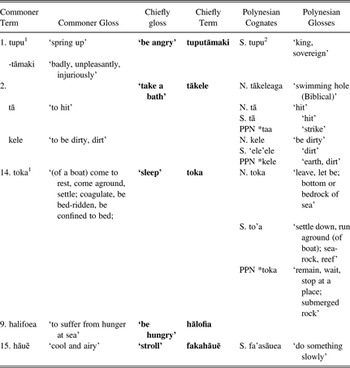
Table 4: Tongan Chiefly Honorifics from Proto-Polynesian, shows that overall there are fewer cognates for the Tongan chiefly words in Niuean and Samoan than in either the commoner vocabulary of Tongan or the kingly vocabulary. There is only one cognate in either of the other two languages that is honorific: tuputāmaki, the chiefly word for ‘angry’ appears as tāma'ī, an honorific noun in Samoan meaning ‘war, calamity’. The Samoan honorific term for ‘angry’ is to'atāma'i. Only three Tongan chiefly terms have cognates in both the other Polynesian languages and PPN reconstructions: tākele ‘bathe’, and ‘ofefine, ‘daughter’, and toka ‘sleep’.
Tongan Chiefly Terms from PPN.

Honorific terms are in bold for other Polynesian languages.
Toka is the source for the derivationally-related chiefly terms toka'aga ‘bed’ and fai'angatoka ‘burial place’. In Niuean, toka has two meanings: toka 1 ‘n. bottom or bedrock of the sea’; and toka 2 ‘1. v.t., ‘to leave’; 2. ‘to let it be’; 3. ‘put something somewhere and leave it there’. Sperlich attributes these meanings to two different but homophonous PPN etyma: PPN *toka ′rock, submerged rock, reef′ and PPN *toka ′remain, wait, stop; coagulate'. In Samoan, to'a can refer to the actions of several different things, meaning (when spoken of liquid or solid body in a liquid, etc.) ‘be still, settle down’; or (of a boat) ‘run aground, strike’; or (of people) ‘stop’. But the cognate of toka is not honorific in either Samoan or Niuean. We will discuss the probable metaphorical extension of the PPN term for honorific usage in Tongan in the next section.
Toka'anga, which is composed of toka ‘sleep’ with the locative suffix -‘anga, is the Tongan chiefly word for ‘bed’ (i.e. ‘place for sleeping’), but the equivalent derived form is not related to sleeping in Niuean or Samoan, nor is it honorific in its compositional meaning with the verb toka in those languages.
The root toka is further used in the Tongan chiefly term for ‘burial place’, composed of fai + ‘anga + toka, which in Niuean refers literally to ‘a place for leaving something’, but given the honorific meaning of toka as ‘sleep’ perhaps means something along the lines of ‘a place for leaving for the purpose of sleeping’ (i.e. in the grave) in Tongan. In Niuean faiaga means ‘place of or for something’, but again, it is not honorific. Samoan has a term faiaga ‘be idle, dilatory’, but it is not honorific. It is only the honorific root toka that gives honorific status to the derived variants toka'anga and fai'angatoka in Tongan, and thus chiefly honorifics can be created through regular derivational morphology involving honorific roots in this language.
Two of the terms that appear in our Tongan chiefly honorific sample, me'a and ‘ilo, are everyday Tongan words which also appear in the other Polynesian languages, as in Tongan, with the meaning of ‘thing’ and ‘know’ respectively. In the Tongan chiefly vocabulary, each of these words is used for various verbs in Tongan. In our honorific sample, me'a means ‘come’, ‘run’ and ‘see’, but it also is used honorifically for ‘to think’, ‘to go’, and ‘to stand up’. Mea does not have verbal meanings in Samoan and Niuean. However, in other Polynesian languages we do see a cognate verb being used for various purposes, as in Māori mea ‘to do’; ‘to cause’; ‘to say’; ‘to intend or wish’; ‘to think’ (Tregear Reference Tregear1969/1891:289); and Tahitian mea ‘do’ (“a word used as a convenient substitute, instead of naming the action” (Davies Reference Davies1988/1851:239).Footnote 5 However, this term is not noted as an honorific term in other Polynesian languages so far as we know. In our sample, ‘ilo, meaning ‘know’ in commoner or everyday speech, is used honorifically for the word ‘eat’, but also is used honorifically for ‘drink’ and ‘smoke’ in Tongan.
Proto-Polynesian
One general finding of the above discussion is that more of the commoner terms than the chiefly and kingly terms have roots derived directly from Proto-Polynesian, using Sperlich (Reference Sperlich1997) and Biggs (Reference Biggs1996) as the basis for identification of the reconstructed PPN vocabulary. Thus 14 commoner terms have PPN roots, sometimes more than one, while only eight words from the kingly list were identified as PPN, and the chiefly list revealed only six words with four PPN roots.
In addition, among the kingly words, langi, and feia are commoner words whose everyday meanings have been semantically extended to create honorific meanings. There are also two chiefly words that are actually commoner words whose meanings have been semantically extended which have PPN roots: ‘ilo, and me'a.
Thus, less than half of the honorific vocabularies we sampled have PPN roots in contrast to the commoner words, which are predominantly PPN. In the formation of chiefly, or lower level, honorifics the PPN terms are being used creatively to form new meanings through semantic extension, compounding and derivation, while the use of these processes to create new meanings is less in evidence though still present among the kingly, or higher honorific level terms with PPN roots.
A Note on Borrowing
As we have already noted, our Tongan honorific data does not offer any direct evidence of Tongan borrowing of honorific lexical items from either Niuean or Samoan, but there remains a possibility that Tongan provided honorific loans to Samoan. Our evidence indicates that the Tongan honorifics for which there are cognates in Niuean and Samoan must have been in each of the languages before the well-known sound changes occurred in each language after separating. For example, it would be predicted that a Samoan form with glottal stop (<PPN *k) would be borrowed into Tongan with that glottal stop, but words descended from PPN with a glottal stop would not have a glottal stop in Samoan (cf. Tongan me'a vs. Samoan mea). By the same logic, cognate forms that might have a glottal stop in both Tongan and Samoan would argue for a loan from Tongan, since this sound change systematically deleted glottal stop from the Samoan phoneme inventory.Footnote 6 No such forms have been found in our lists, so no evidence of borrowing subsequent to the relevant sound changes is available to us at this time.Footnote 7
5. SEMANTIC PROCESSES
Our study has found that of the major hypotheses for sources of Tongan honorifics, only borrowing can be ruled out as a major source in the data we examine here. As we have noted, one of the striking results of our etymological analysis is that the kingly vocabulary consists largely of inherited honorifics (as seen by cognate honorifics in Samoan and/or Niuean), whereas the chiefly level has more honorifics formed by semantic extensions of commoner terms, which can then lead to further compounding and derivation to create even more chiefly honorifics. There are kingly terms for which these same processes are in evidence too, as we will see. However, the semantic extensions in the chiefly vocabulary are both more transparent (including to Tongans) and less shared with other Polynesian languages, suggesting a greater predominance of more local and recent development for the chiefly vocabulary than for the kingly vocabulary.
There are at least two different kinds of semantic processes involved: metaphorical extensions of everyday words and semantic ‘bleaching’. The largest group of individual words is derived from metaphoric extensions of everyday words.
Metaphorical extensions
Table 5: Metaphorical Extensions in Higher Honorific (Kingly) Vocabulary, and Table 6: Metaphorical Extensions in Lower Honorific (Chiefly) Vocabulary, lay out some of the relationships between everyday/commoner and honorific meanings of same words. Polynesian cognates of the same words and their glosses are also displayed to show which of the meanings may be shared across languages.Footnote 8
Metaphorical Extensions in Higher Honorific (Kingly) Vocabulary.

N. = Niuean; S. = Samoan.
Metaphorical Extensions in Lower Honorific (Chiefly) Vocabulary.

N. = Niuean; S. = Samoan.
The images that are evoked by the metaphorical processes in the honorific vocabulary can be characterized as eclectic and varied. And a single word may carry more than one imagistic meaning. At the same time, the metaphorical extensions of everyday words are far from open-ended in their semantic range. Local Tongan explanation of why the word for ‘sky’, i.e. langi, is used to refer to the ‘burial place’ of the king can provide evidence of how Tongans think about the figures of speech in the vocabulary. In Tongan traditions, the sky is where the gods reside, and persons of chiefly rank were traditionally believed to go to an afterlife in the sky when they died, thus the association between the burial place of the king and the sky.
There is generally a strong presence of figures of speech in our data drawing analogies between the qualities of the categories of persons, i.e. the chiefs and the king, who are indexed and referred to through the use of the terms, and ‘the natural world’. The sky, the sea, and allusions to weather, particularly to qualities of wind and water, are all apparent. Chiefs and their experiences are in this way likened to powerful forces of nature. Keating (Reference Keating1998: 48) notes features of the natural universe as sources of figures of speech in chiefly language in Pohnpei. And Taliai (Reference Taliai1989) repeatedly directs attention to the exhaltative nature of the meanings of Tongan honorifics in sharp contrast to the demeaning meanings of self-lowering vocabulary.
The sea is also a focus—not just the conditions of the sea, as in the association in houhau, kingly ‘anger’, of hou with the roughness and agitation of the sea—but also the experience of being at sea. Thus the word for the experience of chiefly ‘hunger’, hālofia, may be etymologically related to halifoea, the everyday word for ‘to suffer from hunger at sea’. And toka, which means ‘to sleep’ in the chiefly vocabulary, has the everyday meaning of ‘a boat coming to rest, coming aground’. The everyday meaning of houhau, the kingly word for ‘angry’, is a ‘redfish with poisonous spikes’, so that a frightening threatening person is likened to a frightening threatening fish.
At the same time, what may appear to be contradictory characterizations of chiefly qualities do reveal the diversity of ways in which chiefs are conceptualized. For example, although a chief may be fierce in his anger, chiefs are in contemporary Tonga nevertheless associated with slowness and stillness, with being in one place and moving in a stately and dignified manner, while commoners run around, hurrying and scurrying—an imagistic contrast particularly evoked by large public ritual activities in which the labors of both preparation and performance are carried out by those of lesser status to honor those of higher status. Thus the images conveyed by toka, chiefly for ‘sleep’, which is also the root of chiefly ‘bed’, toka'anga, and ‘burial place’, faiangatoka, are images of settledness, and even of the bedrock of the sea, and these images convey a heavy weighty quality. Similarly the kingly word for ‘stroll’, fakahokonoa, with its root of noa, ‘nothing’, suggests getting nowhere. And the kingly word for ‘come’, hā'ele, appears to be a variant of ha'ele, the everyday word for ‘toddle’. This too suggests not getting very far very fast, and at the same time may also express an attitude of endearment associated with diminution that appears in speech to and about royalty.
When we compare the figures of speech used in the two levels of honorification, they are similar in the range and diversity of their themes, although the chiefly images have a more mundane, less poetic quality. However, most of the kingly terms that can be recognized as metaphorical extensions when compared with their everyday meanings also have cognates in the other Polynesian languages. This suggests that these particular images are both old and widespread. The chiefly terms that can be recognized as metaphorical extensions of everyday words simply do not have cognates for the derived forms in the other Polynesian languages, although the roots of those words can be found in the other languages. This suggests greater recency and local coining of the chiefly terms.
Semantic ‘bleaching’
The second kind of process involved in the semantic extension of everyday or commoner words in the creation of honorific words is semantic bleaching. Here one word in the honorific vocabulary is used to cover a range of meanings for which there are many words in the everyday vocabulary. Attention was drawn to this process, first by Dixon (Reference Dixon, Steinberg and Jakobovits1971) and then Haviland (Reference Haviland and Shopen1979) in in-law respect vocabularies in non-Austronesian languages in New Guinea and Australia. Errington (Reference Errington1988) similarly documents forms in Javanese honorific language in which there is a one to many relationship between certain honorific forms and the many everyday forms they stand in for. However, he suggests the need to consider making a distinction between a semantic ambiguity that some such Javanese honorific forms convey, and the polysemy, or actual diversity of specific meanings, that other such forms convey.
In our kingly sample, the word ‘afio, ‘see’, has this quality of underspecification. It is conceptualized by Tongans as being used as a substitute for other everyday words as well, including words meaning ‘to sit, to be present, to reside, to look’. It also functions as a noun, ‘Afio, meaning ‘Majesty’, as in His Majesty, and ‘Afiona, ‘Your Majesty’ or ‘you’ in address, as well as figuring in other constructions. ‘Afio has no everyday meaning; it only appears in honorific constructions. This is true for afio in Samoan too, although the semantic range of the term in Samoan is different from that for Tongan.Footnote 9
Our kingly sample also notably includes the term feia ‘to kill’. In Tongan, feia is considered to have the same everyday meaning as fai ‘to do’, only to be more polite. One would customarily thus refer to the use of this term for ‘to kill’ to be a euphemism. However, it is also possible to think of feia as a term that, in its everyday use, is already semantically underspecified, or already semantically bleached, and is in its honorific use being given a semantically much more specific meaning.
In our chiefly sample of words, two have a wide range of meanings. ‘ilo, which in everyday language means ‘to know’, and in our sample means ‘to eat’, also means ‘to drink, to smoke’ in chiefly language. The second chiefly word with a wide range of meanings is me'a. In our sample it appears three times, for ‘come’, ‘run’ and ‘see’. It is also used for ‘go, speak, think’ and other verbs, often in conjunction with various directional modifiers. In everyday language me'a is a noun, meaning ‘thing’. So, like feia, it is, in its everyday use, already semantically bleached or relatively unspecific.
In two different ways, then, the chiefly vocabulary is more closely tied to and derives from local ongoing everyday or commoner speech than is the kingly vocabulary. It involves more metaphorical extensions of everyday words that are not shared with other Polynesian languages and it includes more terms that involve semantically bleached everyday words.
6. CONTEMPORARY USE OF THE TONGAN LEXICAL HONORIFIC SPEECH REGISTER
The etymological sources of Tongan honorifics, then, include both inherited words with honorific cognates in Samoan and the creation of new honorifics through semantic extension of everyday words combined with productive morphological processes in Tongan. The inherited honorific vocabulary shared with Samoan and Niuean is almost exclusively associated with the higher or kingly level of honorification, suggesting that this level is of greater time depth and areal or regional scope than the lower level of honorification. The lower level of honorific vocabulary is characterized by semantic extensions combined with productive morphological processes. The majority of these words are not shared with Samoan or Niuean. They are locally developed and more recent in time in their introduction than the inherited vocabulary of the higher level of honorification. Where the semantic extensions are of a metaphorical nature involving figures of speech, the actions of targets of honorifics are metaphorically empowered and elevated in Tongan cultural terms.
Up to this point our focus has been on our sample of words from word lists of lexical honorifics that have been produced by scholars at various points in time. The question remains how the words in our sample and their contribution to the historical formation of this honorific speech register are related to actual use of honorifics in speech. To answer this question we draw primarily on data recorded by Philips (see Philips Reference Philips and Kiesling2010) in a large Tongan village from three kinds of events: 1) Five fonos, a type of traditional meeting. Here higher level honorifics are used by Free Wesleyan Church ministers in initial prayers to address God and refer to Jesus. Lower level honorifics are used by village leaders primarily for talk about the local noble, i.e. to refer to him rather than address him. 2) A Free Wesleyan church service in which the higher level of honorification is used by a minister in multiple prayers to God and in the sermon. 3) Two magistrate court hearings in which lower honorifics are used by court personnel to address and refer to the magistrate (Philips Reference Philips and Kiesling2010). These are all public activities that occur frequently in Tonga at the village level and they offer typical uses of honorifics in speech. Note it is neither common for the king to appear in public in villages nor for him to be spoken about regularly in the public contexts in the village where honorifics are used, certainly not as regularly as God is made present.
There are several key ways that patterns of honorific use in contemporary Tonga are related to our findings about the prehistoric formation of the Tongan honorific lexicon. First and fundamentally, the two levels of honorification are kept quite separate from each other in the use of honorifics. A given target of honorification, i.e. the social category/person that is being indexed in address or reference, will be associated with only one level of honorification and not the other. There is no mixing of levels in the indexing of any target of honorification. God will always be given higher level honorifics and the noble will always be given lower level honorifics. This habitual careful separation is what makes it possible for the variation in the sources of honorific word formation to be correlated with speech level. Apparently there has been a continuous separation of the speech levels since at least the late 18th century that has preserved the evidence in the vocabulary lists of different historical sources for words in the two levels. This separation of levels over time has been sustained in spite of changes in local political and linguistic conceptualization of targets of honorification (Philips Reference Philips, Makihara and Schieffelin2007). Gone is the Tu'i Tonga as the target of higher level honorifics. New higher level targets are God and King. The conceptualization of some chiefs as Nobles and the extension of lower level honorifics to court magistrates are also new, i.e. post-European contact.
A second key feature of the use of honorifics in relation to their historical formation processes is that the historical differentiation in formation processes for the two different levels is intensified in actual speech. Thus in church and prayers at fonos, the words from the higher level of honorification used for God and Jesus are almost exclusively inherited words that are also honorifics in Samoan. Analogously, the words used in fonos and magistrate's court from the lower level of honorification are overwhelmingly semantic extensions of everyday words.
Third, for each level of use, the actual range of vocabulary is much less diverse or smaller than the variety seen in the word lists. A few honorific words are used repeatedly in any given event, along with a few honorifics that appear infrequently and/or are situation specific.
The higher level of honorification
Of the higher level words in our “kingly” lexical sample of 16, four appear in the speech data being considered here: ‘alo (to refer to Son of God); hā’ele (to refer to Jesus's rise to heaven; and to the Holy Spirit descending on the apostles); taumafa (to refer to Queen's food, in a fono), and ‘afio (‘come’ in our sample; appears in a wide range of meanings in religious discourse). Except for hā'ele,which has a cognate honorific in Niuean, these words have cognate honorifics in Samoan. Moreover, virtually all of the other honorifics that appear multiple times in the speech data are also cognates of Samoan honorifics, e.g. finangalo, ‘will’; fofonga, ‘face’; and huafa, ‘name’. This means the inherited words with honorific cognates in Samoan are predominant in speech with higher level honorifics to a greater degree than in our lexical sample of honorifics.
The words that index God and Jesus and even the Holy Ghost are thus old words associated pre-contact predominantly with the Tu'i Tonga, a mainly sacred power at the time of initial extended contact with Western Europeans in the late eighteenth century. Religious speech today, in this case in the Free Wesleyan Church, is sustaining a particular part of the higher level honorific vocabulary. Honorifics in religious speech present a more purely inherited vocabulary than the word lists or our sample from those lists.
Lower Level of Honorification
Of the lower honorific level words in our “chiefly” sample, four are used in our speech data. They are: me'a, ‘come’; ‘ilo for ‘eat’ and ‘food’, me'a for ‘run’ and me'a for ‘see’. These are everyday words that have been semantically extended to include a range of meanings. They are not metaphorical, they are semantically underspecified or semantically ‘bleached’ words that have both vague and multiple meanings.
Such semantically vague honorifics are very dominant in speech regarding lower level targets (Philips Reference Philips and Kiesling2010). Verbs of motion involving me'a are salient in the fonos in talk about the local noble's activities. They also occur in fonos and in other contexts in invitations and polite directives to (non-chiefly) people to move from one place to another.
So whereas in the word lists the metaphorical extensions are more numerous than the ‘bleached’ forms, they are rare in the use of lower level honorifics in fonos and magistrate's courts in the village where the data we are discussing was recorded. The smaller number of bleached terms are the ones that appear repeatedly in speech. Certainly this means that semantically bleached everyday words are far more predominant in the lower level of honorification in speech than they are in our lexical sample of chiefly honorifics. Since semantically bleached words predominate, Tongans may not actually hear very many of the metaphors that are in the word lists.
Each level has an emblematic word
In Tongan speech, me'a is far and away the most frequently used chiefly word in public discourse, the broader domain of chiefly language use in the village where events were recorded. Recall that me'a in everyday speech means ‘thing’. ‘Afio is the most frequently used kingly word in religious speech, particularly when addressing God in prayer (Philips Reference Philips and Kiesling2010). ‘Afio has no everyday meaning. It is an honorific-only term that is also honorific in Samoan. It pervasively inflects religious speech as being in the higher level honorific sub-register. Both of these terms are semantically vague and polysemous, or ‘bleached’. Errington (Reference Errington1988) similarly found for Javanese speech levels that the honorific terms used with highest frequency were those that were semantically vague and/or polysemous.
In sum the actual use of honorific words shows the two levels of honorification to be even more different in their etymological sources and their processes of register formation than the historical data suggests.
7. CONCLUSION
In this paper we have used historical linguistic analysis of the etymology of Tongan honorifics to expand the scope, both temporal and spatial, of the analysis of honorific register formation. Earlier work on honorific register formation has focused primarily on possible word formation processes, and changes in honorific systems over the past few hundred years under the impact of European colonialism, usually with analysis of changes in a single language. The Tongan honorific system has been formed over a long period of at least a thousand years. It has been shaped by different linguistic processes in different temporal phases of this formation. And this lexical honorific register has been influenced by both local and regional cultural and social processes. Moreover the two higher and lower sub-registers of this honorific speech register have been formed predominantly by different processes and in different time periods.
The higher level of honorification has more inherited words shared primarily with Samoan, but also with Niuean. This is evidence for the common formation of a Samoan-Tongan chiefly honorific vocabulary at some time before the two languages were completely separate, but presumably after some dispersion of the groups of people that today are associated with individual Western Polynesian languages. The archaeological evidence for the emergence of chiefdoms in Samoa and Tonga locates this emergence in the second millennium AD. Linguistic evidence and oral history locate the emergence of the Samoan-influenced Tu'i Tonga cultural and semiotic complex during this same period. It is thus plausible to consider this the period in which many of the honorific cognates shared by Tongan and Samoan came into the Tongan language. This is consistent with Hovdhaugen's (1986) dating of the Samoan sound changes (/k/ to /'/, etc.) at more than 235 years ago, indicating its separation from Tongan. The sharing of honorific vocabulary between Tongan and Samoan makes it clear that the honorific complex is a long-term regional phenomenon, rather than simply a characteristic of two discrete languages.
The higher level of honorification links the king with the kinship lineages of greatest time depth and broadest areal connections known to Tongans. The inherited words in the higher level of honorification connect the king to the past existence of a Tu'i Tongan Empire in the Western Pacific. They also associate the king with a present that is transnational, in keeping with his role as head of state, and indeed kingly terms are extended to other heads of state. The king and God are in this way both associated with a more prestigious cosmopolitan chronotope than that which is associated with the people below them.
The lower level of honorification lacks the cognates that are honorific in other Polynesian languages and is comprised primarily of semantic extensions of everyday words that also are not shared with Samoan and Niuean. This evidence indicates a relatively more recent and more Tongan-local formation of the lower level of honorification.
The ongoing separation of the levels in contemporary language use in a Tongan village has preserved this historical and developmental contrast. In use the contrast between the processes of formation for the two different honorific speech levels is heightened. Overwhelmingly the small number of words in the kingly level that are used repeatedly have honorific cognates in Samoan. A similarly small number of repeatedly used words in the chiefly level are overwhelmingly semantic extensions of everyday words that are both vague and polysemous.
The analytical expansion of the temporal and spatial scope for the formation of honorific speech registers can thus reveal sociolinguistic processes at work in such formations that cannot be known and understood within analytical frameworks with narrower or more restricted temporal and spatial orientations.