



No CrossRef data available.
“Why you so Singlish one?” A semantic and cultural interpretation of the Singapore English particle one
Published online by Cambridge University Press: 26 April 2005
Abstract
The particle one of Singapore English is widely used in Singapore culture, but it is little mentioned and its invariant meaning has not been described, so that not much is known about its meaning and the cultural norms it reflects. This article provides a detailed semantic analysis of this particle, articulates its meaning in the form of a reductive paraphrase using natural semantic metalanguage, and argues that its use reflects Singapore English speakers' tendency to speak definitively and exaggeratedly. The discussion of Singaporean speech norms reflected by this particle includes reference to relevant Anglo English speech norms for comparison and contrast.I am indebted to Anna Wierzbicka for her detailed comments on an earlier version of this article. I am grateful to Jane Hill, Peter Tan and another, anonymous reviewer for their very generous and constructive overall feedback on this paper. I have also benefited from stimulating discussions with Cynthia Allen and Avery Andrews on the topic of relative clauses and the syntax of the nominal one. Jane McGary provided valuable editorial assistance and native Anglo English speaker intuition in regard to some examples. Last but not least, I would like to express my gratitude toward writer Hwee Hwee Tan for giving me a soft copy of her manuscript to do electronic searches.
Keywords
Information
- Type
- Research Article
- Information
- Copyright
- © 2005 Cambridge University Press
INTRODUCTION
Since what seems to be the first publication devoted entirely to describing aspects of Singapore English1
By the term “Singapore English,” I refer to the Singaporean variety of English characterized by a host of words, grammatical structures, speech acts, etc., which come from or originate in the Chinese languages and Malay. This variety is essentially a colloquial variety and, in academic literature, is sometimes referred to as “Singapore colloquial English” (e.g. Gupta 1992a, 1992b, 1994; P. Wong 1994) or “colloquial Singapore English” (e.g. Alsagoff & Ho 1998; Wee 2002). It is also popularly or commonly known as “Singlish” (e.g. J. Wong 2000; McCrum et al. 2002:338; Coxford Singlish Dictionary 2002). There is, of course, a “standard” or formal variety spoken in Singapore, such as that used in local English news broadcasts. This standard variety is, to use Gupta's words, “much like Standard Englishes in the rest of the English-speaking world” (1994:7), at least in form. For the purposes of this study, the notion “Singapore English” does not include the formal variety of English used in Singapore.
To understand a language, one first and foremost has to understand its semantics, for meaning is what language is mainly about. Wierzbicka writes:
Language is a tool for expressing meaning. We think, we feel, we perceive – and we want to express our thoughts and feelings, our perceptions. Usually we want to express them because we want to share them with other people, but this is not always the case. We also need language to record our thoughts and to organise them. We write diaries, we write notes to ourselves, we make entries in our desk calendars, and so on. We also swear and exclaim – sometimes even when there is no one to hear us. The common denominator of all these different uses of language is not communication but meaning. (1992:3)
As Goddard says, “Everything in a language – words, grammatical constructions, intonation patterns – conspires to realise this goal [of expressing meanings] in the fullest, richest, subtlest way” (1998:1). Given that the primary purpose of a language is the expression of meaning, if we know its form but do not “truly understand the semantics of Singapore English,” how can we claim to know what this language is all about?
The role of meaning in the study of language
If we accept that the study of meaning should play a central role in linguistics, it would make little sense to attempt to understand a language or an aspect of it without any reference to meaning. In Wierzbicka's words, “To study language without reference to meaning is like studying road signs from the point of view of their physical properties (how much they weigh, what kind of paint are they painted with, and so on), or like studying the structure of the eye without any reference to seeing” (1996a:3).
Regrettably, this is precisely how most writers of Singapore English approach the topic – with half-hearted interest in meaning at best. These writers do not seem to realize that semantics, the study of meaning, “stands at the very centre of the linguistic quest to understand the nature of language and human language abilities” (Goddard 1998:1). To illustrate this point, one may take as an example the Singapore English particle one, which is the object of this study. This particle is not found in Anglo English, a notion to which I shall return, and seems to be a feature of Singapore English. That it is listed in Brown's (1999:152) Singapore English in a nutshell and the tongue-in-cheek Coxford Singlish Dictionary (2002:79) suggests that it is a culturally significant word. In fact, it is commonly used in Singapore culture, and authentic examples are not difficult to find:

However, despite its apparent cultural significance, to the best of my knowledge, very little has been written on the meaning of this ubiquitous Singapore English particle; the few scholars who have mentioned it (e.g. Gupta 1992a, b, 1994; Alsagoff & Ho 1998; Brown 1999), either at length or in passing, have not articulated its invariant meaning. As a result, we have had no understanding of what this word means and what it can reveal to us about Singapore culture.
Unfortunately, the marginalization of meaning in the study of Singapore English has been compounded with emphasis on word function over meaning, which often leads to confusion between meaning and function, as illustrated in the many discussions of Singapore English particles (e.g. Richards & Tay 1977; Kwan-Terry 1978, 1992; Platt 1987; Platt & Ho 1989; Gupta 1992a, b, 1994; Pakir 1992b; Wee 2002). The predominant approach taken in the majority of these studies may be described as a “functionalist” one (cf. Wierzbicka 1986:523), in which writers characterize the “pragmatic functions” of a particle (Deterding & Low, 2003:59). The main concern with this approach is that, on many occasions, writers seem to equate function with meaning and therefore, to use Goddard & Wierzbicka's (2002b:1) words, have not distinguished “semantic invariants from contextual effects.” For example, Wee claims that the “meaning” of the particle lor “is simply an indication of resignation,” but later in his paper states that the same particle “functions as a resignative” (2002:716, 723). In a similar vein, Kwan-Terry (1992:65) states that the particle wut has “a meaning of objection.” However, while function is obviously related to meaning, the two cannot be equated. Meaning is an invariant property of a word, but function is context-dependent. Meaning determines use, not the other way around. Therefore, even if a linguist wants to study language function or use, the best way is still through meaning ( J. Wong 2004a).
The role of culture in the study of language
Although I maintain that, to use Besemeres & Wierzbicka's (2003:4) words, meaning “is what language is primarily all about,” I hasten to add that language is not an autonomous, self-governing semantic system. It is intrinsically related to and an integral part of culture. As Wardhaugh writes, “That there should be some kind of relationship between the sounds, words, and syntax of a language and the ways in which speakers of that language experience the world and behave in it seems so obvious as to be a truism” (1998:215). One is therefore inclined to agree with Smith that language is “the means of expression of the speaker's culture,” and that language and culture are “inextricably tied together” (1983:8, 10). As such, I completely concur with Apte that “language competence should go hand in hand with cultural competence” (1974:67).
If we accept that language and culture are inextricably linked, it follows that the best way to understand a culture is through the study of language, especially its key expressions. In fact, semantic studies of cultural key expressions in Singapore English and other languages (e.g. J. Wong 2003, 2004a, 2004b, 2004c, forthcoming; Wierzbicka 1992, 1997, 2003a, b, forthcoming; Goddard 1997b, 2000) have revealed the presence of cultural values and speech norms characteristic of the speech community in question. Therefore, it would seem that, to understand language, it is best viewed as a cultural notion.
Many traditional schools of linguistics, especially in the fields of sociolinguistics and applied linguistics, distinguish between “native” (e.g. Platt et al. 1984:2; Trudgill & Hannah 1994:6; Seidlhofer 2000:54; cf. Gupta 1994:14) English varieties and “nonnative” (e.g. Kachru 1983:20) or even “new” varieties (e.g. Platt et al. 1984:2). Presumably, “native English” refers to the variety spoken by “a white person from a traditionally English-speaking country” (Gupta 1994:14–15). However, even though it has been widely used, the term “native” is obviously not unproblematic, given that many varieties of English have developed that are spoken natively but not by white people from traditionally English-speaking societies, such as Black American English, Australian Aboriginal English, Indian English, and Singapore English. Furthermore, the distinction between “native” and “nonnative” is not a very illuminating one, since it does not point to any inherent differences between the different varieties. As such, I would prefer to use expressions like “Anglo English” and “Singapore English,” and think of them as cultural dialects rather than regional ones, if only because these English varieties reflect Anglo culture and Singapore culture in terms of values, attitudes, patterns of thinking, and so on. Thus, what is traditionally referred to as “native English” might be better called “Anglo English,” a cultural notion – not a racial one – to refer to the varieties of English that reflect “a characteristically Anglo-Saxon cultural tradition” (Wierzbicka 2003a:30). Varieties of Anglo English include, among others, those traditionally known as American, Australian, British, Canadian, and New Zealand English.2
As the anonymous reviewer correctly points out, these varieties of English would be more appropriately described as Anglo-American English, Anglo-Australian English, Anglo-British English, etc.
Singapore English
Thus, Singapore English is to be interpreted as a cultural notion, not a racial or geographical one. In terms of form, Singapore English of course has much in common with Anglo English. However, unlike Anglo English, Singapore English does not reflect exclusively Anglo values. Rather, it is characterized by many words that originate from the Chinese languages and, perhaps to a lesser extent, Malay; and those words reflect values and speech norms from their cultures of origin.
To appreciate the multicultural origin of Singapore English, one must first understand that the majority of Singaporeans do not speak a variety of English at home. Singapore society comprises around 76.8% Chinese people, 13.9% Malays, 7.9% Indians, and 1.4% from other ethnic groups (Singapore Facts and Pictures 2001). According to the Singapore Census of Population, 2000, Advance Data Release No. 3, only 23% of the population aged 5 and above speak a form of English at home. The rest speak mainly Mandarin, other Chinese languages, and Malay as their first languages.
Sometime in the 1980s, all government schools in Singapore started to use English as the medium of instruction (Foley 2001). Thus, all Singaporeans who have gone through the education system since then speak a form of English, albeit with varying proficiency. In addition, the “bilingual policy ensures that pupils learn at least two languages in schools – English, and their mother tongue” (Singapore Facts and Pictures 2001:117). However, the term “mother tongue,” as used by the Ministry of Education, does not refer in the linguistic sense to first or home language, but to the language that is representative of the ethnic group of the student in question, which could be Mandarin, Malay, Tamil, or some other. In this sense, the so-called mother tongue of a student may in fact be his or her second language. Therefore, many Singaporeans, especially those of the younger generations, are bilingual or even trilingual. For example, I speak Cantonese at home but have learned the classroom varieties of Mandarin and English in school.
Obviously, most or all of the Chinese and Malay cultural key concepts that Singaporeans want to express every day are not lexicalized in Anglo English. To express these concepts and values when speaking in a form of English, Singaporeans need to employ the processes of borrowing, calquing, and semantic extension. As a result, to meet their total expressive needs Singapore English contains many key expressions and grammatical structures that originate in the Chinese languages and Malay. This is why Singapore English has been described as “a contact variety which arose in a situation of extreme multilingualism and has many traces of influence from other languages,” namely Chinese languages and Malay (Gupta 1994:6).
More specifically, Singapore English can be described as a semantic system that allows its speakers to express a host of meanings and ways of thinking originally associated with the Chinese languages and Malay, as well as those from Anglo English. Thus, while Anglo English reflects “a characteristically Anglo-Saxon cultural tradition” (Wierzbicka 2003a:30), Singapore English allows its speakers to express meanings and ways of thinking traditionally associated with at least three different cultures, and thus captures the Singapore experience. In the words of Ho:
From such a language-in-culture perspective, the use of Singapore English in Singapore's cosmopolitan, multicultural context can be characterised as reflecting certain Western (mainly American/British) ways of thought and behaviour. (English as an international language is not disassociated from the power of the Western culture.) At the same time, Singapore English allows for the construction and expression of Singapore's own conceptual and experiential realities: the Singaporean identity, with its essence of ‘interculturalness’. (2001:111)
Ho's notion of “interculturalness” aptly describes Singapore English and Singapore culture, for it is in this respect that Singapore is different from many other multicultural societies like Australia: The different cultures (e.g. Anglo, Cantonese, Hokkien, Malay) in Singapore interpenetrate. In the words of Wierzbicka:
‘Interculturality’ is not the same thing as ‘multiculturality’. In a ‘multicultural’ society different cultures can co-exist without any significant inter-penetration. In Singapore, however, different cultural traditions do inter-penetrate, to some extent (both on a social and personal level). Singapore English reflects this and it is different in this respect from, say, Australian English. What Ho Chee Lick calls ‘Western (mainly American/British)’ ways of thinking are indeed reflected in the English spoken in Singapore, alongside distinctive Singaporean ways of thinking and relating to people. (2003b:330)
Indeed, if we compare Singapore English with an Anglo variety of English spoken in a multicultural society, like Australian English, the difference seems clear. As Wierzbicka puts it, “No matter how one values Greek, or Vietnamese, or Chinese culture in Australia, one can hardly say that any one of these cultures is a uniquely Australian creation” (1997:198–99). As Wierzbicka adds, it is “Anglo-Australian culture” that is “expressed most clearly in Australian English.” This suggests that even though (Anglo) Australian English is the main language or lingua franca spoken in the multicultural Australian society, it does not reflect Australia's multicultural tradition. In contrast, linguistic evidence presented in various studies (e.g. Ho 2001; Wierzbicka 2003b; J. Wong 2003, 2004a, 2004b, forthcoming a,b) suggests that Singapore English does reflect the multicultural character of Singapore society.
Metalanguage
Given that language and culture are inextricably linked, it follows that every language is culturally biased, or ethnocentric, in the sense that each linguistic system embodies a unique, culture-specific set of ways of thinking. Using complex Standard English words to describe Singapore English, as most linguists have done, spells ethnocentrism; what we would get is an anglocentric view of the Singapore culture. Commenting on ethnocentric metalanguage, Goddard writes: “It is a truism of linguistics – and rightly so – that languages should be described in their own terms, and that one should avoid projecting or imposing the categories of one's native language upon other languages” (2002:8).
To describe Singapore English, or any other language for that matter, the linguist would need to look for a culturally neutral metalanguage if ethnocentrism is to be avoided. Such a culture-free metalanguage can be found in the natural semantic metalanguage (NSM), which has been developed by Anna Wierzbicka and associates over the past 30 years or so. NSM comprises a set of 60-odd words governed by “an inherent grammar which is the same in all languages” (Goddard & Wierzbicka 2002c:2; cf. Wierzbicka 1996a, Goddard 1997a, Goddard & Wierzbicka 2002c). NSM has two important properties that make it useful for metalinguistic purposes: accessibility and neutrality. First, NSM uses words that appear to be resistant to decomposition, in the sense that they cannot be paraphrased in simpler terms after repeated trials. In other words, they are indefinable and represent the most basic of meanings. They are therefore called semantic primes.3
The set of semantic primes, comprising simple, everyday words, may be represented in the form of the following table (cf. Wierzbicka 2001:465–66; Goddard 2002:14):
Substantives: I, you, someone/person, people, something/thing, body
Determiners: this, the same, other
Quantifiers: one, two, some, all, much/many
Evaluators and descriptors: good, bad, big, small
Mental predicates: think, know, want, feel, see, hear
Speech: say, words, true
Actions, events and movement: do, happen, move
Existence and possession: there is, have
Life and death: live, die
Time: when/time, now, before, after, a long time, a short time, for some time
Space: where/place, here, above, below, far, near, side, inside
Logical concepts: not, maybe, can, because, if
Intensifier and augmentor: very, more
Taxonomy and partonomy: kind of, part of
Similarity: like/how
In its application, NSM has yet another advantage: It can be used to describe meaning from any language in the form of a paraphrase that can make sense of the expression in all instances of use. It is important to formulate meaning in the form of a paraphrase because only a paraphrase can represent meaning precisely and also allow the formula to be subjected to the “test” of “substitutability” (Goddard 1998:56–57; cf. Besemeres & Wierzbicka 2003:9). Stating meaning in any other way obscures it. In Allan's words, “Trying to explain a concept other than by paraphrase involves all sorts of extraneous contextualization irrelevant to the statement of meaning” (1986:88). In fact, using a paraphrase to describe meaning has been called a “common-sense approach” (Wierzbicka 1986:529).
For this study, I will use NSM as metalanguage so that meaning can be represented precisely, clearly, and without ethnocentrism.4
It is beyond the scope of this article to delve further into the theory of NSM. For extended discussions and examples on how NSM can be used in cross-cultural semantics and pragmatics, I refer the reader to Goddard 1998; Goddard & Wierzbicka 1994, 2002; Wierzbicka 1992, 1996a, 1997, 1999, 2001, 2003a, forthcoming.
Admittedly, instead of relying exclusively on semantic primes in NSM explications, it might sometimes be more practical to use near-primes to reduce the length of the explication and enhance readability. However, the criterion remains that these near-primes must also be simple, nontechnical, everyday words that are intelligible to all ordinary speakers of the language.
BACKGROUND INFORMATION ON THE PARTICLE ONE
Several sources (e.g. Gupta 1992a, P. Wong 1994, Coxford Singlish Dictionary 2002) attribute the origin of the particle one (henceforth one in italic type) to the Chinese languages. The Coxford Singlish Dictionary (2002:79) says that the word probably stems from Mandarin de

and the Hokkien equivalent of the word. As we shall see, these sources are probably right in saying that the meaning of one originates in the Chinese languages, although the process by which the English form one has come to embody this meaning remains an open question. However, I would like to stress that even though one has a semantic counterpart in Mandarin, it is not obvious that this has been directly transferred to Singapore English from this Chinese language, because it could have come from one or more of the locally spoken Southern Chinese languages, such as Cantonese or Hokkien.
6Kwan-Terry has noted that the early Chinese immigrants “came mainly from southern China, speaking a variety of southern Chinese regional languages or dialects” (2000:87). In other words, most of the Chinese people in Singapore are ethnically Southern Chinese. In fact, according to a report by the Singapore Department of Statistics, three Southern Chinese groups – Hokkien, Teochew, and Cantonese – collectively “formed three-quarters of the Singapore Chinese population” (Lee 2001:2). This suggests that around three-quarters of Singapore Chinese people speak one of these three Southern Chinese languages as their home language or one of their home languages. Because of this, the variety of Mandarin spoken by older Singapore Chinese people, which was learned as a second language in school or otherwise, contains many features that could be traced back to Southern Chinese languages such as Cantonese and Hokkien. In this respect, Singapore Mandarin is not unlike Singapore English, both containing many originally Southern Chinese words and constructions.
The Chinese counterpart of one
As we shall see in the examples below, it can be shown that many Singapore English sentences containing one can be directly translated into Singapore Mandarin and/or another locally spoken Chinese language such as Cantonese or Hokkien. The following authentic Singapore English sentences and their Singapore Mandarin translations7
These Mandarin sentences can also be directly translated into Cantonese and Hokkien with similar or identical syntactic structures.
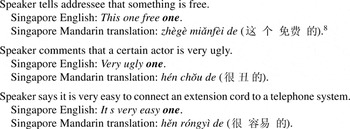
To represent Chinese text in Mandarin, I use both the

representation as well as simplified Chinese characters. To represent Chinese text in Hokkien and in Cantonese, I use only simplified Chinese characters.
In many instances, the Singapore English sentences seem to be literal translations from Singapore Mandarin or another Chinese language, almost word for word, and this is why some of these sentences may sound odd to an Anglo English speaker:
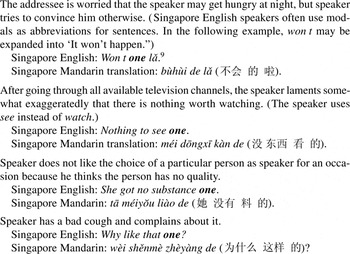
Of course, we will not always find one-to-one, direct translation, because speakers sometimes use English expressions that have no precise semantic matches in a Chinese language, or vice versa. Nevertheless, the meaning of one still matches that of Mandarin

:
He is quite hopeless with kids one.
I have the urge to read [the Bible] everyday one.
This kind of thing no need to seek clearance one.
This book no bar-code one.
His walk [i.e. gait] is like that one one. (Speaker mimics referent's way of walking.)
A person went back to a place which he was assaulted and robbed to take pictures of the place in an attempt to get over the incident. Speaker asks rhetorically why this person acts in such a manner. (The expression

, said in Hokkien here, means, very roughly, ‘pathetic’.)
Why so

one?

All these examples suggest that although one embodies a meaning that has come from the Chinese languages, it has become a very important word in everyday Singapore English. In fact, I would even go so far as to say that, culturally, one is no less significant in Singapore English than its counterparts are in the locally spoken Chinese languages.
Homonymy
In any discussion of the Singapore English particle one, it is important to recognize that the word has at least two homonyms. However, not all writers make this distinction. For example, Gupta says that the word one is a nominalizer which sometimes functions as a particle:
[One] is principally a nominalizer. It is sometimes used pragmatically in [Singapore colloquial English] as an assertive particle with a similar sense to la. The nominalizer particle is of particular interest in terms of the contact relationship between Chinese and English which has resulted in [Singapore colloquial English]. (1992b:36; cf. 1992a:332, 1994:80)
Even if Gupta is correct in positing a nominalizer one, I would argue that this one is semantically distinct from the particle one; a nominalizer “marks as a nominal a word or phrase which does not have a noun or pronoun as its head” (Gupta 1992a:329), while a particle carries illocutionary meaning and reflects the speaker's “attitude” toward something (Wierzbicka 2003a:341; cf. Gupta 1994:79; Wee 1998:191; J. Wong 2004a:784). Clearly, it makes more intuitive sense to treat the nominalizer one and the particle one as homonyms. In what follows, I will provide an overview of various senses of one on the basis of syntactic differences and say how the particle one may be distinguished from the rest.
Pronoun one
The Singapore English pronoun one, as the name implies, has a noun as its antecedent. In other words, it substitutes for a noun, as the following examples illustrate:
John one is at Union level 1. (‘The one organized by John is at Union level 1.’)
I want nice nice one. (J. Wong 2004b:345)
Buy the packet type. Don't buy the box box one. (Gupta 1992a:335)
Is it enclosed or not, the outside one [i.e. the outdoor part of the flat]?
The noun that the pronoun one represents in each of these examples can often be made explicit:
John's function is at Union level 1.
I want nice nice soap box.
Buy the packet type. Don't buy the box box type.
Is it enclosed or not, the outside part.
It seems relatively easy to identify the pronoun one; because it substitutes for a noun, it is usually preceded by a kind of nominal modifier, which could be an adjective, a determiner, or even a reduplicated nominal modifier (cf. J. Wong 2004b). In fact, the use of the Singapore English pronoun one is much like its use in Anglo English.
Nominalizer one
There is a one which is associated with a clause that functions as a noun phrase (NP). The following sentences exemplify such clauses, marked in bold:
She buy one [i.e. the one she bought] got more features than yours. (Alsagoff & Ho 1998:135)
I choose one [i.e. the one I choose] is nicer. (P. Wong 1994:9)
I lost one [i.e. the one I lost] is a Walkman. (P. Wong 1994:12)
Don't worry. I'll take I can eat one [i.e. the food I can eat]. (P. Wong 1994:12)
The word one in such examples behaves like a nominalizer because of its apparent link to an unexpressed head noun in the NP. Syntactically, it occurs at the final, direct-object position of a clause that acts as an NP. Because of this, it is also not difficult to identify the nominalizer one.
Although I have tried to show that there exist a pronoun one and a nominalizer one which are associated with different syntactic frames, they have something in common: They both occur at the NP-final position in an NP whose head is not made overt. Because of this similarity, I will refer to them collectively as the nominal one, as suggested by Cynthia Allen (p.c., 2004). What I want to emphasize is that the nominal one is semantically distinct from the particle one in two ways. First, instances of nominal one are phrasal components and do not always occupy sentence-final position. Second, nominal one has important grammatical roles to play: If the word is omitted from the phrase, the sentence either becomes ungrammatical or takes on a different meaning. The following examples, in which [empty ] represents the absence or omission of pronoun or nominalizer one, illustrate this point:
*Don't buy the box box [empty ].
*Don't worry, I'll take I can eat [empty ].
In sum, we can often distinguish the nominal one from the particle one because the former has grammatical roles to play; if it is omitted, the sentence would become ungrammatical.
Particle one
The particle one, on the other hand, follows a declarative sentence, either in sentence-final position or, frequently, followed by another particle or a tag:
You have to be very careful one. Otherwise, you will lose one.
A: Did Adam enjoy himself?
B: Yeah, he did.
A: Definitely one.
Speaker says that cleaning his flat is a terrible job:
It's so terrible one.
Speaker tells addressee that getting a dental crown is not a painful process:
There is no pain one.

Although particle one is an indispensable pragmatic tool, it does not seem to have much of a grammatical role to play; the grammaticality of the declarative sentence it is associated with will not be affected by its absence. In the following otherwise authentic examples, particle one has been omitted, as represented by [empty ], but the resulting sentences remain acceptable:

It therefore seems fairly easy to identify the particle one: it occurs at the end of the sentence, unless it is followed by another particle or a tag, and can be omitted without resulting in ungrammaticality.
Although in most examples it is fairly easy to tell the particle one from the nominal one, there are ambiguous cases, especially when the word follows one of the demonstratives this and that in sentence-final position. Without the context, a sentence like I don't like this one is ambiguous. The word one could be pronoun preceded by the demonstrative this: I don't like this one (but I like that one). It could also be interpreted as a particle positioned at the end of a sentence: I don't like this (kind of thing) one. The deletion test does not seem to work for such an example; even if we were to delete the pronoun one from the NP this one, the demonstrative this can itself stand as a pronoun. Because such structures are potentially ambiguous, I will avoid using them as examples in this study.
More ambiguity concerning one
In addition to the nominal one and the particle one, there seem to be another one associated with what Alsagoff & Ho (1998:131) would interpret as a relative clause. Following are examples of this so-called relative pronoun one, with the relative clause in bold:
The man, sell ice kachang [a kind of dessert] one, gone home already. (Alsagoff & Ho 1998:131)
That boy pinch my mother one is very naughty. (129)
The man who do camera one not yet come. (128)
When you see the church got stained glass one, you turn right. (128)
That man wear red shirt one Keng's cousin from Ipoh. (128)
The cake John always buy one very nice. (128)
I prefer the pen can put refill one. (128)
Commenting on one in such a structure, Alsagoff & Ho write: “one may be said to function as a relative pronoun because it is essential in linking the attributive clause to the head” (1998:131). However, it is not clear to me that we are looking at the same thing in all these clauses. A clause in that position could be any of the following:
- a restrictive relative clause;
- an NP in apposition with the preceding noun phrase, which means they both “have the same reference and grammatical role in the sentence” (Crystal 1992:24);
- a nonrestrictive, appositive relative clause, which serves as a kind of “parenthetical comment” or “afterthought” (Radford 1988:481), in which case one is the particle;
- a parenthetical remark in the form of a sentence, in which case one is the particle.
Working out the identity of each of the clauses in the above examples is beyond the scope of this study. Therefore, I will also avoid such examples.
The purpose of this section is to show that Singapore English one is homonymous. The particle one, the object of this study, has at least one homonym – a nominal. Although in many examples it is fairly easy to tell them apart, ambiguous cases do exist. For my purposes, I will look only at examples in which one clearly occurs in sentence-final position or followed only by a tag or another particle, and I will avoid ambiguous cases.
THE MEANING OF PARTICLE ONE
Although particle one occurs at very high frequency in everyday, informal speech, some writers, taking a syntactic perspective, may say that its use is “not obligatory” (cf. Pakir 1992b:144). However, while it may be true that the sentence can stand on its own without one, its frequency of occurrence suggests that it has an important pragmatic role to play in speech. In this sense, one cannot say that its use is not obligatory; it is obligatory to the extent that it allows the speaker to express a pragmatic or “interactional” (cf. Wierzbicka 2003a:5) meaning that cannot be concisely communicated otherwise. Given that one is an important pragmatic tool for interactional purposes in Singapore English, one would expect its meaning to reflect certain norms of speaking or even thinking prevalent in Singapore culture. In this section, the pragmatic meaning of particle one will be described with the further objective of discovering these norms.
Let us begin by looking at a few examples:
Speaker is annoyed that things on his office table often go missing:
Things always disappear here one.
Speaker comments on a fashionably dressed old man in a train, saying that he looks like someone who would have a lot of lovers when he was young:
Last time [he] sure a lot of lover one.
A asks B to go to a karaoke function but B does not want to go because he does not know many people there:
A: Go to karaoke lor.
B: All the people I don't know one.
Speaker is annoyed that the bus he wants to take is long in arriving:
The bus so slow one.
Speaker tells addressee that he only watches British sitcoms:
I don't watch any other sitcom one.
The first thing that one may notice is that these sentences are all propositions; in each of these examples, the speaker is commenting about something (e.g. people, things, incidents). Indeed, my examples suggest that the particle one is prototypically associated with a declarative. It does not collocate with an imperative or an interjection:
*Go there now one.
*See me tomorrow one.
*Please don't do that one.
*Damn it one!
*Shit one!
Because the particle is prototypically used with a declarative, one could hypothesize that its meaning has to do with what the speaker thinks about something. As such, the particle one would embody a semantic component akin to ‘I'm thinking about something now’. The component begins with ‘I think’ because it seems that the particle one has to do with what the speaker thinks about something. The prime ‘something’ in the component refers to the subject or topic at hand, which could be a person, a thing, or something situational. This subject or topic is, in many cases, unspecified because it is knowledge common to both speaker and addressee. In other words, the topic can be “exophoric” (à la Halliday 1985:290) – something that is not made explicit, or is contextual. At the same time, the word ‘something’ is also anaphoric in that it refers to the part of the sentence before the particle. This anaphoric reference makes one a particle rather than an interjection.
I hasten to add here that even though I have formulated the component with ‘I think’, which might be taken to mean that a statement made with particle one refers to an opinion, the use of one does not always make any claim about whether the proposition is opinion or factual knowledge. In some examples, like the ones following, the proposition appears to be a matter of opinion or speculation, which is compatible with the proposed component:
Speaker comments on a local dish prepared by a certain food provider:
Very nice one.
Speaker thinks that Australian undergraduates can be very wild:
They very wild one, right?
Speaker tells addressee from his personal experience that once a person starts reading the Bible, it is difficult for this person to stop:
Once you go on [reading the Bible], you cannot stop one.
Speaker says that there is no point leaving money in a savings account in Singapore during an economic crisis because the interest rate may eventually be reduced to zero:
You put the money there [in savings account] is useless one.
However, in other examples, the proposition appears to be something that the speaker knows or considers factual knowledge:
Speaker A tells speaker B, a foreigner, that a certain cup of coffee has milk in it:
A: This one got milk one.
(Addressee asks in reply, What is milk one?)
Speaker is convinced that many people will be late for an opera performance:
Sure got a lot of people late one.
Speaker, referring to a car park, says that one cannot park for free, even after office hours:
No free [parking] one, you know. After midnight have to put [parking coupons] one, you know.
These examples show that no overt distinction seems to be made between opinion and factual knowledge. In either case, particle one can be used to make the proposition sound like a strong statement, as if the speaker is very confident about the validity of what he or she says, as the following examples further demonstrate:
Addressee has just said that the pea shoots he is eating are chewy. Speaker replies:
Chewy things got a lot of fiber one.
Speaker thinks that it is easy to cut up a chicken:
The cutting very easy one, you know.
Speaker thinks that life in Canberra is boring and there is nothing one can do about it:
Like that means like that one.
Addressee is trying to see if there is someone lurking among some tall grasses. Speaker, without so much as a glance in that direction, says:
Nobody one

.
In fact, it is observed that speakers often exude absolute confidence even when saying things that seem mundane, trivial, or inconsequential:
Receptionist says that a certain dentist does not come in on Thursdays:
Thursday he always not in one.
Speaker says that since a friend of his and her husband have chronic rashes, their child will also get it because of genetic transmission:
All the children will have one.
Speaker thinks that once Australian teenagers start drinking, they will not be able to stop:
They don't know when to stop one.
Speaker tells addressee that he usually selects the washing machine's gentle cycle for his clothes:
I always use gentle cycle one.
Speaker comments on her sister's generally small appetite:
She all along like this one.
In view of this, it is perhaps not surprising that particle one is collocative with words that designate definitiveness (my emphasis):
Speaker is confident that a third person will telephone him later in the evening.
He'll call back tonight. Sure call back one

.
“Oh, you broke the glass. You're going to be in trouble.” The boy stuck out his tongue. “My Mummy sure to scold you one.” (Tan 2002:262)
Speaker is sure that a certain Chinese tradition practiced in Singapore did not originate from the Teochew culture:
Definitely not Teochew one.
Speaker says that he will definitely get a parking ticket (roughly speaking, the Malay word kena functions like a verb which means ‘get something bad’.)
Definitely kena one.
Speaker is confident that a third person will telephone the addressee the next day:
She'll definitely call you tomorrow one.
It is also not surprising that particle one can be used with advice; the speaker can use one in telling the addressee what to do or what is good or bad for him or her in a definitive manner. In other words, the speaker can use one to influence the addressee's thinking, as the following examples illustrate (emphasis added):
Speaker tells addressee that it is important to keep track of his bank's interest rates.
A: How much interest rate do you get?
B: I never check.
A: Must check one.
Speaker stresses the importance of backing up one's work on the computer:
You must always have a back-up copy one.
Addressee takes one Mylanta tablet each time he suffers from gastric problem. Speaker asks him to take liquid Mylanta instead of tablets:
You must take the liquid one. One tablet where got enough?
Speaker warns addressee against taking antibiotics for minor ailments:
Antibiotics cannot simply take one, you know.
Speaker advises addressee to settle down with a permanent job rather than working on a short-term basis and moving around the world:
Cannot always go on like this one, you know.
Speaker tells addressee not to reprimand children during the Chinese New Year season:
Chinese New Year cannot scold children one. (Tan 2002:262)
The overt expression of certainty is also reflected in questions. When the Singapore English speaker asks a question, he or she often asks for a definitive answer. The examples below show how a speaker may use particle one to ask about the definitiveness of a proposition:
Speaker thinks that there is no time limit for each turn in a game of Scrabble:
The real game no time one, right?
Speaker remembers a mad person hanging around a place previously:
Last time here got one mad woman one, right?
Speaker B thinks speaker A is pretending to be afraid.
A: I am scared.
B: You pretend one, right?
Speaker has just learned that kangkong, a kind of vegetable commonly eaten in Singapore, is in fact a weed in nature:
Like that one

?
Speaker has just been informed that the addressee is in charge of something:
You in charge one

?
Speaker is surprised that the addressee hugs a bolster to sleep:
You use bolster one meh? (J. Wong 2000:15)
Speaker B is surprised that photography is a tertiary discipline in some universities:
Speaker A: He has a degree in photography.
Speaker B: Photography got degree one meh? (J. Wong 2000:15)
A speaker may also use one in other question forms, including rhetorical questions, to ask for a definitive answer:
B pressed a wrong key on a computer keyboard and the computer restarts. A asks B which key he had meant to press:
A: What happened?
B: I accidentally press ‘restart’.
A: You want to press what one? (Roughly, ‘What/which button did you want to press?’)
Speaker is upset because of his cough:
I'm so upset. Why like that one, you know.
Speaker has an upset stomach:
Stomach why like that one?
Speaker remarks that the addressee's car is very clean:
How come so clean one, your car? (i.e. ‘How come your car is so clean one?’)
Speaker B is surprised that a college sometimes supplies alcohol to its residents:
A: Sometimes they supply booze.
B: So good one

?
Speaker wonders why there are so many ants at one place:
How come so many ants one á?
Besides sounding definitive, particle one also sounds emphatic. Sentences with it tend to sound exaggerated. In fact, particle one is highly collocative with overstatements and frequently co-occurs in sentences with so-called intensifiers (cf. Hübler 1983:68) or words that can be used for hyperbolic purposes, like very, so, always, every day, never. The following examples illustrate this:
Speaker tells addressee that he has been reading the Bible fervently lately and jokes that he is hence very holy:
Nowadays I very holy one.
Speaker, a freelance music teacher, tells addressee that the principal of one of the schools he teaches in has been very good to him:
The principal is very very nice one, you know.
Speaker comments on his high mobile phone bill:
Handphone is so expensive one, you know.
Speaker comments on the hot weather in Singapore:
Very bad one one, you know. The weather is so bad one, you know.
Speaker tells addressee that he lost $40 the night before playing mahjong, and that he lost that amount the last one or two times:
Last night I lost $40. Always $40 one, you know.
Speaker says that a particular person frequently wins in mahjong:
She so lucky one. She always the sole winner one.
Speaker emphasizes the fact that he has been having chicken for dinner over the last few days:
I eat chicken everyday one, you know.
Speaker comments on the low number of patrons in a hotel café due to the existing SARS epidemic:
Horrible one. Nobody there one, you know.
Speaker tells addressee that the packet of peanuts he bought recently contains so many that he has difficulty finishing them:
Cannot finish one, you know.
Speaker comments on the punctuality of one of his students:
Never never early one, you know.
In sum, the speaker uses particle one when he wants to encourage the addressee to accept the proposition by presenting it as one that is definitive, absolute, and perhaps even final – all other ways of thinking seem to be precluded. Whether the proposition is something that the speaker thinks or knows, it is presented with a high level of confidence, and the addressee seems to be expected to accept the proposition without question.
In this respect, particle one is functionally similar to some other Singapore English particles, such as the “impositional” particle

(see J. Wong 2004a:764), which can also be used to influence the addressee's way of thinking. Obviously, while it may be said that one can function like

, it is not the case that their meanings are identical. The fact that one and

can co-occur in the same sentence indicates that they are not truly synonymous, as the following examples show:
Speaker comments on the rain:
Still raining, is it? Won't stop one

.
Speaker says that going somewhere by train is not much faster than going by bus:
Train not much faster one

.
Speaker says that addressee is unfamiliar with a topic but pretends to be knowledgeable:
Actually you don't know one

. (Roughly, ‘Actually, you don't know this.’)
The main difference between particle one and particle

seems to be that while one may sound imposing from an Anglo perspective, it is not as forceful as

, which embodies the component ‘I want you to think like this’ (J. Wong 2004a:766). This is evidenced in the fact that a sentence ending in particle one can be further “reinforced” by particle

, but not the other way round:
He doesn't socialize with other people one

.
*He doesn't socialize with other people

one.
A: They've got pandan leaves there, right?
B: Don't know.
A: Must have one

. (*Must have

one.)
This means that when positing semantic components for particle one, we would need something less forceful than ‘I want you to think like this.’
On the basis of our discussion so far, I propose the following components as the second part of the meaning of particle one:
‘I can't not think about it like this.’
‘You can't not want to think about it in the same way.’
Now that we have considered the various aspects of the meaning of one, we are perhaps ready to describe its meaning fully. I propose the following paraphrase couched in NSM to describe the invariant meaning of the Singapore English particle one, using the example Psalms very boring one:

In this example, the addressee tells the speaker that he has just finished reading the book of Psalms. In response, the speaker comments that the book is boring. The first component is anaphoric in that it refers to the proposition that the book of Psalms is a boring read. The next component expresses the definitiveness and absoluteness of the proposition, and indicates that the speaker considers it as the one-and-only way of conceiving something, precluding all other ways of thinking. The speaker thus reveals his firm stand that Psalms is boring. The last component – in which ‘can't not want to’ is more idiomatically rephrased as ‘have to’ – indicates the speaker's attempt to influence the addressee to think likewise.
CULTURAL VALUES IN THE USE OF PARTICLE ONE
From a grammatical perspective, the use of particle one is not mandatory; however, this particle is very often used in everyday, informal speech exchanges, and if it were omitted, the exchange could sound exceedingly odd. In what follows, I will discuss the use of one and why it is an indispensable conversational tool in Singapore English speech. I will try to show that it is associated with ways of thinking that may be contrasted with those characteristic of Anglo English speech communities.
Particle one and the value of personal autonomy
As discussed, particle one is functionally similar to some other particles of Chinese origin, such as

. Singapore English speakers use these particles routinely in everyday speech to tell the addressee directly or indirectly what or what not to think, say, or do (J. Wong 2004a), without making any overt acknowledgment of the possibility of alternative points of view. From an Anglo perspective, the use of such particles could be seen as forceful. In one of her studies on Singapore English particles, Gupta writes: “Some of the assertive particles are used primarily to mark directives” (1992b:37). In another study, she notes: “The use of particles enables [Singapore colloquial English] speaking children to participate forcefully and successfully in argument from the earliest age” (1994: 82).
The norms of interaction reflected by these Singapore English particles are obviously atypical of Anglo culture, where people are careful not to attempt overtly to tell others what to think or do. As Wierzbicka has noted, “in [Anglo] English, the role of particles is unusually limited” (1986:519; cf. Platt 1987). The question now arises: Why are there so many such interactive particles in Singapore English but virtually none in any variety of Anglo English?
In the Singapore English speech community, the use of one and some other particles in everyday, informal situations suggests that personal autonomy is not a cultural priority. It suggests that Singapore English speakers tend not to view other people as autonomous individuals who can exercise independent thinking. Commenting on the apparent lack of emphasis on personal autonomy and related values in Singapore culture, Wierzbicka writes:
When one watches, for example, the interaction of Singaporeans in the squeeze and the bustle of a hawker centre (with people's elbows touching, and loud conversations criss-crossing the dense network of tables and food stalls), one can well imagine the functionality of interactive Singaporean particles (as well as expressive interjections); and the contemporary Anglo notions of ‘privacy’, ‘personal space’, ‘autonomy’, and ‘non-imposing on other people’ seem scarcely germane. (2003b:346)
Anglo culture on the whole places “special emphasis on the rights and on the autonomy of every individual” (Wierzbicka 2003a:30; cf. 1996b, forthcoming) and uses a host of linguistic devices which reflect respect for the addressee's personal autonomy. Anglo English speakers generally do not make any overt attempt to influence another person's way of thinking, nor do they like to tell others what to do (J. Wong 2004c). They embrace diversity in points of view and value independent thinking. Examples of devices that reflect respect for personal autonomy in Anglo English include the use of interrogative-directives instead of imperatives, epistemic expressions (see the next section), question tags (Wierzbicka 2003a, forthcoming) and the word well, which is used to signal that “each speaker purports to have taken good account of what the other has said, but still see the need to say what she [i.e. the speaker] has to say” (Goddard 1998:177) and allows speakers “to express their own views without overtly attempting to influence the thoughts of others” (Wierzbicka 2003b:346). Thus, from an Anglo perspective, the use of particle one to influence a person's way of thinking about something violates the cultural rule of acknowledging an individual's point of view, and could therefore be interpreted as excessively intrusive, not unlike a speaker's hectoring the addressee. As such, devices like the Singapore English particle one are not found in Anglo English.
On the other hand, from a Singaporean perspective, particle one is crucial in everyday speech because it connects fellow interlocutors by way of influencing each other's thoughts, and it is essential for the cohesion of any informal speech exchange. While Anglo English speakers would find such a speech norm imposing, Singapore English speakers do not normally see it like this. In fact, without the use of such a particle to engage the addressee, the interaction could appear somewhat disjointed, and the exchange would appear “over-formal” (Platt et al. 1984:143), “monological,” “impersonal” (Wierzbicka, 2003b:346), or simply odd. Singapore English speakers who refrain from using such a particle in informal situations could also be interpreted as being uncommitted to the exchange, distant, or even pretentious (J. Wong 2004a). Therefore, one could say that the use of particles like one to influence another's way of thinking is a speech norm and a way of connecting with one another in Singapore culture.
Particle one vs. epistemic words
As discussed previously, it is noticeable that, in using particle one, no apparent distinction is made between what the speaker thinks and what he or she knows, so that an opinion can be presented with the same high level of confidence as a factual statement. Because one is associated with this way of speaking, it is perhaps not surprising that the word is not normally collocative with words that designate uncertainty:
*Maybe he'll call back one.
*Probably not Teochew one.
*Perhaps it is good to have a back-up one.
*It might be good to check the interest rate one.
Anglo English speakers seem far less inclined to speak in a definitive manner. Speakers of Anglo English use a lot of “epistemic qualifiers” (Caton 1966:38), “parentheticals” (Thompson & Mulac 1991:313), and similar expressions – e.g., I think, I assume, I expect, I gather, I guess, I presume, I'm inclined to think, adjectives like arguable, possible, probable, and adverbs like apparently, conceivably, arguably, possibly, presumably (cf. Goddard 2003, Wierzbicka forthcoming) – to express “reliability of knowledge” or varying degrees of “commitment to the truth of the proposition” (Aijmer 1997:18). In other words, they allow the speaker to “qualify saying something so as to indicate something about one's state of knowledge or belief when answering the question whether the thing is so or whether one thinks it is so” (Caton 1966:38) and thus make an overt distinction between knowledge (what one knows) and opinion (what one thinks). Despite their obvious differences in meaning, all epistemic expressions seem to have one thing in common: By using such words, the speaker is expressing the lack of complete certainty or, in Goddard's (2003:132) words, “disclaiming knowledge.” This semantic commonality may be expressed from the insider's perspective in NSM as such (cf. Goddard 2003:132; Wierzbicka forthcoming): ‘I don't say: I know this.’
To show the Anglo English speaker's tendency to explicitly express his or her lack of complete certainty about something, I provide some examples from informal e-mails in Australian English and British English collected in 2002 and 2003 (emphasis added):
Speaker, a mathematician, in jest, says he thinks that the addressee, a non-mathematician, might have solved a longstanding mathematical puzzle:
I expect by now you have solved the mystery of the twin primes and submitted your work.
Speaker was asked if he visited Phillip Island during his holiday in Melbourne. He replies:
Unfortunately didn't make it out to Phillip Island to see the penguins. Can't do everything I guess.
Speaker, in jest, asks her friend, who is pursuing a Ph.D. program in Australia:
So how are your studies in Australia? You will be Dr Jock soon I take it.
Speaker has been asked about the difference in meaning between ‘true’ and ‘real’:
As far as I can tell, all reality is true, but not all truth is real.
Addressee thinks that some photographs turned out well because of the speaker's camera, but speaker thinks the credit has to go to the addressee, who took the pictures:
The actor photo turned out very well. I do not think that the credit lies with my camera, because the photos I took are, on the whole, not as good as yours.
Speaker, who is based in a city in India, thinks that addressee would not like the place:
It's probably not your kind of place – it's too chaotic and dirty and disease ridden to appeal to you.
The fact is that the Anglo speaker would express uncertainty even about something that he or she knows. Here is an anecdotal example. I was once walking along a road with a British friend in descending order of door numbers; the address we were looking for was 7-9. As the numbers got smaller and smaller, the friend pointed ahead and said It all starts there, I presume. From my point of view, there was no doubt that we were heading in the right direction, but when the British speaker said it, he overtly expressed a lack of complete certainty by saying it was something he presumed. Such a speech norm might sometimes confuse a cultural outsider because the discrepancy between the tentativeness expressed in speech and the certainty experienced in reality can appear quite jarring.
Below are more examples taken from e-mails and everyday casual exchanges (2003, emphasis added), to illustrate the Anglo English speaker's display of a lack of complete certainty even about things which the speaker seems to be sure of:
Addressee thinks that the cartoon ‘Simpsons’ will not be telecast at the regular time. Speaker turns on the television and finds that ‘Simpsons’ is being telecast. He says:
There is, it seems.
A: Where are you going?
B: Lunch, probably.
(After replying to A's question, B heads straight for the dining hall.)
Tutor to class, just before starting the class after making allowance for latecomers:
Well, we might start now.
Speaker says to other people during dinner before he walks to the toaster:
I might have some toast.
Speaker says to a friend just before he steps into the bathtub in the bathroom:
I might have a quick bath.
These examples suggest that the Anglo English speaker prefers not to sound too definite when stating a proposition. He or she tends to qualify it in some way to make it sound less certain, less definitive, more tentative. Commenting on I think, Aijmer (1997:21) says that it “softens an assertion which may be too blunt,” which suggests that definiteness can sometimes be interpreted as bluntness in Anglo English. This preference not to sound too definite is also reflected in questions. When asking questions, the tendency is for the Anglo English speaker to appeal more to what the addressee thinks rather than what is definite, and therefore the questions often include question tags such as Do you think?, What do you think?:
Speaker wants to know how far it is from a certain date:
When's 20th March? That's next week, isn't it?
Speaker A and speaker B are talking about a couple who are out on a walk with them. B says that “love blossoms” for the couple. A, who fancies B, asks:
Does love blossom for us, do you think?
Speaker comments on his dirty sink:
I should clean this up, shouldn't I?
Speaker, upon entering a friend's new flat, exclaims:
A bit exciting, isn't it?
Because Singapore English speakers are inclined to speak definitively, epistemic expressions are not a key feature of Singapore English. In fact, many of them, like I gather, I presume, I'm inclined to think or conceivably, evidently, seemingly are either not used in or are atypical of Singapore English speech. Of course, I am not claiming that epistemic expressions are not used in Singapore English at all. In my entire corpus of instances of particle one, numbering over 100, there is in fact one – and only one – example:
Speaker tells addressee that he thinks a certain third person is gay (or on in Singapore gay lingo):
I think he on one.
The fact is that Singapore English speakers use a smaller set of epistemic formulae and at a lower frequency. An electronic search on Hwee Hwee Tan's (2002) novel Mammon Inc. shows that expressions like I think, I gather, I expect, I presume, I suppose, apparently, obviously, presumably are not routinely used in Singapore English speech. When such expressions do occur in speech, they are more often than not used by the fictional speakers who have access to more Anglo or Standard varieties of English, such as the protagonist Chiah Deng, who studied English literature at Oxford University. Following are examples of epistemic qualifiers used by the fictional character Chiah Deng when she is talking to other Anglo or Standard English speakers (my emphasis):
‘I think I'll go for a walk,’ I said, ‘to sort out my head.’ (Addressee: Steve, an Englishman; p. 7)
I shook my head. ‘No, I think there's a way out of the Dark Side. And I think Professor Ad-oy can show it to me.’ (Addressee: Steve, an Englishman; p.14)
‘I guess I believe in Asian demons, but it's more difficult to believe in the Western Devil…’ (Addressee: Professor Ad-oy, from Oxford University; p. 30)
That guy was obviously an insensitive moron. Most people say stupid things when they're trying to sell you something. It's nothing personal. Don't let it get to you. (Addressee: Ethan Edwards, a European by ethnicity; p. 49)
In addition to evidence from Singapore English speech, Brown's (1999) Singapore English in a nutshell and the tongue-in-cheek Coxford Singlish Dictionary (2002) also do not list any epistemic qualifiers. Therefore, it seems reasonable to conclude that such words cannot be considered a distinct feature of Singapore English.
Particle one vs. understatement
As discussed previously, particle one collocates with overstatement, or words that can be used as hyperbolic qualifiers, such as very, always, every day, never. Therefore, it is not unexpected that particle one does not seem to collocate well with understatements:
?The book a bit boring one.
?Nowadays, I rather holy one.
?The principal is a bit/kind of/sort of/rather nice one.
In fact, in some examples involving particle one, such as the following, the sentence would sound odd if it were not overstated:
?The book boring one.
?Nowadays I holy one.
?The principal is nice one.
?He's sometimes in school one.
I approached a few native speakers and asked them to decide on the acceptability of such sentences. While some of them remained unsure whether some of these sentences sounded acceptable even after some deliberation, none of them could provide authentic examples of such expressions that they had come across. The consensus, however, is that such sentences, even if acceptable, would be uncommonly attested. This idea is also supported by my set of data on particle one; in the 100+ examples, not a single understatement can be found. On the other hand, all my informants were prompt to recognize the collocation between one and overstated expressions; they unanimously agree that the sentence The book very boring one is more acceptable and/or far more frequently attested than either The book boring one or The book a bit boring one.
Arguably, the oddity in some of the above examples might have stemmed from the strong collocation between the Singapore English syntactic frame ‘noun phrase (NP) + [empty ] copula + adjectival phrase (AP)’ and overstated expressions, as demonstrated by the following examples (my emphasis):
This coffee house very cheap. (Platt & Weber 1980:63)
Kelantan kain [cloth] sarong very famous. (Platt & Weber 1980:174)
All of them very young but one boy is secondary. (Platt et al. 1983:23)
Sago Lane [name of a street] very good. (Platt et al. 1983:29)
But you so big, you know. (Humphreys 2001:104)
This thing so easy to do, sure can one. (Coxford Singlish Dictionary 2002:104)
Many of these copula-less Singapore English sentences would sound odd or are rarely attested if not overstated:
?This coffee house cheap.
?Kelantan kain sarong famous.
?All of them young but…
?But you big, you know.
*He boring.
The collocation between the syntactic frame ‘NP + [empty ] copula + AP’ and an overstatement is surely worthy of further study, although it is beyond the scope of this article. It suffices to say for the present purposes that this apparent collocation reflects Singapore English's tendency to overstate rather than understate.10
This collocation seems to originate in the Chinese languages, which do not normally allow the syntactic combination NP + AP without the adverb ‘very’ or something similar. (Unlike English, Chinese does not need a copula for such a construction.) For example, in Mandarin, one would not normally say something like ‘she beautiful’

but rather, ‘she really/very beautiful’

. It would appear that this particular Chinese syntactic frame, which seems to predispose the speaker to overstate, has been adopted by Singapore English. Therefore, if the Singapore English speaker uses the copula-less Chinese syntactic frame, he/she would not normally be able to say something like ‘she beautiful’. If the Singapore English speaker does not want to use the word very, he/she will have to use the corresponding Standard English construction instead (i.e. with the copula), in which case he/she would be able to say something like she is beautiful without the need to overstate. In sum she is very beautiful, she is beautiful (both Standard English syntactic frames), and she very beautiful (Chinese syntactic frame) are acceptable in Singapore English, but not so much she beautiful (Chinese syntactic frame).
By comparison, Anglo English speakers are very careful not to exaggerate matters, and very frequently qualify what is being said by toning it down in one way or another by using words that may be referred to as “hedges” (Hübler 1983; Wierzbicka 2003a:44), “downtoners” (Hübler 1983:68), or “deintensifiers” (Lakoff 1973:47111
For the purposes of this study, the word “hedges” is used to refer to expressions that allow the speaker to understate something. Lakoff (1973:471) also uses “hedges” to refer to expressions like sort of, kind of, etc. However, he also includes words like very and often (1973:472), which this study excludes. This is because Lakoff has a different definition in mind; for him, “hedges” refer to “words whose meaning implicitly involves fuzziness – words whose job is to make things fuzzier or less fuzzy” (1973:471).
Perhaps, at this point, it should be mentioned that Anglo English speakers understate selectively. According to Wierzbicka, “The English understatement applies to spontaneous opinions and feelings, not to opinions or feelings which are presumed to be shared” (2003a:45). This idea is supported by the following examples (emphasis added):
Speaker was asked to answer two questions. She wrote in her e-mail reply:
The first [question] was kind of easy.
Speaker, a retiree, tells addressee in an e-mail that she does not want to work full time:
I don't really want to go back to work full-time.
Speaker declines an invitation to an outing in an e-mail:
Unfortunately I am afraid that work is going to prevent me from being able to come along [to an outing] – I have a bit of a deadline to meet at the moment.
Speaker, who is based in India, tells addressee in an e-mail that her parents would visit the following month:
My parents arrive next month. I'll take them sightseeing around India a bit – to see the Taj Mahal and Varanassi, the Ganges, and Jaipur, the Pink City.
Speaker thinks there might be time for a drink before the movie starts:
There might be time for a little drinkie first.
Speaker fumbles for his pocket watch to see what time it is:
The problem with this is – it takes a rather long time to look at the time.
From an outsider's perspective, the Anglo English speaker's tendency to understate can appear to obscure the message. To a cultural outsider who is not familiar with such a speech norm, the proposition that has been toned down can appear somewhat vague or indeterminate, as these examples show:
A asks B, a biologist, if his experiment has yielded any result. B says it has not, but adds that another experiment has yielded something:
I have another result that is semi-important.
Speaker tells others that she spent a lot of money at a certain shop and, in jest, discourages others from going there:
I spent a fair bit of money at the fudge shop.
A: How is John [one of B's colleagues]?
B: He's all right. He's sort of in the office.
A: Did you get any results [in the laboratory] this morning?
B: Sort of.
A: Is this [Good Friday] a holiday for you?
B: Sort of.
C: What do you mean?
B: ‘Yes’ because it's a day off, ‘no’ because I've got lots of work.
In fact, cultural outsiders might even be led to think that Anglo English speakers tone down a proposition for no apparent reason. In the following examples, to a Singapore English speaker there does not seem to be any semantic need for the understatements to be formulated as such:
B slipped and almost fell while walking on a wet road:
A: What happened?
B: Slipped a bit. It's a bit slippery.
Speaker tells her superior and colleagues in a meeting that her floor has problems with mice:
We got a bit of a mouse problem.
Speaker agrees to take a look at an exhibition in an art gallery:
Let's have a little look.
Englishman Humphreys (2001:62–63) writes about his life in Singapore:
I am also a bit of an expert on the old chicken rice curry, seeing as I eat it at least five times a week (I am not kidding), especially the Chinese version with its hot reddish curry and fat potatoes.
Such examples can only suggest to Singapore English speakers that understatements in Anglo English are not totally semantically motivated. They have more to do with expressing a culturally Anglo way of thinking rather than with propositional meaning. They express a cultural value and fulfil a cultural, rather than strictly semantic, need.
The best way to contrast Singapore English overstatement and the Anglo English understatement, I think, is to look at an example in which the both speakers make reference to the same thing. In the following example, British English speaker A and Singapore English speaker B have just used a public lavatory (emphasis added):
A: A bit dirty.
B, in unison: Yeah, very dirty.
A: A trifle dirty.
Although the two speakers are referring to the same toilet booth, one thinks that it is a bit or a trifle dirty while the other thinks that it is very dirty. The two cultural ways of looking at the same thing here seem fairly obvious.
Before I conclude this section, I would like to add that I do not claim that Singapore English speakers do not use words like sort of, a bit, kind of, and so on. They do. However, it remains that these words are not as frequently used in Singapore culture as in Anglo culture. Further, when Singapore English speakers use such words, there is also no evidence to suggest that they use them for the purpose of understating. Given Singapore English speakers' tendency to overstate rather than understate, it seems reasonable to speculate that when these speakers use such words, the words are usually meant to be interpreted literally.
Pervasiveness of particle one
From an Anglo perspective, it could seem that particle one is often used in situations that do not warrant definiteness. Indeed, it is not difficult to find examples of one that do not seem consistent with the explication. Examples include the following:
Speaker, a music teacher, tells addressee that he sees a particular private student every Monday:
I normally see her on Monday one.
Speaker has recently experienced a nasty asthma attack and says he had never had it so bad:
I've never encountered this before one, you know.
Speaker, who is overseas, says that his original plan was to fly home in February:
Actually I wanted to come back in February one.
Speaker tells addressee that the latter can ask the local postal officer to deliver a parcel to his place:
You can ask them to come to your place one.
In examples such as these, Singapore English speakers speak emphatically even when there is no obvious need to. Therefore, I would suggest that this way of speaking has become so ingrained in Singapore culture that it is a kind of cultural habit; like the Anglo English understatement, particle one serves a cultural rather than a strictly semantic need. As a result, words may appear to cultural outsiders to be used out of context in some situations.
One can find something similar in another Anglo English feature. Anglo English has a set of words that allow its speakers to give positive evaluations about people or things around them. Such words, which I shall for the purposes of this study call “positive evaluators,” include good, excellent, fantastic, awesome, wonderful, sweet, beautiful, and so on. Often these words are used in reference to very trivial matters, and these utterances may therefore strike the outsider as odd. The following examples in Anglo-Australian English illustrate this point:
Cashier at a supermarket checks the bag of a customer, to make sure the latter has not stolen anything, and exclaims:
Beautiful.
Someone has initiated a charity project and is talking about it. Speaker, in response, says:
It sounds awesome.
The following is a telephone conversation between a salesperson and a customer. The customer is asking for a particular salesperson who is busy.
Salesperson: He's with a customer. Can I get him to call you back?
Customer: I won't be in later. I'll call him tomorrow then.
Salesperson: Super!
Speakers A and B are talking about the latter's digital video camera.
A: Does it have USB stringing?
B: Yes.
A: Excellent.
In the following telephone exchange, speaker A makes an appointment with speaker B for a haircut. Speaker B has just asked speaker A what time he would like to visit:
A: Nine-thirty.
B: Perfect! What's your name?
A: Jock.
B: Awesome.
In each of these examples, the use of the positive evaluator can sound excessively positive and inappropriate to a cultural outsider.12
According to Jane McGary, an American English speaker, the use of “excessively positive” evaluators such as awesome, perfect, and excellent in such contexts is mostly heard from younger American speakers, usually under 30. My Anglo-Australian consultant Brigid Maher says something similar about Anglo-Australian culture. This may suggest that the value behind this speech norm has within recent decades undergone an upward shift in its cultural importance, at least in Anglo-American and Anglo-Australian cultures. This would be an interesting area of further research, though it is beyond the scope of the present study.
These examples serve to illustrate further the idea that speakers very often use certain words because they are culturally predisposed or conditioned to think in a certain way, rather than because they want to say something genuinely meaningful. Thus, a way of speaking becomes a cultural habit, and its use can in some situations appear to be inappropriate to an outsider. The use of Singapore English particle one seems to reflect such a habit by which speakers speak definitively and exaggeratedly even in situations that may not seem to call for it.
The discourse of one
Hitherto, I have discussed important differences in speech norms between Singapore English and Anglo English speakers. The use of particle one suggests that, at least from an Anglo perspective, the Singapore English speaker has a tendency to
- present a proposition as if it were the only or definitive way of conceiving something, without overtly acknowledging the possibility of alternative viewpoints;
- overtly influence or attempt to influence another person's way of thinking;
- not distinguish explicitly between what he/she thinks and what he/she knows;
- present a proposition with apparent complete certainty (i.e. to present something he/she thinks as if it were something he/she knows);
- present a proposition in a somewhat exaggerated manner, or overstate, or (roughly speaking) say more than actually is the case.
In contrast, the Anglo speaker seems to be just the opposite, with tendencies to
- show overt respect for personal autonomy by acknowledging “possible differences between individual points of view” (Wierzbicka 2003a:37);
- avoid imposing his/her views on the addressee;
- make an overt distinction between what he/she thinks and what he/she knows;
- present a proposition with an apparent lack of complete certainty, even if the speaker is certain about it (i.e. present something he/she knows as if it were something he/she is unsure of);
- tone down a proposition, or understate, or (roughly speaking) say less than what it actually is.
On the basis of these two sets of speech patterns, one can see how easy it is for cultural misunderstandings or misinterpretations to arise between a Singapore English speaker and an Anglo English one. From an Anglo perspective, Singapore English speakers do not to seem to show caution and restraint in what they say. Because of this, their way of speaking may be regarded as irresponsible (cf. Wierzbicka forthcoming). Additionally, they tend to sound definite in their speech, and may, depending on the situation, appear to be excessively assertive (cf. Gupta 1992a, 1992b, 1994), melodramatic, dogmatic, imposing, intrusive, or even downright rude.
On the other hand, Singapore English speakers could think that Anglo English speakers often do not speak the whole truth, and are therefore evasive and uncommitted to the exchange. Also, from a Singaporean perspective, Anglo English speakers constantly sound tentative, and can therefore appear to be indecisive, evasive, “wishy-washy,” uncommitted, uninterested, or insincere.
CONCLUSION
Studies (e.g. Wierzbicka 1997, 1999, forthcoming) have suggested that the best way to access a community's ways of thinking is through the semantic study of its key expressions. In this study, I have tried to show that, by performing a semantic analysis on a Singapore English keyword and articulating its meaning in the form of a reductive paraphrase, one can make important observations about its speakers' culture-specific norms of interaction and interpretation.
I have selected the Singapore English particle one for study because, despite its apparent insignificance, native-speaker intuition has convinced me that it is culturally revealing and speaks volumes about the speech community's ways of thinking. As my analysis has suggested, the use of one expresses definitiveness and the speaker's commitment that the given proposition is the one and only way of thinking something. The speaker does not appear to consider the possibility that the addressee, or any other person, may see the matter differently. The speaker can also use it to try to influence the addressee's way of thinking. Additionally, the use of one suggests that Singapore English speakers do not overtly distinguish between what they think and what they know, insofar as the proposition is often presented with absolute certainty. Last, the use of one suggests that Singapore English speakers have a tendency to exaggerate when stating propositions.
These speech norms, while characteristic of Singapore English speakers, are not representative of their Anglo English counterparts. Anglo English speakers, by contrast, tend to acknowledge the possibility of other viewpoints, overtly mark what they think from what they know, avoid imposing their views on other people, and understate their propositions. This shows that while the two speech communities are both said to speak “English,” the patterns of thought embodied in the two cultural dialects of English can be significantly different.
Although Singapore English makes use of mainly English forms in its structural makeup, many of the cultural values it embodies have been carried over from the Chinese languages. This indicates that even though Singapore is westernized in many respects, and Singapore English speakers are, in varying degrees, literate in the English language, most of them have not fully adopted the Anglo-Saxon values embodied in Anglo English. Instead, the majority of Singapore English speakers still hold on to some ways of thinking traditionally associated with Chinese language use, but they have cleverly found a way to utilize the Anglo English formal system to express these values in the multicultural, cosmopolitan setting that is Singapore.
References
REFERENCES
Aijmer, Karin
(1997).
I think – an English modal particle. In
Toril Swan &
Olaf Jansen Westvik (eds.),
Modality in Germanic languages: Historical and comparative
perspectives,
1–47.
Berlin:
Mouton de Gruyter.
Allan, Keith
(1986).
Linguistic meaning,
vol. 1.
London:
Routledge & Kegan Paul.
Alsagoff, Lubna, &
Ho, Chee Lick
(1998).
The relative clause in colloquial Singapore English.
World Englishes
17:127–38.Google Scholar
Apte, Mahadev L.
(1974)
“Thank you” and South Asian languages: A comparative
sociolinguistic study.
International Journal of the Sociology of Language
3:67–89.Google Scholar
Besemeres, Mary, &
Wierzbicka, Anna
(2003).
Pragmatics and cognition: The meaning of the particle lah
in Singapore English.
Pragmatics and Cognition
11:3–38.Google Scholar
Brook, G. L.
(1981).
Words in everyday life.
London:
Macmillan.
Brown, Adam
(1999).
Singapore English in a nutshell: An alphabetical description of its
features.
Singapore:
Federal Publications.
Caton, Charles E.
(1966).
On the general structure of the epistemic qualification of things
said in English.
Foundations of Language
2:37–66.Google Scholar
Coxford Singlish Dictionary
(2002).
Singapore:
Angsana.
Crystal, David
(1992).
An encyclopedic dictionary of language and languages.
Cambridge, MA:
Blackwell.
Deterding, David
(1994).
The intonation of Singapore English.
Journal of International Phonetic Association
24:61–72.Google Scholar
Deterding, David, &
Low, Ee Ling
(2003).
A corpus-based description of particles in spoken Singapore
English. In
David Deterding
et al. (eds.),
English in Singapore: Research on grammar,
58–66.
Singapore:
McGraw-Hill.
Foley, Joseph
(2001).
Is English a first or second language in Singapore? In
Ooi,
12–32.
Foley, Joseph;
Kandiah, J. A.;
Bao, Z.;
Gupta, A. F.;
Alsagoff, L.;
Ho, C. L.;
Wee, L.;
Talib, I. S.; &
Bokhorst-Heng, W.
(1998).
English in new cultural contexts: Reflections from Singapore.
Singapore:
Oxford University Press.
Goddard, Cliff
(1997a).
The universal syntax of semantic primitives.
Language Sciences
19:
197–207.Google Scholar
Goddard, Cliff
(1997b).
Cultural values and ‘cultural scripts’ of Malay (Bahasa
Melayu).
Journal of Pragmatics
27:183–201.Google Scholar
Goddard, Cliff
(1998).
Semantic analysis: A practical introduction.
Oxford:
Oxford University Press.
Goddard, Cliff
(2000).
“Cultural scripts” and communicative style in Malay
(Bahasa Melayu).
Anthropological Linguistics
42:81–106.Google Scholar
Goddard, Cliff
(2002).
The search for the shared semantic core of all languages. In
Goddard &
Wierzbicka,
1:5–40.
Goddard, Cliff
(2003).
Thinking across languages and cultures: six dimensions of
variation.
Cognitive Linguistics
14:109–40.Google Scholar
Goddard, Cliff, &
Wierzbicka, Anna (eds.).
(1994)
Semantic and lexical universals: Theory and empirical
findings.
Amsterdam:
John Benjamins.
Goddard, Cliff, &
Wierzbicka, Anna
(2002a).
Meaning and universal grammar: Theory and empirical findings. 2
vols.
Amsterdam:
John Benjamins.
Goddard, Cliff, &
Wierzbicka, Anna
(2002b).
Opening statement: meaning and universal grammar. In
Goddard &
Wierzbicka,
1:1–3.
Goddard, Cliff, &
Wierzbicka, Anna
(2002c).
Semantic primes and universal grammar. In
Goddard &
Wierzbicka,
1:41–85.
Gupta, Anthea Fraser
(1992a).
Contact features of Singapore colloquial English. In
Kingsley Bolton &
Helen Kwok (eds.),
Sociolinguistics today: International perspectives,
323–45.
London:
Routledge.
Gupta, Anthea Fraser
(1992b).
The pragmatic particles of Singapore colloquial English.
Journal of Pragmatics
18:31–57.Google Scholar
Gupta, Anthea Fraser
(1994).
The step-tongue: Children's English in Singapore.
Clevedon (England):
Multilingual Matters.
Halliday, M. A. K.
(1985).
An introduction to functional grammar.
London:
Edward Arnold.
Ho, Chee Lick
(2001).
The cultural grounding of Singapore English. In
Ooi,
102–11.
Ho, Mian Lian, &
Platt, John T.
(1993).
Dynamics of a contact continuum.
Oxford:
Clarendon Press.
Hübler, Axel
(1983).
Understatements and hedges in English.
Amsterdam:
John Benjamins.
Humphreys, Neil
(2001).
Notes from an even smaller island.
Singapore:
Times Books International.
Kachru, Braj B.
(1983).
Meaning in deviation: Toward understanding non-native English
texts. In
R. B. Noss (ed.),
Varieties of English in Southeast Asia,
20–49.
Singapore:
Singapore University Press.
Kwan-Terry, Anna
(1978).
The meaning and the source of the “la” and the
“what” particles in Singapore English.
RELC Journal
9(2):22–36.Google Scholar
Kwan-Terry, Anna
(1992).
Towards a dictionary of Singapore English – Issues relating
to making entries for particles in Singapore English. In
Pakir,
62–72.
Kwan-Terry, Anna
(2000).
Language shift, mother tongue, and identity in Singapore.
International Journal of the Sociology of Language (special issue,
Islands and Identity in Sociolinguistics: Hong Kong, Singapore, and
Taiwan)
143:85–106.Google Scholar
Lakoff, George
(1973).
Hedges: A study in meaning criteria and the logic of fuzzy
concepts.
Journal of Philosophical Logic
2:458–508.Google Scholar
Lee, Edmond Eu Fah
(2001).
Profile of the Singapore Chinese dialect groups.
Statistics Singapore Newsletter.
Singapore Department of Statistics.
〈www.singstat.gov.sg/ssn/feat/2Q2001/pg2-6.pdf〉
Accessed 25 June 2004.Google Scholar
McCrum, Robert;
MacNeil, Robert; &
Cran, William
(2002).
The story of English.
3rd ed.
London:
Faber & Faber.
Ooi, Vincent
(2001) (ed.).
Evolving identities: The English language in Singapore and
Malaysia.
Singapore:
Times Academic Press.
Pakir, Anne
(1992a) (ed.).
Words in a cultural context.
Singapore:
Unipress.
Pakir, Anne
(1992b).
Dictionary entries for discourse particles. In
Pakir,
143–52.
Platt, John
(1987).
Communicative functions of particles in Singapore English.
In
R. Steel &
T. Threadgold (eds.),
Language topics, 1:391–401.
Amsterdam:
Benjamins.
Platt, John, &
Ho, Mian Lian
(1989).
Discourse particles in Singaporean English: Substratum influences
and universals.
World Englishes
8:215–21.Google Scholar
Platt, John, &
Weber, Heidi
(1980).
English in Singapore and Malaysia: Status, features,
functions.
Kuala Lumpur:
Oxford University Press.
Platt, John;
Weber, Heidi; &
Ho, Mian Lian
(1983).
Singapore and Malaysia.
Amsterdam:
John Benjamins.
Platt, John,
Weber, Heidi,
Ho, Mian Lian
(1984).
The new Englishes.
London:
Routledge & Kegan Paul.
Radford, Andrew
(1988).
Transformational grammar: A first course.
Cambridge:
Cambridge University Press.
Richards, Jack C., &
Tay, Mary W. J.
(1977).
The la particle in Singapore English. In
William Crewe (ed.),
The English language in Singapore,
141–56.
Singapore:
Eastern Universities Press.
Seidlhofer, Barbara
(2000).
Mind the gap: English as a mother tongue vs English as a
lingua franca.
Vienna English Working Papers
9(1):51–68.Google Scholar
Singapore Census of Population
(December 2000).
Advance Data Release No. 3: Literacy and Language.
Census of Population Office, Singapore Department of
Statistics.
〈www.singstat.gov.sg/papers/c2000/adr-literacy.pdf〉
Accessed 25 June 2004.
Singapore Facts, andPictures
(2001).
Singapore:
Ministry of Information and the Arts.
Smith, Larry E.
(1983 [1981]).
English as an international language. In
L. E. Smith (ed.),
Readings in English as an international language,
7–11.
Oxford:
Pergamon Press.
Tan, Hwee Hwee
(2002 [2001]).
Mammon Inc.
London:
Penguin.
Thompson, Sandra A., &
Mulac, Anthony
(1991).
A quantitative perspective on the grammaticalization of epistemic
parentheticals in English. In
Elizabeth Closs Traugott &
Bernd Heine (eds.),
Approaches to grammaticalization II,
313–29.
Amsterdam:
John Benjamins.
Tongue, R. K.
(1974).
The English of Singapore and Malaysia.
Singapore:
Eastern Universities Press.
Trudgill, Peter, &
Hannah, Jean
(1994).
International English: A guide to varieties of Standard
English.
3rd ed.
London:
Edward Arnold.
Wardhaugh, Ronald
(1998).
An introduction to sociolinguistics.
3rd ed.
Oxford:
Blackwell.
Wee, Lionel
(1998).
The lexicon of Singapore English. In
Foley
et al.,
175–200.
Wee, Lionel
(2002).
Lor in colloquial Singapore English.
Journal of Pragmatics
34:711–25.Google Scholar
Wierzbicka, Anna
(1986).
Introduction.
Journal of Pragmatics (Special issue on particles)
10:519–34.Google Scholar
Wierzbicka, Anna
(1992).
Semantics, culture, and cognition: Human concepts in
culture-specific configurations.
New York:
Oxford University Press.
Wierzbicka, Anna
(1996a).
Semantics: Primes and universals.
Oxford:
Oxford University Press.
Wierzbicka, Anna
(1996b).
Contrastive sociolinguistics and the theory of “cultural
scripts”: Chinese vs. English. In
Marlis Hellinger &
Ulrich Ammon (eds.),
Contrastive sociolinguistics,
313–43.
Berlin:
Mouton de Gruyter.
Wierzbicka, Anna
(1997).
Understanding cultures through their key words: English, Russian,
Polish, German, and Japanese.
New York:
Oxford University Press.
Wierzbicka, Anna
(1999).
Emotions across languages and cultures: Diversity and
universals.
Cambridge:
Cambridge University Press.
Wierzbicka, Anna
(2001).
What did Jesus mean?
Oxford:
Oxford University Press.
Wierzbicka, Anna
(2003a).
Cross-cultural pragmatics: The semantics of human
interaction.
2nd ed.
Berlin:
Mouton de Gruyter.
Wierzbicka, Anna
(2003b).
Singapore English: A semantic and cultural perspective.
Multilingua
22:327–66.Google Scholar
Wierzbicka, Anna
(forthcoming).
English: Meaning and culture.
New York:
Oxford University Press.
Wong, Jock
(2000).
The ‘mE’ particle of Singlish.
Centre for Advanced Studies Research Papers Series no.
18.
Singapore:
Pagesetters Services.
Wong, Jock
(2003).
The reduplication of Chinese names in Singapore English.
RASK
19:47–85.Google Scholar
Wong, Jock
(2004a).
The particles of Singapore English: A semantic and cultural
interpretation.
Journal of Pragmatics
36:739–93.Google Scholar
Wong, Jock
(2004b).
Reduplication of nominal modifiers in Singapore English.
World Englishes
23:339–54.Google Scholar
Wong, Jock
(2004c).
Cultural scripts, ways of speaking, and perceptions of personal
autonomy: Anglo English vs. Singapore English.
Intercultural Pragmatics (special issue on Cultural Scripts)
1.2:231–248.Google Scholar
Wong, Jock
(forthcoming).
Social hierarchy in the “speech culture” of Singapore:
A semantic and cultural study of the Singapore English words aunty,
call, and guai. To appear in
Cliff Goddard (ed.),
Ethnopragmatics: A fresh approach to discourse in culture.
Berlin:
Mouton de Gruyter.
Wong, Peck San
(1994).
The use of ‘one’ in Singapore Colloquial English.
Honours thesis,
National University of Singapore.
 You have
Access
- 27
- Cited by