Held at the American Association for Applied Linguistics Annual Conference, Denver, CO, USA; 21 March 2009.
This all-day colloquium was part of an ongoing discussion of ways that methods and frameworks from micro-ethnography, Conversation Analysis (CA), and Vygotskian Sociocultural Theory are re-specifying ‘language’ and ‘acquisition’ from a socio-interactional view of SLA.
Socio-interactional perspectives offer methods for micro-analysis of language use, including an ‘emic’ perspective that grounds claims in the ways participants orient to language use events as they occur. ‘Language’ is analyzed as resources used to carry out pragmatic action. In exploring ways that the analysis of interaction can provide evidence of ‘acquisition’, socio-interactional researchers focus on changes in situated language use, within a local frame of single occasions or a longitudinal frame seeing change over time.
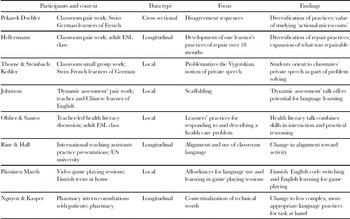
All eight papers reported on analysis of video-recorded interactions. Five analyzed data from classroom settings. Table 1 summarizes the papers.
Summary of colloquium papers’ data and findings.

Simona Pekarek Doehler (Université de Neuchâtel) investigated disagreement sequences in cross-sectional data of intermediate and advanced Swiss German learners of French (presentation title, ‘Documenting L2 learning as language-in-action over time: Disagreement sequences in French L2’). Focusing on turn construction, the paper presented a taxonomy of disagreement sequences and showed clear differences in the two groups, with advanced learners using greater diversification of turn constructional practices related to preference organization, the range of responses used to align, in varying degrees, with or against a prior turn's interactional project. Findings demonstrate the value of a delimited ‘actional microcosm’ like disagreements to study development of language practices.
The paper by John Hellermann (Portland State University) presented a case study of one adult learner of English (‘Inez’) in classroom interaction in the USA (‘From “other” to “self”: Language learning seen in practices for repair’). The data were video recordings of learner–learner interactions in pair tasks. The analysis focused on how Inez initiated and carried out repair of a peer's talk. Focusing on one learner over five terms of study, Hellermann showed change in both what was treated as repairable by Inez and in the mechanisms used to carry out the repair initiations. In her first term of study, repairables for Inez consisted of lexical items and language structure while in her fifth term of study, this had shifted to pronunciation and task action.
The paper by Steven Thorne (Pennsylvania State University) and Fee Steinbach Kohler (University of Basel) investigated the ‘private speech’ of Swiss French learners of German engaged in small group activities (‘The social life of private speech’). Their paper problematizes the Vygotskian notion of private speech by showing how students orient to their classmates’ private speech as part of the social activity of problem solving. They showed how the production of talk as ‘private speech’ allows for other participants to selectively disattend to the producer of the talk, which has the effect of reconfiguring the participation structure.
Duff Johnston (Pennsylvania State University) reported on analysis of one-on-one ‘dynamic assessment’ interactions between a teacher and Chinese learners of English as a foreign language (EFL) (‘Testing as learning: Seeing dynamic assessment from a conversation analytic perspective’). Johnston's analysis combined the perspective of Sociocultural Theory on learning through social interaction with detailed sequential analysis of talk using conversation analysis (CA). In the analyzed interaction, Chinese EFL students interact with an instructor to discuss a film clip using specialized terminology. Johnson identified interactional sequences that constitute potential language learning experiences.
The paper by David Olsher and Maricel Santos (San Francisco State University) focused on a teacher-fronted health literacy discussion in an adult classroom of learners of English as a second language (ESL). Analysis of teacher questioning and student responses reveals learners’ interactional skills in responding to teacher questions and adding ideas in response to other students. Language use is viewed from two perspectives: interactional practices as well as demonstrations of practical knowledge about problems related to health care, which are argued to show membership in an adult immigrant discourse community.
The paper by Emily Rine and Joan Kelly Hall (Pennsylvania State University) was a longitudinal study focusing on an international student training to be a teaching assistant at a US university (‘Changing participation structure in International Teaching Assistant discourse’). In these interactions, the teacher in training practices lecturing to a class of other teachers in training. Focusing on one teacher in training over the course of eight weeks, Rine and Hall show change in the alignment of the teacher in training to his classmates and to the activity. This change in alignment is seen in greater use of classroom-specific language, how the teacher in training ends the practice lecture, and the spatial orientation to ‘teacher space’.
Arja Piirainen Marsh (University of Jyväskylä) focused on the affordances for language use and learning in video game playing sessions of Finnish teens (‘Language alteration as situated action in gaming activities’). Her data came from 13 hours of recorded interactions between boys, aged 10–14 years, playing video games that had English language voice over narrative and subtitles. As they played the games, the boys spoke Finnish but used English as part of their interaction with the game and one another. The English use was shown to be locally-relevant and part of the development of a repertoire of English for game playing. Code switching between Finnish and English was seen to be a key aspect in making the game playing activity both orderly and intelligible.
The paper by Hanh Nguyen (Hawai'i Pacific University) and Gabriele Kasper (University of Hawai'i at Manoa) reported on a longitudinal analysis of pharmacy interns during their work in consultations with patients when dispensing medications (‘Changing competence-in-interaction: Evidence from a pharmacy intern in patient consultations’). Their findings show the contextualization of the use of a particular lexical item changes over time to using language practices that are less complex but, it turns out, more appropriate, for the particular task at hand. The authors show how interactional competence develops in this intern's more effective recipient design work.
The respondent, Leo van Lier (Monterrey Institute of International Studies), suggested that researchers attempting to find evidence of language learning focusing on the learners’ orientation to contextualized language use should look at how learners construct their own linguistic environments. He noted that CA can show indicators of institutional discourse and to describe development, he found the focus on diversification of interactional practices useful. However, he argued that for indications of learning, CA needs help from exogenous theory.
The research presented in the panel shows that micro-analyses of actions done through language can address both processes of learning and outcomes toward which those processes may lead. These papers show new ways of describing the objects of language learning (actions and action sequences) and promote a view of learning that is both local and potentially traceable with a focus on particular kinds of action sequences over time.