1. Introduction: the re-emergence of style
When I first studied linguistics in the early 1970s, ‘style’ was still a keyword. In British linguistics, Crystal & Davy's Investigating English Style (Reference Crystal and Davy1969) was a seminal discovery. Unlike the then dominant Chomskyan linguistics, it used real language and whole texts rather than made up sentences, and it did not see English as a homogeneous whole but as a collection of ‘varieties’ of which any individual speaker would only command a limited number.
In their view, style expressed social meanings of two kinds – meanings related to identity, and meanings related to specific roles, occupational roles, for instance, and specific contexts, e.g. specific types of discourse such as news reading, sports commentary and prayer. Social style, as they saw it, expresses ‘who we are’, in terms of stable categories such as class, gender, age and provenance, and in terms of specific socially regulated activities and the roles we play in them. The former were seen as more or less ingrained habits which are for the most part out of conscious control by the language user. The latter were seen as competencies, social rules of ‘appropriateness’ that must be complied with.
In both cases the distinctive features that manifest specific styles were not seen as meaningful, but as identifying ‘markers’, linguistic labels – as a kind of linguistic ‘uniform’, one could say, that reveals the social role of the wearer at a glance. At the same time, the authors recognized individual style, the ‘relatively permanent features of the speech or writing habits that identify someone as a specific person’ – style, in other words, as a kind of linguistic fingerprint or identifying mark that is in itself meaningless, but does distinguish a person from all others. Such ‘individuality’ was then to be distinguished from ‘singularity’, a form of stylistic individuality that is deliberately developed and manipulated – for instance, the style of a literary author. But, although individual style was recognized in this way, social determination and social variation were seen as the main area of study for linguistic stylistics.
At the time they wrote, this social conception of style still had to be defended against the conception of style which was dominant in literary studies, and which foregrounded, not the social, but the individual, and conceived of style, not as a meaningless identifying mark, but as expressive of personality and attitudes, whether as the result of deliberate decisions or not. ‘Style’, said Pierre Guiraud,
is a study of the stylistic value of means of expression. There are expressive values which give away the feelings, desires, characteristics and social origin of the speaking subject, and there are impressive values which are deliberately produced and get across the impression the speaking subject seeks to create. Guiraud (Reference Guiraud1972: 57)
In short, the concept of style that came across to me in this time created a strong opposition between the social and in the individual. There was on the one hand social style, a matter of inescapable social classification in terms of categories such as class and gender, and of the strictly regulated obligations of social institutions and practices. And there was on the other hand individual style, which somehow managed to live in the interstices of social regulation, like grass growing between neatly laid, rectangular flagstones, and which could only exist because social regulation cannot cover every detail of our behaviour and therefore leaves room for the expression of individuality, even if only in small details, because there was, alongside the public world, the private world, which provided some room for unbuttoning and expressing individuality, and there was, in a world otherwise governed by bony-structured rules, some degree of license for breaking social conventions, especially for women, children and artists.
Whether, in this context, a theory foregrounds and validates the social over the individual, or the individual over the social, this construction of style always constructs the two as opposed and separate – the individual versus the social, the public versus the private and so on.
2. Lifestyle
After the 1960s, the word ‘style’ was heard less and less. The intellectual mood of the day favoured the social, and the backgrounding of the individual which could already be felt in Investigating English Style evolved into a silencing of the individual, perhaps forefelt in Roland Barthes’ concept of ‘degree zero style’ as writing from which all traces of individual personality have been erased, ‘colourless writing, freed from all bondage’ which will set the author free from the ‘prison of style’ (Barthes Reference Barthes1967: 82) and also in his later emphasis on the ‘death of the author’ (Barthes Reference Barthes1977), which was just one of the manifestations of the emphasis on social determination that prevailed in the intellectual climate of the time. At the same time, and well outside of the radar of Althusserianism, a new concept of style was developed in the field of marketing, the concept of ‘lifestyle’, which created a new synthesis out of the elements I have so far described, and a new co-articulation of the social and the individual. What it retained from the concept of social style was that every style is always the style of a social group. But the characteristics of these groups were now no longer conceived of in terms of traditional, stable social positionings such as class, gender and age, or of occupations, but in terms of a combination of, on the one hand, things which formerly would have been the province of individuality, such as ‘attitudes’ and ‘personality traits’ and ‘feelings’, and, on the other hand, things that are more in the public domain such as income, and especially consumer behaviour. Such lifestyles, however, much as they were concerned with intangibles such as attitudes and personality traits, nevertheless had to be signified by appearances, for instance styles of dress, interior decoration etc, and also of speech. As the sociologist David Chaney put it:
Strongly held beliefs and commitment to family values are likely to be symbolized by particular types of aesthetic choice. . .particular ways of dressing, talking and leisure. Chaney (Reference Chaney1996: 96)
Such forms of expression are social because they not only allow people to express interpretations of the world, and shared affiliations with certain values and attitudes, but also to recognize others, across the globe, as sharing these interpretations and affiliations. They are also social because they emerged as corporations looked for new ways of creating market demand, with marketing experts replacing ‘demographics’ with ‘psychographics’, clusters of ‘behaviours’, ‘attitudes’ and ‘consumption patterns’. But it is also individual because it introduces choice where there used to be destiny and does away with the need to dress and talk and act your age, gender, class, occupation and even nationality. While these styles may in fact be shared by many, they are subjectively experienced as individual and personal choices from the wide range of semiotic resources made available by the market. And they are no longer meaningless labels of identity. They express meaning, as I will shortly discuss in more detail.
Here, for instance, are a few of the ‘classes’ of American newspaper readers, showing the typical mixture of social categories and what used to be regarded as individual, psychological rather than sociological categories (from Michman Reference Michman1991: 1–3): ‘Young, bored and blue/Tomorrow's leaders/Achievers/Mr Middle/Senior solid conservatives’. In short, lifestyle entails on the one hand a loss of uniformity and a gain of space for individual style; on the other hand, it draws on deliberately designed and globally distributed ‘off the shelf’ models and does away with individual style as it used to be, with individual style as something that escapes the social.
In linguistics and discourse analysis, and that includes my own practice, ‘style’ has re-emerged much more recently, for instance in Norman Fairclough's analysis of the language of New Labour, in which he relates the concept to politics and says:
Styles are to do with political identities and values; discourses with political representations and genres with how language figures as a means of Government . . . Any speech by Tony Blair, for instance, can be looked at in terms of how it contributes to the governing process (how it achieves consent), for instance, how it represents the social world and the political and governmental process itself, and how it projects a particular identity, tied to particular values – that is, in terms of genre, discourse and style. (Fairclough Reference Fairclough2000: 14)
Unlike the individuality described by Crystal & Davy (Reference Crystal and Davy1969), lifestyle individuality does not derive from the unconscious. In the way that writers, actors and artists had already done earlier, people now created their identities quite deliberately or ‘reflexively’ and could therefore also change them, so that identity became less stable and permanent. Semiotically speaking, traditional social styles were based on systematically organized semiotic systems, or codes. In my book Introducing Social Semiotics I quoted (Van Leeuwen Reference Van Leeuwen2005: 39–40.) the Prague School semiotician Peter Bogatyrev, who described the dress code of traditional Moravian Slovakia (Bogatyrev Reference Bogatyrev1971 [1937]), a code in which dress signified ‘demographic’ characteristics. It could tell you where the wearer came from, for instance. There were 28 costume districts in Moravian Slovakia. You could recognize a man from Pozlovice because he would wear two velvet bands round his hat and two carmine ribbons with a green one in between, a man from Biskupice because his hat had only one velvet band and a red ribbon, and so on. And dress could also tell you the wearer's occupation, social class, marital status and religion. Such dress codes were organized as systematic, binary taxonomies and signified stable social identities, social destinies. Individuality would be expressed through the ‘parole’ of the system, through the way in which the clothes were worn, the angle of the hat on the head, the amount of buttons done up, and so on, in the way that subtle differences in the way school uniforms are worn can express individuality. Dress codes of this kind have not totally disappeared. We can still recognize age differences, such as in dress codes for children and adults, and gender differences, but on the whole they are retreating and remain only in the realm of uniforms and ceremonial dress.
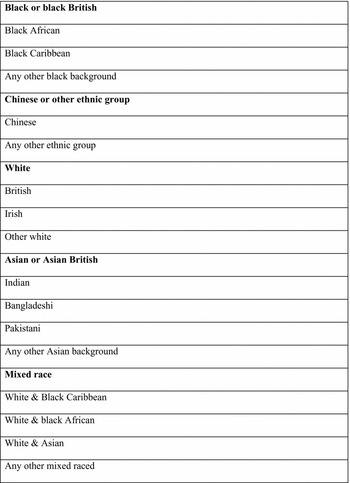
Social identity systems have developed in a similar way. In Global Media Discourse David Machin and I looked at diversity questionnaires, and showed not only that they use the kind of stable and unescapable identities that make or break social destinies, but also that they are structured like binary, taxonomical codes (Machin & Van Leeuwen Reference Machin and Leeuwen2007: 44–50.). The questionnaire in Figure 1, for instance, opposes ‘specific’ to ‘unspecific’ identities (‘others’), ‘mixed’ races to ‘pure’ races, ‘white’ to ’ black’, and so on. Again, it introduces two kinds of ‘whites’, those with and those without a named nationality, and, lower down the tree, two kinds of named nationalities, ‘British’ and ‘Irish’ and so on. All this can be expressed in terms of a rigid, binary taxonomy.
Diversity questionnaire for job applicants at Cardiff University.

Lifestyles, on the other hand, are expressed differently and much less systematically, and rest on one of two principles, the principle of the ‘composite of connotations’ and/or that of experiential metaphor. Connotation, as was already explained by Barthes (Reference Barthes1977) some forty years ago, is not systematically organized. It can be characterized as an unordered lexicon of culturally meaningful signifiers which derive their meaning from provenance, from ‘where the signifier comes from’. The principle is this. A sign from a certain domain – a certain period, or other context, such as region, country, culture, occupation, etc. – is imported into a domain where it has hitherto not been part of the repertoire. In that new domain it carries the associations – the values and attitudes – which, in that new domain, people have with the domain from which it comes, so expressing a kind of affiliation with those values, in the ‘lifestyle’ mode. To use, again, the example of dress, in recent times many signifiers from the military domain have entered the domain of street fashion. People walk around wearing drill trousers with a camouflage motif, for instance. This can then resonate with values such as adventurousness, the resourcefulness of the commando, etc., drawing on discourses that are now ubiquitous in popular culture.
The same can happen also with language. One of the many contributions of Norman Fairclough to critical discourse analysis has been the way he pointed out, already in the early 1990s, how elements of corporate language were introduced into areas where they previously did not belong to the repertoire, such as universities, and how this expressed an affiliation with the values and attitudes of the corporate world. Which shows that very similar semiotic mechanisms now work in both the private and the public spheres, thus contributing to the overall tendency of undoing the split between the private and the public that had been gradually developing and institutionalizing over the last 200 years (Fairclough Reference Fairclough1993).
The point of the idea of the ‘composite of connotation’ is that different connotations can be combined into complex messages. A well-cut expensive shirt (connotations: elegance, a touch of formality) can be combined with the drill trousers, and, perhaps, also with sports shoes, which were also imported from another domain, that of sports, into street fashion, and can perhaps connote healthy living, exercise and sport.
In Global Media Discourse, David Machin and I have analyzed the linguistic style of the Cosmopolitan magazine in the same way – as an amalgam of
• the language of advertising, connoting its association with consumer goods and more generally, the values that advertising stands for: glamour, success, hedonism, sensuality, sexuality, etc.;
• the language of the expert, connoting reliable and trustworthy information on issues such as health, beauty, career and, of course, sex;
• the language of the street, connoting youth, being up to date on the latest trends, a touch of provocativeness;
• conversational style, connoting the way you talk with your friends.
(Machin & Van Leeuwen Reference Machin and Leeuwen2007: 138–149)
This style is reflexively and deliberately adopted, to the point that, for instance, the editor of the Indian version of Cosmopolitan conducted focus groups with young people to get the latest trendy expressions.
Experiential metaphors draw on the material qualities of the signifier to, again, express values and attitudes. In an article on colour, Kress & Van Leeuwen (Reference Kress and Leeuwen2002) explained that the characteristics of colour have a certain potential for metaphoric meaning. For instance, a colour can be plain or ‘modulated’, showing a variety of different shades of the same colour. That physical quality of the colour, plain-ness, can then become a source of metaphoric meaning. It can mean simple, pure, uncluttered and so on. And its opposite, modulated colour, can mean ‘subtle, complex, nuanced, fussy’, and so on. Specific instances of colour are characterized by a range of such features. Not only are they plain or modulated, they are also light or dark, saturated or unsaturated, luminous or dull, and so on, and all these features are graded, capable of many degrees, and not either–ors. So many different complexes of metaphoric meaning can be built up.
In our article we gave examples from home decoration magazines. In one magazine article the owners of a particular home were interviewed and talked about the colours they used in decorating their home. Our article explains that
[they] use nearly the whole spectrum in their house, from mustard yellow and leaf green in the sitting room, to brick red and blue in the dining room. Their bedroom is a soft buttery yellow combined with orange, there's lemon and lime in the breakfast room and cornflower and Wedgwood blues on the stairs. ‘It's great that there are so many bright shades in the house’, says Hamish, ‘It's a shame people aren't more adventurous. It's when you start being timid that things go wrong.’ (Kress & Van Leeuwen Reference Kress and Leeuwen2002: 359)
Clearly there is no connotation here. There is no ‘other domain’ being drawn upon here to yield meaning. It is the physical characteristics of being ‘bright’ and ‘varied’ that are used to express the meaning ‘adventurous’ – and their opposite ‘pale’ and ‘monotonous’, ‘unvaried’ would express ‘timidity’. And clearly the kinds of meanings expressed here are lifestyle identity meanings, ‘personality traits’, ‘attitudes’.
3. Normative discourses
This leads to another point. It is increasingly important to look, not just at semiotic practices themselves, in this case practices of signifying identities of different kinds, but also at the normative discourses that surround them and make them possible. Semiotic codes of the older kind have generally been learnt and internalized in one of two ways, through the authority of written texts and their authoritative interpreters, and through tradition. In the case of tradition, or ‘customary law’, nothing is written down, nothing explicitly and systematically codified, at least not in a form that is accessible to the people who must live by the codes. People do things in certain ways ‘because that's how they have always been done’, or at least, that is what people think, because traditions do in fact change, but generally without people consciously noticing. And the rules of traditions are learnt by social exposure and reinforcement, as every member of the group has the know-how necessary to pass on the tradition.
By and large, I would almost say, traditionally, linguistics has construed language in this way, as passed on between the generations without any form of authoritative regulation occurring, and as changing ‘from below’, through the activity of ‘the people’ with linguists merely recording what is the practice of ‘the native speaker’. But of course the linguistic rules of national languages have been, and still are, in fact strongly policed by authorities, educational institutions, academies, publishing houses and so on. From the 18th century on, they have been codified in the form of written grammars and dictionaries, and these in turn have been taught by certified interpreters in well-regulated and generally authoritative institutions.
The norms and rules of the new lifestyles, on the other hand, are regulated in very different ways, through the ‘rule of the role model’, as I call it. ‘Lifestyle media’ play a particularly important role here. I have already mentioned Cosmopolitan, and ‘Home Beautiful’ type magazines. In these media we are confronted with role models, whether they are celebrities or ordinary people whose choices are presented as a ‘best practice’ model. And even though this does not present itself as a form of social control, it does give us clues as to how to dress, how to talk, how to think about things and so on – precisely those things that form the components of ‘lifestyle’ identity.
Two further characteristics are fundamental here: choice and change. Lifestyle identity is not a destiny, but a matter of choice, although this choice may of course be restricted by the amount of money you have and the amount of access both to the semiotic resources and to the discourses that regulate them. And secondly, the rules change often. A given colour, or length of skirt, or linguistic expression can be ‘in’ one year and ‘out’ the next, so that we must constantly monitor media, compare notes with friends and colleagues, and update the consumer goods and semiotic practices that signify our identities.
4. Technology
However, there is also another form of control over our semiotic practices emerging, and that is technological control. At the same time that linguists began to reintroduce style as the expression of identity, software producers did the same thing. HTML, for instance, introduced the style sheet, on which you program what will be the overall characteristics of the text you are writing, especially through colour schemes and choice of typography, which offers its own metaphor potentials as I have tried to explain elsewhere (Van Leeuwen Reference Van Leeuwen2006). Thus the concept of style, and the way we create an identity for our text and for ourselves as its producer, is as it were built into the very tool we use to create it. Something like this is provided in PowerPoint, the tool I am using in this lecture. PowerPoint obliges me to select, not just my words, and the structure of my presentation, but also its overall style. And through that overall style I necessarily must express my identity as a speaker, and/or the identity of the practice I am engaged in, in other words the attitudes and values that underpin it.
The Chief Financial Officer of the University in which I work used a calm blue sea as background for the slides of his budget speech, which were otherwise full of figures, and he interspersed his figures with quotes from business gurus as well. In this way he sought to present himself as a visionary rather than, say, just a meticulous and precise accountant.
With a tool like PowerPoint, there is no escape. One way or another identity must be expressed. A friend told me that he really dislikes PowerPoint templates and generally uses a plain white background. But he received so many apparently innocent or joking comments (‘a bit bare’, ‘a bit boring’, ‘a bit stark’) that he finally succumbed and changed his practice, upon which the comments stopped. He can now be ‘placed’. And of course I do this too. I recently gave a talk in which I attempted to relate the scent of perfumes to the colours in the ads for these perfumes. I used a template which featured a sensual, hot pink background and a half-open curtain on the side, perhaps suggesting half hidden secrets, in the same way that the ads alluded to sex without showing it.
5. Conclusion
A new concept of identity has come into being over the past thirty years or so. It merges the individual and the social, making individuality a social and socially regulated affair, rather than something which escapes the social, and making the social an apparently individual affair, open to choice, rather than coercive. This kind of identity is expressed through style, that is through semiotic characteristics which are constant for the duration of a whole text or communicative event, or for the identity of a person or corporation during a particular period. In that constellation, style is no longer the arbitrary marker of a particular identity, but it has meaning. It expresses attitudes, values, personality traits and so on, all of which therefore become more consciously and reflexively constructed. To construct such identities, people need to constantly monitor semiotic resources and the discourses that model them.
Needless to say, change does not happen all at once. The old identities from the diversity questionnaire, tied as they are to older institutions, to the nation state and its institutions such as education and health, still play a very important role. The new identities move away from this. It does not matter much where you come from so long as you can pay for the consumer goods. But at the same time, the new identities are not as free as some people make out. Many contemporary writers about identity have critiqued essentialist and singular definitions of identity. In their view identity is infinite. As one book on language and identity has it:
A heterogeneous set . . . endlessly created anew, according to various social constraints, social interactions, encounters, and wishes that may be very subjective and unique. (Le Page & Tabouret-Keller Reference Le Page and Tabouret-Keller1985: 316)
Clearly, people who critique the tendency to essentialize ‘others’ and ‘other cultures’ and ascribe static identities to them are right. But many go a step further and celebrate unique, complex and flexible identities without at the very least realizing that this approach to identity has grown into being in the context of the rise of corporate culture and its ‘lifestyle’ model. As marketing experts and large corporations began to emphasize production over consumption, so did theorists of identity and meaning. As they abandoned singular, stable demographic identities in favour of complex, flexible and individual identities, so did theorists of identity. As they championed the consumer's power of choice, so did theorists of identity. I am not saying either are wrong. The new identity has, in principle, positive potential. But this does not change the fact that the lifestyle model is just as much produced and imposed by a powerful social institution as the older model, even if it propagates a different kind of identity and communicates it in very different ways. It follows that the study of style as a discursive practice of identity deserves its re-emergence from the temporary obscurity in which it has lived.
Theo van Leeuwen is Professor of Media and Communication, and Dean of the Faculty of Humanities and Social Sciences at the University of Technology, Sydney. He has published widely in the areas of critical discourse analysis, multimodality and visual semiotics. His books include Reading images – The grammar of visual design (with Gunther Kress), Speech, music, sound, Multimodal discourse: The modes and media of contemporary communication (with Gunther Kress), Introducing social semiotics and Global media discourse (with David Machin). His latest book, Discourse and practice was published in 2008 (Oxford University Press). He is a founding editor of the journal Visual Communication.